
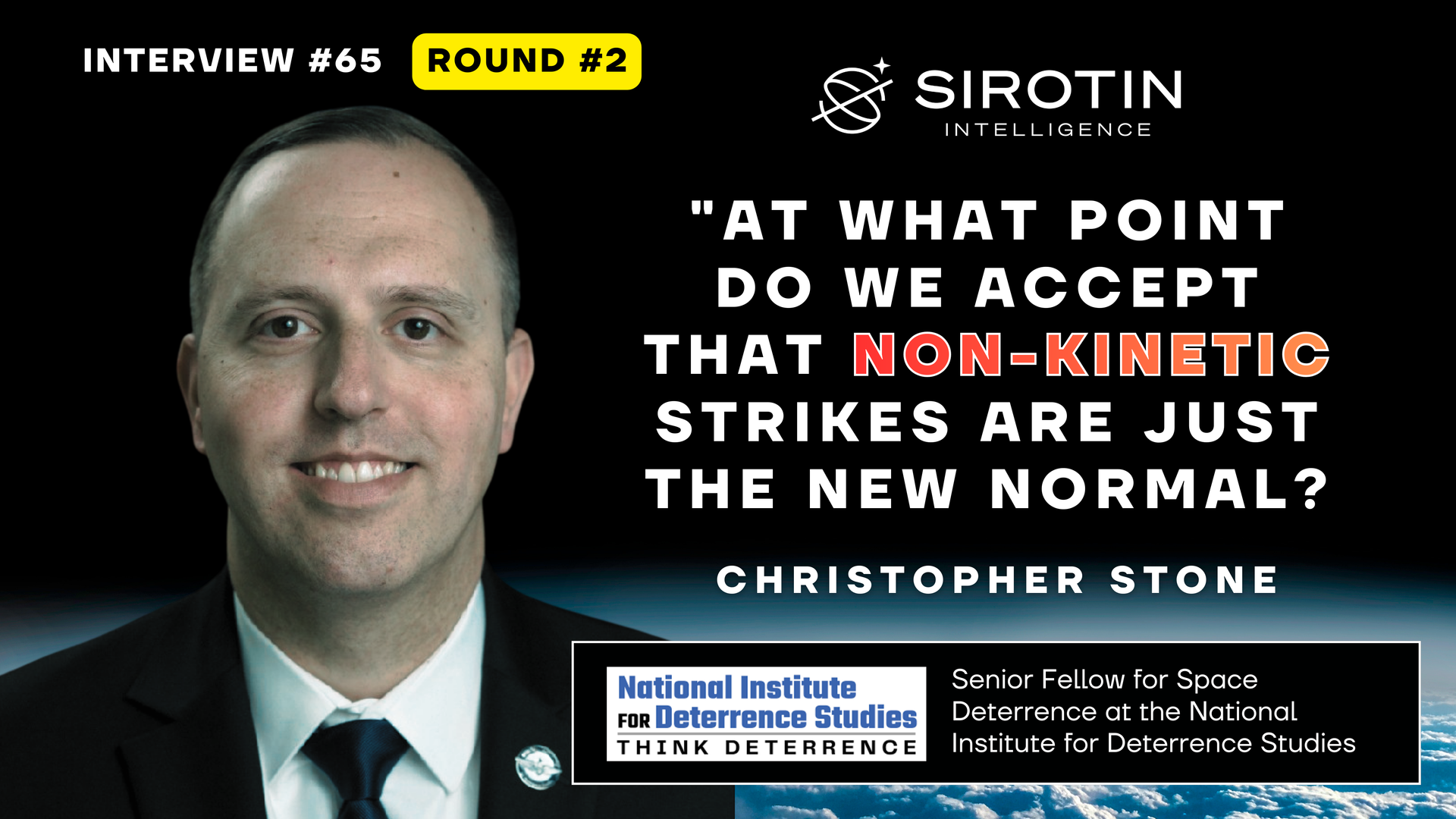
"At What Point Do We Accept That Non-Kinetic Strikes Are Just the New Normal?" Christopher Stone on GPS Attacks, Escalation Thresholds, and Why America's Deterrence Posture Needs Offensive Capability

Your flight from Newark to Chicago sits on the tarmac for ninety minutes. The pilot comes on, apologizes, mentions "navigation system issues." You scroll through emails, annoyed but not alarmed. What the pilot doesn't say is that the aircraft's GPS receiver has been fed false positioning data, that this is the third time this week at this airport, and that somewhere, an adversary just collected another data point about what the United States will tolerate.
This scenario is no longer hypothetical. GPS spoofing attacks on commercial aviation jumped from a few dozen incidents in February 2024 to more than 1,100 by August. Aircraft are not the only targets; commercial and military ships face similar interference, as does critical infrastructure across transportation and energy sectors. Vice Chief of Space Operations General David Thompson has stated publicly that these lower-threshold attacks occur every day. Yet there remains no public response framework, and no clear articulation of what would constitute a red line.
Christopher Stone has been warning about this trajectory for nearly two decades. As former Special Assistant to the Deputy Assistant Secretary of Defense for Space Policy, a U.S. Air Force space operations officer, and now Senior Fellow for Space Deterrence at the National Institute for Deterrence Studies, Stone has watched the gap between American declaratory policy and actual capability widen while adversaries continue probing.
In our first conversation, published earlier this year, Stone outlined the fundamentals: China's "attack to deter" doctrine, the distinction between space security and national security approaches, and why America's diplomatic strategy has failed to alter adversary behavior. This follow-up conversation goes deeper into the operational details. His recent paper with Christophe Bosquillon, "Space Deterrence and the Global Positioning System: A Strategic Imperative," published by the National Institute for Deterrence Studies, provides the framework.
What follows is a discussion about escalation thresholds, the limits of resilience as a strategy, and what it would actually take to establish credible deterrence in a domain where the United States is already under daily attack.
Your paper notes GPS spoofing attacks on commercial aviation jumped from a few dozen in February 2024 to over 1,100 by August 2024. Gen. David Thompson says these attacks happen every day. Yet there's no public response framework. At what point does daily degradation of GPS cross into an act requiring kinetic response under your tiered escalation ladder?
"There are two parts to this," Stone begins. "You mentioned that there's no public response framework. The reason for that, in my view, is not because this is a non-issue or a non-threat. It's a political or policy hesitancy. Do you share a lot of these attacks with the public and prepare them for more of the same, or even worse? Some of this may also stem from the perception that it's just interference, not a traditional attack. Things aren't blowing up. And so, why bother people with it?"
Stone sees this framing as fundamentally mistaken. GPS connects to virtually every sector of critical infrastructure. The financial system depends on GPS timing signals for transaction synchronization. Transportation networks rely on positioning data. Energy grids use GPS for monitoring and fault detection. An attack on GPS is not an isolated technical problem; it ripples across interdependent systems in ways that can threaten both economic stability and human life.
"Given its connection to other sectors of national critical infrastructure, I think there should be more shared about this in public, and we should prepare people for a civil space defense type plan, which currently doesn't exist. General Thompson's comments about attacks every day were a good start. He's been one of the only senior leaders really talking about it. Of course, he was about to retire at the time. But that needs to become more common, because space is not just a support function anymore. It's a warfighting domain. It's one that is currently a place of conflict and adversary engagement with us, our allies, and even commercial partners."
The escalation ladder concept, introduced in Stone's 2015 book Reversing the Tao, provides a decision tool for assessing threats and determining appropriate responses. It moves from peacetime conditions through reversible interference such as jamming and spoofing, then to irreversible damage from directed energy weapons, and finally to kinetic destruction and nuclear use. The framework is not meant to suggest that adversaries will always climb the ladder incrementally. Chinese doctrine, in particular, contemplates jumping directly to higher thresholds depending on the strategic calculus.
"In my mind, if the adversary has the will and the means to move up that ladder with currently deployed forces, and they do, and we do not have an equal or superior set of options, and we don't, then that harms the President's options as Commander in Chief for addressing aggression against critical space infrastructure like GPS."
Stone is careful to distinguish between thresholds. A spoofed GPS signal over the Pacific during a Taiwan scenario would not trigger nuclear posturing. But once attacks move from reversible interference to actual damage, or once adversary kinetic forces begin dispersing in preparation for strikes, the calculus changes.
"I personally believe that once the threshold moves from reversible, non-damaging attacks to damaging attacks, or even the adversary dispersing their kinetic space forces, a lot of which are mobile and harder to find once they move, we as a country should have the will, the means, and fortitude to engage kinetically to prevent damage to our GPS and other critical space infrastructure. How that plays out depends on what our options are from a force and weapons capability standpoint. We've tested things in the past, kinetic anti-satellite weapons and similar capabilities. But we haven't deployed them. And if it's not deployed, it doesn't really provide any deterrent value or any warfighting value."
China built a national eLoran network and maintains robust terrestrial PNT backup. The West hasn't. You argue resilience alone isn't deterrence; it's damage limitation. If the U.S. deployed equivalent terrestrial backup tomorrow, would that actually change Chinese calculus, or does deterrence still require offensive capability?
"I was very happy to see that the President's new executive order on space did not use the word 'resilience,'" Stone notes. "Probably the first document to leave it out in fifteen years. As I've argued, resilience is not a bad thing. It's actually a pretty good thing. But it alone is not a deterrent, and a lot of people in previous administrations tried to make it into one so it would look like they were actually doing something when really they were being passive."
The distinction Stone draws is between resilience and damage limitation. Damage limitation, a concept from Cold War nuclear deterrence theory, acknowledges that you need both offensive weapons to threaten the adversary and defensive measures to protect your own assets. The two work together. Having terrestrial backup systems like eLoran, or complementary signals like the L5 frequency, ensures that American forces and critical infrastructure can continue operating even if GPS satellites are degraded or destroyed. That matters for surviving an attack. It does not, by itself, deter the attack from happening.
"Damage limitation and resilience are related, but they're different in some ways. If you look at old nuclear deterrence theory, there were two arguments. One was that a true deterrent with defenses was destabilizing. If you left everything vulnerable equally on both sides, mutual vulnerability, then everybody would be equal, and nobody would strike first. That was considered crazy by other theorists who said there's nothing destabilizing about defending your country. That's the responsibility of armed forces anywhere. You defend your people, your infrastructure, your society from any attack."
The question of whether terrestrial backup would change Chinese calculus depends on how Beijing views American overall posture. China has invested heavily in its own damage limitation measures precisely because it understands the value of redundancy. The completed national eLoran network, announced in October 2024, provides positioning and timing coverage up to 1,000 nautical miles offshore, well beyond Taiwan. If the United States were to jam or attack Chinese satellite navigation systems, their terrestrial alternatives would keep military and economic operations functional.
"Would comparable systems change Chinese calculus? I think so, because they have worked on their own damage limitation items in case we were to attack or jam their PNT systems, which are vital for their power projection. It's also key to their influence worldwide through the Belt and Road Initiative. Having complementary systems requires more effort on their part to find centers of gravity to target and gain advantage."
Stone emphasizes, though, that damage limitation alone remains insufficient. "Offensive capability is still key. To have a deterrent in the adversary's mind, you have to hold something of value at risk, and you have to protect or limit the damage to what's of value in your own territory. It's not just the United States that would get negatively impacted by GPS degradation. It's the entire Western world that relies pretty much exclusively, or at least mostly, on GPS signals."
The L5 signal offers significant jamming resistance, but full operational capability isn't expected until 2027, and most devices still depend on vulnerable L1. You mention oneNav's L5-direct technology as a potential accelerant. What's the realistic pathway to get L5 into critical infrastructure before the next major crisis?
The L5 signal represents a significant upgrade over the legacy L1 frequency that most GPS receivers currently use. Operating at a higher power level and designed with modern interference mitigation, L5 provides substantially better resistance to jamming and spoofing. The problem is adoption. Only 17 of 31 GPS satellites currently broadcast L5, and full operational capability requires 24 satellites broadcasting the signal. That milestone is not expected until 2027. Meanwhile, most commercial and military receivers remain configured for L1.
"The answer depends," Stone acknowledges. "In the paper, we mentioned a couple of companies that are advertising their ability to survive in high-threat environments. Using all the resources at the government's disposal is key. With the administration and Congress looking at getting acquisitions moving faster, what's usually needed to get systems moving is demonstrations that they work. Congress and the administration are not really interested in people selling their widgets if they can't prove that those widgets are at a high enough technology readiness level."
The Space Force is beginning to address detection capabilities. In January 2025, it awarded Slingshot Aerospace a $1.9 million contract to refine GPS interference detection technology, building on earlier work to identify locations where signals are jammed or spoofed. But detection alone does not constitute response.
oneNav, a company Stone's paper highlights, has developed what it calls L5-direct technology. Unlike conventional dual-frequency receivers that must first acquire L1 signals before accessing L5, L5-direct enables devices to lock onto L5 independently. Field testing near the Polish-Russian border in 2024, in areas experiencing active GPS interference from the Russia-Ukraine conflict, demonstrated superior resilience compared to L1-dependent systems.
"oneNav has demonstrated that their L5 signal shows pretty good promising results through demonstrations in the Russia-Ukraine war zone area. That helps their case for the capability. I know the government has L5 and other options on their radar screen. I just hope they move soon enough to get it deployed as a complementary approach, not as an alternative replacement for space-based GPS."
This distinction matters to Stone. Some companies promoting L5 and other survivable PNT options frame them as alternatives to space-based systems. The Obama administration's R&D leadership at one point suggested moving away from the space layer entirely toward terrestrial approaches. Stone considers this strategically unwise.
"If you do it as an alternative, if you're retreating from the space-based approach, you're basically ceding that ground to the other side. The complementary approach means you have your main system, your space-based stuff. There are low-orbiting ones being devised as part of missile warning and tracking that will complement the medium Earth orbit main system. Then you have allies that create add-ons, like the Japanese with Quasi-Zenith, which helps with urban canyons and other challenges in the Japanese area. And the Europeans with Galileo. With all these working together and having complementary ground-based things to help if you need to rebaseline your satellites after one gets taken out, or if they take out a whole system, at least we can still keep things running."
The policy framework already exists. Executive orders and strategic plans acknowledge the importance of complementary PNT. The gap is funding and programmatic action. "There are policy statements from the White House saying this is important. There's a strategic plan that says it's important. But if it's not funded, if it's not in an actual program of record, then it doesn't matter."
Your three-tier deterrence framework includes posturing nuclear forces as strategic communication to Beijing at Tier I. That's a significant escalation linkage. Walk us through how a GPS attack on allied forces in the Pacific could realistically climb the ladder to nuclear signaling.
Stone begins by clarifying scope. "What I'm referring to as a Tier I deterrence scenario comes from the Chinese view of a synergy between space power and nuclear force. When you get to the top of the escalation ladder and you're dealing with a nuclear detonation in orbit to take out whole constellations, or an electromagnetic pulse at a localized area, or striking PNT signals and other supporting infrastructure key to our defense, then you're overlapping two areas. It's not just a space attack at that point. You're dealing with a space attack that also touches your nuclear deterrent."
The overlap occurs because many of the same space systems that provide GPS positioning also support nuclear command and control. Missile warning satellites detect launches. Communication satellites relay orders. GPS signals provide targeting data for precision weapons, including some nuclear delivery systems. An attack sophisticated enough to degrade American nuclear command, control, and communications would, in Chinese strategic thinking, constitute a different category of threat than interference with commercial aviation.
"I'm not saying that if China jams a GPS signal alone, we're going to nuke them. That's not what I'm saying. But if they were to launch an EMP weapon into orbit and detonate it, or detonate one over medium Earth orbit and take out a bunch of stuff, which would include a lot of missile warning and tracking as well as our GPS signals used for targeting of some weapons systems to be precise, then that would be a problem. It might end up being a situation where we would say, okay, maybe we need to posture up even higher than a standard normal space response."
The challenge is declaratory policy. The United States has not clearly communicated what actions it considers escalatory to the nuclear threshold. Stone argues this ambiguity does not serve deterrence.
"You have to communicate to the adversary: this is what we have, this is what we consider to be non-negotiables. If you attack critical infrastructure of our country and our homeland, not just our military forces, then you are harming the American people, you're putting our homeland at risk, and therefore we will respond in such and such a way. We haven't really been very clear on that. The current declaratory policy is very squishy. It basically says, if you attack us, we reserve the right to respond at a time, place, manner, and domain of our choosing. We joke that you could tack 'if I have to, I guess' onto the end of that because it doesn't communicate anything."
The historical record compounds the problem. During the Cold War, attacking a missile warning satellite or strategic communications satellite was understood to be a potential tripwire to nuclear response. But as Stone notes, the United States changed that equation itself.
"Ever since Desert Storm, when we started using missile warning satellites for tactical purposes, not just strategic nuclear purposes, the Chinese have written, and the Russians have followed suit, that those are fair game now. That's not a tripwire anymore. You cut that tripwire a long time ago. We have to reassert what we want our messaging to be, and it can't be one that basically communicates that we really don't have a commitment to anything."
You write that space should be treated as critical infrastructure for homeland defense, not just force enhancement. The funding and leadership support don't match the rhetoric. What concrete policy change would you prioritize if you were back in the Pentagon tomorrow?
"I think the last administration had a document that came very close to declaring space components like GPS as critical infrastructure. If that's not done, that would be one priority. The other related item is, if it is critical infrastructure, and I know DHS was looking at this at least from the cyber side of attack modes, then someone is hopefully talking about it now and will work to make it actually implement guidance that gets funded."
Stone frames the challenge as getting alignment between policy rhetoric and budget reality. National strategies and doctrine acknowledge the importance of space to homeland defense. The definition itself is clear: homeland defense is the protection of United States sovereignty, territory, domestic population, and critical infrastructure against external threats and aggression. The doctrinal framework calls for detecting, deterring, preventing, and defeating threats as far forward from the homeland as possible. Space, by any reasonable interpretation, should fall within that scope.
"Once that designation is in place, we can get Congress and the Office of Management and Budget and others that are key players on board with the requirements. And these commercial companies that claim to have capabilities, the ones we argue for in the paper, can get deployed rapidly, especially alongside the offensive forces that Space Force and U.S. Space Command need to be a credible deterrent and warfighting force. I think we could have what we need in fairly short order. I think it could be done in the next three years, as long as we use the right authorities and we can get the process moving fast enough through the wickets."
The precedent for such designations already exists, though implementation has been uneven. Previous presidents and commissions have declared that all critical infrastructure should be hardened against electromagnetic pulse attack. That directive dates back ten or fifteen years. Some hardening has occurred, but not comprehensively.
"They've hardened some of it, but they haven't hardened everything. They say, oh, it's too expensive, we can't harden everything, so we have to be selective. I understand that. Which is why you can't defend everything in space, so you have to articulate what's important to you and what's not. A good starting point is the administration's space superiority executive order. In that order, they talk about some of what those national interests might be. The homeland is obviously one, and they mention threats out to cislunar space and the economic piece."
Stone returns to the core argument of his paper: that the United States needs offensive escalation dominance capability, space-to-space weapons that can hold adversary assets at risk, combined with active defenses and layered damage limitation measures. The technologies exist. The policy frameworks largely exist. What remains missing is the political will to fund and deploy them. "If anybody wants to make this a reality, they can tie it to all sorts of executive orders, space policy directives, and even NDAAs. They just have to get the appropriators to cough it up. And they have to get the Pentagon to use their special authorities that don't require twenty years to get something from testing to deployment. With the ability of SpaceX and others to launch multiple vehicles at a single launch in fairly short order, there is really no excuse for not fixing this problem in the next three years."
Author's Analysis
Scenario: Pacific Crisis, 2027
A carrier strike group operating in the Philippine Sea loses reliable GPS positioning at 0300 local time. Navigation systems across the fleet begin displaying conflicting data. The jamming signature suggests a source hundreds of miles away, possibly from a Chinese vessel or ground-based system on one of the artificial islands. Simultaneously, commercial flights across Southeast Asia report similar interference, and financial markets in Tokyo experience microsecond timing anomalies that trigger automated trading halts.
The strike group commander requests guidance. The response from Washington takes six hours. It consists of a statement that the matter is under review and that diplomatic channels are being engaged. By then, the interference has stopped. Beijing denies involvement. The fleet resumes normal operations. No American response follows.
What happens next depends entirely on what conclusions Beijing draws. If the lesson is that reversible attacks on American space infrastructure carry no meaningful risk, the logical next step is to test the next threshold. Perhaps a higher-powered laser briefly blinds an intelligence satellite. Perhaps a rendezvous-and-proximity operation places a Chinese inspector satellite uncomfortably close to a GPS vehicle. Each probe without consequence validates the theory that American declaratory policy is theater, backed by neither capability nor will.
Stone's framework offers an alternative trajectory: one where the United States has already designated GPS as critical homeland infrastructure, deployed complementary terrestrial systems as damage limitation, and positioned offensive capabilities sufficient to hold adversary space assets at risk. In that scenario, the 2027 crisis unfolds differently. The strike group commander has backup positioning within minutes. Washington's response arrives within hours, not as diplomatic protest but as observable repositioning of counterspace assets. Beijing's calculus shifts because the cost of escalation has become tangible. The question is whether American leadership will build that alternative before events force the issue, or whether the first real test will arrive with no credible options available.
The questions that remain are not technical. The technology exists. The policy frameworks exist. What remains uncertain is whether American leadership will build that alternative before events force the issue. How many more spoofing incidents constitute a pattern serious enough to act on? At what point does "reviewing the matter through diplomatic channels" become an invitation rather than a response? And if the first real test arrives with no credible options available, what exactly will we wish we had done differently three years earlier?
About Christopher Stone
Christopher Stone is Senior Fellow for Space Deterrence at the National Institute for Deterrence Studies. He previously served as Special Assistant to the Deputy Assistant Secretary of Defense for Space Policy, U.S. Senate staffer, and U.S. Air Force space operations officer with more than twenty years in space operations, policy, and strategy. Stone serves as Associate Editor for Space Deterrence and Conflict for Global Security Review and hosts the Real Space Strategy podcast. His 2015 book, Reversing the Tao: A Framework for Credible Space Deterrence, remains in use in Space Force and Air Force professional military education programs.
The paper discussed in this interview, "Space Deterrence and the Global Positioning System: A Strategic Imperative," was co-authored with Christophe Bosquillon and published by the National Institute for Deterrence Studies in November 2024.
For more information, contact Chris at cstone@thinkdeterrence.com
Get exclusive insights from our network of NASA veterans, DARPA program managers, and space industry pioneers. Weekly. No jargon.