
"We Are Not Competing. We Are Trying to Complete Each Other": Dr. Mohamed Al-Aseeri, CEO of the Bahrain Space Agency, on Regional Collaboration, Indigenous Space Capabilities, and How a Small Nation Became a Scientific Catalyst for the Arab World

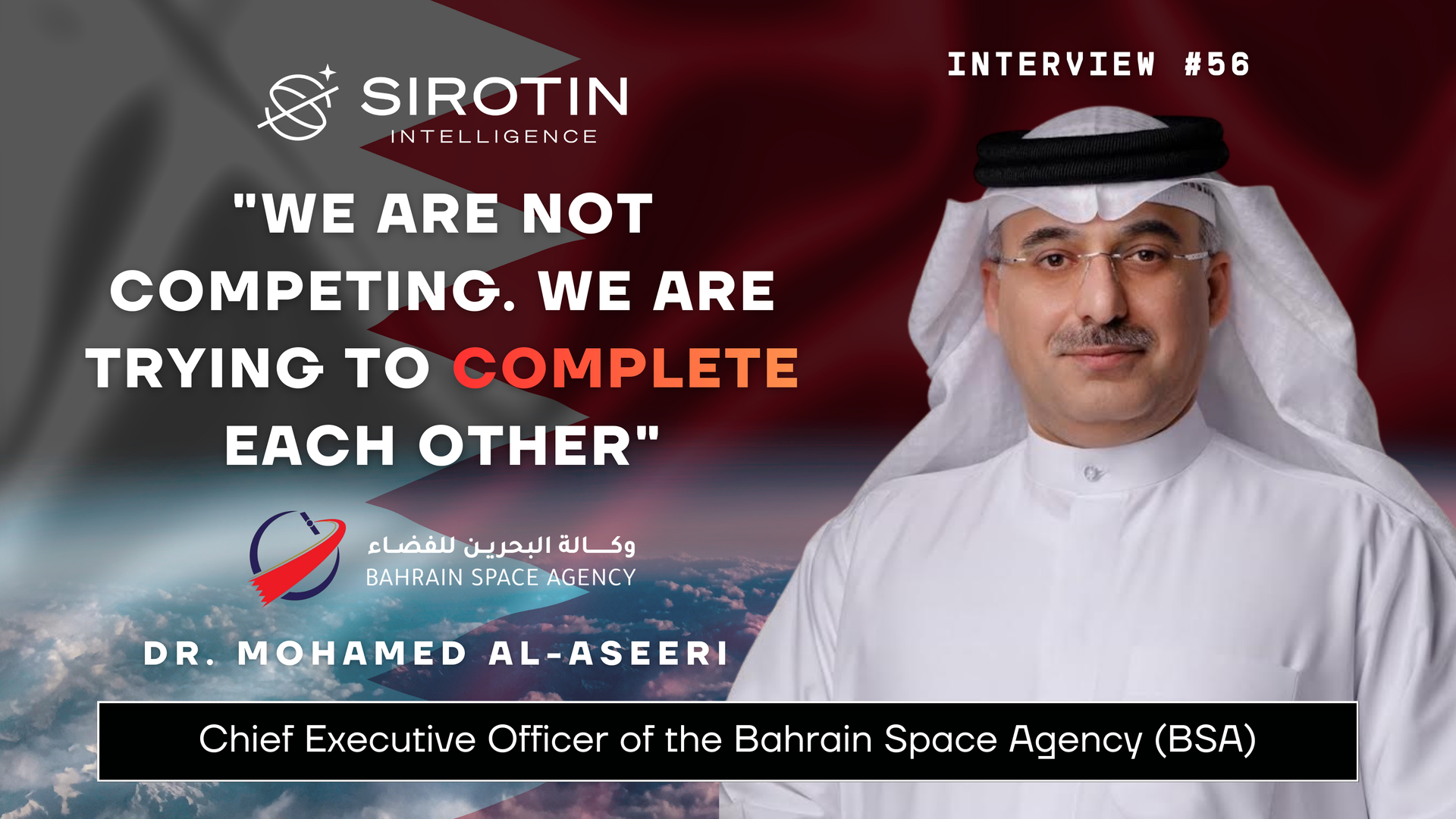
The first modern school in the Gulf. The first oil discovery on the Arab side of the Persian Gulf. The region's first public girls' education. The first aluminum smelter in the Middle East. The first Arab nanosatellite running artificial intelligence onboard. The nation behind all of it has fewer people than Philadelphia and fits inside the city limits of London. It now works with a 14-nation collaboration preparing to launch the Arab world's first joint satellite mission. The country is Bahrain, and for a century it has operated as a proving ground for the region, testing what becomes possible when geography limits scale but not ambition.
The Bahrain Space Agency came into existence by royal decree in 2014. Eleven years later, in March 2025, it launched Al-Munther, a satellite designed and built entirely by Bahraini engineers. The 3U CubeSat captures medium-resolution imagery of Bahrain and its territorial waters, runs a cybersecurity payload with advanced encryption, and, in a touch that feels distinctly Bahraini, broadcasts the national anthem to amateur radio operators around the world. The ground station tracking it sits on the same islands where the engineers who built it grew up.
The agency's strategic plan states directly that neighboring countries are partners. When Saudi Arabia and the UAE heard Bahrain was building a space program, they showed up in Manama with offers to share knowledge, facilities, and contacts. The same instinct that made Bahrain a regional hub for education and banking in the 20th century now positions it as a connective node for Arab nations who've recognized that going it alone limits everyone.
That cooperative instinct now extends across the region. The Arab Space Collaboration Group, which Bahrain helped found, includes 14 member nations. Their flagship project, Satellite 813, named for the year Baghdad's House of Wisdom became a public academy, represents the first collaborative Arab satellite mission. Engineers from across the region built it together at a facility in Al Ain. According to reports from the Dubai Airshow, the satellite cleared its launch readiness review in late 2025 and should be in orbit by year's end.
Leading Bahrain's contribution to this regional ecosystem is Dr. Mohamed Al-Aseeri, the agency's CEO. He holds a PhD in Reactor Design from the University of Florida and a Master's in Bioreactors from Manchester. He spent years teaching chemical engineering at the University of Bahrain before running Bahrain Polytechnic for six years. The background maps more directly to spacecraft than it might appear: closed-loop chemical systems that keep humans alive under conditions that want to kill them. Bahrain's century of experience managing corrosive environments, extreme heat, and industrial-scale chemistry transfers to space applications.
What follows is a conversation about how a small nation builds space capabilities without trying to outspend its neighbors, why Bahrain sees itself as the honest broker for regional collaboration, and what it would take to build an Arab Space Agency modeled on Europe's.
Bahrain is often overshadowed in regional space coverage by Saudi Arabia and the UAE. How does the Bahrain Space Agency differentiate itself, and what specific capabilities are you developing that complement rather than compete with your neighbors?
"Let us talk about Bahrain," Al-Aseeri begins. "Bahrain is a small group of islands located in the center of the GCC. We were the first country in the region where government education started, back in 1919. Women's education started in 1928. We had the first American mission in the GCC, the first hospital, the first oil discovery, the first internet, telecommunication, radio, television. Bahrain has always led in this part of the world."
It's easy to hear this as boilerplate national pride, but Al-Aseeri is making a structural point. According to the Oxford Business Group, Bahrain has one of the longest histories of formal education in the region; UNESCO placed its literacy rate at 99.77% in 2015. The tradition of building institutions before anyone else creates a template. Space is just the latest application.
That history shapes how Bahrain approaches its neighbors. "We are one family. We don't compete. We are trying as much as possible to complement our neighbors." This isn't diplomatic nicety; it's written into the strategic plan. "It is important to mention that even in our strategic plan, our neighbors are not competitors. They are fundamental pillars for a robust regional space ecosystem."
When the royal decree came down in 2014, representatives from Saudi Arabia and the UAE visited Bahrain to offer help. "They visited Bahrain. They offered all what they have: knowledge, facilities, capabilities. They said, under your service." The Saudi contact was the King Abdulaziz City for Science and Technology in Riyadh; the UAE brought the UAE Space Agency and Mohammed Bin Rashid Space Centre. Both opened doors to NASA, ESA, JAXA, and agencies across Europe.
Out of that collaborative context, Bahrain found its focus. "We are currently focusing on micro satellite and nano satellite technologies, particularly using the Internet of Things, Earth observation data applications, and also providing service analyzing space data as a service." The focus on IoT and Earth observation isn't arbitrary; it's tailored for Bahrain's unique archipelago environment and, more broadly, for the needs of small island nations facing climate and maritime challenges. Training extends beyond Bahrain to neighboring GCC countries. Downstream services have reached Brazil and Nigeria. Joint projects let Bahraini engineers apply what they've learned while sharing it across borders.
Building the technical capabilities requires a legal foundation. "We have finalized our space law, and we are trying to keep it up to date in collaboration with the major players in the field, as well as with UNOOSA and our colleagues in Luxembourg." That reference to Luxembourg is telling. The tiny European nation carved out a niche as a hub for space resources through smart regulatory frameworks. Bahrain is attempting something similar, aligned with Bahrain Vision 2030, the economic strategy King Hamad bin Isa Al Khalifa launched in 2008 to diversify the economy beyond oil.
Bahrain brings something Luxembourg lacks: a historical strength as a financial and regulatory hub for the Gulf. The agency is exploring frameworks for space commerce and insurance, aiming to complement the region's growing launch and exploration capabilities with a business-friendly environment that supports the entire value chain. Someone has to insure satellites, finance missions, and create the legal architecture for commercial operations. Bahrain sees that gap and is moving to fill it.
Your background is in reactor design and chemical engineering. How has this expertise informed BSA's approach to space technology development?
"It is unexpectedly pivotal for space," Al-Aseeri says, and you can hear him warming to a topic he's clearly thought about. "It provides a thinking mindset focusing on processes, efficiencies, and closed-loop cycles, which is essentially what spacecraft or space habitat is, especially for the moon and deep space missions."
The connections get specific fast. Life support in space depends on reactor design principles and catalysis for regenerating air and water. Propellant chemistry draws on combustion science, thermodynamics, and material interactions. The agency is exploring partnerships to improve regenerative systems, particularly as environmentally friendly propellants become more important.
The most direct application is materials science for extreme environments. "In the Arabian Gulf, we have rich experience dealing with very high temperatures. We're dealing with corrosion-resistant materials for the energy sector, which is now approaching 100 years. We are investigating how to adapt this knowledge to the harsh thermal and radiation environment of space."
Bahrain's aluminum industry makes this concrete. Aluminium Bahrain (Alba), founded in 1968, runs one of the world's largest smelters at over 1.6 million tonnes per year. It was the first aluminum smelter in the Middle East, built to diversify the economy using natural gas. That expertise translates to satellite manufacturing. CubeSats, the most accessible satellite format for small nations and research institutions, need exactly the kind of lightweight structural components Bahrain's industrial base already knows how to make.
"It is less about direct application and more about fundamental mindset," Al-Aseeri reflects. "The view is basically that a complex chemical process must be carefully designed and controlled. This is where chemical engineering and the rich experience in plant design and operation come to the picture for space."
The Gulf's harsh conditions offer another advantage. Oman has been selected as an analog site for Mars habitat experiments, working with Austrian organizations and the Australian Space Agency. The Arabian Peninsula's extreme heat, arid conditions, and geology approximate Martian surface conditions well enough for serious testing. Nations that have learned to thrive in one hostile environment may find the transition to another less intimidating than outsiders assume.
You've led educational institutions including Bahrain Polytechnic. How is the BSA building indigenous space sector capabilities in a small nation, and what educational pathways are you establishing?
"This is a very interesting question, and it may be more relevant to my heart than the other questions," Al-Aseeri says. His academic career spans the University of Bahrain, the Higher Education Council, and six years running Bahrain Polytechnic, followed by four or five more as Vice Chair of the Board of Trustees. He's spent a long time thinking about how to prepare young people for industries that didn't exist when their teachers were in school.
"Usually, in the classic way, countries will establish very specific streams in their schools or higher education to cater for certain industries. In our case, we cannot accommodate that. We are a small nation, and a small nation cannot compete on scale. We must excel in the quality and specialization of our talent."
Rather than standalone astrophysics programs, the strategy embeds space education across the entire academic journey, from primary school through postgraduate work. "We are creating a holistic ecosystem in collaboration with the Ministry of Education, the Higher Education Council, and local higher education institutes."
Funding this ecosystem is Tamkeen, a National Fund established in 2006. It supports the private sector while helping Bahraini workers become more competitive through training and reskilling. The fund has trained over 54,500 people and mobilized more than $2.5 million, according to its partnership announcement with the World Economic Forum at Davos in 2025. Students can obtain internationally recognized professional qualifications for free.
"This is maybe something unique in the region, or maybe internationally, and it was highly appreciated by the United Nations and UNESCO," Al-Aseeri notes.
Within universities, the agency has created embedded tracks in Space System Engineering, Satellite Data Analytics, Space Law, and Space Policy. The design is deliberate: students don't specialize exclusively in space. Their major stays something like System Engineering. "However, if they show any interest or show that they are keen to join the space sector, they can focus on one of the major subjects and their graduation project to be relevant to space." Find a job in space, great. Don't find one, you still have a broadly applicable engineering degree. The approach keeps young Bahrainis' options open without flooding the job market with graduates who can only work in one field.
"We try not to limit their choices. It is completely open. However, they are equipped with certain knowledge and skills relevant to space. They will understand the terminologies in the space sector because they were taught during one of their major subjects."
The hands-on work matters. BSA engineers visit universities to deliver lectures during the academic year. Students who pick space-related graduation projects get a BSA engineer assigned as co-advisor. Apprenticeship programs with NASA, the UAE Space Agency, the Saudi Space Agency, Planet Labs, and Singapore's Sky Maps provide training that meets regional market standards. These aren't symbolic agreements; they're structured pathways that place Bahraini students and engineers directly into active international projects.
The regional job market is growing. Al-Aseeri says over 200 space companies now operate in UAE, with similar numbers in Saudi Arabia. Bahraini engineers and programmers already work across the GCC, and some companies are looking at opening branches in Bahrain.
Results are measurable. Most students who complete graduation projects with the agency publish at least one scientific paper. Several have presented at international conferences, including the International Astronautical Congress in Australia in 2025. European and Arab universities have reached out asking to set up similar arrangements for their own students.
Bahrain's size, counterintuitively, creates advantages. "Because we are an emerging nation, we are giving students more attention than others can offer, and they are getting more involved in real projects," Al-Aseeri explains. Larger agencies can't always share as openly; patents and classified projects get in the way. "We have some success stories because we are an emerging nation. Others cannot offer this."
The goal, as Al-Aseeri frames it, is a sustainable pipeline: a student gets inspired in a classroom, gains hands-on experience through a local incubator, deploys their skills on a global stage, and remains rooted in Bahrain's growing space sector.
You're a member of the World Economic Forum's Global Future Council on Space. What specific commercial space opportunities can a nation of Bahrain's size realistically capture, and how do you balance national prestige projects with commercially viable ventures?
"The new space economy is a game changer for nations of our size," Al-Aseeri argues. "It has democratized access and created opportunities that were not possible maybe ten years ago."
The clearest opportunities sit in downstream and midstream sectors. "We see huge potential in becoming a regional hub for small satellite manufacturing and integration." The evidence backs this up. BSA built Al-Munther, the nation's second satellite and first domestically designed one, in Bahrain. Launched March 15, 2025 aboard SpaceX's Transporter-13 mission, it operates in sun-synchronous orbit at 550 kilometers, collecting imagery daily through a local ground station.
Work on Al-Munther started in September 2022. Bahraini engineers and scientists led design, construction, and testing. It was finished in April 2024. The team had trained while building Bahrain's first joint satellite with Khalifa University in the UAE, which ranks among the world's top 200 universities.
"Because of our aluminum industry, one of the biggest and most advanced in the world, we can produce the bus, which is one of the most important parts for establishing a satellite." The CubeSat bus, the structural chassis housing satellite components, represents a natural entry point for Bahraini manufacturing. The agency has also built payloads: a CO2 sensor developed with the UK Space Agency and University of Leicester, and a cybersecurity payload for a satellite built with the Mohammed Bin Rashid Space Centre.
Domestically, the agency provides geospatial intelligence to 32 government entities, with products tailored for agriculture, disaster management, climate monitoring, and maritime logistics. Private clients get similar services. International work spans UN-Habitat, Brazil, and Nigeria.
Regional partnerships are deepening technical capabilities. A collaboration with the Egyptian Space Agency on hyperspectral camera design stands out as regionally unique. "We succeeded in submitting the parts relevant to us, and the project is really ready now to be launched next year."
The agency is also exploring space resource utilization, looking at how in-situ resources might eventually be used. It's early-stage work, but it aligns with BSA's broader interest in positioning Bahrain across the entire space value chain.
Underlying many of these projects is data processing. "Our team is very strong in artificial intelligence and machine learning," Al-Aseeri adds. "All the projects I mentioned are maybe just 5% of what we are doing. This year we produced over 25 studies to fulfill national needs, and 17 for the private sector." Most end with NDAs and agreements to publish scientific findings without disclosing confidential details.
The balance between prestige and commercial viability comes down to what Al-Aseeri calls a portfolio approach. A portion of the agency's efforts goes toward inspirational flagship projects that capture national imagination and build scientific capacity. But the core strategy focuses on commercially viable ventures that generate economic returns, attract private investment, and create high-value jobs. "We see national prestige not as an end goal," he explains, "but as a natural byproduct of becoming a commercially relevant and technologically competent player in the global space community."
Through your role in the Arab Space Collaboration Group, you're positioned to shape regional cooperation. How can Arab nations move beyond parallel national programs to create genuine technology transfer and shared capabilities?
"Collaboration is the only path to a sustainable and outstanding Arab presence in space," Al-Aseeri states. "The Arab Space Collaboration Group, or ASCG, is a fantastic platform, and I'm proud to be part of the first team as a founder. But we must move from coordination to deep integration. The key is to shift from parallel play to joint capability building."
The logic is straightforward. Why should 14 nations build 14 identical ground stations when they could build a distributed, more powerful network together?
The group now counts 14 member nations. The proof of concept is Satellite 813, built by engineers from nearly all member countries working together at the UAE's National Space Science and Technology Centre in Al Ain. "This gives us an opportunity to shift from sharing infrastructure and resources to mandatory technology transfer, where all our engineers work together as one team. There is no barrier, no language barrier, no barrier in any mean, because all of them are Arabs. They are considered from the same roots."
The result of that collaboration weighs 260 kilograms and features hyperspectral and panchromatic imaging for climate, environmental, and agricultural monitoring. According to Gulf News, more than 30 Emirati engineers worked alongside colleagues from Saudi Arabia, Egypt, Morocco, Algeria, Jordan, Bahrain, Sudan, Kuwait, Oman, and Lebanon. Its hyperspectral payload can capture over 200 narrow spectral bands across visible and infrared wavelengths, a first for locally developed Arab technology.
The name itself carries meaning. 813 AD marks when Baghdad's House of Wisdom under Caliph al-Ma'mun became a center for scientific translation and discovery during the Islamic Golden Age. The symbolism is intentional.
Beyond the symbolism, Al-Aseeri points to what made Satellite 813 work: institutionalizing technology transfer into the project structure itself. If one nation leads on satellite bus design and another on payload development, the agreement must require engineers from both to work side by side, transferring knowledge at a fundamental level. That's what happened in Al Ain, and it's the model for what comes next.
"I think it is time now, after the success of this project and hopefully the successful launch for Satellite 813, to gain more support from the Arab League and announce a major project to have the first unified Arab Space Agency, similar to the European Space Agency."
Al-Aseeri sees ESA as the model. "European space is a great model in the way that they are sharing resources, sharing the cost for different projects, and sharing the benefit from each project and how it impacts the European continent as a whole, in order to protect their environment, fulfill the SDGs, and face any challenges or disaster management."
Bahrain, he argues, is suited to play a particular role in this future. With its long history as a diplomatic and commercial crossroads, it could serve as a neutral facilitator for regional cooperation, hosting shared R&D centers, standard-setting bodies, and the legal frameworks for intellectual property sharing. "Our role is to be the convener, the honest broker that helps build trust and creates the practical mechanisms that turn the vision of a unified Arab Space Agency into a tangible reality."
Progress at the GCC level is already underway. "We have attended more than three meetings at the General Secretariat for the GCC countries in Riyadh, and I think next year there is another meeting. We conducted several workshops. We also attended joint meetings with leading space nations and agencies, one of them was ESA, in order to learn from their experience and get them engaged with us from the beginning, to build on their success and learn from where we should start."
"There is something being done, but it's not announced. It will take time, but it is coming."
Author's Analysis
Consider what Bahrain accomplished between 1919 and 1932. In thirteen years, the nation established modern public education for boys and girls, built health and communications infrastructure, and discovered the first oil in the Arabian Gulf. Each milestone positioned this tiny archipelago as a regional proving ground, testing models that larger neighbors would later adopt at scale.
The space sector follows a familiar arc. Between 2014 and 2025, Bahrain moved from institutional formation to satellite launch, published over 138 scientific papers, trained engineers through international apprenticeships, and helped build a 14-nation collaboration now preparing to launch the Arab world's first joint satellite.
The Collaborative Multiplier
The GCC's approach to space development differs fundamentally from the Cold War model that shaped American and Soviet programs. Where superpowers raced against each other, Gulf nations are building with each other. Saudi Arabia and the UAE didn't view Bahrain's space ambitions as competition; they showed up with offers to help. This cooperative instinct, formalized in the Arab Space Collaboration Group, suggests a regional space ecosystem where complementary capabilities matter more than duplicated ones.
Bahrain's natural position in this ecosystem draws on century-old strengths. The same factors that made it the Gulf's first banking center apply to space commerce: central location, established regulatory frameworks, educated workforce, and tradition of institutional innovation. Someone has to insure satellites, finance missions, arbitrate disputes, and create the legal architecture for commercial operations. Bahrain is already moving into that space.
The 2035 Horizon
By 2035, the regional space landscape will look dramatically different. Satellite 813's success will have demonstrated that Arab nations can build together. The engineering relationships forged in Al Ain, where teams from 14 countries worked as one, will have matured into institutional frameworks.
Bahrain's trajectory points toward becoming the place where regional engineers train before deploying to national programs, where space law frameworks get drafted and refined, where the financial instruments enabling commercial space operations originate. The Luxembourg model offers a reference point, though Bahrain brings deeper industrial roots in aluminum manufacturing and materials science, along with a workforce development pipeline that other small nations are already asking to replicate.
Al-Aseeri's emphasis on research reveals the underlying strategy. "Space is not only about major projects. It's still important to focus on research. Research is building our capacity, keeping our engineers up to date." The output of 138 papers in roughly four years represents deliberate accumulation of intellectual capital. Relationships with JAXA, ESA, NASA, and agencies across Europe create networks that compound over time.
The compounding works in practice. "Usually they will surprise me," he says of his researchers, "because the research will create more research, and they will bring new opportunities. To be honest, maybe two-thirds of our projects came based on the good relationships we built during our research collaboration."
The Emerging Arab Space Agency
The quiet meetings in Riyadh, the workshops with ESA, the joint sessions at the GCC General Secretariat all point toward something larger taking shape. "There is something being done, but it's not announced. Maybe it will take time, but it is coming."
When a unified Arab Space Agency emerges, it will need exactly what Bahrain offers: a neutral convening ground, established financial infrastructure, regulatory expertise, and a track record of building institutions that outlast the circumstances of their creation.
Bahrain has made this kind of long-term institutional bet before. A century ago, the nation invested in education while the rest of the Gulf relied on pearling and trade. When the pearl market collapsed in the 1930s, the educational infrastructure remained and became the foundation for everything that followed. The space program reflects similar logic: build the human capital and institutional frameworks that will matter regardless of which specific technologies dominate the decades ahead.
The first generation of Bahraini space engineers is four years into their careers. They are publishing research, presenting at international conferences, building relationships that will shape the region's space capabilities for the next forty years. What happens when this generation reaches mid-career, when the engineers who built Al-Munther and contributed to Satellite 813 become the senior leaders making decisions about the next phase of Arab space development?
About Dr. Mohamed Al-Aseeri
Dr. Mohamed Ebrahim Al-Aseeri is the Chief Executive Officer of the Bahrain Space Agency (BSA). He holds a PhD and Master's degree in Reactor Design from the University of Florida, a Master's degree in Bioreactors from the University of Manchester, and a certificate equivalent to a Master's degree in Academic Practice from York St. John University. He earned his Bachelor's degree in Chemical Engineering from the University of Bahrain.
Dr. Al-Aseeri was instrumental in establishing the Bahrain Space Agency and played a driving role in developing the National Space Policy and Strategies aligned with His Majesty's vision. He was a founding member of the Arab Space Cooperation Group, signed in Abu Dhabi in March 2019, and represents BSA in multiple international organizations including the Global Future Council on Space at the World Economic Forum and the National Committee for the Governance of Geospatial Information.
Prior to leading BSA, Dr. Al-Aseeri served as Chief Executive Officer of Bahrain Polytechnic, Director of the Accreditation and Licensing Directorate under the Higher Education Council, Director of the Educational Resources and Techniques Directorate at the Ministry of Education, Project Director of the King Hamad Library, and Director of the Technical and Vocational Education Directorate. He also served as Assistant Professor of Chemical Engineering at the University of Bahrain and has published extensively in scientific journals. He holds over 73 professional certifications from institutions in the United States and the United Kingdom.
Dr. Al-Aseeri was awarded the National Action First Class Medal by His Majesty King Hamad bin Isa Al Khalifa in recognition of his contributions to developing Bahrain's space sector. In 2024, he received the IAF Global Space Leader Award from the International Astronautical Federation. He served on the board of trustees for the Bahrain Center for Strategic, International, and Energy Studies (Derasat) and represented the Kingdom of Bahrain in the GCC team for the exploitation of atomic energy in the production of electricity and desalination.
For more information about the Bahrain Space Agency and their programs, visit www.bsa.bh
Get exclusive insights from our network of NASA veterans, DARPA program managers, and space industry pioneers. Weekly. No jargon.