
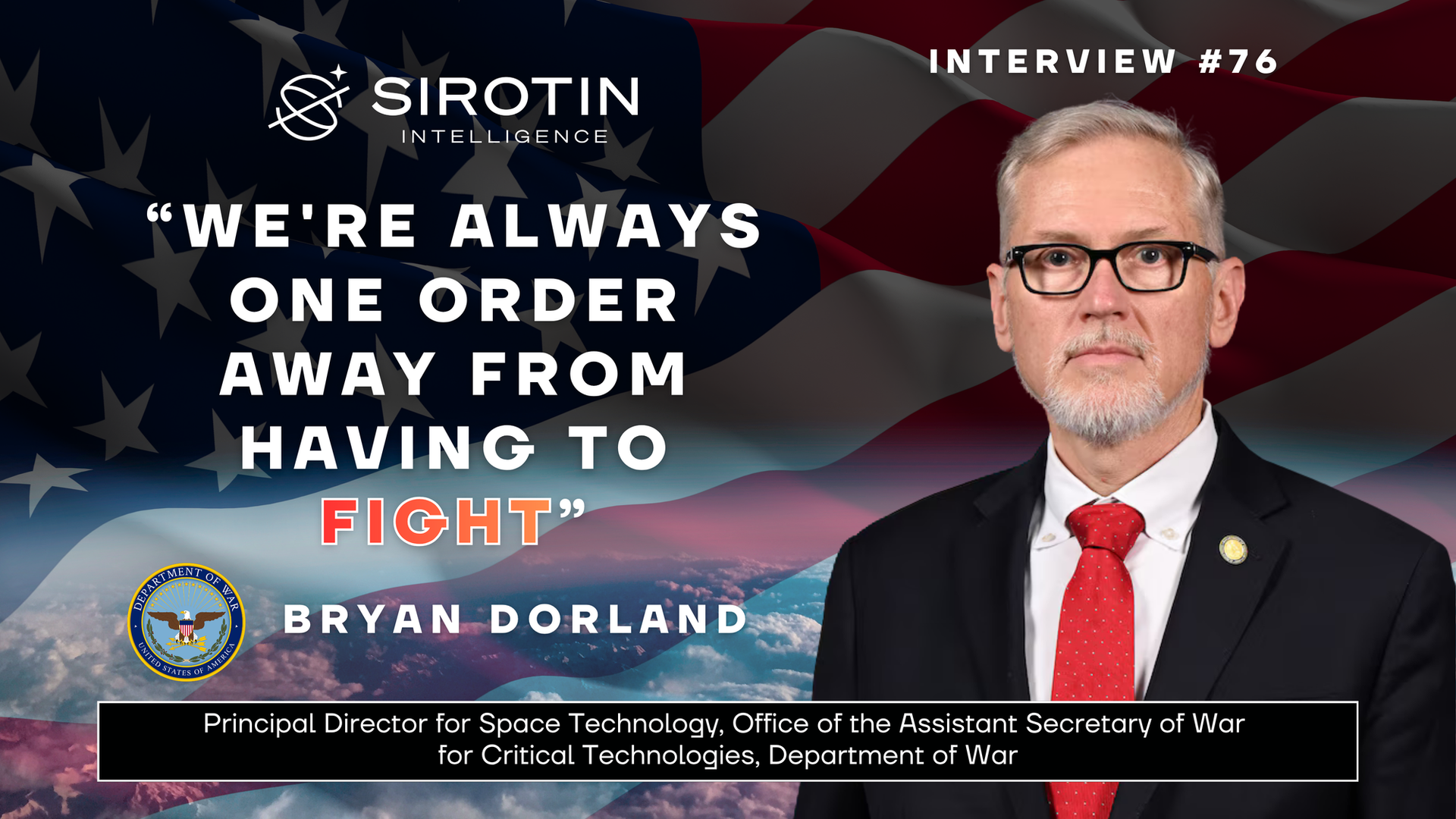
"We're Always One Order Away From Having to Fight": Department of War Principal Director for Space Technology Dr. Bryan Dorland On Marines, Orbital Mechanics, and Why the Moon Race Was Never Supposed to Happen When It Did

In July 1962, the United States detonated a 1.4-megaton thermonuclear warhead 250 miles above the Pacific Ocean.The test, known as Starfish Prime, was part of Operation Fishbowl, a series of high-altitude nuclear experiments conducted at the peak of the Cold War. The explosion created an artificial aurora visible from Hawaii to New Zealand. It also generated an electromagnetic pulse far larger than anyone had predicted, knocking out streetlights in Honolulu and damaging at least a third of the satellites then orbiting Earth. At the time, that meant six or more machines out of roughly two dozen. Telstar 1, the first commercial communications satellite, had been launched just one day earlier. It transmitted the first live transatlantic television pictures that July before succumbing to radiation damage months later.
Twenty-four satellites. That was the entire constellation in 1962. Today, more than 10,000 active satellites circle the Earth, with projections climbing toward hundreds of thousands. SpaceX alone has filed paperwork for constellations that could approach a million. The distance between those two numbers contains most of the story of how space became a domain of commerce, competition, and strategic weight, and why the people working at its center tend to carry unusual combinations of experience.
Dr. Bryan Dorland is one of those people. He serves as Principal Director for Space Technology in the Office of the Under Secretary of War for Research and Engineering, where he is the chief technology officer for the Department of War on space and space-related capabilities. His career spans more than thirty years, beginning as a rifleman in the United States Marine Corps during the late Cold War, then moving through a PhD in physics from the University of Maryland studying the luminous blue variable Eta Carinae using the Hubble Space Telescope, followed by astrophysics work at the U.S. Naval Research Laboratory supporting missile defense, and eventually leadership of the Celestial Reference Frame Department at the U.S. Naval Observatory, where he directed programs in celestial reference systems, space mission development, and advanced detector technologies. Before all of that, he earned a Bachelor of Arts in Liberal Arts from St. John's College in Annapolis, where the entire curriculum is built around the Great Books and Socratic discussion.
A Marine infantryman who reads Plato and studies exploding stars through the Hubble Space Telescope, then ends up briefing Congress on orbital threats. It is an unusual résumé. But the through-line, once you hear Dorland talk, is clearer than it first appears: every role taught him to communicate across a boundary that most people never cross.
How did your specific background, starting in the Marine Corps infantry, shape the way you think about space as a warfighting domain compared to someone who came up through science or engineering?
Dorland did not plan on the military. His path to the Marines began, as he tells it, with a recognition that he lacked the discipline to succeed in college on his first attempt. After a difficult freshman year, he looked for something that was, in his words, "the exact opposite" of the experience he had been failing at. He enlisted in the Marine Corps infantry as a rifleman.
"Those years are very formative," Dorland says. "It really allowed me to develop the discipline and the confidence that was necessary later on, when I did go back to school."
The Marines, particularly the infantry, are focused on one thing. "From the moment you get up the first day, until the day you leave, it's the warfight," he says. "It's all about the rifle. It's all about your comrades. It's all about the mission." Young Marines are given responsibilities that most civilians do not encounter until much later in life. That gap, in Dorland's view, produces a certain kind of confidence and a certain kind of seriousness about what is at stake.
His service coincided with the final years of the Reagan era, when the world felt like it could tip at any moment. The Korean Air Lines Flight 007 shootdown had recently occurred. The 1983 Beirut barracks bombing killed 241 American servicemembers, some of whom had served alongside people Dorland knew. The invasion of Panama came shortly after his departure; the Gulf War followed a few years later. The proximity to real conflict was constant. "The fact that we were very close to getting into a conflict, that was always sort of suffused my entire time in the Marines," he says.
That awareness never left. "For the warfighters, we're always one order away from having to fight," he says. "The stuff we're working on now is absolutely critical, and it is clearly informed by my experiences as a Marine."
I had been reading about Lagrange points and the language people use to describe cislunar space, words like choke pointsand strategic high ground that borrow directly from naval and ground warfare. Given Dorland's military background, I wanted to know whether the naval analogy actually holds, or whether it breaks down once you leave Earth's gravity well. And if Lagrange points really are the strategic positions everyone says they are, why does China still have the only operational asset parked at one?
Naval history offers some of the most direct parallels to space security. The U.S. Navy was originally created to protect commerce, not to project power. What can the naval domain teach us about how space security is likely to evolve, and where do Lagrange points fit into the strategic picture?
The analogy between space and the ocean comes up constantly in defense circles, and Dorland thinks it holds up better than most. Space is clearly not like the ground, and not quite like the air. The ocean, with its vast distances, its strategic chokepoints, and its long supply lines, maps more naturally onto what cislunar operations will eventually look like.
The United States Navy in its modern form emerged not from a desire for conquest but from the need to protect American commercial shipping. The Quasi-War with France in the late 1790s and the Barbary Wars in North Africa forced the young republic to build a credible fleet. "What really forced us to develop a serious, no kidding, Navy was the need to protect our commerce," Dorland says.
He sees a parallel taking shape in cislunar space. Commercial activity around Earth, particularly in low Earth orbit, is already enormous. Interest in the Moon is accelerating, driven in large part by companies like SpaceX and Blue Origin. Dorland projects forward twenty or twenty-five years, to a period when lunar operations may become economically self-sustaining. "At that point, you will have ships going back and forth. We'll have commercial facilities. We'll have commercial property. We'll have humans and robots. All of this worth trillions of dollars plus all the human lives involved." And at that point, he believes, something analogous to a naval capability will be required. "At some point in time, something bad is going to happen, or there'll be bad actors."
He acknowledges that space pirates sounds faintly absurd. But piracy on Earth has never actually stopped. Commercial shipping still contends with it. The underlying logic, valuable cargo moving through poorly governed space, will eventually apply off-planet too. "We're going to have to have some kind of way of enforcing rules and law and order out to the Moon, and then beyond that," Dorland says. The question is whether that capability develops proactively, as it did (eventually) with the early American Navy, or reactively, after something goes wrong.
On Lagrange points specifically, Dorland is less excited than some of the commentary might suggest. The five equilibrium points in a two-body gravitational system, where the competing gravitational pulls of two large objects and the centrifugal force of a smaller object balance out, are genuinely interesting from a physics standpoint. They allow spacecraft to maintain position with minimal fuel expenditure. But Dorland cautions against overstating their strategic importance. "Lagrange points are extremely interesting from a ‘topological’ perspective of the gravitational potential. They allow us to sit there or to orbit with minimal delta-V expenditure. But beyond that, they're not necessarily critical. I wouldn't want to overweight their importance."
The broader picture, he suggests, is more complicated than any single set of points. Once a spacecraft moves beyond geosynchronous orbit, the gravitational dynamics shift from the relatively simple two-body problem to a multi-body problem involving the Earth, the Moon, the Sun, and eventually more distant bodies like Jupiter and Saturn. Trajectories in this regime become chaotic. Small variations in thrust can produce wildly different outcomes. The strategic landscape of cislunar space encompasses the corridors between those points, the dynamics that govern movement through them, and the awareness infrastructure needed to monitor all of it.
To that end, Dorland points to the Oracle program from the Air Force Research Laboratory (AFRL), which aims to place a sensor near Earth-Moon Lagrange Point 1 to demonstrate detection and tracking of objects in cislunar space. "Let's put a sensor out there, and let's keep track of what's coming and going between the Earth and the Moon," he says of the program's rationale. It is one of the first concrete steps the Department of Defense is taking to extend space domain awareness beyond geosynchronous orbit, and a reflection of the fact that, as Dorland puts it, "the Space Force is still trying to sort through, along with the rest of the department, what exactly should we be doing that is different from NASA."
Dorland's caution about not overweighting Lagrange points carried an implicit message about how we think about the Moon more broadly. Everyone talks about the new Moon race as if it is a replay of the 1960s, just with more players. I wanted to push on that assumption. When we went the first time, it was a contest against one rival. Now dozens of countries and a growing number of private companies are involved. Is this really the same kind of race?
The original Moon race was a contest between two superpowers. The current one involves dozens of countries and a growing number of private companies. What makes this new lunar era fundamentally different?
What Dorland offered was not a comparison between then and now so much as a reframing of the original event. He suspects the Apollo program may have been an aberration, a non-equilibrium event driven by the unique pressures of the Cold War, rather than the natural beginning of humanity's expansion into space.
His first memory is sitting in his father's lap watching Apollo 11 land. He followed every subsequent mission. When Apollo 17 lifted off in December 1972 as the final crewed lunar mission, he never imagined it would be more than fifty years before humans returned. But when he looks at the resources the United States committed to the program, the picture shifts. "At one point, something approaching 60% of the integrated circuits being built were specifically being built to support the Apollo program," he says. The intellectual capital and national wealth that went into beating the Soviet Union to the Moon were enormous. This was, after all, the Kennedy era, the same presidency that declared the Moon race and then navigated the Cuban Missile Crisis. The American public was living under a constant threat of nuclear war, and the space program was, in part, a response to that fear.
Dorland's question, then, is worth sitting with: "Maybe the question should be, not so much why did it take so long to get back to the Moon, but how on earth did we do it that first time?" Given the technology available in the 1960s, the fact that every Apollo crew returned alive is, in his view, close to miraculous.
The Starfish Prime data contextualizes just how early and how sparse the space environment was in that era. When the warhead detonated, there were twenty-four satellites in orbit, total. Roughly a third were damaged or destroyed. The entire infrastructure of spacefaring humanity could have been catalogued on a single sheet of paper.
What has changed now, in Dorland's assessment, is that the foundation for sustained lunar activity is being built from the ground up by commercial industry rather than being willed into existence by a single government program. SpaceX, Blue Origin, and a growing roster of smaller companies are generating the demand, developing the launch infrastructure, and driving down costs. "We've now gotten to the point where, naturally, we should be going to the Moon," he says. The current lunar era, in other words, may represent the equilibrium solution, the one that would have arrived on its own timeline had the Cold War not compressed the schedule by decades.
The idea that we are only now arriving at the natural timeline for lunar development reframes the conversation about urgency. If the commercial foundation is real, then the question shifts from "how do we get back to the Moon" to "who is going to build and sustain everything that follows." I had recently spoken with Daniel Scuka, a former communications officer at ESA, who told me that the space sector desperately needs people who are not engineers. I wanted to hear Dorland's version of that from the defense side, where the hiring pressures are different but the underlying talent gap may be similar.
The space workforce looks very different than it did even a decade ago. For someone entering the field today, what skills are most in demand, and how has the hiring landscape changed?
When Dorland graduated in the 1990s, space was a restricted domain. A small number of very large companies worked primarily with the government, clustered around defense laboratories and NASA centers like JPL. Opportunities for new graduates were limited and narrowly defined.
That landscape has fundamentally changed. "There is so much energy and demand right now, and there's so much investment going on, that the huge demand signal for most people coming out of schools with engineering degrees or related scientific degrees is pulling everybody toward commercial," Dorland says. He notes a pattern of cross-pollination that is energizing the entire industrial base. Engineers move from one company to another, carrying lessons and institutional knowledge with them. Many of the most promising small companies he encounters are founded by people with SpaceX experience, people who spent years in a high-tempo environment building things at scale and then took that operational confidence into their own ventures. He sees a similar dynamic at companies like Palantir and Anduril, which are mature enough to train people well but still moving fast enough to attract the kind of talent that wants to build.
His advice to younger professionals is practical. Spend time at one of these larger new-space companies first. Learn the operational tempo of building ten things a year rather than one thing every ten years. Then take that experience to a smaller company, or start one. The confidence that comes from working inside a high-performing organization, Dorland notes, is not unlike the confidence he gained in the Marines: it stays with you and enables what comes next. "I'm kind of envious of people that are graduating school now," he said, "because the landscape has changed so fundamentally from when I got out of school."
The wild card, though, is AI. "The big unknown right now is what impact AI is going to have on the work we do and the skills that people need to have to do that work," he says. The need for autonomy in space systems, both ground-based and on-orbit, is growing rapidly and will only accelerate. With satellite constellations numbering in the tens of thousands and climbing, no human operator can maintain awareness of the full environment. Machines will do much of this work, with humans providing oversight.
But Dorland is measured about where AI actually stands today. "These large language models and AI systems still don't work as well as perhaps they've been represented in the media. From my experience, they still need a lot of insight and care and feeding." The keys cannot simply be handed over. Where things stand in five or ten or fifteen years, he acknowledges, is genuinely unclear. His advice to anyone entering the field is simple: embrace AI as a tool, learn how to work with it, and figure out where human judgment still matters, because that line is still being drawn.
The AI question led naturally to a broader one. If the systems are getting more complex, and the audiences for that complexity span everyone from PhD physicists to Congressional staffers who majored in political science, then communication itself becomes a bottleneck. I have seen this in my own work building Sirotin Intelligence: the most technically impressive analysis in the world is useless if the person who needs to act on it cannot understand it. So I asked Dorland directly whether the space community does a good enough job of translation.
You have briefed Pentagon leadership and members of Congress on complex space technology issues throughout your career. Does the broader space community do a good enough job translating technical realities for policymakers and the public?
To answer this, Dorland went somewhere I did not expect: his undergraduate education at St. John's College in Annapolis. The school has no majors, no lectures, and no traditional academic departments. Students spend four years reading the foundational texts of Western thought, from Plato to Newton to Tolstoy, and discussing them in small seminars organized around Socratic dialogue. It is, to put it mildly, not a typical STEM pipeline.
Dorland considers it essential to who he became professionally. For four years he worked alongside students who would go on to become teachers, lawyers, and artists, people who did not share his facility with physics and mathematics. That experience taught him how to explain things to people who think differently than he does, and he has relied on that skill ever since.
The communication problem, as he describes it, has several layers. There is what he calls "mil-speak," the language and mindset of the uniformed military that most civilians simply do not understand. There is the analogous barrier between technical specialists and non-specialists, the physicist or engineer who has spent decades surrounded by peers who all speak the same language and can forget that most people do not. And there is the institutional barrier between the executive branch and Congress, where members may come from entirely different professional backgrounds and lack exposure to the technical details they are being asked to fund and oversee.
Dorland describes these gaps as "impedance mismatches," borrowing a term from electrical engineering. The signal does not get through because the systems on either end are not calibrated to each other. He has seen this at every level, from general officers to Congressional hearings.
His method goes back to St. John's. "Don't assume whoever you're talking to knows exactly what you're talking about, but don't talk to them like they're an idiot," he says. Lay things out clearly. Encourage questions. The goal, as he frames it with an explicit reference to Plato, is to be a midwife for ideas. "You're not there to lecture somebody. You want them to grasp what it is you're trying to communicate."
He paused, then added with a laugh: "You're not trying to win arguments. I've learned that in my marriage." The joke carried a real point. Whether the audience is a spouse, a Congressman, or a four-star general, the objective is the same. "You want to reach some kind of consensus on understanding, if not on how to proceed."
That is easier said than practiced, especially in a town built on winning arguments. But Dorland has spent thirty years crossing between communities that speak different languages, Marines and physicists, engineers and policymakers, Great Books seminarians and satellite operators. The translation itself, he has found, is where the real work happens.
Author's Analysis
It is 2042. A consortium of American and allied companies operates a refueling depot in a halo orbit around Earth-Moon Lagrange Point 1. The depot services commercial cargo vehicles transiting between low Earth orbit and a permanent research installation on the lunar south pole. Revenue from the corridor has grown steadily for five years. Insurance underwriters in London and Singapore have developed specialized policies for cislunar transit risk. A small but growing body of case law governs liability for proximity operations near the depot.
One morning, a cargo vehicle inbound from LEO transmits a routine status update and then goes silent. Tracking data from the depot's sensors, descendants of the technology first demonstrated by AFRL's Oracle program two decades earlier, show an unidentified object performing a low-thrust maneuver on a trajectory that intersects the cargo vehicle's planned path. The object's transponder is off. Its origin is ambiguous. The depot's operations team, a mix of former SpaceX engineers, a retired Space Force officer, and a logistics specialist who started her career in commercial shipping, convenes an emergency call with U.S. Space Command, two allied space agencies, and the consortium's legal counsel.
The situation requires someone who understands orbital mechanics well enough to interpret the tracking data, who can communicate the implications to military leadership and elected officials in language they can act on, and who carries enough operational instinct to distinguish a genuine threat from a sensor anomaly. That person probably did not follow a straight line to get there. They may have started in the infantry, or in a Great Books seminar, or at the console of a commercial launch provider. What matters is that they learned to think across boundaries and to communicate across them, too.
Dorland's career suggests that the people best suited to navigate these moments are not the ones with the narrowest expertise. They are the ones who have moved between worlds, who have translated between languages, and who understand that the most dangerous impedance mismatch is the one you do not notice. If the space community needs more people like that, and it almost certainly does, where are they supposed to come from? And who, right now, is responsible for making sure they exist before the phone rings?
About Bryan Dorland
Dr. Bryan Dorland serves as the Office of the Assistant Secretary of War for Critical Technologies' principal director for Space Technology under the authority of the Office of Under Secretary of War for Research and Engineering.
In this role, he is the chief technology officer for the Department of War on space and space-related capabilities, working across the department, with the intelligence community, NASA, commercial entities, and international allies and partners to ensure development of critical space capabilities.
Prior to assuming his current duties, Dorland served as a senior project leader supporting requirements, cost, and effectiveness assessments for space missions under the Office of the Director of National Intelligence, director of the Celestial Reference Frame Department at the United States Naval Observatory (USNO), and astronomer and astrophysicist at USNO and the Naval Research Laboratory (NRL), respectively. During his time at USNO and NRL, Dorland primarily focused on development and maintenance of the Celestial Reference Frame across multiple wavelengths, high accuracy astrometry, the development of space missions and space technology, and missile defense research and development. He also led international partnering efforts with the United Kingdom, France, Australia, and Japan.
Dorland holds Master of Science and doctorate degrees in physics from the University of Maryland and a Bachelor of Arts in liberal arts from St. John's College.
Before attending college, Dorland served 4 years in the Marine Corps infantry. He completed his tour of duty as a sergeant and was stationed in Guam and at Camp Pendleton, with deployments to Okinawa, Panama, and at sea.
Get exclusive insights from our network of NASA veterans, DARPA program managers, and space industry pioneers. Weekly. No jargon.