
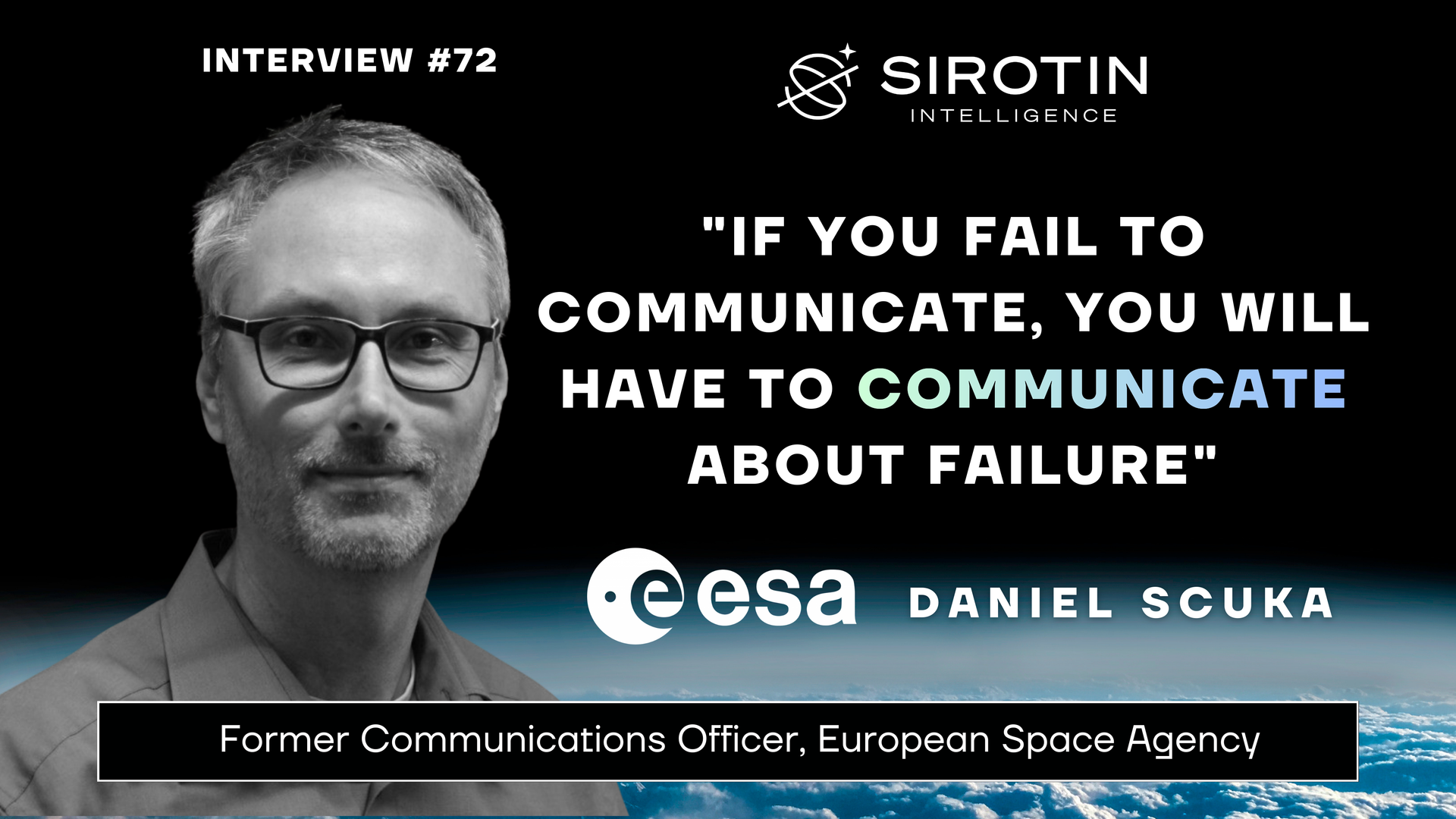
"If You Fail to Communicate, You Will Have to Communicate About Failure": Former ESA Communications Officer Daniel Scuka on Storytelling, Crisis Transparency, and Why Space Needs More Than Engineers

In October 2016, a room full of journalists, scientists, engineers, and mission controllers watched in real time as the European Space Agency's Schiaparelli lander descended toward Mars. The entry, descent, and landing module was then part of the ExoMarsprogramme, a joint venture between ESA and Roscosmos, and it represented Europe's second attempt to place hardware on the Martian surface. The parachute deployed. Telemetry streamed back through the Trace Gas Orbiter overhead. Then the signal stopped. Schiaparelli had impacted the surface at roughly 540 km/h, and NASA's Mars Reconnaissance Orbiter would soon photograph the dark scar it left behind.
What happened next in the press room is, in some ways, more instructive than the crash itself. The cameras were still running. The media were waiting. And it was one of the mission engineers, not a spokesperson, who offered the clearest message: we got the data, we will know what caused this, and we will fix it for the next time. The communications team had spent years building trust with the people who actually flew the missions, and in that moment, it showed.
Daniel Scuka was there. A former officer in the Royal Canadian Electrical and Mechanical Engineers (RCEME), Scuka transitioned from maintaining armored vehicles and weapon systems in the Canadian Army to becoming one of Europe's most experienced space communications practitioners. During more than two decades at ESA's European Space Operations Centre (ESOC) in Darmstadt, Germany, he worked on the communication team, most recently as Programme Communication Officer for Operations and Space Safety, later becoming Head of ESA's Content Office. He built ESA Operations' social media presence in Twitter from nothing to over a quarter of a million followers, collaborated in communications for landmark missions including Rosetta, the Trace Gas Orbiter, and missions to planets, asteroids and the ISS, and was among the earliest voices inside the agency to push for public transparency on the growing problem of space debris.
His co-authored publications span peer-reviewed journals and industry conferences, from "Hello, World!" Harnessing Social Media for the Rosetta Mission and An Ordinary Camera in an Extraordinary Location: Outreach with the Mars Webcam to contributions in telecommunications policy and the interdisciplinary A Sign in Space project exploring the potential reception of an extraterrestrial signal.
We spoke about why the best leaders are almost always the best communicators, how to tell stories that bring audiences into the mission rather than merely informing them, what crisis communication actually looks like when a lander hits Mars at terminal velocity in a live webcast, and why the space industry desperately needs people who are not engineers.
You have an unusual trajectory, from the engineering branch of the Canadian Army to space communications at ESA. How did military service shape the way you think about communication, and was there a specific moment when you realized that storytelling was the skill that mattered most?
The path from armored vehicles to satellite operations is less improbable than it sounds. Both worlds run on complex machinery, high operational tempo, and hierarchical organizations. Getting information to the right people at the right time matters in both. Scuka's years in RCEME, where he led soldiers responsible for maintaining and repairing fleets of wheeled and armored vehicles and weapon systems, gave him a clear view of what separated competent officers from exceptional ones.
"Some of the best leaders are also the best communicators," Scuka says. "I saw senior officers, the colonels and the generals, who got further, who achieved more, who generated a lot more loyalty from their soldiers, because they could communicate very well as to what the goal would be. They made sure everybody knew what the goal was. And they communicated with a great deal of empathy. And they told great stories."
He carried that observation with him. Getting soldiers to follow a general into a difficult objective and getting a public audience to support, often with their taxpayer euros, an expensive and risky space mission turn out to be closer problems than most people assume. Both depend on clarity of purpose and trust. And in both cases, the technical details, while essential, are secondary to the narrative.
"The technical details are not as important as what is the overall story," Scuka says. "What is that goal? Why are we doing what we're doing? The technical details will always follow for those who need them or want them. However, you've got to tell a great story."
The transition from military to space operations happened in stages. Originally from Canada, Scuka moved to Germany and joined ESA at ESOC in 2004, initially working as a web editor covering topics such as human spaceflight and spacecraft operations. Over the following years, he expanded into social media, real-time mission communications, and eventually strategic content leadership for the agency.
You grew ESA Operations' social media presence from zero to over a quarter of a million followers. That is not a trivial accomplishment for a European intergovernmental agency. What did you figure out early that others missed, and what mistakes did you make along the way?
Social media in 2007 was a different landscape. Algorithms were simpler, organic reach was real, and a new follower actually meant something in terms of network effects. Scuka and his colleagues at ESA began building channels during what he describes as the "wide open, high growth phase" of the platforms. But the temptation to treat social media as a distribution pipe for existing content was strong, and they fell into it early.
"Initially, I think many of us made those mistakes," Scuka says. "We said, 'Oh yeah, just publish a press release to our website. Just post the link on Twitter. Done.' Well, that led to nothing."
The shift came when they stopped treating channels as bulletin boards and started treating them as communities with their own identity and expectations. Scuka recognized something that, at the time, few other agencies or even ESA itself was doing at scale: real-time communications tied directly to mission events. Twitter was built for this. A spacecraft separates from its launch vehicle, a signal gets acquired, a critical maneuver goes right or wrong. The ESA Operations channels were there for all of it, relaying what the mission teams were experiencing as it happened.
"We could build up a little bit of tension in our channels," Scuka says. "We could let people know that we were there with them. We were bringing them on board and letting them hear exactly what those mission teams had to say, were thinking, were experiencing. You didn't have to bring space to the audience. You could bring the audience to space."
The approach gained momentum through a series of high-profile missions. Rosetta's arrival at Comet 67P, launches to Mars, the deployment of astronomy missions like Herschel and Planck, all of these provided natural narrative arcs that could be told in real time. When ESA announced a clean spacecraft separation or signal acquisition, the community amplified the news organically. People began to feel ownership of the missions.
Scuka keeps coming back to the same point: treat each channel as its own living, breathing thing. Recognize that the audience is a community. Tell stories with structure, a beginning, a middle, an end. And keep them wanting to come back.
Every good story needs a hero. You have said that before. When the hero is a spacecraft headed for Jupiter's radiation belts or the dust environment around a comet, how do you make people care?
I asked this as a follow-up because the principle is easy to agree with and genuinely hard to execute. Most space missions involve objects, not people. The human drama is real, but it happens in control rooms and laboratories, not on camera. Scuka has thought about this more than most.
"Every good story needs a hero. No hero, no story," he says. "So if you're going to craft a story, who is your hero? Is it the teams who are flying those missions under, usually, very demanding situations? Is it the spacecraft itself, deploying some new technology for the first time, going out to some incredibly challenging environment? The radiation environment around Jupiter, the dust environment around a comet. Is it the astronauts, putting themselves absolutely in harm's way?"
At ESA, Scuka and his colleagues applied this directly to the Juice mission bound for Jupiter's icy moons, turning the satellite itself into a character that audiences could follow through a long journey of discoveries, challenges, and technical difficulties.
He also stresses structure. A story needs a beginning, a middle, and an end, and even a single operational milestone, a flyby or a trajectory correction, can be framed that way. The audience learns what is about to happen, follows the tension as the critical moment approaches, and then finds out how it went. And when the day is over, they know there is more coming.
"When you can get people connected to it, that's when they say, 'that's me, I'm part of that mission now,'" Scuka says. People want that sense of participation. A headline that floats by in a feed does not stick. But a story someone followed in real time, whose outcome they waited for, that they carry with them and tell other people about.
When something goes catastrophically wrong on a live mission, and you have journalists in the room and cameras rolling, how do you balance transparency with the institutional instinct to control the narrative? What does good crisis communication actually look like at that moment?
Every space agency has faced this at some point. The instinct to limit information, to wait for a full investigation before saying anything publicly, is powerful and not always wrong. There can be legal reasons, or programmatic ones, or contractual obligations to a partner that need to be coordinated first. The problem is that the public and the press do not operate on investigation timelines.
What Scuka emphasizes is that the groundwork has to happen long before the crisis arrives.
"You've got to establish a relationship of trust with those who are flying the missions, controlling the satellites, sending the commands," he says. "And that trust goes both ways."
The Schiaparelli incident in October 2016 is his most concrete example. The lander's signal was lost during descent, and the ESA team quickly understood that the outcome was not what they had planned. The media were on site. The webcast was running. There was no opportunity to wait.
"It was actually one of our engineers, one of our mission managers, who said, 'Hey, our message here is very simple,'" Scuka recalls. "'We got the data. We had signal contact all the way down until actual impact. We've got the data. It's going to take us a long time to go through it, but we will know what happened. We will know what caused this, and we will fix it for the next time.'"
The communications team had been prepared to craft something more elaborate. Instead, the engineer's message was already the right one. The relationship of trust that Scuka describes made this possible. Because the mission managers knew the communicators were not going to misrepresent them, they were willing to step up to the microphone themselves. Scuka considers it one of the Agency’s stronger crisis responses, not because the mission succeeded, but because the communication was credible when it mattered most.
Scuka distills the approach into practical terms. Have a crisis communication plan ready, and keep it to two pages. Identify the constraints immediately: what can you not yet discuss, and why? Wrap your message around what you can share. When there has been loss or damage, express genuine acknowledgment of what has happened. And above all, be transparent. "Even if there's some aspect of it that you can't go out with right away, just go out with what you can, and be transparent. And furthermore, be seen to be transparent."
An audience can work with incomplete information, provided the source is clearly acting in good faith. What they tend not to forgive is the sense that something is being hidden.
You were talking about space debris before it was a politically contested issue. ESA's debris team was communicating openly about the problem while much of the agency, and the broader industry, preferred not to discuss it. How did you build internal support for that transparency, and what changed over time?
The politics of space debris communication are more nuanced than they appear from the outside. Agencies contribute to the debris environment and have legacy missions still in orbit as potential hazards. Talking openly about the problem means, at some level, talking about your own contribution to it, which is uncomfortable when your funding depends on public confidence.
What Scuka describes is not a campaign that played out over a news cycle. It took decades.
"Within our space debris effortat ESA, we saw again and again that the debris team was absolutely in the lead in terms of going out with information that nobody else would want to go out with," he says. They talked about the scope of the problem, what caused it, and which of ESA's own missions were part of it. Crucially, they had senior management support to do so.
The rest of the agency took longer to come around. Colleagues working on launchers, technology development, and other mission areas were not initially enthusiastic about public discussions of orbital debris. The communication team's approach was patient and evidence-based: they tracked share of voice, monitored media coverage, and demonstrated that ESA's willingness to lead the conversation was generating positive visibility. When ESA appeared ahead of NASA and other agencies in search results for space debris terms, the internal case for transparency became harder to argue against.
"Over a long period, and I will say it was decades, the rest of our colleagues across the agency slowly came to see that this was the right way to go about it," Scuka says. Today, ESA has formalized its position through the Zero Debris Charter, a framework that is attracting signatories from countries and organizations within and outside Europe. The communications groundwork laid years earlier is a significant part of why that initiative has credibility.
The parallel to climate change communication is one Scuka draws himself: it takes a long time for institutions to acknowledge unintended consequences of their own activity, but the organizations that lead the discussion, rather than being dragged into it, tend to emerge with their reputations stronger.
He also identifies several emerging issues that will need the same kind of long-game communication approach. The environmental impact of rocket exhaust and satellite re-entry burn-up is still under active investigation. The assumption that the atmosphere can absorb increasingly large numbers of deorbiting satellites without consequence is worth questioning. Radio frequency interference from mega-constellations and the growing number of individual missions is already a significant problem. And the dark skies issue, the impact of satellite constellations on astronomical observation, is only growing. None of these will be resolved in a single news cycle, and none will be communicated well by organizations that wait until they are forced to talk.
ESA operates across national, linguistic, cultural, and institutional boundaries. When you are managing communications for a mission with that many stakeholders, each with their own expectations and political sensitivities, how do you actually get alignment?
The multinational dimension of ESA's work introduces a layer of complexity that most national agencies do not face. A single mission might involve national governments and regional ones, the European Union, industrial partners spread across several countries, and scientific institutes in multiple countries with their own agendas. Internally, the science team developing a mission has different communication needs than the flight dynamics team executing a trajectory correction. A contributing member state wants to see its investment reflected in the public narrative. An industrial partner may have contractual sensitivities around what can be disclosed and when.
Scuka has a method, though he is quick to say there is no magic formula.
"Start by grouping your stakeholders," he says. Each one arrives with expectations that, while individually distinct, tend to cluster into recognizable categories. Once grouped, the work is to understand what each cluster's primary concern actually is. "Figure out what their one thing is. What are they really most concerned about? You can literally list it in your notes."
The communications plan then becomes an exercise in negotiation. Give each stakeholder group at least something of what they need. They may not be entirely satisfied, but the critical threshold is that they see themselves reflected in the communication. Once they do, they start amplifying it on their own.
"All of a sudden, it's not just the agency itself communicating," Scuka says. "It's all those other players – industry, national actors, partners, scientific institutes – everybody is now shouting as loudly as they can your message. And that's exactly what you want."
It is not glamorous work. It requires mapping expectations, revisiting them regularly, maintaining the communication loop through every phase of a mission. But when it works, the result is a coordinated communications ecosystem that extends far beyond the agency's own channels.
Space is increasingly a domain of strategic sovereignty, critical infrastructure, and geopolitical competition. For someone starting their career, what roles exist beyond engineering and science, and why should they consider space as a field?
The space sector has always needed engineers, scientists, and technicians. Those roles are certainly evolving, but are well understood. What is less visible, and increasingly urgent, is the demand for people working in strategy, international relations, industrial relations, legal affairs, finance, communications, and policy.
"Space has risen to the level of critical strategy and critical sovereignty," Scuka says. "The large number of people who are profoundly overworked in strategy, in international relations, in any other kind of relations... those people are desperately needed."
He adds a caveat. These roles cannot be filled by people who come to space without any orientation toward the domain. You do not need to be an engineer, but you need to understand what it means to fly a satellite, to develop the programs that are going to go to the Moon, to build the infrastructure for deep space exploration. Without at least that baseline, enthusiasm alone is not enough to be useful in a strategic, legal, or communications role.
The opportunity, though, is real. Even as a young graduate, you find yourself working at the international level, on programs that involve genuinely difficult engineering and science. And space touches nearly everything now, from navigation and climate monitoring to telecommunications and national security.
"It doesn't matter that your background is not hardcore engineering," Scuka says. "It matters that you've got the passion to be part of this incredible story of what we humans are trying to do up there."
He left me with a line I have been thinking about since we spoke. "If you fail to communicate, it means you are ultimately going to have to communicate about failure." And the other side of that holds, too. If you communicate well, early, and honestly, the audience will be with you when things go right, and they will stay with you when they don't.
Author's Analysis
It is 2030. A European commercial launch provider has just experienced a partial failure on a mission carrying payloads for three different nations and a private Earth-observation company. The upper stage underperformed, placing two of four satellites in a lower orbit than planned. One can be recovered with onboard propulsion at the cost of reduced operational life. The other cannot. Within minutes, fragments of video from the launch webcast are circulating on social media, stripped of context and captioned with speculation. The contributing member states need reassurance. The insurance underwriters need facts. The Earth-observation company's investors need a narrative that distinguishes a recoverable anomaly from a catastrophic loss. And the launch provider's next customer, scheduled for a flight in eight weeks, needs to know whether the vehicle is trustworthy.
The company's communications lead, someone who studied international relations and picked up space domain fluency on the job, opens the two-page crisis plan that has been sitting in a shared folder since their first week. She has relationships with the flight directors because she spent months in the control room during nominal operations, earning trust before she needed to spend it. Within an hour, the company issues a statement acknowledging the anomaly, explaining what is known so far, and laying out a timeline for a full assessment. Three of the four stakeholder groups issue supportive statements within the day. The social media speculation does not disappear, but it is crowded out by authoritative information.
None of this required a PhD in astrodynamics. It required domain awareness, stakeholder mapping, trust built over time, and the discipline to communicate before the narrative was written for you. Scuka spent two decades showing that the space sector's most consequential communication challenges are human and political, not technical, and that they require people trained to navigate them. The industry is growing faster than its communication capacity. When the next crisis lands, who will be in the room to talk about it?
About Daniel Scuka
A graduate of the Royal Military College of Canada, Daniel Scuka served in the Canadian Forces as a maintenance engineer at home and abroad before re-entering civilian life and working in Tokyo during the dot-com boom. There he gained experience communicating and evangelizing emerging technologies, which proved essential when he joined the communication team at the European Space Agency (ESA) at their mission control centre in Darmstadt, Germany. After developing multi-channel communications projects for ESA's Space Safety programme and mission operations teams, he advanced to leading teams as Communication Officer and Head of the Content Office, building organizational capacity in communication strategies requiring coordination across European and international partners. Memorable high-profile missions include Huygens, Rosetta, Mars Express, ExoMars TGO, Solar Orbiter, Hera, Proba-3, RAMSES, and the Sentinel series. In 2025, after 21 years, Scuka departed ESA and now remains active in consulting and project development for communication within the space sector. His co-authored publications include work in CAPjournal, Acta Astronautica, Telecommunications Policy, and the ESA Bulletin. He is co-author of iMode Developer's Guide (Addison-Wesley, 2002).
Further Reading and Resources
Selected Publications:
- "A Sign In Space: An Interdisciplinary Exploration of the Potential Reception of an Extraterrestrial Signal" (Acta Astronautica, 2023), Daniela de Paulis et al.
- "Hello, World!" Harnessing Social Media for the Rosetta Mission (CAPjournal, Issue 19, 2016), Emily Baldwin et al.
- Using Competitions to Engage the Public: Lessons Learnt from Rosetta (CAPjournal, Issue 19, 2016), Emily Baldwin et al.
- Operators at Crossroads: Market Protection or Innovation (Telecommunications Policy, 2016), A. Weber, D. Scuka
- An Ordinary Camera in an Extraordinary Location: Outreach with the Mars Webcam (Acta Astronautica, 2011), T. Ormston et al.
- Mobile Service Innovation: A European Failure (Telecommunications Policy, 2011), A. Weber et al.
- Visual Monitoring Cameras in the ESA Fleet (ESA Bulletin, 2009), M. Denis et al.
- iMode Developer's Guide (Addison-Wesley, 2002), Paul Wallace et al.
Featured ESA Content:
- ESA's Solar Orbiter Ducks Behind the Sun (ESA, written by Daniel Scuka)
Research Profile:
Related:
Get exclusive insights from our network of NASA veterans, DARPA program managers, and space industry pioneers. Weekly. No jargon.