
"The Least We Can Do Is Throw A Better Party": TSAS President & Founder, Erick Weiss On Building The New World's Faire In Houston, The Storytelling Gap That's Holding The Industry Back, And Why Every Company Is Already A Space Company

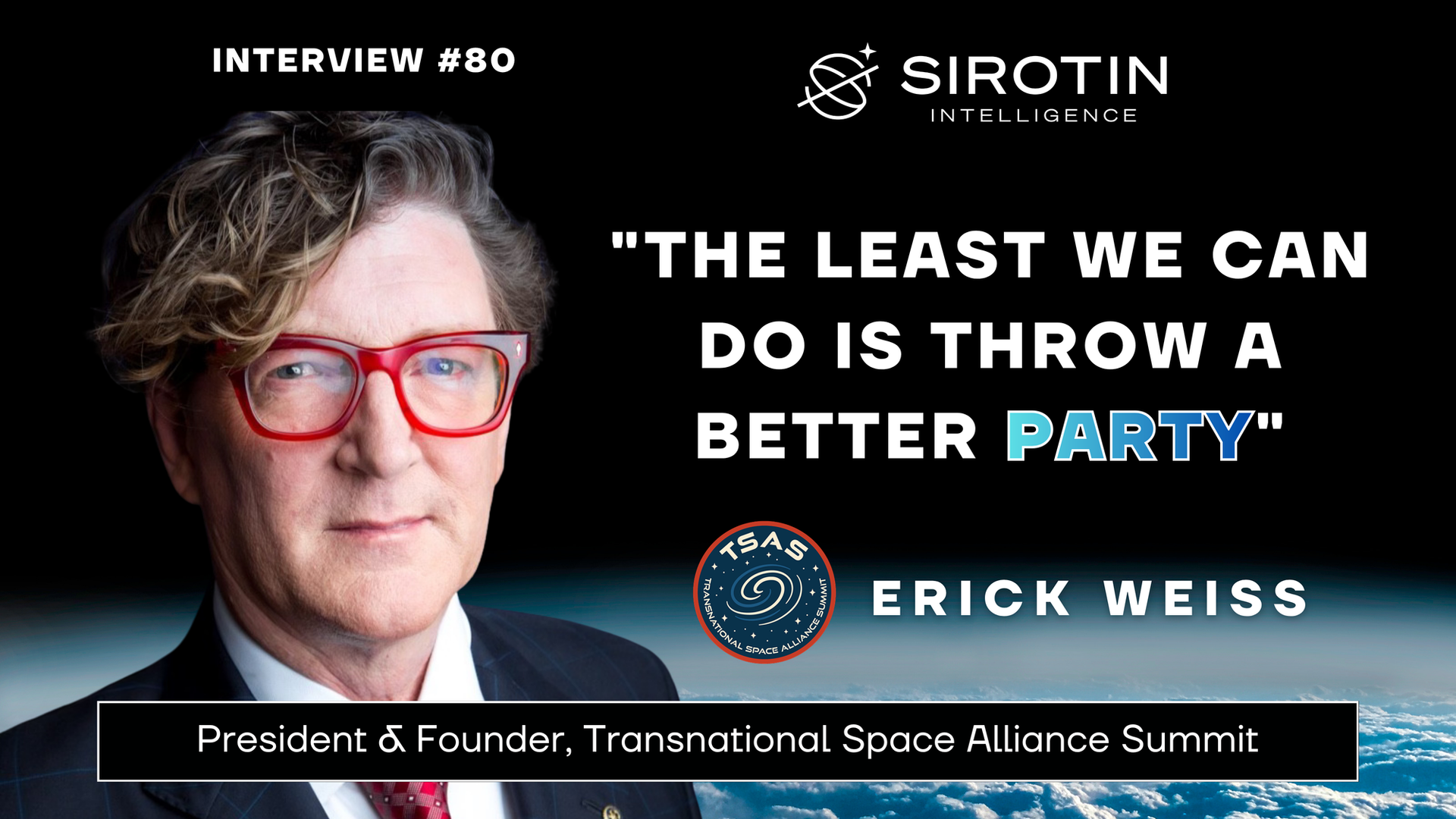
The New World's Faire lands at the George R. Brown Convention Center in Houston on December 1 through 3, 2026. The big vision is to build a city-wide event over the next 5 to 7 years starting with over 1000 attendees in year one and building to over 15,000 plus from over fifty countries. Multiple cross-industry vectors. Forty-five to sixty million dollars in projected economic impact for the city. The internal pitch: "the South by Southwest of space." The man producing it had never worked a space industry event in his life.
Erick Weiss has been producing live events in Los Angeles since 1990. Grammy celebrations for the Recording Academy, twenty consecutive years. ASCAP Awards, ten. Premieres for Titanic, Forrest Gump, all the Men in Blacks, all the Supermans, often million-dollar one-night experiences for the major studios between 1990 and 2005. The 2015 World Indoor Lacrosse Championships, hosted by the Haudenosaunee on the Onondaga Nation in upstate New York, the first time a world sports organization had allowed an indigenous nation to host a world game. The L.A. Political Roast, every year. His father was Dr. Volker Weiss, a physicist, VP Graduate Affairs at Syracuse University and former Associate Director for Science & Technology at the U.S. Army Research Laboratory. His mother was Dr. Peg Weiss, a Kandinsky scholar and Getty Fellow whose archives are housed at the Getty Research Institute. He grew up watching the moon landings.
The pivot started in a room he wasn't supposed to be in. In January 2025, at PCMA Convening Leaders in Houston, Weiss wandered into a breakout session called Navigating Cultural Differences When Working Internationally. He had not read the fine print. The panel turned out to be a Space Cities Network conversation: convention center directors from Christchurch, Lucerne, and Toronto and Houston, talking shop about how aerospace events were reshaping their cities. Then someone in the room said the global space economy had reached $630 billion in 2023 and was on track to $1.8 trillion by 2035, citing a World Economic Forum and McKinsey study from the prior April. Seventy-five years to build the first $630 billion. Ten years to triple it. Weiss left the room with a different career trajectory.
The $1.8T Curve
Five months later, on June 7, 2025, he incorporated the Transnational Space Alliance Summit in California. Five months after that, in November 2025, he met Rick Tumlinson at the New Worlds conference in Austin. Tumlinson, the so-called Godfather of commercial space and co-founder of the Space Frontier Foundation, has been running New Worlds since 2014 and had just published Why Space? The Purpose of People. Within weeks the two were aligned on a joint vision. Tumlinson floated the name New World's Faire. Weiss did not push back.
The conversation that follows covers what Weiss thinks the space industry misunderstands about its own economy, why he believes every company on Earth is already a space company, what the Haudenosaunee taught him about transformative gatherings, how producing duties divide between him and Tumlinson, and the case he makes that the limiting factor on the trillion-dollar trajectory is storytelling.
Eighteen Months
You don't come from the space industry. Walk me back to the moment you decided this was the thing.
Weiss tells the origin story like a man still slightly surprised by it. In January 2025 he flew to Houston for the PCMA Convening Leaders conference, a five-thousand-to-seven-thousand-person event of professional convention producers, attended by big pharma, big banks, big associations, and the kind of destination exhibitors who pitch Four Seasons Madagascar and Visit Paris. He had never been before. He wandered into a breakout session called Navigating Cultural Differences When Working Internationally without reading the fine print. The panel turned out to be space-industry people from convention centers in Christchurch, Lucerne, and Toronto and Houston, talking about something called the Space Cities Network. Then someone in the room said a number.
"It was a $760 billion industry worldwide," Weiss recalls. "And I thought, okay, that's a big number. Then they said, it's expected to grow to between $1.8 and $2.2 trillion over the next ten years. I thought, holy moly. It took us seventy-five years to get to $630 billion. In the next ten years, we're going to triple. There must be business here."
The figure landed differently than it might have for someone with no preexisting framework for it. Weiss's father was a NASA-consulting physicist, metallurgist, and aerospace engineer. His mother was a Kandinsky scholar and Getty fellow whose archives are now housed at the Getty itself. He had grown up watching the moon landings, with Navajo rugs his mother brought back from her travels covering the floors of the house.
"So I have this left-brain, right-brain thing going on," he says. "Both my parents are gone now, and I'm sitting in this breakout session thinking, how did I get here, and why does this feel like home?"
He started researching. There were hundreds of space conferences worldwide, most between two hundred and a thousand attendees, a handful in the five-to-seven-thousand range, and IAC at the top with a 45-year track record. What he found, almost uniformly, was siloing. The events were structured around the supply side of the industry. Lockheed Martins and Boeings selling widgets to the government, manufacturing tracks, government tracks, teaching tracks. The arts got a corner, medicine got a corner, law got a corner. Nobody put them all together.
"That's when I started realizing the space economy is miles bigger and miles wider than the space industry," Weiss says. "Every company on this planet, whether they know it or not, is a space company. AI is going to be a tool. Space is going to be the engine."
You draw a sharp distinction between the space industry and the space economy. Most people use those interchangeably. Why does the difference matter?
It matters because it's the difference between two-thirds of the economy. The space industry, in Weiss's framing, is the supply side. It's the people who build the hardware, run the missions, hold the government contracts, manage the launches. The space economy includes every business those outputs touch downstream. Agriculture, because farmers depend on Earth-observation data. Insurance, because catastrophe modeling now runs on satellite imagery. Logistics, because every container moving across an ocean is being tracked from orbit. Health, because microgravity research will produce drug candidates that cannot be developed on Earth.
McKinsey and the World Economic Forum split the same thing along the same line, calling the first piece the backbone and the second piece reach. In 2023, backbone was $330 billion and reach was $300 billion. By 2035, backbone is projected at $755 billion and reach is projected past $1 trillion. The reach side is growing faster than the backbone side. By the middle of the next decade, the second-order applications of space-enabled services will be the larger half of the industry's total economic footprint.
"If you are running a space conference today and you are only inviting the backbone," Weiss argues, "you are leaving roughly two-thirds of the economy outside the room."
The conversation he thinks the industry needs, and the one he is structuring TSAS around, is the one that puts both halves in the same building. Not rocket-versus-rocket, propulsion-versus-propulsion, or contract-versus-contract. Backbone meeting reach.
You've been to a lot of space events by now. What's the gap, in your view, that most of them are not closing?
Weiss has been producing live events for thirty-five years. He came up as an actor and a director, with five years running the Philadelphia Area Repertory Theatre, recurring roles on Star Trek: The Next Generation and Deep Space Nine, and an episode of Murder, She Wrote. He moved to L.A. in the late eighties and fell in love with the production side. From 1990 through 2005 he produced movie launches for nearly every major studio: Titanic, Forrest Gump, all the Men in Blacks, all the Supermans. Million-dollar one-night events celebrating film releases. In 2007 he started Honeysweet Creative, and over the next two decades he produced the Recording Academy's Grammy celebration, the ASCAP Awards, Navy SEAL Foundation events across the United States, and the L.A. Political Roast on annual cadences.
The diagnosis he carries into space comes out of all of that.
"The thing that sticks with people is their overall experience of joy," he says. "The space events I have attended so far, with respect to the people putting them on, are not joyous. The people there are joyful. They are inspired. They are some of the most fascinating humans I have ever met. But the events themselves lack any creative integrity."
He means it operationally. The PowerPoints do not always work. The audio is not always clean. The breakout rooms are not always laid out so the keynote does not fight the buffet line. Programming budget goes to content, speakers, and matchmaking, all of which he agrees are essential, and almost nothing goes to production polish or transformative experience design.
"If we want to make space matter to the wider world," Weiss says, "we have to make people walk out and say, that was the best experience I have ever had at a conference. And I have to be there next year. That is the gap. That is the part nobody is yet doing well."
You mentioned the 2015 World Indoor Lacrosse Championships. Walk me through that. What did producing it on the Onondaga Nation teach you that you carry into your space work?
Weiss grew up in Syracuse. The Onondaga Nation, about ten square miles outside town, was a regular family destination through his childhood, with spring harvest festivals and lacrosse games on the field. His mother, the modernist art historian, loved indigenous art and kept Navajo rugs in the house from her travels. So when the project came to him in 2014, the geography and the tradition were not strangers to his biography.
"That event is probably going to remain the highlight of my career," he says, "regardless of where space takes me."
The Haudenosaunee, the six-nation confederacy formerly known to outsiders as the Iroquois, invented lacrosse. The Onondaga are the central fire of the confederacy, the equivalent of the capital. In 2014, the Onondaga had decided to host the 2015 World Indoor Lacrosse Championships. It was the first time any world sports governing body had let an indigenous nation host a world game. Weiss does not believe it has happened since. Oren Lyons, Faithkeeper of the Turtle Clan and one of the most important indigenous philosophers of the past century, was the person who told Weiss he was the right producer for it.
The first lesson came almost immediately.
"I realized very quickly that I was not there to come in with my vision of a dignified Iroquois story," Weiss says. "If I was going to succeed, I had to facilitate the Haudenosaunee telling their own story."
That meant traveling across upstate New York, into Canada, Michigan, Massachusetts, and New Jersey, meeting all the different nations, and earning the trust of the clan mothers. In the Haudenosaunee, the men run the council, but the women hold the power.
"The clan mothers elect the chiefs," Weiss explains. "The clan mothers seat the men on the council. The clan mothers are the only people who can take a nation to war. The men cannot. The clan mothers had to trust me to tease out their story before I could serve as the production engine underneath it."
The execution played out the way the production discipline says it should. An Olympic-style village on the Onondaga Nation. Team tents arranged in a circle, against the advice of organizers who warned the teams would fight. They did not fight. They got into each other's ice baths. They shared food. An arts and crafts festival pulled in every indigenous group across Haudenosaunee territory. The tournament ended at what was then the Carrier Dome at Syracuse, in front of more than 20,000 people, the largest indoor lacrosse audience ever recorded. The 2028 Los Angeles Olympics will include lacrosse as a medal sport for the first time since 1908. The world is catching up to a game these communities have been playing for centuries.
"The key to transformative experience is listening," Weiss says. "I am on a listening tour right now in space. I am talking to people. I am taking notes. I am not coming in with the answer."
Industry → Economy
The New World's Faire lands in Houston December 1 through 3, 2026. What is somebody walking through the door going to encounter that is different from a typical space conference?
The architecture of the experience is still in motion at the time of this conversation, but four elements have already settled.
The first is the arts. Performance, NFTs, digital art, storytelling, poetry. Weiss is treating creative practice as a programming layer in its own right, not as decoration around the speakers. Sian Proctor, who flew on Inspiration4 and is an accomplished poet and artist independent of her astronaut credential, has come on board. Several other artists are in conversation.
"The event does not need to be a gallery," Weiss says. "It needs to be artfully produced."
The second is the venue. The George R. Brown Convention Center was designed to look like a ship. TSAS is taking a center section with a giant ballroom that will double as the exhibit hall and the venue for the Space Cowboy Ball, plus multiple sized breakout rooms and a theater with a serious rake and built-in technology. The footprint is configured around a central nest, so that attendees are never walking to the far end of the building to find their next session.
"The vectors are being designed deliberately," Weiss says, "so that the pharmacy people walk past the STEM students, who walk past the teachers, who walk past the medical researchers, who walk past the physicists. Everyone is going to be forced to commingle. That is the only way the cross-industry conversation actually happens."
The third is the framing. Weiss is encouraging costumes. He gets the obvious question.
"People look at me and ask if we are going to be a Renaissance Fair," he says. "The answer is that the word “faire” is meant to make you smile. A new world is going up. It is going off-world. This is a chance to introduce your kids, your friends, your family, your colleagues to what is possible. Dream big. The poster says exactly that."
The fourth, still in development at the time of this conversation, is a job-market component. Weiss wants a recruiting partner planted at the event, with companies posting open roles and attendees applying on the floor. Resume drops, preliminary interviews, a live job fair. The space economy is going to need hundreds of thousands of people over the next decade, ranging from welders and machinists to Harvard-trained physicists to the kind of fashion designers NASA used to commission. He keeps returning to the Apollo example.
"NASA in the 1960s commissioned Andy Warhol, Norman Rockwell, and Robert Rauschenberg to make work about space," Weiss says. "That is how the public absorbed what the program meant. NASA has fallen away from that. The faire is one place where we can bring it back."
You're building this with Rick Tumlinson, who has been doing New Worlds since 2014. How does that partnership actually work, and what does each of you bring that the other doesn't?
The two of them came together quickly. Weiss had incorporated TSAS in June 2025 with a vision of an international, cross-sectional, macroeconomic space event, but he had not yet figured out what it would be called or exactly what it would look like. He attended Tumlinson's New Worlds conference in Austin in November 2025, sat in the audience for the first time, and got on the phone afterward. Weiss read Why Space? The Purpose of People, Tumlinson's book. Tumlinson read what Weiss was building.
"Rick came up with the name," Weiss says. "The minute he said it, I knew it was right. It needs to be public-facing. It needs to feel fun. It cannot just be another set of suits talking to suits about widgets."
The division of labor that emerged works because each partner is bringing what the other lacks. Tumlinson coined the term NewSpace. He co-founded the Space Frontier Foundation. He is one of the founding board members of the X Prize. He has spoken before Congress six times. He has hosted Jeff Bezos, Gwynne Shotwell, Jared Isaacman, and Rod Roddenberry at the Space Cowboy Ball over the past decade.
"When Rick picks up the phone, people answer," Weiss says.
What Weiss brings is the production discipline. He knows what it takes to put 20,000 people in a stadium and have all of them leave saying it was the best night of their lives. He knows how to design vectors, negotiate venue contracts, keep a budget, integrate artists, land sponsors.
"And I know how to listen," he adds, "which I learned from the clan mothers of the Haudenosaunee."
The recognition that the production side mattered as much as the network side took a beat. Weiss says it openly.
"It has taken Rick a minute to understand that I really do know what I am doing around producing an event. I think he knows it now. Once we got past that, the collaboration has been excellent."
The New World's Faire
What are the early signals you're tracking? What does success look like for year one?
The qualitative signal is uniform so far. Weiss says that when he talks to people in the space industry or the broader space economy and explains what TSAS is trying to do, the response is total. They want to be there. They want to bring their teams, their families, their sponsorship dollars.
"The recognition that this is the right idea is broad and consistent," he says. "The trick is converting that recognition into a year-one financial reality."
The big-fish meetings are real. Tumlinson had a strong conversation with Marshall Smith, the CEO of Starlab, Voyager Technologies' commercial space station joint venture, who took over the role in August 2025. TSAS is in broader conversations with the leadership at Voyager Technologies. There is a relationship with Kam Ghaffarian's family of companies, which includes Axiom Space, Intuitive Machines, and X-energy. The astronaut roster is coming together. The biomed track is shaping up. Artists, politicians, and global spokespeople are in the pipeline.
What year-one success looks like, in Weiss's framing, is concrete.
"One thousand attendees through the door, or close. Multiple countries represented. A job fair that puts people into open roles. Programming that crosses multiple vectors and creates the cross-industry collision the space economy actually needs. A Space Cowboy Ball that people will be talking about in February. And every single attendee leaving inspired to tell the New World's story."
If year one lands, year two writes itself. The model is closer to South by Southwest than a single trade show. It is a year-round program of TSAS-branded mini-conferences, monthly meetups, co-branded partner events, and content production, all funneling back into the New World's Faire as the annual flagship.
"Houston is the base," Weiss says. "The faire is the marquee. TSAS is the engine."
The Engine Of The Future
If you could give one piece of advice to somebody who wants to break into the space industry, somebody outside the field, somebody who heard you talk and thought yes, I want in, what is it?
Weiss reaches for an old joke.
"Somebody asks a violinist in New York, how do you get to Carnegie Hall? Practice."
The same logic, in his framing, applies to space. The space economy needs welders, machinists, manufacturers, physicists, scientists, fashion designers, lawyers, communicators, artists, educators, and finance professionals. The talent pipeline is not yet filling those roles, mostly because the pipeline does not know there is space work waiting for it. The next industrial revolution is not AI, AI is a screwdriver. The next industrial revolution is space. The function he wants the New World's Faire to perform, in part, is matchmaking. Introduce the audience to the field. Introduce the field to the audience. Then let people self-select into whatever piece they want to claim.
He closes with the Apollo example again. NASA in the 1960s commissioned Willem de Kooning and Robert Rauschenberg alongside Warhol and Rockwell to make space art for a public that needed help absorbing what the program meant. The commissions were not decorative. They were part of how a moonshot became a generational event rather than a technical program. NASA, in Weiss's read, has fallen away from that posture, and the rest of the industry has followed.
"We are sitting at the top of a new industrial revolution," Weiss says. "The least we can do is throw a better party."
14 Tracks · Cross-Industry Collision
Author's Analysis
Three forces converge in what Weiss and Tumlinson are building, and they are worth naming because the success of the New World's Faire depends on whether the convergence holds.
The first is the maturity moment of the space economy itself. The World Economic Forum and McKinsey put the global space economy at $630 billion in 2023, with a credible median path to $1.8 trillion by 2035 and an upside scenario of $2.3 trillion. The Space Foundation's 2025 Q2 Space Report measured 2024 at $613 billion using a different methodology. Both numbers point the same direction. The driver is not rockets. It is the reach layer, the second-order applications of space-enabled services into agriculture, logistics, insurance, health, retail, supply chain, and defense. The reach layer is projected to grow faster than the backbone layer and to exceed $1 trillion by 2035. That growth is what Weiss saw when he sat in the PCMA breakout in January 2025. It is what made him recalibrate a thirty-five-year career.
The second is the storytelling deficit that Weiss diagnoses. The space industry, in his telling, has built a generation of technical conferences that serve insiders extraordinarily well and serve outsiders almost not at all. The widgets-to-manufacturing-to-government-contracts orientation of most space events is accurate. It is also incomplete. If the space economy is going to triple over the next decade, the industry needs a public posture that resembles what NASA cultivated in the 1960s, when Warhol, Rockwell, Rauschenberg, and de Kooning were commissioned to make space art that helped the public absorb what Apollo meant. That public posture has lapsed. Weiss is not the first to notice. He may be the first event producer of his pedigree to commit a Hollywood-grade production discipline to closing the gap.
The third is the partnership architecture. Weiss is a Hollywood event producer with thirty-five years of credentials and zero space-industry pedigree. Tumlinson is one of the most networked figures in commercial space history with thirty-plus years of relationships across the founder, investor, policy, and astronaut communities and one of the most cited movement-architects in the field. Each is bringing the asset the other lacks. The shorthand at TSAS is that Weiss runs the production, Tumlinson opens the doors, and the New World's Faire becomes the marquee where the cross-industry collision they both believe in finally has a venue.
Whether that convergence holds depends on three things. Sponsorship economics in year one. Attendee composition (the goal of creating a city-wide event over five years with attendees across 50 countries with cross-industry tracks is ambitious ). And programming follow-through will be central to success (Weiss describes a job-market component, a strong arts presence, a Space Cowboy Ball-style closing event, and a vector design that forces cross-industry collisions on the convention floor). The execution risk on any of those is non-trivial. The upside if all three land is that Houston becomes, for one week each December, the place where the space economy and the space industry stop being separate conversations.
If the New World's Faire does what Weiss and Tumlinson believe it can in 2026, what does the December 2027 marquee look like once the cross-industry conversation has been validated and a generation of public attendees has chosen which piece of the economy they want to claim?
About Erick Weiss
President and Founder
Erick Weiss, Founder and President of the Transnational Space Alliance Summit, is a distinguished event producer and creative visionary, renowned for orchestrating some of the most ambitious and culturally significant events in the entertainment and nonprofit sectors. Weiss has led the production of high-profile events, including Universal Studios' multi year 10,000 to 20,000-person holiday parties, The Grammy Celebration for 20 years (the largest entertainment industry awards gala in the country for over 6000 guests) the inaugural NFT LA convention with over 4,000 attendees, and the historic World Indoor Lacrosse Championships hosted by the Haudenosaunee Confederacy in Onondaga.
Weiss's expertise lies in seamlessly integrating storytelling with large-scale event production, a skill honed through his background in theater and performance. He holds a Master’s degree in Dramatic Theory and History from the University of Toronto's Graduate Centre for the Study of Drama, and a BFA in Acting and Directing from Syracuse University. Fittingly, his early career as a professional actor included appearances on television series such as "Star Trek: The Next Generation" and "Star Trek: Deep Space Nine".
In 2007, Weiss founded Honeysweet Creative to pursue his passion for live show and award show production. Under his leadership, the company has produced events featuring A-list performers like Garth Brooks, Stevie Wonder, and the Red Hot Chili Peppers. Notable productions include the Make-Up Artists & Hair Stylists Guild Awards, which he has produced for over seven years last year garnering over 3 billion media impressions.
Weiss's commitment to cultural storytelling is exemplified by his role in producing the 2015 World Indoor Lacrosse Championships. This event was the first internationally sanctioned sports tournament hosted by an indigenous nation, featuring 12 countries and 1,000 athletes. Broadcast world-wide with MSNBC Sports. The event included a major opening ceremony with former Vice President Al Gore, live webcasting, and a week-long indigenous arts festival. A documentary about the event, "Spirit Game: Pride of a Nation," was released in 2017 and is now part of the Smithsonian Permanent Collection.
Weiss also serves as the Senior Executive Producer for The Edge of Company, a platform that explores the future of NFTs and Web3 culture.
Born into a family of accomplished scholars, Weiss is the son of Dr. Volker Weiss, a renowned physicist and former Associate Director for Science & Technology at the U.S. Army Research Laboratory . His mother is a world-renowned art historian and Getty Fellow, Dr. Peg Weiss,, with archives housed at the Getty Research Institute.
Through his work, Erick Weiss continues to redefine the landscape of live events, blending artistry, cultural significance, and strategic storytelling to create unforgettable experiences.
Get exclusive insights from our network of NASA veterans, DARPA program managers, and space industry pioneers. Weekly. No jargon.