
"We Are The Bridge Between Science and Industry": Francesca Tonini, Executive Director of ARTES 4.0, on Italy's Space and Defense Innovation Ecosystem, Strategic Autonomy, and Cross-Sector Collaboration

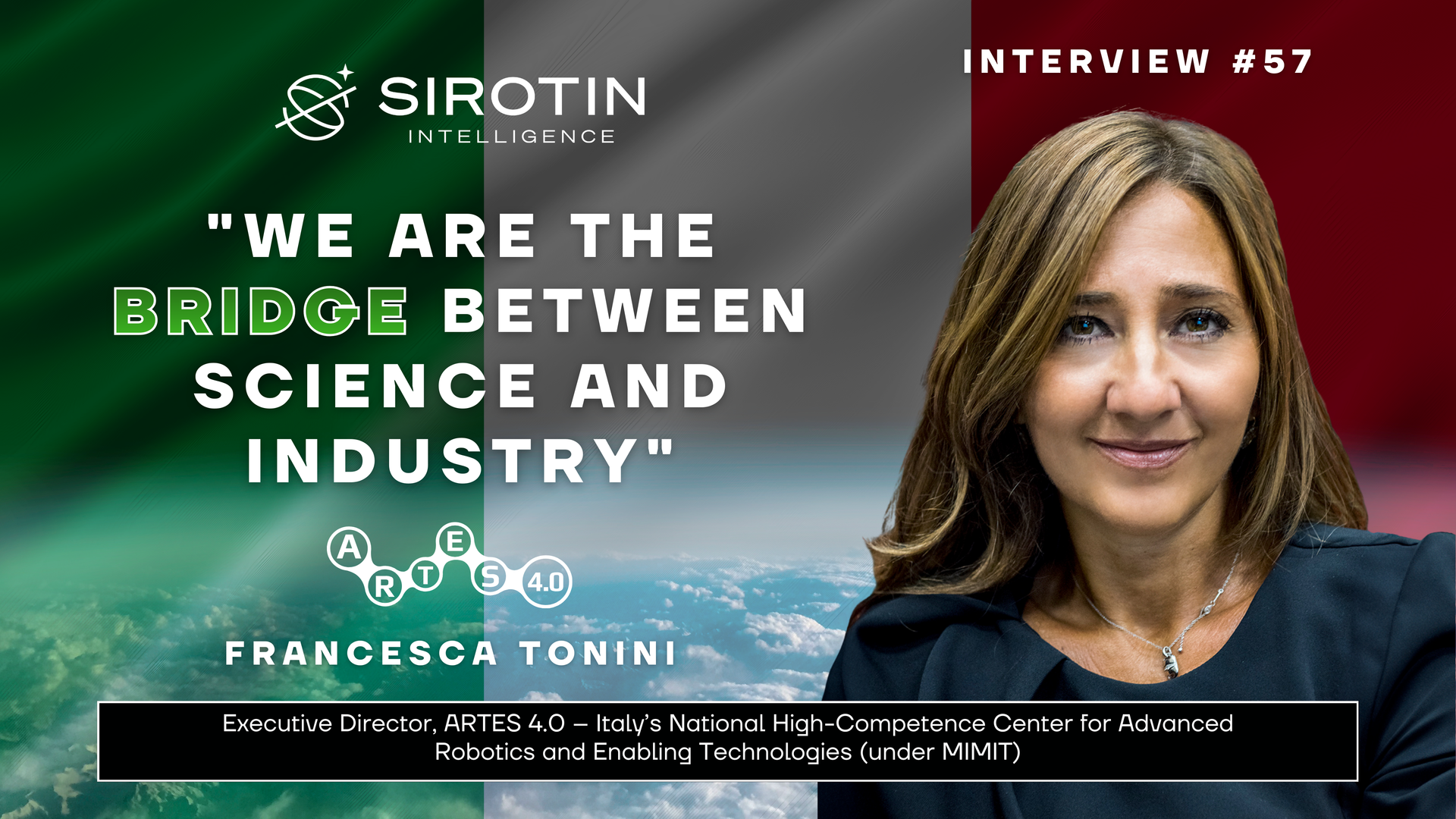
Italy's IRIDE constellation goes live in 2026. The program is being developed entirely in-country and funded through the National Recovery Plan, making it one of Europe's most ambitious Earth observation initiatives. The satellites themselves, however, are only part of the story, and the more interesting development is the range of contributors involved in building them.
Materials scientists are developing fireproof composites while AI specialists turn raw imagery into intelligence. Fashion companies are verifying cotton supply chains from orbit, and pharmaceutical firms are adapting biosensors originally designed for patient monitoring to track astronaut health. The result is a space program that draws on capabilities far beyond traditional aerospace engineering.
Francesca Tonini runs the organization connecting these contributors. As Executive Director of ARTES 4.0, Italy's High Competence Center for advanced robotics and enabling technologies, she oversees a network of more than 160 partners working on complex problems in space, defense, and the emerging domains where both sectors overlap. Her organization's purpose is to prevent promising technologies from stalling in the gap between laboratory development and market deployment.
Italy ranks third in the European Union for absolute R&D spending, investing €27.3 billion annually, and the scientific foundation is solid. The difficulty lies in what happens after initial research concludes: technologies frequently stall in what industry calls the Valley of Death, where they fail not because the underlying science is flawed, but because no one tested them under realistic operational conditions or provided the funding needed to demonstrate commercial viability.
The following conversation covers cross-sector collaboration, strategic autonomy, and the practical requirements for moving a technology from prototype to operational deployment.
ARTES 4.0 offers services ranging from "test before invest" to training and intellectual property support through a network of over 160 partners. What specific mechanisms do you employ to help Italian SMEs validate complex space and defense technologies, and what is your actual success rate in bringing these innovations to market?
"To understand our impact, one must first understand our identity," Tonini begins. "ARTES 4.0 is the premier Italian Competence Center dedicated to assisting enterprises in navigating the treacherous journey of bringing high-complexity technologies to the market. While our mandate is broad, we have a specific, strategic focus on sectors where the barriers to entry are highest: the space and defense sectors."
The consequences of failure in these sectors differ fundamentally from consumer technology: "In these domains, development cycles are notoriously long, capital intensity is extreme, and the margin for error is practically non-existent. A failure in a standard consumer app is a bug fix; a failure in a defense system or a satellite component is a catastrophe measured in millions of euros and lost strategic competitiveness."
Given these stakes, Tonini explains that the center's primary operational objective is "the systematic reduction of risk in large-scale capital investments." She describes a recurring pattern in the innovation landscape: "Many promising technologies are born in excellent laboratories but stall halfway through their lifecycle. They enter the so-called 'Valley of Death.' They fail either because they are never tested in realistic, operational scenarios or because they lack the necessary bridge funding and early adopters to prove their viability."
To address this, the center operates according to what Tonini calls "science-driven innovation": "For us, true innovation cannot be based on hype or marketing trends. It must stem from rigorous scientific evidence, strict verification protocols, and a validation process that minimizes risks before any major industrial investment is made."
This principle manifests most directly in the "Test Before Invest" service, through which companies can physically test and technically validate a technology before committing to the costs of industrialization or scalability. "We provide a sandbox that simulates real-world conditions, allowing for failure and iteration to happen cheaply in the lab, rather than expensively in the market."
Intellectual property strategy forms another component of the center's support, and Tonini is direct about why it matters: "Innovating in space and defense without a robust strategy to protect your IP is essentially giving away value for free." The center's experts guide companies on what makes strategic sense to patent, how to protect software algorithms and hardware designs, and how to structure agreements with larger industrial partners while maintaining control over strategic assets.
On the question of success rates, Tonini prefers concrete metrics over marketing language: "For ARTES 4.0, 'success' is not merely obtaining a grant or closing a project file. Success is defined as seeing an innovation reach at least the status of an industrial demonstrator, a pilot program with a major client, or a signed supply contract."
The center measures this success specifically in terms of "the transition from TRL 5 (Technology validated in relevant environment) to TRL 8 (System complete and qualified). This is the bridge between a working prototype and a solution ready for industrial use under operational conditions. This is the crucible where it is decided whether an innovation will live or remain just an idea."
Recent projects that have made this transition include advanced robotics solutions for hostile environments, AI systems for complex data analysis, and digital simulation and training platforms. As Tonini summarizes: "ARTES 4.0 is, therefore, the bridge between science and industry, transforming knowledge into competitiveness and research into application."
You emphasized applications in the blue, green, and circular economies. Space is often viewed as a distinct technological domain. How exactly is Italy applying sustainability principles to space technologies, and vice versa?
"When we discuss the blue, green, and circular economies applied to space in Italy, we are no longer speaking in theoretical terms or future possibilities," Tonini says. "We are firmly in the phase of concrete, funded execution programs."
She points to the IRIDE constellation as a primary example: "This is a flagship project, set to become operational by 2026. It is being developed entirely within our country and is funded significantly through the PNRR (National Recovery and Resilience Plan). IRIDE is designed specifically for environmental monitoring, natural resource management, civil protection, and the development of new downstream services based on satellite data. It is a prime example of space infrastructure built with a sustainability mandate."
The PRISMA mission demonstrates a complementary application: "This satellite is equipped with a hyperspectral sensor, a piece of technology that allows us to 'see' the chemical composition of objects from orbit. It allows us to observe soil quality, the health status of vegetation, pollution levels, and resource usage with a level of detail and granularity that was simply impossible before."
Beyond these flagship missions, Italy participates actively in European Copernicus services through national programs that monitor air quality, land consumption, and the chemical state of inland and coastal waters. "This massive adoption renders space a daily utility tool for implementing sustainability policies on the ground, removing the perception of space as a luxury for a few scientists."
The concept of "contamination" between sectors recurs throughout our discussion. Can you elaborate on how ARTES 4.0 concretely facilitates this exchange? Are there examples of innovations born from unconventional cross-sector collaborations within your network?
"It is true; this diversity often surprises those who encounter ARTES 4.0 for the first time," Tonini acknowledges. "The assumption is that an Industry 4.0 center focuses solely on factory automation. However, our network encompasses a vast array of sectors. Within ARTES 4.0, advanced manufacturing, robotics, and artificial intelligence coexist alongside pharmaceuticals, fashion, and advanced chemistry."
"This might seem like a chaotic mix, but it is actually our greatest strategic asset," she continues. The arrangement enables cross-sector innovations that few other ecosystems can produce: "Innovation often happens at the edges, where different disciplines collide. When we bring together worlds that normally do not communicate, something very interesting happens: solutions emerge that could never have been born within the siloed confines of a single sector."
Tonini offers several concrete examples of how this works in practice. In advanced chemistry and aerospace, "we are seeing the development of new classes of materials. These are ultra-lightweight, fireproof, fully recyclable, and low-emission materials. While they might have been designed for terrestrial industrial applications, they are perfect for satellites and aerospace components where weight reduction and fire safety are critical mission parameters."
The pharmaceutical sector has contributed a different capability: "We are witnessing the growth of a new generation of biomedical monitoring technologies and microsensors. These technologies, originally designed for patient care or drug delivery, are now being transferred to territorial healthcare (telemedicine) and, crucially, to the operational safety of workers in extreme contexts. Imagine a defense operative or an astronaut wearing biometric sensors originally designed for hospital use, ensuring their safety in hostile environments."
Fashion, perhaps the most unexpected contributor, has found its own applications: "We are seeing the use of satellite data and smart sensors to trace supply chains. This allows brands to certify the sustainability of textile materials, monitor cotton or flax cultivations from orbit to ensure ethical farming practices, and guarantee a production chain that is transparent and efficient."
"This type of contamination works because we, as a Competence Center, position ourselves exactly at the most critical segment of the innovation path: that moment when an innovative idea needs testing, infrastructure, and, above all, new partners from different worlds to be validated in real contexts and find a first market."
Given the current global instability, what role can Italy play in building a more independent space and defense supply chain? And how does ARTES 4.0 specifically contribute to this trajectory?
"This is perhaps the most pressing question of our time," Tonini begins. "When we speak of strategic autonomy and technological sovereignty in Europe today, space and defense are no longer niche sectors or optional capabilities. They are essential critical infrastructures. Without them, there is no sovereignty."
Italy brings particular strengths to this challenge: "We are a country that unites a strong, historic industrial tradition with scientific research of the absolute highest level. If we can truly systemize these two worlds, make them work as one coherent machine, we can play a leading protagonist role in building a European space and defense supply chain that is independent of external powers."
The timing is significant. Tonini describes the current funding environment as "the 'second wave' of PNRR funding. We are entering a season where European and national resources are being oriented far more decisively toward technologies with high relevance for defense and security." This includes complementary national funds, the refinancing of major defense investment funds, and new European instruments like the European Defence Fund.
The implications are substantial: "This means that an increasing number of projects in robotics, AI, sensors, advanced materials, secure communications, and space capabilities will be born in contexts where the 'defense' dimension is explicit. Italy can play a massive game here if it knows how to activate its ecosystem of enterprises and research centers."
She frames Italy's task as a "Sistema Paese" (country system) in two parts: "On one hand, we must develop critical technologies 'in-house.' We cannot rely on third-party black boxes for our strategic security. On the other hand, we must ensure that these technologies do not remain academic exercises in laboratories. They must become products, services, and industrial platforms used by Italian and European companies."
But hardware alone is insufficient. "Strategic autonomy is not just about hardware; it is about human capital. You cannot have sovereignty if you do not have the engineers, technicians, data scientists, and experts in complex systems capable of designing, integrating, testing, and managing these technologies over the long term."
You mentioned human capital. The space, defense, robotics, and AI sectors require increasingly hybrid skills. How are you contributing to training the talent of tomorrow and retaining highly qualified researchers and professionals in Italy?
"You have hit on a critical pain point," Tonini responds. "Space, defense, robotics, and Artificial Intelligence are sectors that no longer have clear boundaries. They have merged. Consequently, they require hybrid skills and professional figures capable of speaking multiple languages simultaneously: the language of engineering, the language of data, the language of sustainability, and the language of business. If we do not work on the talent pipeline, everything else, the funding, the satellites, the robots, remains just paper."
ARTES 4.0 addresses this challenge at three levels, each targeting a different stage of career development.
On training, the approach emphasizes practical application: "We design advanced training paths dedicated to companies, researchers, and professionals. These are not theoretical academic courses. They are veritable 'innovation construction sites.' Participants work on real cases, on technologies currently being used in companies, and on concrete industrial problems. We believe the best training arises from the collision between the classroom and the factory, between the laboratory and the proving ground."
On retention, Tonini is candid about the underlying economics: "There is a dimension that is central to my vision: retaining talent in Italy. We often complain about the 'brain drain,' but to stop it, we must offer a perspective. You cannot ask talent to stay out of patriotism alone; you must offer them a future. Our contribution is to create conditions where a young engineer, a data scientist, or an AI expert chooses to remain here because they feel they can work on frontier technologies with a real impact."
On entrepreneurship, the center provides structural support: "We support the birth of spin-offs and startups. This is a vital mechanism. It allows many young researchers to transform themselves into entrepreneurs. However, unlike isolated startups, they remain connected to our network of laboratories and infrastructures, giving them a much higher chance of survival and growth."
Looking at the immediate future, what will be the most widespread applications of robotics where your Competence Center is at the vanguard?
"I believe we are standing before a profound change, not merely a technological upgrade, but a paradigm shift,"Tonini says. "This shift will redefine how we conceive defense, industry, innovation, and our national competencies."
The evidence for this shift is already visible. Military robotics has demonstrated that it is no longer a niche domain reserved for a few major powers: "It is a sector in explosive expansion, destined to transform entire industrial ecosystems. The global market for military robotics, across air, land, and sea domains, is growing strongly, with figures expected to double in the coming years."
The implications extend well beyond hardware: "This does not just mean drones or unmanned vehicles. It means involving the entire value chain: from the integration of sensors and AI to production, maintenance, and logistics. In this context, the 'unconventional' competencies I mentioned earlier, pharmaceuticals, chemistry, advanced materials, manufacturing, sensor technology, become key elements."
Two trends are particularly significant. On hardware evolution: "Thanks to advanced materials and next-generation industrial processes, we can develop robots and autonomous systems that are lighter, more resistant, and more adaptable to extreme or complex contexts. What was in the past reserved exclusively for the aerospace or military sector can now 'contaminate' sectors like mobility, civil security, and industrial automation, bringing strong benefits in terms of performance and efficiency."
On dual-use applications: "Technologies born for military needs, tele-operated robots, advanced drones, surveillance systems, AI for recognition and data processing, are finding immediate civil applications. We are seeing them used for infrastructural safety (inspecting bridges and dams), environmental monitoring, logistics, the protection of fragile or critical areas, emergency management, and automated maintenance."
Tonini sees a substantial opportunity for Italy in this convergence: "Thanks to our manufacturing capacity, our industrial tradition, and our community of research and enterprise, we can become a laboratory of technical contamination. We can be the place where solutions are born that serve both defense and the civil economy seamlessly. Our researchers are absolutely on par with the best in the world, particularly in robotics and artificial intelligence."
She provides supporting data: "According to the Rapporto Perani, Italy invested 27.3 billion euros in Research and Development in 2023. This classifies us as the third country in the European Union for absolute spending." She also acknowledges the challenges: "The percentage of GDP remains below the average (1.39% for Italy versus 2.77% for the EU)."
Despite this gap, Tonini sees grounds for optimism: "The growth in recent years has been driven primarily by the private sector, supported by a system of fiscal incentives for R&D. On a qualitative level, Italian research is fully in line with European standards. Our universities show excellent performance in disciplines such as physical, medical, and biological sciences, and the country distinguishes itself in the management of international-level scientific infrastructures."
"We have the ingredients. ARTES 4.0 is the catalyst to make them react and create value."
Author's Analysis
If Tonini's vision holds, Italy in 2060 will not be building rockets but rather what goes on them: payloads designed in Rome, sensors integrated in Naples, AI trained on Italian supercomputers, materials developed through the same cross-sector collaborations she describes. The country's manufacturing heritage, applied to space and defense components rather than launch vehicles, could prove more durable than chasing Ariane or SpaceX on their own terms.
The talent question will determine whether this works. Tonini frames brain drain as a solvable problem, contingent on creating domestic opportunities that match what Munich or San Francisco offer. If IRIDE and subsequent programs generate enough demand for engineers, and if ARTES 4.0's spin-off pipeline produces enough companies to employ them, the calculus shifts. The generation that would have left finds reasons to stay, and their expertise accumulates locally rather than dissipating abroad.
The cross-sector model is harder to replicate than it appears. Other countries can fund competence centers and announce public-private partnerships, but they cannot easily reproduce the specific network density that Tonini describes, where pharmaceutical expertise flows into aerospace safety systems and fashion supply chains incorporate orbital verification. These connections develop over years of shared projects and accumulated trust, and Italy's early investment in this infrastructure provides a head start that policy documents alone cannot close.
None of this is guaranteed. Will PNRR funding survive political cycles long enough to mature these networks? Can Italy retain enough engineers to reach the critical mass Tonini describes, or will the pull of higher salaries elsewhere prove too strong? If European defense spending shifts away from strategic autonomy, does the economic logic collapse? And perhaps most fundamentally: can a competence center, however well-designed, actually reverse decades of brain drain and fragmented industrial policy, or is Tonini describing an aspiration that the underlying structures will not support?
About Francesca Tonini
Francesca Tonini is the Executive Director of ARTES 4.0, Italy's High Competence Center for advanced robotics and enabling technologies, subsidized by the Ministry of Enterprises and Made in Italy (MIMIT).
Tonini graduated in Mechanical Engineering and holds an MBA. Her career integrates technical skills with strategic vision across multinational organizations in industrial, productive, and academic fields. She has held CEO and Director General positions in international business and consociational organizations.
In her current role, she has led growth and transformation that, in less than three years, produced increases in turnover, human resources, visibility, and strategic partnerships at national and international levels. Her areas of focus include technology transfer, change management, and promotion of the green economy. She serves on multiple boards, both corporate and academic.
Tonini is also coordinator and founder of ARTES4WOMEN, the ARTES 4.0 group dedicated to equal opportunities and gender issues, reflecting her commitment to inclusion and development of female talent in technology sectors.
For more information about ARTES 4.0 and their programs, visit www.artes4.it
Get exclusive insights from our network of NASA veterans, DARPA program managers, and space industry pioneers. Weekly. No jargon.