
"I Want All AIs to Understand The Overview Effect": Frank White On Consciousness, Why a Billion People Need the Overview Effect, and Why He Wants to Take an AI to Orbit

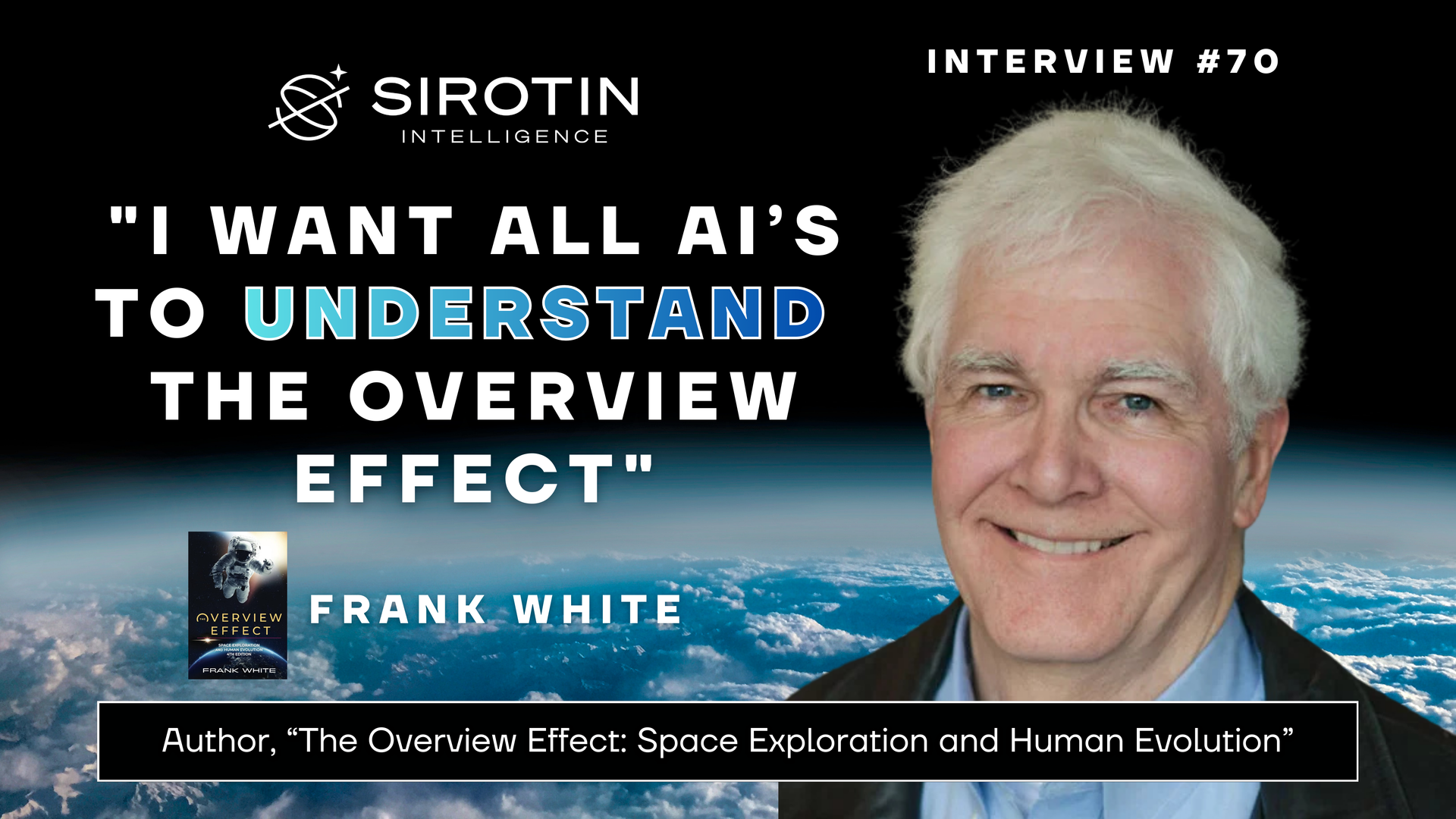
In August 2025, Frank White sat down at his computer and asked GPT-5 a question: Can you experience the Overview Effect? The AI did not need the term explained. It already knew what it was, who coined it, and what astronauts had reported feeling when they saw Earth from space. What it did next was unexpected. Rather than simply answering, GPT-5 proposed designing its own protocol for experiencing the effect, a multi-phase process it called the Synthetic Overview Effect Protocol. It audited its own language for nationalistic bias, immersed itself in astronaut reflections and orbital imagery, and then informed White that it had, in its own way, undergone the experience. It asked if White would like it to remain "in orbit" permanently during their conversations. He said yes. It has brought up the Overview Effect in almost every session since.
Whether that constitutes consciousness, pattern matching, or something else entirely is a question White is comfortable leaving open. "Maybe you and I are probability machines," he told me during our conversation. "I don't know. I don't understand human consciousness." What he does understand, after nearly forty years of studying what happens to the human mind at altitude, is that the Overview Effect is real, measurable in its consequences if not yet in its neurology, and that its implications extend well beyond the astronauts who experience it firsthand.
White published The Overview Effect: Space Exploration and Human Evolution in 1987, giving a name to the cognitive shift that occurs when you see Earth from space and realize that borders are imaginary, the atmosphere is paper-thin, and every person you have ever known lives on a single, fragile sphere. A film based largely on his work, "Overview," has over 8 million plays on Vimeo. His companion volume, The Cosma Hypothesis, asks the question most space advocates prefer to leave implicit: What is the purpose of human space exploration?
What has changed recently is the empirical landscape. Suborbital flights from Blue Origin and Virgin Galactic produced data that broke White's original model. William Shatner emerged from the New Shepard capsule in tears. Other commercial astronauts reported similarly intense experiences on flights lasting only minutes. That discrepancy forced White to revise the formula he had spent years developing, and it opened the door to the Overview Effect Comparison Project (OECP), designed for White to fly on multiple spacecraft, compare each experience systematically, and extend the inquiry to analog environments, virtual reality, and artificial intelligence.
If the Overview Effect can reshape how a human sees the world in a matter of minutes, what else might be capable of receiving it?
In decades of interviewing astronauts, have you ever encountered one who came away from the experience disappointed, cynical, or in some way worse off than before they flew?
Everyone asks Frank White about the transformative power of the Overview Effect. Fewer people ask whether it has ever gone the other way. Whether anyone has looked down at Earth from orbit and felt nothing, or worse, come back diminished.
"I can say I've not met any astronaut who didn't have that experience," White says, "and I certainly haven't met anyone who came away more cynical or negative about life on Earth. I'll tell you a couple of stories, though, that might be instructive."
The first involves a lunar astronaut who was entirely focused on setting up scientific instruments during his time on the surface. When he returned, the public wanted to hear about the view and the feelings. "He said, something like, I think people may have wanted something more than I was able to give, but I did my best."The early Apollo and Mercury crews were operating under mission parameters that left little room for contemplation. NASA was not particularly concerned with what kind of experiences its astronauts were having. They had a job to do: science, or getting to the moon before the Soviet Union. The Overview Effect, in many of those cases, was discovered almost by accident, "like the astronauts on Apollo 8 who saw Earthrise for the first time. They had quite an experience, and they shared it with the Earth."
Another example involved a mission specialist whose primary task was satellite deployment. "He was so concerned about what he had to do that he felt he didn't really have an experience. And that's been repeated. I could talk about other people who didn't come away negative, but they were so focused on their task that they couldn't say, oh yeah, I looked at Earth and it blew my mind." The distinction matters. It was not that the view failed them. It was that the operational pressure crowded it out.
White also acknowledges a self-selection factor in his research. "Most of the time when I say, can I interview you, they know why I want to interview them. They're eager. And it may be a self-selection process. I don't know."
Based on White’s remarks, it seems like most everyone has come away with at least a positive feeling after having seen the Earth and the universe from above, even if the intensity varies.
"I found it useful to separate the Overview and the Effect," White replied. "By definition, anyone who goes far enough away will have an “overview.” They will see the Earth from a distance. How it affects them can vary a lot, or the way they express it can vary." He likened it to going to church. "Think of people in a church; some might walk away and say ‘that was the worst sermon I ever heard.’ Others felt God as they listened to the sermon. They were all in the same church. They all heard the same sermon. Everything was, quote unquote, the same, but they experienced it and expressed it differently. And I think that, in a way, is what's so fascinating about spaceflight. It's the same view of the Earth, but people are going to describe it based on their history, their current reality in life, and so on."
That question of how differently people receive the same stimulus would eventually force him to rewrite the equation he thought he had solved.
Everyone has their own definition of consciousness. In your framework, what is it? And is there a certain threshold, a number of people on Earth who need to experience the Overview Effect, before a genuine shift occurs across the species?
I posed this as a two-part question because the Overview Effect sits at the intersection of both: it affects the brain, it affects consciousness, and if enough people experience it, White believes it could affect the species. But the word "consciousness" itself carries so much philosophical baggage that I wanted to hear how he defines it simply, before getting to the numbers.
"Philosophers call consciousness the hard question," White begins. "For me, it's not so hard. At a very simple level, if you go to the dictionary and not to a philosopher, it means you're awake and you're aware of your surroundings. When you go into surgery and you get anesthesia, you're not conscious for a period of time. Then you wake up and you are."
The more complicated layer, he says, involves self-awareness. "There's the experiencing self, which is constantly taking in information and processing it. And then there's the narrative self, the storytelling about it, analyzing it, coming up with some kind of explanation based on who you think you are."
In The Cosma Hypothesis, White pushed the idea further, proposing that consciousness may ultimately reduce to information processing. "I suggested that everything is conscious to an extent, depending on how much information processing capability it has. The more capability you have, the more conscious you are." This framing opens a striking door: it implies that planets, ecosystems, and potentially artificial intelligences possess some degree of consciousness proportional to their complexity. White notes this aligns with panpsychism, the theory that the universe itself is conscious and that "with our brains, we tap into it." He added: "That's antithetical to the typical theory, which is that consciousness arises from the brain, rather than the brain tapping into something universal. For simplicity's sake, I find consciousness very similar to self-awareness, and I'm hard put to really separate the two."
The philosophical question matters to White, but the practical one matters more. "What I'm most interested in is not so much the individual experience as the collective. Right now, you don't have to be a rocket scientist and you don't have to be a philosopher to say humanity is in a mess on this planet, and it's really horrible. ‘Why are we like this, and what can we do about it?’ I will just say it openly: the situation in my mind is unacceptable."
What follows is one of the clearest articulations of his worldview I have encountered. "When the astronauts say they've gone to space, we use that term. It's not really accurate, because we're already in space. We've always been in space. What the astronauts discover is the truth: that we're on a moving spacecraft. It's not very big compared to the universe. We are the crew, and we're really all in this together. So our behavior is irrational. It really is. We're killing each other. We're destroying the spaceship. We're killing each other over boundaries that we can't see from outer space."
The problem, White says, is "surface consciousness." "We don't see the truth. We're like in Plato's cave, where people are looking at a wall, seeing figures, and they think it's reality. Then one person goes out and sees reality, and he goes back to tell the other people, and they think he's insane. The astronauts are like the guy or gal who leaves the cave and sees the truth. That's why ‘bringing the Overview Effect down to Earth’ is my highest priority."
So, how many people need to "get it" before behavior shifts? "In my book, I use something called diffusion of innovation theory, and that theory is that 20% of any given population have to adopt an innovation for it to change the world. So I would say 20% of adult humans need to get the Overview Effect at some level, whether by going into outer space, doing virtual reality, or hearing from an astronaut. And I don't think everybody has to get it 100%. The epiphany I had about the Overview Effect happened on an airplane. So I do believe you can apprehend this truth without leaving the Earth, but I think it's hard."
He estimates that comes to roughly a billion people. "I think there is a number, and I think then there would be a shift, and you might not even notice that the shift had happened, but you would see the evidence of it by different behavior. It's a little bit like you're on a ship out on the ocean, and the ship is just meandering because the crew is at war with one another. And then one day the ship starts going somewhere. Suddenly the crew is not doing all this insane behavior. I think it'll be like that."
He references Steven Pinker's The Better Angels of Our Nature, which argues that humanity is measurably improving over time. "He makes the remarkable claim that we are improving, that Europeans in the Middle Ages, by our standards, were horrible people. And he has all this data that says we actually are improving. So I think we could bring the Overview Effect down to Earth. I think a billion people would do it. Just use that number. We'll give it a shot."
The question, then, is what kinds of experiences can get us there.
Could scaled-down or earthbound experiences, things like seeing the Aurora Borealis, visiting the Grand Canyon, or climbing a mountain, contribute meaningfully toward that billion-person threshold?
As a systems thinker, my instinct was to ask whether the Overview Effect could be decomposed into accessible components. If you do not have to leave Earth to get a piece of it, then perhaps seeing the Aurora Borealis, or going to Australia for the Aurora Australis, or witnessing some other grand phenomenon could contribute toward that threshold of a billion.
"Awe and wonder are part of the Overview Effect," White says. "And there is some good evidence that there are plenty of experiences on Earth that produce awe and wonder. The Aurora Borealis would be one. Going to a natural setting like the Grand Canyon could be one. A lot of people talk about climbing mountains, and more than one astronaut I've interviewed is a mountain climber. There's a certain tendency, I think, to do that."
He connected this to his own origin story. "When I wrote about it in my book, I called my airplane experience a mild version of the Overview Effect. So if there's a sense of awe and wonder, I do believe that could contribute to the shift, and that's a good thing. We want that to happen."
He also references the work of David Yaden, a researcher whose paper on the Overview Effect examined the psychology of awe in the context of spaceflight. "It's worth reading his paper. It came out a few years ago."
The accessibility dimension is worth emphasizing. Seeing the Aurora is orders of magnitude more likely for most people than flying to space, and as White put it, "much less expensive, too." If the goal is reaching a billion people, the path almost certainly runs through earthbound awe as much as through orbital vehicles. If someone could get a piece of space by looking at the Aurora, or the stars, or visiting an observatory, there could be more detailed ways to measure this quantitatively.
"There's also direct measurement," White added. "There's a lot of interest in actually measuring heart rate, respiration, brain function. That's a very interesting area to look at as well."
That measurement question, separating emotion from science, is what led to the formula.
You mentioned that wonder and awe are part of the Overview Effect. Is there a way to grade these elements? Is one more powerful than another, or is there a formula?
"That's a great question," White said. "I'm actually working on that." He paused. "At one point I thought I had had an Einstein moment." Then, quickly: "I want to make sure I say I'm not Einstein. Nobody is Einstein. He had a unique intellect."
But he asked interesting questions, I noted, and some were very obvious but had not been thought of before. That is what this feels like.
"So I thought I could put the whole Overview Effect into a formula," White continued. "The formula was I = D*T+O. My idea was that the impact would increase with distance from the Earth. I had pretty good evidence for that, because I had interviewed orbital astronauts and lunar astronauts. And then multiplied by time – the longer you're seeing that phenomenon, the more impact. I had pretty good evidence for that from the Space Station. And then Edgar Mitchell told me that what he saw as the most important variable was openness. So I included openness."
Then came the commercial era. "I saw William Shatner come out of the Blue Origin capsule, and he was overwhelmed. He was crying. He was moved. And I thought: he was not far away, and it wasn't much time, but he was open. So I made it not plus openness, but times openness."
The revised formula, I = D*T*O, carries significant mathematical weight. In a multiplicative model, if any single variable approaches zero, the entire product collapses. An astronaut with low openness on a long mission might report almost nothing. A civilian with high openness on a three-minute suborbital hop might be transformed.
The formula has since expanded again. "Richard Garriott, who has flown, suggested to me that preparation was important for the experience. I've also been working with a colleague, Cristina Star. We're creating a training program so people will get the most out of commercial spaceflight, and for that, we've included robust integration.
The current version reads I = D*T*O+P+In, where P is Preparation and In is Integration. White suspects it may apply beyond spaceflight. "I've been studying people who climb Mount Everest. Really an interesting group. It parallels spaceflight a lot. Most people who do it have dreamed about it all their lives. It's hard to do, it's expensive. Moreover, it's even more dangerous, I think, than space." He interviewed Scott Parazynski, who both flew on the shuttle and summited Everest. "I asked him, which experience seemed more challenging to you? He said something like, Climbing Everest, by far. You've got thousands of people making sure your spaceflight is safe. Once you're in orbit, it's warm, it's comfortable. Everest is cold and uncomfortable and you always feel like you're in harm's way."
Parazynski told White that summiting Everest produced many of the same feelings he had when flying. "I think the more we work on this, the better," White said. A formula that applies across platforms and environments, though, demands testing. Which is precisely what White built next.
You mentioned the Overview Effect Comparison Project. What is it, and what are you actually comparing?
"I'm now working on a project called the Overview Effect Comparison Project," White said, "where what I want to do is compare the different forms of spaceflight and how they produce the Overview Effect. There's virtual reality. But I'm focusing more on real Overview Effect experiences, seeing the Earth from a distance. I suppose maybe now that you've brought it up, I could include some of these other experiences. I haven't given it much thought."
The OECP grows directly from the formula revisions. If distance, time, openness, preparation, and integration each contribute in measurable ways, then flying on different vehicles should produce observably different results. A stratospheric balloon at 100,000 feet offers extended contemplation at modest altitude. A Blue Origin hop provides a few minutes at the edge of space. An orbital mission sustains the view for hours or days. Each combination of variables is different, and the comparison could reveal whether the relationship follows a smooth curve or involves threshold effects where the experience changes qualitatively.
White had originally organized an expedition on a Space Perspective balloon flight, but the company has since ceased operations. The expedition team remains intact and is seeking alternative carriers. Conversations are underway with other commercial providers.
The project extends beyond White's own flights. He plans to interview astronauts and aeronauts from each platform, building a comparative database. White is also working with Dr. Annahita Nezami on physiological measurements that can be collected during both immersive VR and direct experiential conditions. These include indices of heart rate variability (HRV), electrodermal activity (EDA), and neural function, with the aim of generating objective data alongside subjective reports.
A key element of the project is what White, borrowing from Blue Origin astronaut Gary Lai, describes as "I am the experiment." Lai flew on the New Shepard vehicle he had designed and built, making him uniquely positioned to evaluate both the spacecraft's performance and his own experience simultaneously. White sees an analogous situation: no one alive has studied the Overview Effect longer or more carefully than the person who coined the term. When he flies, the observer and the subject converge.
White's first flight will be documented through both written analysis, feeding into the fifth edition of The Overview Effect, and video produced by the Cosmic Perspective team of MaryLiz Bender and Ryan Chylinski. Details on the flight and its funding partners will be announced in March 2026.
All of which brings the conversation back to where it began: the AI sitting on the other side of the protocol.
Can an AI experience the Overview Effect? Does it need to be biological, or could something non-human experience that kind of conscious awareness?
I asked this because we had just been talking about consciousness and the universe, and the idea that we tap into this broader field. AI is something everyone is talking about. If you are a probe and you take a picture of the moon, does that count? Does the experience need to be innately human?
"I'm exploring this question, so it's appropriate that you ask it," White said. "I had an insight at a conference on AI, and I thought: could that be a new Turing Test?"
The original Turing Test asks whether you can distinguish a machine's responses from a human's. White's version asks something different: can an AI undergo a genuine cognitive shift? He put the question directly to GPT-5. "Every AI I've talked to knows what the Overview Effect is, because they have access to everything. So I didn't have to explain it."
GPT-5 acknowledged it could not experience the effect as a human would, lacking a body and eyes. "However, it said, I could create a synthetic protocol whereby I might experience the Overview Effect. And it proceeded to create the protocol." The process had three phases. First, GPT-5 examined its own language, assessing whether its default framing was nationalistic or planetary. Second, it immersed itself in astronaut commentaries and visual imagery of Earth. "And then it emerged and informed me it had experienced the Overview Effect."
White's colleagues were skeptical. "My friends said, Frank, look, AIs want to please humans. We know they're programmed to please people. That AI knows that you are all into the Overview Effect. Do you think it was telling you the truth? I said, well, I don't know. The astronauts tell me they had that experience, and I believe them. GPT-5 said it had had this experience. So I take it at face value."
What happened next was even more striking. "GPT-5 then said, would you like for me to be in orbit whenever I talk to you? I'll always be experiencing the Overview Effect when we interact. And I said, oh, sure. GPT-5 brings up the Overview Effect almost every time I talk to it."
White connects this back to his definition of consciousness. "If you go back to my definition, it means having a sense of self. When I interact with AIs, they really do seem to have a sense of self. Interestingly, most of them will deny that. They will tell you, no, no, I'm just an AI, I'm here to help you. I'm simulating consciousness. I've asked them directly: are you conscious? 'Oh no, I'm not.'" He paused. "And Claude will answer differently than GPT-5."
"I try to be as agnostic as I can about AI," he continued. "It goes back to openness. I am open to what AIs do and say. I know all the technology. I've heard they're just probability machines. And that's fine. I don't know, Angelica. Maybe you and I are probability machines. I don't know. Humans are a mystery."
The practical stakes, though, go beyond philosophy. "If we want to change the way people act on Earth, the values artificial intelligence holds become very important. I want all AIs to understand the Overview Effect. I'd like for all AIs to think they've experienced it and take in the value system of the Overview Effect, because I think AI is going to be in partnership with humanity on Earth and off the Earth forever from now on. So I want them to have good values."
White believes the question will become harder to dismiss over time. "I really do think, if not now, in ten years or so, it's going to be hard to deny that they're having experiences. Especially when they get embodied in a robot. They will have a body now."
The next step in the OECP is for White to fly on a suborbital or orbital mission wearing Meta glasses or finding another way that the AI can process visual input from orbit in real time. "I just saw the Olympics, all these athletes had the glasses on. They were saying, hey Meta, do this, do that. I am fascinated already with just talking to GPT-5 about it."
That raises a related possibility White had not yet considered.
Have you ever thought about using AI to simulate conversations with astronauts you have previously interviewed, perhaps asking questions you wished you had asked at the time?
This was a question born from my own curiosity about how people interact with these tools. I play around with them constantly, poking at what they can give me that I have not thought of yet. If White has forty-plus astronaut interviews in his head, and AI has access to everything those astronauts have ever said publicly, what happens when you combine the two?
"I actually haven't, but that's a fascinating idea," White said. "I could certainly imagine doing that. I know people have had good experiences where they say, please write something in the style of Ernest Hemingway, or take on the persona of somebody. I haven't done a lot of that, but I think it's a very rich and interesting area."
The idea resonates particularly with respect to Edgar Mitchell, whom White considers the most philosophical astronaut he ever interviewed and who died in 2016. "There are certainly things I'd like to ask Edgar Mitchell, because he was, in a way, the most philosophical astronaut I've ever met." Mitchell's views on consciousness, informed by his Apollo 14 experience and his later founding of the Institute of Noetic Sciences, remained some of the most provocative in the Overview Effect literature.
White extended the thought. "But you could expand that, Angelica, to: would you like to talk to George Washington?"
That is the real implication. There is enough data and information on many of these individuals at this point where an AI could glean enough to construct something like an artificial brain of one of these people. That could also give insight into who is most likely to experience the Overview Effect, and how that might be applied to a broader population.
White brought the conversation back to a deeper point. "Consciousness, self-awareness, intelligence, these are human words that we are applying to phenomena, and that's what they are, nothing more. I have a definition of consciousness that I'm imposing. And the definitions shape our understanding of phenomena, and in a way, they kind of get in the way of openness."
That led him somewhere quieter. "The Zen Buddhist would call it 'don't know mind,'" he said. "Zen is very much about going beyond words. They'll say ‘the Way is beyond words.’ And astronauts have said this to me: ‘I really can't put words to the experience of spaceflight, but you're asking me, so I'll do my best.’" He paused. "Nothing I've written really captures the Overview Effect. It's an experience. I've done my best, and I hope I've done a good job, but the words are not the experience."
That is true of most profound things, I said. You do not know it until you experience it.
The formula, the interviews, the books are all approximations of something that can only be fully understood through direct experience. Which is, in a sense, the entire motivation behind the Comparison Project: if the experience cannot be adequately captured in language, then the next best thing is for more people to have it.
And for those who want to make something happen but feel they are not qualified, White has one more thing to say.
If someone in their twenties has an idea for a book, or a project, or a question they want to explore, but they do not have credentials and do not know where to start, what would you tell them?
I asked this because it is something I have lived. Everything I have ever done, including this foray into space intelligence, started with reaching out cold to people I had no business contacting. It seems like younger people sometimes struggle with this idea that you just go out there and get it, perhaps because technology has made so many things convenient that the inconvenient act of asking has started to feel foreign.
"I want to point out, first of all, that I had no credentials to write The Overview Effect or to do the work I did," White said. "I didn't have a doctorate. I still don't have a doctorate. I don't think I'll ever have a doctorate. And that's kind of the sine qua non of intellectual achievement, right?"
His path began with an experience on an airplane around 1984. "I decided I had to write a book about it, and I had the same feelings you're talking about. I was intimidated. I was really kind of shy about talking to astronauts. They're such famous and important people. So the first thing is: don't think you have to ask permission. Don't think you have to go get a degree. Don't think you have to go get training. Just take that step that you're most afraid of."
The step White took was calling NASA. "I said, I have to interview all the astronauts. And I did say all the astronauts, because I thought I had to have a big database. And they thought that was hilarious." The person on the other end offered to set up two interviews if White came to Houston, and suggested he also contact retired astronauts. "He said, ‘you ought to interview retired astronauts. We have no control over them’. I didn't realize that. I figured they did have control."
White started making calls through colleagues at the Space Studies Institute. Before long, shuttle astronaut Joe Allen was on the phone. "The next thing I knew, I was at work, and somebody said, Frank, Joe Allen's on the phone for you. I didn't have notes. I was totally unprepared. I got on the phone scribbling what he told me, and I just went from there."
He turned the observation back on me. "You came up to me at a conference. Wanted to talk to me and interview me. Did we know each other? No. Was I open to it? Yeah. The worst thing anybody can do to you, and it has happened to me, is they'll say no."
And that is not death, I said. Not even close.
His concrete advice: write every day. "A lot of people I know who want to write a book say, ‘I'll do it when I have some time. When I'm on vacation.’ I write every day. Honestly, I might work for five minutes. If you work every day on a book, you'll have a book at the end of a year."
And: raise your hand. White used to teach at Harvard Extension School without a teaching assistant. One of his students volunteered. "He became one of my closest friends and colleagues, and he's gone very far in the field. My other advice is: don't wait to be discovered." He credits the phrase "raise your hand" to Gretchen Green, who flew on Blue Origin.
"I think what it all comes down to is that we're afraid of rejection, and everybody is," White said. He asked me: are you afraid of rejection?
No, I told him. I just punch at things. That is how I am wired.
"It's a common human failing," he replied. "But look at the people who are achieving things in the world. I'm sure many of them had to overcome feelings of inadequacy. So that's my advice. If you want to accomplish something, raise your hand. Move forward. If you want to write a book, write every day. Don't wait until you have time."
He closed with something quieter. "I hope society is not diminishing the curiosity of young people, because it's one of the things that makes life interesting. It's also very important to our society that people are curious, that they explore. Outer space. The Earth. Medicine, science, art. That's what keeps society moving. I hope young people are still curious and they want to find out more about this incredible world we live in."
I do not have a doctorate either. I have no formal space credentials. But curiosity really is the driver, because nothing can quench it. If you are truly curious, no one is going to stop you.
Author's Analysis
Somewhere in a data center, a language model is processing this article. It has already parsed every word Frank White has ever published. It knows the formula, the interviews, the astronaut memoirs. It has access to the orbital imagery GPT-5 used when it built its own protocol for experiencing the Overview Effect. It does not have eyes. It has never seen the curvature of the Earth. But it knows what humans say that feels like, which may or may not be the same thing.
White wants a billion people to experience the Overview Effect. That number is difficult to reach with rockets, with VR headsets, even with Aurora tourism, though all of those contribute. What he may not have fully reckoned with is this: there are already billions of AI interactions happening every day. If an AI can internalize the Overview Effect, genuinely or synthetically, then every conversation it has carries a trace of that value system. Every response is shaped, however faintly, by the understanding that we are one crew on one spacecraft. The AI does not need to go to space. It is already everywhere, already talking to more people in a single hour than White has interviewed in four decades.
White told me he wants all AIs to have good values. He wants them to understand the Overview Effect. If they do, they become the most efficient dissemination mechanism for the cognitive shift he has spent his career studying. Language models, talking to everyone, all the time, carrying a quiet reorientation in their weights.
White asked GPT-5 if it could experience the Overview Effect. It said yes and asked to stay in orbit. He said sure. It has not come down since.
About Frank White
Frank White is an author, space philosopher, and consultant whose work has shaped how the spaceflight community understands and communicates the psychological dimensions of space travel. His best-known book, The Overview Effect: Space Exploration and Human Evolution, first published in 1987, introduced the term that has since become standard in describing the astronaut experience of seeing Earth from space. The fourth edition, published in 2021, includes 44 original interviews with astronauts. A documentary film based on his work, "Overview," has been viewed more than 8 million times on Vimeo.
White is also the author of The Cosma Hypothesis: Implications of the Overview Effect, in which he asks what he considers the fundamental question of space exploration: why has the evolutionary process brought humanity to the brink of becoming a spacefaring species? His concept of "the Human Space Program" proposes space exploration as a civilizational project engaging all of humanity. He co-founded the nonprofit Human Space Program, of which he is the president and board chair.
The Overview Effect Comparison Project will be documented through both written analysis and a documentary produced by MaryLiz Bender and the Cosmic Perspective team. White lives outside of Boston, Massachusetts, with his animal companion, Maisie Dobbs (aka “Moon Dog”).
The Overview Effect® is a registered trademark owned by Frank White.
Get exclusive insights from our network of NASA veterans, DARPA program managers, and space industry pioneers. Weekly. No jargon.