
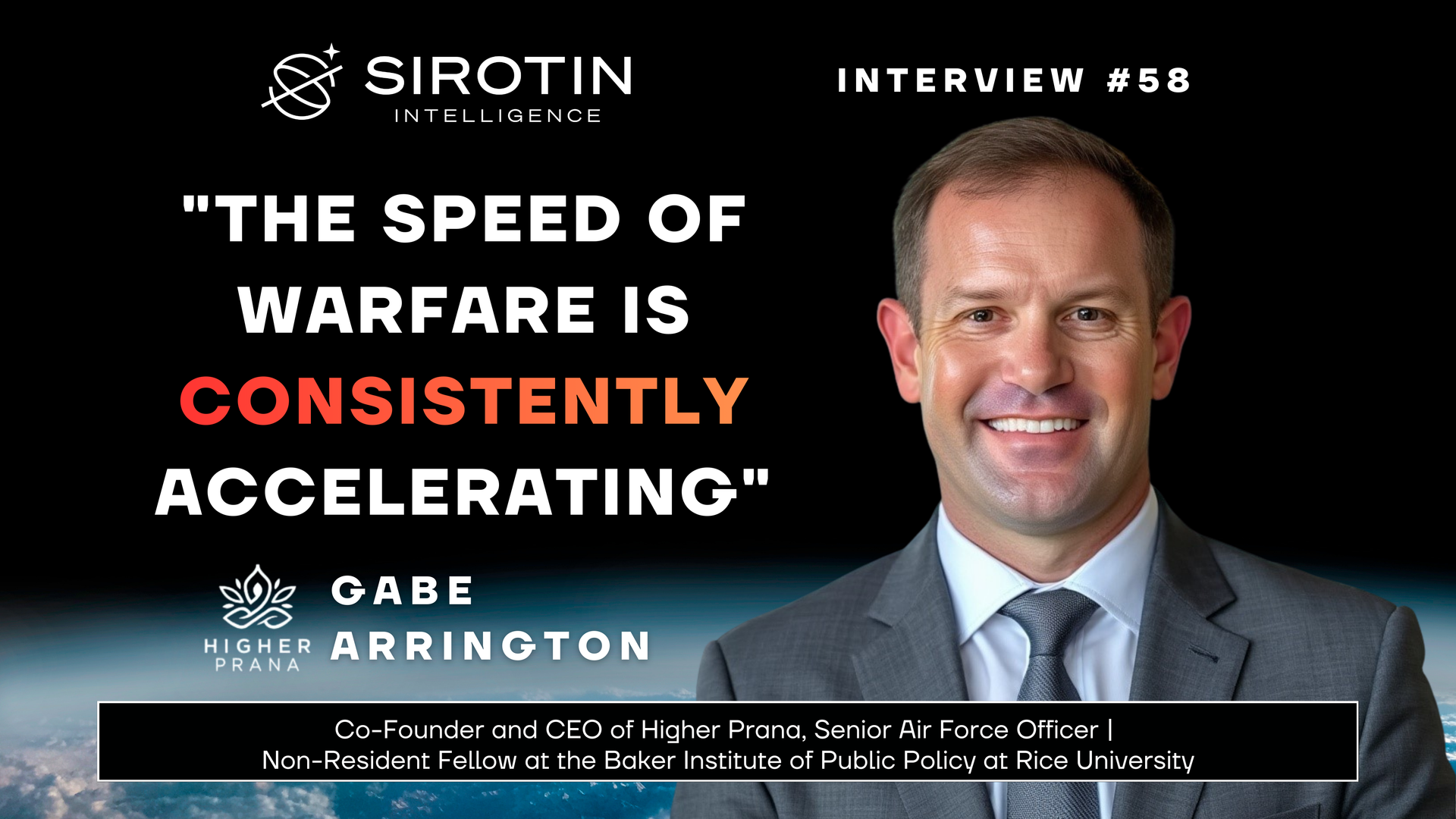
"The Speed of Warfare Is Consistently Accelerating": Gabe Arrington on Autonomous Cargo Aircraft, SpaceX's Global Mesh Networks, and Why Strategic Gaming Still Underestimates AI

A C-17 pilot needs critical data updates over the Pacific. The request bounces through three separate systems that don't talk to each other. By the time the data arrives, it's twenty minutes old. This happens thousands of times daily across military operations worldwide, while teenagers stream 4K video from their phones using commercial satellites.
As an operator, strategist and technologist, Gabe Arrington lives this paradox. As a Senior Air Force Officer and mobility pilot who's managed global air operations, he watches FedEx and UPS solve problems the military still struggles with after decades and billions in spending. The recently retired commander of Air Mobility Command, General (Ret) Mike Minihan, just joined the board of Reliable Robotics, a company building autonomous cargo planes for commercial shippers. The future of military aviation is being built in Silicon Valley warehouses. Pentagon conference rooms operate on different timelines.
Now also a Non-Resident Fellow at Rice University's Baker Institute and co-founder/CEO of Higher Prana, a VR-based capability for mindfulness and mental health, Arrington tracks patterns that determine who controls future conflict. This is an experience trend not readily adopted throughout the military – and one Arrington has been critiqued for – yet the current Chairman of the Joint Chiefs of Staff followed a similar path. His background spans three master's degrees, including Military Operational Art and Science and Philosophy in Strategy, plus fellowships at MIT's Seminar XXI and experience in the policy arena at the Center for a New American Security. SpaceX launches more satellites in a month than the military does in a year. Ukrainian teenagers modify commercial drones faster than American defense contractors can update specifications. China locks down lithium mines while congressional committees debate supply chain security.
What happens when commercial innovation outpaces military modernization so dramatically that traditional concepts of defense superiority become obsolete? When adversaries can buy better capabilities on Amazon than militaries can procure through official channels, doesn't every assumption about force projection need reexamination?
You've spent your career as a mobility pilot managing global operations. What's the one capability pilots have been asking for that the acquisition system still hasn't delivered?
"My background as a mobility pilot is obviously global operations, and so I approach it from the mindset of anytime and anywhere," Arrington begins. "We are constantly on the go. So I would say the one big capability is seamless data flow."
He specifies the operational requirements. "Whether that be voice, whether that be ones and zeros, flight plans, changing mission sets." These needs extend beyond mobility operations. "That stems from the more kinetic operations that the military has. But global data flow, I would say, is big with communications."
This challenge becomes striking when you consider the scale of Air Mobility Command. The command operates approximately 650 aircraft conducting missions across 144 countries, yet many of those platforms still rely on communication systems designed in the 1990s. In contrast, commercial carriers have invested billions into integrated data systems that track weather patterns, fuel consumption, and cargo positioning in real-time. The gap widens every year.
"This is going to be a theme for my opinion, but the military doesn't lead that. That's something that society and humanity leads." Arrington emphasizes learning from commercial innovation. "I'm big on societal and leading technologies, whether it's data flow that's applicable to FedEx or UPS Airlines or our railway systems or trucking systems."
The comparison is hard to ignore. FedEx operates 670 aircraft flying to 220 countries. UPS handles 20 million packages daily across its global network. These companies solved data-integration problems the military has struggled with for decades, largely because inefficiency costs them money immediately. A delayed package hits the bottom line. A delayed military communication may not be recognized until a crisis exposes the vulnerability.
"It's good to humble ourselves to learn some of the lessons that the worldwide logistics picture is leading for us," Arrington notes. This acknowledges a reversal of traditional innovation flow. Military research once drove civilian advancement, from GPS emerging from navigation needs to the internet originating with DARPANET. Now commercial logistics companies develop capabilities the military later attempts to adapt.
With adversaries potentially degrading space-based navigation and communications, what backup solutions should industry be developing that we're not discussing enough?
"When it comes to space-based assets and their role in data flow, whether it be PNT, GPS, and communications, creating that mesh network is optimal," Arrington explains. "Luckily, industry is doing that for us already."
He provides immediate evidence. "You can walk outside right now, and if you look hard enough, within a few seconds, you'll see a Starlink satellite passing overhead." SpaceX has deployed over 6,000 satellites and plans for 42,000. Each satellite maintains connections with multiple ground stations and other satellites, creating redundancy that single-point systems lack.
Mesh networks fundamentally change space architecture. Traditional military satellites operate as individual, high-value assets, expensive to build and catastrophic if lost. The SpaceX Starlink constellation treats satellites as expendable nodes in a larger network. Losing dozens of satellites barely affects service quality. Destroying one satellite becomes meaningless when thousands provide backup routes. Jamming grows more difficult when signals arrive from multiple angles simultaneously.
"That's the global connectivity that whether it's SpaceX or another satellite company, they're proliferating low Earth orbit and bringing communications worldwide." The scale transforms strategic calculations in ways military planners are still processing.
Regulatory variations affect global deployment. "There's pros and cons to that, and different areas of the world allow Starlink coverage versus not, but the capability is there." Some nations ban Starlink to maintain information control. Others embrace it for economic development. The technology exists regardless of political decisions about access.
The Federal Communications Commission has approved over 12,000 Starlink satellites, with applications pending for 30,000 more. Amazon's Project Kuiper plans 3,236 satellites. OneWeb targets 648. This proliferation of commercial constellations creates distributed infrastructure that no single adversary can completely degrade.
"That's one area that I see as just a natural backup to military operations and communications to, from, and through space that industry is already leading." Commercial investment dwarfs military spending in this domain. SpaceX alone has invested approximately $30 billion in Starlink, matching the entire U.S. Space Force budget for fiscal year 2024.
When running wargames with AI-enabled adversaries, what patterns emerge that surprise even experienced strategists?
"The speed of life, and therefore the speed of warfare, is consistently accelerating and getting faster," Arrington states. The acceleration compounds when AI enters the equation. "The use of AI in wargame scenarios and the ability to run multiple iterations instantly of red movements of military capabilities creates a very data-rich environment that speeds up military thinking."
Modern AI systems can process thousands of variables simultaneously, including terrain, weather, logistics, enemy positions, civilian populations, and rules of engagement. They generate tactical options no human commander could conceive in real-time. This capability sounds powerful until you consider the risks.
"If you don't have the right left and right limits, and you don't have the right data feeding your AI models, it can very much lead strategists down a path where they feel sure of recommendations and decisions, and come to find out they were completely wrong."
Commercial AI deployment has revealed similar challenges. When Amazon's AI recruiting tool showed bias against women, it demonstrated how historical data patterns can create discriminatory outcomes. Military AI faces comparable risks. Training on past conflicts might optimize for yesterday's wars while missing tomorrow's innovations.
"Arguably, this is the same fog of war that we've experienced throughout history, just with the application of a different emerging technology that humanity is grasping onto." The fundamental uncertainty of conflict persists. Only the technology accelerating decision cycles has changed.
Current wargaming remains primarily human-driven. "Right now, it's still mostly human in the loop. I've seen tertiary, very little incorporation of artificial intelligence." The integration stays experimental rather than foundational. "We're still at the point where AI is plugging into different areas of life and proliferating, so it'll continue to grow in strategic gaming scenarios."
The institutional landscape reveals varied approaches. "You have academia, you have government, you have big industry. Lockheed Martin's Lighthouse in Virginia is a prime example." Each brings distinct perspectives and constraints. "There's inherent institutional and personal bias baked into those depending on who's funding the wargames or what area they're looking at, the tactical to strategic to the impact of certain capabilities."
The Lockheed Martin Lighthouse facility in Suffolk, Virginia, spans 65,000 square feet where defense contractors test concepts before proposing them to the Pentagon. Academic institutions like MIT and RAND run simulations with different assumptions. Pentagon wargaming centers focus on current force structures and doctrine. Each approach yields different insights and blind spots.
"Big picture, I see AI growing exponentially in strategic gaming scenarios." The challenge becomes maintaining human decision authority as processing speeds exceed human comprehension. A wargame running millions of scenarios per second generates patterns no human could identify through traditional analysis. Those insights, however, depend entirely on the initial parameters and data quality that humans provide.
What unconventional partnerships could give the United States an edge in space that we're potentially overlooking?
"Having the pleasure to be associated with the Baker Institute as a Non-Resident Fellow and helping in their Center for Energy Studies, you're seeing that play out on the world stage right now with energy, rare earth elements, and critical minerals," Arrington explains.
The scramble for these materials intensifies monthly. China currently controls 60% of global rare earth production and 90% of processing capacity. This dominance came through decades of strategic investment, not geological advantage. These materials prove essential for F-35 fighter jets, SpaceX rockets, and iPhone screens alike.
"Just in the last month, major moves by many different nations, but particularly the United States, securing critical supply chains of rare earth elements and minerals so that we can ensure we have the materials for our aerospace sector, for our space sector." The U.S. recently signed agreements with Mongolia for rare earth processing and with several African nations for lithium and cobalt access. The Pentagon awarded $45 million to MP Materials to establish domestic rare earth processing, attempting to break decades of Chinese monopoly. These partnerships often involve nations not traditionally considered strategic allies, yet their mineral wealth makes them crucial.
Launch geography presents additional partnership opportunities rarely discussed in traditional alliance frameworks. "Right now the United States has certain FAA regulations that drive us towards certain launch locations, but I'm seeing rapidly growing interest in certain states, Texas being one of them, to have spaceports and inland launch capability at various sizes."
The FAA's current regulations restrict launch azimuths and require extensive safety zones, limiting U.S. launches primarily to coastal facilities. SpaceX's Boca Chica facility in Texas demonstrates how new launch sites can emerge with proper regulatory support, though the process remains complex and time-consuming.
"Luxembourg has completely different regulations when it comes to space launch than what we're used to." Luxembourg positioned itself as a hub for space mining companies through favorable legal frameworks, becoming the first European nation to establish legal frameworks for space resource utilization. The Luxembourg Space Agency, despite the country being smaller than Rhode Island, has signed agreements with NASA, ESA, and multiple commercial space companies. Their space sector now contributes over 2% of GDP, the highest concentration in Europe.
"Similar to aircraft operations, I wonder how we can expand partnerships with allies and partners globally to increase our access to space," Arrington notes. Airlines already register aircraft in countries with favorable regulations. Cargo ships fly flags of convenience. Space operations could adopt similar strategies, using allied nations' territories and regulatory frameworks to expand launch options beyond traditional constraints.
You've seen what commanders need in the field and how Washington allocates resources. What's the biggest disconnect that everyone notices but nobody wants to admit publicly?
"The biggest capability that I see in the changing character of warfare right now is RPA or UAS, remotely piloted aircraft or unmanned aerial systems," Arrington states. The evidence accumulates daily from multiple conflict zones. "We see it playing out every day between Russia and Ukraine. The view of air power has completely changed based on that scenario."
In Ukraine, traditional air superiority doctrine proves less relevant when $500 commercial drones modified in garage workshops can destroy multimillion-dollar tanks. According to the minister, Ukraine's drone production now exceeds four million units annually. Ukrainian producers were delivering about 20,000 of the dish-plate-sized quadcopters a month at the start of 2024, but increased investment and better-organized supply chains and manufacturing processes spiked output to 200,000 aircraft a month in January 2025. Designs iterate faster than any traditional procurement process could accommodate.
"We saw it play out with Iran in attacks directed towards Israel." Iran deployed over 300 drones and missiles in coordinated attacks, demonstrating how unmanned systems enable new operational concepts. Traditional air defense systems designed for aircraft struggle against swarms of cheap drones arriving from multiple vectors.
Manufacturing capacity emerges as the critical constraint. "How do we have the manufacturing base to not only produce these RPAs and UASs, but produce capabilities to defend ourselves?" The economics prove unforgiving. A $500 drone can destroy a $10 million tank. A $50,000 counter-drone system might stop one drone but fails against swarms of twenty. The mathematical asymmetry favors attackers overwhelmingly.
"Adversaries are employing daily changes to tactics, techniques, and procedures on the offense," Arrington observes. Ukrainian forces modify commercial drones hourly to evade Russian jamming. Russian forces adapt electronic warfare systems daily to counter new Ukrainian variants. The innovation cycle now measures in days, while traditional military procurement cycles span years.
The Pentagon's Replicator initiative aims to field thousands of autonomous systems within two years. Even this accelerated timeline seems sluggish compared to garage workshops in Kyiv producing new variants daily. The bureaucratic processes designed to ensure reliability and accountability now inhibit adaptation speed.
Geographic assumptions that protected America for centuries have eroded. "The United States has had the luxury of having two big oceans and not having to worry about that much, but we're starting to see an uptick in some of those uses even within the continental United States." Mystery drones appear over sensitive sites including nuclear facilities and military bases. Attribution often remains impossible.
Recent incidents highlight vulnerabilities. Drones shut down Gatwick Airport for 33 hours in 2018, affecting 140,000 passengers. Similar incidents occurred at Newark, Dubai, and Singapore. If commercial airports cannot stop hobby drones, military base defense against weaponized swarms raises serious questions.
"That's an area that I don't think globally is being addressed, not just the United States or our defense ecosystem, that's globally." The observation extends beyond American challenges. Every military force structured around traditional platforms faces similar adaptation problems. Acknowledging this gap would require admitting that existing force structures and procurement processes cannot adapt quickly enough to proliferating unmanned threats.
Fast forward to 2035. What major changes are coming to air mobility operations that the Air Force isn't preparing for despite all the briefings and planning cycles?
"Look at Reliable Robotics," Arrington says immediately. "Reliable Robotics is making fully autonomous cargo aircraft, and look at their interests with FedEx and UPS, how those leaders in air mobility are embracing and advancing that type of emerging technology."
Reliable Robotics has completed over 30 autonomous flights of Cessna aircraft with no pilot onboard. Their system retrofits existing aircraft, transforming conventional planes into autonomous vehicles. The company raised $100 million in funding led by Coatue Management, with participation from Eclipse Ventures and Teamworthy Ventures. The technology exists today, not in theoretical papers.
"Couple that with the fact that Reliable Robotics has hired multiple retired four-star general officers to their board, to include the recently retired commander of Air Mobility Command, and the writing is on the wall." General Mike Minihan, who led Air Mobility Command from 2021 to 2024, joined Reliable's board in 2024. He previously commanded 107,000 personnel and nearly 1,100 aircraft. His decision to join a startup building pilotless planes signals understanding of where the industry heads. Of note, Reliable also hired General Richard Clarke, former lead of U.S. Special Operations Command, and Major General David O’Brien, whose history of acquisitions expertise is proving invaluable for the company. “With former leads for mobility, special operations, and acquisitions focusing on changing the way humanity experiences autonomous flight, it’s only a matter of time before Reliable Robotics and similar overlapping companies leading in emerging technologies get to a tipping point.”
The transformation extends beyond removing pilots from cockpits. "Mobility is changing through autonomy and data flow." Arrington connects multiple threads. "We pointed out earlier how SpaceX is ensuring we have that data flow to those air platforms."
Ground operations face equal disruption. "What happens to airfield operations? Fully autonomous aircraft. How about K-loaders that used to be driven by people up to the back of C-17s, and people pushing out cargo? All that can go away."
K-loaders cost between $400,000 and $800,000 each depending on model and contract pricing, and require trained operators. The Air Force maintains hundreds across global bases, with major loader models like the 25K and 60K deployed for most heavy lift missions. Automating them could eliminate operators, training pipelines, maintenance personnel, and significant support infrastructure for operational readiness. Einride already operates fully autonomous, cab-less electric trucks on public roads in Sweden and the United States, relying on sensors and remote computing instead of human drivers. If 80,000-pound trucks are now navigating highways autonomously, military cargo operations are likely to follow for similar automation advances.
"The human in the loop is really being questioned, and really the need for, what is the future of being a pilot going to look like? What's the future of the Air Force, or logistics air travel?" The personal dimension affects military families directly. "Something that my 14-year-old son and I talk about quite a bit, because he wants to be a pilot, and I'm telling him, son, it's going to look different. Think through this." This father-son conversation captures a generational transition. The aspiration to become a pilot has motivated military service for decades. The Air Force Academy, where Arrington graduated in 2003, exists primarily to train pilots. The institution's core purpose faces fundamental questions.
Amazon's Prime Air received FAA approval for drone delivery operations. Walmart conducts thousands of drone deliveries monthly. If packages fly themselves to doorsteps, cargo planes flying themselves across oceans becomes a matter of timeline, not possibility.
What's the biggest public misconception about what the Space Force is and why it matters?
"It's not about the Space Force, it's about everyday life," Arrington corrects. "Credit cards, using banks, the Tesla that I drive around in with autopilot, everything is connected because of space."
GPS satellites enable navigation but also provide timing signals that synchronize financial transactions globally. Without precise timing from space, ATM networks fail, credit card processing stops, and stock markets cannot function. The GPS.gov website lists over 20 critical infrastructure sectors dependent on space-based timing, from agriculture to telecommunications. "It's not just to protect and ensure American interests in, from, and through space. It's to establish international norms of behavior with the American view of what that should be."
The mission connects to broader strategic objectives. "That's part of our national security strategy. That's part of defending the homeland, and it's part of spreading democracy and prosperity globally." Space operations maintain the current international order by protecting economic infrastructure.
The space economy exceeded $469 billion in 2021, with projections reaching $1 trillion by 2040. The Space Force protects this economic activity, not just military satellites. Netflix's "Space Force" comedy series portrayed bureaucratic incompetence launching pointless missions. The actual service protects infrastructure enabling trillions in economic activity.
The U.S. Space Force tracks over 47,000 objects in orbit, from active satellites to debris fragments. A collision cascade, known as Kessler Syndrome, could render entire orbital regimes unusable for generations. The 2009 collision between Iridium 33 and Cosmos 2251 created over 2,000 trackable fragments still threatening other satellites today.
Arrington's explanation reveals dependencies most people never consider. Every GPS-guided delivery, every international bank transfer, every precision agriculture operation requires space assets the Space Force protects. The service ensures invisible infrastructure continues functioning. When space systems work perfectly, nobody notices. When they fail, modern civilization would notice immediately.
Author's Analysis
Scenario: Taiwan Strait, 2028
A commercial cargo ship approaches the Taiwan Strait carrying semiconductors worth $4 billion. The vessel relies on GPS for navigation, Starlink for communications, and automated systems for collision avoidance. Its Ukrainian crew has been monitoring social media reports of increased military activity.
The cargo ship's systems continue functioning perfectly. SpaceX has launched another 200 satellites this month, adding redundancy to an already resilient mesh network. Even if adversaries destroy dozens of satellites, thousands more maintain connectivity. The ship's captain streams video calls to headquarters while automated systems track every container's location and temperature.
Military assets in the region struggle with coordination. American, Japanese, and Australian forces operate on different communication systems that require manual bridges. A P-8 Poseidon aircraft requesting real-time intelligence from a destroyer waits twelve minutes for data that travels through three translation protocols. Coalition partners share intentions through PowerPoint slides emailed between incompatible networks.
Combat unfolds through systems no traditional procurement process anticipated. Commercial drones purchased on Alibaba and modified in garage workshops swarm defensive positions. Both sides deploy capabilities that didn't exist six months ago. The innovation cycle that once took years now happens in days. A defensive system that worked yesterday fails against modifications implemented overnight.
The cargo ship navigates through this environment using better situational awareness than most military vessels. Its commercial systems provide capabilities that defense contractors are still presenting in budget meetings. The crew watches everything unfold on screens powered by the same technology that delivers packages and streams movies.
By morning, the ship reaches port safely. Its voyage succeeded because commercial innovation created systems too distributed to destroy, too numerous to jam, and too profitable to abandon. The semiconductors arrive on schedule. The global economy continues functioning. Military planners schedule another conference to discuss acquisition reform.
This scenario draws from existing capabilities. Every technology described operates today. Commercial cargo ships have better connectivity than military assets. Drone swarms already fly in Ukraine. Communication gaps persist across every coalition operation. Traditional defense procurement continues falling behind commercial innovation moving at Silicon Valley speed.
Arrington's observations illuminate these patterns. When retired Air Mobility commanders join companies building pilotless cargo planes, when Space Force budgets equal single company satellite investments, when Ukrainian workshops out-innovate American defense contractors, the implications become clear.
Military superiority increasingly depends on integrating commercial capabilities faster than adversaries. The side that accomplishes this integration defines what conflict means in an era where teenagers have better phones than generals have command systems.
But integration raises fundamental questions. How does a military bureaucracy designed for deliberate acquisition integrate technologies that evolve weekly? When commercial companies already provide better intelligence through social media than classified systems deliver through official channels, who actually controls information warfare? If China secures lithium mines while Congress debates supply chain reports, has the competition already ended? When pilotless cargo planes become standard for FedEx but remain experimental for the Air Force, which organization better understands logistics vulnerability?
Perhaps most pressing: If the next conflict starts tomorrow, would victory depend more on traditional force structure or on who can more quickly repurpose commercial drones from Amazon warehouses?
About Gabe Arrington
Gabe Arrington is a Senior Air Force Officer as well as the Co-Founder and CEO of Higher Prana. A well-known defense visionary and maverick, Gabe graduated from the United States Air Force Academy with Military Distinction in 2003. He has Master of Arts Degrees in National Security Studies and Military Operational Art and Science, as well as a Master of Philosophy in Strategy. His passion for empowering humanity through emerging technology led him to Co-Found Higher Prana, a VR-based capability for mindfulness and mental health. He also serves on the Board of Directors for AI 2030, PPE Kids, and Brandeis University. He is well known in the Policy, Think Tank, and charitable communities for his work across many global issues and is currently a Non-Resident Fellow at the Baker Institute of Public Policy at Rice University. He is a Massachusetts Institute of Technology Seminar XXI Fellow as well as a National Defense Fellow at the Center for a New American Security graduate. He has provided expert commentary and has been published in Defense One, The Hill, Breaking Defense, Real Clear Defense, and Air University. His background in Wargaming, Strategy, and Policy make him a world-renowned expert in emerging technology and strategic analysis.
For more information, contact Gabe directly on LinkedIn.
Get exclusive insights from our network of NASA veterans, DARPA program managers, and space industry pioneers. Weekly. No jargon.