
"Culture Is a Positive-Sum Game in a Zero-Sum Region": Artist Giusy D'Arrigo on Connessus, Cultural Diplomacy as Statecraft, Why Culture Reaches Where Formal Diplomacy Stalls, and Sicily's Strategic Return to the Center of the Mediterranean

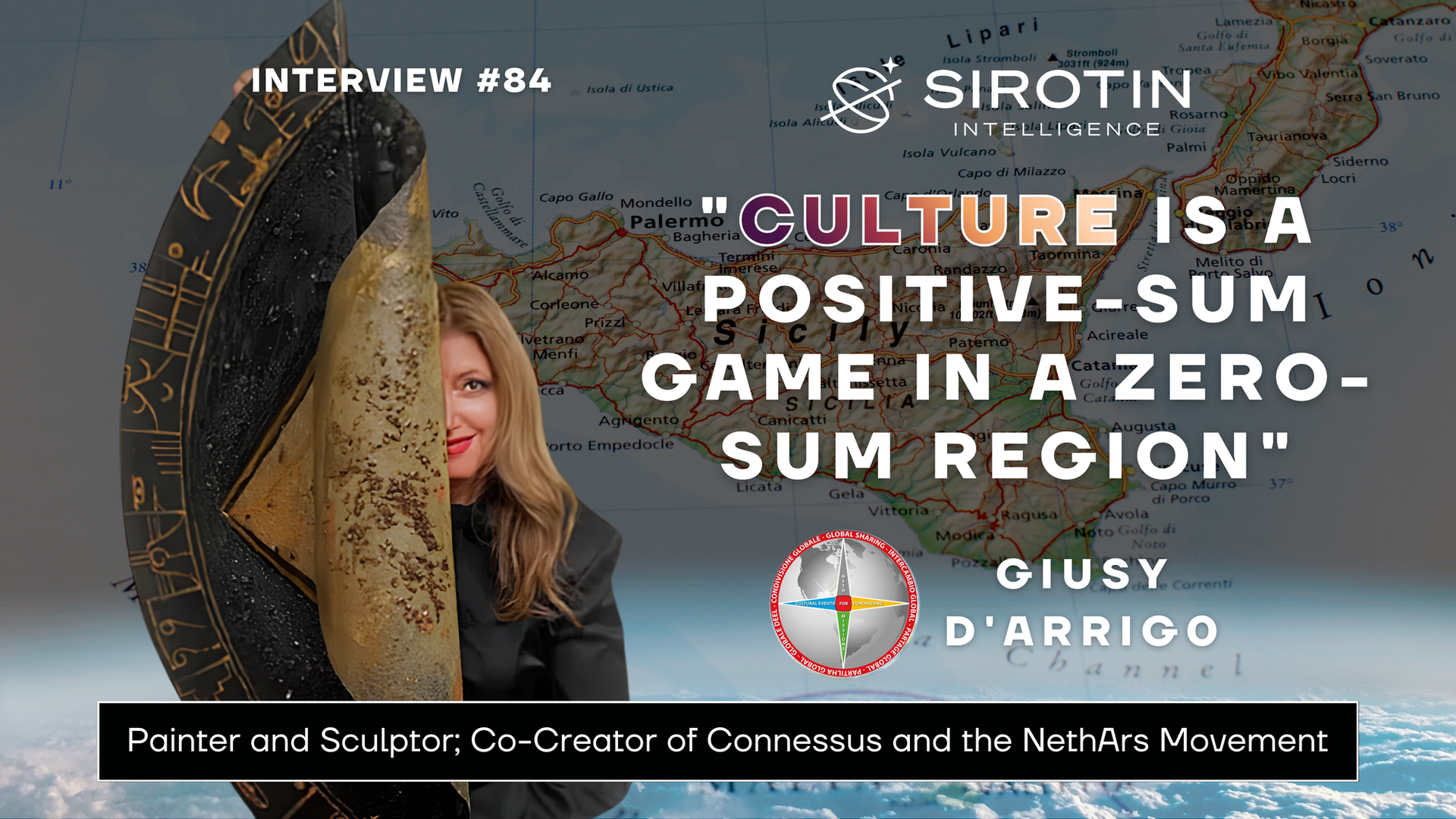
The Mediterranean is one of the most heavily worked pieces of water on the map. It is NATO's southern flank, a migration corridor, and a basin where European, North African, Middle Eastern, and great-power interests press against one another daily. Most of the instruments brought to bear on it are hard ones: fleets, patrols, treaties, and borders. Connessus is a bet on a cultural one. It is a cultural program created by the artist Giusy D'Arrigo, who designed both the Neth and the program around it, with its development and future governance entrusted to the Italian admiral Paolo Russotto, appointed Ambassador in Europe of the Connessus Project. It is built on the premise that culture can stand on equal footing with formal diplomacy, and it argues that case in the language of strategy rather than sentiment.
The worldview underneath it belongs to a man no longer alive to argue it. Angelo D'Arrigo, the Italian pilot the press called the Human Condor, spent his life learning to fly the way birds do, raising endangered crane chicks under the wing of his hang-glider so they would imprint on him and follow him along migration routes they had no other way to learn. He crossed the Sahara and the Mediterranean engine-free beside an eagle, flew over Everest in 2004, and died in a crash at an airshow in Comiso, in Sicily, in 2006, at the age of 44. His sister Giusy is the artist of the family, a painter and sculptor based in Rome who has spent the years since turning his communion with the natural world into sculpture, into a book, and now into Connessus. When Paolo, who manages its strategy, first described it to me, he framed it as a double portrait: Angelo as the source of a reflection on nature and on the barriers people raise to protect economic and political interests, and Giusy as the artist who carries that reflection across painting, sculpture, and writing. I know both Giusy and Paolo personally, and this conversation grew out of that relationship.
The object at the center of the program is a twelve-meter sculpture called the Neth, a word from the same root as nexus that means needle. The metaphor is deliberate, since a needle sews, and each Neth, raised in public squares across five continents, is meant to stitch cultures together, with a sealed steel compartment inside holding objects and writings chosen by local young people. Giusy answered my questions in writing from Rome, and what comes through is a theory of influence. She frames culture as a positive-sum game in a zero-sum region, as neutral ground where ministries cannot operate, and as the one arena where Sicily's location becomes an advantage rather than a vulnerability. We spoke about why she believes culture reaches where institutions cannot, what her brother's legacy has to do with statecraft, and why the island at the center of the basin is on the strategic map again.
The Neth is a twelve-meter sculpture whose name shares a root with nexus and means needle. Its proportions echo numbers shared across four faiths, and a sealed steel compartment inside holds writings and objects chosen by local young people, kept for those who come later.
Sicily sits at the crossroads of Europe, Africa, and the Middle East, one of the most strategically significant regions in the Mediterranean. As global attention shifts toward this basin, what role do you believe Sicily can play in connecting people, cultures, and ideas across these regions?
She begins with the premise that connection itself is the asset. "The connection between peoples and cultures, as an absolute value, has always been a source of profound exchange," she writes, and she means more than trade. The exchange she has in mind moves goods and natural resources, but also ideologies, hospitality, and the aspirations for peace that she believes Mediterranean peoples hold in common as a shared historical inheritance.
Sicily, in her account, is where that exchange becomes visible. She calls it "the ideal laboratory, both geographically and culturally: a bridge-land that for centuries has woven diverse influences into a tapestry of shared wealth." This is where the metaphor that runs through all of Connessus first appears. The work of the project, she writes, is to "stitch together, using the needle represented by our Neth technology, not only heaven and earth, but nations themselves alongside their shared purposes." Sicily becomes the barycenter of that network, the point where the energies of Europe, Africa, and the Middle East converge. It is a large claim to make for a single island, and it rests less on Sicily's present economic weight than on its history as a place where civilizations have repeatedly met.
The sea pinches to just 145 kilometers between Sicily and Cape Bon, the gate between the western and eastern Mediterranean. Nearly all east-west traffic between Gibraltar and Suez threads this strait, with Pantelleria sitting in the middle of it. Whoever holds the island reads the whole sea.
Your brother Angelo's life was defined by exploration, nature, and a search for meaning that went past material success. How has his worldview shaped the philosophy of Connessus, and why do you believe these ideas matter in an era dominated by technology and virtual connectivity?
This is the question that opens her up, and her answer is both personal and programmatic. "To be the sister of such an extraordinary and towering personality has been a profound honor for myself and my family," she writes. "More importantly, it has served as a source of enduring strength, the ultimate catalyst for my lifelong passion, which is Art." For more than thirty years, by her account, his example gave her the resolve to stay on the demanding path that an artist's life requires.
She is careful to say that Angelo's work was never only about the birds. The imprinting and the migrations were the visible part. Underneath them, she writes, he had a rare ability to instill values tied to nature and the environment, using sport as a vehicle for the growth of a younger generation that she believes has lost its bearings, scattered by a technological progress that is not always wisely managed. By her account, his story is still taught in Italian schools for that reason, as a way of passing on those values. "My brother's life was a journey toward the essential, guided by exploration and a continuous dialogue with the natural world," she writes. "In a society that frequently measures human worth through material achievement, Angelo sought, and found, the profound meaning of existence in authentic connections, the kind that require no digital screen to exist."
That sentence is the hinge of the entire project. "This very vision constitutes the soul of Connessus," she writes. "From him, we learned that any true evolution must first be human and spiritual." The Neth follows directly from it. She describes the sculpture as a needle meant to mend the bond between people, the earth, and one another, rather than standing as a piece of technology valuable in itself. Where she thinks contemporary technology can hijack the course of the young, Connessus is built to repurpose that same technology and set them back on their path, working through what she calls the transcendent power of art and beauty. "Art is the universal language that translates the invisible," she writes, and the line is doing real work in her argument, because the whole program depends on the claim that beauty can carry meaning that policy cannot.
The image she returns to is her brother's. Just as Angelo used the wings of his hang-glider to teach migratory species to rediscover their path, Connessus, she writes, aspires to be a kind of compass for modern humanity, a platform where technology brings people together rather than isolating them. "Through the Neth, we extend his flight," she writes. It is the clearest statement of what this project means to her, and the reason a cultural program reads, in her telling, as an act of inheritance.
Before Connessus, there was Angelo. He crossed the Sahara and the Mediterranean with no engine, beside an eagle, then led a generation of Siberian cranes along a migration route they had no other way to learn. The idea Giusy carries forward, teaching a path before it is needed, was his life's work.
Nations have long exerted influence through military power, economic dominance, technology, and formal diplomacy. Yet culture has uniquely shaped how civilizations understand one another. Do you believe initiatives like Connessus can foster international cooperation in ways traditional institutions sometimes cannot?
Here her answer turns analytical, and it is sharper than the romantic framing of the project might lead you to expect. She believes cultural initiatives reach places where traditional diplomacy and formal institutions run into barriers, and she lays out three reasons in terms a diplomat would recognize.
The first she calls humanizing the other. Foreign policy and commercial treaties, she writes, treat nations as "geopolitical blocks defined by strategic interests," while culture speaks to the individual. When students, scientists, and artists work on something together, whether coastal sustainability or a shared piece of art, the other person stops being an abstraction or a threat and becomes a colleague. The second is trust. She describes formal institutions as operating inside a zero-sum logic, where one side's gain is another's loss, the logic of tariffs and territorial disputes. Culture, in her framing, is "a positive-sum arena: sharing identity, art, or scientific research enriches both parties without impoverishing either," and that builds a kind of interpersonal trust that can survive a geopolitical crisis. The third is neutrality. Ministries and embassies are bound by protocol and official lines, while a transnational cultural project has enough autonomy to offer neutral ground, a space where, as she puts it, prejudices can be dismantled and hard problems addressed with an intellectual freedom that official diplomacy cannot afford.
Her conclusion states the thesis plainly. "While military strength and economic power delineate world borders, it is cultural diplomacy that weaves the invisible fabric holding civilizations together." Without that fabric, she argues, a political agreement is a fragile thing, lacking any root in what people actually feel. It is the boldest claim in the conversation, and it is worth holding onto, because it is also the one most open to challenge.
Hard instruments work bloc to bloc and zero-sum, where one side's gain is another's loss and the arrangement breaks when politics shift. Culture, by Giusy's account, speaks to the individual and runs positive-sum, building a trust that survives the crisis. That is the gap Connessus is built to occupy.
Sicily's identity was forged by centuries of interaction among different civilizations, religions, and traditions. How has that history shaped Connessus, and what can modern societies learn from the Sicilian experience as a cultural crossroads?
Her answer to this one is the most autobiographical. "Sicily represents the very core of my family history," she writes. "Although I was born in Paris, I experienced firsthand the dualism of two cultures that are seemingly poles apart." That doubleness, French and Sicilian, was not a difficulty to be resolved so much as a working method. It produced what she describes as a continuous dialogue of contrasting yet complementary perspectives between her and her brother, and she credits it with shaping what each of them set out to do. "We are, in essence, two artists who have channeled the finest elements of two distinct worlds," she writes, which is a striking way to describe a sculptor and an aviator, and a clue to how completely she reads Angelo's flying as an art.
Sicily, in this telling, was the springboard rather than the backdrop. Because of its position, she writes, the island has been "the beating heart of the Mediterranean, an open-air laboratory of cultural, artistic, and philosophical syncretism," and that is the matrix Connessus draws on. The project, she is careful to say, aims to network diversity rather than standardize it, on the conviction that dialogue between distant identities amplifies a person rather than diminishing them. From that history she draws two lessons. The first is that diversity is an asset, not a tolerance to be managed. She points to the Sicily of Frederick II, arguing that the island's most prosperous eras were its most open ones, and that inclusion has functioned as an engine of innovation and growth rather than only a moral duty. The second is that coexistence is the realistic future. The cultures that thrive, in her view, will be the ones capable of dialogue, able to generate new syntheses instead of fracturing into the identity-driven conflicts she sees defining the present.
Every Mediterranean power in turn ruled Sicily and left something behind: Greek temples, Roman grain, Arab citrus and irrigation, a Norman court that worked in three languages. Under Frederick II the island produced the first poetry written in Italian, two centuries before Dante. This is the syncretism Giusy means when she calls it an open-air laboratory.
Looking ahead, what is the long-term ambition for Connessus? Beyond the art itself, what role do you hope it will play in shaping Sicily's international profile and in promoting dialogue, education, and cooperation across the Mediterranean and beyond?
The ambition, she writes, reaches well past Sicily as a destination. The island is the point of departure, a way to "reignite that desire for shared beauty and cultural dissemination that Italy has historically broadcast to the world." What she wants Connessus to become is a replicable model of cultural diplomacy, and she breaks that down into three concrete aims.
The first is education. She envisions Connessus as a permanent platform for educational and creative exchange, drawing students, researchers, and young creatives to Sicily from across the Mediterranean and Europe, with programs that pair local heritage with digital skills and social awareness. The second is to recast Sicily itself as a central, neutral crossroads for intercultural dialogue rather than a peripheral edge of Europe, a place where nations can convene around what unites them, which she names as intangible heritage and collective memory. The third is the positive-sum argument again, now pointed at outcomes: she believes that artistic and cultural exchange lays the groundwork for steadier political and economic alliances, with art serving as the language that gets past linguistic and political barriers.
She ends where the project's emotional center is. "The Mediterranean is not a barrier that divides lands," she writes, "but a warm embrace that unites them." It is the sentence the whole conversation has been building toward, and whether it reads as conviction or as aspiration depends a great deal on what happens next.
Each Connessus site is more than a sculpture. A Neth stands at the center of a public square modeled on the Greek agora, ringed by a theatre, exhibition and event space, and a Neth-shop, and it runs on renewable power so it can be raised almost anywhere. Inside, a sealed compartment keeps what local young people leave for those who come later.
Author's Analysis
What makes this interview unusual for our pages is that it asks a question we usually reserve for satellites and missile defense, only here it is asked of a sculpture. Can culture do the connective work that hard power cannot? Giusy D'Arrigo's answer is unambiguous, and the framework behind it is more rigorous than the language of beauty and spirit around it suggests. Positive-sum against zero-sum, individual contact against bloc-to-bloc posturing, neutral space against rigid protocol. A foreign-ministry planner would recognize every move in it. The logic holds. What matters is what it implies once you take it seriously.
Giusy's case rests on three moves a cultural channel can make that official ones cannot. It treats people as individuals rather than blocs, it trades in a positive-sum currency that builds trust that survives a crisis, and it holds enough autonomy to offer neutral ground. Together they open conversations formal diplomacy cannot reach.
What it implies is that a cultural platform can occupy ground official actors cannot. Embassies carry flags and attribution. A program built around art, education, and a sculpture carries neither, which is the reason it can convene people, build standing, and open conversations on terms that formal channels cannot reach. In a calm region that would be a pleasant footnote. In the Mediterranean it is something else. This is NATO's southern flank, a migration corridor, and a basin where European, North African, Middle Eastern, and great-power interests are actively competing, and it is exactly there that a neutral, credible, culturally legitimate point of contact becomes an asset rather than an ornament. Sicily's position, usually described as exposure, reads here as leverage.
Consider the first Neth on a Sicilian headland, twelve meters of steel and stone drawing students, researchers, and officials from three continents into a square built for dialogue. A few miles offshore the same water is patrolled, surveilled, and contested. Both things are true at once, and the relationship between them is the point. The platform builds presence, relationships, and trust in the one register the contest itself cannot, and it does so before anyone needs to call on it. Standing of that kind cannot be assembled on demand. It has to be built early, quietly, and in plain sight, by whoever understands its value first.
Giusy frames this as inheritance, and the metaphor reaches past sentiment. Her brother spent years teaching captive-born cranes a migratory route before they ever needed it, and the payoff came later, when the birds flew it on their own. The route was laid down in advance. That is the logic of what she is describing, a piece of connective infrastructure put in place ahead of the moment it becomes useful. The framework is sound, the position is real, and the platform is already taking shape at the center of the basin. So the question worth leaving open is a different one. Who recognizes a neutral instrument sitting at the decisive crossroads of the Mediterranean, and who moves to engage it before someone else does?
Sicily is already a hub. Naval Air Station Sigonella is the main operating base for NATO's Alliance Ground Surveillance, flying five RQ-4D Phoenix drones over the Mediterranean and beyond. Nearby Niscemi hosts a MUOS satellite station, one of only four on the planet, and Augusta serves the US Sixth Fleet. The island a cultural program plants itself on is the one that already watches the sea.
About Giusy D'Arrigo
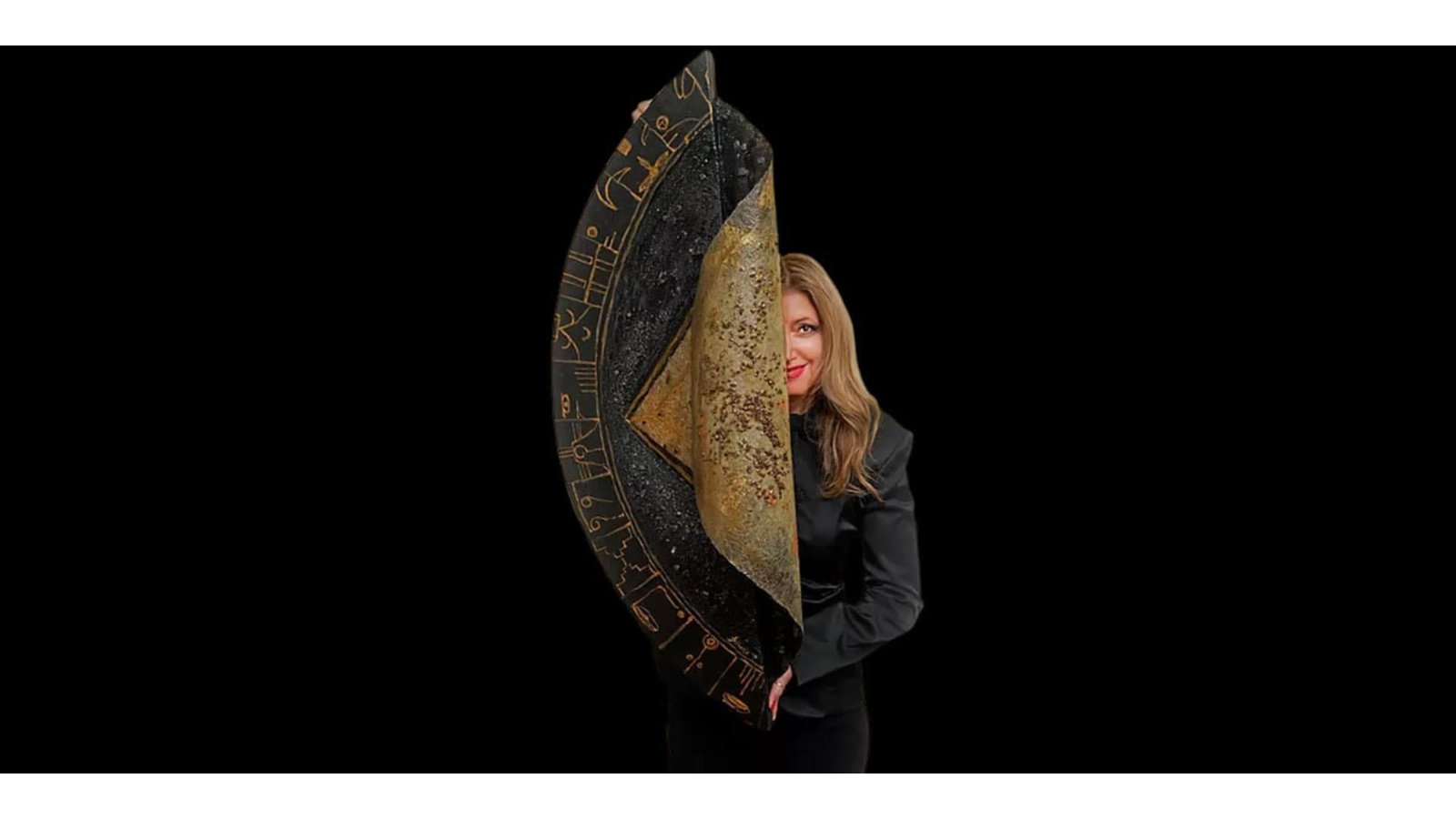
Giusy D'Arrigo is an Italian painter and sculptor born in Paris in 1970, where she trained in the city's art ateliers with French and later Roman artists before settling in Rome, where she lives and works today. Her practice spans painting, sculpture, art design, and functional art, and her work has been shown in galleries in Italy and abroad. In recent years she has focused her research on ecological sustainability and the protection of natural and human balance, including segments produced for Italian public broadcaster RAI on the creative reuse of materials.
Much of her work is bound to the memory of her brother, the free-flight world champion and explorer Angelo D'Arrigo, who died in 2006. She dedicated a traveling exhibition, "Metamorfosi," to him, showing in Buenos Aires, New York, Los Angeles, Milan, and Rome, presented her 2013 solo exhibition "Spiral Life" in New York, and wrote a book about his life, "Al di là delle nuvole (Sulle ali del mio Angelo)," published by Istituto Armando Curcio in 2022 and presented at the Italian Senate. She is the creator of the international Connessus program and its Neth sculpture, the cultural-diplomacy initiative that is the subject of this interview.
About Connessus
Connessus is an international cultural program that describes itself as an intercultural agora for the safeguard of humanity and its habitat. Its premise is that art and culture can rebuild a sense of shared purpose that constant digital connection has thinned, and its method is to create permanent public spaces, modeled on the ancient Greek agora, where citizens, artists, scientists, and students gather around questions of common concern. The initiative was created by the artist Giusy D'Arrigo, CEO of GDart Srl, with its development and future governance entrusted to the Italian admiral Paolo Russotto, CEO of the consultancy BMART Srl and Ambassador in Europe of the Connessus Project.
At the center of the program is the Neth, a twelve-meter sculpture whose name shares a root with the word nexus and means needle, and the movement built around it, NethArs, "the art of unity." A signature of the movement is that several artists collaborate on a single work. Each Neth is designed to stand at the heart of a public square, a Connessus Agora, alongside spaces for performance, events, and exhibition, and to run entirely on renewable energy so that it can be raised in almost any territory. Inside each sculpture sits a sealed steel compartment, a kind of message in a bottle, holding writings, drawings, and objects chosen by local young people and preserved for those who come later. The program intends to erect Neths across five continents, and its proportions, twelve meters of height, a three-meter base, four sides, and a seven-degree incline, are chosen to echo numbers and symbols shared across the Jewish, Christian, Muslim, and Buddhist traditions.
Author's note: This interview was conducted and edited by Angelica Sirotin, founder of Sirotin Intelligence, who serves as Connessus Ambassador for International Strategy and Expansion. Sirotin Intelligence is covering the initiative as part of its ongoing reporting on the Mediterranean.
Get exclusive insights from our network of NASA veterans, DARPA program managers, and space industry pioneers. Weekly. No jargon.