
"Going in Circles in Low Earth Orbit Is Not Going New Places": Space Policy Historian John Logsdon on Why Artemis Is Still About Leadership, What NASA Should Actually Be For, and Why He's Skeptical of the Helium-3 Story

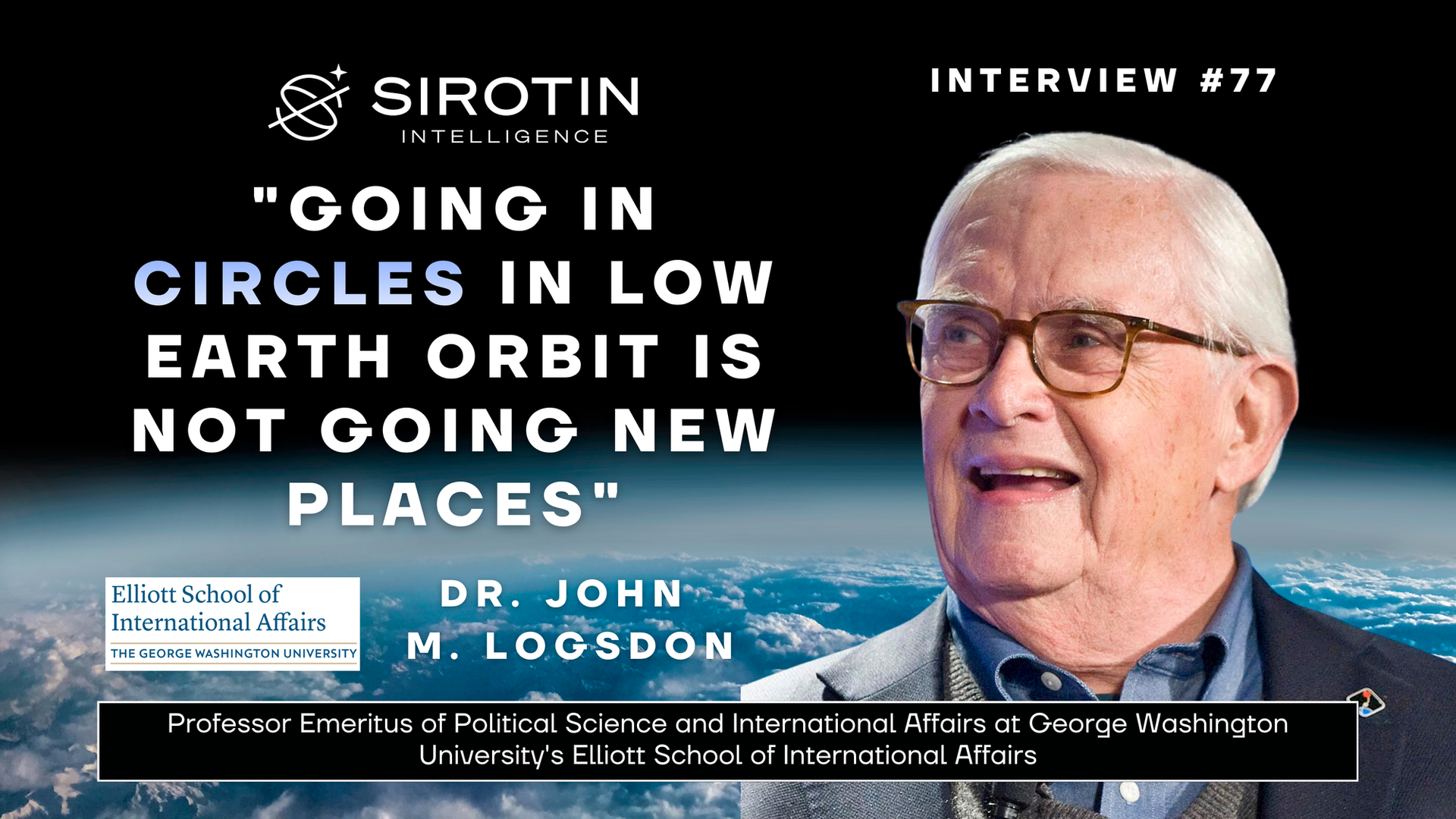
In October 1957, a 20-year-old physics student at Xavier University paid no attention to Sputnik. Four years later, when John F. Kennedy stood before Congress and committed the United States to landing a man on the Moon by the end of the decade, the same young man, now working as a technical writer in Manhattan, also paid no attention. The moment that pulled John Logsdon into what became his life's work was smaller and closer to the ground. In February 1962, he left his office, walked three blocks, and watched Vice President Lyndon Johnson parade John Glenn through midtown Manhattan after Glenn became the first American to orbit the Earth.
"I said, hey, this looks like pretty interesting stuff. I'd like to find out more about it," Logsdon recalls. By the fall of that year he had enrolled in a political science graduate program at NYU, where, by his own account, he turned every paper in every course into an excuse to write about space. The dissertation that came out of it, published in 1970 as The Decision to Go to the Moon, landed him a tenure-track position at George Washington University, where he spent the next 38 years and founded the Space Policy Institute in 1987. He served on the Columbia Accident Investigation Board, sat twice on the NASA Advisory Council, wrote three award-winning books on the Kennedy, Nixon, and Reagan administrations' space decisions, and edited the seven-volume Exploring the Unknown documentary history of the U.S. civil space program.
He is Professor Emeritus now. Artemis II had launched the week before our call, and the reaction had surprised him. That surprise was part of why I wanted to talk to him. The man who wrote the definitive account of why Kennedy chose the Moon had some things to say about why, in his view, we are going back.
You've spent more than six decades studying space policy. What actually pulled you into this field, and when did you know it would be your life's work?
Before the dissertation, before GW, before the seven-volume document series and the three presidential studies, there was a parade in Manhattan and a young man with a physics degree who had not yet figured out what he wanted to do with it.
Logsdon is careful to correct the obvious assumption. The Sputnik moment, so often invoked as the awakening of a generation, passed him by entirely. "When Sputnik went up in October 1957, I was about to turn 20, and I paid no attention to it," he says. "When Kennedy announced his decision to go to the Moon in May of 1961, I was four years older, and paid no attention to it either." I mentioned that I had heard something similar from Ambassador Henry Cooper, who often describes Sputnik as a wake-up moment for his generation. Logsdon shook his head. "I didn't pay any attention to it. It was not a Sputnik moment for me. It was not until 1962 and Glenn's flight that I was paying attention to space."
The Glenn parade gave the pivot a subject. He started at NYU in the fall of 1962 and focused his coursework on space issues from the first semester. Once he finished his comprehensive exams, he chose as his dissertation topic the foreign policy uses of the U.S. space program. The research kept pulling him back to one specific decision. "I realized the decision to go to the Moon was what I was really interested in," he says, "and so I focused the dissertation on Kennedy's decision." By the time the book came out in 1970, he had been invited to watch Apollo 11 from the Cape as part of the press corps, and a small policy group at GW had noticed his work. A tenure-track offer followed.
Apollo was shaped by a very specific Cold War competition. Artemis is launching into a different world. What, in your view, is Artemis actually for?
The week before we spoke, Artemis II had lifted off with a crew bound for lunar orbit. Logsdon had been watching the public response, and his first comment about it was that he had not expected it to be so intense. I asked him how much of the old Apollo logic still applies.
He is direct on the Apollo question, and he thinks Kennedy's motivation is routinely misread. "Lots of other justifications were invented for it after the fact," he says, "but the core reason that Kennedy chose to go to the Moon was he decided that space leadership was an important element of global leadership, and the United States had to be the global leader, and therefore had to be first in space." The memorandum Kennedy sent Vice President Johnson eight days after Yuri Gagarin's flight, asking him to identify a space effort the U.S. could win, is the document Logsdon returns to most often. The request was not for a scientific rationale. It was for a contest the country could be seen to win.
Artemis, in his reading, runs on a version of the same logic despite a very different geopolitical landscape. "It's a much different context, lots of countries active in space," he says. "But I think it's still a sign of national power and national vigor to be the leader in space achievement, and in particular in human space flight. So I think the fundamental reason that we are doing Artemis is to mark the United States as the leader in space, and by implication, the leader in the world."
I pushed on the word "leader." The U.S. Space Force had recently released its warfighting framework formally designating space as a warfighting domain. If leadership in space is the prize, does that necessarily include military dominance in orbit? Logsdon was careful to separate the two. "My meaning is broader," he said. "It is recognized by the general public and by the leaders of multiple countries as being the leader in space achievement, not something as specific as designating space as a warfighting area. It's being there, being visible. And I think that's what's so important about Artemis." The militarization of orbit is real and moving, but it is a separate story from the one that makes a crewed lunar mission land on the front page of every paper in the world.
What surprised him, and what he kept coming back to, was that the symbolism still works. He had expected the public response to Artemis II to be muted, the way most human spaceflight news has been received in the years since the Shuttle. It was not.
You served on the Columbia Accident Investigation Board in 2003 and argued that NASA's institutional culture contributed to the accident. Has the agency actually changed?
The CAIB's finding that NASA's internal culture was as much at fault as the foam strike that doomed STS-107 remains one of the more contentious legacies of the Shuttle era, and Logsdon's fingerprints are on the argument. I asked him whether the NASA he sees in 2026 is the NASA he and his fellow board members were critiquing in 2003.
His answer is measured. NASA is a meaningfully different organization now, and part of that difference is an institutional commitment to safety that has hardened since the Columbia finding, particularly where crewed missions are involved. The deeper shift, in his telling, is political. The public's tolerance for fatal accidents in spaceflight has collapsed. "Back in the 80s and 90s, and even in 2000, accidents were expected," he says. "It was viewed as a very risky thing. Challenger disintegrated. Columbia disintegrated. We didn't say, stop the program. We said, "What caused that, and let's fix it."
A comparable accident today would not produce a comparable response. That change in the political environment is part of what is driving NASA's internal caution, and Logsdon treats it as both a genuine improvement and a new source of pressure. An exploration program operating under zero-tolerance expectations is harder to run than one operating under the assumptions of the Shuttle era, and the Artemis era will test whether the agency's current processes hold under that kind of weight.
NASA doesn't do just one thing. With the commercial sector taking on more and more, what should the agency actually focus on?
I asked this because the question of NASA's relevance has become one of those debates where everyone seems to be arguing a different premise, and I wanted Logsdon to set his own terms.
He did, and the first thing he did was refuse the framing. "NASA doesn't do one thing, and so you have to unpack the question," he said. "Do we still need NASA? My answer is yes." The case rests on two functions that nobody else is positioned to perform. The first is exploration, which he defines tightly enough to exclude most of what the public associates with the agency. "Exploration is going new places to learn new things," he says. "The space station program is not exploration. Going in circles in low Earth orbit is not going to new places." That definition draws a working boundary around where he thinks the agency's irreplaceable value sits. The International Space Station, by that standard, is on the wrong side of the line, regardless of its scientific output.
When I asked him to define exploration further, his answer surprised me with how concrete it was. "The purpose of exploration is to gain new knowledge to answer questions," he said. "Are we alone? Can we live in other places? Are there resources in space that are economically viable? Is space presence essential to military power? Those are the questions we don't really have the answers to." Four questions, and he was specific about not knowing how any of them resolve. Two of them, as became clear later in the conversation, he doubts will resolve in his lifetime at all. The framing also flagged something about his vocabulary. He does not use the word "colony" when talking about off-Earth settlement. "I don't like the word colony," he said, almost in passing. He prefers "outposts." It is the kind of word choice that carries more weight than it sounds like, given that he has spent decades around people who use both terms loosely.
The second function is the basic research and technology development that private companies rarely find economically justifiable on their own. "Since World War II, a role for the government has been to make early investments in various areas of technology and then turn it over to the private sector for development," he says. "Nobody else is going to do it. The return on investment for an individual company is not great enough to justify the investments needed to advance the capabilities."
What should NASA stop owning? Commercialization and military applications, both of which, in his view, belong to other actors. "If there are economic or military payoffs from being in space, I don't think NASA is the organization to pursue them," he says. "It's the private sector, the defense community, but not NASA." The agency's job is the early exploration of the solar system with humans, and the exploration of the broader universe with instruments like James Webb and the forthcoming Nancy Grace Roman Space Telescope. No private actor will fund those at the necessary scale, and no military service has the mandate.
I asked whether that means the current framing of NASA-versus-SpaceX, which dominates most of the coverage I read, is asking the wrong question. He did not quite answer directly, but his earlier sentences made the answer clear. An agency whose job is the things markets will not price and militaries will not prioritize cannot be in competition with a company whose job is to move mass to orbit at a profit. They are operating on different problems.
Every headline these days calls this "Space Race 2.0." Is that a useful frame, or is it simplifying something that doesn't fit the old model?
This is the question I was most curious to hear him answer, because the phrase has become almost automatic in coverage of U.S.-China space competition, and if anyone has earned the right to tell the press to stop using it, Logsdon has.
He gave it partial credit, and then he took it apart. "In terms of public understanding of what's going on, I think it's probably helpful," he said, "because the general public likes races, likes competitions, likes winners and losers."As a description of what is actually happening, though, he thinks it does not work. "I don't think there's a finish line. So it can't be a race. It is an ongoing competition for market share, if you wish, of space achievement."
That distinction matters more than it sounds like it does. A race has an endpoint. Apollo had one. The whole point of Kennedy's framing was that a contest with a finish line could be won, and then, in a political sense, ended. What Logsdon is describing is structurally different. A sustained competition across a growing domain, with two leading powers, a number of middle players wanting their share, and no defined moment at which anyone wins. Planning for a contest with an exit and planning for a contest without one are not the same exercise.
I asked him about China's announced ambition to land a crew on the Moon by 2030, which is the milestone everyone points to when they want to make the race framing feel real. Logsdon did not dismiss it and did not dramatize it. China's lunar program is serious, the timeline is aggressive, and whether they meet it or slip it by a year or three is worth tracking. What he was not willing to do was treat a second country's landing as the kind of event that settles anything. "It is an ongoing competition," he said again. A Chinese landing in 2030 would be a data point in that competition, not the end of it. The harder question for U.S. planners is what the United States is doing in the same domain ten years after that.
What actually makes a space program, or a space company, successful? Is there a pattern?
I asked this knowing Logsdon would probably give me a one-word answer, because he had already used the word earlier in the conversation without quite noticing.
"Focus," he said. "There are very few countries and very few private sector entities that have the resources to do a comprehensive space program. So countries and companies have to decide what they want to do." The example he reached for was SpaceX, and what he said about it was sharper than the usual commentary. Strip away the Mars rhetoric, he argued, and the actual company is narrower and more disciplined than its own marketing suggests. "If you look at what SpaceX actually does, it's pretty focused," he said. "We're going to get a reusable rocket and revolutionize space transportation. And once we've done that, we're going to create a global communication system that can be used by everybody. You've got Elon and all his rhetoric about cities on Mars. But if you look at what SpaceX actually does, it's pretty focused." Two problems, in sequence. The interplanetary vision is a marketing layer sitting on top of an operational strategy that is much more constrained.
I noted that focus is easy to say and hard to execute, and that most of the people I interview say the same thing about themselves. He laughed. "The path to failure is trying to do too much with too little." It is true, in his telling, at every level he has watched. Countries that announce comprehensive space ambitions without matching resources, startups that chase every revenue stream at once, agencies that try to be everything to everyone all run into the same wall.
You've said you're a skeptic on the economic payoffs of space activity beyond Earth orbit. What do you mean by that?
Logsdon raised this himself, almost as an aside, near the end of our conversation. I had told him I was out of questions and asked if there was anything else he wanted to bring up. He paused for a second and then said, "Well, not really, except I'm a skeptic on the economic payoffs of space activity beyond Earth orbit." I stopped him and asked him to tell me about that.
He drew the line carefully. Communications satellites, Earth observation, the established commercial activities in low Earth orbit: those have produced real economic returns and he has no argument with any of them. What he does not believe in, at least not within any timeframe that matters to the people currently raising money against it, is the cislunar economy that a growing part of the industry is building its narratives around. "Helium-3 to fuel reactors that don't exist," he said. "Extracting water on the Moon to turn into rocket fuel. Establishing large outposts of human presence on the Moon and beyond. I'm very skeptical that within any relevant lifetime, any of those possibilities will become real." He paused and added, "Visions excite people. I'm not sure there's any substance behind the visions."
I asked him why so much of the public conversation treats these propositions as near-term. "People want it to be true," he said. "There is a certain segment of the population with visions of the future that include activity not only on Earth but other places in the solar system and eventually beyond. And those people, in a sense, preach a gospel that all these wonderful things are there for the taking, if only we pay for it." He is not arguing the visions are impossible. He is arguing the gap between the vision and the engineering is much larger than the marketing suggests, and that the timelines being quoted bear no resemblance to what would actually be required to close it.
Then he said the line that stayed with me longest. "I'd love to be wrong. I'd love it if space exploration leads to productive space exploitation, and if there gets to be a space economy beyond Earth orbit. But I'm skeptical."
I told him about two recent interviews on opposite sides of the question. The first was with a mining engineer who has spent decades running actual extraction operations on Earth, and who told me the most significant progress humanity has made toward mining the Moon is a nine-inch hole, after which the drill broke. The second was with an entrepreneur who is openly building what he calls a helium-3 value chain, mapping out how the resource would move from lunar regolith to terrestrial reactors. I told Logsdon I find it useful to put the skeptics and the believers next to each other and let the reader decide where the weight lies. He laughed and said I should try to get Harrison "Jack" Schmitt, the Apollo 17 geologist-astronaut, on record. "He's kind of the evangelist of helium-3," Logsdon said. "Asking him now where he thinks we're at with helium-3 would be interesting." It was the historian's instinct showing through. Test the strongest version of a proposition by asking its strongest advocate to defend the timeline.
What would you tell someone in their twenties who wants to contribute to the space field but doesn't know where to start?
Logsdon answered this one twice. First with a story about his grandson, a freshman at Ohio State studying aerospace engineering, whom he described as entirely captured by Artemis II. "He's oriented his studies to understanding the space domain, getting prepared to work in it," Logsdon said. "The degree he's gotten captured by the space program is surprising, even to me." That detail cuts against the assumption that younger generations have tuned out on human spaceflight, and it carried more weight coming from a grandfather than it would have from a press release.
The structural answer is less sentimental. "The key to the future is being good at something," he said. Get a specialty first. Develop a strategic vision for what you want to do with it. If your specialty happens to intersect with space, follow that intersection into the sector and make your impact there. "Follow your desires and follow your emotions, follow your capabilities and choose the space sector as the place to make your impact." The order matters. Logsdon's own path came through a physics degree and a political science PhD before anything like a space policy program existed, and he is the proof of his own advice. The people who do the most useful work in this field almost always arrive with a skill they trained for elsewhere.
Author's Analysis
What would it take for the space industry to admit that some of the things it is selling are not going to happen on any timeline that matters? That is the question Logsdon answered without anyone asking it, in the last five minutes of our call, after I had already told him I was out of questions.
Here is what makes his position unusual. Earlier in the conversation, when I asked him to define exploration, he gave me four questions. Are we alone? Can we live in other places? Are there resources in space that are economically viable? Is space presence essential to military power? The first three, he said, are the questions NASA exists to answer. The fourth belongs to the Space Force. By the end of the conversation he had told me, in a different framing, that he does not expect two of those questions to resolve in any lifetime that matters. The agency he wants to keep funding is defined by a set of open questions, and the historian most associated with describing that agency cannot bring himself to say the answers are coming.
The tension is the most interesting thing in the interview, and it is the thing nobody in the field will say out loud. Logsdon is not a contrarian. He thinks Artemis is important. He thinks the symbolism still works, and the intensity of the public response to Artemis II surprised even him. He is not a man looking for reasons to doubt. He is a man who has spent six decades watching how often the industry's economic projections have outrun the engineering, and how rarely the engineering has caught up.
Somewhere between "we are going back to the Moon because national leadership still matters" and "we are going back to the Moon because there is a trillion-dollar economy waiting up there" is the honest answer. Logsdon, in retirement, will tell you which one he believes. So who else, while still inside the rooms where the decisions are being made and the rounds are being raised, is willing to say it on the record?
About John M. Logsdon
Dr. John M. Logsdon is Professor Emeritus of Political Science and International Affairs at George Washington University's Elliott School of International Affairs, where he served on the faculty for 38 years. He founded the Space Policy Institute at GW in 1987 and served as its longtime director. He also directed the Elliott School's Center for International Science and Technology Policy from 1983 to 2001, taught at the International Space University from 1988 to 2020, and held the Charles A. Lindbergh Chair in Aerospace History at the Smithsonian Institution National Air and Space Museum in 2008-2009. He holds a B.S. in Physics from Xavier University and a Ph.D. in Political Science from New York University.
His books include The Decision to Go to the Moon: Project Apollo and the National Interest (1970), John F. Kennedy and the Race to the Moon (2010), After Apollo? Richard Nixon and the American Space Program (2015), and Ronald Reagan and the Space Frontier (2019). The three presidential studies collectively won three Gardner-Lasser Aerospace History Awards from the AIAA and two Eugene M. Emme Astronautical Literature Awards from the American Astronautical Society. He is also the general editor of the seven-volume Exploring the Unknown documentary history of the U.S. civil space program and edited the Penguin Book of Outer Space Exploration (2018).
In 2003 he served as a member of the Columbia Accident Investigation Board. He sat on the NASA Advisory Council from 1998 to 2001 and again from 2005 to 2009. He holds NASA's Exceptional Public Service, Distinguished Public Service, and Public Service Medals, the 2005 John F. Kennedy Astronautics Award from the AAS, the 2006 Barry Goldwater Space Educator Award from the AIAA, the 2013 Frank Malina Space Educator Award from the International Astronautical Federation, and the 2019 Ordway Award for Sustained Excellence in Spaceflight History. He is a Fellow of the AIAA, AAS, and AAAS, and a member of the International Academy of Astronautics, where he formerly chaired the Commission on Space Policy, Law, and Economics. He was the founding North American editor of the journal Space Policy.
Get exclusive insights from our network of NASA veterans, DARPA program managers, and space industry pioneers. Weekly. No jargon.