
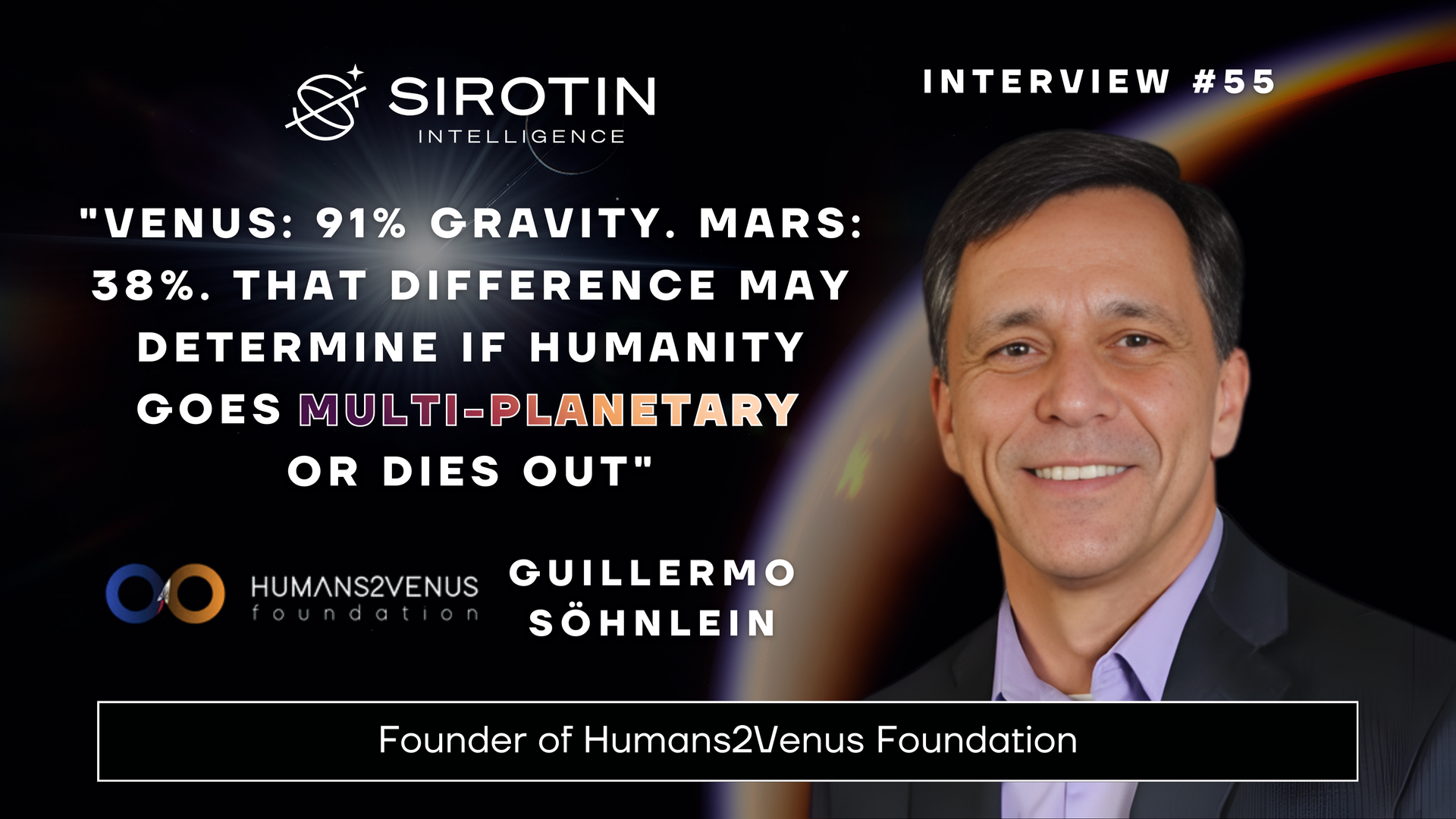
"Venus: 91% Gravity. Mars: 38%. That Difference May Determine If Humanity Goes Multi-Planetary or Dies Out": Guillermo Söhnlein, OceanGate Co-Founder & Humans2Venus Founder, on Venus Settlement, Extreme Environments, and Off-World Governance

Fifty kilometers above the surface of Venus, the sky is yellow. Sulfuric acid clouds drift below you, lit from beneath by the dim glow of a planet hot enough to melt lead. The pressure outside your habitat matches sea level on Earth. The temperature hovers around 25°C. You weigh almost exactly what you would in Los Angeles or London. And if you look up, through the haze and toward the stars, you can see the pale blue dot where your species began.
This is not science fiction. In 1915, the Soviet Vega 1 and Vega 2 missions deployed helium balloons that drifted for more than 46 hours at this altitude, traveling roughly one-third of the way around the planet before their batteries died. They remain the only aircraft ever flown in another world's atmosphere. The engineering is difficult. The engineering is not impossible.
Guillermo Söhnlein wants to put a thousand people there by 2050.
The co-founder of OceanGate and founder of the Humans2Venus Foundation, Söhnlein has spent his career at the intersection of extreme environments and human ambition. His focus on Venus seems counterintuitive: the planet's surface hosts temperatures exceeding 450°C and pressure ninety times that of Earth. But that crushing hellscape exists below the clouds. Above them, in what Söhnlein calls the "Goldilocks zone," Venus offers something Mars cannot: gravity at 0.907g versus Mars at just 0.377g.
That difference may determine whether humanity becomes a multi-planetary species or merely a species that visited other planets before dying out. No human has conceived, carried a pregnancy to term, or raised a child off-planet. Research suggests that reduced gravity impairs the conditions needed for implantation and maintaining pregnancy. Mars offers only 38% of Earth's gravitational pull, raising questions about whether multiple generations could even develop normally there. Venus's near-Earth gravity eliminates this problem, though it introduces others: sulfuric acid, an unbreathable atmosphere, and the engineering challenge of maintaining permanent floating habitats.
You co-founded OceanGate with Stockton Rush before stepping away years ahead of the Titan incident. Now you're focused on Venus exploration, including concepts for floating habitats at fifty kilometers altitude. What draws you to these extreme environments, and why do you see them as viable for human activity?
"It's not so much that I get drawn to the extreme environment," Söhnlein clarifies. "It's that I'm one of these people that since I was a kid, since I was eleven years old, I've thought that humanity was going to be a multi-planetary species, and I've done whatever I could to help push that along."
The extreme environments follow as consequence rather than motivation. If humanity intends to exist beyond Earth, extreme conditions become unavoidable. "It just happens that if humanity is going to be a multi-planetary species, by definition, we're going to be existing in extreme environments."
The chronology matters here. Söhnlein had already spent seven or eight years in space-related work before co-founding OceanGate. He met Stockton Rush through space circles, not ocean exploration. His four years as OceanGate CEO functioned almost as a sabbatical from space work. After departing in 2013, he returned to space advocacy and was already advancing the Venus initiative when the Titan incident occurred in 2023. The past two and a half years have drawn him back into ocean-related discussions while he continues the Venus work in parallel.
The path to this point began with a childhood dream. "I had a recurring dream that I was the commander of the first human settlement on Mars, and that pushed me to want to be an astronaut." From age eleven to nineteen, that trajectory seemed clear. Then his eyesight degraded from perfect to 20/40, disqualifying him from military flight training and, by extension, from the NASA astronaut pipeline he had envisioned.
"At age nineteen, my entire world fell apart." What followed was a period of recalibration: an economics degree, work at a law firm, law school, four years in the Marine Corps, then a tech startup in Silicon Valley during the internet boom. That startup launched a twenty-five-year entrepreneurial career spanning more than a dozen ventures.
Looking back, Söhnlein sees connections that weren't apparent at the time. "If we're setting up a new permanent human presence, let's say in the Venusian atmosphere or on the Martian surface, we are going to have to figure out what kind of legal system those societies are going to have. So that's where my law school comes in. We're going to have to figure out what kind of economic system we're going to have. That's where my economics degree comes in." The micro-careers that seemed unrelated have converged on the question of establishing permanent human presence off-planet.
You mentioned legal and economic systems for off-world settlements. Since that's your background, how does one go about structuring governance on Venus?
Söhnlein begins with a premise that reframes the question. "If we're talking about making humanity a multi-planetary species, we're really talking about going beyond low Earth orbit and the moon." In his view, the moon functions as part of the Earth-Moon system, close enough to remain economically and politically tethered to terrestrial institutions. The designation of the moon as "the eighth continent" captures this relationship.
Mars and Venus present fundamentally different circumstances. "When you think about how far away those two planets are, the thought of expanding Earth institutions just doesn't make sense." Initial expeditions might carry national flags and operate under terrestrial authority, but Söhnlein sees this as temporary. "They're so far away that Venusians are going to be Venusians, and Martians are going to be Martians, and they're going to have to figure out how everything works" … for them.
This leads to what he acknowledges is philosophical territory. Off-world communities represent something close to blank slates, though constrained by both human nature and environmental conditions. "Knowing everything that we know about human history and Homo sapien species, if we could start with a blank slate, what would we do? How would we set it up?"
His answer challenges assumptions common among Americans and Westerners. "When Americans or Westerners think about a human colony on Mars, I think they view it as a democracy." Söhnlein does not share this expectation. "Homo sapiens are probably centuries away from making space safe enough to afford the luxury of democracy."
His reasoning draws on his experience leading underwater expeditions into extreme environments. Managing risk requires minimizing complexity. "We've never even had it in LEO. I can't think of any space mission at all that Americans have participated in that have been executed under democratic principles. There's no democratically elected Governor of the ISS right now."
This observation is factually grounded. The International Space Station operates under a three-tier legal framework established by the 1991 Intergovernmental Agreement, which extends each partner nation's jurisdiction over its own modules but establishes hierarchical command structures for operations. A Code of Conduct requires crewmembers to comply with the ISS Commander's orders and ground control directives. Decisions about resource allocation, scheduling, and safety flow through designated authority, not deliberation.
The same logic extends to economic organization. "I don't see us having free market capitalism off-planet. I don't see us having a concept of private property on Mars or Venus. It's just going to be too problematic and too difficult to create."
Consider religion. "Would you allow religion? If you do allow it, which religion or how many religions? It would almost be easier to not allow religion or to go the other extreme and make the thousand people in Venus a theocracy." The reasoning is operational rather than ideological: minimizing variables that could generate conflict in environments where conflict threatens everyone's survival.
"If we have a thousand people living on a floating habitat in Venus or on a Martian colony on the Martian surface, one individual exercising their right to personal freedom could potentially kill the other 999."
Söhnlein acknowledges that these conversations proceed more slowly than engineering discussions, even though they may prove more consequential. "Everyone's focused on how we're going to get there and how we're going to keep us alive there. But the greater questions are, how are we going to get there and keep ourselves from killing each other?"
Your Humans2Venus Foundation proposes long-term human presence in Venus's upper atmosphere, dealing with pressure, heat, and sulfuric acid. What makes this pathway more practical than Mars or the Moon?
"First of all, I don't think it's an either-or thing," Söhnlein emphasizes. "Humanity needs to establish an expanded presence in low Earth orbit. We need to go back to the moon and set up an expanded presence on the moon. And we need to go to the surface of Mars, and we need to go to the Venusian atmosphere. I think we need to do all of it, and I think we have the capacity to do all of it."
With that framing established, he offers a one-word answer for Venus's advantage: gravity.
"When you think about setting up an off-planet presence and making humanity a multi-planetary species, it means we have to be multi-generational, which means, by definition, we have to be able to reproduce." This is where he distinguishes between the moon, which he views as part of the Earth system, and true off-world settlement. "No one's going to go to the moon and have babies. It's only three days away, so we're going to have babies here, and then we're going to go to the moon and then come back."
Mars presents a different challenge. Humans will need to reproduce there, but no one knows if they can. "Right now we don't know if Homo sapiens can reproduce in less than 1g of gravity." Gravity is the one environmental factor humans cannot control or replicate on a planetary surface. Mars offers only 38% of Earth's gravity, and there is only one way to determine whether humans can reproduce and develop normally under those conditions: conduct the experiment.
"We need to send humans to the surface of Mars. They need to conceive. They need to carry a fetus to term. They need to deliver a baby with no birth defects. That baby needs to grow into adulthood, and then that baby needs to repeat the whole process again with another Martian-born Homo sapien." Until the second generation completes this cycle, the viability of Martian settlement remains uncertain. "We could be going to Mars and then die out within a generation." (For readers interested in the current state of space reproduction research, a 2019 review in Nature Reviews Endocrinology documents significant concerns including disrupted estrous cycling and impaired pregnancy outcomes in rodent studies.)
This uncertainty led Söhnlein to examine Venus more closely five years ago. The planet's similar size and mass to Earth provides 91% of Earth's gravity. "But I knew five years ago what everyone knows. We're never going to land on Venus's surface. The pressure is too high and the temperature is too high." (The NASA Venus Fact Sheet records surface pressure at 92 bars and temperature at 737 K - 464°C, hot enough to melt lead and zinc.)
Then he discovered what Soviet Venera mission data had revealed decades earlier. Between fifty and sixty kilometers above the Venusian surface exists a zone where conditions approach those of Earth. "The pressure is one atmosphere and temperature is roughly 25 centigrade." According to measurements by the Magellan and Venus Express probes, the altitude from 52.5 to 54 km has a temperature between 20°C and 37°C, with pressure matching Earth's sea level at around 49.5 km. Combined with Venus's near-Earth gravity and sufficient atmospheric thickness above to provide radiation protection, this altitude band offers conditions surprisingly suited to human habitation.
The remaining challenges involve the carbon dioxide atmosphere and sulfuric acid clouds. "The good news about those two is that we currently have technologies that can deal with both of those. We know how to convert CO2 into breathable air, and we have materials that are resistant to sulfuric acid." Unlike artificial gravity or faster-than-light travel, the required technologies already exist. "We could theoretically go tomorrow."
Why does Venus receive so little attention compared to Mars and the Moon?
Söhnlein laughs at the question because he asked himself the same thing five years ago. "It turns out that a lot of people are looking at this, and have looked at this, even NASA has looked at this." The work happens in silos, though, with researchers and advocates scattered across institutions and countries without coordination.
This fragmentation motivated the creation of the Humans2Venus Foundation. Beyond its public mission of promoting Venus science and education, the foundation curates a global community of roughly 300 people focused on Venus settlement. "Our goal is to get Venus into the general public dialog a lot more, so that when you go to a space conference and there's a panel about the moon, Mars and beyond, it becomes a panel about moon, Mars, Venus and beyond."
Progress has been incremental. Speaking engagements and conference panels focused on Venus have increased over the past year. Söhnlein expects 2026 to represent a breakthrough year for public awareness.
The primary obstacle is institutional momentum, particularly at NASA. "NASA is such a big 800-pound gorilla on the global stage that wherever NASA is pointed, that's where everyone else is facing." Two decades ago, NASA found a narrative that resonated with congressional funders: moon, Mars, and beyond. That framing has driven priorities ever since. "If anybody starts bringing in Venus, that's going to throw off all of congressional support for NASA."
This could change. The current administration is, as Söhnlein puts it, "rewriting the rule books on everything," and a new NASA administrator may be willing to consider different approaches. Over the next few years, a shift in NASA's orientation could influence space agencies and research priorities globally.
Söhnlein is also working on a book tentatively titled Marketing Venus - Volume 1, scheduled for publication in 2026. The project compiles insights from five years of conversations with Venus experts worldwide, aiming to increase public awareness and drive scientific research, technology development, and investment toward Venus exploration.
What lessons from OceanGate are guiding your approach to Venus missions, especially when operating in hostile environments?
Söhnlein reframes the question. Viewing the Titan incident narrowly as a crewed submersible event limits its applicability. Only about a dozen submersibles worldwide can dive deeper than 1,000 meters, and Titan was rated to 4,000 meters, approaching the ocean's average depth of 4,500 meters. The submersible world is exceptionally niche.
"However, Titan was, at its core, an innovative new design of a human transportation system." Viewed this way, the category expands to include autonomous vehicles, supersonic business jets, stratospheric balloons, and electric vertical takeoff and landing aircraft. The Venus context is instructive here: NASA's HAVOC study proposed a 129-meter-long airship capable of supporting a crew of two at 50 km altitude for 30 days, with the total mission time of 440 days including transit. Any such vehicle would represent exactly the kind of "innovative new design of a human transportation system" Söhnlein describes.
One lesson concerns corporate governance. "For human transportation systems, when you are in the business of creating disruptive innovations for human transportation systems, you go through a technology development cycle." At some point, by definition, the cycle requires placing a human into the technology. "That moment when you put that first human into the technology, you are exposing the company to a lot of risk."
The risk extends beyond the test subject. After the Titan incident, OceanGate ceased operations. The company exists now only to manage ongoing investigations and lawsuits. From a shareholder perspective, the company is effectively gone.
"One of the critiques was that OceanGate put humans into a sub before the sub was ready for humans." Söhnlein believes that decision, given its implications for company survival, should not rest with a CEO alone. "I think it should be a board decision. I think the board of directors should make that kind of decision."
He applies this reasoning to other ventures. "If I was Elon, and I'm testing Starship, at some point I got to put humans on that rocket. I wouldn't want to make that decision. I'd want to take it to the board and say, look, here's the testing protocols we've done, here's the program we've done, here's the data. I believe that we're ready. Here's what my engineering team thinks, here's what my ops team thinks. But I think we're ready. What do you guys think?"
The board might agree. Or it might request an independent evaluation. Either way, distributing that decision reduces the risk of any single person's judgment error destroying both lives and the company. "You run the risk of not only killing a human, but you could also kill the company." Additional lessons involve crisis management and communications, though Söhnlein considers those more specific to the submersible world.
Investors have become more cautious after the SPAC downturn. How do you make the case for ventures focused on extreme environments like Venus? Who's showing real interest?
Söhnlein responds with an anecdote. Twenty years ago, he spoke with someone planning a space elevator, a project estimated at $3 trillion over fifty years. The question was how to attract investors for something that massive and distant.
"One of the things that we talked about was, instead of looking at this as one company that's trying to build a space elevator, why not look at it as a whole ecosystem of companies and organizations that are going to build the different component capabilities, technologies and capabilities that you're going to need over the next thirty, forty, or fifty years, and start with the ones that can make money today, or that are fundable today."
This systems approach now guides the Venus initiative. The founding vision of 1,000 people in the Venusian atmosphere by 2050 is aspirational, "a line in the sand to draw toward." Working backward reveals intermediate requirements.
One requirement is better scientific understanding of Venus. "We don't know that much about the planet, so we're going to need a lot more science missions." Hence, a nonprofit focused on promoting Venus science. Another requirement is a generation that considers Venus settlement plausible rather than fantastical. The students who might arrive at Venus in 2050 are currently in grade school. "We were going to need students to grow up thinking about Venus." Hence, Venus education programs.
"Funding Venus science and Venus education programs is something that's relatively easily done today. We don't have to worry about this craziness of having people in the Venusian atmosphere, having floating cities."
No company could secure funding today to own and operate a floating research station in the Venusian atmosphere within the next decade. The approach instead involves building blocks. Over the coming year, Humans2Venus Foundation will unveil additional pieces: a family of related companies and organizations assembling capabilities in ways that attract funding now for something that becomes reality in two or three decades.
The logic parallels what Elon Musk executed with SpaceX. Bob Zubrin's The Case for Mars inspired Musk, who recognized that transportation represented the primary bottleneck. Improving the transportation system enough to reach Mars would also generate revenue in the near term. "You end up with SpaceX. You end up with Falcon 1 and Falcon 9 and Falcon Heavy and Starship." Systems thinking identifies components that can make money and attract investment today while advancing toward a long-term objective.
You've worked in two of the most dangerous frontiers: deep ocean and space. What motivates you to pursue these extreme missions, and how do you distinguish bold exploration from unacceptable risk-taking?
Söhnlein offers another anecdote. He views Homo sapiens as an animal species, and the best lens for understanding human expansion off-planet comes from observing other species on Earth. His preferred analogies are ant colonies and beehives.
Both are run by queens. When conditions are favorable, the vast majority of the colony or hive stays put. They work on maintenance and resource gathering. Venturing out makes no sense when safety, food, and protection are assured. "However, the Queen instinctively knows that at some point she may have to move the colony or hive, and she knows that when that moment comes, she can't do it blind."
So the queen sends out perhaps one percent of the population to explore. They scatter in all directions, gathering information about what lies beyond the next tree or over the next hill. Most die. Enough return to provide intelligence for potential migration.
"I think that one percent of the ants or the bees are almost genetically wired to explore. If you told them to just stay in the hive or the colony and work on the hive or the colony, they'd probably go nuts."
Söhnlein suspects humans operate similarly. When circumstances are comfortable, the natural instinct is to stay put. "We're averse to risk. We're averse to change. If we're in a valley that's providing us protection from the elements and clean drinking water and food, there's no reason for us to move."
Yet some percentage of humans feel compelled to explore regardless. "We're genetically wired to want to go outside the valley, go over the hill, go around the bend and see what's there, even though we know that's risky and we could die doing it." They may not understand why they feel this compulsion. Many explorers rationalize it with socially acceptable explanations, like advancing scientific knowledge or protecting the planet. "But deep down inside, we don't know why we do it. It's just how we're wired."
This framing rejects the characterization of explorers as thrill-seekers or reckless risk-takers. "Some of the best explorers I know are very risk averse, but we're better at managing risk and getting comfortable with risk." Distinguishing bold exploration from unacceptable risk-taking involves judgment about preparation and probability. It is not the impulse that differs but the execution.
Author's Analysis
Democracy emerged on Earth over millennia, through trial and considerable bloodshed. It survived because the worst outcome of political conflict was generally not the death of everyone involved. A bad election might cause suffering, but rarely extinction. Off-world, the math changes. When a habitat maintains pressure against vacuum, the freedom to dissent, to protest, to withdraw cooperation, becomes harder to exercise when dissent might kill everyone breathing the same air.
Three scenarios for 2075:
Scenario 1: Venus First
The gravity research came back conclusive in 2031. Mice conceived at 38% gravity developed spinal deformities; none survived to reproduce. Mars settlement, already underway, pivoted to research outposts staffed by rotating crews who would never have children there. Venus became the focus.
By 2075, three floating habitats house 400 people above the clouds. Governance evolved through necessity: the first habitat nearly failed when a faction dispute over resource allocation escalated into work stoppages that threatened atmospheric processing. The survivors wrote a charter that looks nothing like any Earth constitution. Decisions flow through technical councils with override authority during emergencies, which, fifty kilometers above a planet that melts lead, means most of the time. Critics call it authoritarian. Residents call it breathing.
The first generation born there (now in their twenties) have never seen Earth's blue sky, but their bones are strong enough to visit. Some have. They describe Earth as overwhelming, chaotic, and wasteful. They do not understand why anyone would tolerate a system where a corrupt leader could remain in power for years. In the clouds, incompetence kills fast enough to be self-correcting.
Scenario 2: Mars Anyway
The billionaires won. Mars had momentum, narrative, and sunk costs. The gravity research was disputed, funded by competing studies, then quietly classified as a problem for future generations. By 2075, Musk City holds 12,000 people.
The reproduction problem found a workaround. Natural conception proved difficult at 38% gravity, and children who survived gestation developed skeletal abnormalities that worsened with each generation. But biotech adapted: artificial wombs with centrifugal gravity simulation, embryos gestated at 1g, then gradually acclimated to Martian conditions after birth. The children are healthy enough, though they require a pharmaceutical regimen dependent on supply chains stretching back to Earth. Some ethicists call them the first post-natural humans. The Martians themselves have stopped engaging with the debate.
Governance fractured early. Corporate founders wanted efficiency; colonists wanted representation; Earth governments wanted jurisdiction. The compromise pleased no one. Three legal systems now operate in overlapping territory, enforcement depending on which security contractor you encounter. Corruption thrives in the gaps – water rights, hab allocation, access to the reproductive clinics. A class system emerged: original colonists and later arrivals, return tickets and lifers, the naturally born and the centrifuge children.
Scenario 3: Neither
The 2030s brought wars, pandemics, and political collapse. Space budgets evaporated. The ISS deorbited in 2031, and nothing replaced it. The species that had begun reaching for other worlds turned inward, toward older conflicts over water, land, and food.
By 2075, the moon hosts a Chinese military installation and three corporate mining operations that answer to no flag. Governance there is simple: the company owns the habitat, the company makes the rules, the company decides who breathes. Workers sign contracts that would be illegal in any Earth jurisdiction. Some call it exploitation. Others call it the only job that pays enough to matter. Nobody calls it a civilization.
Mars and Venus remain as they were in 1975: distant, dead, and irrelevant to the humans fighting over aquifer rights in what used to be California. Söhnlein's foundation closed in 2034, three years after he died in a submarine accident that felt, to those who remembered, like history rhyming. Nobody remembers the Goldilocks zone. The species that couldn't govern itself well enough to survive on one planet never got the chance to fail on another.
Which scenario satisfies Söhnlein's stated mission of making humanity multi-planetary? The first and second, though the second requires redefining what "human" means when reproduction depends on industrial intervention. Which aligns with current funding and public attention? The second. Which matches historical precedent for how civilizations handle long-term existential planning? The third.
This leaves questions worth sitting with: What would it take to shift resources from a destination with narrative momentum to one with biological viability? If the gravity research confirms Söhnlein's thesis, how long before that information changes behavior, and who bears the cost of the delay? Can a species that struggles to coordinate on climate change coordinate on something harder, slower, and further away?
The floating cities of Venus, if they ever exist, will answer these questions with their lives.
About Guillermo Söhnlein
Guillermo Söhnlein is the author of Titan Unfinished: An Untold Story of Exploration, Innovation, and the OceanGate Tragedy. He is also founder of the Humans2Venus Foundation, an international nonprofit organization that supports Venus science and education programs with a long-term vision of establishing a permanent human presence of 1,000 in the Venusian atmosphere by 2050.
Over the course of a 25+-year entrepreneurial career that started in Silicon Valley during the height of the Internet Boom, Guillermo has helped launch more than a dozen for-profit ventures and nonprofit organizations. Prior and current startups include the International Association of Space Entrepreneurs in 2003, Space Angels Network in 2006, OceanGate in 2009, Humans2Venus Foundation in 2020, Fortivo Music in 2022, Space Bridge Partners in 2023, Gaia Venture Studios in 2024, and Venus Vanguard in 2025. He serves on multiple boards and advises two seed-stage space-focused venture capital funds.
A former officer in the US Marine Corps, Guillermo was admitted to The Explorers Club in 2012 after organizing and leading six ocean exploration expeditions using crewed submersibles. He earned his AB in Economics from the University of California at Berkeley and his JD from the University of California San Francisco College of the Law. Born in Buenos Aires and raised in Silicon Valley, he currently resides in Barcelona.
For more information about the Humans2Venus Foundation and their programs supporting Venus science and education, visit humans2venus.org
Get exclusive insights from our network of NASA veterans, DARPA program managers, and space industry pioneers. Weekly. No jargon.