
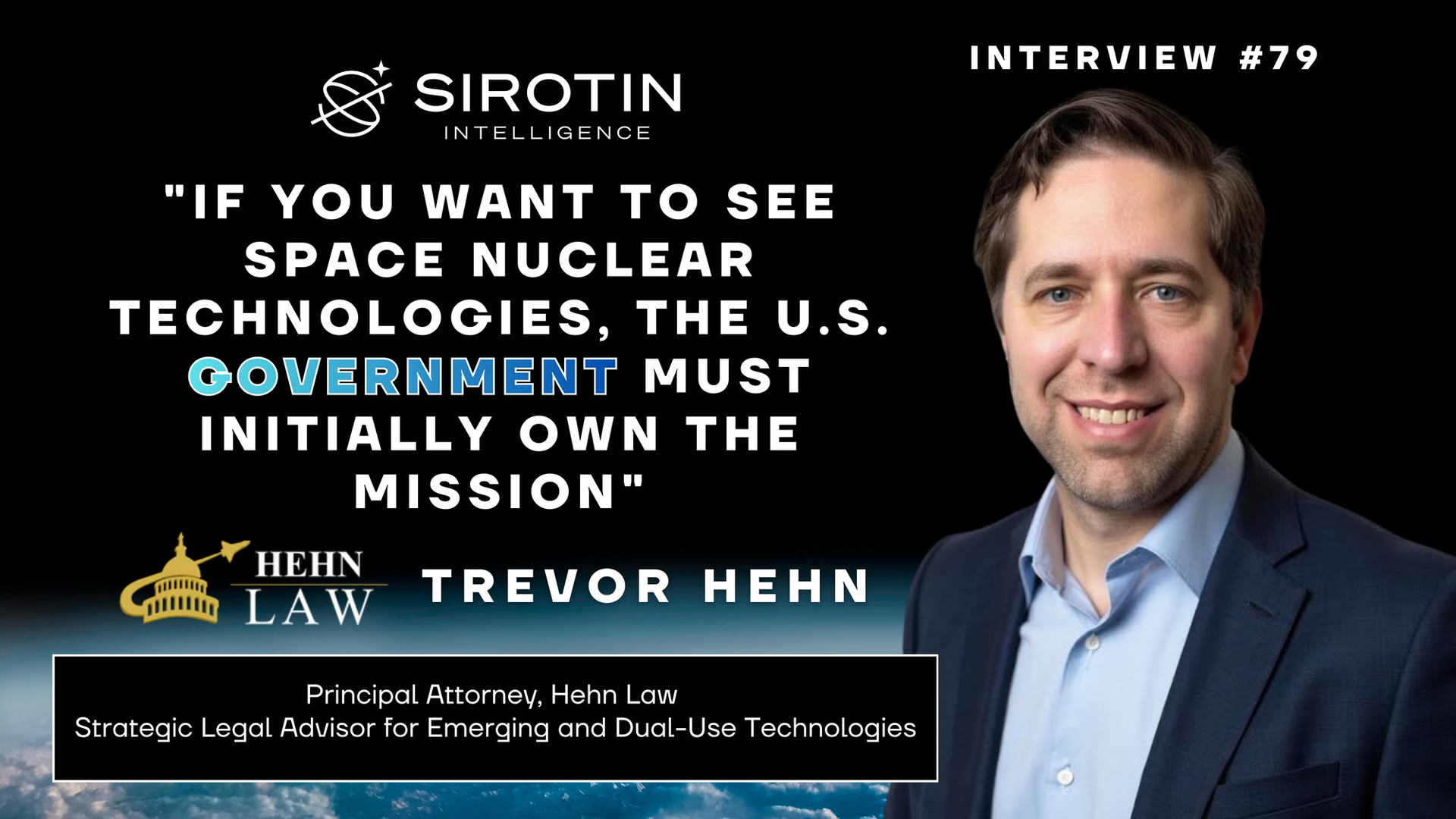
"If You Want To See Space Nuclear Technologies, The U.S. Government Must Initially Own The Mission": Attorney Trevor Hehn Returns On Space Nuclear's Legal Architecture, The 2028 Launch Trio, And The Indemnity Gap Blocking Commercial Reactors

On April 3, 1965, the United States launched its first and only nuclear fission reactor into orbit. SNAP-10A operated for 43 days from a 1,300-kilometer polar orbit before an unrelated voltage regulator failed and the reactor was commanded shut down. It remains there today, in a graveyard orbit with a projected lifetime of 4,000 years. The technology worked. What happened in the 60 years that followed was a different kind of failure, the kind that sits inside committees and budget cycles rather than inside the physics.
Sixty Years Of Silence
The silence is ending. NASA Administrator Jared Isaacman said the quiet part out loud at the agency's Ignition event on March 24, 2026: the lack of an operational space nuclear reactor is an execution problem, not a technology problem. NASA committed at that event to launch Space Reactor-1 Freedom before the end of 2028, the first interplanetary spacecraft powered by fission. President Trump's December 18, 2025 executive order, "Ensuring American Space Superiority," sets a lunar surface reactor ready for launch by 2030. In April, the Office of Science and Technology Policyissued NSTM-3, the directive that operationalizes the executive order through interagency timelines for NASA, the Department of War, and the Department of Energy.
What is the legal architecture supporting all of this, and where are the gaps? Trevor Hehn has been working through that from the practitioner's chair. The founder of Hehn Law PLLC and a former Army infantry officer and JAG, Hehn advises clients across emerging and dual-use technologies, with deep work in space nuclear in particular. When we last spoke, he laid out how the Outer Space Treaty framework, the Artemis Accords, and the dual-use overlap between commercial and defense shape his work. This time, returning to space nuclear specifically, his diagnosis arrives in two parts. The federal authority to launch reactors into space already exists, and has for nearly seven years. The indemnity infrastructure commercial actors will need to build their own does not.
From a legal and policy perspective, what is the actual state of space nuclear right now? Is the framework legitimate, or are we still working from drafts?
"It's almost unremarkable on one hand, and really exciting on the other. Let me explain. It's almost unremarkable because the federal government's authorization to develop space nuclear systems doesn't need any new legislation. It doesn't need any new authorization from the President. It exists today, and in its current form has existed for almost seven years.
National Security Presidential Memorandum-20, or NSPM-20, was issued back in August 2019. It set up the launch authorization process for spacecraft containing space nuclear systems and established the Interagency Nuclear Safety Review Board to replace the ad hoc panels we had been using since the 1960s. That isn't a new Trump administration thing. President Biden didn't cancel it. It survived different administrations. Congress had opportunities to curtail the executive authority and didn't. Congress passed the ADVANCE Act in July 2024 to modernize terrestrial nuclear and create a clearer path for fusion commercialization. From the authorization side, the federal government has the authority it needs to execute right now.
What's exciting is that the executive is now actually exercising that authority. The December 2025 executive order, 'Ensuring American Space Superiority,' directs the deployment of nuclear reactors on the Moon and in orbit, including a lunar surface reactor ready for launch by 2030. The recent OSTP directive, NSTM-3, creates the implementation roadmap and the National Initiative for American Space Nuclear Power. So it's more than a possibility. The authorization exists. The directive exists. The top cover from the President exists. Federal agencies have what they need to begin adopting space nuclear technologies."
The Authority Stack
How realistic is a near-term reactor on orbit? Are we actually going to see space nuclear flying soon?
"I can't say which company. But I was in a room back in February when one of the companies working on space reactors said they could have a reactor on orbit by 2028. The reaction in the room wasn't shock. It was a technical challenge. We can get it done. The capability is there. The legislation has not been the issue for decades.
At no point has Congress come in and said 'don't do space nuclear things.' Congress has been aware since 1965 that the executive is interested in this. That's when we launched SNAP-10A, the only fission reactor the U.S. has put in orbit. It completed a partial mission and demonstrated technical capability. It failed because of an electric component, not because of the reactor itself. It's still up there in a graveyard orbit, safe.
There is also no federal legislation specifically regulating the operation of a nuclear reactor on orbit. That matters because clear authorization provides assurance to industry and confidence to the commercial sector. Without that confidence, there has been hesitation on the commercial side and on federal agencies to actually put these systems on orbit. It's not a regulatory issue in the strict sense. It's an operational confidence issue.
If you followed NASA's announcement on Ignition, Space Reactor-1 Freedom is what's going to break that pattern. Two reactors, electric thrusters, a transit to Mars by the end of 2028. The efficiency relative to chemical propulsion isn't significantly different in this iteration, so we're not gaining a whole lot in raw transit time. What this mission does, and it's genius, is provide a real purpose for proving the technology.
By NASA owning that mission directly, the agency buys down the operational risk of running reactors in space. We're not just doing it to say we can run a reactor on orbit. There's a destination. There's a fleet of helicopters called Skyfall that the spacecraft will deploy at Mars to scout for human landing sites. That's the kind of mission NASA should be doing, the hard challenges that are difficult to justify on pure economic risk for investors but inspiring as science. It will also generate real flight data on how the reactor behaves. Decades of study get validated. Where they need adjustment, that adjustment will be informed. I don't think we'll see a serious anomaly. We're past that in our understanding of nuclear systems. If something does happen, that becomes a learning opportunity rather than a setback."
The 2028 Launch Trio
If a commercial company puts a nuclear reactor on a U.S. rocket and something goes wrong, who carries the liability? Is it the company, the launch provider, the government?
"Indemnity is still a significant issue. That's the unsolved nut for commercial space nuclear. When I say the authority exists to launch these systems, I'm being specific. That authority covers the federal government's ability to launch and operate. It does not include all of the other considerations: indemnity for accidents, licensing of the material on the ground, the entire ground preparation regulatory infrastructure. There are a lot of pieces on the ground that still need figuring out before you even get a system to orbit. It's messy and cumbersome, but it's not impossible.
Where the commercial side is absolutely limited right now is on indemnity. If a commercial provider sells a space reactor to the government for a government mission, and the government owns the reactor at launch, then the government has sufficient indemnification authority to cover any of the ground preparation work the contractor would otherwise be liable for during reactor development. The government also owns the risk of operations on orbit. It would probably indemnify the company for issues arising from its workmanship of that reactor once on orbit too.
That path is not exactly straightforward, but it exists. There are at least a few attorneys who are smart on these pathways. I'm not the only one. The reactor can get to orbit on a government-owned and operated mission, the way the NASA missions are structured. If the Department of War starts looking at it, they'd have authority too. Other federal agencies with interest in operating reactors in space would have authority too. Exactly how it takes place is complex, but it isn't impossible."
Two Paths To Orbit
What questions are investors and founders in space nuclear avoiding that they absolutely should be asking? What's the elephant in the room?
"Savvy investors are going to bring on a nuclear engineer with deep familiarity with the particular type of nuclear system they are considering investing in, before they commit any funds. It really requires a nuanced understanding of the concept of operations. To what end is this nuclear capability being employed?
Founders might be nuclear engineers. They might not be. They might have hired one. They might be very good salespeople. Having a nuclear engineer on the investor side, evaluating the technical claims and the regulatory pathway, is one of the smartest things to do. I'm working with a company that took that approach. The conversations they've had probably wouldn't have gotten as far without a nuclear engineer on the investor side familiar with the technology the company is looking to incorporate. I know that sounds vague, but it's specific in practice.
The other thing worth flagging is the difference between law and policy. I've seen attorneys confuse the two. Policy doesn't win the day. You're not going to court to argue that the policy said it was okay to cross a red light. Everyone knows that's unlawful. There is a law against it. Policy might say something like, 'red lights at this intersection should last no longer than 30 seconds.' Is it really unlawful if a particular light lasts 35? No. The law is about not crossing on red. Policy informs the flow of traffic.
There are a lot of policy points around space nuclear, both domestically and internationally. People can get easily caught up in the policy side, and that can be detrimental to the success of nuclear operations in space. Some of the policy might not be achievable for 15 or 20 years. Some of what those policies call for doesn't add to the safety guidelines for a particular system, and doesn't add anything not already addressed under current law. The Outer Space Treaty, for instance, requires the launching state to be responsible for what it puts up. A new nuclear reactor would be covered. The launching state has to supervise launch activities. A nuclear reactor in space would still need that supervision. The framework already exists.
International guidelines, on the other hand, suggest things like end-of-mission disposal protocols. Move the reactor to a high enough orbit that radioactive material decays before reaching the atmosphere. That's a sensible guideline. It's how nuclear reactor mission planners are thinking already. There is no law specifically requiring it that way. Law and policy are independent of one another in those cases. They happen to help each other because they don't conflict, and the operator can deliver the capability to space without policy standing in the way."
The NRC just released Part 57 for micro-reactor licensing, and NASA's lunar surface reactor RFI is still pending. Does Part 57 actually move commercial space nuclear forward, and what changes when we go from an orbital reactor to one on the lunar surface?
"The NRC has no jurisdiction in space. Their reactor regulations don't apply to space reactors. Where their regulations do apply is the commercial nuclear material itself. Possessing nuclear material commercially probably requires an NRC license. The Department of Transportation regulations apply to transport. So if you're moving the material, even while it's in transit, the NRC has authority over the material and DOT has authority over the transport.
The new NRC regulations, including Part 57, the proposed micro-reactor rule released earlier this month, might provide some insight or guidance into operating a reactor in space, certainly more for surface operations than for orbital operations. But it doesn't have authority to do that. It's more of a suggestion for space than a regulatory regime for space nuclear.
I'd argue that's okay. If the federal government is saying we want to launch reactors and we want to enable commercial reactors, then realistically you need to think through what the buildup looks like. There's going to be a contract between the reactor maker and the federal government detailing how risk gets indemnified, the expectations of the government purchaser, and the support required from the reactor maker. There will be a way to hold reactor makers accountable when they're building reactors for the government. The government has a compelling reason to ensure those reactors are operated safely, because it wants to keep developing these capabilities and enable commercial development too. There's an inherent reason for the government to do things safely with space nuclear. Accepting too much risk would set back the entire space program, not just space nuclear, for an unacceptable period of time. The public's perception of nuclear risk matters more than the technical risk in many ways.
If I had a crystal ball for the next five to ten years, any commercial reactor company that wants to develop reactors for a broader commercial market, rather than a single specific government customer, will be best served by selling that first reactor to a government customer and working with them to establish flight heritage. The space industry loves the word heritage. They want to see flight heritage. Iterate on that, and then scale to the commercial market. That's appropriate, because government oversight of those operations gives us the experience to right-size commercial space nuclear regulations down the road. It's regulation built on actual operational experience, not on what someone in an ivory tower thinks the rules should be.
The orbit-versus-surface distinction is real, and it's mostly an engineering matter rather than a regulatory one. When NASA announced Ignition, the lunar surface reactor was framed as a follow-on to SR-1 Freedom. SR-1 launches at the end of 2028, and the lunar reactor starts to take more priority after that. The sequencing is sensible. Thermal management on a reactor in space is one of the harder engineering challenges, and SR-1 will give us real data on how that performs in transit. Then for the lunar surface, thermal management has to contend with a different environment, with people potentially nearby in radiation-hardened space suits.
The radiation risk to crew operating reasonably close should be relatively low, but on a regular basis you don't want crew operating extremely close to a reactor anyway. What's the safety protocol for operations near the reactor? That's a policy matter more than anything else. You set a stand-off distance based on a rare-but-non-zero risk of malfunction, and you operate accordingly. These reactors aren't designed to have meltdown risk in the way a terrestrial reactor might. They're not capable of a runaway critical reaction that produces a Chernobyl or Fukushima or Three Mile Islandoutcome. The bigger consideration is projectile risk in any explosion or malfunction, and how much margin you build around the reactor for personnel and equipment.
You also have the end-of-mission disposal question. We're done with this reactor. What do we do with it? Do we bury it on the lunar surface? Do we launch it elsewhere? How do we move it from where it's been operating without risking the people or equipment moving it? Those are real challenges, but not the kind that stops the mission."
Orbit Vs Lunar Surface
Does this Trump administration's approach to space nuclear represent a fundamental shift, or is it more of an operational cadence change?
"The fundamental shift is the ownership of the space nuclear mission. The federal government recognizes that if it wants to see this technology, it has to own the mission itself, because that's the fastest way to deliver what we know is technically possible to orbit. That's a significant change from the earlier Trump administration and certainly from the Biden administration.
Look at what happened with DRACO, the joint DARPA-NASA project to develop and demonstrate a nuclear thermal propulsion system. That program relied on a commercial authorization process, which is unproven for launching nuclear systems. Even though there was a process, where was the indemnity that the commercial company would need to provide nuclear-as-a-service? DRACO was terminated. Moving away from that model, where a contractor delivers a good and the government owns it on delivery, is the right approach for nuclear right now.
The other piece is the executive support. The December 2025 executive order on space superiority pulled everyone in: we're going to land a reactor on the lunar surface by 2030, NASA is going to lead it, here's how the agencies coordinate. NASA was already moving in that direction from announcements made by then-Acting Administrator Sean Duffy in late 2025. The executive order validated those plans. It's been notable to see Administrator Isaacman champion the cause of all things space nuclear. He recognizes the value of nuclear sources of power, both radioisotope power systems and reactors, for lunar operations and for deep space beyond that. It gives us capability NASA only dreamed about decades ago, and we're now positioned to actually deliver it. That part is exciting."
Looking ahead to the rest of this year, what should we be watching, and what isn't getting enough attention?
"By the end of the year, we're going to know what company or companies are producing the reactors for SR-1 Freedom, which is due to launch December 2028. We're also going to have a much clearer sense of what the launch authorization process actually looks like for all the space-specific nuclear missions due to launch in 2028. NASA has at least three publicly announced: Dragonfly launches in July 2028 with a Multi-Mission Radioisotope Thermoelectric Generatorbound for Titan. Rosalind Franklin launches in 2028 with NASA-provided radioisotope heater units bound for Mars. And SR-1 Freedom launches at the end of the year.
Watching the Interagency Nuclear Safety Review Board exercise that volume is going to be critical to the subsequent success of the commercial space nuclear market. The INSRB safety reviews will inform any subsequent commercial launches of space nuclear systems. There's an issue I think isn't getting enough attention: there are no funds appropriated specifically for INSRB operations. Each agency contributing a member, the Departments of State, Defense, Energy, Transportation, the EPA, NASA, and where appropriate the NRC, does so out of their operating budget. INSRB participation is essentially an extra duty for any board member. If you have a high volume of launches needing review, is the INSRB structurally set up to scale those reviews? Do calls need to get louder for dedicated appropriations? That's why I bring it up. It will be interesting to see whether the cadence the INSRB currently operates on holds, what needs to change, how it might be improved. Could AI be safely used to expedite reviews without significantly adding cost? I don't know yet. It's worth watching.
Companies that aren't NASA also need to get through INSRB for their own launches. That's the part of the conversation that's still developing. The NASA missions get the public attention. The commercial side is moving in parallel.
On export controls, one more piece worth flagging because it comes up frequently. Things we launch into space are not considered exports for the purposes of export control. If a system lands in another country because of a malfunction or unplanned reentry, it's still subject to U.S. jurisdiction. It's not an export. The export control concern arises if a U.S. company tries to sell a reactor to a non-U.S. person, or transfers ownership in space from a U.S. person to a non-U.S. person. Then you have an export issue, because the technical data related to the reactor is subject to export controls. Launching the reactors themselves is not going to be an export control issue. Selling fuel developed here for use in another country's reactor, that could be. The framework is there. It's about understanding where the export actually is, what's being controlled, and whether you need a license under ITAR or EAR. The export licenses aren't really structured to restrict commerce. They protect sensitive technologies."
INSRB: The Bottleneck
Author's Analysis
The decade ahead for American space nuclear is shaped by three asymmetries that the executive order, NSTM-3, and the existing NSPM-20 framework don't fully resolve.
The first is between authority and operational confidence. As Hehn explains, the federal government has had the legal authority to launch reactors into space since at least 2019. What changed in late 2025 and early 2026 was not the existence of authority, but the executive's willingness to use it directly, with NASA owning the mission rather than serving as a customer for a commercial nuclear-as-a-service offering. The DRACO program tested the commercial-authorization path and was terminated. SR-1 Freedom inverts that approach. NASA owns the spacecraft, the Department of Energy supports the fuel and safety analysis, and a contractor delivers the reactor as a good rather than as a service. That structure resolves the indemnity question for SR-1 because the government takes on the operational risk at launch. It does not resolve the indemnity question for any subsequent commercial mission that wants to operate a reactor on its own.
The second asymmetry is between near-term execution capacity and the volume the executive order implies. The 2028 launch trio (Dragonfly in July, Rosalind Franklin around the same window, SR-1 Freedom in December) is the opening, not the peak. Ignition's lunar manifest implies multiple radioisotope-powered missions per year through 2031 to survive the lunar night, layered with the 2030 lunar surface reactor and the Department of War's mid-power in-space reactor target of 2031. Estimates from the April 2026 Nuclear Launch Seminar in Washington put the floor at no fewer than a dozen space nuclear launches between 2028 and the end of 2031. Every one of them passes through the Interagency Nuclear Safety Review Board under NSPM-20's tiered framework. The INSRB has no dedicated appropriation. Its members from the Departments of State, Defense, Energy, Transportation, the EPA, NASA, and the NRC participate as an extra duty drawn against their home agency's operating budget. That volume exceeds anything the INSRB structure has ever processed. Hehn's question of whether the existing review cadence holds, or whether dedicated funding is required, is the procedural bottleneck most likely to slow the timeline. It is also the bottleneck least visible from the announcements.
The third asymmetry sits between NASA's direct ownership model and the commercial sector's longer-term ambitions. The path Hehn describes, where commercial reactor developers sell first to a government customer to establish flight heritage and iterate toward a broader commercial market, is sensible and probably correct. It is also slow. A reactor company today, looking past 2028, is asked to design a system that meets DOE-supported government safety requirements, fly that system on a NASA-owned mission, accumulate operational data, and then return to a regulatory regime that does not yet exist for commercial space nuclear, and may not exist for years. The NRC's Part 57, the proposed micro-reactor licensing framework released in May 2026, applies to terrestrial micro-reactors. It does not have authority over reactors in space. It will inform space nuclear regulatory thinking, but it is not the regime commercial space reactor companies will eventually need.
Imagine the 2030 lunar surface reactor sitting at the lunar south pole, providing the continuous fission surface power the executive order requires for an enduring lunar presence. The mission is government-owned. The reactor was built by a contractor, delivered as a good, and operated under NASA and DOE oversight. By that point, SR-1 Freedom has either reached Mars and deployed Skyfall, or it has demonstrated where the technology gaps actually are. The INSRB has either scaled to handle the launch cadence or has become the visible bottleneck slowing it. A second-generation commercial reactor company is now seeking authority to fly its own reactor, on its own mission, under its own indemnification structure. The legal architecture for that next step does not exist today. It will have to be built using the operational data from missions launching in the next 30 months.
If the INSRB does not get dedicated appropriations, and the indemnity framework for commercial operators does not develop in parallel with NASA's mission ownership, what does the second-generation commercial pathway look like in 2032, when the government has launched four to six reactors and the commercial sector still cannot indemnify its first?
About Trevor Hehn
Trevor Hehn is the founder of Hehn Law PLLC, a boutique law firm built for the most innovative ventures in emerging and dual-use technology. His practice covers space nuclear, new nuclear, AI, space, and defense applications, and he serves as legal counsel to startups, growth-stage companies, and investors operating at the cutting edge of science and engineering.
Before founding Hehn Law, Hehn served as both an infantry officer and a Judge Advocate in the U.S. Army, experiences that continue to shape his work on national security, operational risk, and dual-use technology regulation. He later co-founded OrbitsEdge, a space edge compute company, where he led legal and operational strategy through a period of reduced investment across the space sector. The combination of military operations, law, leadership, and startup experience gives Hehn practical insight into investor relations, government contracting, and compliance regimes including ITAR, EAR, and the evolving industry standards around space nuclear and commercial space.
A recognized voice on the legal and policy dimensions of space and dual-use technologies, Hehn has spoken at the inaugural Commercial Space Law Symposium at Catholic Law, the Maine Space Conference, SpaceCom 2023, the Nuclear Emerging Technology for Space (NETS) 2025 Conference, and the Seminar Series on International Space Law in Leicester, UK. In November 2025, he attended the United Nations' invitation-only space law and policy conference in Vienna. He is working with Aerospace Corporation and industry to determine how to deliver on the Executive Order's mandate to deploy nuclear systems to space, including leading Chatham House Rules roundtables and meetings at SpaceNEXT in Tysons, Virginia in February, the 41st Space Symposium in Colorado Springs in April 2026, and ASCEND 2026 in Washington, D.C. Hehn was with the OSTP Coordinator for Strategic Capabilities the morning OSTP formally rolled out NSTM-3 and the National Initiative for American Space Nuclear Power.
At the core of his practice is a commitment to enabling technologies that promote human flourishing while managing risk responsibly, with emphasis on transparency, accountability, and long-term thinking.
Previous Coverage
Get exclusive insights from our network of NASA veterans, DARPA program managers, and space industry pioneers. Weekly. No jargon.