
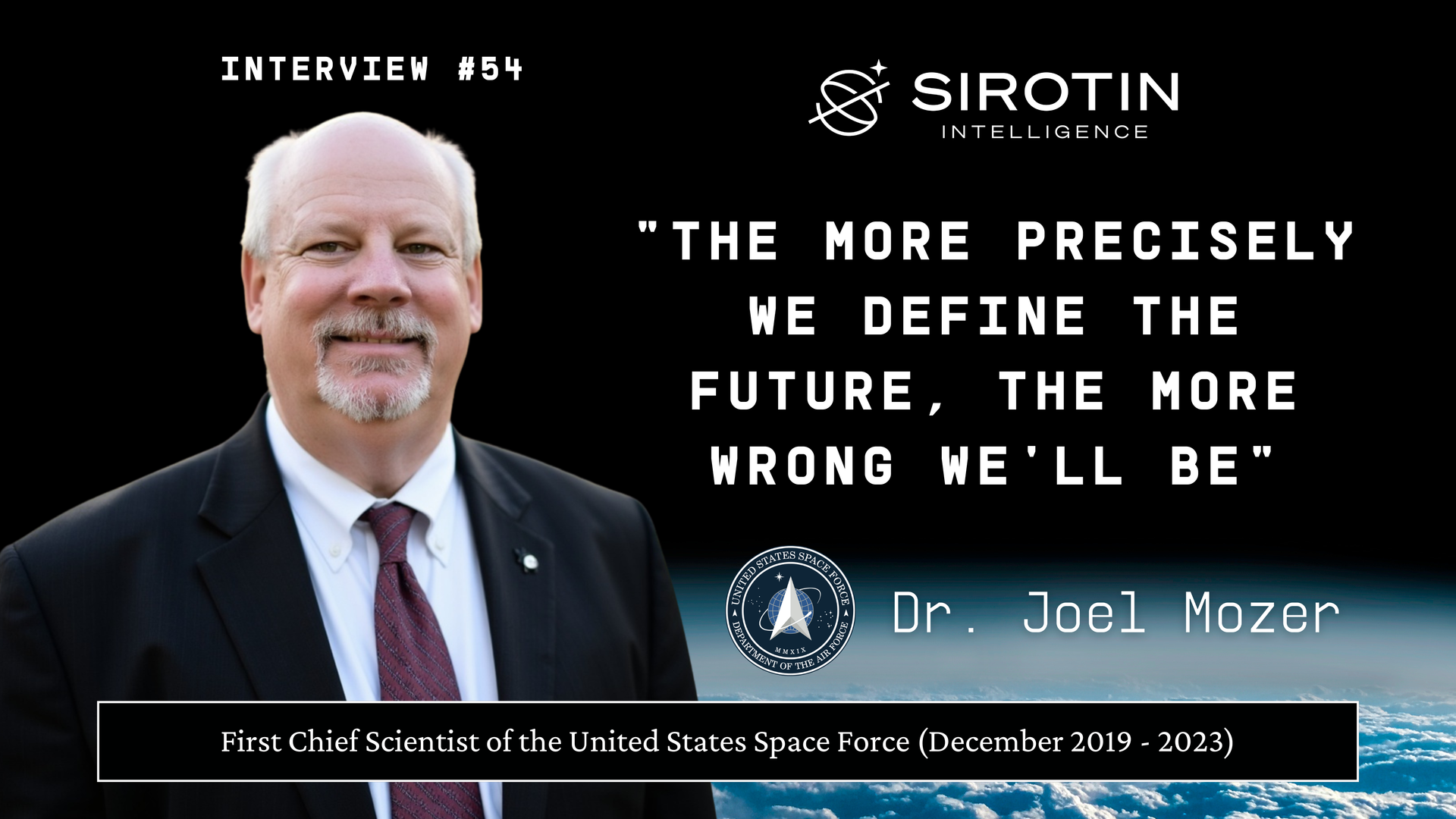
"The More Precisely We Define the Future, The More Wrong We'll Be": First United States Space Force Chief Scientist Joel Mozer on Strategic Foresight, Multiple Plausible Futures, And The Coming Cislunar Crisis

Every eleven years or so, the sun reverses its magnetic poles driving solar cycles. At the peak of these cycles, coronal mass ejections can reach Earth in seventeen hours, carrying enough energy to disable satellites, corrupt GPS signals, and overload power grids. Joel Mozer studied these phenomena through solar telescopes before becoming the first Chief Scientist of the United States Space Force.
From 2019 to 2023, Mozer developed planning frameworks for America's newest military branch. He divided space operations into three horizons. Current operations receive roughly 70% of resources. Near-term threats over five to ten years get 28%. The third category, addressing threats beyond predictable timeframes, receives 2%. These percentages illustrate a principle rather than prescribe a formula – mature systems like GPS might follow this model, while emerging autonomous mesh networks could require 40/40/20 allocation, and existential defense systems might justify 30/30/40 distribution.
"You wake up some morning and all your GPS satellites are out," Mozer explains. "You don't know if it was an attack or a geomagnetic storm." This scenario exemplifies the fundamental challenge Mozer identified throughout his tenure: preparing not for a single predicted future, but for multiple plausible scenarios that could unfold simultaneously. The attribution problem becomes critical when response windows shrink to minutes. Solar storms and electromagnetic weapons produce similar signatures. Distinguishing natural from hostile events might prove impossible before escalation begins – demonstrating precisely why single-point projections fail when multiple futures converge.
The space domain continues evolving from information transfer to resource extraction. Current orbital assets primarily transmit data. Future activities could include helium-3 mining, asteroid processing, and manufacturing at Lagrange points. The Space Force organized to support terrestrial military operations, faces expanding requirements to protect American interests, including commercial ventures in cislunar space, requiring strategic foresight to prepare for missions using sensors and doctrines that don't yet exist.
As Chief Scientist during the Space Force's formative years, you helped shape America's newest military branch. What were the most critical scientific and technological priorities you established?
"Before the Space Force stood up, I was the Chief Scientist of Air Force Space Command, which morphed into the Chief Scientist of the Space Force," Mozer begins. This continuity provided institutional knowledge spanning from Cold War reconnaissance programs to the current era of commercial megaconstellations.
The Space Force's establishment in December 2019 marked the first new military branch since 1947, when the Air Force separated from the Army following World War II. That earlier split was in response to demonstrated combat aviation capabilities. The Space Force emerged differently, during peacetime, to address threats that remained largely theoretical – requiring unprecedented investment in capabilities whose necessity might not become apparent for decades.
"There are a lot of space operators who go to work every day to do operations in space. They sit at stateside terminals, or they get deployed. My job was to help them from a technology perspective, as well as future generations." Current operational needs include maintaining aging GPS satellites, defending communication links, and tracking approximately 50,000 pieces of orbital debris. The five-to-ten-year horizon addresses identifiable threats: Chinese anti-satellite weapons demonstrated in 2007, Russian co-orbital interceptors tested repeatedly since 2014, Iranian jamming capabilities expanding annually. The generation-after-next category ventures into territories that challenge linear planning: quantum sensing, directed energy weapons, and autonomous satellite swarms.
"It's too far down the road, and we don't necessarily know what the technologies are going to be, but we need to plan for it anyway," Mozer explains. This investment in uncertain futures determines strategic advantage. "Science that you can demonstrate in a laboratory on a bench will take 10, 20, sometimes more years to become a piece of fieldable kit."
Historical precedents illustrate these timelines. The Manhattan Project moved from Einstein's 1939 letter to the Trinity test in 1945, a remarkably compressed schedule driven by wartime urgency. GPS required 20 years from the initial concept in 1973 to full operational capability in 1993. SpaceX took eighteen years to make rocket reusability economically viable. These development cycles suggest that the capabilities needed in 2045 require investment decisions today – even though we don't know precisely what 2045 will look like.
Mozer established five strategic priorities, each addressing different aspects of space operations evolution while maintaining flexibility for multiple futures:
First, space power and propulsion address a fundamental military principle. "In a military scenario, the person with the most energy wins." While Newton's laws remain unchanged, applications multiply as space activities expand. Nuclear propulsion could reduce Earth-to-Moon transit from days to hours. Advanced solar cells might enable persistent operation in Earth's shadow. Ion drives already allow satellites to change orbits repeatedly, evading threats or pursuing targets.
Second, operations beyond geosynchronous orbit recognize that strategic competition extends past the traditional 22,236-mile altitude of communication satellites. "As we expand further into cislunar space, there are things we need to do. We need to be able to maneuver through there. We need to be able to communicate. We need to be able to do space domain awareness." China announced lunar base plans in 2019. Russia joined as a partner in 2021. Meanwhile, American capabilities to monitor activity beyond GEO remain limited.
Third, advanced remote sensing pushes beyond current reconnaissance capabilities. Today's satellites can identify vehicle types from orbit. Future quantum sensors might detect submarines by minute gravitational anomalies. Persistent surveillance could simultaneously track every moving object on Earth's surface. Information superiority often determines the outcome of conflicts before kinetic engagement begins.
Fourth, cybersecurity and mission trust acknowledge that space operations fundamentally involve data transmission. "Space is largely about transmitting bits and bytes, and you need those to be secure and attributable." A single compromised GPS satellite could misdirect precision munitions or cause civilian aviation accidents. Authentication becomes as critical as encryption when response times shrink to milliseconds.
And fifth, autonomous space operations recognize that human reaction times become liabilities at orbital velocities. "We're going to be doing more and more dynamic operations in space and relying on autonomy to get it done." When satellites maneuver at 17,000 miles per hour, automated systems must make engagement decisions faster than human operators can process sensor data.
To implement these priorities, Mozer established Strategic Space Technology Institutes as university-led consortia. For example, Texas A&M leads an effort with the University of Cincinnati on In Space Operations research. For Space Domain Awareness, the University of Colorado-Boulder and Virginia Tech are the leads. The University of Michigan and Rochester Institute of Technology drive work in Advanced Space Power and Propulsion. Altogether, there are a couple of dozen schools working on problems of specific interest to the Space Force.
"I've always felt that the Department of Defense underutilizes academia," Mozer notes. Historical examples support this view. MIT's Radiation Laboratory developed radar during World War II. Johns Hopkins created the proximity fuse. Berkeley contributed to nuclear weapons development. During the Cold War, Stanford designed reconnaissance satellites, Michigan advanced missile defense, Texas pioneered spacecraft materials. "We have the best universities in the world. Not only can they do some of the technology for us, but they can do some of the big, far-off strategic thinking. The generation-after-next kind of strategy. And they train our pipeline for the workforce."
With your extensive background in solar physics and space weather prediction, how do these natural phenomena illustrate the challenges of preparing for multiple plausible futures?
"You don't really realize how dynamic and interesting the sun is until you look at it through a properly configured telescope," Mozer observes. His years studying solar physics revealed patterns of activity that most people never consider. Sunspot regions can span distances larger than Jupiter. Magnetic field lines build tension over weeks before releasing energy equivalent to billions of nuclear weapons.
Space weather serves as a perfect case study for why single-point future predictions fail. The sun follows an eleven-year cycle of magnetic reversal, essentially flipping its north and south poles. During solar maximum, which we're experiencing now in 2025, competing magnetic fields create conditions for frequent flares and coronal mass ejections. Solar minimum brings relative calm, though significant events can occur at any point in the cycle. This variability demonstrates how natural systems defy linear projections – precisely the kind of convergent risk that strategic foresight must address.
The Carrington Event provides our primary reference for extreme space weather. In September 1859, British astronomer Richard Carrington observed an unprecedented solar flare through his telescope. Seventeen hours later, the resulting geomagnetic storm reached Earth. Telegraph systems failed globally. Operators reported severe shocks and equipment fires. The aurora borealis, typically visible only at high latitudes, appeared as far south as the Caribbean and Hawaii.
"Just imagine if that same thing happened today," Mozer says. The implications reveal how a single unpredicted event could trigger cascading failures across multiple domains – the convergence of futures that linear planning cannot address. In 1859, the world's most advanced technology consisted of approximately 200,000 miles of telegraph wire. Current space infrastructure includes 8,000 active satellites, with thousands more launching annually.
A Carrington-scale event would affect all these systems simultaneously. "There'd be a big geomagnetic storm, a radiation storm which could upset all the electronics. It could create drag and de-orbit constellations. Starlink constellations would be massively affected if a Carrington-like event happened today."
The comparison to COVID-19 illuminates preparedness gaps. "People predicted that a pandemic was plausible and possible, but when it happened, we found ourselves unprepared for it. The same thing could happen with space weather." Both scenarios demonstrate how institutions optimize for probable rather than plausible futures, creating strategic vulnerability.
Space weather presents similar dynamics. Scientists understand the threat. Governments acknowledge the risk. Investment remains minimal. "I would say very unprepared," Mozer states when asked about current readiness levels.
"Especially from the warfighting perspective or the Space Force perspective, I'm not sure we've got our grips on what could happen to our critical systems." The military dimension adds complexity beyond civilian infrastructure concerns. Modern warfare depends on space-based communications, navigation, and intelligence. But the attribution problem exemplifies the convergent risks that make multiple-future planning essential.
"Even a more run-of-the-mill geomagnetic storm, which we only do a so-so job of predicting, could be used as cover for a military operation." This scenario keeps strategists awake: "You wake up some morning and all your GPS satellites are out. You don't know if it was an attack or a geomagnetic storm."
In space, natural phenomena can perfectly mimic hostile action – demonstrating why preparing for a single predicted future leaves institutions vulnerable to strategic surprise. Solar radiation looks identical to electromagnetic pulse weapons. Satellite failures from debris impacts resemble kinetic interceptor strikes. By the time analysts determine the actual cause, escalation dynamics might be irreversible.
Engineering provides partial mitigation. "A lot of the effects of run-of-the-mill space weather can and have been engineered out. We have shielding for our satellites, our most critical systems, and we have backups." Yet cascading failures remain probable. The Starlink constellation lost 40 satellites in February 2022 due to a minor geomagnetic storm, demonstrating vulnerability even with modern engineering.
Mozer extends the threat assessment beyond solar activity. "Near-Earth asteroids, think about an asteroid or a bolide, which is an exploding asteroid in the sky, being mistaken for a nuclear attack. World War Three could be triggered by mistake." These scenarios illustrate why strategic foresight must consider the full range of plausible futures, not just the most probable ones.
During your 26 years at AFRL, you transitioned from atmospheric research to space warfighting capabilities. What breakthrough technologies from your time are now operational?
"One of the great things working for the Department of Defense is you get to do a variety of things," Mozer reflects. "I did everything from tropospheric weather to space weather to rendezvous and proximity operations to advanced technologies."
His proudest achievement: serving as Mission Director for ANGELS (Automated Navigation and Guidance Experiment for Local Space). The 200-kilogram satellite demonstrated autonomous rendezvous and proximity operations in geosynchronous orbit – approaching, inspecting, and maneuvering around other satellites without human control.
"You could say, go over there and inspect that satellite, and it would trundle over to it and put itself in an orbit, or do a fly-by and take pictures of it," he explains. ANGELS pioneered dynamic space operations – satellites that maneuver rather than maintaining fixed positions. "That was really kind of the first foray into what I would call dynamic space operations, where you're not just a communication satellite that hangs in one place and transmits bits and bytes. You're actually actively maneuvering and going from one place to another, responding to real-world events." The experimental capability evolved into an operational reality. "There's an active operational constellation called GSSAP that does that operationally now."
Looking forward, Mozer sees acceleration of dynamic operations. "More dynamicism in space, not just RPO, but logistics, transporting mass from one position to another to take advantage of in-source resource utilization. I imagine a whole world in the future with lots of activity and dynamic activity in space, supporting not only military but commercial ventures."
You've described your work as supporting "our space warfighters." How do you translate complex scientific concepts into actionable intelligence for operators?
"When I say warfighter, I'm thinking of a Guardian sitting at a console at Schriever Space Force Base operating a satellite," Mozer clarifies. These operators face mounting challenges: proliferating satellites, antiquated systems, and insufficient automation. "There are more and more things to operate, and fewer and fewer people to do it. They need automation. They need updated capability. In some cases, they're using very old, antiquated computers and networks."
The numbers illustrate the crisis. "We used to talk about dozens of satellites that we had to keep track of. Now there are tens of thousands we have to keep track of." Mozer created "mixing bowls," structured encounters between technologists and operators. "We would bring the technologists from places like the Air Force Research Laboratory and the operators from Schriever Space Force Base, and have them sit in a room and say, 'What keeps you up at night? What can't you do that you wish you could do?'"
The challenge intensifies with temporal distance. "Today's fight tonight, it's fairly straightforward to identify the gaps. The further you get in time – the next generation and generation after next – it gets much fuzzier." Future planning requires different conversations about multiple plausible scenarios. "You want to bring the operators and technologists together to think about a lot of what-ifs. What if the world just experienced a big solar storm, and now we have to recover from it?"
The space domain is increasingly dominated by commercial actors. How should the Space Force leverage commercial innovation while maintaining military advantage?
"This is one of the enduring tensions in space innovation," Mozer acknowledges. "Who leads the innovation and for what purpose?" Commercial entities bring undeniable advantages. "The United States has a very vibrant set of commercial interests to drive innovation. We need to take advantage of that in the military as much as possible." But market forces create gaps. "We have unique capabilities that we need – unique capabilities that we're trying to develop – that markets won't address by themselves."
His analogy crystallizes the distinction. "In the military air world, we refuel aircraft in flight all the time. It gives us long legs so we can get to the other side of the world. You don't see commercial aviation ever doing refueling because it doesn't make sense for them." Space presents identical dynamics. "There are military requirements that need to be done, and we can't over-rely on commercial entities to provide that."
The microchip crisis exemplifies the danger. "The decision to offshore a lot of our microelectronics production was done for bottom-line purposes. It was cheaper to do it offshore, so businesses decided to do so. That was not in the best interest of national security. Now we're in the process of trying to claw back some of that stuff, so we have our own sovereign capability."
As a self-described "futurist and long-term thinking advocate," what does strategic foresight mean for space warfare in 2050?
"I can't predict what space is going to look like any more than anybody else can," Mozer admits. "I have no idea what conflict in 2050 will look like." His concern isn't prediction but preparation for multiple plausible futures. "What I rail against is people who don't think of the full range of plausible possibilities. Space could become a hotbed of high-value mining, transport, and piracy. A lot of activity in the future, in which case the role of the Space Force would be different than it is today."
Current wealth streams involve information transfer. Future wealth might involve raw materials, logistics, and physical goods. The Space Force must prepare for both continuities and discontinuities. "Most of the future is unknowable. We don't know what tomorrow will bring. If something happens that you haven't thought about before, you're going to be surprised."
Alternative futures demand consideration. "We could have this very bustling, high-value commerce and activity going on. Or something could happen tomorrow, maybe we have a runaway breakdown of orbital debris, Kessler syndrome. Ten years from now, low Earth orbit is basically nothing happening because it's unusable."
His friend, former Air Force Chief Scientist Dr. Richard Joseph, provides the operative metaphor: "If you're trying to go down a slalom course on your skis, you don't go fast by staring at the tips of your skis. You have to look out in front of you and anticipate things that are coming."
Current planning relies on single-point projections. "Our intelligence community will look at our adversaries and allies, look at the threats and capabilities out there, and then project them forward 5, 10, or 15 years into the future. They develop a future operating environment, then assume that is what we're going to have to operate in." This approach guarantees surprise. "The more precisely we try to define a future operating environment, the more wrong we're going to be."
What are your recommendations to Space Force leadership and the space development community?
"Don't rely on a single future operating environment," Mozer states. "Think across the range of plausible futures and develop a strategic foresight mindset." The pushback arrives predictably. "That's the fuzzy future. We'll deal with it when it becomes real." But exponential technology development in AI, quantum computing, and breakthrough propulsion compresses reaction time.
"It doesn't have to be a lot of money. If an organization spent 1 or 2% of its RDT&E resources on that kind of strategic foresight, that will pay off dividends." The exact allocation depends on mission maturity and threat severity – existential risks might justify an investment of 30-40% in generation-after-next capabilities. The alternative: "Expensive, desperate fixes in the moment where you've got to spend large chunks of the national treasury to solve the problem. Again, think COVID."
General Jimmy Doolittle's wisdom resonates across decades: "In order to get anything done in the future, you have to over-emphasize the future." Commercial innovation won't solve military-unique problems. "Don't assume commercial innovation is going to cover all military needs." The dual mandate looms as the defining challenge. "Today in 2025, the Space Force exists mostly if not 100% to support the joint warfighter on the ground. If World War III broke out tomorrow, the Space Force would be providing the comms, the PNT, the intelligence for the joint war fight on the ground. We call that looking down from space."
But the future demands looking up. "There's the possibility of vibrant commerce and valuable goods coming from the cislunar environment that we also have to protect." This dual mandate exemplifies the challenge of preparing for multiple futures simultaneously. "We can't shirk our responsibility to support the Army and the Navy and the Marines and the Air Force. But we also have to think about the other mandate, to protect U.S. space assets in the future."
Mozer's retirement from the Space Force stemmed partly from communication failures. "There is a tendency for Space Force leaders to pay more attention to people on the outside than their own people on the inside. It's a strange and not particularly healthy phenomenon, but it's real."
Author's Analysis
Consider the following situation developing over 48 hours in March 2035:
Chinese mining robots have been extracting helium-3 from lunar regolith for six months. American surveillance satellites monitor these operations from cislunar orbits. A solar flare erupts at 14:32 UTC, magnitude X28.4, the largest recorded since modern observations began. NOAA's Space Weather Prediction Center issues warnings. Twelve hours remain before impact.
The plasma wave arrives earlier than predicted. GPS satellites begin transmitting position errors of 500+ meters. Air traffic control grounds transpacific flights after two near misses. Automated trading systems halt as timestamp synchronization fails. Power transformers in Quebec and New England begin arcing.
At Schriever Space Force Base, operators observe cascading system failures. Analysts cannot distinguish atmospheric drag effects from potential Chinese anti-satellite weapon deployment. The relatively new Guardians lack sensors positioned to monitor cislunar space where Chinese activities continue.
Decision timelines compress. The National Security Council convenes virtually, as Washington's power grid flickers. Are Chinese satellites maneuvering under storm cover? Have electromagnetic pulse weapons been deployed? The President has only a few minutes to decide on the response posture.
This scenario illustrates how natural events enable strategic surprise – not because we couldn't predict solar storms, but because we optimized for single-point futures rather than convergent risks. The solar storm didn't cause the Chinese lunar expansion, but it created conditions in which expansion could occur without observation or response. The convergence of multiple challenges, what Mozer calls "multiple futures arriving simultaneously," overwhelmed planning based on single-point projections.
The Space Force finds itself managing two distinct crisis categories simultaneously. Traditional requirements involve restoring GPS for naval operations in the Taiwan Strait. Simultaneously, protecting American commercial satellites and monitoring Chinese lunar expansion requires "looking up" capabilities that were never fully developed.
Investment patterns from 2020-2025 now show consequences. The 1-2% allocated to generation-after-next capabilities meant autonomous systems remain in prototype phase. If different missions had received appropriate allocations – perhaps 10% for emerging threats, 30% for existential risks – autonomous systems could maintain surveillance despite human operator overload.
The institutional dynamics Mozer observed also manifest here. Leadership's preference for external consultants over internal expertise meant Guardian warnings about solar vulnerability went unheeded. Academic partnerships withered as immediate operational needs consumed resources.
Consider how strategic foresight might have changed outcomes. Radiation-hardened satellites at Lagrange points would provide continuous cislunar monitoring. Quantum sensors might distinguish natural from artificial electromagnetic phenomena. Academic research translated to operational capability would offer response options beyond those available in 2020.
The dual mandate Mozer identified proves particularly problematic. The Space Force organized and trained for supporting joint operations, cannot rapidly pivot to protecting commercial assets and controlling cislunar territory. An institution can optimize for one primary mission or maintain capability for multiple contingencies, but not within existing resource constraints.
This future remains speculative, but its components exist today. Solar storms occur regularly. Chinese lunar ambitions are publicly stated. Commercial space activities expand monthly. The convergence of these trends creates a strategic vulnerability that only multiple-future planning can address.
What happens when the next Carrington Event coincides with great power competition in cislunar space? How should the United States balance immediate operational needs against investments in capabilities that might not be needed for decades? When natural phenomena and hostile action become indistinguishable, how do nuclear-armed nations maintain strategic stability?
What percentage of defense resources should address scenarios that sound like science fiction today but could determine strategic advantage tomorrow? And perhaps most fundamentally: can institutions designed for single-point futures adapt to a world where multiple plausible scenarios unfold simultaneously, or does strategic foresight require fundamentally different organizational cultures and planning processes?
About Dr. Joel B. Mozer
Dr. Joel B. Mozer served as the first Chief Scientist of the United States Space Force from December 2019 through 2023, leading science and technology matters for a military service branch comprising 16,000 space professionals worldwide and managing a global network of satellite command and control, communications, missile warning, and launch facilities.
Before the establishment of the Space Force, Dr. Mozer was the Chief Scientist of Air Force Space Command. His Air Force Research Laboratory career spanned research from cloud physics to solar mass ejections, including service as Mission Director for the ANGELS satellite mission, which demonstrated autonomous rendezvous and proximity operations in geosynchronous orbit, and as Principal Investigator for the EAGLE satellite experiment. His AFRL tenure culminated in his serving as Chief Space Experimentalist.
Dr. Mozer received his Ph.D. in Atmospheric Physics from the University of Arizona in 1992. He currently pursues research in Strategic Foresight, Artificial Intelligence, and the Science of Strategy from Colorado Springs as a member of AFRL's Voluntary Emeritus Corps.
For more information, contact Joel directly at jbmozer@gmail.com.
Get exclusive insights from our network of NASA veterans, DARPA program managers, and space industry pioneers. Weekly. No jargon.