
"The Enemies of the Grid Are Converging While We Keep Diverging": Power Systems Veteran and Smart Grid Pioneer Mike Swearingen's Final Warning on Why America's Power System Will Fail Sooner Than Anyone Expects

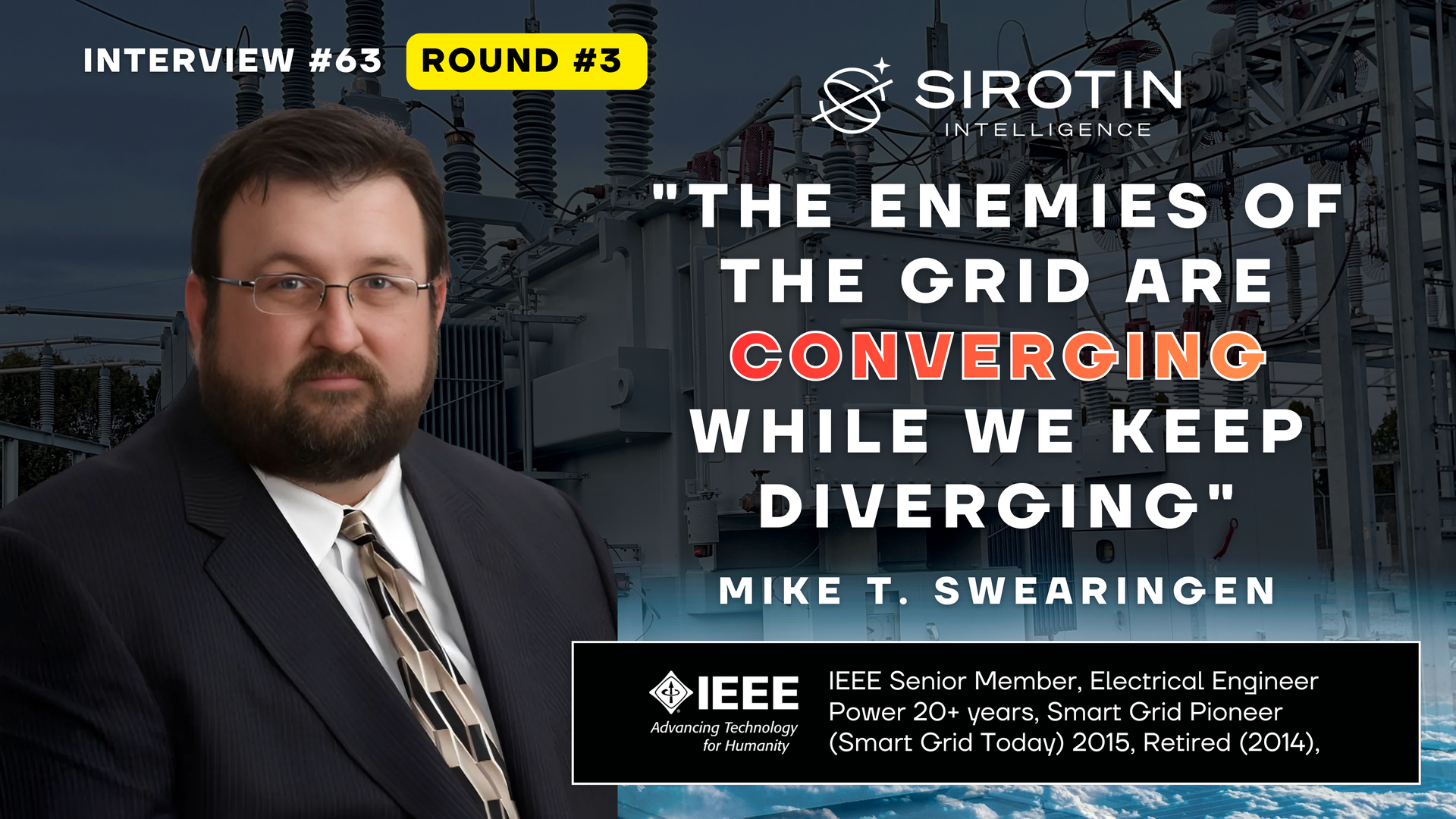
For years, when government agencies could not figure out why something was going wrong with the electric grid, they would call Mike Swearingen. The Department of Energy, the Department of Defense, FERC, utilities facing operational puzzles or security concerns. Swearingen once described his post-retirement role as being "that thick reference book that sits on the shelf with some dust on it." When the usual answers failed, someone would take him off the shelf, dust him off, and start asking questions.
The book is closing now.
Parkinson's disease forced Swearingen out of hands-on engineering over a decade ago, but the requests never stopped. Requests to write analyses, review projects, explain what really happened when the Iberian Peninsula grid collapsed, walk officials through how an adversary might actually take down the system. The demands accumulated until he finally drew a line.
"I told a bunch of them: I'm backing out," Swearingen explains. "The only thing I'm participating in is subcommittee three of the National Electric Safety Code, which writes the standards for electric substations. Beyond that, I'm done."
But before stepping away, he wanted to deliver one final message. A comprehensive assessment of where America's grid actually stands, addressed to anyone willing to listen.
In our first conversation, Swearingen laid out his autonomous grid framework and the cybersecurity approaches adapted from his Air Force space systems experience. In the second, he detailed physical vulnerabilities, Iranian infiltration concerns, and the endemic problem of default passwords protecting critical infrastructure. This third interview is different. He calls it his prophecy.
The threats facing America's power infrastructure are converging toward a common attack surface, while the institutions responsible for defending it continue diverging from any coherent solution. The grid is getting weaker. The people who could fix it are not talking to each other. And the window for action is narrowing faster than policymakers realize.
"This is exactly how it is," Swearingen states. "Whether you like it or not. It's up to you from here."
The grid is getting weaker. You've been saying this for years, but what specifically has changed? What does the operational picture look like right now?
"The grid, as it stands, is getting weaker," Swearingen begins. "The reason for this is the build-out hasn't been as quick as the demands require. The demands of the load are growing. The types of the load are growing. And the way we've handled generation, we're just not thinking it through."
He emphasizes that this observation transcends political affiliation. "I don't care about Republican or Democrat. I'm an engineer that has not only worked on the grid but lived it and breathed it. It's a part of me. So I'm always going to tell you exactly what the situation is. If I upset you, I don't care."
The numbers tell the story. "Back in the early and middle parts of my career, 25% reserve was considered low. We'd say, we need to build out and build up a little more generation reserve. Now 25% is actually a ceiling for a lot of the utilities in the RTOs and the ISOs." Regional transmission organizations and independent system operators are the entities that manage wholesale electricity markets and coordinate grid operations across regions. Their reserve margins, the buffer between available generation capacity and peak demand, have been steadily eroding.
Swearingen worked as an analyst and independent merit reviewer for DOE beginning under the Obama administration. He declined to participate under Biden, citing concerns about competence in the department's formation that he says had nothing to do with political ideology and everything to do with practicality. Under the current Trump administration, his contacts have continued reaching out through established channels. But regardless of who occupies the White House, the fundamental trajectory has remained the same.
"Either way, through the administrations, the electric grid as far as generation still hasn't been handled correctly."
You've described the regulatory environment as almost impossible to navigate. Can you explain how regulatory overlap specifically impedes grid development?
At the end of his career, Swearingen built a regulatory department for the last utility he worked for. He made a joke at the time: regulatory is where old engineers go to die. But the experience gave him deep insight into how regulations interact with operational reality.
"The one problem with regulatory matters is there are so many regulations out there. Not only did they make it hard to develop transmission lines or generation, you had regulations that contradict each other."
He provides a concrete example. "It was not uncommon to sit there with the corporate lawyers and say, okay, we've got to obey this one. Well, we're going to violate that one." The legal calculus became: which regulation is more beneficial for the utility to comply with, and which violation carries less severe consequences? Even regulatory lawyers in government who understood the system recognized this dynamic.
The Bureau of Land Management illustrates how regulatory interpretation can become operationally absurd. Under the Obama administration, the agency adopted an expansive definition of "navigable waters" that included bar ditches along county roads. Substations are typically built near county roads and highways for a reason: they need to be accessible for maintenance and equipment replacement, especially during outages.
"According to them, we were violating the navigable waters rule because we were too close. They said, well, you could put the substation somewhere else. I said, no, that's impractical, because you'd have us putting it out in the middle of a field, and as soon as there was a large rain and a washout, you would call whatever runoff there was navigable waters. You're costing multi-millions of dollars to move substations to places where they can't be maintained, and you're constantly causing the utility to pay more money."
The costs flow downstream. "The big utilities are going to come back for rate recovery. So now you're raising the prices on the very consumers you politically campaign to protect."
Anyone who has noticed transmission lines changing direction repeatedly across the landscape is seeing this regulatory reality mapped onto infrastructure. Sometimes a farmer refused to grant right-of-way. Often, Bureau of Land Management or other agencies required the line to avoid particular areas for environmental or historical preservation reasons. The angles add cost, and added costs eventually affect rates.
"I could go on and on, but I think those are good examples of how regulatory is slowing down creating the backbone that we need in order to build out our system the way we need to build it out."
You've described the entities involved in grid management as operating in "parallel universes." What do you mean by that?
"The interesting thing about all this is it's like a bunch of parallel universes, and some of them are realistic and some of them are not." Swearingen ticks through the list: utilities operate in one universe, government in another, regulatory agencies in yet another. FERC occupies its own space. DOE has its domain. NGOs and advocacy groups orbit the system without ever connecting to operational reality. And then there's the IT and OT communities, the information technology and operational technology specialists who approach grid security from fundamentally different assumptions.
"All these parallel universes can never converge into operating together. This creates a glut that removes the focus of building a system."
Each universe operates according to its own logic. Utilities have to be realistic because they actually operate the grid. But that does not mean utilities are without fault. "They are slow to react when it comes to security. And why is that? It comes down to money."
Investor-owned utilities face a specific structural problem. When they build generation or transmission, they can file with FERC for rate recovery under the "just and reasonable" standard established by the Federal Power Act. If FERC approves the rate case, the utility recovers its investment. But security investments have no equivalent mechanism. "If you do security, there's no rate recovery for that."
The result is predictable. "An IOU is looking at it like, we have these generation issues and we have this transmission issue, we're going to have to find a way to build it. We're going to have to get around the regulatory stuff and that's going to take us a few years. So we've got to invest our money in that. We'll get our money back. But beyond just doing enough to secure the reliability of our grid, we don't really need to take a whole-of-system approach."
Swearingen believes this calculus would change if insurance premiums were tied to security posture and if rate recovery became available. "They would put security up there fairly close to generation and transmission, because now they have a means."
The distribution side of the industry faces different constraints. Roughly 75 to 80 percent of the interstate transmission system serves distribution cooperatives, public power districts, smaller municipal utilities, and city utilities. These entities face hard ceilings on available capital. Cooperatives operate on margins that must be allocated at year end to one of three purposes: paying down debt, reinvesting in the system, or returning capital credits to members. There is no war chest for major security upgrades.
"So you can imagine that they're not going to have a lot of money to invest in cyber security or physical security or anything like that."
The problem extends to outside observers who lack operational experience. "These NGOs and other groups—of course, a majority of them have never run a system. They look at it and say, 'Well, look, you guys have just got to go and do this.' They don't understand the infrastructure involved. When you touch one moving part, you affect all other moving parts, because the whole thing's interconnected."
Congressional hearings on grid security seem to generate more heat than light. What is your experience with how policymakers engage with these issues?
Swearingen has testified before FERC. He has watched countless committee hearings. His assessment is blunt.
"It's a typical committee meeting. All the senators or congressmen always have the same statement. 'Chairman, thank you for bringing up this very important issue that we must deal with concerning our electric grid.' Okay, great. I roll my eyes because I know they're saying that, but in DC it's a political beast. It's a political animal among all the other parallel universes."
"DC is the most unrelatable group because they have created a solipsistic world for themselves," he continues, using a term he returns to repeatedly. "They've created a world in their own mind that they assume has got to be the reality everywhere else, and it's not. And then they wonder why they can't bring the two together."
The best way to describe that world? "It's an echo chamber filled with a cacophony of noise. They make all those statements, but nothing really ever comes out of it."
The witnesses called to testify compound the problem. "The people that they invite are, for the most part, people who never ran a system. That's also the utilities' fault. I think more than ever, utilities need to take their top engineers, the people who have actually been in the trenches and are not that far removed from being in the trenches, and say, hey, look, you want to have these meetings? We'll send these men and women up there."
The deeper issue is cultural. "When it comes to experience, I hate to say this, but we've gotten in a bad habit of valuing your pedigree rather than your actual practical experience."
The issue extends beyond Congress to the national laboratories and policy research institutions. "We hand these studies over to Oak Ridge National Labs or Idaho National Labs. Yeah, they've got smart people there, but the smart people have never really gone out and built a transmission line."
Swearingen recalls his own early education. His mentor, the engineer who hired him, had a particular philosophy about learning the craft. "I would design the substation with him, with a consulting firm, we would work together. And then one day he said, okay, now you go out there to the substation, help them put it together."
Most engineers would take that as an insult. Swearingen understood the purpose. "As I was out there trying to build that substation with the linemen, I saw little things where linemen would get frustrated. Building it like this is kind of stupid. And I'd look at it and think, you know what? They're right. That is stupid. Why do we do that? And then I'd change the design."
"That's where you get to learn the practicalities of engineering, the practicalities of running a system. A lot of these people at Idaho National Labs or Oak Ridge National Labs and several others, they don't understand that, because they've never been there. They've never had to build out the results of what they say should be done."
You mentioned the Iberian Peninsula grid collapse as a case study. What actually happened there, and what does it reveal about our own vulnerabilities?
When Spain and Portugal experienced a major grid disturbance, Swearingen was asked to analyze the event. He examined the data from Red Eléctrica, the Spanish transmission system operator, and identified the root cause within a day.
"They didn't understand that they were operating somewhere in the 70 to 80 percent renewables range," he recalls, noting the precise figure would require checking his notes. "But what they didn't understand is how load curves change as time of day changes. The load started to decrease, and what happened was that caused the system to become what we call leading, where the current leads the voltage."
For readers without electrical engineering backgrounds, the condition he describes involves a fundamental relationship between voltage and current in AC power systems. When current leads voltage, the system experiences what engineers call a leading power factor, typically associated with capacitive loads. This creates specific challenges for grid stability.
"That causing an oscillation is like if you were to take a slinky and pull it out and then hit it in the middle. You'll notice that it will oscillate. That oscillation starts to affect the frequency, which starts to affect the fixed generation." Fixed generation refers to traditional power sources like natural gas, coal, and hydro plants that provide consistent, controllable output. "It causes a system imbalance."
The technical term is sub-synchronous oscillation. The operators had no idea this phenomenon would emerge as renewables reached a certain penetration level. They did not adjust their generation mix to account for the changing system dynamics.
"In the United States, we've had that happen a couple of times, and we're going to have it happen again if we don't change our approach." The saving grace for American utilities has been tight operational parameters. "We are so tight on our parameters that we learn quickly because we can't let them get too far out. But it still doesn't mean it's not going to happen."
What about transmission infrastructure? Is it keeping pace with changing generation sources?
"Transmission is probably in worse shape than the generation," Swearingen states. "And you've got to build transmission lines, which takes, believe it or not, probably even more time than generation. To build an interstate transmission line or tie into a long transmission line, it takes as long as generation, or maybe a little bit longer, because of all the regulatory things I talked about."
There are efforts underway to address the transmission bottleneck. Swearingen has been consulted on high-voltage DC transmission projects. "DC transmission lines are a good solution, because you could create a brand new backbone that could work alongside the AC interstate transmission system." Direct current transmission can move large amounts of power over long distances with lower losses and can connect asynchronous AC grids.
But even promising technical solutions run into the same institutional obstacles. "All the regulatory slows all this down, so we're dealing with the regulatory universe again."
He returns to the fundamental problem: each parallel universe remains focused on its own concerns. "We have ideology and philosophy trying to drive decisions when it should be practical engineering. And a lot of these parallel universes have what I call perception focus."
Swearingen coined this term to describe a particular cognitive trap. "Perception focus means you are so focused on one thing that you say, if I solve this, it solves all other things, because that's what I'm focused on. That's my perception of how it works."
The IT and OT communities exhibit this tendency. "They're like, don't worry about the relay at the substation. We take care of everything else, the communication system. You're not going to have a problem. Wrong." The engineers, meanwhile, dismiss cybersecurity as someone else's domain. Both communities believe solving their piece solves the whole puzzle.
Your colleague Joe Weiss has been warning about Aurora and other vulnerabilities for years. Are those warnings being heeded?
"Since 2012, Joe Weiss and I, besides talking about cyber, we've been trying to remind people of a phenomenon called Aurora, which is an attack where you try to close in systems out of sync in frequency with the system that's operating."
Aurora refers to a vulnerability first demonstrated at Idaho National Laboratory in 2007. By manipulating circuit breakers to connect a generator to the grid when it is out of phase, attackers can cause physical damage to expensive, difficult-to-replace equipment like generators and transformers. The attack leverages the grid's own protective systems against itself.
"They'll say, oh, well, we got safeguards against it. Well, no, you don't. It's been demonstrated." Swearingen has, in classified settings, walked officials through attack scenarios that combine Aurora with other techniques. "If I were going to take down the grid, I would do this, this, this. I would use Aurora here, and I would use this there. And the result was the entire grid goes down, or at least 70 to 80 percent."
He frames his own background as evidence of the problem's accessibility. "I'm just an engineer who is a country boy that grew up in the country. I come from a town of 36,000 people. I graduated from Eastern New Mexico University, not a really big college. So if I can figure that out, then there's tons of engineers that can figure it out. And I could give them multiple strategies. They asked, you mean there's more than one? Yeah, I can give you a whole bunch more if you want me to."
Given all these parallel universes and diverging solutions, what is actually happening to grid security posture?
"Here's my point. While we're not converging to a solution, the threats to the grid are converging." Swearingen lists the attack vectors: cyber intrusions from state actors and criminal groups, physical attacks like the 2013 Metcalf substation shooting and the 2022 North Carolina transformer attacks, electromagnetic pulse concerns, Aurora vulnerabilities, and the operational risks from poorly managed generation transitions.
Add to this the concerns he raised in the second interview about infiltration by foreign military-trained operatives. "State-sponsored military people, sleeper cells that are here in order to be another part of compromising our electric grid."
Then factor in the load growth from server farms and AI data centers. "Part of what made the grid weaker was the server farms. So as we're adding more load, even though some are creating their own generation, that's not necessarily a solution to the overall grid problem."
"So we have all these issues that are enemies of the grid converging, while we, as the people who should be solving it, are diverging."
"In the end, whether they like it or not, and this is not only what I'm afraid of, it's what I'm certain of: this grid's going to go down in a major way sooner than anybody would think. And that's a scary deal. It's not because of anything except what I mentioned here. While we're diverging, the enemies of the grid are converging."
"There's gonna come a day, and I'm afraid that day is not far off, that we're going to reap the disadvantages of our current strategy, and we're going to have to figure out how to deal with it as a reactive force rather than a proactive force."
Is a major grid failure more likely than the terrorist attacks policymakers spend most of their time worrying about?
"Yes, they're not taking it as seriously," Swearingen responds. "There's a lack of understanding, as I stated before, and all these different universes that operate on their own. While they talk about taking it seriously, it's not like they make a major investment in it."
He draws a distinction between intention and action. "Taking something seriously with your words without action is simply talking about something that's going to happen. Taking action instead of talking incessantly about it is what solves the problem. And right now, we are not solving the problem."
"Our electric grid is part of our national security infrastructure, just as much as our nuclear facilities, just as much as our military bases, whether they be Air Force, Marine Corps, Army, or Navy. It's just as important as our Navy fleet. Just as important as all the planes we have. It is as big of a national security asset as the F-22 Raptor or the F-35."
Yet the grid does not receive comparable investment in protection. "We are not taking the physical approach to it that we should. We're just talking about it. That's what's going to lead to our downfall."
When asked whether failure is now inevitable, whether the country simply waits for a crisis before acting, Swearingen's answer is succinct. "Unfortunately, yes. We have a tendency to make huge mistakes and then learn from them, rather than trying to anticipate and prevent them."
Are there any international models we could learn from? Countries that have taken a more proactive approach?
Swearingen has studied international grids and does not find obvious templates to adopt wholesale. "I don't think there's anybody that has a complete grasp of it. Europe had done some good things, but the Iberian incident proved to me there's lack of experience in engineering and some other things."
The structural differences between European and American grids make direct comparisons difficult. "Europe's grid is a lot different from our grid. Never mind that they operate at 50 hertz while we operate at 60. The way they set up their grid is completely different. They have a lot of high-voltage transmission that goes to different places with less distribution infrastructure. We took the opposite approach. Yes, we have a large interstate transmission system, but we have a much larger distribution system."
The geopolitical context also differs. "Unlike them, we are the most powerful nation on earth, at least on paper and in our economy, our military, and everything else. So the pressures on us for security and the threats to our system are much greater than those faced in other countries."
He points to Russia's attacks on Ukrainian grid infrastructure as a microcosm of what could happen in the United States, but notes the consequences would be far more severe given America's position in the world.
"It's up to the United States to develop our own security, and it's up to us to find the right people that have the knowledge and the passion, and then to actually take action rather than just talking."
If you could get this message to the right people, who would that be? Where should this interview land?
Swearingen has thought about this. "I would talk with Department of Energy, where I used to help. I would talk with Department of Defense. Only because they've got to get the entrenched bureaucrats to move."
He would include FERC leadership. "FERC plays an integral part in this."
And ultimately, the principals. "The only other people I would talk to would be the President or Vice President of the United States, only for this reason: they're the head, so they're the ones that have got to push for the changes that need to be made. All these changes need to be discussed with Department of Energy, Department of Defense, FERC. But you still have to have the head up there pushing."
He would not prioritize Congress. "Congress is just there to talk. Congress really doesn't, aside from establishing the Federal Power Act, Congress is really baffled by this. They don't know what to do because the ones who claim they are serious about it, really it's more about what can get me votes."
He mentions Senator Martin Heinrich of New Mexico as an example. "He has some passion, and sometimes he states some things and I think, well, okay, that was good. But for the most part, a lot of them know just enough to be dangerous. We don't need people who know enough to be dangerous. We need people who can move the ball."
The path forward requires specific actions from specific institutions. DOD could treat grid security with the same strategic priority it applies to developing aircraft and submarines. DOE could move past philosophy and toward concrete actions. FERC could examine how the Federal Power Act might enable faster progress. The President and Vice President could make it a top priority and apply pressure, including on EPA and other regulatory agencies to eliminate contradictory rules.
"How do we do that? We talk to engineers and operators and people who are in the system that have to build all this stuff and operate it. We need to ask them what needs to be gotten rid of. They need to talk to people like me."
Author's Analysis
When I first called Swearingen the "engineering prophet" in our initial interview, he deflected. This time, he embraced it. "This whole thing is my prophecy," he told me. "And it's not a prophecy of something that won't happen. It is exactly how the grid is right now. The result is what's going to happen, unless we can make that change from being divergent to convergent very, very quickly."
The structural problems he identifies are verifiable. Reserve margins have declined from comfortable buffers to bare minimums. Security investments have no rate recovery mechanism. The institutions responsible for grid protection operate in parallel universes that, in his words, "can never converge."
Each institution operates rationally within its own constraints. The result is collective irrationality: a system that everyone agrees is vulnerable but no one is positioned to fix.
"Less talk and more action," Swearingen says. "The more we talk, the less secure we are. The less we talk and the more action we take, that's what's going to make the difference."
Whether his warning will be heard by the people with power to act remains, like so much about America's grid security, uncertain. So consider what happens if it isn't.
It begins on a Tuesday in July. The temperature in Phoenix hits 118 degrees. Dallas, Houston, and Atlanta are all above 105. Air conditioners across the Southwest and Southeast are running at maximum capacity. Reserve margins, already thin, drop below five percent in three regional transmission organizations simultaneously.
At 2:47 PM Central Time, a coordinated cyber intrusion activates across seventeen substations in Texas, Oklahoma, and Louisiana. The attack had been months in preparation. The attackers don't shut anything down. They do something more precise: they manipulate relay settings to create a cascading series of false trips. Protective systems, designed to isolate faults, begin isolating healthy equipment.
Within ninety seconds, ERCOT loses 12,000 megawatts of generation capacity. The frequency drops. Automatic load shedding kicks in, but the algorithms weren't designed for this scenario. They shed the wrong loads in the wrong sequence.
By 2:52 PM, the Texas Interconnection separates from emergency ties to the Eastern Interconnection. Eight million customers lose power instantly. The cascading failures, following the physics Swearingen described, propagate through SPP and into MISO.
By 3:15 PM, forty-three million Americans have no electricity. Temperatures inside homes begin rising immediately. Cell towers have battery backup for four to eight hours. Hospitals switch to generators with twenty-four to seventy-two hours of fuel.
Water systems in most municipalities require electricity to pump. Treatment plants go offline. Within six hours, major cities begin issuing boil-water advisories that most residents cannot follow because they have no way to boil water.
The attacks were not coordinated with physical sabotage. The grid's existing fragility, its eroded reserve margins and aging infrastructure and security gaps without funding mechanisms, did most of the work.
Recovery begins immediately. But the specialized transformers that failed will take twelve to eighteen months to manufacture. The utilities, their engineers working around the clock, begin the process of sectionalizing and restoring what they can.
Some areas regain power within days, while others wait weeks. The economic damage exceeds $400 billion. The death toll, concentrated among the elderly and medically vulnerable who could not survive the heat without air conditioning, reaches into the thousands.
Congressional hearings convene within the month. The opening statements are familiar: "Chairman, thank you for bringing up this very important issue that we must deal with concerning our electric grid."
In New Mexico, a retired engineer watches the coverage. He delivered his warning months earlier. Whether anyone acted on it is now a matter of public record. What will it take to make the parallel universes converge?
About Mike T. Swearingen
Mike T. Swearingen is a retired electric cooperative power systems engineer with over 20 years of experience working in every aspect of power systems operation including control systems, protection systems, transmission design, substation design, distribution design, and NERC compliance as well as regulatory matters. Named a Smart Grid Pioneer by Smart Grid Today in 2015, he is an IEEE Senior Member and holds a patent for a "Security System, Device, and Method for Operational Technology Networks."
Swearingen began his career as a Space Equipment Maintenance Specialist with the United States Air Force at Joint Defense Facility Nurrungar in Australia from 1992-1994 in support of Desert Shield and Desert Storm operations. After completing his Bachelor of Science in Computer Science/Mathematics Engineering at Eastern New Mexico University, he spent his civilian career with rural electric cooperatives, progressing from Engineering Assistant, Engineering and Operations Manager to Regulatory Compliance Manager before retiring in 2014 due to Parkinson's disease.
Throughout his career, Swearingen has been deeply involved in industry standards development and regulatory processes. He represented his cooperative as a member of the Southwest Power Pool's Transmission Working Group (TWG), Market Operations and Policy Committee (MOPC), and Market Working Group (MWG). He served as an analyst and independent merit reviewer on several projects at the Department of Energy (DOE) and was a technical advisor for the National Electric Energy Testing Research and Applications Center (NEETRAC). He has recently been reinstated to the National Electric Safety Code subcommittee for electric stations.
As an author and researcher, Swearingen has presented and published two IEEE papers: "Real Time Evaluation and Operation of the Smart Grid using Game Theory" and "Regulatory Evolution and its Effect on System Operations and Security." He has published several articles for different periodicals within the power industry and has a paper on ResearchGate titled "Autonomous Self Aware Living Grid." He has participated in and reviewed several standards for publication and serves as an IEEE peer reviewer.
Swearingen co-authored IEEE Computer Magazine articles "There Is No Chilling When Your Control System Cybersecurity Is Unfulfilling" and "Resilient Without Zero Trust." He has spoken at the U.S. Air Force Cyber College, the National Sheriffs Association Annual Conference, ICS Cybersecurity Conferences, and NRECA TechAdvantage. He has also worked with Navy Surface Warfare and Dahlgren Labs on cybersecurity and the AURORA vulnerability.
This interview represents Swearingen's final major public statement on grid security and infrastructure. He continues to follow developments in the industry but has stepped back from active consultation.
For more information, contact Mike at michaeltswearingen@gmail.com
Further Reading:
Get exclusive insights from our network of NASA veterans, DARPA program managers, and space industry pioneers. Weekly. No jargon.