
"Every Exoskeleton on Earth Has It Wrong": Robert Carriere, Inventor of the Kinetic Resistance Apparatus, on Passive Augmentation and the Future of Human Performance in Space and on Earth

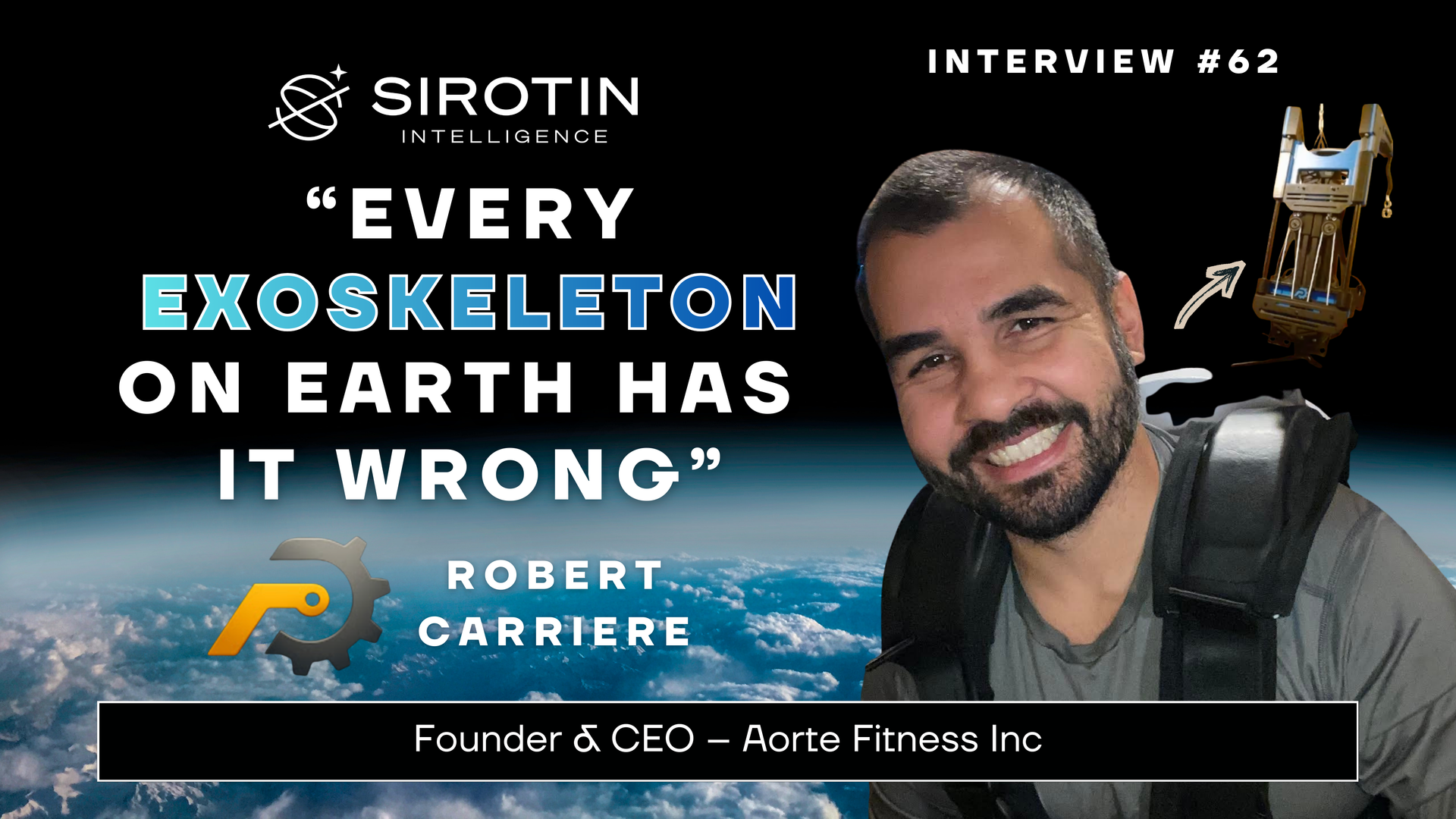
Astronauts on EVA spend hours fighting their own suits. The pressurization that keeps them alive also resists every movement. Tools drift away. Grip fatigue accumulates. And in microgravity, stopping a moving object is just as exhausting as starting it, because inertia doesn't care that you're weightless.
Robert Carriere thinks he solved this problem in his basement in Ontario. Using pulleys.
Think Tony Stark, but swap the arc reactor for something that works precisely because it has no power source at all.
The device looks almost primitive: a compact frame between the shoulder blades, a continuous cord running through sheaves in a W-pattern, springs for tension, tethers to the hands or tool. When you pull down with your right arm, the cord lifts your left. Your own muscles become the motor. There are no batteries, no electronics required. The Canadian Space Agency reviewed the mathematics in 2014 and validated it. NASA and ESA stakeholders have since seen demonstrations. The underlying physics, capstan mechanics and Hooke's Law, predate electricity by centuries.
A video of Carriere demonstrating the device went viral, accumulating half a million views across social media in a matter of days. In the footage, movements that should require strain appear effortless. He describes a 70-pound load feeling like five or six pounds. What caught attention was less the lift assist than what happened when he took the device off mid-task and found he could not continue. His nervous system had already adapted to the bilateral force transfer. His brain expected the feedback loop that was suddenly gone.
This is the Kinetic Resistance Apparatus. It offloads 35 to 50 pounds while preserving full mobility. It has reached technology readiness level 7. The patent expires in 2036. And almost nobody in the exoskeleton industry wanted to hear about it.
That simplicity is precisely what makes the industry uncomfortable. The following conversation explores why a basement inventor with no defense contracts outpaced programs with hundred-million-dollar budgets, what happens to the brain when it starts treating a mechanical system as part of its own body, and whether anyone with the resources to scale this technology will recognize what Carriere built before the patent window closes.
You've spent fifteen years developing the Kinetic Resistance Apparatus, largely alone, without the resources of a Lockheed or Sarcos. What led you here, and why did you stay when the industry ignored you?
"I didn't pick this up in university and decide to make a career of it," Carriere begins. "That's where, in my view, the exoskeleton and robotics people have it wrong. They studied mechatronics, got hired by a company, and started iterating on existing concepts. Different story for me entirely."
The path started earlier than most origin stories. Carriere was identified as gifted early and grew up under the literal infrastructure of his father's plastics engineering business, learning manufacturing and mechanical systems by proximity. His mother taught him mathematics with physical cubes. He became a national Lego champion, though his approach differed from typical builders.
"I didn't make spaceships. I covered myself in it. I made gloves and hats. The passion to cover myself with something started from inception."
Then came the injury that shaped everything. At thirteen, Carriere stepped on a glass bottle. The glass penetrated deep into his foot, and a medical error left fragments inside. "I still have a cane when it gets really cold. I've always been disbalanced. My body has always had this polyaxial twist that I was fighting."
That physical asymmetry drove obsessive thinking about equilibrium. In university, Carriere developed what he describes as a mechanical application of game theory principles, an attempt to balance two sides of an equation using physical systems. He challenged Newton. He challenged Nash. The university dismissed his mathematics.
He persisted anyway.
"The theory just wouldn't leave my head. I can balance two sides of the equation on a mechanical front. Everybody still thought I was crazy. To be honest, fifteen years later, people still think I'm a little bit on the crazy side. But I built it. The proof is right here."
He submitted the concept to the Canadian Space Agency around 2014. "They loved it. They said your math is valid, the logic is valid. It doesn't apply right now because of iRED and ARED systems, but maybe in the future it does."
That future, Carriere believes, has arrived.
Programs like DARPA's Warrior Web and TALOS consumed hundreds of millions chasing powered exoskeletons. The KRA uses pulleys and cords with no power source. Why does passive beat active for the warfighter?
Carriere is careful not to dismiss the engineers working on competing systems. "These are talented people. They can do things I can't, especially the mechatronics engineers with PhDs in specific movement domains. But as a whole, the vision is gone."
The industry, in his view, has split into two camps that both miss the point. Active exoskeletons use motors and actuators to add torque at specific joints. Passive exoskeletons use elastic tethers and springs to offload strain. Both approaches share a fundamental limitation: they operate unilaterally, isolating specific body parts rather than treating the human as an integrated system.
"You see all these exoskeletons with a fixed anchor right here at the shoulder," Carriere demonstrates. "Great for isolating the shoulder. How does it help with anything else? How does it help with the neurological transfer, the cognitive transfer? Maybe it's great if you're putting a rivet into the side of a naval ship for that one oriented task. It's not good for anything else."
The problems compound for powered systems in operational environments. Thermal signatures give away positions. Electromagnetic emissions interfere with sensitive equipment. Charging logistics add complexity to already strained supply chains. And failure modes under load tend to occur precisely when operators need the system most.
"Let's say you're a Navy SEAL and you go through water. Even if you have the most sealed unit in the world, something can go wrong. What if your powered system only lasts six hours? Now look at Project TALOS. They had to start considering nuclear batteries because the thing got so heavy and power-hungry. It went so far out of direction they essentially shelved it."
For comparison, consider two systems often cited in defense contexts. Lockheed Martin's ONYX is a powered lower-body exoskeleton, primarily knee-focused, using motors and AI to reduce leg fatigue. Mawashi's UPRISE is a passive system that redirects load from the shoulders down through a frame into the ground. Both represent serious engineering, and both address isolated portions of the problem. Yet neither transfers force bilaterally across the body, keeps the brain's balance systems continuously engaged, or works the same way whether you are standing, kneeling, prone, or inverted.
The KRA takes a different approach entirely. Instead of adding external force at fixed points, it routes force through the body using a continuous cord system. When you pull down with your right arm, the cord transfers that motion through a series of sheaves, and your left arm receives lift assistance. The opposing limb becomes the actuator. The brain stays involved in every movement. Carriere calls it a "smart tendon," designed from scratch for the human body rather than adapted from industrial servo motors that were never meant to interface with human neurology.
Most exoskeletons attempt to replace your muscles with motors. The KRA takes a different approach, making your muscles work together more efficiently. Your right tricep helps lift your left bicep's load, or vice versa. Your legs can assist your arms, or one leg can assist the other. The system allows force to be shared across limbs in a task-dependent way. It redistributes the force you are already generating rather than adding external force. The KRA enables bilateral limb-to-limb, limb-to-load, or load-to-load force transfer, directing effort into your body's strongest muscle chains.
"Where everybody's trying to shorten the length of travel, I've elongated it. So I'm widely rejected in the exoskeleton field as this guy who's trying to go big or go home. But I'm not going big. I'm going very small, compact, and stealth, while the internal elements go long."
Most exoskeleton designers try to minimize cord travel in their systems. The KRA does the opposite, elongating it. Why is that the critical variable?
The length of cord travel through the system turns out to be the critical variable that most exoskeleton designers have optimized in the wrong direction.
"The longer you have, the more sensory data you can upload. The more of an internal measurement tool it becomes for robotics and AI interfaces. We're measuring stuff versus just lifting it. And at the end of the day, we're also lifting. We kind of kill all of the birds with one really compact element while still remaining passive."
Greater travel enables a more controllable force curve. It increases damping and mitigation for tremor and recoil. It improves measurability of load and motion, enabling real-time analysis, data uplink, and adaptive control.
The tremor reduction capability illustrates the principle. Carriere returns to the example of the elderly person struggling with a five-pound weight.
"Take a 100-year-old individual. Give them a five-pound weight. They're shaking. That five pounds now feels like 100 pounds because of the tremor. Now stabilize it. It feels like five pounds again. What just happened? How did that mass variant change from 100 to five without changing the mass of the object?"
The answer lies in how the bilateral system dampens oscillations. Small movements on one side are counterbalanced by the opposing side, smoothing the force curve rather than amplifying instability. The same principle applies to firearm stabilization, precision tool work, and any task where tremor degrades performance.
"If we can control tremor and mitigate that tremor, we've solved a huge portion of the problem. Then it moves into neurological rehabilitation plus physical rehabilitation. This is going to be relevant for cerebral palsy, Rett syndrome, stroke recovery. Because we can balance the human brain."
The KRA is purely mechanical, yet you've built a software platform called SHIFT-FORCE to analyze its data. How does a passive system generate useful metrics for AI, and what does the software actually measure?
Carriere argues that current exoskeleton companies approach AI integration backwards.
"They're crossing that bridge into AI with very stern analytics. Lab-tested results. They simulate a box lift. Great industrial box squat. Have you ever seen that done in the real world? Maybe once in the morning when you're primed and in perfect form. Then as the day goes by, you're strange, you're tired, you're moving this way and that way."
The problem is that AI uplinks in current systems target isolated metrics: percentage reduction in musculoskeletal stress on specific joints, return-on-investment calculations for corporate buyers. They optimize for the lab rather than the field.
"None of those exoskeleton companies are really going to stand the test of time. They're missing that Apple vision, the technology that will stand into the final frontier."
The KRA generates data differently. With bilateral force transfer through a continuous cord system, two sensor points capture force differentials across every task.
"Those left and right force metrics can be received with every task you're doing. Whether you're lifting a basket of laundry, picking up a cup, using a precision tool, or holding a firearm."
This is where SHIFT-FORCE comes in. Carriere's software platform processes the bilateral force data in real time, tracking symmetry, analyzing load distribution, and mapping adaptive resistance. The interface displays left and right force readings, equilibrium status, and tremor reduction percentages. Technical specifications from the current prototype show a force range of 0-12.5 kg per side, precision of ±0.03 degrees, and response time under 10 milliseconds. The system includes presets for industrial, defense, rehabilitation, and space applications. Force vectors can be visualized and manipulated in real time.
"We can simulate gravity by attaching it to your legs. Before you know it, are you in a resistance trainer, or are you in a higher gravity environment? Are you in water? If I put this on and wear it, it feels like I'm swimming. It feels like I have mass just loaded on top of me."
The neurological dimension matters as much as the mechanical.
"A lot of people say they will never put on an exoskeleton in their life because it's uncomfortable. Maybe not physically, but it doesn't feel right mentally. There's a disconnect." Carriere's solution is to design for seamless integration with the brain's existing balance systems. "You have to make the human brain get reprogrammed once into wearing a suit. That's where it has to be seamless. It has to be focused on balance. The AI uplink needs to be continuous and constant."
The adaptation happens faster than most people expect. Within minutes of putting on the KRA, users begin relying on the bilateral feedback loop. Within hours, the brain starts treating the device as an extension of its existing motor control systems. Carriere discovered this when he took off the device mid-task and found his body confused by the absence of the feedback it had already learned to expect.
The KRA is "endo-skeletal" rather than exo-skeletal, sitting beneath gear instead of over it. What's the operational difference for someone in full kit?
"Exoskeletal systems rely on external frames that support or offload load," Carriere explains. "Endoskeletal systems, as I define them, function as tendon-like internal routing layers."
The difference becomes obvious when you picture a soldier in full kit. An external exoskeleton frame adds bulk, creates snag points on doorways and vegetation, and restricts the ability to go prone or crawl through confined spaces. An endoskeletal system like the KRA sits beneath the plate carrier, invisible from the outside. The cords route along the body in task-dependent triangular paths, while the pulleys nestle against the spine. Nothing protrudes or catches on the environment.
The practical implications become clear in operational contexts. Endoskeletal architecture can operate under armor and mission gear. It reduces snag hazards. It preserves shouldering, prone positioning, crawling, and dynamic movement patterns that external frames would restrict.
"As the system evolves, this routing layer becomes a discrete, stealth element. It's hidden beneath equipment while simultaneously supporting and managing multiple subsystems, including precision tools, communications gear, medical technologies, and eventually directed-energy or AI-assisted platforms."
This positions the KRA as a foundational layer for future integrated wearables – internal lift-assist and steering support for mecha suits or jet propulsion systems, load management for MOLLEs and rucksacks, even a dynamic sling for firearms. For powered programs that struggled with weight and battery life, a passive bilateral underlayer could reduce motor load and extend operational time.
The same routing principles enable haptic control. Hand motion and load feedback can steer or interface with autonomous systems.
"This is the evolution of the tactical sling concept into a fully integrated control layer. You're not just carrying a weapon or a tool. You're creating a neural network between the operator and their equipment."
From a defense perspective, the advantages compound. There is no electromagnetic signature for detection, no thermal output beyond the operator's body heat, no failure modes from power loss, and no charging logistics to manage. The system works in water, in mud, and in electromagnetic pulse environments.
"The wars of tomorrow, if we're going to fight them in outer space, sometimes the wars of tomorrow are who can repair that satellite. And if you're in the KRA, you can repair it faster. Your tool is not going to get away from you. You know exactly where it is. It's coming straight back to you."
EVA suits are notoriously fatiguing, and astronauts constantly chase tools that drift away in microgravity. How would the KRA integrate with spacesuit architecture?
"EVA fatigue arises primarily from suit pressurization stiffness, joint torques, grip fatigue, and continuous micro-corrections," Carriere explains. "It's not absolute load alone. People on Earth who aren't familiar with microgravity say everything's easy up there. No. It's dangerous. Once that object starts moving, good luck controlling that mass."
He illustrates with a scenario.
"You're using a 30-kilogram precision tool on a spacewalk. That tool doesn't feel like 30 kilograms in microgravity. But then you start using it, and it starts to shift. And it doesn't stop shifting. Inertia allows that tool to keep going. Stopping it is tricky. A motorized exoskeleton would have to predict the movement to stop it. If it can't predict it, how does it stop it?"
The KRA approach keeps the tool in a constant loop cycle. The cord connecting to the tool runs through the shoulder-mounted sheaves, maintaining gentle tension at all times.
"It pulls right back to you. It doesn't have to pull back fast, but it's cognitively in a movement-centralized system. You're no longer accounting for that mass of the object. All you're accounting for is steering and maneuvering."
In Carriere's terrestrial demos, this manifests as tools that snap back to ready position the moment you release grip pressure. A shovel returns to center, a drill retracts to your hip, and a weapon stays exactly where you expect it. The same principle applies in microgravity, though the stakes are higher: a tool that floats away during an EVA is not just inconvenient but potentially mission-ending.
NASA already employs EVA safety tethering concepts. Carriere sees KRA as an extension of that principle, functioning as a passive force-routing layer capable of supporting precision tools, tool caddies, sustained reach, and asymmetric equipment loads.
Prior engagement includes early CSA technical review and approval, along with exploratory conversations involving ESA and NASA stakeholders.
"These discussions were preliminary and focused on identifying appropriate EVA and training subsystem integration pathways, including relevance to emerging Space Force requirements. This is where your network comes in handy."
The KRA has been described as "gravity-invariant." What does that mean for lunar or Martian surface operations, where weight drops but inertia doesn't?
"In partial gravity environments, weight decreases but inertia does not," Carriere states. "Tools, equipment, and bodies still resist acceleration and control, creating fatigue and instability."
Powered systems face significant challenges in these environments: dust exposure, thermal management, charging infrastructure, and maintenance requirements. Passive mechanical systems offer continuous duty, robustness, and field repairability independent of infrastructure.
"When described conservatively, KRA's gravity-invariant behavior means the system manages force moments and vectors regardless of gravity level. It maintains predictable control whether in 1 g, 1/6 g, or 1/3 g environments."
The mechanical principles remain constant across gravitational contexts.
"Space isn't going to change the spring. It's not going to change the length of the rope. It might change some of the slack, but eventually we're going to create suspension tether systems on the inside between the carabiners. What you're going to have is this fluid, sound motion system, taking the stress off the heart, taking the stress off the brain."
Carriere frames this as the difference between controlling mass and controlling momentum.
"Where is that tremor energy going when you're running with a firearm? Where is it going? Why aren't we harnessing it? In my opinion, I can make it disappear. Or I can transfer it to kinetic energy, or electricity. The patent includes energy recovery. We're still transferring kinetic energy. We're still transferring force. We may as well utilize it."
Astronauts lose muscle and bone density in microgravity, and current countermeasures require hours of dedicated exercise. Could the KRA work as an in-flight countermeasure for deconditioning?
Carriere sees the resistance exercise application as one of the most immediate paths to space deployment.
"Systems like ARED are effective but bulky, structured, and location-dependent. You have to go to a specific location on the station, strap in, and spend dedicated time. KRA offers something different: a wearable, high-frequency micro-session system. You're enabling continuous conditioning during daily tasks."
The bilateral force transfer creates resistance that can be tuned from subtle to significant. An astronaut wearing the system while performing routine maintenance would experience constant low-level loading, the kind of frequent stimulus that research suggests may be more effective than concentrated exercise sessions.
"The simplicity of these mechanical principles highlights how early we remain as a species in fully exploiting foundational physics. Elegant solutions often appear simple in hindsight, even when their outputs are complex."
Integrated with SHIFT-FORCE, the system tracks symmetry, analyzes force distribution, and maps adaptive resistance over time. The software can flag developing imbalances before they become injuries.
"So if you're on the space station, you have one item that is your fitness suit, your EVA tether, and your measurement tool of how healthy you are. Three functions, one device, no power required."
The KRA has reached TRL-7, the prototypes work, and the software is complete. What's the realistic path to getting this on an astronaut, a soldier, or a patient?
"Here's the fun part," Carriere says. "I move at the speed of whatever funding or bureaucracy allows. And I move at the speed of what we need."
He gestures to the 3D printer running behind him during our conversation, producing new components for the next iteration. The current prototype weighs roughly six pounds and can be assembled in his workshop in three days. The manufacturing is deliberately low-tech, relying on off-the-shelf pulleys, standard springs, 3D-printed housings, and commodity cord. There is nothing exotic, nothing that requires specialized supply chains.
"Right now it's just me and my father. I'm very fortunate to have a father who's a savant. When I get stuck, I just go to him. Resolder this to this, let's reprint that, and it's done. The prototypes, I can rip one of these out in three days. It's already pretty cool. You put that on, you're lifting 50 pounds and mitigating that 50 pounds."
The system has reached a state where pilot testing could begin immediately with appropriate partners.
"I'm ready to ship one of these to NASA and say, put this on an astronaut on Earth. Give me your feedback. We iterate. We can go as fast as the funding allows us to. The software is complete. I even have the upload to put into a visor for aim control."
Carriere sees applications across defense, industrial safety, rehabilitation, and space. The challenge has been finding the right audience.
"I've spent the last year talking to high-IQ savants, and I started to realize it's not what I'm saying. It's the audience I'm putting it in front of. I'm starting to gain that audience that actually understands what I'm doing."
He's philosophical about competitors who have adopted fragments of his concepts.
"I've had one company overseas completely copycat the idea, but without the pulleys. And I start to say, wow, that's great for marketing. They're putting the concept out that there's an exoskeleton that can do this. But only mine can do it effectively. The copycats are actually working in my favor. They're missing the key elements."
The KRA patent expires in 2036. The continuation patents could extend protection further. But Carriere seems less concerned with intellectual property defense than with getting the technology deployed.
"If our soldiers and our people and our leaders never surrender, nor will I. I will get this on them. I will change the course of history with it. That's my life's goal."
Author's Analysis
It is 2035. A four-person crew is conducting surface operations at the lunar south pole, moving equipment from a lander to a habitat construction site roughly 200 meters away. Each crew member wears a six-pound passive endoskeleton beneath their suit. The device has no battery to drain, no motor vulnerable to lunar dust, no charging station to return to.
When an astronaut lifts a 50-kilogram container, the bilateral cord system routes force through their core and into their legs. The load feels closer to 15 kilograms. They have been working for six hours. The system performs exactly as it did in hour one.
Nearby, a second crew tests a powered exoskeleton prototype. The battery indicator shows 18 percent. The motors are running hot, struggling with thermal dissipation in the vacuum. By hour four, the system enters low-power mode. By hour five, it shuts down entirely. The astronaut removes it and continues working unassisted, now carrying both the equipment and the dead weight of the exoskeleton frame.
The crew wearing Carriere's device finishes their shift at hour eight. The pulleys still turn. The springs still compress. The cords still route force bilaterally. Nothing has degraded. Nothing needs to be recharged.
Consider what this might mean for Artemis surface operations, where EVA time is limited by suit consumables and crew fatigue. Consider what it might mean for Mars transit, where every kilogram of equipment competes with life support mass. Consider what it might mean for a soldier on a 72-hour patrol, or a factory worker on their eighth consecutive shift, or a stroke patient relearning how to lift their own arm.
The physics works. The prototype exists. The question is whether anyone with the resources to scale it will recognize what Carriere built before the patent window closes in 2036. And if they do, what happens to the billions already invested in powered alternatives?
About Robert Carriere Jr.
Robert Carriere Jr. is a patented inventor and founder of Aorte Fitness Inc., working at the intersection of biomechanics, mechanical systems, and human-machine integration. He is the inventor of the Kinetic Resistance Apparatus (KRA), a patented passive endoskeletal system (US10,888,728) that redefines how force is distributed, stabilized, and transferred through the human body.
Carriere's work centers on what he terms Endo-Skeletal Equilibrium Augmentation (ESEA), a mechanical framework that enables bilateral load shifting, tremor mitigation, and force redirection using pulleys, springs, cords, and linear rails without motors, batteries, or powered actuation. The KRA has reached TRL-7, demonstrating the ability to offload 35 to 50 pounds of operational load while preserving mobility and fine motor control.
Complementing the hardware is SHIFT-FORCE, a software platform that translates kinetic equilibrium into measurable data, enabling real-time analysis, simulation, and optimization of human movement and mechanical interaction.
His work spans defense, industrial safety, rehabilitation, and robotics, with applications ranging from weapon and tool stabilization to injury prevention, gait correction, haptic control, and EVA-adjacent systems. A second-generation patented inventor, Carriere is focused on advancing practical, ethical, and scalable approaches to human-machine systems grounded in mechanical reality rather than powered dependency.
He is based in Brights Grove, Ontario, Canada.
For more information, contact Robert directly on LinkedIn.
Patent References:
- Continuation Patent (US10,888,728B2): https://patents.google.com/patent/US10888728B2/en
- Original Patent (US20160206912A1): https://patents.google.com/patent/US20160206912A1/en
Further Resources:
KRA Hardware & Software Walkthrough
Get exclusive insights from our network of NASA veterans, DARPA program managers, and space industry pioneers. Weekly. No jargon.