
SPECIAL FEATURE: "The Third World War Is Already Underway": Major General Vladyslav Klochkov, Former Chief of Moral-Psychological Support for Ukraine's Armed Forces, on Why Ukraine Is the Central Node of Global Transformation

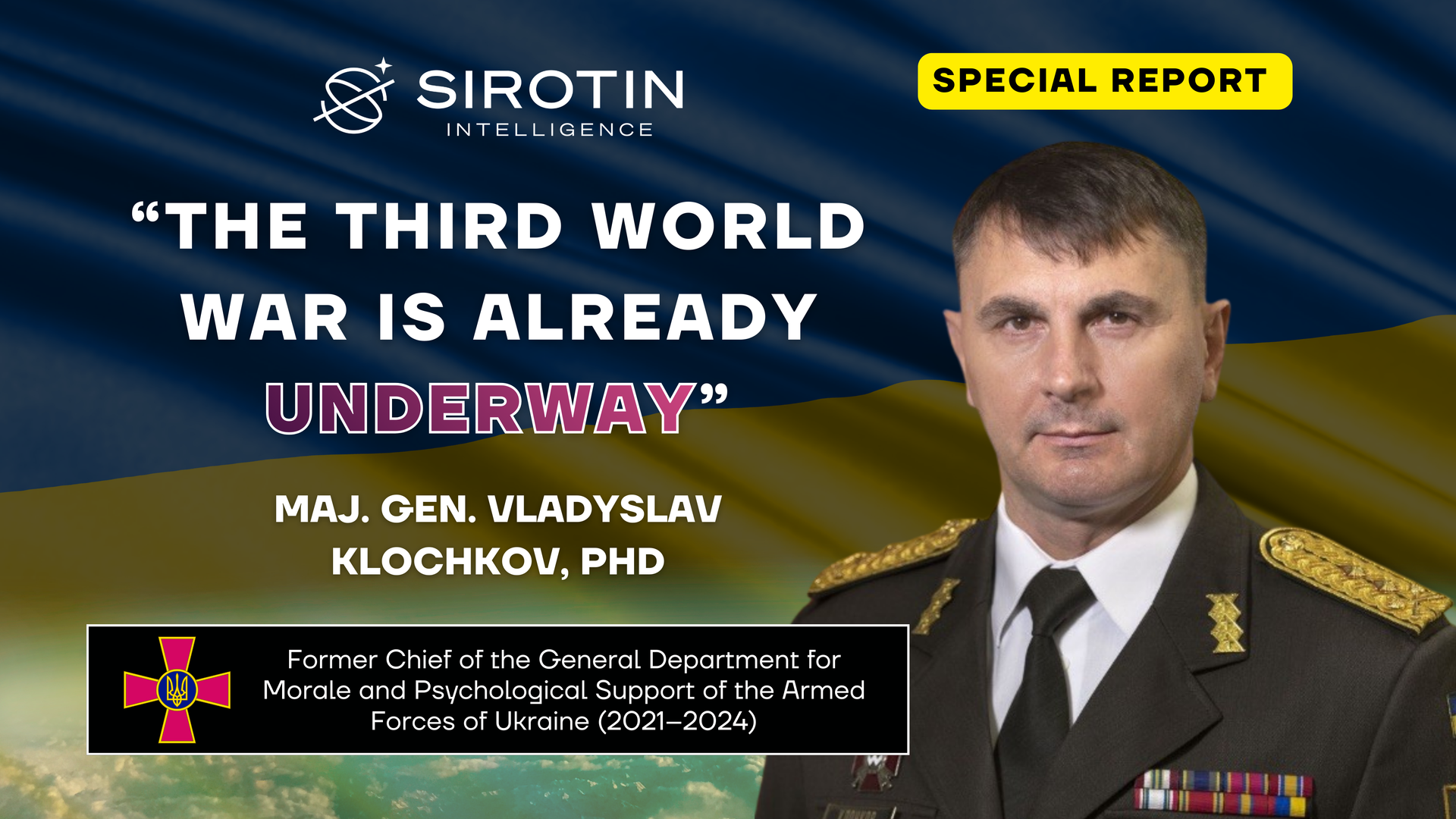
When Major General Vladyslav Klochkov spoke with us in September 2025, the conversation was about minds. How you stabilize soldiers psychologically in real time, under fire, and return them to formation within hours. How TikTok became a battlefield more strategically significant than some physical fronts. How peer-to-peer therapy embedded in combat command kept Ukrainian forces fighting through Bakhmut when conventional logic said they should have broken. Seven months later, Klochkov has shifted registers entirely. At a roundtable on global geopolitical transformations, the former Chief of the General Directorate of Moral and Psychological Support for Ukraine's Armed Forces (2021 to 2024) is no longer talking about the psychological dimension. He is presenting a structural thesis: that the world has already entered a Third World War, that it operates across kinetic, economic, informational, technological, and cognitive domains simultaneously, and that Ukraine sits at its center. What follows is the full text of his address, translated from Ukrainian, followed by analysis.
Full Address: Roundtable Discussion Theses
Topic: "Global Geopolitical Transformations of Ukraine and the World in 2026 Under the Conditions of a Third World War"
Speaker: Major General Vladyslav Klochkov
Speaking time: 10 minutes
Translated from Ukrainian
Distinguished Ladies and Gentlemen!
It is a great honor for me to be invited to participate in this roundtable dedicated to discussing extraordinarily pressing issues of our time, the place and role of Ukraine in global geopolitical transformations under the conditions of a Third World War.
The year 2025 definitively cemented a reality that had long been spoken of cautiously, and at times its direct articulation was avoided altogether. Today we live under the conditions of a Third World War, one that takes not a classical, but a hybrid, distributed, and asymmetric form. It has not been formally declared, yet it manifests through systemic military, political, economic, technological, and informational confrontations on a global scale.
In this war, Ukraine is not a peripheral theater of operations or a "regional case," but a central node in the transformation of the world order. The beginning of 2026 is characterized by profound changes in the international system, which can increasingly be described as a state of global war of a new type, without clearly defined front lines, but with total engagement of political, economic, informational, and technological resources. In this context, Ukraine remains one of the key geopolitical players in the current global confrontation.
Today it can be clearly stated that the world in 2026 has definitively moved away from the unipolar model. A conflictual multipolarity is forming, within which:
- the role of regional power centers is growing;
- the confrontation between democratic and authoritarian models of development is intensifying;
- international institutions are unfortunately losing their influence over the regulation of global security.
The Third World War in its modern understanding manifests not only in military action, but also in sanctions wars, cyberattacks, struggles over resources, information influence, and technological superiority. Unlike the First and Second World Wars, the current war:
- has no single front;
- is not limited to official declarations;
- combines kinetic combat operations with economic, energy, technological, and cognitive dimensions, which we directly feel every day. Unfortunately.
We are witnessing a fragmented global war, where combat operations in Ukraine, conflicts in the Middle East, tensions in the Indo-Pacific region, sanctions and trade wars, and attacks on critical infrastructure are all components of a single global process. The key distinction of this war is that strikes are directed not only against armies, but against states as systems, along with their populations, economies, and societal resilience. The Russian Federation's approach to conducting military operations in Ukraine clearly demonstrates this.
For Ukraine, 2025, and now 2026, has become a stage of transition from the role of an object of international politics to a fully-fledged geopolitical subject. This is manifested in:
- strategic partnership with Western states;
- active participation in shaping the regional security system;
- growing diplomatic and military-political agency.
Ukraine has become a space in which international norms, principles of sovereignty, and collective security are being transformed.
Today, Ukraine is no longer perceived solely as a victim state of aggression. It has become:
- a proving ground for modern 21st-century warfare;
- a source of unique combat experience;
- a factor in the transformation of the military doctrines of NATO and partner states.
Ukraine has proven the possibility of intercepting hypersonic missiles, adapting Western air defense systems to new types of threats, and maintaining the functioning of the state under conditions of systematic terror against civilian infrastructure. This changes not only the understanding of defense, but also the role of medium-sized states in the global security system. After the conclusion of combat operations, Ukraine has every reason to assume a worthy place not only as a regional, but also as a global player in the field of security.
The European continent has returned to a deep analysis of its own capabilities regarding future military challenges, to the logic of forceful deterrence, a rethinking of neutrality, and the formation of a long-term security economy. In this context, Ukraine:
- has become the eastern shield of Europe;
- is integrating not only politically, but also militarily and technologically;
- is forming a new security architecture for Eastern Europe.
In fact, without Ukraine, European security no longer exists as a self-sufficient concept. The war in Ukraine has also triggered a reassessment of energy and food security, the militarization of the economies of leading states, the growing role of defense alliances, and a rethinking of neutrality.
In my view, the main challenges of 2026 remain:
- the risk of escalation of local conflicts into global ones;
- the intensification of information manipulation;
- the fragmentation of the global economy.
At the same time, opportunities are opening for the formation of a new security architecture in which Ukraine can play the role not only of an outpost, but also of an active participant in making strategic decisions. In the event that agreements are not reached, Russia will continue its missile terror against civilian infrastructure, combining military strikes with political signals and attempting to impose the logic of fear as an instrument of diplomacy.
The Third World War is already underway, and its key feature is a struggle not only for territories, but for models of the future world. Ukraine in 2026 is not an object, but a subject of global geopolitical transformations. The outcome of the war in Ukraine will determine the security architecture of Europe, the effectiveness of international law, and the role of force in the 21st century.
The geopolitical transformations of 2026 indicate that the world has entered a prolonged period of instability. Under these conditions, Ukraine acts not only as a victim of global conflict, but also as a factor in shaping a new world order.
Thank you for your attention. I am ready for discussion and questions.
Sirotin Intelligence Analysis
The word worth pausing on in Klochkov's address is "system." When he describes strikes directed against states as systems, he is identifying something that most Western analytical frameworks still classify as escalation. But for anyone tracking Russian operations in Ukraine since 2022, the simultaneous targeting of energy grids, water infrastructure, civilian logistics, information networks, and economic confidence looks less like escalation and more like baseline doctrine. Russia did not arrive at this approach through frustration. It is executing a coherent theory of warfare in which the relevant target is the coherence of a society, not the position of an army. Klochkov names this directly, and the naming matters. It reframes the central question from how to win engagements to how a state sustains itself under multi-domain assault over years. That reframing, in turn, helps explain the shape of NATO procurement in 2026: proliferated satellite constellations, resilient energy architecture, cognitive security programs. Four years ago, most of these line items did not exist. Now they absorb hundreds of billions in spending. The connection between what Russia demonstrated in Ukraine and what Western defense budgets now prioritize is, at this point, fairly direct.
His framing of "conflictual multipolarity" deserves similar attention. In Klochkov's telling, the unipolar moment has ended, and what replaced it is an unstable contest between competing civilizational models, with Ukraine functioning as the central stress test. When he spoke with us in September 2025, he described Russia as a vassal operating within an axis directed by Beijing, with North Korea and Iran as suppliers. This address extends that logic. If the war's outcome shapes international law and the role of force for the rest of the century, as he argues, then bilateral negotiation with Moscow alone cannot produce a durable settlement. The relevant interests and calculations extend to Beijing, Pyongyang, and Tehran. Any architecture that accounts only for Russia will, in this framing, fail structurally. One can disagree with the "Third World War" label and still find the analytical scaffolding beneath it serious. Klochkov is describing a condition in which the old categories, "regional conflict" on one end, "great power competition" on the other, have merged into a single interconnected confrontation operating across kinetic, economic, informational, technological, and cognitive domains at once.
Perhaps the most consequential claim in the address is also the least dramatic. Klochkov argues that Ukraine has completed a transition from object to subject in international politics, and he supports this with capabilities rather than rhetoric: hypersonic missile interception, the adaptation of Western air defense systems to threat profiles they were not originally designed for, the sustained functioning of state institutions under systematic infrastructure terror. These results have already influenced NATO doctrine, reshaped European defense spending, and shifted assumptions about what medium-sized states can accomplish under sustained pressure. For those of us tracking the defense and space sectors, the downstream effects are visible in everything from responsive launch investment to orbital ISR architecture to edge compute requirements for contested environments. The operational data emerging from Ukraine is, in practical terms, shaping how the next generation of security infrastructure gets designed and funded.
A few questions worth sitting with: If the relevant target in modern warfare is the state as a system, what does adequate defense of that system actually look like, and who is building it? If the resolution of this war requires accounting for Beijing, Pyongyang, and Tehran in addition to Moscow, what negotiation framework can accommodate that complexity? And if Ukraine has, as Klochkov argues, already earned its place as a geopolitical subject through demonstrated capability, what happens to the broader security architecture if Western institutions are slow to formalize that status?
About Major General Vladyslav Klochkov
Major General Vladyslav Klochkov is a distinguished Ukrainian military leader and expert in psychological resilience with over 26 years of service in the Armed Forces of Ukraine. His career represents a unique blend of combat leadership, strategic command, and pioneering work in military psychology and morale support.
Rising through the ranks from platoon commander to Major General, Klochkov has demonstrated exceptional leadership across all levels of military command. His combat experience includes commanding mechanized units during critical periods of Ukraine's defense, culminating in his command of the renowned 93rd Mechanized Brigade from 2015 to 2019 during active combat operations in Eastern Ukraine.
As Chief of the General Department for Morale and Psychological Support of the Armed Forces of Ukraine from 2021 to 2024, Klochkov led transformative initiatives to strengthen the psychological resilience of Ukrainian forces during wartime. His academic contributions include pioneering research on psychological resilience in combat conditions, resulting in five scientific publications, a monograph titled "Psychological Resilience of a Soldier," and ten training manuals on psychological support in military settings.
Klochkov holds a PhD in Public Management and Administration from the National Defense University of Ukraine, where his dissertation focused on "Development of Psychological Resilience in Land Forces Servicemen in Combat Conditions." His educational background also includes advanced studies in command and control, project management, and engineering mechanics from Ukraine's premier military institutions.
A prolific military scholar, his bibliography extends beyond psychological resilience to include analytical work on strategic communications, including "Resetting the World Order 2022," as well as contributions to social and cultural work within the military framework. His expertise has been instrumental in developing NATO-standard psychological support systems and implementing international best practices in the Ukrainian Armed Forces.
Fluent in Ukrainian with proficiency in English and basic Arabic, Major General Klochkov has been recognized with numerous state and departmental awards for his service. Released to the reserve in August 2024, he continues to contribute his expertise to strengthening Ukraine's defense capabilities and advancing the field of military psychology.
His legacy includes not only his combat leadership but also his transformative work in establishing comprehensive psychological support systems that have proven crucial for maintaining force morale and effectiveness during times of unprecedented challenge.
Previous Coverage
Get exclusive insights from our network of NASA veterans, DARPA program managers, and space industry pioneers. Weekly. No jargon.