
"Sicily Is Not a Southern Border. It Is the Center of Gravity for European Stability": Rear Admiral (Ret.) Paolo Russotto on NATO's Undervalued Southern Flank, Space and Mediterranean Naval Operations, and What the Next Geaneration Needs to Understand

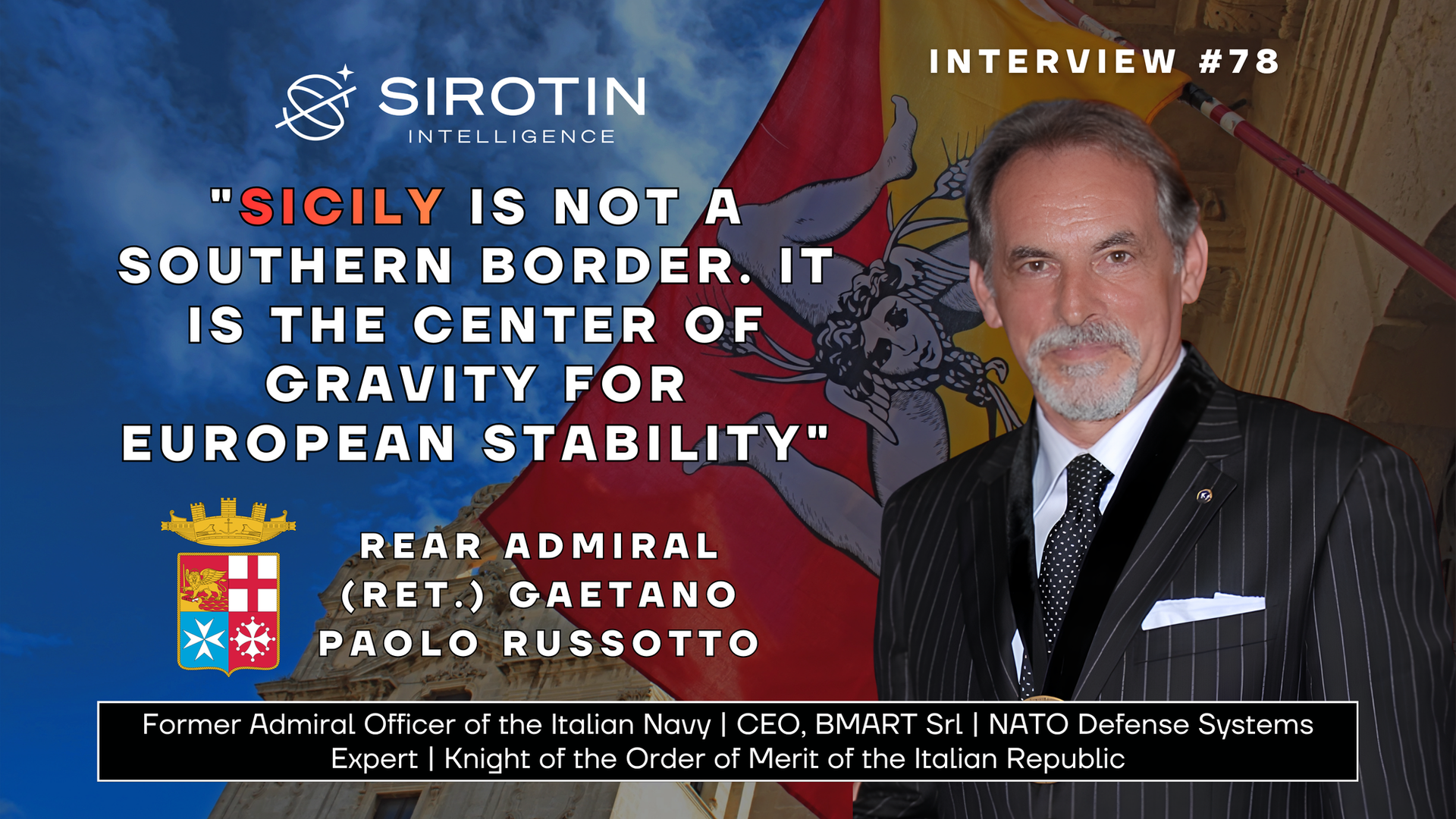
When Rear Admiral Gaetano Paolo Russotto describes Sicily, he does not reach for the phrases you hear at tourism conferences or regional development summits. He calls it a "natural aircraft carrier." He means it literally. The island sits on the maritime route connecting the Suez Canal to the Strait of Gibraltar, closer to the Libyan coast than to Milan, equidistant from three continents, with deep-water ports, NATO satellite ground stations, and drone surveillance hubs already operating from its soil. For a retired flag officer who spent more than three decades managing ammunition depots, weapons systems, and NATO infrastructure across the island, the geography is not abstract. It is operational.
Russotto's career began at the Italian Naval Academy in Livorno in 1968 and stretched across some of the more consequential decades in Mediterranean security. He trained in the United States on complex weapons systems and military telemetry at General Dynamics and the U.S. Navy's Naval Surface Warfare Center in Port Hueneme, California, and Indian Head, Maryland. He served as a technical delegate at the Italian Ministry of Defense for NATO working groups. He consulted for the Kuwaiti Navy during the First Gulf War. For twenty years, he held operational and administrative responsibility for strategic ammunition bases and NATO infrastructure across Sicily as Head of the Ammunition Office for the Autonomous Maritime Military Command. He represented the Italian Navy within the European Tartar Working Group (ETWG) and the International Tartar Working Group, bodies coordinating missile defense systems across allied navies.
After retiring with the rank of Rear Admiral and the distinction of Knight of the Order of Merit of the Italian Republic, Russotto moved into the private sector as CEO of BMART Srl, a consultancy spanning defense technology scouting, cleantech, international trade, and, in a turn that says something about the man, art consulting.
I wanted to talk to him because most of the conversations I have about the Mediterranean treat it as a secondary theater, a place where things happen on the way to somewhere more important. Russotto does not see it that way, and the infrastructure he spent his career managing suggests he may have a point.
Sicily sits at the geographic center of the Mediterranean. How has that positioning shaped Italy's operational priorities in maritime domain awareness and NATO's Southern Flank strategy, and do you believe the region receives the strategic attention it deserves from allied partners?
Russotto began where most naval officers would, with the water. But he moved quickly to what sits above it, beneath it, and in orbit around it.
"Sicily is much more than a geographical center. It is an irreplaceable strategic hub," he said. "Its position is not just a cartographic fact but a power factor that allows NATO to project stability and monitor multidimensional flows in an intersection area between three continents." He frames the island along three operational axes. The first is transit control. Sicily sits directly on the route between Suez and Gibraltar, and from its position, allied forces can maintain constant monitoring of merchant and energy traffic through one of the most consequential shipping corridors on Earth. The second is proximity to North Africa. The distance between Sicily and the Libyan and Tunisian coasts is short enough that Russotto considers the island a "front line" for rapid response to humanitarian crises, irregular migration, and asymmetric threats. The third is what he calls strategic depth: Sicily as a base from which to project operations toward the Sahel and the Middle East, providing logistical continuity for engagements far south of the Mediterranean basin.
The intelligence infrastructure reinforces the geography. Russotto pointed to the NATO Alliance Ground Surveillance (AGS) program operating out of Naval Air Station Sigonella, where RQ-4D Phoenix drones conduct persistent surveillance across vast stretches of land and sea. "I consider this base the beating heart of NATO intelligence," he said. He was equally direct about what lies underwater. "With the increase in hybrid threats to critical infrastructure, I pay particular attention to seabed surveillance. The Strait of Sicily has become a critical point for the protection of submarine cables, both data and energy, which constitute the exposed nerves of our modern digital society."
The network extends beyond Sigonella. Augusta remains the deep-water pillar of naval logistics for allied fleet replenishment. Trapani Birgi provides air superiority and AWACS support for airspace defense. Outposts at Lampedusa and Pantelleria serve as advanced radar sensors monitoring the African coast.
I asked whether allied partners appreciate this architecture for what it is, or whether it remains undervalued in the broader NATO conversation. Russotto's answer was careful but pointed. He frames the island not as a border but as a center of gravity, and the distinction matters. A border is something you defend. A center of gravity is something you build strategy around. Whether NATO's planning culture has fully internalized that distinction is, in his view, still an open question.
The Southern Flank has historically been treated as secondary to NATO's Eastern priorities. Has that calculus changed in recent years, and if so, what is driving it?
Officials still connected to alliance politics tend to hedge on this one. Russotto, now in the private sector, was more direct.
The calculus has changed. Not because of any single driver, but because several pressures arrived at roughly the same time and none of them receded. "I observe with extreme attention the increased Russian and Chinese presence in the Mediterranean," he said. "The navigation of non-NATO naval units is not just a matter of physical presence but a challenge to the basin's stability that demands constant and sophisticated monitoring." Russian naval activity in the Eastern Mediterranean has intensified steadily since Moscow's intervention in Syria, and Chinese port investments from Piraeus to North Africa have added a commercial dimension to what was already a military concern.
Then there is the infrastructure. Russotto considers the defense of undersea cables and pipelines an "absolute priority." The Transmed pipeline, which carries Algerian natural gas to Italy through Tunisia, runs through waters where sabotage would produce immediate repercussions for European energy supply and digital connectivity. The Nord Stream pipeline explosions in September 2022 demonstrated how quickly subsea infrastructure can move from background assumption to front-page crisis, and the Mediterranean's cable and pipeline density makes it comparably exposed.
And then there is a driver that rarely appears in traditional threat assessments: climate. "I interpret climate instability in Africa as a threat multiplier," Russotto said. "Its effects are directly reflected in the security of our borders, influencing migratory flows and the stability of governments in the southern neighborhood." Drought, desertification, and resource competition across the Sahel feed into migration pressures and governance fragility that, viewed from Sicily, are not distant phenomena. They land on your coast.
Whether all of this has fully rebalanced NATO's geographic attention is something Russotto left partly unresolved. What he did say, with some force, is that the Southern Flank is no longer a secondary conversation. The threat environment made that impossible. Technology made the monitoring feasible. Political will, for now at least, appears to be catching up.
Space-based assets are now deeply embedded in maritime operations. How has the integration of space capabilities changed how navies plan and execute in contested environments like the Mediterranean?
Russotto spent years working with complex weapons systems and military communications infrastructure, and it showed here. His familiarity with what orbits above the Mediterranean is granular in a way that most policy conversations about space and defense are not.
He began with communications. The MUOS (Mobile User Objective System) ground station at Niscemi, Sicily, is one of only four such stations in the world. It manages UHF satellite communications for mobile users, including troops, drones, and ships, and Russotto considers it "a fundamental pillar" for ensuring interoperability among NATO forces. Adjacent to it, the Naval Radio Transmitter Facility provides long-range radio transmission he described as vital for Mediterranean fleet operations.
The surveillance layer has changed even more fundamentally. The COSMO-SkyMed constellation, developed by the Italian Space Agency (ASI), uses Synthetic Aperture Radar to image through cloud cover and darkness. Russotto framed this capability as both an intelligence tool and a territorial monitoring system. "These same radars monitor hydrogeological instability and the erosion of our Sicilian and Calabrian coasts today," he noted. The second generation of COSMO-SkyMed satellites, operational in 2026, delivers centimeter-level precision applicable to everything from precision agriculture to disaster management. Italy is also investing roughly 300 million euros in new optical spy satellites to complement the radar constellation with high-resolution visual data.
The part that stayed with me, though, was how Russotto described the convergence of military and civilian uses of these assets. Data from the ESA's Copernicus program, processed in Southern Italian centers, serves Frontex for border security and Italian Civil Protection for wildfire prevention and drought management simultaneously. "I consider dual-use capability not only a technical opportunity but an economic and social necessity," he said. "It allows for maximizing the utility of extremely expensive and technologically advanced assets."
He also raised a concern I had not expected from a career naval officer: post-quantum security. "Implementing Post-Quantum Cryptography protocols is a necessary preemptive move," he said. "We are armoring our sensitive data against future computational threats. Integrating quantum-resistant algorithms directly into the architecture of satellites launched in 2026 ensures our Defense communications remain inviolable for decades to come." The timeline pressure is real. Satellites launched today will operate for fifteen or twenty years. If quantum computing matures within that window, any satellite without hardened encryption becomes retroactively vulnerable.
What Russotto was describing, without ever quite saying it this way, is that space has moved from a supporting capability to a defining one. Naval planning in the Mediterranean now starts with what you can see from orbit and what you can communicate through it. The ships and the aircraft still matter, obviously. But the operational picture they act on is assembled somewhere else entirely.
Italy holds a unique position as both a founding NATO member and a Mediterranean nation with complex relationships to its south and east. How do you navigate the tension between alliance commitments and Italy's distinct regional interests when those don't fully align?
I expected Russotto to answer this through a diplomatic lens. He answered it through an industrial one, which was more revealing. The tension he described has less to do with political disagreement within NATO and more to do with where Italy sits in the European defense industrial base, and how that positioning shapes its options.
"I consider Italy the essential mediator in the European space industrial triangle," he said. "Our ability to engage as a peer with France and Germany is what holds the Union's security architecture together." He mapped this concretely. France leads in signals intelligence. Germany leads in radar. Italy, with COSMO-SkyMed and its new optical programs, provides what he called "the missing piece completing the European surveillance mosaic." Through the Vega C launcher produced by Avio, Italy guarantees Europe a degree of autonomous launch capability for small and medium satellites, which Russotto considers critical in a market increasingly dominated by large American commercial providers. "Having a national carrier for sensitive institutional payloads allows us to protect what matters," he said.
On the alliance side, Italy's contribution to the NATO Space Centre in Ramstein and the Centre of Excellence in Toulouse feeds Italian satellite data into the Alliance's early warning networks. Italy's Space Operations Command (COS) coordinates with both NATO and EU frameworks simultaneously. In Russotto's view, this dual positioning is not a source of tension but a strategic asset. Italy can operate as the hinge between EU ambitions for strategic autonomy and NATO's established command architecture precisely because it is embedded in both.
The IRIS² constellation, a sovereign European satellite communications system, represents one concrete expression of that balancing act. Russotto considers Italy's contribution "an act of strategic independence," providing ultra-secure communications for both military and civilian missions while reducing dependence on non-European providers.
He also pointed to something closer to home: the National Underwater Dimension Hub (PNS), headquartered in La Spezia but with operational nodes in Catania and Augusta. The hub coordinates development of unmanned underwater vehicles (UUVs) that Russotto described as "the silent guardians of our energy sovereignty," protecting submarine cables and gas pipelines. This capability serves NATO's collective defense mission and Italy's national infrastructure simultaneously, which is the kind of overlap that makes the alliance-versus-national-interest question less binary than it sometimes appears in public debate.
The honest answer, though Russotto did not frame it quite this bluntly, is that Italy navigates the tension by making itself indispensable to both frameworks. When your satellites feed NATO's early warning systems and your launcher guarantees European access to orbit, the alignment question becomes less about choosing sides and more about remaining the country that both sides need.
For the next generation of defense and security professionals, particularly in Southern Italy and Sicily, what do you believe they need to understand about this region's strategic importance that isn't being communicated clearly enough today?
Russotto's answer here surprised me, because he did not start with threats or deterrence. He started with technology transfer and startups.
"I view the Defense Ministry's opening toward the private sector as the true turning point," he said. "The challenge is no longer just defending territory, but fueling a dynamic technological ecosystem that generates economic value." He described a shift he sees accelerating in 2026: defense innovation incubators allowing small businesses and civilian startups to access military laboratories, creating what he called "a virtuous circle of technological sovereignty." The defense establishment gets private-sector speed and innovation. The startups get access to funding streams and security standards, both cyber and physical, that would otherwise be out of reach.
The geographic argument feeds into this. Southern Italy's complex terrain and Mediterranean climate make it, in Russotto's framing, "a perfect open-air laboratory" for testing dual-use technologies. Drone surveillance capabilities developed for Sigonella's AGS program have already migrated to Italy's Fire Brigade and Civil Protection for search-and-rescue operations in Calabria's rugged interior. Military 5G trials at the port of Augusta are producing security protocols now being adopted by civilian banks and energy grid operators.
He connected this to the broader space economy in terms similar to what I had heard from Giuseppe Finocchiaro in a previous interview for this publication. The space sector's value increasingly sits downstream, in data processing, software development, and the integration of satellite-derived information into commercial applications. A young engineer in Catania does not need to build rockets to participate. She needs to understand how Copernicus data flows into agricultural monitoring, how COSMO-SkyMed imagery supports coastal erosion management, how UUV technology protects the undersea cables that keep the internet running.
"Southern Italy has become the primary test-bed for dual technologies," Russotto said. What the next generation needs to understand, in his view, is that the defense infrastructure they see around them in Sicily and Calabria is not just a military inheritance. It is the foundation of a technology economy that has barely begun to be exploited commercially.
He closed with something that carried the weight of a career spent inside institutions that move slowly. "Every site is interconnected to ensure our surveillance capability is seamless, from the ground to space. This is not just a list of bases. It is proof of how Southern Italy has become the true laboratory for European stability."
Author's Analysis
Scenario: Sicily 2030
It is early 2030. A hybrid incident in the Central Mediterranean, origin unclear, method ambiguous, has severed one of the submarine cables connecting Southern Europe to North Africa. Internet traffic across three countries degrades within hours. Energy markets in Rome and Tunis spike on rumor alone. NATO's Allied Maritime Command requests situational awareness from its Southern Flank assets. The first usable imagery comes from a COSMO-SkyMed pass over the Strait of Sicily, processed at a ground station in Matera and relayed to Sigonella within minutes. An unmanned underwater vehicle deployed from the Catania node of the National Underwater Dimension Hub reaches the cable site before any crewed vessel. A Copernicus-derived damage assessment is simultaneously forwarded to Italian Civil Protection and to a Palermo-based logistics firm coordinating commercial rerouting.
None of this is science fiction. Every capability in that sequence exists in 2026, in the locations Russotto described, operated by the institutions he spent his career building and staffing. The question is not whether the technology works. It is whether the political and institutional frameworks surrounding it have matured enough to deploy it under pressure, across jurisdictions, with the speed a hybrid incident demands.
What Russotto's perspective reveals, and what makes it different from the policy analyses that tend to dominate this conversation, is that the infrastructure of the Southern Flank is not a plan. It is already in place. MUOS is broadcasting from Niscemi. Phoenix drones are flying from Sigonella. UUVs are being developed in Catania and Augusta. Optical and radar satellites are imaging the basin around the clock. The density of capability concentrated in Sicily and Calabria is, by any reasonable measure, extraordinary for a region that most NATO commentary still treats as peripheral.
So why does the peripheral framing persist? Is it institutional habit, a legacy of Cold War geography that rewarded eastward attention and never fully recalibrated? Is it that the Southern Flank's threats, migration, climate instability, subsea sabotage, hybrid provocation, do not fit neatly into the categories NATO was designed to address? Or is it something simpler: that the people making alliance-level decisions have not spent enough time in the places where these capabilities actually operate, talking to the people who built them?
Russotto describes Southern Italy as a "laboratory for European stability." The hardware supports the claim. The question is who, at the level where resource allocation and strategic priority are actually decided, is willing to treat it as one. And if the next Mediterranean crisis arrives before that recognition does, what exactly was the point of building all of it?
About Rear Admiral (Ret.) Gaetano Paolo Russotto
Rear Admiral (Ret.) Gaetano Paolo Russotto is a former admiral officer of the Italian Navy and current CEO of BMART Srl, a consultancy integrating defense technology scouting, international trade, cleantech solutions, and art consulting.
Russotto after completing his studies in industrial electronics at the G.Giorgi Industrial Institute in Brindisi(Puglia) continued his training at the Naval Academy of Livorno and received advanced training in the United States in computing, complex weapons systems, and military telemetry at General Dynamics (Pomona Division, Columbus-Wisconsin) and the U.S. Navy's Naval Ship Weapon System Engineering Station (NSWSES) at Port Hueneme, California, and Indian Head, Maryland. He represented the Italian Navy within the European Tartar Working Group (ETWG) and the International Tartar Working Group (ITWG), coordinating allied missile defense systems.
Over a forty-year military career, he served for twenty years as Head of the Ammunition Office for the Autonomous Maritime Military Command of Sicily, holding operational and administrative responsibility for strategic bases and national and NATO infrastructure. He served as Head of the Technical Delegation at the Italian Ministry of Defense for NATO working groups and as a consultant for the Kuwaiti Navy during the First Gulf War.
Following his military service, Russotto served as General Manager of the EEIG "COSTA MED," facilitating access to EU funding programs, as Director at Neptune Risk Ltd in Malta, and as a consultant for the Economic and Scientific Affairs Office of the Embassy of Israel in Rome, focusing on energy and environmental innovation. He held a senior management role at TEA Shipping, coordinating logistics for the FSO Leonis vessel supporting the Vega Oil platform.
He holds the Knight of the Order of Merit of the Italian Republic, the Maurizian Medal for distinguished military career, and the 2015 International Award for Social Commitment (Livatino-Saetta Memorial). He is an Ambassador of the international CONNESSUS Program for the protection of humanity and its habitat, Honorary President of the "Antonietta Labisi" International Association, and a longstanding member of Kiwanis International, where he has served as Club President, Lieutenant Governor, and currently as District Chair for the Italy-San Marino District.
Editor's note: A previous version of this article described Rear Admiral Russotto's affiliation with ANPIT as a Board membership. This was a transcription error in translation from Italian. Rear Admiral Russotto's actual role is that of an external professional collaborator with ANPIT, independent of the organization's internal governance. The text has been updated and we regret the error.
Get exclusive insights from our network of NASA veterans, DARPA program managers, and space industry pioneers. Weekly. No jargon.