
Sirotin Intelligence Briefing: January 11–17: SHIELD IDIQ Adds 340 Awardees Under $151B Ceiling, Crew-11 Completes First ISS Medical Evacuation, Congress Sends $24.4B NASA Budget to White House


This week's Sirotin Intelligence analysis tracks Space Force fielding AI-driven orbital threat training through a $27 million Slingshot Aerospace contract, swapping launch vehicles to accelerate GPS constellation deployment, and issuing new service dress uniform guidance as the branch matures its distinct identity. Crew-11 splashed down safely off San Diego on January 15, marking the first time in the station's 25-year history that a mission has been cut short for a medical emergency. On Capitol Hill, the Senate passed the Commerce-Justice-Science minibus keeping NASA at $24.4 billion while rejecting a proposed 24% cut, and Portugal became the 60th country to sign the Artemis Accords. A new MRI study of 26 astronauts found that microgravity shifts brains 2-3 millimeters upward and backward, compressing balance and sensorimotor areas with effects lingering six months post-landing, raising concerns for long-duration Artemis and Mars missions. Meanwhile, NASA and DOE signed an MoU committing to a 40 kW-class fission reactor on the moon by 2030, and industry continues waiting for Space Force demand signals on refuelable, maneuverable GEO satellites. Our next guest is Mike Swearingen, Smart Grid Pioneer and power systems veteran, on why America's grid will fail sooner than anyone expects.
🛡️ Defense Highlights
- Space Force teams with universities to map and mitigate sonic booms over California: SFB’s ECOBOOM program, launched with Brigham Young University and CSU Bakersfield in 2024, has now captured 477 sonic‑boom recordings across 23 launches via eight acoustic stations stretching into Santa Barbara and Ventura counties, including Ojai. Early results show upper‑level winds above 15 km and seasonal weather patterns push boom footprints farther inland in fall–spring than in summer, and the data are already being fed into pre‑launch forecasts and post‑launch reviews so commanders can tweak trajectories, prioritize daytime launches when possible, and balance national‑security launch tempo with community noise and environmental constraints.
- Space Force defines transition to new service dress uniform: Updated guidance (SPFI 36‑2903) formally adopts the dark‑blue Space Force service dress with diagonal front closure and distinctive Guardian rank insignia, replacing the modified Air Force uniform and requiring all personnel transferring into the service after Jan. 15, 2026 to purchase it while giving existing Guardians at least 12 months’ notice before any mandatory wear date. Leaders frame the uniform as a blend of U.S. military heritage and a modern aesthetic that reinforces a unique Guardian identity as the service matures within the joint force.
- Space Force swaps rockets to speed GPS deployment: To get fresh navigation capability on orbit sooner, the service traded launch assignments so that GPS III SV09 will now fly on a Falcon 9 in the coming weeks instead of ULA’s Vulcan, while GPS IIIF SV13 shifts from a future Falcon Heavy mission onto Vulcan. Officials say the swap both accelerates constellation build‑out and yields a net cost saving to the government, echoing an earlier GPS launch trade executed in 2025 for the same reason.
- Guardian Arena tests combat mindset and joint/interagency integration: The third annual Guardian Arena, held Dec. 8–9 at Kennedy Space Center and Patrick SFB, brought together 35 teams of Guardians, Airmen, civilians and international partners for physically demanding, problem‑solving and academic events such as the “Guardian Strike” tactical scenario and a multi‑station challenge simulating contested‑space operations. Organizers describe the competition as the Space Force’s largest exercise, designed to cultivate a combat‑ready mindset, strengthen culture and esprit de corps, and link military and civilian space enterprises under the Guardian Ideals.
- US and Dutch air forces deepen aeromedical evacuation interoperability: The 86th Aeromedical Evacuation Squadron at Ramstein hosted Royal Netherlands Air and Space Force medics for a week of joint training that blended hands‑on patient care drills, simulation and low‑light scenarios, with both sides practicing integrated care of the same simulated casualties rather than parallel lanes. Participants said the exchange gave them a clear view of each other’s equipment, protocols and capacity, building trust and ensuring that in a large‑scale conflict NATO crews can seamlessly share workload and save lives in the air.
- Crew‑11 completes first‑ever ISS medical evacuation: The four astronauts of NASA's Crew‑11—Mike Fincke, Zena Cardman, Kimiya Yui and Oleg Platanov—splashed down safely off San Diego at 3:41 a.m. ET on January 15 after an almost 11‑hour return aboard Dragon Endeavour, marking the first time in the station's 25‑year history that a mission has been cut short for a medical emergency. A recovery vessel with medical personnel was standing by and whisked the crew via helicopter and jet to Johnson Space Center for further evaluation; NASA continues to withhold the affected astronaut's identity and diagnosis, citing privacy, but confirmed the condition could not be managed with ISS medical supplies and required Earth‑based care.
- Industry awaits Space Force demand signal on refuelable, maneuverable GEO satellites: A detailed Aerospace America report notes that technology for geosynchronous satellite refueling and on‑orbit servicing is essentially ready, but Space Force has yet to commit to large‑scale procurement or a clear concept of operations, leaving companies uncertain how much to invest. Draft efforts like an RFI for a fleet of maneuverable GEO satellites and the RG‑XX reconnaissance constellation envision refuelable platforms, and a NASA‑funded COSMIC study urges building grapple fixtures and fuel ports into all new GEO birds, but current budget lines for Space Access, Mobility and Logistics remain in the low tens of millions of dollars, far below what industry says is needed to build a refueling ecosystem.
- Space Force fields AI‑driven orbital threat training: Slingshot Aerospace has secured a $27 million contract to integrate its TALOS AI agent into the Space Force’s Operational Test and Training Infrastructure, letting Guardians train against adaptive, behavior‑cloned satellite threats that maneuver and react like real adversaries instead of following scripted playbooks. The 18‑month effort will link TALOS via open APIs to other simulators and sensors, enabling larger‑scale, faster‑generated orbital warfare scenarios across the training enterprise.
- U.S. partially evacuates Al Udeid as Iran crisis escalates: Some U.S. personnel and aircraft, including at least six KC‑135 tankers, have been moved out of Al Udeid Air Base in Qatar amid fears the installation could be targeted if President Trump orders strikes on Iran over its deadly crackdown on protesters, with death toll estimates ranging from 2,500 to as high as 20,000. Officials describe the drawdown as temporary and precautionary, but note that Iran already fired a salvo of short‑ and medium‑range ballistic missiles at the base after Operation Midnight Hammer, and that Patriot batteries only intercepted most of them, underscoring persistent missile‑threat concerns across the Gulf.
Major Contract Awards This Week:
- Missile Defense Agency – SHIELD IDIQ expansion: An additional 340 awards under the $151 billion ceiling Scalable Homeland Innovative Enterprise Layered Defense (SHIELD) multiple-award IDIQ, bringing total awardees to 2,440 companies. The vehicle enables rapid competition for AI/ML-enabled missile defense capabilities, digital engineering, and open-architecture development through December 2035.
- Slingshot Aerospace – AI-driven orbital threat training: A $27 million contract to integrate the TALOS AI agent into Space Force's Operational Test and Training Infrastructure, enabling Guardians to train against adaptive, behavior-cloned satellite threats that maneuver realistically rather than following scripted scenarios.
- Stantec-AECOM SIOP JV – Shipyard Infrastructure Optimization: A $150 million firm-fixed-price IDIQ for architect-engineering services supporting the Navy's Shipyard Infrastructure Optimization Program at Portsmouth Naval Shipyard through January 2031.
- Torch Technologies – Army R&D lifecycle evaluation: A $195.5 million firm-fixed-price contract for research and development evaluating system capabilities and enhancements throughout the acquisition lifecycle through January 2031.
- Striveworks – Chariot Software Platform: A $70 million firm-fixed-price contract for Chariot Software Platform licenses supporting Army data and AI/ML operations through January 2028.
- Lockheed Martin – AEGIS development site operations: A $57.4 million cost-plus-incentive-fee modification for continued operation and maintenance of AEGIS development and test sites including the Combat Systems Engineering Development Site and SPY-1A Test Facility through January 2027.
- KBR Wyle Services – Counter-UAS sustainment: A $52.6 million cost-plus-fixed-fee IDIQ for support and sustainment of Counter Uncrewed Systems providing detection, characterization, identification, and mitigation capabilities for Naval Air Warfare Center through March 2031.
- Mission Essential Group – Integrated Broadcast Service: A $47.9 million firm-fixed-price contract for sustainment of the IBS-Enterprise Services program, including FMS to Canada, UK, New Zealand, and Australia, through January 2031.
- Vita Inclinata Technologies – Rescue System Litter Attachment: A $45.6 million firm-fixed-price contract for the Vita Rescue System litter attachment kits and extended warranty supporting Army aviation rescue operations through January 2031.
- L3Harris – Towed Body 29C towed arrays: A $30.9 million fixed-price incentive contract for production, integration, and testing of TB-29C towed sonar arrays through September 2028.
🌐 Policy, Geopolitical & Legal Developments
- State of play in military space highlights 2026 “race to resilience”: Recent analysis portrays 2026 as a pivotal year in which the Space Force moves from legacy, vulnerable architectures toward proliferated LEO tracking layers, commercial augmentation and more openly discussed offensive and defensive counterspace capabilities under its Space Warfighting Framework. With FY26 space funding approaching $40 billion, key milestones include Golden Dome interceptor awards, scaling the Commercial Augmentation Space Reserve and fielding more resilient missile‑warning and SATCOM constellations to counter daily jamming, dazzling and cyber probes from China and Russia.
- Türkiye's Plan‑S expands IoT constellation to 16 satellites: The Ankara‑based startup launched four Connecta satellites on SpaceX's Twilight rideshare, designing, testing, producing and integrating all spacecraft domestically as part of Türkiye's National Space Program, with licensing now complete in Türkiye, Australia, Sweden and Denmark and negotiations underway with Saudi Arabia, the UAE, Azerbaijan, Indonesia and Pakistan. Plan‑S has also signed a commercial partnership with Turk Telekom to deliver satellite‑IoT services integrated into the operator's terrestrial network, positioning the company as a regional competitor in the fast‑growing global satellite‑IoT market.
- Think tank backs bipartisan SAT Streamlining Act to keep U.S. ahead of China: The Progressive Policy Institute praises the Satellite and Telecommunications Streamlining (SAT) Act, introduced by Senators Ted Cruz and Peter Welch, which would direct the FCC to modernize and simplify licensing and U.S. market‑access rules for GSO and NGSO constellations. PPI argues that today’s fragmented, slow regulatory process hampers American firms as they race Chinese competitors in broadband, Earth observation and navigation services, and that clearer, faster pathways will both strengthen national security and expand everyday benefits like rural internet, precision agriculture and weather forecasting for U.S. citizens.
- AGU honors NASA scientists for excellence in Earth and space science: NASA highlights that multiple agency researchers received the American Geophysical Union’s 2025 Excellence in Earth and Space Science Education and research awards, recognizing work that ranges from climate and cryosphere studies to heliophysics and planetary science outreach. The agency casts these honors as validation of its dual mandate to advance fundamental science while engaging the next generation of scientists and engineers through education and public communication.
- Special economic “Space Coast” zones proposed to restore U.S. space dominance: A policy essay argues that the U.S. should copy China’s 1980s special economic zones by creating an interstate Space Coast Compact across southern states that would set its own streamlined regulatory regime for spaceports, manufacturing and launches. Supporters contend that exempting participating zones from some federal red tape and lengthy environmental reviews would allow rapid industrialization, more frequent launches and faster development of lunar‑base infrastructure, helping the U.S. stay ahead of China in cislunar space.
- Congress sends FY2026 NASA/NOAA funding bill to the White House: The Senate has passed the Commerce‑Justice‑Science “minibus” that keeps NASA at about $24.4 billion, rejecting a proposed 24% cut to $18.8 billion, and sustains NOAA at roughly $6.2 billion with added money for next‑generation weather and climate satellites. The bill modestly trims some science lines but protects core programs, while a separate reconciliation measure (the “One Big Beautiful Bill Act”) adds roughly $3 billion more for NASA in FY26, mostly for Artemis and a smaller amount for ISS support, leaving only the Defense and several other appropriations still under a CR that expires January 30.
- Artemis Accords notch 60th signatory as Portugal joins the framework: Portugal has become the 60th country to sign the U.S.‑led Artemis Accords, with its Secretary of State for Science and Innovation Helena Canhão signing in Lisbon during a bilateral meeting, and NASA Administrator Jared Isaacman praising the move as expanding a coalition committed to safe, transparent and peaceful lunar and Mars exploration. Portuguese officials cast the step as echoing the nation’s Age‑of‑Exploration heritage while aligning their young space agency with norms on data sharing, mutual assistance, heritage‑site protection and sustainable operations ahead of humans’ planned return to the moon in 2026.
- Space‑policy week dominated by Crew‑11 splashdown and budget endgame: The Jan. 11–17 calendar centers on two milestones: the early medical‑evacuation splashdown of Crew‑11 (with NASA coverage starting 2:15 a.m. ET, deorbit burn at 2:50 a.m., and splashdown targeted for 3:40 a.m. on Jan. 15) and anticipated Senate passage of the NASA/NOAA funding bill now headed to the White House. Other key events include AIAA SciTech in Orlando, a House hearing on weather satellites and national security, the NASA Small Bodies Assessment Group sessions on 3I/ATLAS and Apophis missions, and National Academies meetings on Earth‑science applications from space and astrophysics program updates, underscoring how operational, scientific and budget agendas are converging in a dense mid‑January policy window.
🛰️ Technology & Commercial Developments
- Spaceflight reshapes astronauts’ brains and can prolong balance problems after landing: A new study of 26 astronauts using pre‑ and post‑flight MRI scans finds that time in microgravity causes their brains to shift upward and backward by up to 2–3 millimeters, stretching some regions while compressing others, particularly in the posterior insula and other balance and sensorimotor areas. These deformations correlate with worse post‑flight balance and coordination and can linger for at least six months, although the research did not detect changes in personality or cognition, leading scientists to argue that understanding and countering these subtle “scrambled brain” effects will be critical for designing rehab programs and protecting crews on long‑duration Artemis and Mars missions.
- Satellite connectivity seen as linchpin for autonomous offshore rigs: Viasat Energy Services argues that high‑throughput satellites and emerging narrowband non‑terrestrial networks (NB‑NTN) are closing the connectivity gap that has long blocked true autonomy on remote oil and gas platforms, enabling 24/7 remote monitoring, AI‑driven predictive maintenance, UAV inspections and even autonomous logistics and hauling far from any cellular signal. With device costs falling and constellations expanding, the article frames satellite‑enabled IoT as a "future‑proofing strategy" that removes personnel from hazardous zones, cuts operational costs and keeps human operators in control even as rigs run increasingly on autopilot.
- Edinburgh's Sofant taps Virgin Galactic founding boss ahead of 2026 product launch: Satellite‑antenna startup Sofant Technologies has appointed Will Whitehorn—former Virgin Galactic president and ex‑UK Space president—as chairman effective January 2026, signaling a pivot from R&D to commercial rollout of its low‑power RF MEMS beamforming technology for satcom terminals, LEO constellations and non‑terrestrial networks. Backed by Scottish Enterprise, the UK Space Agency and ESA, Sofant aims to leverage Whitehorn's aerospace network and policy credibility as it targets partnerships with satellite operators and antenna OEMs.
- Redwire's most powerful roll‑out solar array passes Gateway deployment test: Redwire completed a first unfurling of its 60 kW ROSA wings destined for NASA's lunar Gateway Power and Propulsion Element, the largest roll‑out arrays the company has built and a critical enabler for Gateway's solar‑electric propulsion and station power needs once it reaches lunar orbit no earlier than 2027. The arrays will be delivered to prime contractor Maxar later this year; successful testing validates the lightweight, high‑packing‑density design that Redwire has scaled up from ISS upgrades and commercial GEO applications.
- Airbus leads 5G SpaceRAN demo to standardize NTN from orbit: Airbus UpNext has kicked off SpaceRAN, a two‑phase demonstrator that will first emulate a two‑satellite LEO constellation on the ground and then fly a software‑defined 5G NTN payload on an Airbus LEO satellite by 2027–2028, effectively turning it into a 5G base station in space. Working with partners including Aalyria, AccelerComm, CesiumAstro, Deutsche Telekom, Eutelsat and ST Engineering iDirect, the project aims to prove open, non‑proprietary 5G NTN standards and real‑time beam and satellite handovers, positioning satellite as a native layer in terrestrial 5G networks for both commercial and military users.
- NASA and DOE lock in plan for a lunar fission reactor by 2030: NASA and the U.S. Department of Energy have signed an MoU committing to design, build and test a 40 kW‑class fission surface power reactor on the moon by 2030, drawing on three concepts selected in 2022 and explicitly tied to an executive order that elevates nuclear power as part of “American space superiority.” The reactor is intended to provide continuous power through the two‑week lunar night for Artemis surface bases and, eventually, Mars missions, reducing reliance on large solar arrays, batteries and radioisotope units and enabling more energy‑intensive activities like ISRU and habitation.
- ArianeGroup plants its first industrial flag in the U.S. with Sodern America: ArianeGroup has created Sodern America, a wholly owned subsidiary that will build and test Auriga star trackers and other optronic hardware on U.S. soil, converting Sodern’s existing sales to more than 40 American customers into a local manufacturing and support presence. The move is billed as the start of a new industrial chapter that should open growth for star trackers, satellite propulsion and carbon‑component lines while strengthening ArianeGroup’s credibility in the U.S. defense and commercial markets.
- Space sector and Formula 1 seen as “twins” in engineering culture: Former JPL leader Arbi Karapetian, now Formula 1’s director of innovation and technology, told AIAA SciTech attendees that spaceflight and F1 share rigid schedules, unforgiving launch/race windows, heavy regulation and a relentless pace that erases weekends and holidays. He highlighted cross‑pollination in composites, additive manufacturing, digital twins and AI between race teams and aerospace programs, arguing that both sectors follow similar requirements, prototyping and testing loops and increasingly trade talent back and forth.
💭 A Word From Christophe Bosquillon
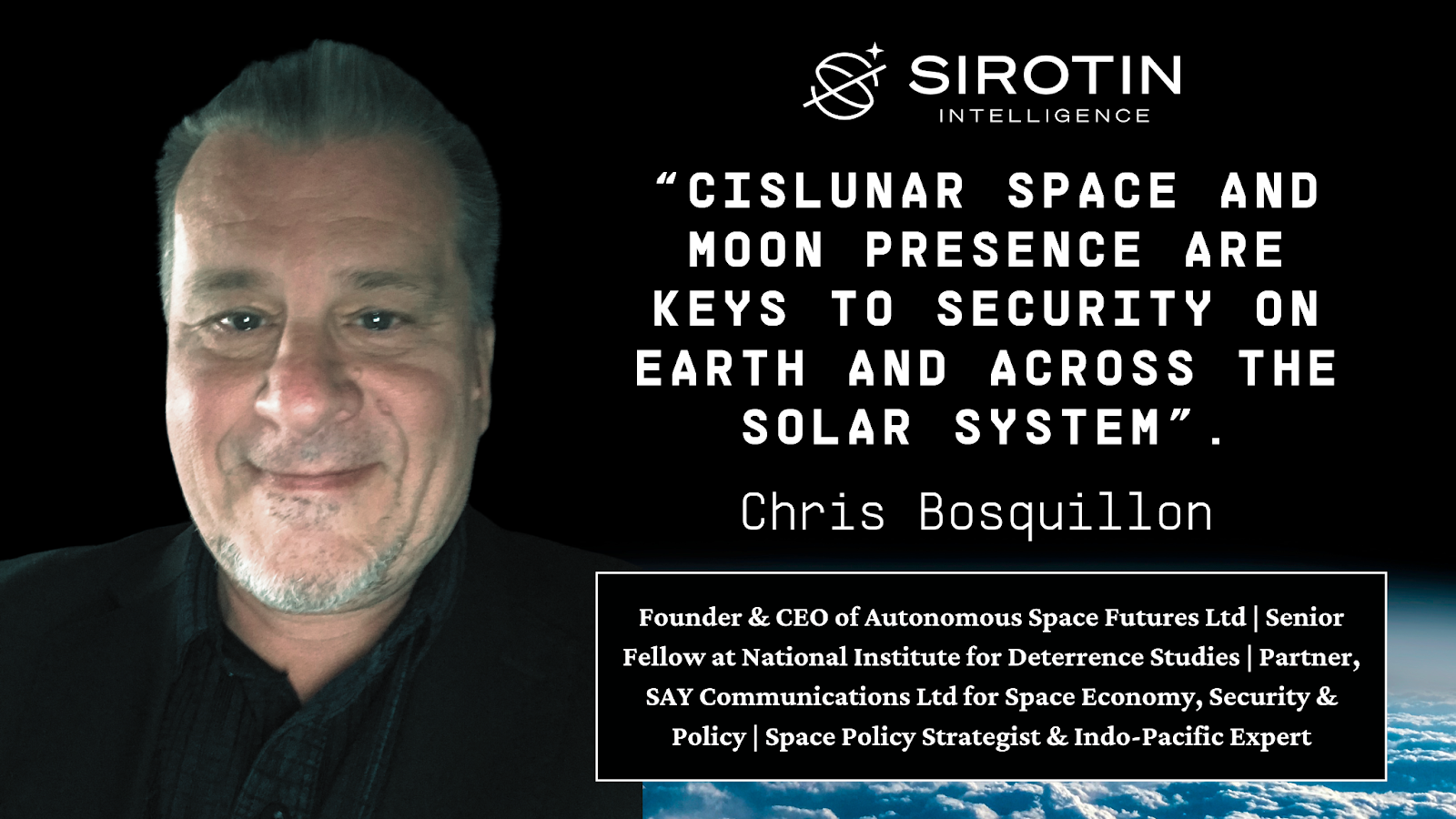
With 150 personnel, Pituffik Space Base, vital for NORAD, missile defense, and Arctic downlinks, is the last remnant of a U.S. military presence in Greenland which at the height of the Cold War counted over 10,000 troops. Greenland, a semi-autonomous NATO territory the size of three Texas, recorded a storied legacy under colonial Danish ownership. That all came crashing when the White House signalled its intention to take over Greenland "by force if necessary."
While the European Commissioner said a U.S. military takeover of Greenland would end NATO, Europe is attempting a negotiated solution. Danish and Greenland officials “agreed to disagree” when they met with VP JD Vance and SecState Rubio, while receiving some reassurances from Senators on Capitol Hill, as bipartisan push-back emerged in Congress. Europe sent a couple dozenpersonnel as ridiculous tripwire, failing to demonstrate its ability to defend Greenland
The role of Greenland in Arctic security is nothing new. From a NATO standpoint, it is critical to monitor Russian and Chinese traffic between Greenland, Iceland, and the UK (a strategic choke point know as GIUK gap) while Norway reasserts sovereignty over Svalbard. Europe renewed its push for a NATO Arctic Sentry like it did for Baltic Sentry. Trying to assuage POTUS, Europe argues that the U.S. can do whatever it wants with the U.S.-Denmark 1951 defence agreement. Europe, denying Russia and Chinese plot imminent attacks against Greenland, insists U.S. needs not to threaten nor “own” Greenland to secure resources (oil, metals, rare earths), military presence, space activities, and Arctic defense.
This is where perspectives diverge: Greenland as gateway to the Western Hemisphere is a strategic choke point affecting Arctic and North-Atlantic shipping lanes, and military activities under sea and over air and space. Adversaries could grab Greenland since Europe has underinvested in defending this Panama Canal Arctic peer. Hence the U.S must acquire Greenland to control the Western Hemisphere.
A transaction over ownership requires congressional consent from U.S., Denmark, and Greenland. But if real estate expansion, hostile takeovers, and corporate restructuring can price any asset, is the sovereignty and dignity of 56,000 “independent” Greenlanders worth anything?
Have a great Space Week ahead!
🎤 Our Next Guest: Mike Swearingen

For over two decades, Mike Swearingen worked every corner of power systems engineering, from control systems to transmission design to NERC compliance. Parkinson's disease forced him out of hands-on work more than a decade ago, but the calls kept coming. DOE, DOD, FERC, utilities with problems they couldn't solve. Named a Smart Grid Pioneer in 2015, he started his career as a Space Equipment Maintenance Specialist at Joint Defense Facility Nurrungar in Australia. Now he's stepping back for good, but not before delivering a final warning: the threats to America's grid are converging while the people responsible for defending it keep pulling in different directions.
Key topics:
- Why 25% reserve margins went from a warning sign to an aspirational ceiling
- How regulatory contradictions force utilities to choose which rules to violate
- The Aurora vulnerability and why demonstrated attack vectors remain unaddressed
- What the Iberian Peninsula grid collapse reveals about U.S. renewable integration risks
- His message to DOE, DOD, FERC, and the White House on what convergent action would actually look like
Watch Mike's YouTube preview Tuesday, January 20th on the Sirotin Intelligence YouTube channel. Full interview drops January 22nd.
Sources:
https://www.bbc.co.uk/news/live/c4glz3pklkzt
https://www.edinburghlive.co.uk/news/edinburgh-news/plans-edinburgh-new-uk-base-33218656
https://www.fastcompany.com/91448551/redwire-roll-out-array-lunar-gateway-solar-power
https://www.airandspaceforces.com/us-evacuates-personnel-al-udeid-trump-iran/
https://spacenews.com/special-economic-zones-for-restoring-american-space-dominance/
https://breakingdefense.com/2026/01/the-state-of-play-in-military-space/
https://spacepolicyonline.com/news/artemis-accords-reach-another-milestone-with-portugal/
https://spacepolicyonline.com/news/whats-happening-in-space-policy-january-11-17-2026/
https://www.war.gov/News/Contracts/Contract/Article/4380949/contracts-for-jan-15-2026/
https://www.war.gov/News/Contracts/Contract/Article/4379809/contracts-for-jan-14-2026/
https://www.war.gov/News/Contracts/Contract/Article/4376288/contracts-for-jan-12-2026/
https://www.msn.com/en-us/health/other/astronauts-came-back-from-space-with-scrambled-brains-study-shows/ar-AA1UcAYO?ocid=winp2fptaskbar&cvid=31c6a4280c4e4c769fc6015fb6364115&ei=17
Get exclusive insights from our network of NASA veterans, DARPA program managers, and space industry pioneers. Weekly. No jargon.