
Sirotin Intelligence Briefing: January 25–31: Space Force Budget Hits $40B as Partial Shutdown Begins, Russia's "Luch" Inspector Satellite Destroyed by Debris, SpaceX Launches Free Stargaze Tracking Service


This week's Sirotin Intelligence analysis tracks the Space Force entering a brief partial shutdown with its FY2026 budget poised to reach nearly $40 billion once the House takes up the Senate-amended minibus. Russia's suspected "Luch" electronic-intelligence satellite fragmented in graveyard orbit, with Swiss analysts pointing to accidental debris impact rather than controlled breakup. SpaceX unveiled Stargaze, a free space situational awareness service that generates conjunction data messages within minutes using attitude data from roughly 9,600 Starlink satellites, a move that could reshape the commercial SSA market even as critics note its limitations to low-altitude orbits. The Space Force activated SPACEFOR-NORTH at Peterson SFB, embedding space domain awareness and missile warning capabilities directly into homeland defense through U.S. Northern Command. A GAO report found the Space Development Agency has overestimated technology readiness and underpriced risk in its Tracking Layer, while China's main space contractor laid out an integrated roadmap linking space tourism, lunar resource extraction, and orbital AI data centers as a single portfolio for the 2030s. Our next guest is Christopher Stone, Senior Fellow for Space Deterrence at the National Institute for Deterrence Studies, on GPS vulnerability, escalation thresholds, and why America's deterrence posture needs offensive capability.
🛡️ Defense Highlights
- Artemis 2 fueling test delay tightens launch window and affects ISS crew rotation: NASA has pushed the SLS wet dress rehearsal back to Feb. 2 due to freezing weather at Pad 39B, which means Artemis 2 can no longer target Feb. 6–7 and now has realistic launch opportunities on Feb. 8, 10 and 11, with an 11:20 p.m. ET liftoff time on Feb. 8. If Artemis 2 flies within that window, NASA will delay the Crew‑12 Dragon launch to the ISS to no earlier than Feb. 19, after the four Artemis astronauts complete their 10‑day lunar‑orbit mission and return to Earth, to avoid overlapping campaigns on the Cape.
- Analysts say debris likely destroyed Russia’s “Luch” inspector satellite in graveyard orbit: Swiss tracking firm S2A Systems reports that Russian satellite Luch (NORAD ID 40258)fragmented on Jan. 30 in graveyard orbit, with the pattern consistent with an accidental debris impact rather than a controlled breakup. The spacecraft, long suspected by Western analysts of serving as an electronic‑intelligence “inspector” that drifted close to foreign GEO assets, had drawn concern alongside other Russian programs such as Kosmos‑2553, which U.S. officials link to possible nuclear ASAT work and which began tumbling irregularly in 2024.
- New Space Forces Northern component embeds Space Force directly in homeland defense: The Space Force has activated U.S. Space Forces Northern (SPACEFOR‑NORTH)at Peterson SFB as its service component to U.S. Northern Command, joining existing components for INDOPACOM, CENTCOM and EUCOM. Led by Gen. Robert Schreiner, the new command will tailor space‑domain awareness, missile‑warning, comms and other capabilities to NORTHCOM’s mission set, providing “independent options in, from and to space” for homeland defense and NORAD.
- Investors look to a “$1.2 trillion aerospace and defense supercycle”: A Seeking Alpha analysis argues that surging U.S. and allied defense budgets—culminating in a proposed $1.5 trillion U.S. defense top line for 2027—plus multi‑year backlogs at primes like Lockheed, RTX and General Dynamics are creating a long up‑cycle in defense and space spending that could exceed $1.2 trillion in incremental opportunities. The piece highlights record order books (e.g., RTX at $251 billion backlog) and strong contract flow in missiles, munitions, ISR and space architectures like Golden Dome as reasons to expect sustained revenue growth for both large contractors and focused players such as AeroVironment.
- SpaceX launches free “Stargaze” space‑tracking service built on Starlink: SpaceX has unveiled Stargaze, an online SSA tool that uses attitude data from roughly 9,600 Starlink satellites to autonomously detect objects in low LEO, estimate their orbits in near–real time, and generate conjunction data messages (CDMs) within minutes rather than hours. The company will share CDMs at no charge with operators who provide their own ephemeris, a move experts say could reshape the commercial SSA market and complicate the now‑defunded Commerce Department TraCSS civil tracking effort, even as critics note Stargaze is limited to low‑altitude orbits and cannot replace a neutral, government‑run, standards‑based global backbone.
- Army space leaders: “Business is great in Army Space” as career field formalizes: Nearly 200 Army space professionals gathered at Peterson SFB and virtually for the annual Army Space Operations Training Forum, where senior leaders stressed the transition to a formal Army Space Branch and the growing role of space in delivering land‑domain combat power. Brig. Gen. Donald Brooks said victory is “not achievable without the integration and interdiction of space capabilities,” emphasizing that the Army is an “active, essential and increasingly dominant participant in joint space operations” and is fielding more mobile, expeditionary space forces that can keep pace with maneuver units.
- SWORD simulation platform elevated as cornerstone of space‑superiority training: Program officials told Military Times that the Space Warfighting Operations Readiness Development (SWORD) environment is becoming central to training Guardians and joint operators for space superiority, providing a high‑fidelity, threat‑rich synthetic battlespace that integrates orbital mechanics, EW, cyber and kinetic effects. The platform allows crews to rehearse scenarios involving jamming, dazzling, spoofing and direct‑ascent or co‑orbital ASAT threats at scale, giving commanders a way to stress‑test TTPs and command‑and‑control concepts before they face real‑world crises.
- GAO warns SDA is overestimating tech readiness and underpricing risk in Tracking Layer: A new Government Accountability Office report, “Missile Warning Satellites: Space Development Agency Should Be More Realistic and Transparent About Risks to Capability Delivery,” finds SDA has overrated the maturity of key spacecraft elements for its Tracking Layer and still has not demonstrated the timely 2D on‑orbit and 3D ground tracks needed to counter hypersonic threats. GAO also notes that satellites are only designed for five‑year lifetimes and that the life‑cycle cost through at least Tranche 3 remains undefined, recommending that DoD force SDA to build an architecture‑level integrated schedule, trace requirements more rigorously, and produce reliable, regularly updated cost estimates—recommendations the Pentagon largely concurred with.
- Space Force budget caught in a short partial shutdown, but topline still near $40 billion: With the latest continuing resolution expiring, Defense (including the Space Force) and several other departments are entering at least a brief partial shutdown while the House takes up a Senate‑amended “minibus” next week that drops Homeland Security and replaces it with a two‑week CR. If the House concurs, the bill would fund the U.S. Space Force at $26.135 billion in base appropriations plus $13.843 billion from the reconciliation “One Big Beautiful Bill Act,” for a total FY2026 level of $39.978 billion, and set FAA/AST at $41.755 million, slightly below both the request and FY2025 enacted level.
- China links space tourism, deep‑space exploration and space‑based AI data centers in latest roadmap: China’s main state contractor CASC has pledged to achieve suborbital space tourism operations within five years, “gradually develop orbital space tourism,” and build a gigawatt‑class space digital‑intelligence infrastructure—essentially large space‑based AI and data‑processing platforms—as part of a broader push toward lunar research stations and exoplanet searches. Beijing frames 2030–2040 as a decisive decade for deep‑space navigation, autonomous resource extraction and debris monitoring, signaling that commercial tourism, off‑Earth computing and strategic exploration assets are now being planned as a single, integrated portfolio in its competition with the United States.
- China’s main space contractor lays out a three‑pillar plan for resources, tourism and on‑orbit computing: CASC leaders told SpaceNews that China’s next Five‑Year Plan will explicitly pursue lunar and asteroid resource extraction, suborbital and orbital space tourism, and a “space‑based digital intelligence infrastructure” that includes AI‑enabled data centers and edge compute in orbit. The roadmap envisions thousands of new satellites, reusable launchers, a commercial low‑orbit space station, and cislunar logistics as Beijing seeks both economic returns and strategic advantage vis‑à‑vis U.S. and European constellations.
- France pushes a “Buy European Act” for defense and space components: French space minister Philippe Baptiste argued that if the EU is serious about defense, it must stop buying non‑European parts and adopt a Buy European Act that bars off‑the‑shelf U.S. components and ITAR‑controlled subsystems from key programs. Citing dependence on U.S. missiles, fighters and even SpaceX launches for Galileo satellites—and Elon Musk’s decision to limit Starlink use in Ukraine—he called for “ITAR‑free constellations,” coordinated EU LEO networks, and faster consolidation around European primes to secure autonomous access to space under growing counterspace threats.
Major Contract Awards This Week:
- Boeing Co. – F-15 Republic of Korea upgrades: A $2.81 billion hybrid contract for design and development of integrated aircraft systems to support modification of F-15K aircraft for the Republic of Korea Air Force through December 2037.
- Raytheon – Lower Tier Air and Missile Defense Sensor: A $1.03 billion modification for Year Two requirements for Lower Tier Air and Missile Defense Sensor production through March 2030.
- Amazon Web Services – Cloud One Program: A $581.3 million contract for Amazon Cloud Services in support of the Air Force's Cloud One Program through December 2028.
- Faxon Machining LLC – Bomb bodies: A $473.2 million contract for BLU-136/B 2,000 lb. high fragmenting bomb bodies and containers in support of Air Force and potential Foreign Military Sales through January 2031.
- Skookum Educational Programs (Tessera) – Air Force Academy support: A $386.7 million contract for U.S. Air Force Academy Civil Engineering base maintenance support, including engineering services, facilities maintenance, and emergency management through February 2034.
- L3Harris Technologies Inc. – Ground control element support: A $283.3 million indefinite-delivery/indefinite-quantity contract for ground control element support and sustainment services through January 2031.
- General Dynamics Mission Systems – Strategic Weapon System Fire Control: A $255.1 million contract for fiscal 2026-2027 Strategic Weapon System Fire Control Subsystem efforts supporting U.S. and UK submarine fleets through June 2033. Options could bring total to $740.4 million.
- Sabena Aerospace Engineering – F-16 Ukraine support: A $235.4 million contract for F-16 intermediate and depot level aircraft and engine maintenance and material management support for Ukraine through January 2029.
- Raytheon – TOW missiles: A $193.7 million modification for procurement of tube-launched optically tracked wireless guided missiles through September 2028.
- Lockheed Martin – C-130J training systems (Australia): A $130 million contract for Royal Australian Air Force C-130J Maintenance and Aircrew Training Systems, including weapon system trainers and simulator upgrades through March 2030.
- L3Harris Technologies Inc. – Contractor logistics support: A $95.6 million contract for sustainment of aircraft and ground stations through December 2027.
- Oracle America Inc. – Cloud One Program: An $88.1 million task order for Oracle Cloud service offerings in support of the Air Force's Cloud One Program through December 2028.
- L3Harris Technologies Inc. – National Space Defense Center sustainment: An $80.3 million modification for National Space Defense Center and Distributed Space Command and Control System Sustainment Option Year Seven, including depot-level maintenance, mission software support, and cybersecurity support through January 2027. Total contract value now $1.59 billion.
- Dark Wolf Solutions LLC – Cyber space innovation: A $67.2 million contract for cyber space innovation support services, assisting in rapid accreditation of emerging technologies for cyber vulnerability assessment through February 2031.
- CAE USA Inc. – F-16 Block 70 simulators (Taiwan): A $69.9 million definitization modification for F-16 Block 70 Training Simulators for the Taiwan Air Force through August 2028. Total contract value now $128 million.
- Filius Corp. – Control and Reporting Center support: A $64.3 million contract for Control and Reporting Center TYQ-23A/TSC-250 contractor logistics support through January 2031.
- L3Harris Technologies Inc. – Space surveillance systems sustainment: A $62.7 million modification for Eglin Radar, Ground-Based Electro-Optical Deep Space Surveillance Telescope, Space Surveillance Telescope, and Agile Portfolio Engineering Sustainment Option Year Seven through January 2027. Total contract value now $1.51 billion.
- Helicopter Institute Inc. – Rotary-wing flight training: A $57.5 million contract to provide Navy rotary-wing flight students with basic primary flight instruction in commercial helicopters through October 2030.
- Northrop Grumman Systems Corp. – Nuclear command software: A $50 million task order for commercial agile software development services supporting Strategy Mission Planning and Execution, Data Fusion, and Visualization software for nuclear weapons through October 2031.
- C. Martin Co. Inc. – Wright-Patterson civil engineering: A $48 million contract (ceiling $125 million) for civil engineering facility and equipment support services at Wright-Patterson AFB through January 2031.
- CCI CAPCO LLC – Airborne countermeasures: A $38.2 million contract for manufacture of airborne expendable countermeasure devices through January 2031. Includes Foreign Military Sales to 13 nations.
- Raytheon Co. – Dual band radar support: A $29.4 million modification for dual band radar design agent and technical engineering support for Gerald R. Ford-class carriers and Zumwalt-class destroyers through January 2027.
- Sierra Nevada Company – Survivable Airborne Operations Center: A $26.4 million modification for repair of stringer cracks on the E-4B replacement Engineering and Manufacturing Development aircraft through December 2027. Total contract value now $13.1 billion.
- Boeing Co. – Infrared search and track pods: A $25.5 million modification for production of 16 IRST pod block II weapon replaceable assemblies for Navy low-rate initial production Lot Eight through August 2028.
- Kongsberg Defence & Aerospace – Amphibious Combat Vehicle turrets: A $22.4 million modification for procurement of 16 medium caliber cannon protector remote turrets for the Advanced Reconnaissance Vehicle program through June 2028. Total potential value $282.8 million.
- Lockheed Martin – Three-dimensional expeditionary radar: An $18.8 million modification to produce one three-dimensional expeditionary long-range radar system through December 2027. Total contract value now $572.9 million.
- Lockheed Martin – Digital magnetic anomaly detection kits: An $18.7 million modification to procure 24 digital magnetic anomaly detection kits and associated hardware for Navy P-8A aircraft through April 2027.
- Lockheed Martin – MK48 torpedo maintenance: A $19.1 million modification for engineering and maintenance services at Intermediate Maintenance Activity, Pearl Harbor, in support of MK48 heavyweight torpedo efforts through February 2027.
- Gentex Corp. – Ballistic helmets: A $17.2 million contract for ballistic helmet-2 and associated subcomponents for Air Force through January 2031.
- Teledyne Scientific & Imaging – Thermal management systems: A $9.8 million modification to exercise Phase Two option of the Miniature Integrated Thermal Management Systems for 3D Heterogeneous Integration program through January 2028. Total contract value now $17 million.
- Lockheed Martin Space Mission Systems – Mark IV-B weather program: A $10.2 million modification for the Mark IV-B weather program supporting sites across the Pacific through January 2027. Total contract value now $21.9 million.
- Sikorsky Aircraft – CH-53K tooling: A $9.5 million order for tooling in support of CH-53K gearbox and main rotor head maintenance, repair, and overhaul through August 2027.
- Systems & Technology Research – Acoustic warfare payloads: A $9.6 million modification for development of innovative payloads to conduct acoustic warfare to counter active surface sonars through January 2027. Total contract value now $20.5 million.
- Atmospheric Environmental Research Inc. – Geospace environment research: A $9.1 million contract for research to quantify the impact of the space environment on national security systems through April 2029.
🌐 Policy, Geopolitical & Legal Developments
- Late‑January policy week dominated by budgets, Artemis II, and space‑nuclear stability talks: The Jan. 25–31 calendar features the Senate in session and the House largely in recess as they work the second FY2026 minibus that includes the Commerce‑Justice‑Science bill for NASA/NOAA and the separate, still‑pending Defense/THUD/State “minibus” that just triggered the partial shutdown. Concurrent events include Commercial Space Week in Orlando, the 18th European Space Conference, NASA’s Crew‑12 pre‑launch briefings, and an invitation‑only Secure World Foundation/Carnegie dialogue on “Strengthening Stability at the Space‑Nuclear Nexus,” underscoring how human‑spaceflight operations, civil budgets and emerging nuclear‑in‑space questions are converging in the policy conversation.
🛰️ Technology & Commercial Developments
- JWST delivers largest, sharpest dark‑matter map yet: Using weak‑lensing measurements from the James Webb Space Telescope, astronomers have produced one of the most detailed high‑resolution maps of dark matter, showing where its gravity has pulled normal matter into today’s galaxy structures and marking those regions in blue. Lead author Diana Scognamiglio notes the map is roughly twice as precise as prior efforts, turning what was once a “hazy” picture of the universe’s invisible scaffolding into a much clearer framework that will test cosmological models and the behavior of dark matter over cosmic time.
- Voyager builds new space and defense complex in Pueblo as part of industrial‑base push: Construction has begun on a 150,000‑square‑foot Voyager Technologies facility at PuebloPlex (the former Pueblo Chemical Depot), backed by more than $39 million in federal funding to re‑onshore energetic materials and propulsion‑system components. The site is expected to create about 120 new jobs and support high‑volume production of “weapon‑systems‑enabling components and propulsion systems,” which Colorado officials describe as one of the largest defense investments in southern Colorado in over a decade.
- Redwire folds Edge Autonomy into a unified brand as it eyes SHIELD opportunities: A new investor note says Redwire’s recent selection onto the Missile Defense Agency’s SHIELDIDIQ is more about gaining access to a broad contract vehicle—shared with over 2,400 vendors—than immediate guaranteed revenue, but it positions the firm to compete for homeland‑defense sensing and space‑domain‑awareness work. The company is simultaneously retiring the Edge Autonomy brand and consolidating its space and defense activities under the single Redwire banner, with analysts projecting roughly 27% annual revenue growth if execution is strong and the firm can leverage SHIELD plus its clearer two‑segment structure to win more programs.
- ISS crew uses Astrobee robots and VR to advance autonomous ops and human‑factors research: On Jan. 27, NASA astronaut Chris Williams powered up Astrobee free‑flying robots in Japan’s Kibo module for a student robotics challenge in which Asia‑Pacific teams uplink code to command the cubesats to find hidden objects, a STEM exercise that also helps refine autonomous navigation and fault‑tolerant operations in cluttered interiors. Meanwhile, Roscosmos cosmonauts Sergey Kud‑Sverchkov and Sergei Mikaev conducted the “Virtual” investigation using VR headsets, audio/visual cues and facial/head electrodes in Nauka to track how balance, spatial orientation and sensory integration adapt to microgravity—data that should help crews transition faster both into weightlessness and back to Earth gravity after long missions.
- NASA and industry complete first full‑scale nuclear‑thermal propulsion reactor tests since the 1960s: Engineers at Marshall Space Flight Center have finished “cold‑flow” tests of a full‑scale nuclear thermal propulsion (NTP) reactor engineering unit, simulating how hydrogen propellant would circulate and be heated in flight, marking the first such testing on a flight‑like reactor since the NERVA era. Earlier in 2025, General Atomics Electromagnetic Systems and NASA also demonstrated NTP fuel elements surviving temperatures up to 3,000 K, which would enable engines roughly two to three times as efficient as chemical rockets, positioning NTP as a leading contender for rapid cislunar transport and future human Mars missions even after the DRACO flight demo was canceled.
- Northwood Space raises $100M Series B and secures nearly $500M from Space Force to modernize the Satellite Control Network: El Segundo‑based Northwood Space closed a $100 million Series B led by Washington Harbour Partners and co‑led by Andreessen Horowitz, funding its push to build “internet‑like” ground infrastructure for satellites. In parallel, the company landed a $498 million Space Force contract tied to upgrading the Satellite Control Network used for GPS and other critical constellations, giving Northwood both capital and long‑term government demand as it scales automated antenna farms and cloud‑native command‑and‑control services.
- Small Wars Journal flags structural limits of space cooperation in a gray‑zone era: A recent analysis argues that while multilateral space agreements and norms are proliferating, they sit uneasily alongside a 2025 U.S. National Security Strategy that emphasizes restraint and hemispheric focus, which adversaries may interpret as a green light for gray‑zone campaigns in and through space. The piece warns that rivals are likely to probe below the threshold of open war with tactics like reversible interference against satellites, proxy attacks on ground infrastructure, and economic coercion in space‑enabled sectors, and urges U.S. planners to treat “small wars” and limited conflicts in space as a core design case, not a peripheral risk.
- Sidus Space and Maris‑Tech hit integration milestone for LizzieSat‑4 edge‑AI payload: Sidus announced that Maris‑Tech’s video and AI edge‑computing payload has entered hardware test and integration for flight on LizzieSat‑4, with initial bench testing starting this week ahead of mating to the LS‑4 bus and a planned launch later in 2026. Executives from both firms frame the milestone as proof that Sidus’s LizzieSat platform can host sophisticated third‑party processing payloads, and that Maris‑Tech can demonstrate real‑time video and AI analytics in orbit as it pivots from defense and UAV markets into space.
- European space sector debates how far “strategic autonomy” should go in procurement :Beyond the Buy European rhetoric, Reuters notes that Baptiste wants EU‑level rules, not just national preferences, to avoid fragmented French, German and Italian constellations and to ensure jointly funded LEO systems serve immediate defense needs with low latency. He warned that with U.S., Chinese and Russian satellites already maneuvering and carrying potential weapons, Europe must move quickly to field its own resilient constellations, agree collision‑risk norms for LEO, and negotiate with Washington and Beijing as peers rather than as a perpetually dependent junior partner.
💭 A Word From Christophe Bosquillon

The 2026 US National Defense Strategy (NDS) dropped on January 23rd. Widely analysed, debated, and criticized, the Department of War "Peace Through Strength" strategy rests on four lines of effort: "Defend the U.S. Homeland; Deter China in the Indo-Pacific Through Strength, Not Confrontation; Increase Burden-Sharing with U.S. Allies and Partners; Supercharge the U.S. Defense Industrial Base (DIB)."
Defend Homeland and Hemisphere first, deter China second. Access without control is strategically fragile and requires to defend borders, key geographic terrain from Greenland to Gulf of America and Panama Canal, reshape air/missile/cyber defenses and counter-narcotics/ Islamist terrorism under a “Trump Corollary” to the Monroe Doctrine. Deterring means to attain credible denial capabilities starting with the First Island Chain. Military-to-military communication with Beijing aims at risk reduction, avoiding domination or humiliation while preventing Chinese dominance over U.S. or allied interests.
Russia is a “persistent but manageable threat” to be dealt with by Europe. North Korea a significant threat, for which South Korea should assume primary deterrence responsibility. Iran remains a regional challenge, making Israel and Arabian Gulf partners defense integration critical. Africa must be prevented from being used as regional safe havens for Islamists to strike the U.S. Homeland. The risk of multiple concurrent threats (“simultaneity problem”) requires readiness across domains- land, air, sea, cyber, space.
Revitalize the DIB means a “once-in-a-century” effort to restore American industrial capacity for rapid, large-scale production of munitions, systems, and platforms. Innovate and rebuild supply chains for strategic advantage, with accelerated procurement reform shortening acquisition timelines.
Deterrence failure is less about technology and more about credibility gaps - political, industrial, and societal. By tying Homeland and Hemisphere governance directly to external strategic vulnerability, the NDS reframes deterrence, conventional and nuclear, as a whole-of-nation problem rather than a purely military one.
Some keep hyperventilating about “the end of the rule-based world order" and a less consensual, more transactional, industrial, and sovereignty-driven U.S. security posture. But Elbridge Colby’s common sense vision points toward a future deterrence defined not by intent or rhetoric, but by demonstrable capability and credible resolve. Not unlike the iconic painting of Washington crossing the Delaware.
Have a great Space Week ahead!
🎤 Our Next Guest: Chris Stone
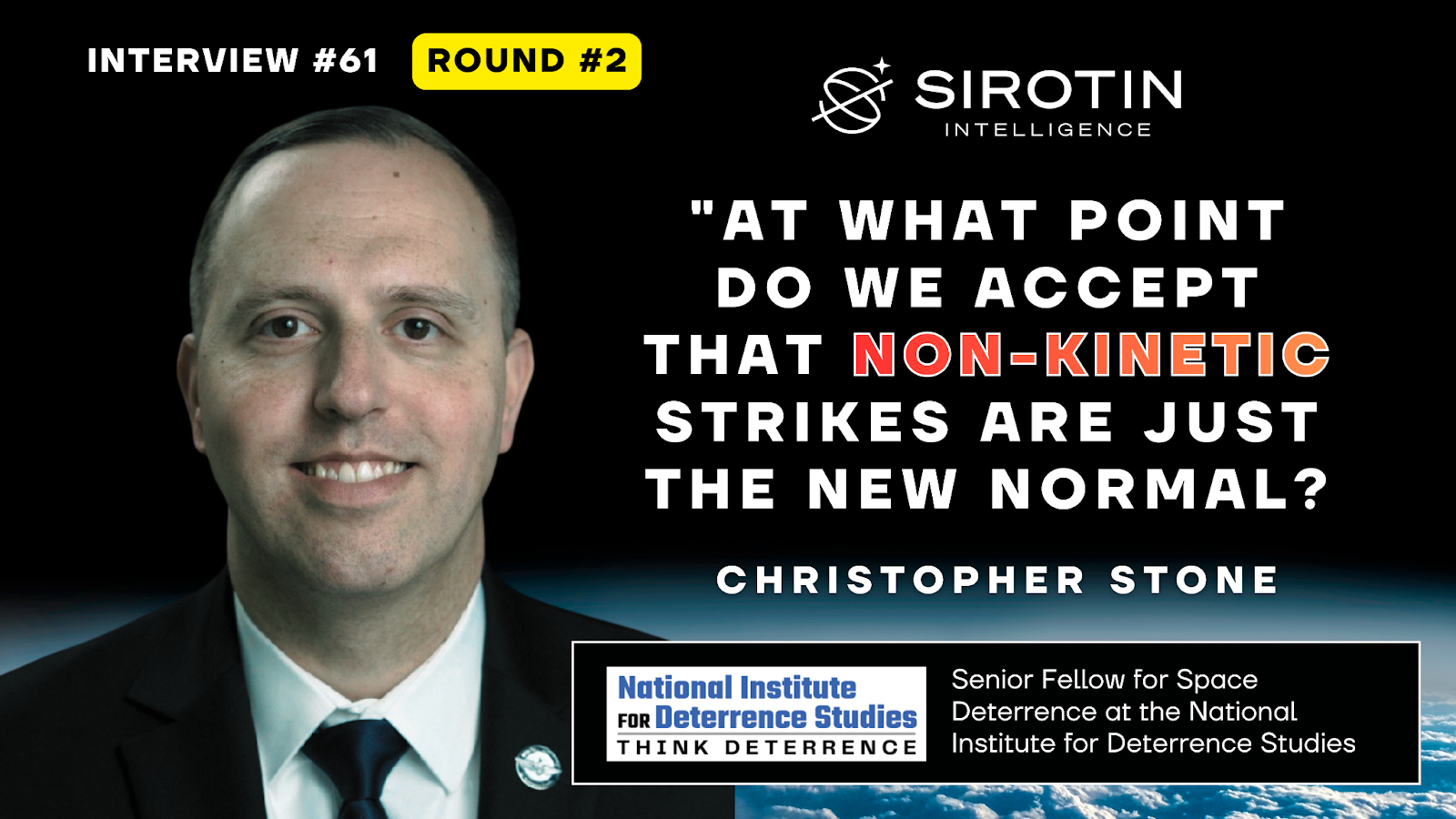
Christopher Stone has spent nearly two decades tracking threats that most people encounter only as unexplained flight delays or navigation glitches. He served as Special Assistant to the Deputy Assistant Secretary of Defense for Space Policy, flew as a U.S. Air Force space operations officer, and now holds the position of Senior Fellow for Space Deterrence at the National Institute for Deterrence Studies. GPS spoofing attacks on commercial aviation climbed from a few dozen incidents in February 2024 to more than 1,100 by August, and Vice Chief of Space Operations General David Thompson has acknowledged these attacks occur daily. Yet no public response framework exists. Stone's recent paper with Christophe Bosquillon, "Space Deterrence and the Global Positioning System: A Strategic Imperative," argues that resilience measures alone amount to damage limitation, not deterrence; without offensive capability to complement defensive posture, the President lacks credible options when adversaries test the next threshold.
Key topics:
- How GPS interference could climb an escalation ladder toward nuclear signaling
- China's completed national eLoran network, and why the West hasn't built an equivalent
- L5 frequency adoption and what a realistic pre-crisis timeline would require
- What would actually change if GPS received critical infrastructure designation
- The case for a three-year window to address American space deterrence posture
Watch Christopher's YouTube preview Tuesday on the Sirotin Intelligence YouTube channel. Full interview drops this week.
Sources
https://www.space.com/news/live/artemis-2-moon-rocket-nasa-fueling-test-jan-30-2026
https://www.cpr.org/2026/01/29/new-space-and-defense-facility-pueblo/
https://seekingalpha.com/article/4864573-the-1-2-trillion-aerospace-and-defense-supercycle
https://finance.yahoo.com/news/redwire-shield-role-brand-shift-091126537.html
https://breakingdefense.com/2026/01/spacex-unveils-stargaze-space-tracking-system/
https://aviationweek.com/defense/supply-chain/hexcel-focus-defense-space-growth-ceo-gentile-says
https://spacepolicyonline.com/news/whats-happening-in-space-policy-january-25-31-2026/
https://www.neimagazine.com/news/nasa-tests-nuclear-space-tech/
https://news.crunchbase.com/venture/northwood-space-tech-100m-seriesb-washington-harbour-a16z/
https://smallwarsjournal.com/2026/01/30/the-limits-of-space-cooperation/
https://spacenews.com/china-eyes-space-resources-space-tourism-and-on-orbit-digital-infrastructure/
https://www.ft.com/content/3e81f272-a1d1-4424-8890-ccc7e364a6d3?utm_source=chatgpt.com
https://www.war.gov/News/Contracts/Contract/Article/4394525/contracts-for-jan-30-2026/
https://www.war.gov/News/Contracts/Contract/Article/4393248/contracts-for-jan-29-2026/
https://www.war.gov/News/Contracts/Contract/Article/4392289/contracts-for-jan-28-2026/
https://www.war.gov/News/Contracts/Contract/Article/4391076/contracts-for-jan-27-2026/
https://www.war.gov/News/Contracts/Contract/Article/4389804/contracts-for-jan-26-2026/
Get exclusive insights from our network of NASA veterans, DARPA program managers, and space industry pioneers. Weekly. No jargon.