
Sirotin Intelligence Briefing: July 27–August 1, 2026: Pentagon Awards $135 Billion in Mega-Contracts in a Single Day, USSPACECOM Codifies the 2040 Space Fight, and Washington Tears Down Launch Licensing Barriers

This week's Sirotin Intelligence analysis covers the Pentagon's roughly $135 billion contract Wednesday – Lockheed Martin's Patriot interceptor deal worth up to $58.6 billion through 2032 as the Iran war depletes stockpiles, and $76.6 billion to General Dynamics Electric Boat and HII Newport News for nine Virginia-class and five Columbia-class submarines – alongside U.S. Space Command's release of Space Warfighting Environment 2040, the first installment of its "Space Trilogy" doctrine defining how the Joint Force fights in a contested space domain through 2040. We also examine the Trump administration's move to waive 13 federal environmental laws to accelerate commercial launch licensing paired with the FCC's Space Modernization Order, SpaceX's $1.6 billion task order for 18 Falcon 9 national security missions – the first award under the newly tripled $17 billion NSSL ceiling – Rocket Lab's $266 million for 12 suborbital missile-defense missions from Alaska, and Russia's most brutal aerial campaign in months, including a 70-missile, 280-drone barrage that killed eight Ukrainians and dropped a missile inside Poland. Rounding out the week: Accenture's $821 million War Data Platform award, Sphinx Defense's $287 million ESS ground segment prototype, NASA fueling the Roman Space Telescope for its August 30 launch months ahead of schedule, SpaceX hitting its 90th orbital launch of the year, Christophe Bosquillon's Space Zeitgeist Nugget going deep on SWE 2040 – and our interview this week is with Paul Williams, the four-decade European propulsion veteran behind Black Arrow Space Technologies, on demisable tanks, seaborne launch for nations without spaceports, and why orbit is "a global resource, not a rich man's plaything."
🛡️ Defense Highlights
- Pentagon commits $135 billion in a single day – Patriot interceptors and nuclear submarines anchor the largest one-day contract haul in recent memory: The Defense Department announced two massive contract packages July 29 worth approximately $135 billion combined. The Army awarded Lockheed Martin a Patriot interceptor production contract worth up to $58.6 billion, converting April's one-year, $4.7 billion deal into a seven-year framework agreement running from FY2026 through 2032 – a direct response to the Iran war's drawdown of a dwindling U.S. interceptor stockpile and among the largest missile procurement commitments ever signed. The Navy simultaneously awarded General Dynamics Electric Boat and HII's Newport News Shipbuilding $76.6 billion for nine Virginia-class attack submarines and five Columbia-class ballistic-missile submarines, with work running through July 2038. The structural story is the shift to multiyear mega-contracts: the administration is deliberately trading procurement flexibility for industrial-base certainty, betting that guaranteed seven-to-twelve-year demand signals will finally get primes to invest in capacity expansion that annual contracting never incentivized. The Patriot math is the sharpest signal – at wartime expenditure rates, interceptor magazines have become the binding constraint on American air defense commitments from the Middle East to the Pacific.
- USSPACECOM releases Space Warfighting Environment 2040 – the "Space Trilogy" opens by committing effect chains and cislunar strategy to formal doctrine: U.S. Space Command released Space Warfighting Environment 2040 this week, the first installment of its J7-produced "Space Trilogy" defining the trends, competitive dynamics, and strategic implications shaping military space operations through 2040 – a framework explicitly designed to prepare, not predict for, the Joint Force to fight and win in a contested space domain. The document organizes the fight around the "effect chain" – ground-to-space, space-to-space, space-to-ground – frames the threat landscape as China (mass and scale), Russia (disruption), and Iran/North Korea (asymmetry), and makes two consequential doctrinal commitments: elevating commercial industry and allied partners from supporting roles to integral elements of military capability, and flagging cislunar space as a first-mover-advantage domain where chokepoints and gravitational corridors carry strategic weight. SWE 2040 complements the Space Force's Future Operating Environment 2040 and Objective Force 2040, and stands apart as the only framework in the set that projects the operating environment forward rather than cataloging the present. For a plain-English breakdown, Sirotin Intelligence released "The Space War of 2040, in Plain English" – an 18-slide visual briefing on the document – on July 31, and Christophe Bosquillon's column below goes deeper on what the doctrine means.
- SpaceX lands the first task order under the expanded NSSL ceiling – $1.6 billion for 18 Falcon 9 missions flying sensing and targeting satellites: The Space Force awarded SpaceX a $1.6 billion contract July 29 for 18 Falcon 9 launches carrying Space-Based Sensing and Targeting satellites from Vandenberg through 2027 – the first task order issued since the service tripled its NSSL Phase 3 Lane 1 ceiling to $17 billion earlier this month. The award pushes SpaceX to at least $7 billion in Pentagon contracts this year and puts hard numbers on the demand surge Gen. Saltzman warned Congress about: the missions largely serve the proliferated sensing and targeting layers underpinning Golden Dome, and they will fly from the same strained Vandenberg ranges the Space Force says may eventually force launch caps. Eighteen dedicated national security missions inside roughly eighteen months, awarded to a single provider, is both a testament to Falcon 9's operational maturity and a fresh data point in the concentration-risk debate – with Vulcan and New Glenn still grounded, every incremental national security payload continues flowing to one company.
- Rocket Lab takes $266 million for missile-defense target launches – twelve suborbital missions from a new Alaska pad build out the testing infrastructure Golden Dome needs: The Space Force awarded Rocket Lab $266 million on July 27 to launch 12 suborbital missions over the next three years, most from a new launch pad in Alaska – target and test flights supporting the missile-defense development pipeline. The award attacks the same bottleneck the UK's Project Bowline contract addressed at Farnborough: hypersonic and ballistic missile defense programs are chronically constrained by the availability of realistic targets to shoot at, and a dedicated, high-cadence suborbital target capability is prerequisite infrastructure for the intercept testing campaign Golden Dome's timeline demands. For Rocket Lab, the deal deepens a defense relationship that now spans launch, targets, and – pending the Iridium acquisition's close – global communications infrastructure.
- Russia unleashes its heaviest barrage in months and a missile lands in Poland – 70 missiles and 280 drones kill eight as Zelensky pleads for air defense: Russia launched over 70 missiles and 280 drones against Ukraine in the early hours of July 30, killing at least eight people including three children – five members of a single family died in a direct Iskander strike on their home near Kryvyi Rih – and wounding dozens across Kyiv, Lviv, and other cities. Ukraine's air force intercepted 55 missiles and 265 drones, a defense rate that still let through enough ordnance to produce the deadliest night in months; a follow-up strike on Kyiv July 31 killed three more. The NATO dimension arrived uninvited: a suspected Russian missile fell into a field in Poland's Lublin region during the July 30 barrage, triggering air raid alerts across eastern Poland and a fresh Article 4 debate. The attack's arithmetic – saturation packages sized to exhaust interceptor magazines – is exactly the problem the week's $58.6 billion Patriot contract and Europe's Bliksem EXO consortium are racing to solve, and Zelensky's renewed air defense plea landed within hours of the Pentagon formalizing the largest interceptor buy in history.
- VanHerck warns U.S. bases are exposed to Ukraine-style drone attack – former NORAD chief says American installations could suffer their own Spiderweb: Retired Air Force Gen. Glen VanHerck, former head of U.S. Northern Command and NORAD, warned July 30 that heavily guarded U.S. Air Force bases remain vulnerable to the kind of containerized drone attack Ukraine used to devastate Russian bomber bases – a scenario in which cheap FPV drones smuggled near installations destroy strategic aircraft parked in the open. The warning carries institutional weight precisely because of who issued it: the officer formerly responsible for homeland defense saying publicly that the attack vector remains open, three years after Ukraine proved the concept and with counter-sUAS authorities inside the homeland still fragmented across agencies. It lands the same month the Pentagon committed $1.1 billion toward 300,000 offensive one-way attack drones – the U.S. is industrializing the sword considerably faster than the shield.
Major Contract Awards This Week:
- Lockheed Martin Corp. – Patriot interceptor production: A contract worth up to $58,600,000,000 converting the April 2026 one-year, $4.7 billion agreement into a seven-year framework for Patriot interceptor production from FY2026 through 2032, announced July 29.
- General Dynamics Electric Boat and HII Newport News Shipbuilding – Attack and ballistic-missile submarines: A combined $76,600,000,000 Navy award for nine Virginia-class attack submarines and five Columbia-class ballistic-missile submarines, with work expected through July 2038, announced July 29.
- SpaceX – National security launch services: A $1,600,000,000 Space Force task order for 18 Falcon 9 launches carrying Space-Based Sensing and Targeting satellites from Vandenberg through 2027 – the first task order under the expanded $17 billion NSSL Phase 3 Lane 1 ceiling, announced July 29.
- Accenture Federal Services – War Data Platform: An $821,000,000 contract to mature the Pentagon's War Data Platform, expanding AI-powered battlefield data integration and decision support, announced July 28.
- Sphinx Defense – ESS ground segment: A $287,000,000 Space Systems Command award announced July 27 to develop a mission planning prototype for the Evolved Strategic Satellite Communications program's ground segment.
- Rocket Lab – Suborbital target missions: A $266,000,000 Space Force award announced July 27 for 12 suborbital missions over three years supporting missile-defense testing, most flying from a new launch pad in Alaska.
- Impulse Space Inc. – Orbital maneuver vehicles: A $27,770,000 modification for two additional Mira space vehicles, bringing the contract's total cumulative face value to $62,808,900, announced July 29.
🌐 Policy, Geopolitical & Legal Developments
- Washington tears down launch licensing barriers on two fronts – FAA waives 13 environmental laws as the FCC adopts its Space Modernization Order: The Trump administration moved July 28 to waive what it called "unnecessary environmental laws and regulations" constraining commercial launch and reentry licensing, with the formal waiver published in the Federal Register July 30 – authorizing the FAA to set aside requirements from 13 federal statutes including the National Environmental Policy Act, Endangered Species Act, and portions of the Clean Water and Clean Air Acts for specified license actions. The move compounds the FCC's Space Modernization Order, adopted July 22, whose sweeping satellite-licensing overhaul drew its first detailed industry legal analyses this week. Together the back-to-back actions constitute the most aggressive commercial space deregulation in the industry's history, arriving as SpaceX approaches triple-digit annual launch cadence and as the Space Force's own study calls for a third heavy-lift launch site. The controversy is proportionate: Space Coast environmental groups and legal scholars are already flagging litigation risk, and the waiver's durability across administrations is an open question – but for launch providers, the near-term effect is a licensing pipeline that finally moves at something closer to flight rate.
- Commercial space station Phase 2 feedback closes as NASA sketches a $1 billion competition – final RFP expected late August, award in spring 2027: Industry feedback on NASA's draft Commercial LEO Destinations Phase 2 solicitation closed Monday, July 27, advancing the procurement that will determine who controls the primary infrastructure for human spaceflight in the 2030s. The emerging structure: a final RFP in late August, proposals due roughly 60 days later, contract award penciled in for spring 2027, and winners required to fly a crewed test flight by 2029 – leaving barely two years between award and astronauts in orbit, a schedule that will favor bidders with hardware already in work over paper stations. With the ISS's retirement clock running, the Phase 2 award is shaping up as the most consequential civil space procurement of the decade.
- Roman Space Telescope fueled for its August 30 launch – a flagship observatory flying months ahead of schedule enters final countdown: NASA fueled the Nancy Grace Roman Space Telescope on July 27, one of the final milestones before its Sunday, August 30 launch aboard a SpaceX Falcon Heavy from Kennedy – a mission flying roughly eight months ahead of its earlier targets, a nearly unheard-of direction for a flagship astrophysics mission to move. Roman's wide-field infrared survey capability – Hubble-class resolution across a field of view 100 times larger – will attack dark energy, exoplanet demographics, and infrared astrophysics, and its early arrival owes to disciplined hardware integration and an agency increasingly willing to buy commercial heavy lift at market cadence. After a decade in which James Webb's delays defined public expectations for flagship missions, Roman launching early is a quiet institutional milestone worth marking.
🛰️ Technology & Commercial Developments
- SpaceX hits 90 orbital launches before August – NRO classified mission and Starlink cadence keep the machine running at unprecedented rate: SpaceX closed July with its 90th orbital launch of the year – the Starlink 17-52 mission late July 31 from Vandenberg, following a classified National Reconnaissance Office launch July 29 – a pace that puts the company on track to shatter its own annual record and to single-handedly exceed the entire world's 2020 launch total. The cadence contextualizes everything else in the week's news: the FAA's environmental waivers, the Space Force's spaceport strain warnings, and the $1.6 billion 18-mission task order all trace back to a single company operating launch infrastructure at a tempo the regulatory and range architecture was never designed to support. One of the V3 Starlink satellites deployed on Flight 13 also returned imagery of Starship itself in space – a small image with large implications, as next-generation constellation hardware begins documenting the vehicle that will deploy it at scale.
- Impulse Space doubles its Mira fleet under Space Force contract – orbital maneuver vehicles keep climbing the national security priority list: The Space Force exercised a $27.8 million modification July 29 adding two more Mira orbital maneuver vehicles to its Impulse Space contract, bringing the total value to $62.8 million. Mira's high-thrust, rapid-repositioning profile addresses what Space Force leaders increasingly describe as sustained space maneuver – the ability to move assets dynamically between orbits without the fuel-hoarding constraints that make today's satellites predictable targets. The award is small in dollars and large in signal: dynamic space operations is graduating from experiment to program of record, and the vendors who can deliver delta-v on demand are collecting the early franchise positions.
- Launch cadence records fall as the year passes 200 orbital attempts – 2026 tracks toward smashing 2025's record 324 launches: With SpaceX at 90 launches, China maintaining its double-digit monthly tempo, and new vehicles – Starship, Neutron, Vulcan's return, New Glenn's December comeback – all pointed at operational service in the coming months, 2026 remains on pace to exceed 2025's record 324 orbital launch attempts, the trajectory Christophe Bosquillon's column detailed last week via the Space Foundation's $686 billion space economy report. The constraint story keeps shifting from vehicles to infrastructure: pads, ranges, licensing, and processing capacity are now the binding variables, which is precisely why this week's FAA waivers and the Space Force's third-launch-site study matter more than any single vehicle milestone.
💭 A Word From Christophe Bosquillon
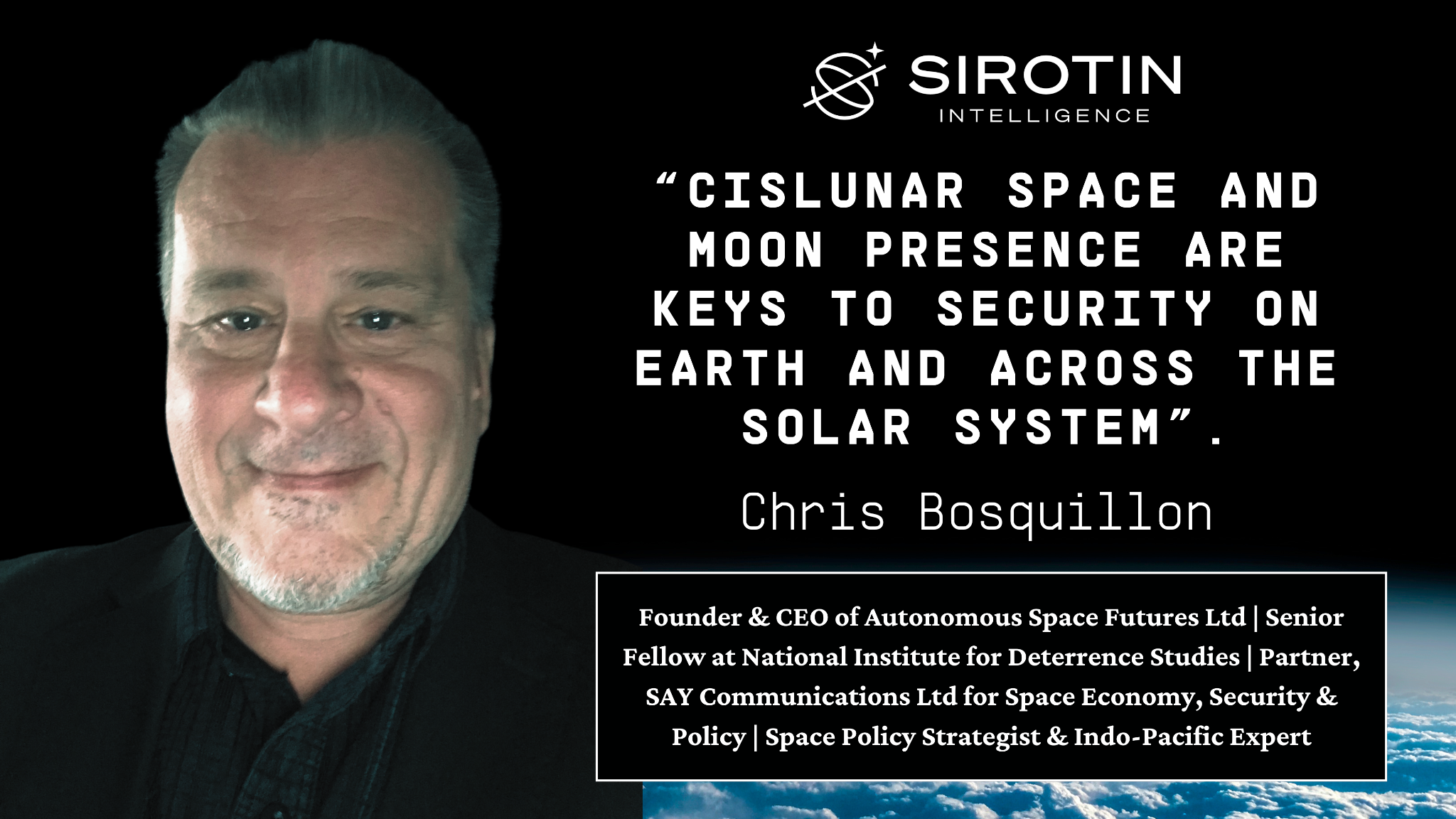
The U.S. Space Command (USSPACECOM) just released Space Warfighting Environment 2040 (SWE 2040) as a framework to ensure future Joint Force's all-domain advantage. This works as first instalment of its "Space Trilogy," a J7-produced doctrine that defines the trends, competitive dynamics, and strategic implications shaping military space operations through 2040. This is intended to prepare (not predict for) the Joint Force to fight and win in a contested space domain.
SWE 2040 complements previously released USSF's Future Operating Environment 2040 and Objective Force 2040 by defining how the Joint Force fights and wins within that environment. The SWE 2040 organizing principle is the "effect chain" - ground-to-space, space-to-space, space-to-ground - as the lens for understanding where advantage and vulnerability reside. SWE 2040 frames the competitive landscape around China (mass, scale), Russia (disruption), and Iran/North-Korea (asymmetry). It accounts for emerging partners Poland, Norway, Luxembourg, UAE, and India as diversifying, largely constructive space actors.
Space is treated as a cross-domain system whose value lies in the continuous flow of trusted information and effects. Every decision in space directly affects land, sea, air, and cyber operations. By 2040 the domain will be more crowded, contested, and commercially driven. Innovation cycles are compressed from decades into one single operational cycle. Post-quantum encryption transition and quantum sensing/comms maturation add pressure. AI recast C2 into "kill meshes" that enable multiple concurrent decisions in seconds.
Two shifts emerge: first, elevation of commercial industry and allied partnerships from supporting roles to integral elements of military capability the Joint Force cannot generate alone- the document argues that distributed architectures, rapid innovation, and broad collaboration will prevail over exclusive government ownership of critical systems; second, SWE 2040 flags cislunar space as a first-mover-advantage domain (chokepoints, gravitational corridors) playing a foundational norms-setting role. USSPACECOM is absolutely serious in committing cislunar strategic logic to its doctrine.
Budgeting for organizational priorities, by 2040, USSPACECOM must train for contested space as baseline rather than exception, with rapidly adaptable HR/capabilities supporting all domains under persistent competition and disruption. Adversary capabilities and threat spectrum will drive situational awareness and the new definitions of space intelligence requirements.
Have a great Space Week ahead!
PS: On 31 July 2026, Sirotin Intelligence released "The Space War of 2040, in Plain English" – a Visual Briefing on the U.S. Space Command's Space Warfighting Environment 2040 Report, by Angelica Sirotin. Link to this stunning 18 slides briefing here.
🎤 Our Next Guest: Paul Williams
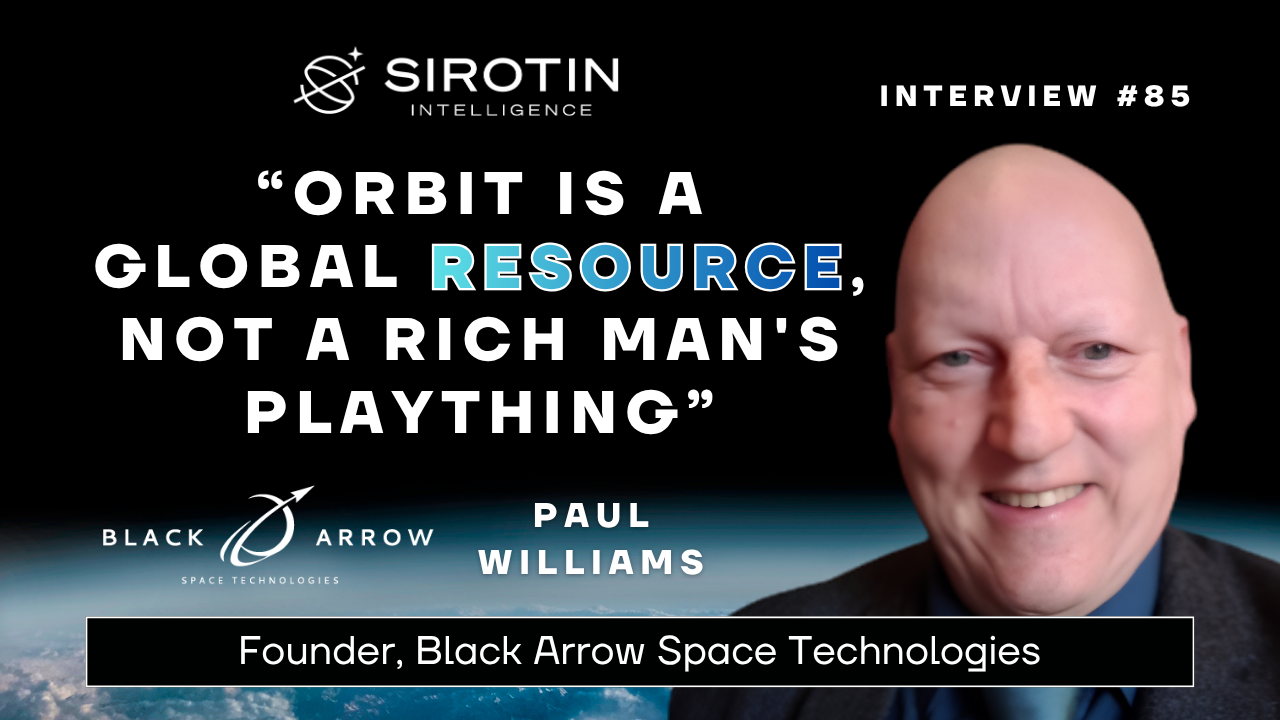
Paul Williams is a career engineer and technologist with 42 years in the European space industry, primarily in chemical propulsion and product assurance. He served on the launch team for ESA's Olympus telecommunications satellite at Kourou in 1989, worked propulsion on the Cluster science satellites lost on Ariane 5's first flight, and has supported major European programs including ATV, Galileo, and ExoMars through his consultancy ISP International Space Propulsion. In 2017 he founded Black Arrow Space Technologies – reviving the name of Britain's cancelled national launcher – and in 2024 spun out Sea to Space to develop a seaborne "spacefleet" for launching small satellites from the waters of customers with no spaceport of their own. Through AstroTanks, he is developing demisable propellant tanks designed to burn up cleanly on reentry.
- How a failed academic and teenage apprentice ended up running a heat-transfer lab alone – and on the Olympus launch team twelve years later
- What watching Ariane 501 destroy years of Cluster propulsion work taught him about reliability, and why "if everybody did the correct job, product assurance would be redundant"
- America is "allowed to fail" – why European startups importing Silicon Valley iteration rhetoric without American budgets get it wrong
- Reviving the Black Arrow name, the seaborne spacefleet built for regions without spaceports, and the funding catch-22 trapping small launch
- Demisable tanks, 30,000-satellite constellations, and why weekly Starlink collision dodges "scare the pants off me"
- The 85-15 downstream-upstream investment split, the jammed door of a one-company launch market, and why the builders aren't in the room where strategy gets made
- Orbit as a global resource governed by a single nation's licensing bodies – "not just a rich man's plaything" – and the asteroid-warning conversation the world keeps refusing to have
Watch Paul Williams' YouTube preview Tuesday on the Sirotin Intelligence YouTube channel. Full interview drops Thursday.
Sources:
https://www.bloomberg.com/news/articles/2026-07-29/pentagon-awards-mega-contracts-to-firms-amid-iran-war-strains https://thehill.com/policy/defense/6000739-lockheed-martin-contract-patriot-interceptor-missiles-stockpile/ https://mezha.net/eng/bukvy/909b9b24_pentagon_awards_lockheed/ https://www.benzinga.com/news/politics/26/07/60788234/pentagon-commits-over-135-billion-to-patriot-missiles-nuclear-submarines-as-trump-pressures-defense-contractors-to-ramp-up-production https://www.spacecom.mil/Newsroom/News/Article-Display/Article/4555148/usspacecom-releases-space-warfighting-environment-2040-as-framework-to-ensure-f/ https://www.spacecom.mil/Portals/57/%5bFINAL%5d%20USSC%20Space%20Warfighting%20Environment%202040.pdf https://www.executivegov.com/articles/usspacecom-swe-2040-released https://www.sirotinintelligence.com/space-war-of-2040-visual-briefing/ https://thedefensepost.com/2026/07/30/us-rocket-launch-spacex/ https://easternherald.com/2026/07/30/spacex-space-force-contract-16-billion-falcon-9/ https://www.airandspaceforces.com/space-force-to-launch-18-comms-targeting-missions-by-end-of-2027/ https://keeptrack.space/space-brief/space-brief-2026-07-28 https://www.washingtonpost.com/world/2026/07/30/russia-ukraine-war-zelenskyy-missile-attack/e7f2146c-8bdf-11f1-8912-d71e69d679d7_story.html https://www.washingtonpost.com/world/2026/07/31/russia-ukraine-war-zelenskyy-missile-attack-ballistics/43091f78-8d50-11f1-8912-d71e69d679d7_story.html https://kyivindependent.com/explosions-heard-in-kyiv-as-russia-launches-large-scale-ballistic-missile-attack-across-ukraine/ https://www.npr.org/2026/07/30/g-s1-136276/russia-ukraine-war https://time.com/article/2026/07/30/russia-ukraine-attack-drones-missiles-defense-death-toll/ https://www.airandspaceforces.com/news/ https://www.cnbc.com/2026/07/28/space-launches-faa-environmental-spacex-blue-origin-sean-duffy.html https://www.federalregister.gov/documents/2026/07/30/2026-15415/waiver-of-specified-statutory-requirements-for-commercial-space-launch-and-reentry-actions https://www.clickorlando.com/news/local/2026/07/29/faa-proposal-to-speed-up-commercial-rocket-launches-sparks-debate-on-space-coast/ https://www.akingump.com/en/insights/newsletters/akin-space-law-regulation-and-policy-update-or-july-28-2026 https://spacenews.com/nasa-releases-details-on-revised-next-phase-of-commercial-space-station-development/ https://www.inkl.com/news/nasa-launches-1-billion-contest-to-build-commercial-space-station-replacing-iss-by-2030 https://federalnewsnetwork.com/defense-news/2026/07/accenture-wins-821m-pentagon-ai-data-platform-contract/ https://www.war.gov/News/Contracts/Contract/Article/4556787/contracts-for-july-27-2026/ https://www.war.gov/News/Contracts/Contract/Article/4557600/contracts-for-july-28-2026/ https://www.war.gov/News/Contracts/Contract/Article/4559059/contracts-for-july-29-2026/ https://www.war.gov/News/Contracts/Contract/Article/4560267/contracts-for-july-30-2026/ https://spaceflightnow.com/2026/07/31/live-coverage-spacex-to-launch-24-starlink-satellites-on-falcon-9-rocket-from-vandenberg-sfb-12/ https://www.space.com/space-exploration/launches-spacecraft/spacexs-starship-seen-in-space-by-next-gen-starlink-satellite-video https://www.space.com/space-exploration/launches-spacecraft/spacex-starlink-falcon-9-launch-group-17-52-ocisly-vandenberg https://science.nasa.gov/blogs/roman/2026/07/27/nasa-fuels-roman-space-telescope-for-late-august-launch/ https://www.insideglobaltech.com/2026/07/28/fcc-approves-massive-modernization-of-satellite-licensing-regime/
Get exclusive insights from our network of NASA veterans, DARPA program managers, and space industry pioneers. Weekly. No jargon.