
Sirotin Intelligence Briefing: June 22–26, 2026: Pentagon Claims First Golden Dome Intercept, $35 Billion THAAD Surge After Iran War, and Rocket Lab Shatters the Responsive-Launch Record


This week's Sirotin Intelligence analysis covers the Pentagon's announcement of the first milestone intercept test of President Trump's Golden Dome shield on June 23, the Missile Defense Agency's $35.3 billion sole-source award to Lockheed Martin to quadruple THAAD interceptor output after the Iran war drained up to 80% of the U.S. stockpile, and Rocket Lab's record 16-hour-42-minute Victus Haze launch for the Space Force. It also covers the White House's $87.6 billion supplemental request — $67 billion of it for the Pentagon — Boeing's $2 billion win to keep the MUOS narrowband constellation alive, the House Appropriations markup setting a record $55.5 billion Space Force budget, and the SASC hearing for the next NRO director. Rounding out the week: Lockheed's new low-cost hypersonic glide body, Katalyst's audacious Pegasus-XL mission to rescue NASA's decaying Swift observatory, SpaceX's relentless Starlink launch cadence (another 24 satellites up June 24), Rocket Lab's June 26 Electron flight, the FCC blinking on Amazon Leo's deployment deadline, and a programming note: in lieu of a guest, Angelica Sirotin is headed to San Diego next week for Space Samurai – the space trilogy she's producing at Angelic Pictures, Inc., a Universal Studios Vendor Affiliate.
🛡️ Defense Highlights
- Pentagon declares first Golden Dome intercept a "full mission success" — directed energy and autonomous targeting down a salvo of drones and cruise missiles: Secretary of War Pete Hegseth announced on June 23 that the Golden Dome program had passed its first milestone live-fire test, with what the Pentagon called the Dynamic Defense Autonomous Defeat (DDAD) system detecting, tracking, targeting, and destroying a series of simulated incoming threats. Hegseth described a "full mission success" in which a directed-energy weapon, cued by an autonomous targeting architecture, neutralized multiple drone and cruise-missile surrogates without a human in the firing loop. The test is the clearest signal yet that Golden Dome is moving from PowerPoint to hardware roughly a year after Trump signed the executive order standing it up. It also lands amid intense congressional scrutiny over the program's still-undefined architecture, its CBO-flagged cost trajectory, and the technical leap required to scale directed energy and space-based interceptors. The directed-energy result matters strategically because cost-per-shot is the entire argument for layered homeland defense — interceptors run millions per round, photons run pennies. Expect this single test to be cited repeatedly as appropriators debate how much of the FY2027 buildup to commit to a system that, until this week, had no flight data behind it.
- Lockheed Martin wins a $35.3 billion THAAD megadeal — the Iran war burned through the stockpile, and the Pentagon is buying its way back at four times the rate: The Missile Defense Agency on June 24 awarded Lockheed Martin Missiles and Fire Control a multi-year, sole-source, fixed-price-incentive contract worth $35,327,237,604 to mass-produce Terminal High Altitude Area Defense interceptors through June 2032. The deal raises annual THAAD output from 96 missiles to as many as 400 — a near-quadrupling — and follows reporting that the spring conflict with Iran consumed up to 80% of the U.S. THAAD inventory defending forces and partners in the region. The MDA obligated $842.9 million at award, with the balance flowing across the six-year performance period, and work spans Dallas, Sunnyvale, Troy, and Camden. One offer was solicited and one received, underscoring how few suppliers exist for exo-atmospheric hit-to-kill interceptors. The contract is the most concrete evidence yet of a hard lesson from 2026: magazine depth, not just capability, decides whether integrated air and missile defense holds under sustained salvos. It also previews a broader munitions-replenishment fight now landing on Capitol Hill in the supplemental request.
- Rocket Lab launches Victus Haze in 16 hours, 42 minutes — a new responsive-space world record and proof the Space Force can field a satellite faster than an adversary can react: Rocket Lab launched the Victus Haze Tactically Responsive Space mission for Space Systems Command's Space Safari office and the Defense Innovation Unit on June 19, lifting off from Launch Complex 1 just 16 hours and 42 minutes after receiving the Notice to Launch — beating the prior record by more than ten hours. Victus Haze marked the first time a single prime delivered an end-to-end responsive mission: Rocket Lab built the maneuverable Pioneer spacecraft, executed the rapid launch, and now runs on-orbit operations. The company activated Pioneer for its first orbital maneuver within 37 hours and 36 minutes, beating a 72-hour deadline by more than a day. Pioneer is now conducting rendezvous and proximity operations against a non-cooperative satellite, rehearsing exactly the kind of rapid-response, on-orbit inspection-and-defense scenario the Space Force says it needs against China's growing counterspace fleet. The strategic message is timing: the value of responsive launch is denying an adversary the assumption that it can degrade U.S. space assets faster than Washington can reconstitute them.
- Boeing takes $2 billion to keep MUOS alive — and unseats incumbent Lockheed on the military's "cellphone network in space": Space Systems Command announced June 24 that Boeing won a contract worth up to $2 billion to build two satellites under the Mobile User Objective System Service Life Extension Phase II effort, extending the narrowband constellation's service to 2035 — five years beyond its current life. Boeing edged out incumbent Lockheed Martin, which built the existing four-satellite-plus-spare MUOS fleet, in a notable competitive upset. The geostationary system functions as a secure cellular network for troops, ships, aircraft, and special operations forces using small terminals far beyond terrestrial coverage, and the two new spacecraft are slated to launch no earlier than 2031 and 2032 with work complete by FY2035. The award reflects a deliberate Pentagon push to sustain assured narrowband connectivity — the unglamorous but mission-critical backbone of tactical comms — even as flashier proliferated-LEO programs dominate headlines.
- White House asks Congress for $87.6 billion — $67 billion for the Pentagon to refill magazines, pay for the Iran war, and fund Golden Dome priorities: The administration on June 24 sent Congress a supplemental funding package totaling roughly $87.6 billion, the majority of it — about $67 billion — for the Department of War. The Pentagon tranche includes $21 billion to rebuild munitions stockpiles, $17.3 billion for operational costs from the conflict with Iran, $12.1 billion for classified programs, and roughly $4 billion in additional high-priority Space Force funding. The request also carries money for the Ebola response in Central Africa and aid to American farmers. It faces an uphill climb: backing it reads as an endorsement of an unpopular war for vulnerable Republicans, and Democratic opposition puts Senate passage in genuine doubt. The supplemental is the budgetary echo of the THAAD award — both are the bill coming due for a high-intensity 2026, and together they frame the central appropriations question of the summer: how fast Washington is willing to pay to restore the depth its forces just spent.
- Lockheed unveils a "manufacturing-first" hypersonic glide body — the affordability pivot reaches America's premier weapons maker: Lockheed Martin announced on June 24 that it is accelerating development of its Next Generation Glide Body (NXGB), a hypersonic weapon designed around a "manufacturing-first" methodology that starts from producibility and works backward to aerodynamics and materials — inverting the traditional design sequence to drive down cost while promising greater range and velocity than current designs. The NXGB cleared its Preliminary Design Review and is slated for a 2027 flight demonstration, and Lockheed says it can be launched from multiple platforms across multiple domains. The timing is pointed: the Army signaled in April that it would pivot away from buying Lockheed's pricey Long Range Hypersonic Weapon in favor of cheaper alternatives, and NXGB is Lockheed's answer. It marks a clear inflection in U.S. hypersonics — from exquisite, low-rate prototypes toward affordable, mass-producible munitions, the only path to the magazine depth a Pacific fight would demand.
Major Contract Awards This Week:
- Lockheed Martin Missiles and Fire Control – THAAD interceptor production: A $35,327,237,604 multi-year, sole-source, fixed-price-incentive (undefinitized) contract to produce Terminal High Altitude Area Defense missile rounds, raising annual output toward 400 interceptors, with work in Dallas, Sunnyvale, Troy, and Camden through June 2032.
- Boeing – MUOS Service Life Extension Phase II: A contract worth up to $2 billion to design, build, and provide launch and on-orbit test support for two narrowband communications satellites, extending the MUOS constellation to 2035, with launches no earlier than 2031–2032.
- Strategic Mission Systems LLC – E-4B sustainment: An indefinite-delivery/indefinite-quantity contract with a $984,000,000 ceiling for communication support services for E-4B "Nightwatch" mission systems, performed in Oklahoma City, San Antonio, and Offutt AFB through June 2037.
- Raytheon Co. – AMRAAM design review: A $398,691,358 cost-plus-fixed-fee and cost-reimbursement (undefinitized) action for Advanced Medium Range Air-to-Air Missile D4/C9 system requirements and preliminary design review, including Foreign Military Sales to more than 30 allied nations, through December 2027.
- Alloy Surface Co. – Countermeasure decoys: A $300,000,000 modification for production, testing, and delivery of M211 and multiple MJU-series infrared decoys, with an estimated completion date of March 2031.
- Alliant Techsystems Operations LLC (Northrop Grumman) – Advanced weapons technology: A $90,460,778 cost-plus-fixed-fee IDIQ for design, development, and technology demonstrations spanning AARGM, ramjet propulsion, RAM rocket motors, and Stand-in Attack Weapon systems, performed in Northridge and China Lake through June 2031.
- Lockheed Martin Corp. (Orlando) – Apache MTADS/PNVS logistics: An undefinitized action not to exceed $66,759,431 for the AH-64 Apache Modernized Target Acquisition Designation Sight/Pilot Night Vision Sensor performance-based logistics program, through December 2026.🌐 Policy, Geopolitical & Legal Developments
- House Appropriators set a record $55.5 billion Space Force budget — the service's funding line is now growing faster than any other in the force: On June 24 the House Appropriations Committee took up the FY2027 Defense Appropriations bill, with the Defense Subcommittee having approved $1.072 trillion for defense overall. Of that, $55.5 billion is earmarked for the Space Force — $1.78 billion for Military Personnel, $8.80 billion for Operations & Maintenance, $9.62 billion for Procurement, and a striking $35.32 billion for Research, Development, Test and Evaluation. That RDT&E-heavy split confirms the Space Force is still very much a force under construction, pouring the bulk of its money into Golden Dome architectures, proliferated constellations, and next-generation missile-warning. The $55.5 billion figure is a major jump over the roughly $40 billion the service received in FY2026, and the administration is angling for another $12 billion through a contested third reconciliation bill that Senate leaders say lacks the votes. The throughline is unmistakable: even in a tight fiscal environment, space is where the defense budget is expanding fastest.
- Senate Appropriations moves on the NASA budget — again — as Congress prepares to reject the White House's deep science cuts for a second straight year: The Senate Appropriations Committee on June 25 proceeded with markup of the Commerce-Justice-Science bill that funds NASA, NOAA, and NSF, after postponing it from June 4 over unrelated controversy in the Justice portion. The administration's FY2027 request again proposed deep cuts to everything at NASA except human exploration — and House appropriators already rejected those reductions in May, with key senators signaling they view the request as inadequate. Congress rejected similar cuts in FY2026, so the political pattern is now well established: the White House proposes austerity for science and aeronautics, and a bipartisan coalition on the Hill restores it. For the space-science community, the recurring whiplash is itself the problem, complicating multi-year mission planning even when the funding ultimately survives.
- Senate Armed Services vets the next NRO director — Roger Mason's nomination signals continuity at the agency that runs America's spy satellites: The Senate Armed Services Committee on June 25 held a nomination hearing for Roger Mason to be Director of the National Reconnaissance Office and Erich Hernandez-Baquero to be Assistant Secretary of the Air Force for Space Acquisition and Integration. Mason, currently Chief Growth Officer at V2X and a former Assistant Director of National Intelligence for Systems and Resource Analysis, would succeed Chris Scolese, who has led the NRO since 2019. Hernandez-Baquero, now a Raytheon space-ISR vice president with a long Air Force and NRO career, would become DOD's senior architect for space systems. The two nominations matter because the NRO and ASAF/SQ sit at the seam between intelligence and warfighting in space — and filling them with industry-experienced leaders reflects the administration's push to accelerate acquisition and tighten the loop between the spy-satellite enterprise and Space Force operations.
- Katalyst bids to rescue NASA's Swift observatory — a Pegasus-XL launch from Kwajalein could become the first commercial save of a dying science satellite: NASA and Katalyst Space are targeting June 27 for the air-launch of a Northrop Grumman Pegasus-XL carrying Katalyst's LINK on-orbit servicing spacecraft, tasked with attaching to the Neil Gehrels Swift Observatory and reboosting its decaying orbit. Swift, launched in 2004 to study gamma-ray bursts, is dropping faster than expected because of heightened solar activity and would otherwise reenter this fall. NASA awarded Katalyst a $30 million contract in September on what the company's Kieran Wilson called an "absolutely unprecedented development timeline." The catch: Swift was never designed to be captured, so LINK and the observatory will fly maneuvers in tandem so LINK can find the right grip point, followed by a two-to-three-month reboost. Air-launched from a modified L-1011 staging out of Kwajalein Atoll to match Swift's low 20.6-degree inclination, a success would be a landmark proof point for commercial satellite servicing — and a template for salvaging billion-dollar assets rather than abandoning them.
🛰️ Technology & Commercial Developments
- SpaceX keeps the Starlink machine running — a June 24 Vandenberg launch adds another 24 satellites to the megaconstellation: SpaceX continued its relentless deployment cadence on June 24, when a Falcon 9 lofted 24 Starlink satellites — the Starlink 17-45 mission — from Space Launch Complex 4E at Vandenberg Space Force Base. The flight is one more data point in a tempo that has averaged roughly one dedicated Starlink mission every three to four days through 2026, steadily widening the capacity-and-coverage gap between Starlink and every rival constellation. That operational dominance is the backdrop to SpaceX's expanding national-security footprint — and the reason the Space Force keeps routing missions its way, from launch to proliferated-LEO tracking. For competitors and Pentagon planners alike, the strategic question raised this week is the one raised every week: how to avoid over-reliance on a single provider pulling further ahead with every flight.
- The FCC blinks on Amazon Leo's deadline — 367 satellites up, but Amazon won't hit its July 30 milestone, and Washington is choosing growth over enforcement: With 367 production satellites now in orbit, Amazon Leo (formerly Project Kuiper) is the third-largest constellation aloft — but well short of the roughly 1,600 it needed to launch half its system by July 30, 2026. In June the FCC waived that deadline rather than penalize Amazon outright, instead "temporarily demoting the spectral priority" of satellites launched after the milestone until Amazon accelerates its build rate. The company is targeting 20-plus launches in 2026 across Atlas V, Falcon 9, Ariane 6, Vulcan, and New Glenn, with a limited U.S., U.K., France, Germany, and Canada beta slated for late 2026 or early 2027. The regulatory leniency reflects a strategic calculus in Washington: a credible second Western broadband constellation is worth more than a hard deadline, especially with Starlink now public and dominant and Chinese state-backed mega-constellations racing to fill orbital shells.
- Rocket Lab caps the week with a June 26 Electron launch — and presses toward Neutron's medium-lift debut:Rocket Lab closed out the week on June 26 by launching its "Ten Owl of Ten" mission — Synspective's 10th synthetic-aperture-radar satellite and the company's 12th launch of 2026, extending a 100% mission-success record for that customer. The flight expands Synspective's Japan-based Earth-observation constellation used for city planning, infrastructure monitoring, and disaster response. Looking ahead, the company continued building toward the late-2026 debut of its partially reusable Neutron rocket — backed by a recent five-Neutron block sale and roughly $2.2 billion in backlog — with CEO Peter Beck pointing investors to hardware moving onto test stands as the next milestone. Neutron would vault Rocket Lab from small-lift specialist into direct competition with Falcon 9 for commercial constellations and national-security Lane 1 missions. After a week of keeping its commercial cadence humming, Neutron is the bet that Rocket Lab can scale that tempo into the medium-lift market.
💭 A Word From Christophe Bosquillon
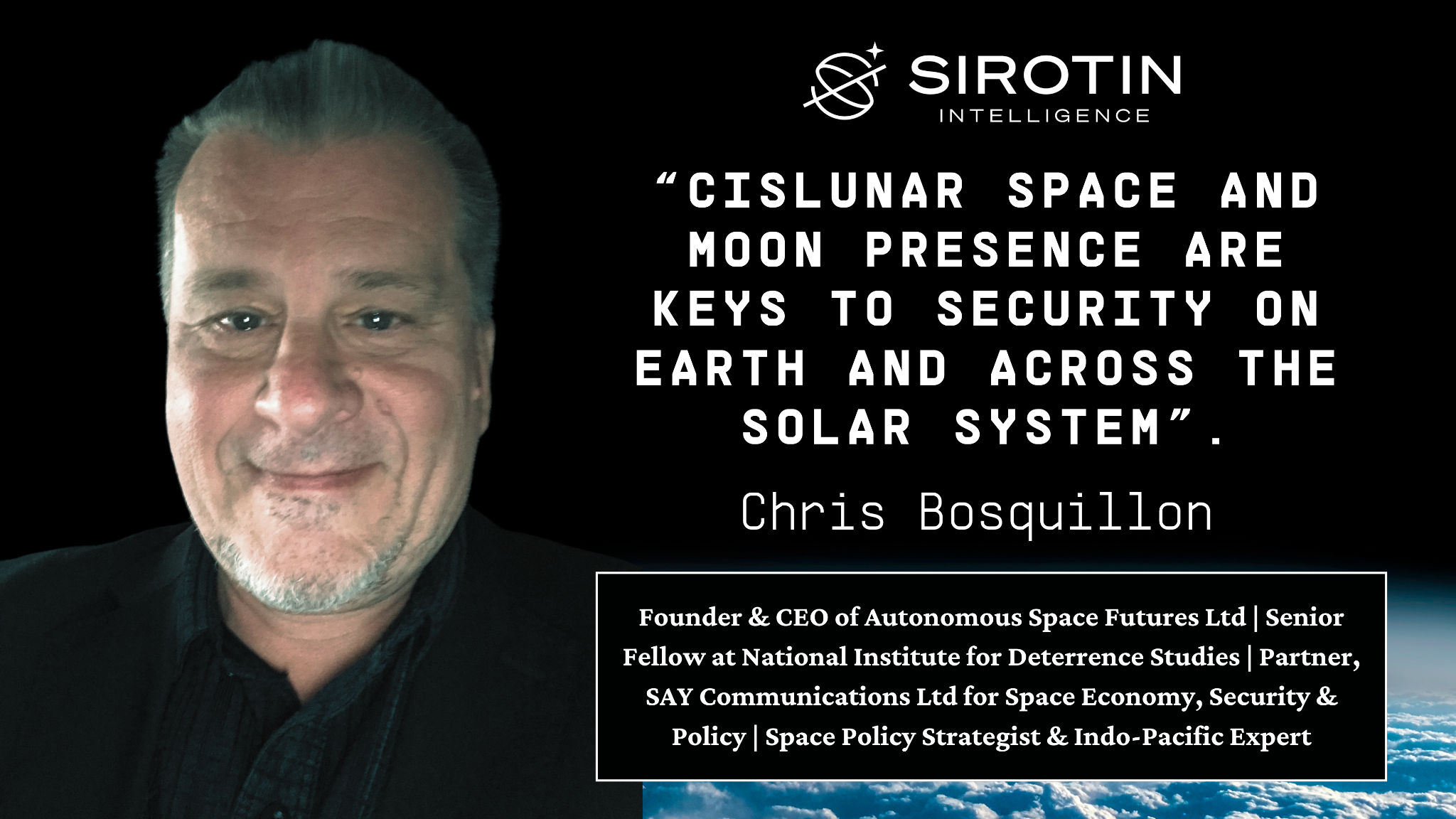
On Tuesday night this week, Secretary of War Pete Hegseth tweeted: “Today, the first milestone test of Golden Dome for America (GDA) was a full mission success — and I was honored to witness it firsthand. Cutting edge directed energy was harnessed and the Dynamic Defense Autonomous Defeat (DDAD) system flawlessly and autonomously cued, targeted, and eliminated a multitude of incoming threats. This test was executed on schedule — and dynamically defeated every threat. (...) President Trump is making President Reagan’s Strategic Defense Initiative (SDI) vision a reality. With Golden Dome, the War Department will defend our homeland more powerfully than ever before. Golden Dome is real, powerful, and on track.”
On Thursday this week, in a SpaceNews webinar "Golden Dome: How Could Sensors Protect the United States?" Sandra Erwin featured industry executives discussing the program from the standpoint of vision, tech needs, challenges, acquisition strategies, and industry roles. L3Harris (Rob Mitrevski) detailed broad involvement across sensing, comms/data links, and propulsion for interceptors. Arcfield (Dan Knight) covered digital/mission engineering, modeling and simulation, real-time adaptability, and novel ground/space sensors for hypersonics and fast threats. LeoLabs (Tony Frazier) elaborated on space domain awareness and missile defense via proliferated radars, orbital intelligence, analytics, emphasizing transportable sensors for coverage gaps.
Key sensing challenges in a layered architecture are early threat detection and handling dim, fast, maneuvering hypersonics. Attrition and dynamic optimization of a "living" network require the architecture to go "disaggregated" with AI-driven real time adaptability. For implementation, contractors are distributed across DoD agencies and new Portfolio Acquisition Executives (PAEs). Industry highlights need for budget certainty, consistent demand signals, and acquisition reform. International partnerships and burden-sharing (allied sensors, FMS) are encouraged.
Golden Dome funding in FY26 had significant requests ($24B+) but FY27 faces congressional uncertainty. The House Appropriations Committee report specifically called out Golden Dome : "The committee strongly believes that a program of this strategic importance deserves sustained, transparent funding through the discretionary budget, with rigorous congressional oversight and competition-driven efficiencies." Of the Space Force’s $71B request, around $59 billion is built into the Defense Department’s base budget, with the remaining $12Bfunded through reconciliation. However, in the FY27 budget request, nearly all the $17.5B being sought for Golden Dome will be in the reconciliation request, with around $400M in the base request.
Space Based Interceptors (SBIs) tech is proven, now SBIs need to achieve integration/interoperability, aiming at dynamic, flexible architectures by ~2035 through prototypes, scaling, and adaptation. While Christopher Stone had previoulsy crafted ‘A response to the opponents of SBIs’ and their tired argument “it will not work, it will cost too much, and it will destabilize deterrence with adversaries,” Rep. Bill Foster (D-IL), member, House Committee on Science, Space, and Technology, made this claim during a hearing on Wednesday this week: "If we're really interested in large scale fraud, not at the hundreds of thousands of dollars level, not at the hundreds of millions, but at the hundreds of billions, we should look at Golden Dome. For 40 years, scientists have been telling Republican politicians that the Golden Dome – Star Wars back in the day – was never going to work for scientific reasons.”
You really have to wonder whether the worst threats to Golden Dome aren't coming from inside Congress.
Have a great Space Week ahead!
🎤 Next Week: Angelica Sirotin Heads to San Diego for Space Samurai

No guest interview this week — Angelica Sirotin is headed to San Diego for Space Samurai.
Sirotin is a Product Placement Executive and Executive Producer at Angelic Pictures, Inc., a Universal Studios Vendor-Affiliate producing the Space Samurai Trilogy — positioned as the next major space franchise following Star Trek (we're taking it back to the old school of movie-making!). The first movie, Space Samurai: Oasis (think: Die Hard meets Gravity), is projected for theatrical release in 2027 through Universal Studios, Angelic Pictures' distribution vendor-affiliate partner, with an anticipated global viewership of over 38 million in its first year. Production begins in July 2027.
The plot: Space Samurai: Oasis is set aboard a luxury space station in 2063. A battleground in zero gravity. Secrets buried in orbit resurface. The Cold War never ended; it just moved higher. An unlikely hero rises — an edge-of-your-seat thriller from start to finish. The underlying message: the things we build to protect ourselves become the things that define us. Innovation is survival, and the nation that leads in space leads the future.
Read the full Space Samurai brief and contact Angelica Sirotin directly: https://www.sirotinintelligence.com/space-samurai-oasis/
Story Line
It’s 2063. The International Space Station is now “Oasis,” a space resort for billionaires and the Ultra Rich. The only one of its kind luxuriating among the stars, Oasis is perfection. When the best luxury money can buy malfunctions, Oasis must evacuate. During the emergency, a highly trained team of extremists take over the space station and hold the world hostage with an unusual weapon secretly installed, activated, and now poised to destroy the major arteries of Earth civilization. These mercenaries are led by a madman, who orders the assassination of a few post-evacuation stragglers.
Sources:
https://www.theepochtimes.com/us/hegseth-hails-first-test-of-americas-golden-dome-missile-defense-shield-6052543 https://en.wikipedia.org/wiki/Golden_Dome_(missile_defense_system) https://www.govconwire.com/articles/golden-dome-june-2026-update-opportunities-govcon https://www.cbo.gov/system/files/2026-05/62379-golden-dome.pdf https://www.war.gov/News/Contracts/Contract/Article/4525817/contracts-for-june-24-2026/ https://www.btimesonline.com/articles/177895/20260625/pentagon-awards-35-billion-thaad-deal-after-iran-war-burned-through-up-to-80-of-u-s-missile-stockpile.htm https://rocketlabcorp.com/updates/victus-haze/ https://www.space.com/space-exploration/launches-spacecraft/rocket-lab-launches-us-space-force-mission-with-less-than-17-hours-notice-a-new-record https://defensescoop.com/2026/06/23/space-force-victus-haze-launch-rocket-lab/ https://www.airandspaceforces.com/space-force-boeing-2-billion-narrowband-communication-satellites/ https://spacenews.com/boeing-wins-2-billion-space-force-contract-for-communications-satellites/ https://www.cbsnews.com/news/iran-war-supplemental-funding-request-pentagon-trump-congress/ https://www.cnbc.com/2026/06/24/iran-war-supplemental-trump-congress.html https://www.stripes.com/theaters/us/2026-06-24/white-house-supplemental-spending-iran-22068764.html https://www.armyrecognition.com/news/navy-news/2026/u-s-navy-orders-first-50-blackbeard-hypersonic-missiles-for-super-hornet-fighters https://news.lockheedmartin.com/Lockheed-Martin-Accelerating-Development-of-Affordable-Scalable-Hypersonic-Glide-Body https://www.airandspaceforces.com/lockheed-accelerating-production-new-hypersonic-glide-body/ https://www.vandenberg.spaceforce.mil/News/Article-Display/Article/4519296/vandenberg-space-force-base-modernizes-historic-space-launch-complex-6-for-next/ https://spacepolicyonline.com/news/whats-happening-in-space-policy-june-21-27-2026/ https://appropriations.house.gov/sites/evo-subsites/republicans-appropriations.house.gov/files/evo-media-document/fy27-defense-subcommittee-bill-summary.pdf https://www.katalystspace.com/news/katalyst-develops-design-for-nasa-to-rescue-500m-space-telescope https://science.nasa.gov/blogs/swift/2026/06/19/aircraft-carrying-swift-boost-satellite-takes-off-from-nasa-wallops/ https://www.cnbc.com/2026/06/12/spacex-ipo-spcx-live-updates.html https://www.npr.org/2026/06/12/nx-s1-5855004/stock-ai-spacex-ipo-elon-musk https://spacenews.com/space-force-awards-spacex-4-16-billion-to-build-satellite-network-for-airborne-target-tracking/ https://www.cnbc.com/2026/05/29/spacex-wins-4point16-billion-space-force-contract-for-threat-detection-satellites.html https://www.aboutamazon.com/news/innovation-at-amazon/project-kuiper-satellite-rocket-launch-progress-updates https://en.wikipedia.org/wiki/Amazon_Leo https://www.airandspaceforces.com/ula-vulcan-second-space-force-launch-set/ https://en.wikipedia.org/wiki/Vulcan_Centaur https://spaceflightnow.com/2026/05/07/rocket-lab-announces-five-launch-neutron-deal-as-it-continues-aiming-for-late-2026-debut/ https://www.globenewswire.com/news-release/2026/06/26/3318432/0/en/Rocket-Lab-Completes-10th-Consecutive-Launch-with-100-Mission-Success-for-Synspective.html https://spacenews.com/rocket-lab-launches-10th-synspective-satellite/ https://spacepolicyonline.com/events/golden-dome-how-could-sensors-protect-the-u-s-space-news-june-25-2026-virtual-100-145-pm-et/ https://www.spaceforce.mil/news/
Get exclusive insights from our network of NASA veterans, DARPA program managers, and space industry pioneers. Weekly. No jargon.