
Sirotin Intelligence Briefing: March 1–7: Space Force Fires First in Iran, Congress Rewrites NASA's Future, and Defense-Space Capital Hits Escape Velocity


This week's Sirotin Intelligence analysis opens with the operational proof point the space-defense community has been anticipating: U.S. Space Command and Cyber Command acted as first movers in Operation Epic Fury, blinding Iranian defenses through satellite-enabled ISR, uplink/downlink jamming, and cyber penetration of missile-launch networks before the first kinetic strike landed. On Capitol Hill, the Senate Commerce Committee voted out the NASA Authorization Act of 2026 — extending the ISS to 2032, mandating a permanent lunar base, effectively killing Mars Sample Return as designed, and giving NASA 60 days to solicit for two commercial stations. The capital markets matched the policy signal: Sierra Space closed a $550 million Series C at an $8 billion valuation with a decisive pivot to national-security satellite manufacturing, Vast raised $500 million to accelerate Haven station production past the $1 billion invested mark, and two additional defense-space firms closed a combined $1.05 billion round. China formalized space as an "emerging pillar industry" in its 15th Five-Year Plan, the FCC opened a formal satellite-reciprocity proceeding targeting the EU Space Act, and the UK committed over £500 million in new space allocations while publishing the world's first regulatory pathway for space-manufactured pharmaceuticals. Our interview this week is with Paulo Pinheiro, founder of the Space Systems Innovation Platform in Switzerland, who is building structured acceleration infrastructure to move space and deep-tech research from laboratory concept to scalable industrial production — and who believes pharmaceutical crystallization will be the first microgravity application to reach repeatable, commercial-grade output.
🛡️ Defense Highlights
- Space Force's infrared and cyber capabilities proved central to Operation Epic Fury missile suppression campaign: The NY Post reports that during Operation Epic Fury against Iran, U.S. Space Force's infrared missile-warning satellites tracked Iranian ballistic missile launches from ignition, enabling Patriot missile intercepts and shelter warnings while U.S. Cyber Command — cued by Space Force sensor data — penetrated and disabled Iranian radar and missile-launch computer networks. In the first 72 hours of the operation, U.S. forces struck 1,700 targets and destroyed more than 200 of Iran's ballistic missile launchers — roughly half its total inventory — while HELIOS high-energy laser systems deployed aboard Navy destroyers off the Iranian coast neutralized drone threats, underscoring how space-enabled ISR and precision cyber operations now backstop every element of modern joint warfighting.
- Cornell-led NYCST deploys DoD-funded Round 2 grants to close space industrial-base capability and workforce gaps in New York: The New York Consortium for Space Technology Innovation and Development (NYCST), led by Cornell University and funded through the DoD Defense Manufacturing Community Support Program, has announced its Round 2 grant recipients, directing awards to projects ranging from a new Cornell Orbital Materials Environment Test (COMET) Facility — the first of its kind for testing reusable polymers in simulated orbital conditions — to a Griffiss Institute program enrolling middle schoolers in hands-on rocket-payload design. NYCST executive director Mason Peck frames the initiative as aligning New York's deep aerospace-company heritage with top-tier research universities to mature technologies, strengthen supply-chain resilience, and build the human capital the U.S. military's space industrial base urgently needs as competition with China intensifies.
- Two defense space-tech firms close combined $1.05B round, underscoring sustained national-security investment appetite: Law360 reports that two aerospace and defense tech companies have raised a combined $1.05 billion in back-to-back funding rounds, with the capital earmarked for national-security space initiatives — adding to a broader surge in defense-space venture investment that saw national-security-focused U.S. startups raise $46.3 billion across nearly 1,900 deals in 2025. The raise reflects continued investor confidence in the convergence of commercial space infrastructure with DoD requirements for more resilient, distributed, and rapidly modernizable space capabilities.
- Sierra Space closes $550M Series C at $8B valuation, pivots decisively to national-security satellite manufacturing: Sierra Space has raised $550 million in Series C funding led by LuminArx Capital Management, with General Atlantic, Coatue, and Moore Strategic Ventures participating, raising total investment since 2021 to over $2 billion and lifting the company's valuation to $8 billion. New CEO Dan Jablonsky — former Maxar head — is pivoting the company firmly into defense-tech manufacturing, with current programs including a $740M SDA Tranche 2 missile-warning satellite contract (nine satellite structures completed three months ahead of schedule), a classified $450M national-security award for high-exquisite satellites, and Dream Chaser's re-baselined first flight now a free-flying defense demonstration planned for late 2026.
- Ibeos CGO John Moberly argues radiation-hardened edge compute is now the defining bottleneck for contested-space operations: In an ExecutiveBiz interview, Ibeos(formerly Cubic Aerospace) chief growth officer and government programs GM John Moberly makes the case that the true constraint in next-generation space architecture is not launch cost or constellation size but radiation-tolerant, high-performance onboard processing — the ability to run AI inference and sensor fusion at the edge, in orbit, without relying on ground links that adversaries can jam or spoof. Ibeos is scaling its standard and custom spacecraft electronics line to address this gap, positioning the company as a critical enabler for both SDA proliferated-warfighter satellites and commercial operators who increasingly require onboard autonomy for collision avoidance, tasking, and data compression.
- India fast-tracks "bodyguard" satellite program through private startups, targeting first test launch by June 2026: Indian security agencies have enlisted domestic deeptech and spacetech startups to develop "bodyguard" satellites — autonomous spacecraft designed to escort, protect, and counter orbital threats to India's high-value military, reconnaissance, and communications satellites. Discussions are reportedly in advanced stages with two distinct designs under development: one with a robotic arm to physically reposition hostile spacecraft, and a second that can enclose and contain smaller attacking satellites before moving them away; first test launches are targeted for H1 2026 with additional launches by late 2026 or early 2027, after which government agencies plan to procure and scale the technology.
- BEL and Bellatrix Aerospace sign MoU to build indigenous VLEO satellite platforms for India's strategic and civilian space missions: State-owned defense electronics firm Bharat Electronics Limited (BEL) has signed an MoU with Bengaluru-based startup Bellatrix Aerospace to jointly design, develop, and manufacture satellite systems and payloads purpose-built for Very Low Earth Orbit (VLEO) operations, a demanding environment that requires specialized propulsion and thermal management. The partnership combines BEL's decades of experience across radars, EW, avionics, and mission-critical electronics with Bellatrix's space-qualified green chemical propulsion and Hall Effect Thruster (HET) technology — already validated with ISRO, the U.S., the EU, and Japan — giving India a vertically integrated domestic supply chain for next-generation VLEO satellites.
- OrbitalToday and legal scholars warn 1967 Outer Space Treaty's gaps leave SDA-style dual-use and autonomous systems legally ungoverned: An OrbitalToday analysis argues that the rise of Space Domain Awareness (SDA) sensors, autonomous inspection satellites, and AI-enabled orbital systems has exposed fundamental ambiguities in the Outer Space Treaty — which does not define what constitutes a weapon in orbit, does not address dual-use technologies like rendezvous-and-proximity-operations vehicles, and has no enforcement mechanism for the "due regard" and "non-interference" obligations. Legal scholars argue that without a Conference of the Parties model, common inspection and registration protocols, or agreed standards for autonomous-system liability, the accelerating deployment of bodyguard satellites, kinetic interceptors, and co-orbital electronic-warfare platforms will outpace the treaty's capacity to prevent inadvertent escalation.
- CENTCOM destroys Iran's space command — experts say it posed little real orbital threat: U.S. Central Command chief Adm. Brad Cooper announced that U.S. forces struck Iran's IRGC Space Command as part of Operation Midnight Hammer, framing the strike as degrading Iran's ability to coordinate retaliatory strikes. Defense One and experts from the Secure World Foundation and AEI immediately noted the hollow nature of the declaration: Iran has only a handful of low-capability satellites, has never demonstrated a kinetic ASAT capability, and its main counter-space tools are GPS jamming and spoofing — leading analyst Todd Harrison to suggest the strike announcement may signal the U.S. is "working its way down to the bottom of the target list" rather than neutralizing a genuine space-warfighting threat.
- South Korean defense stocks surge up to 30% as Iran war rekindles global rearmament trade: South Korean defense stocks staged dramatic gains on March 3 when markets reopened after a public holiday, with Hanwha Aerospace surging 22%, Lignex1 (Korean air-defense systems) up 30%, Victek and Firstec (EW and missile components) both rising over 20%, and Hyundai Rotem up more than 18%. Analysts frame the surge as a fresh catalyst on top of an already strong multi-year rearmament cycle driven by Poland, Romania, and broader European defense-budget increases since Russia's 2022 invasion of Ukraine, with South Korea now targeting the position of world's fourth-largest defense exporter by 2030.
- Ohio House passes HB 292 to create a Defense and Space Commission, sending it to the Senate: The Ohio House approved House Bill 292 by a 72–10 bipartisan vote, establishing the Ohio Defense and Space Commission — a 13-member body of legislators, business leaders, military partners, and academic institutions charged with developing strategies to grow Ohio's defense and aerospace industrial base. The commission would administer the Defense and Aerospace Industries Expansion Program, recruit international defense and aerospace businesses to Ohio, promote R&D in counter-UAS technology, and study policies to improve quality of life for service members — part of a broader state-level push to attract federal defense investment and compete for manufacturing jobs as the national defense industrial base rebuilds.
Major Contract Awards This Week:
- Lockheed Martin Rotary and Mission Systems – C-130J JMATS IV training system: A $1.9 billion IDIQ contract for production, modernization, sustainment, and support of C-130J aircrew and maintenance training devices across USAF, USMC, USCG, ANG, and overseas locations, through February 2039.
- RTX Corp. / Pratt & Whitney – F135 propulsion system spares advanced long lead materials: A $256.3 million modification for F-35 Joint Strike Fighter engine spares procurement for USAF, USMC, USN, cooperative partners, and FMS customers, through December 2029.
- Northrop Grumman Systems Corp. – E-130J Take Charge and Move Out training systems: A $225.1 million cost-plus-incentive-fee modification for design, development, and delivery of E-130J training weapons systems and courseware, through March 2027.
- Raytheon Co. – Patriot system hardware and services (FMS UAE): A $183.7 million firm-fixed-price contract for new Patriot kit hardware, procurement, installation, inspection, logistics support, and program management under FMS for the United Arab Emirates, through March 2031.
- Lockheed Martin Aeronautics Co. – F-35 flight test support: A $132.9 million cost-plus-incentive-fee modification for continued flight test support including maintenance, test preparation, training labs, and ALIS/ODIN labs for F-35 air system testing, through March 2027.
- US Foods Inc. – Subsistence prime vendor support: A $124 million fixed-price IDIQ contract for subsistence prime vendor support serving Army, Navy, Air Force, Marine Corps, Coast Guard, and federal civilian agencies, through March 2031.
- AMETEK SCP / Epsilon Systems / Massa Products / SyQwest / Teledyne D.G. O'Brien – TR-317 Hull Penetrator assemblies: Five firms awarded parallel IDIQ contracts with a combined ceiling of $99.6 million for design, manufacture, and delivery of TR-317 Series Hull Penetrator assemblies for undersea warfare, through December 2031.
- VetPride-EMI Maintenance Solutions – Primary training ranges operations and maintenance: A $91.1 million contract for operations, maintenance, threat systems, scoring, and target support across eight USAF training ranges, through January 2031.
- Lockheed Martin Aeronautics Co. – F-35 canopy special tooling and test equipment: A not-to-exceed $83.7 million undefinitized modification for F-35 canopy tooling procurement for USAF, USMC, USN, and non-DoW participants, through January 2027.
- R4-Integration – HC-130J KuKa beyond-line-of-sight communications integration: A $74 million firm-fixed-price contract for 39 KuKa BLOS Communication Suite systems including hardware, software, integration, testing, and satellite communication services, through June 2030.
- Q.E.D. Systems Inc. – Surface combatant specification development and availability support: A $69.6 million cost-plus-award-fee modification for specification development and availability execution support for U.S. Navy surface combatants, through February 2027.
- Huntington Ingalls Inc. – USS Harry S. Truman (CVN 75) refueling overhaul long lead materials: A $60 million cost-plus-fixed-fee modification for additional long lead-time material for the carrier's refueling and complex overhaul, through September 2026.
- Renk America LLC – Diesel engines: A $57.6 million firm-fixed-price sole-source contract for diesel engines supporting the Army, through December 2027.
- Concept Plus LLC – Reliability and Maintainability Information System support: A $51.7 million task order for continued support and new functionality development for the USAF Reliability and Maintainability Information System, through March 2031.
- Northrop Grumman Systems Corp. – B-1B AN/ALQ-161A Band Driver/Transmitters: A $44.1 million firm-fixed-price requirements contract for B-1B electronic countermeasures components, through March 2029.
- L3Harris Technologies – Integrated Broadcast Service sustainment and modernization: A $42.7 million IDIQ contract for IBS-CIB Uplink Site sustainment and modernization including engineering support and program management, through February 2031.
- General Atomics Aeronautical Systems – MQ-9A contractor logistics support (FMS Netherlands): A $35.3 million modification for Royal Netherlands Air Force MQ-9A logistics support, maintenance, engineering, spares, and field services, through September 2028.
- Raytheon Co. – BladeRunner prototype system: A $26.8 million cost-plus-fixed-fee contract for integration of ultra-wideband processing with multi-beam phased array to create a system prototype under ONR, through February 2028.
- General Electric Aerospace – T-64 engine repair support: A $31.3 million fixed-price long-term contract for T-64 engine repair support, through March 2029 (with option to March 2031).
- Raytheon Co. – DCGS signals intelligence field support: A $31.2 million contract for distributed common ground system SIGINT sustainment providing near-real-time actionable intelligence to warfighters and national mission partners, through February 2027.
- General Electric Aerospace – Contractor engineering and technical services (FMS): A $29.1 million IDIQ contract for advisory engineering and technical services supporting FMS customers including Bahrain, Israel, Korea, Egypt, Slovakia, and Bulgaria, through December 2028.
- BlueHalo Labs – Titan SV MPv3 counter-sUAS systems: A $22.8 million modification for procurement of additional Titan SV MPv3 organic counter-small UAS systems and spare parts for USMC air self-defense, through July 2026.
- Galapagos Federal Systems – Space Systems Command advisory and assistance services: A $20.7 million contract for critical advisory and assistance services supporting the Battle Management C3 and Space Intelligence Program Executive Officer, through February 2031.
- GM Defense LLC – Infantry Squad Vehicles: An $18.8 million firm-fixed-price order for 121 Infantry Squad Vehicles, ABS/ESC kits, and storage covers (cumulative contract value $458.4M), through April 2027.
🌐 Policy, Geopolitical & Legal Developments
- Senate Commerce Committee passes NASA Authorization Act of 2026 — extends ISS to 2032, mandates Moon base, saves Chandra, kills Mars Sample Return as originally designed: The Senate Commerce Committee voted out a landmark NASA Authorization Act of 2026 on March 4, extending ISS operations from 2030 to September 30, 2032, requiring NASA to immediately solicit proposals for two commercial space stations, directing the agency to build a permanent Moon base under Artemis, and preserving the Chandra X-ray Observatory and other science programs that the 2025 DOGE-era budget proposal sought to cancel. The bill also effectively cancels the Mars Sample Return mission as originally conceived in favor of lower-cost alternatives, backs recent Artemis architecture changes, and gives NASA 60 days to publicly release commercial-station requirements — framing the whole package as a competition response to China's Tiangong expansion and planned 2030 lunar landing.
- NASA and OPM launch "NASA Force" to rebuild technical bench hollowed out by DOGE-era cuts: NASA and the Office of Personnel Management have stood up NASA Force, a dedicated talent track within the broader U.S. Tech Force initiative, offering two-year term positions paying $150,000–$200,000 to early- and mid-career engineers, software developers, and systems specialists for mission-critical roles in exploration, science, and aerospace technology. Administrator Isaacman framed the push as essential to maintaining U.S. space leadership after the 2025 workforce reductions thinned the agency's technical ranks, and Bloomberg notes the effort is also an implicit acknowledgment that short-term DOGE cuts created capability gaps NASA now urgently needs to close ahead of Artemis II and accelerating commercial-station timelines.
- China's 15th Five-Year Plan officially elevates space to "emerging pillar industry," locking in deep-space funding: At the annual National People's Congress "Two Sessions", China's leadership unveiled the 15th Five-Year Plan (2026–2030), which formally designates the space sector an "emerging pillar industry" alongside AI, quantum computing, biomanufacturing, and 6G — effectively guaranteeing large-scale state subsidies, R&D investment, and policy support for commercial and civil space. The plan sets explicit deep-space ambitions including a crewed lunar landing around 2030and lays groundwork for Mars exploration, while private launch firms like LandSpaceare expected to benefit from the same state-backed innovation ecosystem now accelerating Chinese AI and robotics manufacturing.
- Matt Anderson sails through Senate hearing for NASA Deputy Administrator, full vote set for March 12: Retired Air Force Colonel Matt Anderson faced the Senate Commerce, Science and Transportation Committee on March 5 and drew no significant opposition from either party, pledging to "100 percent support" Administrator Isaacman in executing the President's space policy. The full committee vote on his nomination — alongside several others — is scheduled for March 12 at approximately 11:30 a.m. ET, after which the nomination moves to the Senate floor; Anderson's Air Force acquisition and systems background is seen as an asset for managing Artemis procurement and commercial crew relationships.
- NASA Force brings industry talent in on two-year rotations to rebuild core competencies after DOGE-era losses: Administrator Isaacman, speaking at the A16Z American Dynamism Summit and then with OPM Director Scott Kupor, announced NASA Force — a term-appointment talent pipeline offering roughly two-year industry rotations at NASA for aerospace engineers, software developers, and systems specialists, positioned as part of OPM's broader U.S. Tech Force initiative. Isaacman frames the program as essential to restoring NASA's "eroded" internal competencies after roughly 4,000 employees left through the 2025 DOGE Deferred Resignation Program and JPL layoffs, arguing the agency needs experienced industry professionals to "season" its remaining workforce and land astronauts on the Moon in 2028 before China does.
- FCC Chair Carr threatens satellite-market lockout if EU's Space Act moves forward, framing it as "reciprocity not retaliation": FCC Chairman Brendan Carr, speaking at Mobile World Congress in Barcelona, warned that if the EU's proposed Space Act — which imposes stricter debris, cybersecurity, night-sky-brightness and legal-representative requirements on foreign satellite operators including SpaceX and Amazon Kuiper — moves forward, the U.S. will adopt a mirror-image ban on European satellite companies operating in the American market. The FCC has already opened a formal public-comment proceeding on "satellite market access reciprocity," and EU Executive Vice President Henna Virkkunen pushed back that the Space Act is about competitive fairness and reducing Europe's dependence on U.S. platforms — framing the standoff as part of a wider tech-sovereignty fight over AI, cloud, and semiconductors.
- Baikonur's Site 31 back online — Progress MS-31 cargo launch set for March 22 to resupply ISS: Roscosmos has completed repairs to Site 31 at the Baikonur Cosmodrome, the sole launch pad supporting Russian crewed and cargo ISS missions, which was taken out of service in late November 2025 after a structural section damaged by fire or explosion required months of rebuilding. The pad's return clears the way for the Progress MS-31 cargo mission to launch on March 22, delivering supplies to the six-person ISS crew and ending uncertainty about Russia's ability to sustain its ISS obligations as the station's authorized life is extended to 2032 under the newly passed Senate Commerce NASA Authorization Act.
- Week of March 1–7: Artemis architecture reset, NASA authorization markup, war-winning-in-space debate shape a dense policy calendar: SpacePolicyOnline's weekly digest highlights the Senate Commerce Committee NASA Authorization Act markup (March 4), a Matt Anderson deputy-administrator nomination hearing (March 5), and a high-profile CSIS "Warfighting and War Winning in Space" virtual panel on March 4 asking how space differs from other warfighting domains and what offensive options mean for deterrence. Other events include the Rendezvous and Proximity Operations (RPO) Workshop in Utah, the Amsterdam Space Symposium, an SASC hearing on the National Defense Strategy, and the launch of the 2026 IEEE Aerospace Conference in Big Sky — together signaling that Artemis governance, commercial-station timelines, and contested-space doctrine are simultaneously cresting as the sector's defining policy priorities.
- FCC formally opens satellite-reciprocity proceeding, putting EU Space Act and UK C-LEO exclusivity in its crosshairs: Building on FCC Chair Brendan Carr's Mobile World Congress threat, the FCC has published a formal Notice of Proposed Rulemaking on international satellite-market reciprocity, specifically targeting the EU's draft Space Act and Digital Networks Act and noting that roughly 75% of the UK Space Agency's budget flows to ESA procurement that bars U.S. companies. The Register notes the core irony: the EU argues its Space Act imposes the same rules on everyone, while U.S. law already privileges domestic industry through the Buy American Act and the Berry Amendment — framing the dispute as a clash of two industrial-policy blocs rather than a principled debate about free markets.
- UK bets £30M on C-LEO Round 2 to capture share of a £40B satellite-connectivity market at Space-Comm Expo: Space Minister Liz Lloyd, speaking at the Space-Comm Expo at ExCeL London, announced a new £30 million funding call under the UK Space Agency's Connectivity in Low Earth Orbit (C-LEO) programme, targeting advanced antennas, inter-satellite optical links, AI-driven data-routing and other hardware that can be integrated into commercial LEO constellations. The round is positioned against the EU Space Act dispute — Lloyd said maintaining domestic sovereignty over where UK data "lands and is held" is as important as commercial competitiveness — and the UK government separately unveiled a broader space-sector industrial strategy at the same event.
- The Verge argues SpaceX's IPO is being complicated — and possibly corrupted — by the xAI merger and Musk's political entanglements: A Verge analysis revisits Musk's 2013 memo warning that going public before reaching Mars would be catastrophic for SpaceX, and asks what changed. The piece argues that the xAI merger transforms a clean IPO into a vehicle for bailing out xAI investors from the Twitter deal, papering over xAI's near-$10 billion annual cash burn on just $210 million in revenue, and giving Pentagon AI contracts a SpaceX halo — while exposing public shareholders to activist risk, regulatory scrutiny of Musk's government role, and the inherent unpredictability of a founder whose other ventures (Starship setbacks, xAI content controversies) could drag the company's valuation.
- UK commits £500M at Space-Comm Expo, carves out pharma, SDA, and ISAM as priority pillars alongside satcom and launch: Space Minister Liz Lloyd, speaking at Space-Comm Expo at ExCeL London, announced over £500 million in new space-sector allocations — part of a £2.8 billion government commitment through 2030 — split across four strategic priorities: Satellite Communications (£30M C-LEO round), In-Orbit Servicing, Assembly and Manufacturing (£105M), Space Domain Awareness (£85M including a new national ground-sensor network), and Launch infrastructure (£20M for Scottish spaceports). Lloyd framed the package as a "One Government approach" replacing fragmented departmental spending, backed by a £65M National Space Innovation Programme, £40M Unlocking Space Programme, and £91M space-science programme, with the full UK Plan for Space to follow later this year.
- UK creates the world's first regulatory pathway for commercial space-manufactured drugs — from orbit to patient: In a coordinated announcement by the UK Space Agency, MHRA, Regulatory Innovation Office, and Civil Aviation Authority, the UK has published the world's first end-to-end regulatory framework for in-orbit pharmaceutical manufacturing — covering guidance documents, a re-entry regulatory sandbox, supply-chain engagement, and licensing rules that give biotech and pharma firms a clear pathway from microgravity research to patient access. The announcement spotlights BioOrbit, which received a £250,000 feasibility grant to design a scalable microgravity drug-crystallization mission for biologics and cancer treatments, building on precedent set by Space Forge's ForgeStar-1 and Astroscale UK's ELSA-D as the first licensed in-orbit manufacturing operations under UK law.
🛰️ Technology & Commercial Developments
- Vast closes $500M raise — over $1B invested in Haven stations to date — as Senate bill presses NASA to move on commercial LEO replacements: Long Beach-based Vast has raised $500 million in new funding ($300M Series A equity + $200M debt) to accelerate production of its Haven commercial space stations, bringing total investment in the company above $1 billion since its 2021 founding. The raise follows the successful flight, operation, and deorbit of Haven Demo last month, comes days after the Senate Commerce Committee's bill directed NASA to immediately solicit for two commercial stations, and positions Vast's Haven-1 — targeted as the world's first commercial space station — and its proposed Haven-2 ISS successor as the leading operational candidates to fill the post-2032 LEO gap.
- ESA's Mars Express reveals Arabia Terra's 4-billion-year crater archive in stunning new color imagery: ESA's Mars Express High Resolution Stereo Camera (HRSC) has released a new mosaic of Arabia Terra, one of Mars' oldest geological formations, dating back 3.7–4.1 billion years, packed with craters in every stage of erosion — some floored with dark volcanic deposits, others with light rippling dunes — anchored by the ~130-km Trouvelot Crater. The images offer a window into the epoch when Mars lost its magnetosphere and had its atmosphere stripped by solar wind, and researchers are using the crater density and fill patterns to reconstruct ancient Martian climate, wind direction, and the duration and distribution of liquid water on the surface.
- ESA's Mars Express and ExoMars TGO record Mars's strongest-ever solar storm response — a warning for future crewed missions: In late February, ESA's Mars Express and ExoMars Trace Gas Orbiter (TGO) captured Mars's most intense recorded response to a solar superstorm, with radiation levels equivalent to 200 normal days compressed into 64 hours and electron densities in key atmospheric layers rising to nearly triple baseline values. Both orbiters experienced temporary computer errors during the event — the most powerful coronal mass ejection to strike Mars in the modern observing era — and scientists say the data directly informs how future crewed missions to Mars will need to design radiation shelters, mission timelines, and surface operations to protect astronaut health.
- Japan's HTV-X1 completes ISS berthed mission, departs March 7 for extended on-orbit demonstration: JAXA's HTV-X1, Japan's next-generation cargo spacecraft that arrived at the ISS in October 2025, is scheduled to depart the station on March 7 at 2:05 a.m. JST, completing the berthed cargo phase of its first mission and transitioning to a free-flying on-orbit demonstration that can last up to 1.5 years before reentry. Unlike its predecessor Kounotori, HTV-X is designed for post-ISS human spaceflight utility — potentially supplying Gateway in lunar orbit under Artemis — and its extended autonomous operations after ISS departure give JAXA a low-risk testbed for on-orbit servicing, technology demonstrations, and future commercial LEO payloads.
- Vast's $500M round draws Qatar's QIA and Mitsui as Gulf and Asian sovereign capital enters commercial-station race: Vast's $500M raise ($300M Series A equity + $200M debt), led by Balerion Space Ventures, included strategic participation from the Qatar Investment Authority (QIA), Mitsui & Co., MUFG, Nikon Corporation, IQT, and Vast founder Jed McCaleb. Former NASA chief technologist A.C. Charania joins Vast's board as part of the deal; the company has already delayed Haven-1's launch to Q1 2027 and just won its first private astronaut ISS mission, with the capital funding production scale-up toward both Haven-1 and a longer-term Haven-2 ISS successor.
- Space data-center hype is driving real investment even as engineers warn cooling is the unsolved engineering problem: Axios Pro reports that space-based data centers have shifted from fringe concept to active investment thesis, with SpaceX having filed FCC proposals for a million-satellite compute network, Musk merging xAI with SpaceX to pursue the vision, and a clutch of startups raising specifically against the orbital-AI-infrastructure thesis. The sober counterweight: Nvidia's Jensen Huang called the economics "poor today," CNBC notes xAI is losing roughly $9.5 billion annually and urgently needs SpaceX's IPO cash, and engineers consistently point to heat dissipation in vacuum as a physics constraint no amount of venture capital resolves in the near term
- Georgia Tech's CreationsVC Space Fellows Program launches first six dual-use startups spanning AI chips to autonomous rovers: Georgia Tech's faculty startup engine Quadrant-i and the Space Research Institute have launched the inaugural cohort of the CreationsVC Space Fellows Program, each startup receiving $125,000 over a three-year engagement with mentoring in customer discovery, product validation, and commercialization. The six ventures address real-world gaps spanning radiation-tolerant AI processors for onboard compute (CIMTech.ai), lightning-powered upper-atmosphere mapping for GPS-free navigation (SkyCT), limited-information spacecraft autonomy algorithms for in-orbit servicing (Penumbra Autonomy), adaptive reconfigurable lunar/Mars rovers (TerraMorph), real-time space supply-chain visibility to cut 8-month sourcing cycles to weeks (OpenWerks), and a sixth biotech-adjacent space-materials startup — all targeting dual commercial and national-security markets.
- PLD Space closes €180M Series C, lands Mitsubishi Electric as strategic anchor, targets first Miura 5 orbital launch this year: Spain's PLD Space has secured a €180 million ($209M) Series C — its largest raise ever, bringing total funding above €350 million — led by a €50 million strategic investment from Mitsubishi Electric, who gains priority access to Miura 5 launch slots for a planned satellite constellation in Japan and across Asia. Additional backers include CDTI Innvierte, COFIDES, and Nazca Capital; the money funds Miura 5 production scale-up and launch infrastructure, with the orbital debut still targeted for 2026 — which would make PLD one of only a handful of European private companies with actual orbital launch capability and position Miura 5 squarely in the European Space Act debate over launch sovereignty.
- Arabsat and Aljazira Capital invest $5M in Seraphim's early-stage fund, bringing Arab sovereign capital into SpaceTech VC: Pan-Arab satellite operator Arabsat has made a $5 million strategic investment in Seraphim Space's new early-stage SpaceTech fund alongside Aljazira Capital, seeking early access to emerging technologies in AI-powered EO, intelligent on-orbit processing, quantum-resilient communications, and next-generation satellite payloads. Arabsat CEO Dr. Badr Al Suwaidan frames the investment as part of a broader transformation from traditional satellite operator to innovation-driven space organization, and the deal deepens Seraphim's global LP base to include not just European and Asian industrials but Gulf sovereign and financial institutions actively linking space-sector innovation to regional economic diversification.
- UK awards £560K to seven agri-space startups to turn satellite and AI tools into real-world farm productivity gains: Following a Defra/Innovate UK hackathon that drew 50 applicants, seven British businesses have each received £80,000 in Space Commercialisation Credits to develop satellite and AI applications addressing food security, nature recovery, and farm productivity, with each winner receiving expert support from the Satellite Applications Catapult to reach market within a year. Defra cites data showing every £1 invested in Earth Observation research returns up to £8.20 in economic value, and the awards build on the broader £120M Farming Equipment and Technology Fund and Farming Innovation Programme while positioning the UK's space sector as a direct contributor to agricultural resilience rather than a purely strategic or communications-focused asset.
- Two Japanese women are quietly building the infrastructure that makes a crowded orbit usable: Euronews Next profiles Ito Miki, EVP of Astroscale Japan, whose ADRAS-J mission completed history's first close-inspection of large orbital debris — approaching within 15 metres and moving to Phase 2 to deorbit the object — and Kurahara Naomi, co-founder of Infostellar (Infrastella), whose software platform democratizes ground-station access by connecting satellite operators to a shared antenna network rather than forcing each to build their own. Both women frame their work as critical infrastructure: Ito warns that debris traveling 100 times faster than a bullet train could cascade into an unusable orbit threatening GPS, banking, and broadband, while Kurahara argues that lowering connectivity costs for small operators is what enables the next generation of commercially viable space businesses to exist at all.
💭 A Word From Christophe Bosquillon
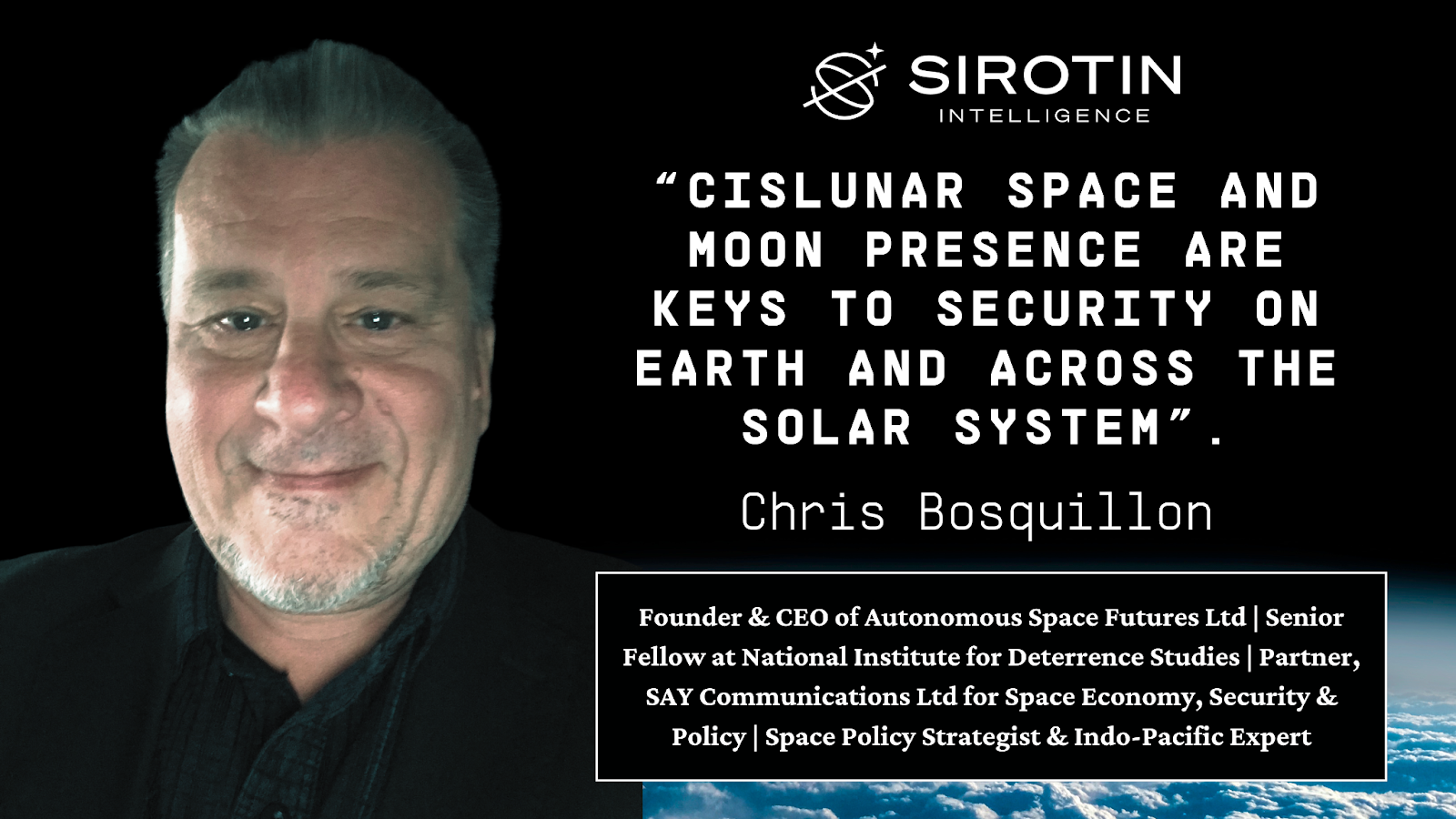
In the opening hours of Operation Epic Fury, U.S. SPACECOM and CYBERCOM acted as first movers to blind enemy defenses by disrupting satellite communication, navigation, and surveillance networks. These initial 1,000 strikes enabled ground, sea, and air dominance, with space and cyber as integral opening-phase warfighting capabilities, shaping the battlefield before kinetic strikes occured.
Current Space Force architectures allow near-real-time multi-domain coordination, including AI-assisted targeting workflows. ISR, signals intelligence, and targeting data integrated into joint command systems, enable faster targeting cycles. Missile early warning, targeting, satellite intelligence, and battle damage assessment, further demonstrate how command-and-control relies on space-based communications with satellite networks linking aircraft, drones, ships, and ground forces.
Space systems offensive electronic warfare (jamming/spoofing) led to significant disruption of GNSS (global navigation satellite systems), affecting both aviation and maritime navigation in the Strait of Hormuz. U.S. SPACECOM conducted uplink/downlink jamming against Iranian satellites, disrupted communications, limiting sensor data flow to Iranian forces. Navigation warfare means over 1,100 ships in the Gulf experienced GPS/AIS interference, such as ships appearing incorrectly located inland on navigation systems, with major maritime safety risks in the Strait of Hormuz.
The cyber domain cemented pre-strike disruption and information operations. Cyber attacks preceded kinetic strikes, targeting command-and-control networks, logistics systems, and situational awareness tools, while cyber operations included information warfare inside Iran. The integration of satellites, cyber intelligence feeds, and drones allows machine-speed targeting cycles and real-time operational coordination. There was little Iran’s cyber retaliation and jamming and spoofing capabilities could do against U.S. satcomms facilities in Bahrain, Qatar, and Saudi Arabia.
A decimated command-and-control led to chaotic attacks by Iran against Arab neighbors, with Russia providing Iran with targeting information on U.S. warships and aircrafts.. Operation Epic Fury aims to render Iran incapable of projecting military force and threatening U.S. allies and regional bases, while suppressing conventional defense of its nuclear nexus.
Iran has transitioned its military architecture to China's BeiDou-3 navigation system, and accesses Yaogan and Jilin satellites. In this conflict, the U.S. and Chinese space forces learn from outcomes. It is a matter of time until they engage with each other in orbit.
Have a great Space Week ahead!
🎤 Our Next Guest: Paulo Pinheiro

Paulo Pinheiro is Founder and Executive Director of the Space Systems Innovation Platform (SSIP), headquartered at Technopark Luzern in Switzerland. A mechanical engineer with two decades across naval propulsion, marine engineering, and aerospace manufacturing — including satellite assembly at Beyond Gravity under ESA/ECSS and NATO defense standards — he founded SSIP in 2025 to build structured acceleration infrastructure that moves space and deep-tech research from laboratory concept to scalable industrial production.
Key topics from the interview:
- Why "innovation doesn't die from lack of ideas — it dies from friction," and how Pinheiro's career in high-reliability industries shaped SSIP's compliance-as-engineering model
- The Space BioDistrict Lucerne: SSIP's flagship initiative connecting microgravity research, advanced manufacturing, life sciences, and international market access under Swiss coordination
- How SSIP operationalizes collaboration through anchor partnerships with HSLU and CSEM, curated investor pathways, and international gateways — so partners leave with "owners, defined next steps, and timelines" rather than business cards
- What happens inside SSIP when a technology hits a new EU dual-use control list — and why the platform treats regulatory surprises like non-conformance reports
- Why pharmaceutical crystallization will be the first microgravity application to reach scalable production — and why "the first winners won't be the loudest experiments, they'll be the most repeatable processes"
- Swiss neutrality as operational infrastructure: how Pinheiro is converting Switzerland's reputation for institutional trust and precision culture into a coordination layer for the global space economy
Watch Paulo Pinheiro's YouTube preview Tuesday on the Sirotin Intelligence YouTube channel. Full interview drops Thursday.
Sources:
https://nypost.com/2026/03/04/world-news/how-us-space-force-stops-irans-missiles-in-their-tracks/
https://spacenews.com/vast-raises-500-million-for-commercial-space-station-development/
https://spacepolicyonline.com/news/whats-happening-in-space-policy-march-1-7-2026/
https://www.law360.com/articles/2449227/2-defense-space-tech-companies-raise-combined-1-05b
https://news.cornell.edu/stories/2026/03/nycst-grants-boost-new-york-state-space-tech-industry
https://www.executivebiz.com/articles/john-moberly-ibeos-interview-space-computing
https://www.digitimes.com/news/a20260305VL201/uk-satellite-communications-space-tech.html
https://gulfbusiness.com/qia-joins-funding-round-for-spacetech-firm-vast/
https://www.axios.com/pro/all-deals/2026/03/02/space-data-centers-investing-elon-musk
https://www.theregister.com/2026/03/05/trump_administration_spoiling_for_a/
https://www.newswise.com/articles/new-space-startups-take-off-at-georgia-tech
https://inc42.com/buzz/centre-ropes-in-spacetech-startups-to-build-bodyguard-satellites/
https://www.digitimes.com/news/a20260306PR200/launch-itri.html
https://satelliteprome.com/news/arabsat-invests-5m-in-seraphim-spacetech-fund/
https://www.euronews.com/next/2026/03/03/the-women-leading-japans-high-tech-orbital-revolution
https://www.theverge.com/tech/887899/spacex-ipo-risks-ai
https://tech.eu/2026/03/04/spains-pld-space-raises-eur180m-to-scale-satellite-launch-infrastructure/
https://www.digitimes.com/news/a20260302VL216/space-tech-expo-uk-government-commercial.html
https://www.uktech.news/space-tech/government-throws-weight-behind-space-manufactured-drugs-20260305
Get exclusive insights from our network of NASA veterans, DARPA program managers, and space industry pioneers. Weekly. No jargon.