
Sirotin Intelligence Briefing: March 21–27: NASA Pauses Gateway for $20B Moon Base, Space Force Goes to War in Iran, and Anduril and Palantir Build Golden Dome’s Brain


This week’s Sirotin Intelligence analysis covers NASA pausing Gateway indefinitely and redirecting $20 billion toward a permanent lunar base and a nuclear-powered Mars spacecraft, Space Force counterspace operators getting their first real combat test jamming Iranian communications in Operation Epic Fury, and Anduril and Palantir being confirmed as Golden Dome’s software architects with summer testing on the clock. Gen. Whiting warned the Senate that China’s 1,300 satellites represent 667% growth since 2015 and that Russia retains the capability to put a nuclear weapon in orbit, SpaceX is preparing a confidential S-1 for what could be the largest IPO in financial history, and the Army shelved its flagship Valkyrie laser in favor of a joint program with the Navy. Artemis II’s crew arrived at Kennedy today ahead of an April 1 launch — and our interview this week is with Laura Montgomery, the former FAA space lawyer and Prometheus-nominated science fiction author who spent two decades writing the rules for commercial spaceflight and now wants to know why you’d need a license to bake a cake on the Moon.
🛡️ Defense Highlights
- Space Force counterspace operators confirmed active in Operation Epic Fury – SATCOM jamming, EW, and cyber operations degrading Iranian capability in the war’s opening hours: CENTCOM’s Adm. Brad Cooper confirmed Space Force operators are degrading Iranian capability and protecting American forces; the Chairman of the Joint Chiefs said CYBERCOM and SPACECOM were the first movers, “disrupting and blinding Iran’s ability to see, communicate and respond.” Analysts say the operations almost certainly include SATCOM uplink jamming via the Counter Communications System (16 deployed units), L3Harris’s Meadowlands, and SpRCO’s Remote Modular Terminals (24 delivered, 160 funded) – the first acknowledged combat employment of U.S. counterspace weapons. Defense Secretary Hegseth assessed that Iranian forces “can barely communicate, let alone coordinate.”
- Gen. Whiting tells Senate that Russia’s potential nuclear weapon in orbit is “the single greatest threat to our space architecture” – China’s 1,300 satellites represent 667% growth since 2015: Whiting told the SASC on March 26 that space systems were critical in Operations Midnight Hammer, Absolute Resolve, and Epic Fury, and that adversaries are “moving at an alarming pace” – singling out China’s growth to 1,300+ satellites including 510 ISR platforms and Russia’s potential to place a nuclear weapon in orbit, which he called “the single greatest threat to our space architecture.” Top FY27 priorities: integrated space fires, active satellite protection, enhanced battlespace awareness, and cyber defenses for the space domain.
- Anduril and Palantir confirmed as Golden Dome’s software architects – consortium with Scale AI, Aalyria, and Swoop targets summer testing: Anduril and Palantir are jointly building Golden Dome’s C2 software – fusing radars, space sensors, and ground assets into a single operating picture and routing fire-control solutions in real time. Aalyria (networking), Scale AI (model training), and Swoop (autonomous systems) round out the consortium alongside Lockheed, RTX, and Northrop on hardware. Software testing targets this summer – an aggressive timeline for a $185 billion architecture whose cost independent analysts estimate could reach $3.6 trillion over 20 years.
- Space Force broadens Ground Based Radar Digitization to all eight legacy strategic radars – single common software architecture targeting IOC by Q1 FY30: SSC expanded GBRD from six to all eight legacy strategic radars – adding Cobra Dane (Alaska) and AN/FPS-85 (Eglin) – equipping each with a common software back end and digitized front end to replace 1970s-era systems “nearing obsolescence.” The FY26 reconciliation package includes $1.98 billion for missile defense radar under Golden Dome; IOC targets Q1 FY30 with four rapid prototype sites, FOC across all eight by Q2 FY31. Vendors have until April 1 to respond.
- Army shelves 300-kilowatt Valkyrie high-energy laser program – pivots to Joint Laser Weapon System with Navy under Golden Dome: The Army is killing Valkyrie rather than transition it to production, reducing the program to a single test prototype due in September that will inform the Joint Laser Weapon System (JLWS), a new joint program with the Navy designed to plug into Golden Dome. Persistent challenges sustaining a beam powerful enough to destroy hardened cruise missile warheads drove the pivot – folding directed-energy ambitions into a joint architecture but leaving the Army’s short-range air defense dependent on a system that does not yet exist.
- Army selects Carlyle and CyrusOne for hyperscale commercial data centers on Army installations – Fort Bliss and Dugway Proving Ground chosen: The Army selected Carlyle (1,384 acres at Fort Bliss) and CyrusOne (1,201 acres at Dugway Proving Ground) to build and operate commercial hyperscale data centers on Army land at no upfront cost through the Enhanced Use Lease program. Fort Bliss targets IOC in FY27, Dugway in FY29 – following the executive order directing DoD to facilitate AI data center infrastructure.
- MBDA announces €5 billion investment to boost missile production 40% as Middle East and European demand surges: MBDA will invest €5 billion over 2026–2030 – double the prior plan – and hire 2,800 workers to boost production 40%, with Aster air-defense missile output doubling in 2026 to meet surging Middle Eastern and European demand. Order backlog now stands at €44.4 billion driven by the conflicts in Ukraine and Iran.
- Parsons awarded $98.5M for GARDEM Two C2-Space ISR software development and maintenance at Colorado Springs: Parsons won a $98.5M task order for R&D, prototyping, and deployment of the GARDEM Two C2-Space ISR software baselines – the software underpinning Space Force’s C2 and ISR processing at Schriever and Peterson SFBs, through May 2031.
Major Contract Awards This Week:
- Raytheon Co. – AN/TPY-2 radar development ceiling increase: A $773,500,000 noncompetitive contract modification increasing the total IDIQ ceiling from $1,472,000,000 to $2,246,000,000 and extending the ordering period to October 2030, providing continued research and development support for the Army Navy Transportable Radar Surveillance Control Model-2 (AN/TPY-2) radar for the Missile Defense Agency.
- Raytheon Co. – AN/TPY-2 spares and development continuation: A $193,200,000 noncompetitive modification increasing a task order from $145,930,819 to $339,130,819 for spares replenishment and continued AN/TPY-2 development support, through October 2030.
- Advanced Engineering Solutions & Services LLC – Sensors-Platform Integration production: A $454,781,907 firm-fixed-price contract for replicating and enhancing prototype shelter systems and integrating technologies onto military and commercial platforms to address urgent Quick Reaction Capability C5ISR requirements, through March 2031.
- The Boeing Co. – CH-47F Block II Chinook remanufacture: A $326,050,000 firm-fixed-price contract for procurement of six CH-47F Block II remanufactured cargo helicopters, through August 2031.
- Beyond New Horizons LLC – Arnold AFB test operations and sustainment: A $236,508,476 modification for test operations and sustainment at Arnold Air Force Base, Tennessee.
- HDR Engineering Inc. – NAVFAC Hawaii civil engineering: A $249,000,000 firm-fixed-price IDIQ contract for civil design and engineering services at Navy and Marine Corps installations within the NAVFAC Hawaii area of responsibility, through March 2031.
- National Technologies Associates Inc. – Presidential helicopter maintenance: A $235,996,762 cost-reimbursable IDIQ contract for organizational, intermediate, and depot-level maintenance, modification, and instrumentation of presidential helicopter platforms, through November 2031.
- Northrop Grumman Corp. – GQM-163A Coyote supersonic target Lot 18: A $127,319,699 firm-fixed-price contract for 28 GQM-163A supersonic sea-skimming targets and associated support for the Navy, Japan, and Korea, through August 2030.
- Austal USA LLC – T-ATS 11-13 towing and salvage ships: A $126,500,000 firm-fixed-price modification exercising an option for detail design and construction of T-ATS 11-13, funded under the One Big Beautiful Bill Act (Public Law 119-21) in support of the national shipbuilding revitalization effort, through May 2029.
- Parsons Government Services Inc. – GARDEM Two C2-Space ISR: A ceiling $98,451,047 cost-plus-fixed-fee task order for C2 and space ISR software development supporting Space Force, through May 2031.
🌐 Policy, Geopolitical & Legal Developments
- NASA pauses Gateway indefinitely and redirects resources to $20 billion permanent lunar base – Space Reactor-1 Freedom nuclear spacecraft targeting Mars launch before end of 2028: Administrator Isaacman announced at NASA’s “Ignition” event March 24 that Gateway is paused indefinitely to redirect ~$20 billion over seven years toward a permanent lunar base built through dozens of commercially procured missions at an initial cadence of every six months, with international partners Canada, Italy, and Japan. He simultaneously unveiled SR-1 Freedom, the first nuclear-powered interplanetary spacecraft, targeting a Mars launch before end of 2028 to deploy Ingenuity-class helicopters for site scouting and water-ice prospecting – the first-ever use of nuclear electric propulsion in deep space.
- Artemis II crew flies to Kennedy as April 1 launch holds – first humans beyond LEO in 53 years: The Artemis II crew – Wiseman, Glover, Koch, and Hansen – flew to Kennedy Space Center on March 27 to begin quarantine ahead of an April 1 launch for a 10-day free-return trajectory around the Moon, the first crewed flight beyond LEO since Apollo 17 in 1972 and the hinge point for Artemis III’s crewed landing and the competition with China’s pre-2030 lunar timeline.
- Vulcan grounding cascades through national security manifest – Space Force shifts GPS III SV-10 to SpaceX Falcon 9: Space Force reassigned GPS III SV-10 from the grounded Vulcan to a Falcon 9 with launch targeted by end of April. The Vulcan grounding – from a February 12 GEM 63XL nozzle failure – could last months with no return-to-flight date, threatening a backlog of USSF and NRO missions and deepening SpaceX’s dominance in a market Space Force leaders say they want to diversify.
- SASC hearing highlights “historically dangerous” strategic environment – bipartisan alarm over Russian and Chinese advances: The March 26 SASC hearing with Whiting and STRATCOM’s Adm. Correll drew bipartisan alarm: Sen. Wicker said threats are advancing “by leaps and bounds,” Sen. Reed called it “a historically dangerous strategic environment.” Correll noted the B-21, Columbia-class subs, and Sentinel ICBM are all entering production to underpin deterrence – underscoring that space, nuclear, and cyber domains are now inseparable in great-power competition.
- Space Force official warns China is outpacing every expectation – CMSgt Lerch at SATShow discloses 1,300 satellites with 700% growth: At SATShow, Space Force CMSgt Lerch warned China’s space development is “outpacing expectations,” with 1,300 satellites (700% growth since 2015) and two mega-constellations planned at 13,000 and 15,000 satellites. China’s 15th Five-Year Plan accelerates space as a driver of “new productive forces,” with the Long March-10 reusable rocket targeting first flight H1 2026 and a crewed lunar landing before 2030.
- Satellite 2026, GovMilSpace, and Munich Space Summit convene – NASA Authorization Act advances: Satellite 2026, GovMilSpace, the Munich Space Summit, and National Academies Space Science Week all convened this week. The Senate Commerce Committee unanimously passed the NASA Authorization Act of 2026, setting strategic direction to ensure the U.S. – not China – leads the next era of exploration and builds the first moon base.
🛰️ Technology & Commercial Developments
- LEO attracting billions as orbital economy accelerates — space data centers drawing unprecedented investment: LEO is attracting billions as AI compute demand, space-grade silicon, and reusable launch economics converge around orbital data centers, Earth observation, and manufacturing. Planet Labs reported $734 million in backlog (up 215% YoY), and the industry continues diversifying beyond comms into compute, AI, and in-space services.
- SpaceX continues relentless Starlink cadence with multiple launches this week: SpaceX launched Starlink missions from Cape Canaveral (March 22, 27) and Vandenberg (March 25), now surpassing 10,000 simultaneous Starlink satellites — roughly half of all active spacecraft — while continuing to absorb national security missions from ULA’s grounded Vulcan.
- SpaceX preparing confidential S-1 filing for what could be the largest IPO in financial history — valuation estimated at $1.5–$1.75 trillion: Reports emerged March 26 that SpaceX is preparing to file a confidential S-1 prospectus with the SEC targeting a June 2026 listing, with an estimated valuation of $1.5–$1.75 trillion — which would make it the largest IPO in history, dwarfing Saudi Aramco’s $1.7 trillion debut. The filing comes as SpaceX dominates launch, broadband, and now national security missions, and would give the company a public-market war chest to fund Starship, Mars, and Starlink expansion simultaneously.
- Astroscale’s ADRAS-J completes historic space debris rendezvous mission — first commercial spacecraft to approach and photograph defunct rocket hardware: Japan’s Astroscale confirmed on March 27 that its ADRAS-J satellite has begun its final descent after successfully approaching within 15 meters of a large piece of defunct rocket debris — the first commercial mission ever to rendezvous with and photograph uncontrolled space junk. The mission validates the technical foundation for active debris removal, a market projected to grow rapidly as LEO congestion accelerates.
- Rocket Lab launches 84th Electron mission, stock surges 10% as backlog tops $2 billion: Rocket Lab successfully deployed Synspective’s eighth StriX SAR satellite to 573 km orbit on March 21, marking the company’s 84th Electron launch, while selling 28 new launches in Q1 2026 alone. Shares surged over 10% on March 25 to $72.88, fueled by the $190 million HASTE hypersonic test contract, SpaceX IPO buzz lifting the sector, and a Clear Street Buy initiation with an $88 price target.
- Isar Aerospace in talks to raise €250 million ahead of first orbital launch attempt: German launch startup Isar Aerospace is in discussions to raise €250 million ($289 million) ahead of a first orbital launch attempt planned for late March 2026, Bloomberg reported on March 23. The round would position Isar as one of the best-funded European launch providers as the continent races to close its sovereign access-to-space gap with the U.S. and China.
- Amazon Project Leo crosses 200 satellites as $10 billion Starlink challenger scales toward commercial service: Amazon’s Project Leo broadband constellation has now placed more than 200 satellites in orbit following 11 successful launches since April 2025, with the company deploying a $10 billion war chest to challenge Starlink’s dominance. Commercial service rollout is accelerating through 2026 as Amazon leverages its global logistics and AWS infrastructure to differentiate on the ground segment.
💭 A Word From Christophe Bosquillon
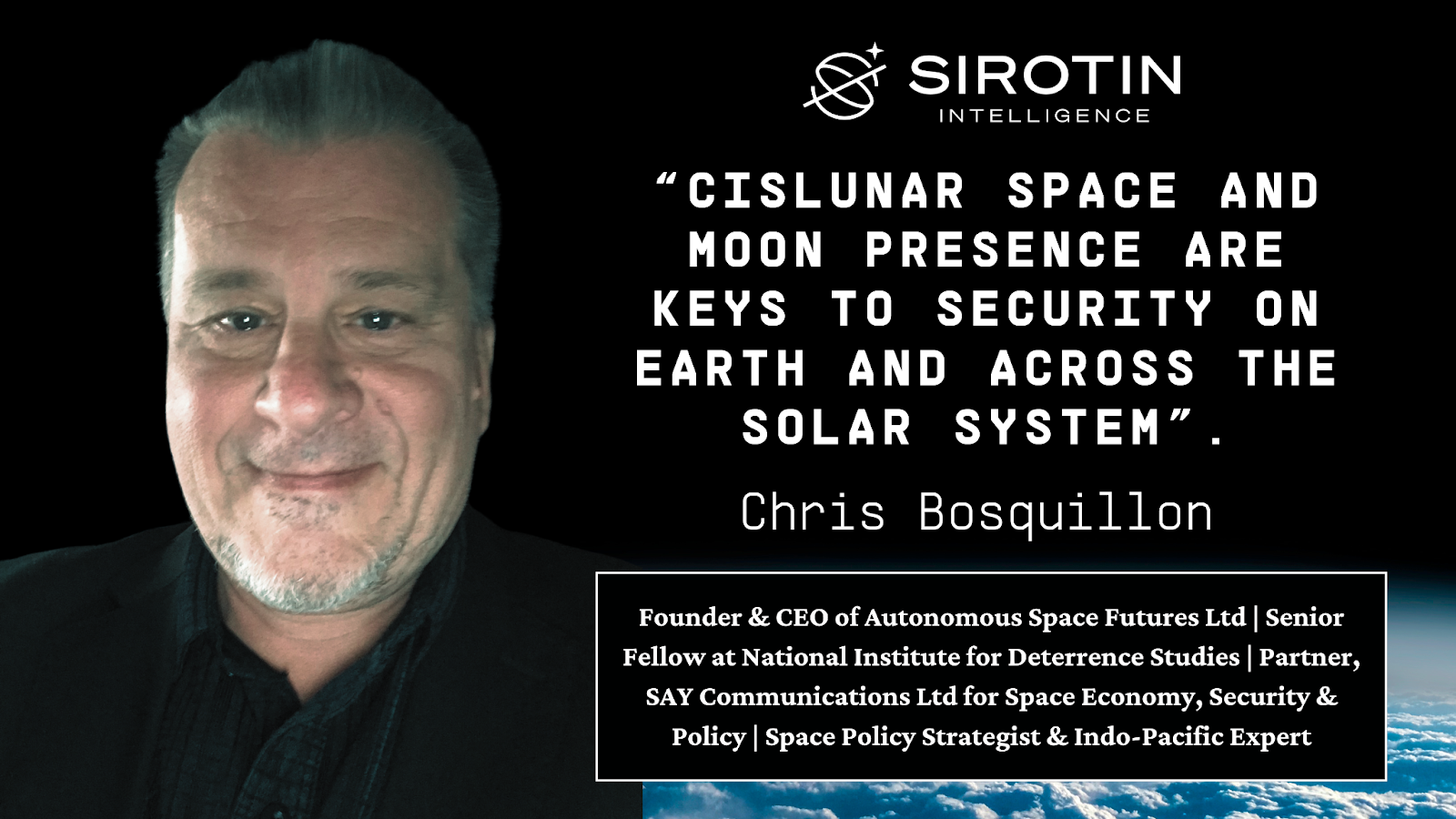
The Space Force is going boldly into cislunar operations. Said Thomas Ainsworth, Assistant Secretary of the Air Force for Space Acquisition and Integration: “I don’t have a final plan for it yet, but specifically coming out of the president’s Executive Order for Space Superiority, we do need to begin integrating cislunar capability into the Space Force, and so we are serious about that. We are going to be standing on leadership positions and integration points where we can start bringing those technologies in and actually have a plan to execute them going forward.”
The Space Force intends to act as a “good partner” to NASA and work closely with Department of War innovators such as the Air Force Research Laboratory, whose Oracle program will launch several cislunar space domain awareness satellites in the coming years. The January 2026 White House Executive Order for Space Superiority has called for more investment in deep-space navigation capabilities, enabling U.S. space power to expand from very low-Earth orbit to cislunar domain.
This has started to materialize with nine Portfolio Acquisition Executives (PAEs). Of the Space Force planned nine PAEs, six have been announced: Space Access; Space Based Sensing and Targeting; Infrastructure; Battle Management, Command, Control, Communication & Space Intelligence; Satellite Communication and Positioning, Navigation & Timing; and Missile Warning and Tracking.
Another three planned PAE categories are Space Control; Electronic Warfare, Cyber Warfare and Orbital Warfare; and Integration. The Integration PAE will be instrumental for cislunar space, as the focal point for maturing tech for new mission areas. This will be made possible by focusing on system architecture and integrating technology from offices like DARPA, the Space Rapid Capabilities Office, the Defense Innovation Unit, and continuous innovations from the commercial sector – Like Chief of Space Operations Gen. Chance Saltzman had previously commented, "As U.S. interests go further and further into space, there’s going to be a need to protect and defend those interests.(...) I don’t want to get caught flat-footed when we start to have to protect U.S. interests out there. So we’re along for the ride, if you will, and we’re collaborating closely.”
Have a great Space Week ahead!
🎤 Our Next Guest: Laura Montgomery

Laura Montgomery is a former FAA Senior Attorney for Commercial Space Transportation who spent more than two decades managing the agency’s Space Law Branch – drafting the regulations that govern every commercial launch license in America, representing the FAA at the United Nations, and chairing a White House interagency working group on space property rights. She testified before Congress on the Commercial Space Launch Act and left the agency in 2016 to found Ground Based Space Matters, LLC, where she advises commercial space companies navigating the regulatory architecture she helped build. She is also a Prometheus Award-nominated science fiction author whose novels draw directly on the legal gray zones she spent two decades trying to resolve – and in many cases, couldn’t.
Key topics from the interview:
- What she would change about the regulations she helped write – why the FAA’s payload review has been misread as a blank check to regulate everything in space, and how a 1990s insurance ruling defied the plain text of the law
- Why you don’t need a license to bake a cake on the Moon – what happens when a company wants to do something in space that no regulator on Earth has authority over, and why Article VI of the Outer Space Treaty is not self-executing
- The legal logic of space property rights – why the 2015 Commercial Space Launch Competitiveness Act borrows from fishing rights law, and whether adverse possession could apply to sustained lunar habitation
- Why concentrated authority is the existential risk for off-world colonies – “whoever is in charge could just cut off the air to some dissenter while he’s sleeping” – and how you design governance to prevent it
- How science fiction and space law feed each other in directions neither field expects – from a novel about deorbiting dead satellites that turns on a property rights question to a terraforming theory built from entomologist newsletters
- Whether big multilateral space treaties are dead – why the Artemis Accords work precisely because they put flesh on the Outer Space Treaty’s bones, and why the next frontier is property rights in land, not just extracted resources
Watch Laura Montgomery’s YouTube preview Tuesday on the Sirotin Intelligence YouTube channel. Full interview drops Thursday.
Sources:
https://spacenews.com/nasa-halts-work-on-gateway-to-develop-a-lunar-base/
https://www.globalsecurity.org/military/library/news/2026/03/mil-260326-dodnews02.htm
https://rollcall.com/2026/03/26/senators-worry-about-historically-dangerous-strategic-threats/
https://www.globalsecurity.org/military/library/news/2026/03/dod-contracts_4445165.htm
https://www.globalsecurity.org/military/library/news/2026/03/dod-contracts_4444449.htm
https://www.globalsecurity.org/military/library/news/2026/03/dod-contracts_4442927.htm
https://www.cnbc.com/2026/03/22/why-low-earth-orbit-is-attracting-billions-in-investment.html
Get exclusive insights from our network of NASA veterans, DARPA program managers, and space industry pioneers. Weekly. No jargon.