
Sirotin Intelligence Briefing: March 8–14: Artemis II Gets a Launch Date, the Pentagon Claims Cislunar Space, and Iran Proves the "Glass Battlefield" Is Here


This week's Sirotin Intelligence analysis tracks the most consequential Artemis milestone since the program's 2022 uncrewed debut — NASA has set an April 1–6 launch window for Artemis II, the first crewed mission to cislunar space in 53 years, after a unanimous Flight Readiness Review. The Pentagon formally designated cislunar space a military domain under a December executive order, with Oracle-M, DARPA's LASSO nanosatellite, and L3Harris's GBOSS ground-sensor network as the first operational tools, while Anduril acquired ExoAnalytic Solutions and its 400-telescope global tracking network to position for Golden Dome space-tracking and missile-defense contracts. BAE Systems cleared PDR on the $1.2B RMWT MEO Epoch 2 missile-warning constellation in under nine months, Space Force activated the 630th Cyberspace Squadron at Vandenberg to defend launch and C2 infrastructure, and the Iran conflict proved the "glass battlefield" problem — commercially available satellite imagery from non-U.S. providers flooded global markets within hours of U.S. strikes, with Iran reportedly turning to Russian reconnaissance satellites to rescue targeting after its own sensors were degraded by cyber and electronic warfare. MDA Space launched a $300M NYSE IPO, a NYT investigation revealed near-daily lunar collision alerts from NASA's MADCAP traffic office, and APL began physical assembly of Dragonfly — the first nuclear-powered drone bound for Titan. Our interview this week is with Daniel Scuka, former ESA communications officer who built the agency's real-time mission communications from zero to a quarter-million followers, managed the Schiaparelli crisis on live television, and spent decades building the transparency groundwork behind ESA's Zero Debris Charter.
🛡️ Defense Highlights
- Anduril acquires ExoAnalytic Solutions, doubling its space unit with a 400-telescope global tracking network aimed at Golden Dome: Anduril Industries has signed a definitive agreement to acquire ExoAnalytic Solutions, a California-based company operating roughly 400 ground-based optical telescopes worldwide that track thousands of objects including foreign military satellites, merging it into Anduril's existing ~120-person space division and immediately doubling headcount to about 250. ExoAnalytic's network — which first exposed China's Shijian-21 rendezvous-and-proximity operations for U.S. national security agencies — will be integrated with Anduril's AI-powered battle-management and fire-control stack and sold externally as a commercial SSA data product, positioning the combined entity as a primary contender for Golden Domespace-tracking and missile-defense architecture contracts as Anduril simultaneously raises $4 billion with Thrive Capital and Andreessen Horowitz.
- MDA Space launches $300M U.S. IPO to ride the defense-space investment wave it helped create with the Canadarm: Toronto-based MDA Space — builder of the ISS Canadarm2, the Canadarm3 for Gateway, and the CHORUS satellite constellation — has launched a $300 million IPO targeting a NYSE listing, seeking access to U.S. capital markets as global defense budgets surge and governments race to expand space-based assets. The listing comes as MDA's order backlog has grown significantly on contracts including Globalstar LEO satellites, Space Canada's military communications work, and international SDA sensor programs, and the NYSE listing is designed to raise MDA's profile with U.S. institutional investors and DoD prime-contractor partners simultaneously.
- Pentagon formally designates cislunar space a military domain — Oracle-M, DARPA LASSO, and L3Harris GBOSS are the first tools: Aviation Week reports that a December Trump executive order on space superiority formally extended the U.S. military's area of responsibility from LEO to lunar orbit, directing Space Force to detect, characterize, and counter threats across the entire cislunar domain. AFRL and Space Force have completed building Oracle-M, a dedicated cislunar SSA satellite targeting year-end launch as a secondary payload on ULA Vulcan — though Vulcan is currently grounded after a Feb. 12 solid-rocket-motor anomaly — while DARPA's LASSO program is funding an autonomous nanosatellite to map lunar water sources at high resolution, and L3Harris's GBOSS ground-sensor network can now investigate on-orbit activity from LEO to deep space within minutes to support offensive or defensive operations.
- BAE Systems clears PDR for Space Force's $1.2B RMWT MEO Epoch 2 missile-warning constellation in under nine months: BAE Systems has completed the Preliminary Design Review for the Resilient Missile Warning and Tracking – MEO Epoch 2 (RMWT MEO Epoch 2) program, a 10-satellite constellation in medium Earth orbit designed to detect hypersonic glide vehicles, ballistic missiles, and advanced maneuvering reentry vehicles that can evade traditional GEO-based infrared sensors. The PDR — completed in less than nine months from contract award — establishes the full technical blueprint for both the space segment and the ground command-and-control system, and clears BAE to move into detailed design; the program is expected to launch before end of decade and will complement existing SDA Tranche satellites as part of a layered, proliferated missile-warning architecture.
- Space Force terminates AeroVironment's BADGER satellite-control antenna contract — company plans to redesign and recompete: The Space Force has officially terminated AeroVironment's contract for the BADGER (Broadband Agile Ground-station Enterprise Radio) antenna system — a portable satellite command-and-control terminal — after the design failed to meet program requirements, causing AeroVironment shares to fall sharply. AeroVironment says it will rework the BADGER antenna design based on lessons learned from the failed effort and intends to compete for the follow-on procurement, underscoring the growing USSF push to consolidate satellite-control architecture under a unified, software-defined ground system as ground-segment complexity multiplies with proliferated constellations.
- Voyager Technologies opens 140,000-sq-ft "Space Beach" hub in Long Beach, clustering with Anduril and True Anomaly: Denver-based Voyager Technologies (NYSE: VOYG) has opened a 140,000-square-foot facility in Long Beach — its second large defense-manufacturing complex in two months, following a 150,000-sq-ft Pueblo, CO missiles facility in January — to develop and produce AI-enabled electronics, next-generation propulsion, missile defense components, and integrated sensing and autonomy systems. The facility will employ 150–200 people and works alongside neighboring Anduril Industries and True Anomaly, who have both recently established Long Beach operations, cementing the city's "Space Beach" identity as the emerging West Coast cluster for defense-autonomy, missile, and space-platform manufacturing.
- Karman Space & Defense poaches L3Harris C-suite veteran Jon Rambeau as new CEO to drive next growth phase: Karman Space & Defense (NYSE: KRMN) has named Jon Rambeau — most recently president of L3Harris's $8 billion Communications & Spectrum Dominance segment covering EW, advanced comms, threat sensing, and targeting — as its new CEO effective March 23, succeeding founder Tony Koblinski who retires after 40 years in leadership but stays on as a director. Rambeau's hire signals Karman's intent to accelerate growth by leaning into its position as a critical sub-tier supply-chain integrator for defense primes and commercial launch customers, with his EW and spectrum background particularly relevant as space-based communications and electronic warfare converge into contested-spectrum environments.
- Politico Pro Space: The Iran war from orbit is already an information-war crisis for the Pentagon: This week's Politico Pro Space spotlight identifies a new dilemma created by the Iran strikes — commercial satellite imagery of U.S. missile strikes, troop movements, and sensitive infrastructure is now flooding a global marketplace that the Pentagon cannot control. Several U.S. companies have already voluntarily restricted access to their Middle East imagery, citing adversary exploitation concerns, but a growing number of non-U.S. commercial providers (European, Asian) are under no such obligation and can sell the same views to anyone — framing the Iran conflict as the first test of whether the U.S. commercial-imagery ecosystem can be relied upon to support military operational security or whether it constitutes an uncontrollable strategic liability. The newsletter also notes that a NASA OIG report has called out Starship's remaining technical hurdles ahead of 2028 lunar landing, and that NASA is racing to finalize its commercial-station replacement plan "in the next couple weeks."
- Space Force's GALAXY program fast-tracks junior officers and civilians through hands-on tech leadership at JPL and industry: Space Systems Command's GALAXY Program is a rapid professional-development pipeline designed for junior Guardian officers and civilian counterparts, providing hands-on technical leadership through cohort-based experiences at facilities including NASA's Jet Propulsion Laboratory, defense primes, and national labs. The program aims to close a critical talent gap identified by Space Force Vice Chief of Space Operations — who has said the Space Force "probably needs twice as many Guardians" as it currently has — by accelerating the technical depth and program-management maturity of its junior force before they take on SSC acquisition and operations leadership roles during the most demanding build-up in the service's six-year history.
- Inaugural Space Force Medicine Stakeholder Summit maps gaps in Guardian readiness, cognitive performance, and occupational health: Over 100 DAF leaders and civilian partners gathered in Falls Church, Virginia in late February for the first-ever Space Force Medicine Stakeholder Summit, organized by the Air Force Surgeon General's Space Force Medical Operations Directorate to address the unique occupational demands of space warfighters — including electromagnetic radiation exposure, shift-work cognitive impacts, geographically isolated duty stations, and the psychological stress of controlling billion-dollar assets in contested orbital environments. The summit produced consensus around three priorities: standardizing Guardian medical qualifications, expanding access to care at geographically separated units, and deploying the GAMORA (Guardians Aggregate Medical Operations Readiness Application) data tool to give commanders real-time readiness trends — with NASA's deputy chief health officer reinforcing that integrating medical expertise early in system design prevents costly retrofits and protects long-term mission success
- Space Force activates 630th Cyberspace Squadron at Vandenberg to defend launch, C2, and SDA from cyber threats: A formal activation ceremony on March 10 stood up the 630th Cyberspace Squadron (630 CYS) under Space Launch Delta 30 at Vandenberg SFB, commanded by Maj. Torius Davis and aligned under Space Systems Command. The unit's mission is to deliver cyber defense operations and mission assurance specifically for space launch, space command and control, and space domain awareness at Vandenberg — translating to defending Range assets, ground-control stations, and SDA sensor networks at one of the busiest and most strategically significant launch facilities in the United States.
- Space and cyber "first mover" doctrine proved decisive in Operation Midnight Hammer against Iran: Space & Defense's analysis of the Iran conflict documents how U.S. Space Command and U.S. Cyber Command were deliberately sequenced as "first movers"before any conventional strikes — using satellite-enabled signals intelligence to map Iran's C2 architecture, then cyber effects to blind radar and communications networks, then electronic warfare to suppress air defenses, creating a "path" for kinetic strikes that minimized U.S. casualties and maximized target destruction. The Iran conflict also accelerated what analysts now call the "glass battlefield" problem: commercially available EO satellites from non-U.S. providers captured strike damage within hours, with Iran reportedly seeking Russian satellite reconnaissance support to re-cue retaliatory targeting after U.S. cyber and EW degraded its own sensors — underscoring the limits of voluntary commercial imagery restrictions and the strategic vulnerability of operating in a world where LEO-based surveillance is no longer exclusively a superpower capability.
Major Contract Awards This Week:
- The Boeing Co. Defense – E-7A Rapid Prototype Airborne Mission Segment: A $2.34 billion option exercise modification for the E-7A airborne early warning and control program, bringing total contract value to $4.91 billion, through August 2032. (A separate $99.3 million modification on the same contract covers the E-7A's MESA radar diminishing manufacturing sources effort, bringing the cumulative value to $5.01 billion.)
- Raytheon Co. – SM-3 Block IB All-Up Round production restart: A $1.37 billion definitized modification for 78 SM-3 Block IB interceptors including one-time production line restart costs, bringing total contract value to $3.31 billion, through May 2030.
- University of Dayton Research Institute – Rapid operational capabilities and manufacturing for optimized readiness: A ceiling $850 million IDIQ contract for engineering, research, development, and technology transition supporting the Air Force Rapid Sustainment Office, through March 2033.
- Lockheed Martin Corp. – F-35 Lots 20/21 long lead materials (FMS Denmark and partners): A $700.4 million modification for long lead material, parts, and components for F-35 production aircraft for Denmark, cooperative partners, and FMS customers, through December 2030.
- Raytheon Co. – SM-3 Block IB production (previously announced scope definitization): Included in the $1.37 billion total above — definitizing two previously undefinitized actions for an additional 23 All-Up Rounds on top of the original 55.
- Lockheed Martin Aeronautics Co. – F-35 Drag Chute System (FMS Lots 18–19): A $111.5 million firm-fixed-price order for F-35 drag chute systems for non-U.S. participants and FMS customers, through October 2030.
- Bechtel Plant Machinery Inc. – Naval nuclear propulsion components: A $112.8 million modification for nuclear propulsion components, through September 2034.
- Technomics Inc. – Combat weapon systems cost analysis support: An $83.3 million firm-fixed-price contract for cost, economic, and technical analyses for combat weapon systems, support systems, and acquisition reporting, through May 2031.
- Beaver Aerospace & Defense Inc. – ICBM Flywheel Modules: An $18.2 million modification for flywheel modules supporting the ICBM fleet, bringing total contract value to $19.1 million, through March 2029.
- Viasat Inc. – Global satellite communications for Naval senior leadership aircraft: A $14.0 million firm-fixed-price contract awarded by Space Systems Command Commercial Space Office for satellite communications services on Navy C-37 aircraft, through March 2028.
- Call Henry Inc. – Vandenberg Space Force Base real property maintenance: A $13.3 million modification (Option Year Three) for maintenance, repair, and modernization services at Vandenberg SFB, through March 2027.
🌐 Policy, Geopolitical & Legal Developments
- NASA sets April 1–6 window for Artemis II after flight readiness review — first humans to the Moon in 53 years: Following a successful two-day Flight Readiness Review in which all teams voted "go," NASA has officially targeted April 1 as the opening of a six-day launch window for Artemis II, the first crewed flight of SLS and Orion and the first human mission to cislunar space since Apollo 17 in December 1972. The crew — NASA's Reid Wiseman, Christina Koch, Victor Glover and Canadian Space Agency astronaut Jeremy Hansen — will enter quarantine at JSC on March 18, travel to KSC on March 27, and if all goes well, spend 10 days on a free-return trajectory around the Moon before splashing down, with SLS rolling back to Pad 39B on March 19 for final countdown preparations.
- NASA's MADCAP lunar traffic office reveals a near-miss between Blue Ghost and Chandrayaan-2 — and a growing crisis above the Moon: A NYT investigation reveals that NASA's MADCAP (Mission Design and Conjunction Assessment Program) team at JPL issued a "red alert" — collision probability exceeding 1-in-100,000 — on March 1, 2025, when Firefly's Blue Ghost lander, in its pre-descent polar orbit, appeared likely to cross paths with ISRO's Chandrayaan-2 orbiter. The alert was ultimately stood down after refined trajectory analysis, and Blue Ghost landed safely on March 2 — but MADCAP's logs show near-daily red alerts in 2023 among four orbiters simultaneously, no international framework requires spacecraft to respond to MADCAP warnings, and the article calls out the "100-km round number" orbit preference as a structural collision risk that could be reduced with trivial altitude changes — a preview of the coordination failures likely as lunar traffic multiplies ahead of Artemis.
- SpaceWar/The Conversation op-ed warns the U.S. has no credible "Plan B" if SpaceX faces a financial or leadership crisis: Johns Hopkins SAIS scholar Svetla Ben-Itzhak argues in a widely shared op-ed that U.S. space policy has achieved its commercial-integration goals so completely that it has created a single point of failure: SpaceX controls the vast majority of U.S. crew transport capacity, a dominant share of launch, and a growing share of military satellite connectivity, meaning any serious disruption — financial distress, technical failure, or a conflict of interest between Musk's government role and SpaceX's commercial incentives — could cripple national space strategy. She argues that Madison's Federalist 51 logic applies to space infrastructure: durable strategic systems require competing forces and redundancy, not efficiency-maximizing consolidation, and that while the current NASA Authorization Act's mandate for multiple commercial station providers and diversified lunar-lander sources is a step toward a real Plan B, "Plan B exists on paper — but in reality is still under construction"as Artemis, commercial crew, and cislunar logistics all remain operationally dependent on SpaceX through at least 2030.
- Week of March 8–14: Matt Anderson NASA confirmation, Cygnus-23 ISS departure, ESA Celeste launch, and AAS Goddard Symposium dominate a packed schedule: SpacePolicyOnline's weekly digest highlights Thursday, March 12 as the most consequential day — Senate Commerce Committee vote on Matt Anderson's nomination as NASA Deputy Administrator, Cygnus-23's departure from the ISS (7:00 a.m. ET), and the ESA pre-launch briefing for the Celeste LEO-PNT demonstration satellite at 9:00 a.m. EDT. The AAS Goddard Space Science Symposium runs Thursday–Friday in D.C. with headline speakers including NRO Director Chris Scolese (also receiving the Goddard Memorial Trophy), NASA's Casey Swails, GSFC acting director Cynthia Simmons, and White House OSTP's Charlie Powell; the week concludes Friday with a Schriever Spacepower virtual seminar featuring Lt. Gen. Dennis Bythewood and the National Space Club's Goddard Memorial Dinner.
- Project DisCo argues space-based data center hype demands urgent AI policy attention — FCC spectrum allocation is the immediate bottleneck: A new Project DisCo analysis at George Mason University's Mercatus Center argues that the proliferating proposals for orbital AI data centers (from SpaceX, Google's Project Suncatcher, Starcloud/Crusoe, and others) are advancing far faster than the regulatory frameworks needed to govern them. The paper identifies FCC spectrum allocation as the most immediate chokepoint — orbital data centers require massive inter-satellite and downlink bandwidth that current allocations don't accommodate at scale — and calls for coordination across the FCC, FAA, and OSTP before a wave of 2027 pilot launches creates conflicting precedents in spectrum, orbital debris rules, and international telecom treaty obligations.
- Eutelsat terminates two Russian satellite capacity leases, shrinks GEO fleet to 31 after Express AT1 failure and AT2 relocation: France's Eutelsat has ended its capacity agreements on the Express AT1 (56° East) and Express AT2 (140° East) satellites, both operated by Russia's RSCC (Russian Satellite Communications Company) — AT1 after a satellite failure and AT2 following RSCC's planned relocation out of its contracted orbital slot. The move reduces Eutelsat's GEO fleet from 33 to 31 satellites, with only a low single-digit million euro revenue impact and "virtually no" EBITDA effect on the current fiscal year, but it represents another erosion of the Russian-European commercial satellite relationship that began unraveling after the 2022 invasion of Ukraine and adds to RSCC's growing portfolio of distressed or degraded orbital assets.
- China maps its most ambitious space year ever — 2026 schedule includes two crewed Tiangong missions, a year-long solo endurance record attempt, Chang'e 7, and the Xuntian telescope: China's China Manned Space Agency has laid out an extraordinary 2026 flight manifest beginning with Shenzhou-21 (the replacement crew already aboard), Shenzhou-22 (a second crewed mission), and Tianzhou-9 cargo resupply — while one member of the outgoing Shenzhou-21 crew will remain aboard alone for an extended year-long solo endurance experiment, a first in Chinese spaceflight history. Beyond LEO, Chang'e 7 targets a mid-2026 launch to survey the lunar south pole for water ice in preparation for a crewed landing, and the Xuntian space telescope — a Hubble-class instrument with more than 300 times Hubble's field of view — is set for late 2026 launch from the Tiangong complex, alongside the historic first spaceflight of astronauts from Hong Kong or Macao as Beijing extends the symbolic reach of its space program.
- ESA's Kourou spaceport closed 2025 with Ariane 6's fourth flight and Vega-C's first commercial Korean satellite launch — a fragile recovery from years of launcher disruption: After years of delays from Vega-C's 2022 in-flight failure and Ariane 6's 2024 inaugural flight, Europe's Spaceport in Kourou concluded 2025 with an accelerating cadence: four Ariane 6 flights (including the first commercial mission in March carrying CSO-3 for France's DGA) and four Vega-C flights capped by the KOMPSAT-7 Korean EO satellite on Dec. 1 — the sixth Vega-C launch ever and a major confidence-builder for European launcher competitiveness. Looking ahead, ESA has authorized Isar Aerospace, MaiaSpace, PLD Space, and Rocket Factory Augsburg (RFA) to use Kourou for new small/medium launchers, positioning the spaceport as a multi-vehicle European hub while Ariane 6 and Vega-C progressively ramp toward their annual flight rate targets of 8–9 and 4–6 missions respectively.
🛰️ Technology & Commercial Developments
- APL begins physical assembly and testing of Dragonfly — first nuclear-powered drone to explore another world's skies: Technicians at the Johns Hopkins Applied Physics Laboratory have begun the integration and testing phase of NASA's Dragonfly rotorcraft, the car-sized nuclear-powered drone bound for Saturn's moon Titan on a Falcon Heavy launching no earlier than July 2028 and arriving in 2034. Current work focuses on the integrated electronics module (navigation, data-handling, power switching) through early 2027 before shipping to Lockheed Martin in Littleton, CO for systems testing; Dragonfly's aerodynamic shell has already completed wind-tunnel testing at Langley, cryogenic insulation assessments are underway, and at a cost of $3.35 billion the mission will execute one hop across Titan's organic-rich surface every 16 Earth days looking for prebiotic chemical signatures.
- UW and Caltech astronomers observe real-time evidence of a planet-scale collision around star Gaia20ehk — the most Earth-Moon-like impact yet recorded: Using archival data from the Zwicky Transient Facility (ZTF), NEOWISE, and Spitzer, University of Washington astronomer Anastasios Tzanidakis identified a remarkable light-curve inversion around the distant star Gaia20ehk: as visible starlight flickered and dimmed from dust and debris passing in front of it, infrared brightness simultaneously spiked sharply — the thermal signature of material hot enough to glow. The team's interpretation is that two Earth- or Mars-sized planets underwent a series of grazing collisions before a final catastrophic full merger, ejecting billions of tons of glowing debris into an orbit that periodically transits the star; of the handful of planetary collision candidates ever identified, this is the one that most closely mirrors the giant impact hypothesis for the formation of Earth's Moon, offering what Tzanidakis calls "a window into our own origin story."
- OHB Italia wins €81M ESA contract to build RAMSES, Europe's rapid-response Apophis reconnaissance spacecraft: ESA has awarded OHB Italia — part of the Bremen-based OHB Group — an €81.2 million contract to design, build, and deliver the RAMSES (Rapid Apophis Mission for Space Safety) spacecraft, which must launch in 2028 to arrive at asteroid Apophis approximately two months before the asteroid's historic April 2029 close approach, when it will pass within just 32,000 km of Earth — closer than many geostationary satellites. RAMSES is built on the proven Hera spacecraft heritage (OHB built Hera in four years, roughly half the typical development timeline), and will conduct close proximity observations of Apophis before, during, and after the flyby to measure gravitational, tidal, and surface-change effects — data that will directly inform both planetary defense deflection planning and scientific understanding of how Earth's gravity reshapes near-Earth asteroids during close encounters.
- Germany's ISPTech raises €5.5M seed to scale non-toxic in-orbit propulsion from five systems a year to dozens by 2030: Munich-based ISPTech has closed a €5.5 million seed round led by Join Capital with participation from High-Tech Gründerfonds (HTGF), DLR, Faber, First Momentum Ventures, Lightfield Equity, Final Frontier Liftoff, and Start-up BW Seed Fonds, to scale production of its green (non-toxic hydrazine-free) propulsion systems for spacecraft ranging from small nanosats to medium platforms. CEO Lukas Werling frames the thesis as "mobility unlocking the space ecosystem": reliable access to orbit is now commoditized by reusable rockets, but the second-order constraint is in-space maneuverability at scale — the ability to raise orbits, avoid collisions, conduct rendezvous and proximity operations, and de-orbit responsibly — and ISPTech plans to use the capital to build an in-house test facility and grow from roughly four or five propulsion units per year to the dozens needed to serve the proliferating commercial constellation market.
- Pasadena high schooler Matteo Paz wins $250,000 Regeneron Prize for AI algorithm that discovered 1.5 million previously unknown cosmic objects: Then-18-year-old Matteo Paz, working at Caltech through the Planet Finder Academy mentorship program, built VARnet — a custom machine-learning model designed to detect variable infrared sources in NASA's NEOWISE archive, a dataset too vast for manual inspection. VARnet catalogued 1.9 million objects and identified 1.5 million as entirely new discoveries — including supermassive black holes, newborn protostars, and supernovae — leading to a single-author paper in The Astronomical Journal and the top $250,000 Regeneron Science Talent Search prize; Paz says VARnet's temporal pattern-recognition architecture could also apply to stock-market chart analysis, atmospheric pollution monitoring, and any domain where periodic cycles appear in time-series data.
💭 A Word From Christophe Bosquillon
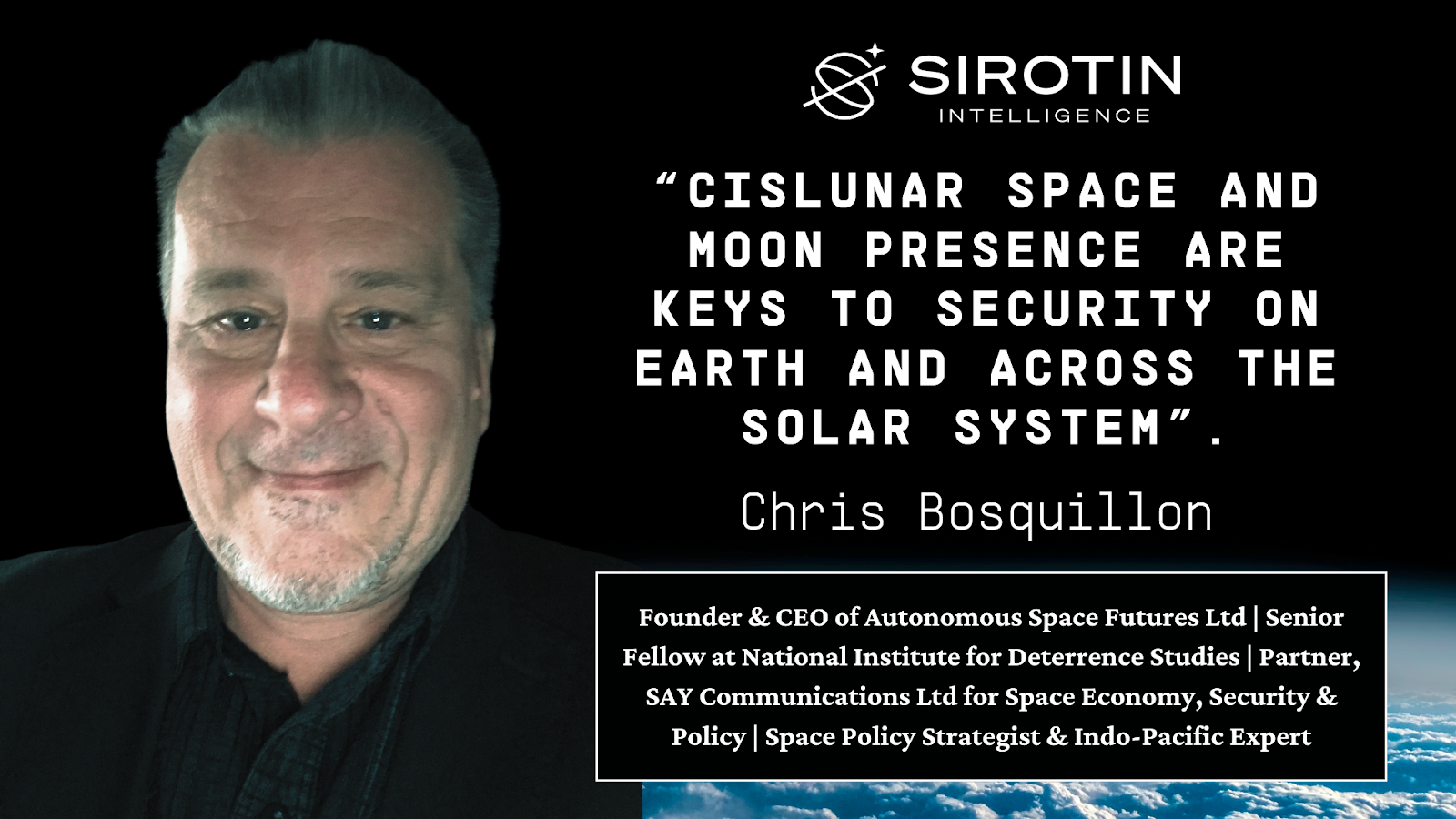
The White House released President Trump’s "Cyber Strategy for America," a concise framework that shifts U.S. policy toward a more aggressive, offensive posture while prioritizing deregulation for the private sector. The strategy reinforces a deterrence model based on disruption and retaliation, rather than purely defensive cybersecurity. This reflects the ongoing shift in U.S. doctrine toward persistent engagement and forward defense in cyberspace.
Cyber operations may increasingly be integrated with military, intelligence, financial, and diplomatic tools, as cyberpower becomes a core instrument of national power, combining offensive operations, technology competition, and deep public-private integration. Operators in cybersecurity, technology infrastructure, and critical systems should expect more government collaboration, stronger supply-chain scrutiny, and rapid adoption of advanced security architectures.
The core framework consists in six policy pillars: 'Shape Adversary Behavior' ; 'Promote Common Sense Regulation' ; 'Modernize and Secure Federal Government Networks' ; 'Secure Critical Infrastructure’ ; 'Sustain Superiority in Critical and Emerging Technologies’ ; and 'Build Talent and Capacity.' This bears consequences, as businesses and critical infrastructure owners must prepare for streamlined compliance but higher expectations for rapid recovery.
Investing in zero-trust, post-quantum crypto, and U.S.-origin supply chains will qualify for new incentives and procurement advantages. Competitive procurement will favor agile innovators and federal contractors and tech firms should position offerings since AI-enabled cyber tools and agentic AI will become standard requirements. Cybersecurity teams workforce pipelines will expand with upskilling and aggressive hiring, while aligning with government sharing programs.
Offensive disruption operations may create new hunt forward partnership opportunities. National efforts will shoulder more burden, but cyber hygiene and basic resilience (multi-factor, updates, backups) remain essential for individuals and small businesses. In the domestic arena, the Cyber Security Strategy was immediately augmented with an Executive Order which 'Combats Cybercrime, Fraud, and Predatory Schemes Against American Citizens.'
International partners must prepare for joint operations and shared risk models. In an environment leveraging deregulation and rapid tech adoption, foreign platform with embedded surveillance, censorship, and biased ideologies will face rejection. Organizations that move quickly to adopt relevant technologies and build resilient, U.S.-centric supply chains will gain competitive and regulatory advantages in the coming years.
Have a great Space Week ahead!
🎤 Our Next Guest: Daniel Scuka
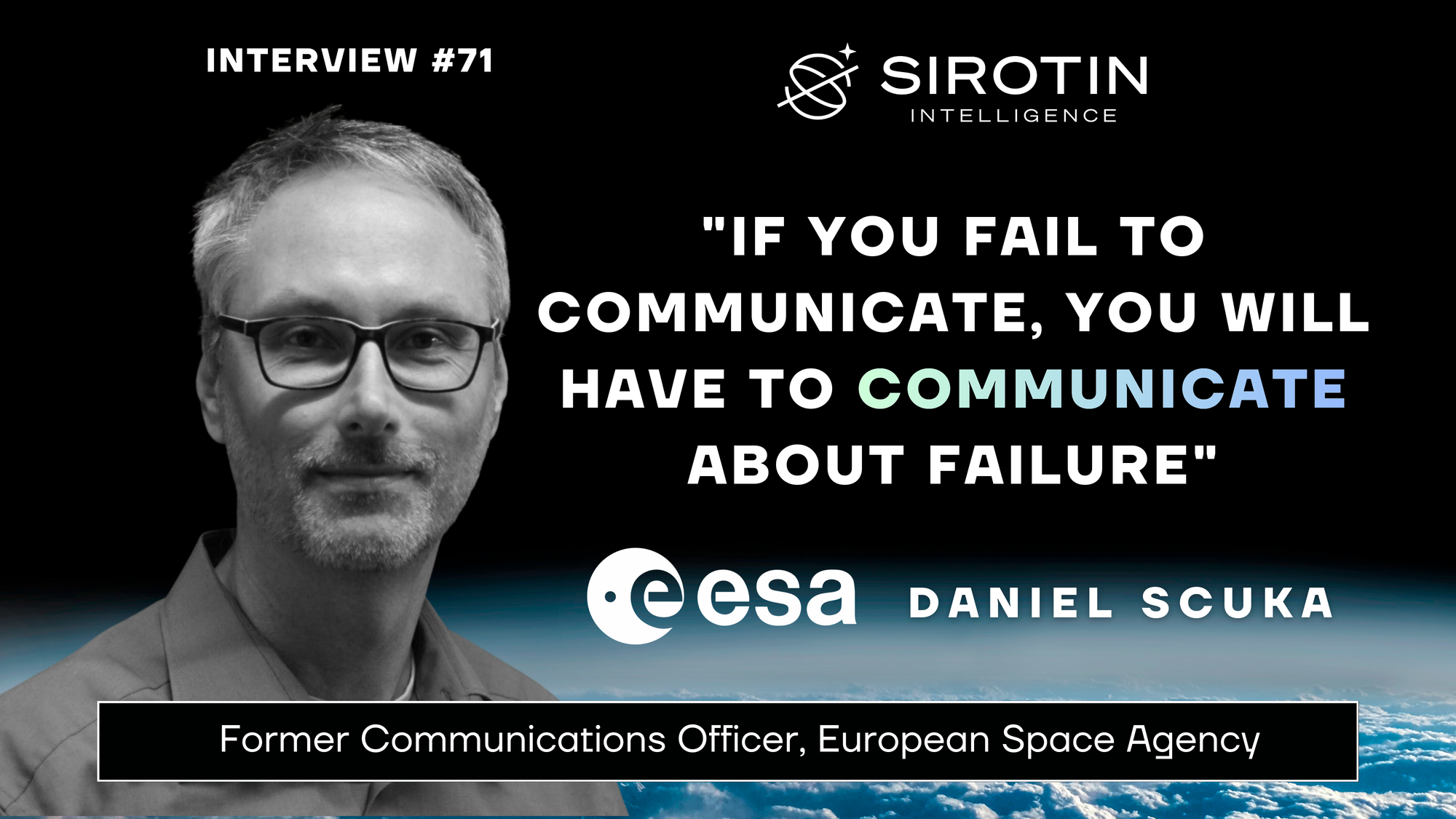
Daniel Scuka is a former officer in the Royal Canadian Electrical and Mechanical Engineers (RCEME) who spent over two decades at the European Space Agency's European Space Operations Centre (ESOC) in Darmstadt, Germany, where he served as Programme Communication Officer for Operations and Space Safety and later Head of ESA's Content Office. He built ESA Operations' social media presence from zero to over a quarter of a million followers, led real-time communications for landmark missions including Rosetta, ExoMars, Solar Orbiter, and Hera, and was among the earliest voices inside the agency to push for public transparency on space debris — groundwork that helped establish ESA's Zero Debris Charter.
Key topics from the interview:
- Why the best leaders are almost always the best communicators — and what Canadian Army colonels and ESA flight directors have in common
- How ESA Operations built a real-time social media presence by "bringing the audience to space" rather than bringing space to the audience, and the early mistakes that got them there
- The Schiaparelli crisis: what happened when ESA's Mars lander hit the surface at 540 km/h on live television, and why an engineer's unscripted message became the agency's strongest crisis response
- How ESA's space debris team spent decades building internal support for transparency that much of the agency initially resisted — and why the communications groundwork made the Zero Debris Charter credible
- Managing multinational stakeholder alignment across member states, industrial partners, and scientific institutes: "Figure out what their one thing is"
- Why the space industry desperately needs people who are not engineers — and why "if you fail to communicate, you will have to communicate about failure"
Watch Daniel Scuka's YouTube preview Tuesday on the Sirotin Intelligence YouTube channel. Full interview drops Thursday.
Sources:
https://www.nytimes.com/2026/03/12/science/moon-red-alert-close-call.html
https://www.nbcnews.com/science/space/nasa-artemis-moon-mission-launch-astronauts-april-1-rcna262569
https://spacenews.com/voyager-opens-defense-and-space-tech-hub-in-long-beach/
https://project-disco.org/innovation/space-based-data-centers-bringing-ai-policy-into-the-equation/
https://spacenews.com/eutelsat-exits-two-russian-capacity-leases-after-satellite-failure/
https://spacepolicyonline.com/news/whats-happening-in-space-policy-march-8-14-2026/
https://www.universetoday.com/articles/chinas-space-programme-prepares-for-its-busiest-year-yet
https://www.ft.com/content/5b35fcb0-d51b-4cc7-a5ae-ffa883bd933f
https://spaceanddefense.io/space-technology-emerges-as-a-critical-domain-in-the-iran-conflict/
https://evertiq.com/news/2026-03-12-german-space-tech-firm-isptech-raises-55-million
https://supercarblondie.com/tech/high-school-student-discovered-unknown-space-objects-own-ai/
Get exclusive insights from our network of NASA veterans, DARPA program managers, and space industry pioneers. Weekly. No jargon.