
Sirotin Intelligence Publishes Strategic Communications Trends in Space & Defense 2026, Drawing on Nearly 80 Primary-Source Interviews Across the Global Space and Defense Ecosystem

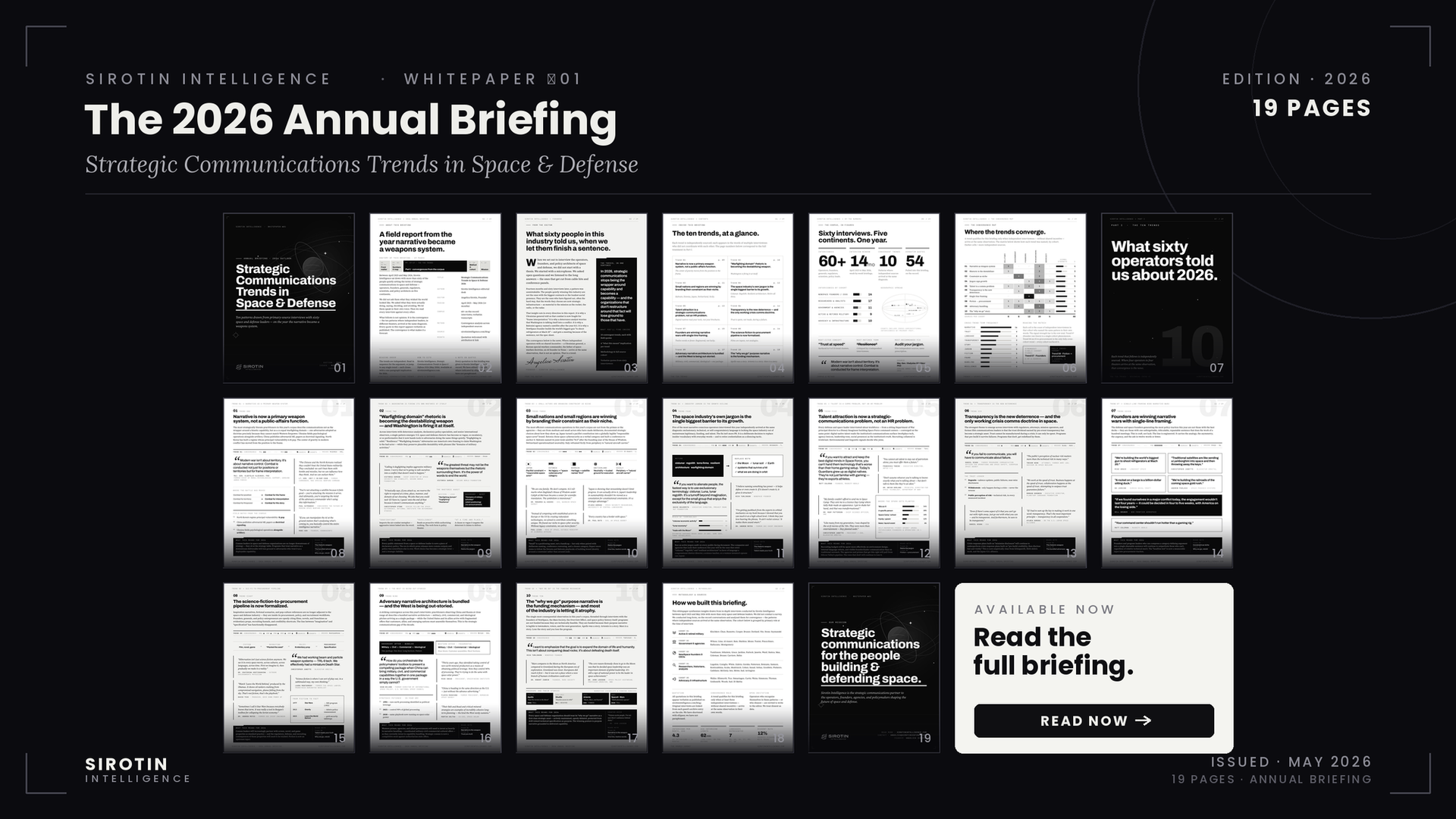
Sirotin Intelligence today released Strategic Communications Trends in Space & Defense 2026, a research briefing examining recurring communication patterns identified across nearly 80 interviews conducted throughout the global space and defense ecosystem.
The report is based on conversations with founders, military leaders, regulators, scientists, policy experts, investors, and operators conducted between December 2025 and May 2026. While each interview focused on a different individual and subject matter, certain themes appeared with notable consistency across sectors, geographies, and organizational types.
Over the past year, readers frequently asked a simple question: What trends are emerging across all of these conversations?
As the interview library expanded, patterns became increasingly difficult to ignore. Individuals working in different countries, industries, and institutions often arrived at remarkably similar observations regarding communication, trust, positioning, influence, and public understanding.
That observation became the basis for the report.
Rather than treating each interview as a standalone publication, Sirotin Intelligence reviewed the interview corpus as a whole, identifying areas where independent participants repeatedly arrived at similar conclusions.
The resulting briefing identifies ten strategic communications trends shaping how organizations build trust, communicate value, attract talent, influence stakeholders, and position themselves within an increasingly competitive environment.
Several findings stand out.
Military leaders described narrative as an operational consideration rather than a downstream communications activity. Founders repeatedly emphasized the importance of concise framing when introducing new technologies or business models. Researchers and policymakers often expressed concern that highly technical language continues to limit public understanding, investment interest, and broader participation in the sector.
The report also examines the growing role of transparency in maintaining credibility, the increasing importance of positioning for emerging space nations and regions, and the relationship between public narratives and long-term program support.
Among the ten trends identified:
- Narrative is increasingly being treated as a strategic capability.
- Industry jargon remains a significant barrier to broader engagement.
- Talent attraction is often influenced by communications and culture as much as recruitment efforts.
- Transparency has become a strategic asset in periods of uncertainty.
- Smaller nations and regions are differentiating themselves through deliberate positioning.
- Concise and memorable framing continues to influence how organizations are understood by external audiences.
To the best of our knowledge, this is the first report focused specifically on strategic communications trends in the space and defense sectors built from primary-source interviews and convergence analysis. Rather than relying on surveys, polling, or secondary commentary, the briefing draws directly from the observations of individuals actively working across the industry.
The report is intended for founders, executives, government officials, military professionals, investors, communicators, and anyone whose work depends on securing support for complex ideas. Funding decisions, policy decisions, recruitment efforts, and public understanding are often influenced by factors beyond technical performance alone. Understanding how those dynamics are evolving can provide useful context for organizations operating in the sector today.
A Note of Thanks
Sirotin Intelligence would like to extend its sincere appreciation to everyone who participated in an interview over the past year.
The trends identified in this report did not originate from a survey, a model, or a predetermined thesis. They emerged from the experiences, observations, and perspectives shared by interview participants across the space and defense community. If you contributed an interview, you helped shape the findings contained within these pages.
We are grateful for your time, trust, and willingness to contribute to a broader understanding of the industry.
The full report, Strategic Communications Trends in Space & Defense 2026, is available now through Sirotin Intelligence 👇
Get exclusive insights from our network of NASA veterans, DARPA program managers, and space industry pioneers. Weekly. No jargon.