
"Space Is a Patchwork Quilt": Space Technologies LTD Principal and Former U.S. Space Force Branch Chief David Beck on Autonomy in Orbit, the Real Meaning of Digital Assets, and What Founders Get Wrong Selling to the Pentagon

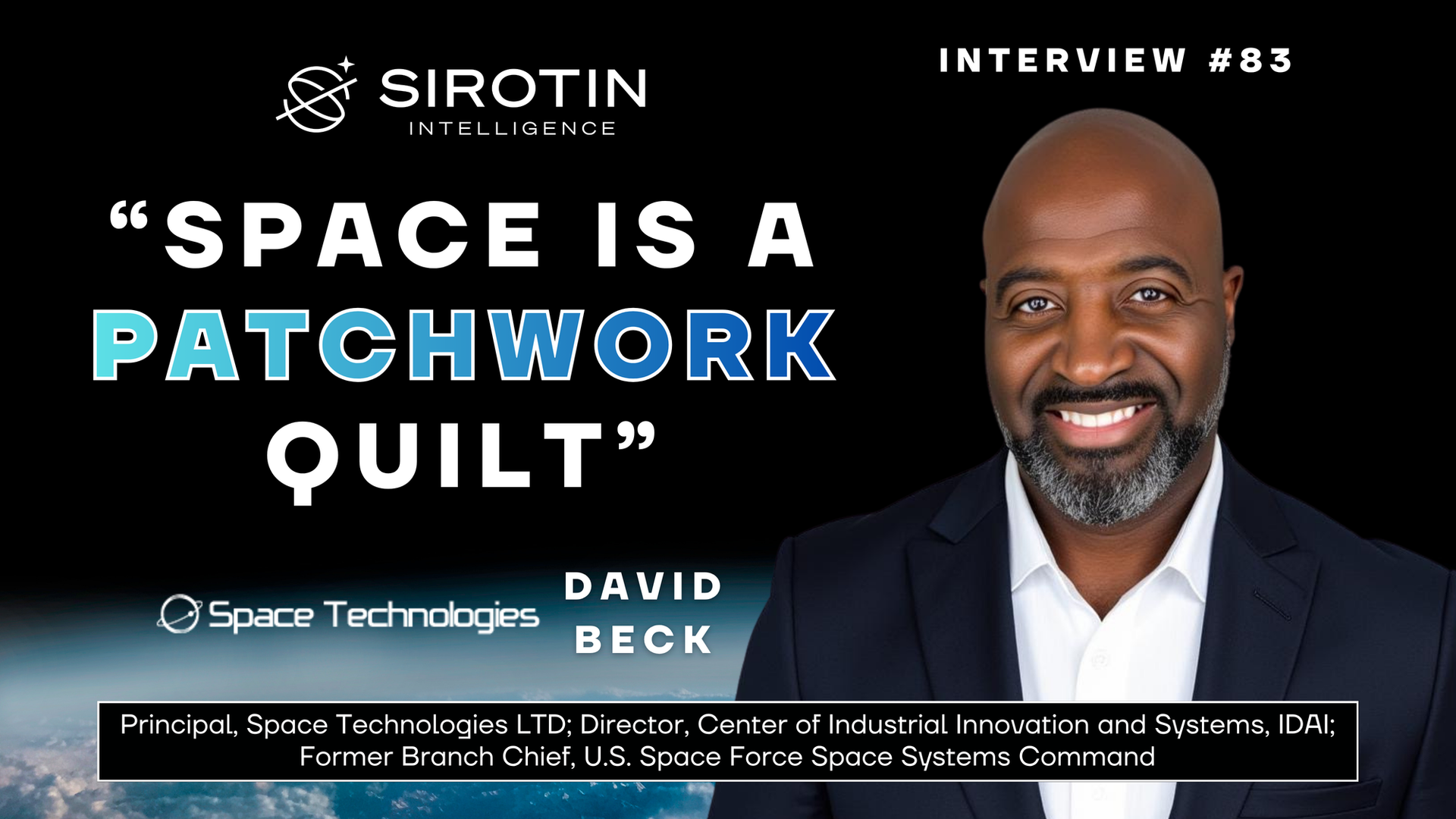
Near the end of our conversation, David Beck reached for an image to describe the space sector. "Space is a patchwork quilt," he said, "and everybody fits on that quilt together." It is a warmer way to talk about the field than most insiders manage, and it doubles as a description of how he thinks. He looks for the places where domains, disciplines, and people connect, and he treats that connective view as the most valuable thing he carries into a room.
Beck is the Principal of Space Technologies LTD, a Northern Virginia consultancy focused on dual-use innovation, advanced manufacturing, and assured access to space. He directs the Center for Industrial Innovation and Systems at the Institute for Digital Assets and Innovation, helped found the AI company Autonomous Directive Ventures, and runs DefenceWorks LTD on allied industrial-base growth. Before any of that he was a Branch Chief inside the U.S. Space Force's Space Systems Command, working on assured access to space and supply-chain resiliency. By his own count he has founded, advised, or helped shape more than 35 companies across aerospace, AI, manufacturing, and education.
The range is the point. He has worked the land, air, and sea domains before space, on the factory floor and in the acquisition office, and he carries that habit of crossing lines into a sector that often rewards staying inside them. We spoke about where autonomy is actually heading in orbit, what "digital assets in space" means once you strip the jargon off it, why the Civil Air Patrol deserves a place in the country's space pipeline, what founders keep getting wrong when they try to sell to the Pentagon, and the one phrase he would retire from the industry tomorrow.
How did you go from undersea defense and systems engineering into space? Was there a specific moment that pulled you in, or did it happen more gradually?
He answers the question two ways, because the honest answer has two timelines. The long one starts when he was a child. "I got into space when I was about six years old," he says. He watched Star Trek on a black-and-white set at his grandmother's house in the 1970s and came away with a durable belief that science fiction is a rehearsal for science fact. The path he wanted, a route straight into space-focused engineering, was not available to him at the time, so he took a longer way around. He joined the Marine Corps hoping to fly and eventually reach orbit, but at six-foot-four-and-a-half with imperfect eyesight, the pilot track was closed to him. He served as artillery instead, finished his degree, and kept working his way toward space from the side.
The shorter answer is about adjacency. At Naval Sea Systems Command, he says, the Navy does far more in space than the public realizes, since the development lifecycle for undersea technology runs through the same agencies, DARPAamong them, and touches the same questions of low-Earth-orbit sustainment and ISR data. "If you're doing something undersea and it goes up to space, you're working in the same areas as the other agencies," he says. "You're just doing it domain to domain, instead of launching into that domain." The move felt natural because he had already crossed those lines. Before entering government in 2013 he spent years at three aerospace companies, working everything from the fuselage to the auxiliary power unit to wing design, doing the geometric tolerancing that aircraft demand and automotive work does not.
The throughline he draws from all of it is perspective. Having built things on a manufacturing line, programmed his first robot in 1998 with ladder logic, and moved through land, air, and sea programs, he sees connections between domains that a specialist can miss. An engineer buried in a single propulsion concept can lose the larger picture, and Beck's argument is that space, more than any prior domain, punishes that kind of tunnel vision. The work rewards people who can hold several fields in view at once, which is the vantage the rest of the conversation kept returning to.
You work a lot at the intersection of AI and autonomous systems. Where do you actually see autonomy heading in the orbital domain, and how realistic is the timeline people are throwing around right now?
"I think space is the plateau for AI," Beck says, meaning the place where the technology will get pushed hardest. He is careful about what that does and does not imply. He does not believe orbit should run on full autonomy, and he keeps coming back to the phrase human in the loop. A space community that grows up with AI driving everything, and no human judgment shaping it, would develop in ways he considers dangerous.
To make the point concrete, he describes a chart he built at three in the morning mapping space systems against AI capability from 2015 to 2035. The line climbs steadily, then dips around 2020, when the early large language models arrived and the field briefly reorganized itself around them. His read is that space cannot simply inherit that consumer trajectory. Orbit runs continuously and demands open architectures that can be changed in place, which is why he points to neuromorphic processors and AI layers that let a single system shift between commercial and military use without being rebuilt. Dual-use, in his framing, belongs in the chip itself, designed in from the beginning.
Then the conversation turns to the human body, which is where his real concern sits. Radiation passes through a person regardless of how thick the suit is, he notes, and it is passing through all of us on the ground as we speak. Inside a vehicle there is no purely mechanical fix. His proposed answer is to put AI to work keeping people alive: sensors that gauge radiation zones, shielding concentrated where crews sleep, even hydroponics arranged so that circulating water slows radiation through the night. The goal he keeps in view is survival. He wants crews to last longer and stay functional in an environment that wears the body down the entire time they are in it.
Quantum computing comes up as the adjacent piece, and he is quick to narrow it. People assume quantum means encryption and stop there. In his telling its near-term value in space is as a guide for AI systems, accelerating the processing and navigation decisions that have to happen in real time when a vehicle is deciding whether to rotate or maneuver with no margin for lag. He extends it to the search for life, where a quantum-assisted system could evaluate whether a sample's chemistry actually points to something living rather than shipping every reading back to Earth for analysis. The realism, in his account, is less about whether these capabilities arrive and more about whether the field keeps a human positioned to overrule them.
"Digital assets in space" is a phrase more people are starting to use but not many really understand. What does it mean to you, and why is now the moment it starts to matter?
He defines it by contrast with what came before. A traditional satellite, he explains, is an asset: radiation-hardened, hermetically sealed, built around an older processor because spacecraft do not keep pace with consumer computing. Once it is up, the architecture is effectively frozen. His example is Voyager 1 and 2, still transmitting from beyond Pluto, where engineers have to work within the original system's limits and rewrite code around constraints rather than simply updating it. "You can't really change it," he says. "You have to simplify the zeros and ones to the point where you trigger one thing to open another."
A digital asset, by contrast, decides in real time. He describes it in almost bodily terms. "I blink my left eye, we go left. I blink my right eye, we go right." A system built this way can maneuver away from debris or an approaching satellite the ground cannot even see yet, and it keeps itself alive and adapting rather than waiting on a command from Earth. The reason it matters now is partly cost and partly necessity. Orbit is crowded, with hundreds of thousands of pieces of debris in and around low-Earth orbit, and the decisions that avoid a collision often have to happen faster than a ground station can react.
The economics are what make this more than a design preference. CubeSats can start in the low thousands and climb to a few hundred thousand dollars, he says, mid-size platforms run into the millions, and full systems reach into the billions. He points to a roughly $2.5 million communications satellite he helped build with the University of Portland using commercial off-the-shelf parts, then to the real bottleneck: radiation-hardening is expensive, only a handful of facilities worldwide can do it, and everyone is in line, with SpaceX largely handling its own. Until that cost comes down to where small companies can participate, he argues, the field cannot scale the way its enthusiasts imagine. Autonomy is partly a way to protect assets that remain very expensive to put up and very slow to bring down.
You served in both Space Force and the Civil Air Patrol. CAP doesn't come up much in commercial space conversations, but its pipeline runs deeper than people realize. What role do you think it should be playing as the country builds out its space future?
This is the question he was most glad to get, in part because he thinks the answer is obvious once the scale is clear. The Civil Air Patrol operates one of the largest civilian air fleets anywhere, built over decades from former military members and aviation-minded volunteers who train cadets and run search-and-rescue. In 2015 the Air Force folded CAP into its Total Force as its official civilian auxiliary, a recognition of a pipeline that had been running on its own for years. Beck served with it, and he frames it less as a hobbyist organization than as existing infrastructure for producing people.
His argument is that space now needs exactly that kind of pipeline. The Space Force has begun putting Guardians in orbit, starting with Col. Nick Hague, who commanded NASA's Crew-9 mission, and the service is still assembling the structures around a young force. A CAP-style program, in his view, could give teenagers and students a path into space careers on the ground first, learning to operate as junior auxiliary officers before moving on to a service academy or an ROTC commission. The training, the access, and the cadet structure already exist. What is missing is the deliberate connection between that machinery and the space domain.
He widens this into a longer answer about who the next-generation force should be. His advice to incoming Guardians is to keep an open mindset, learn the mission environment deeply, and treat the work as more than a job, because the psychological weight of operating in space is real. "You're never the same person again," he says of people who get involved in it. The force he wants is not only soldiers. It is parents, lawyers, doctors, therapists, educators, the full range of people, because guarding humanity's future in orbit is a civilizational task rather than a narrowly military one. Some of the roles that will define it, he notes, do not exist yet, which is itself an argument for building the pipeline early.
As a startup advisor and venture partner, you sit on both sides of the table. What do you see space companies getting wrong when they try to sell to the DoD, and where does the DoD itself still need to catch up?
He starts with a caution about the timing, because the customer itself has been moving. The Defense Department adopted the Department of War as a secondary title in 2025, and in Beck's experience the disruption around that period, combined with ordinary turnover, has thinned the ranks of people who genuinely understand the technology they are buying. Founders are walking into rooms where the institutional memory is shallower than it used to be. That puts more weight on a founder's ability to explain plainly what the technology is actually for.
The mistake he sees most often is a founder who values what they built over the application it serves. A technically or operationally minded founder falls in love with the system itself and underweights the use case, and that is fatal in front of a government buyer. Drawing on his time as an acquisition officer, he is blunt about it. "It's fine to have some algorithms on a page," he says, "but if you don't have a use case, it falls on deaf ears." His recommended discipline is to study the demand signal first, then assess honestly whether the technology is more viable on the commercial or the military side before committing to either path. He thinks the gap is large enough that he recently started an organization in Long Beach focused on sharpening exactly that demand-side analysis for startups.
His counterexample is a 24-year-old founder he had spoken with the day before. That founder went to the private sector first, built a minimum viable product and working robots, and only then approached the Defense Department, arriving with a proven concept the government did not have to fund. The reception, in Beck's telling, was open arms. The lesson he draws for founders is partly about sequence and partly about self-protection: prove the concept on someone else's timeline, and be careful with equity, since the difference between diluted and non-diluted funding is the kind of thing that can quietly take a company away from the person who built it. Underneath it all sits a line he repeats often, that your network is your net worth, and that the relationships have to exist before the pitch does.
On the comms side, since that's where I live, what's the biggest mistake you see space and defense companies making when they try to tell their own story? And if you could ban one buzzword from the industry forever, what would it be?
On storytelling, his answer is the one a former acquisition officer would give. The biggest mistake is embellishment, the slow drift away from what a company has actually done. Memory is unreliable, he allows, and everyone shades the story a little. But in a market where claims get checked against contracts, that drift tends to catch up with the people telling it.
The buzzword he would retire is "for the good of mankind," and his objection is about honesty rather than language. Companies invoke it constantly while building, in the end, for revenue, and the mismatch erodes the trust the sector runs on. He extends the same complaint to "quantum," which he thinks is now used mostly to attract investment by people who could not build a quantum system if asked. The technology dates to the 1970s, he points out, and he recalls a 2019 gathering in Washington of roughly 170 of the people who actually built it. He is careful to stay on the right side of his own rule here. His institute has access to a quantum chip, he notes, "but I'm not a quantum expert," and he treats that distinction as exactly the kind of honesty the industry's vocabulary tends to blur.
The part of his answer that lands hardest is about delivery. Good communication, in his practice, means reading the person in front of you and adjusting to them. With a founder from a military background, he goes straight at it: "Punch me with it. I want the facts." Someone from a heavy academic background gets the same truth in a softer, more contextual form. A founder who came up in the trades gets it plainly and fast. What stays constant is the candor, even as the framing changes from one person to the next. That brings him back to trust, the word he uses for the whole enterprise. "We have a zero-trust situation in orbit," he says, meaning it literally in the cybersecurity sense and figuratively about the sector, and his argument is that the ecosystem does not hold together without the trust honest storytelling builds.
Author's Analysis
Underneath the five topics, Beck keeps circling one worry. The space economy, in his view, is building its machinery faster than it is building the human and institutional scaffolding the machinery depends on, and the gap is widening just as the technology speeds up. Bounded autonomy, satellites that can adapt in orbit, a trained pipeline of people, founders who sell on proven results, a sector held together by trust: none of it, in his account, arrives on its own, and the current pace makes the patient work harder to justify.
The timing sharpens the point. Launch is getting cheaper, autonomy is maturing, the first Guardians are reaching orbit, and the Pentagon spent much of the last year absorbing a rename and the turnover that came with it. Each of those developments rewards speed. None of them automatically produces the things Beck keeps naming as prerequisites: trained people, honest demand signals, trustworthy partners, and systems a human can still overrule. His own career is the implicit argument. He can see how undersea work connects to orbit because he moved through the domains slowly, one at a time, and that slow path is the one the current moment is least inclined to fund.
Consider a dual-use startup in 2028 with a genuinely capable autonomous satellite, a defense buyer interested in it, and a workforce on the government side that has turned over enough that few people in the room can fully evaluate the technology. The founder can move fast, the hardware can maneuver on its own, and the money is available. What is uncertain is whether anyone in the transaction has the cross-domain literacy to ask whether the system should be doing what it can do, and whether the human-in-the-loop Beck insists on is a design requirement or a line in a pitch deck.
Beck is not against autonomy, cheaper launch, or a bigger force. He wants all three. His caution is about the parts that get less attention: the people pipeline, the honest use case, the trust between buyer and builder, and the human kept in the loop. Those parts are harder to fund and slower to show results, and they are also what decides whether the rest holds together. The sector can build them deliberately, alongside the satellites, or it can find out later what happens when they are missing. The question worth leaving open is a plain one: as more of orbit runs on systems that act without waiting for a person, who is being prepared to judge what those systems should and should not do?
About David Beck
David Beck is the Principal of Space Technologies LTD, a Northern Virginia–based consultancy focused on advancing deep technology, dual-use innovation, and sustainable systems supporting the commercial and defense space sectors. His work centers on assured access to space, industrial base development, advanced manufacturing, space mobility and logistics, and emerging AI-enabled technologies that support future space infrastructure and commercialization.
He currently serves part-time as the Director for the Center of Industrial Innovation and Systems at the Institute for Digital Assets and Innovation (IDAI). He is the founding Senior Principal Scientist for Autonomous Directive Ventures (ADV), an artificial intelligence and machine learning company focused on transportation systems, sustainment technologies, logistics modernization, and autonomous operations. He is also the founder of DefenceWorks, LTD, supporting allied industrial base growth and dual-use technology partnerships across North America and emerging international space markets.
Previously, Mr. Beck served as a Branch Chief within the United States Space Force's Space Systems Command (SSC), supporting initiatives tied to Assured Access to Space, supply chain resiliency, and future in-space operations. Throughout his career, he has founded, advised, or helped shape more than 35 startup companies and initiatives spanning aerospace, artificial intelligence, advanced manufacturing, venture development, education, and nonprofit sectors. He holds a BS in Industrial Engineering and an MBA in Marketing, as well as several technology certificates in related engineering disciplines.
Get exclusive insights from our network of NASA veterans, DARPA program managers, and space industry pioneers. Weekly. No jargon.