
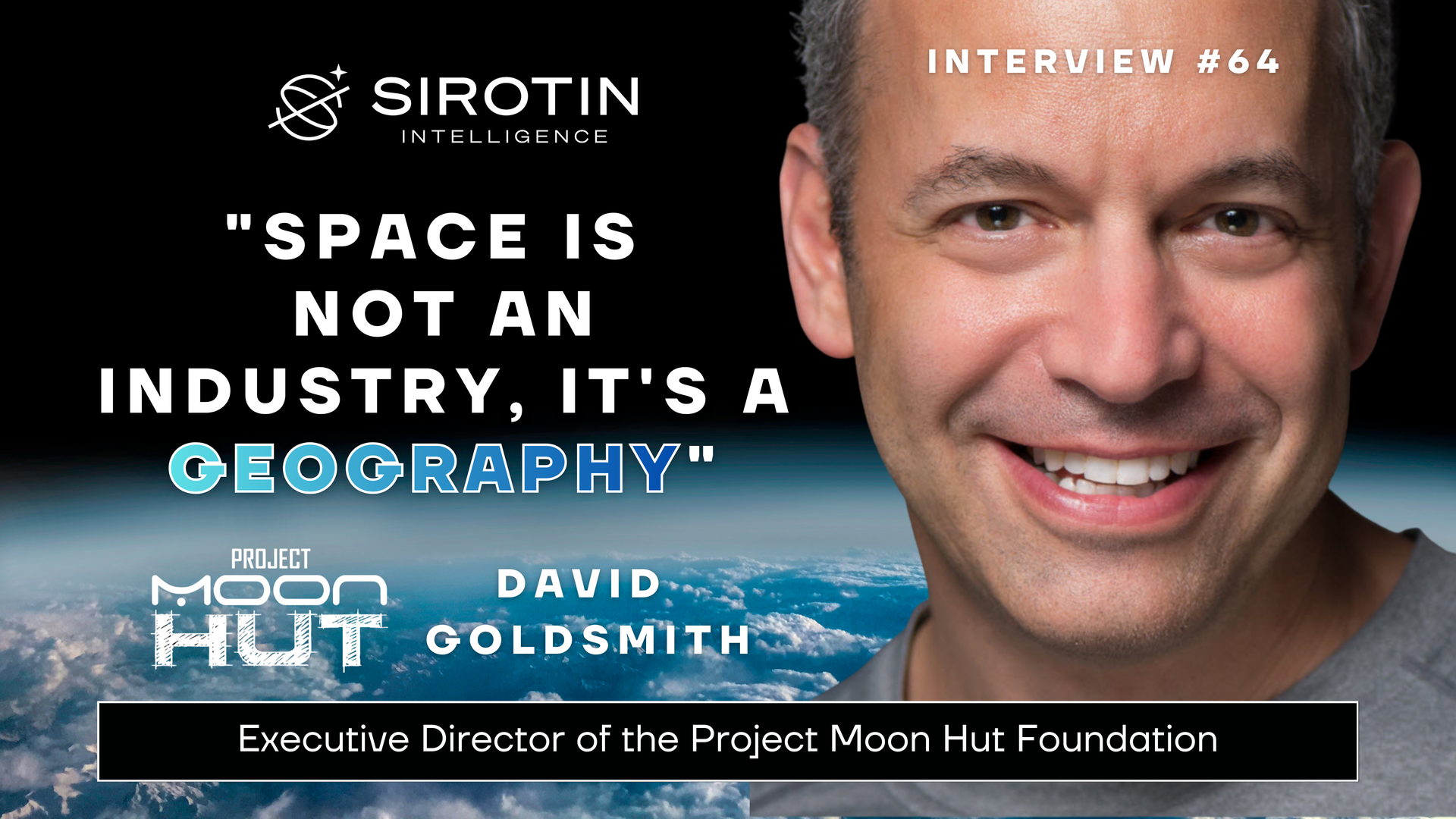
"Space Is Not an Industry, It's a Geography": David Goldsmith, Executive Director of the Project Moon Hut Foundation, On Mearth, the Myth of Lunar Mining, and a 40-Year Plan for Lunar Living

The art on David Goldsmith's wall has a story.
Around 2000, he was speaking to 3,000 people in New Orleans when he wandered into a gallery and met artist Alex Beard. Over the next hour, Goldsmith shared 23 ways Beard's business could be improved. He left without ever really looking at the paintings.
The next day, when David returned, Beard ran up to him. The team had stayed up all night implementing the ideasand sold a piece that had been sitting untouched for 12 years.
"Pick anything in the gallery," Beard told him. Over time, Goldsmith selected four.
One of those pieces now hangs behind him on nearly every video call. Beside it sits a whiteboard sketch, one his team insists belongs in a museum. That drawing, made the day after Goldsmith outlined a four-phase, 40-year approach to developing the Moon while visiting NASA, contains the first plans ever drawn for Project Moon Hut.
"We're still following it today," Goldsmith says.
The origin was straightforward. After leaving NASA and returning home to the U.S., Goldsmith went into his basement and asked himself: "If I were responsible, not theoretically but actually responsible, to build what I outlined for NASA, how would I do it?"
What emerged that day became the foundation for everything that followed.
On camera, Goldsmith traces the image, walking through the connections: the 4Phases, pathways, alliance development, governance coordination, and intersections that frame the development of the Moon over four decades.
His background is unusually broad. Organic chemistry, physics, calculus. Twelve years teaching at NYU in executive strategy and new product and service development. He once ran a rock quarry, dropping 22,000 tons of stone. He does his own carpentry, plumbing, and electrical work. He draws, paints, and sculpts.
When COVID forced him to return to the U.S. after living overseas for ten years in Hong Kong, and set up a workspace upstairs, his wife vetoed hanging his own art. She insisted on Beard's piece instead positions over 20 feet up in a vaulted ceiling**.** So Goldsmith climbed a ladder in the middle of the pandemic, pulled the painting down from their vaulted living room, and rehung it behind his desk.
The next day, someone on his team in Germany noticed the whiteboard behind him on the call.
"What's that?" Goldsmith explained it was the first thing he ever drew for Project Moon Hut. The immediate reaction was visceral: "That should be under glass. That should be in a museum. Never touch that."
They haven't.
The project has been almost entirely self-funded, with Goldsmith and his family carrying the majority of the financial burden. Approximately $500,000 has come from external contributors, while the rest has been funded as an act of long-term commitment rather than short-term return.
Goldsmith describes this as contribution, a duty to help build systems designed to serve generations beyond his own.
At the same time, he is clear that the work is no longer isolated. They are already in discussions with investors across multiple areas of the initiative, from Moon-based development to advanced robotics to a new exchange structure, and active negotiations are underway.
The timeline is deliberately long. Forty years, ending in 2063, unfolding across four phases: 8 people, then 90, then 578, and finally 1,644.
One senior reviewer, the Chief Liaison to the U.S. Congress from the U.S. Space Force, summarized the work this way: "I've seen every project on this planet. You have the most in-depth and detailed project of anybody anywhere."
The plans were also reviewed under NDA by Hans Koenigsmann, SpaceX's fourth hire and the engineer who helped put the Falcon rockets into space. His assessment, according to Goldsmith, was blunt: "SpaceX is not thinking this big."
Which raises a more interesting question.
What happens when someone who doesn't care about space builds a Moon development project? What questions does he ask that the space industry hasn't?
You've worked across 300 industries in more than 50 countries, and you've solved problems for organizations like Maersk in three hours that internal teams had worked on for two years. Yet you consistently describe yourself as "not a space person," someone who wouldn't even take a ticket to the Moon. So how does not caring about space make you better at building for it?
"That doesn't, yet it does allow me to ask different questions. Often what the beyond Earth Ecosystem won't ask." Goldsmith says. "That shared, I'm not a space person. I don't look up. I don't dream about going to the stars. I'm an Earth person."
He goes further.
"If I were handed a ticket to the Moon, I wouldn't go," he says. "I'd give it to someone on our team. Maybe one day I'd go, but only after the people who worked so hard to make the Moon Hut real had their turn to experience it."
This perspective shapes everything Project Moon Hut does.
Most space initiatives begin with expansive ambitions: save humanity, extend civilization to the stars, explore the unknown. These ideas generate excitement, but they often lack operational specificity.
"When I first entered this ecosystem," Goldsmith says, "everyone was talking about science, research, and exploration, going to the stars, saving the human species. Those pursuits don't resonate with me. They're activities. Science, research, and exploration are activities."
What resonates with him is more grounded.
"I think about it as: can we make this life a good life, if we can?" he says. "Historically, that's how humanity has always operated. We expand outward from our home and establish another home. A Box with a Roof and a Door on the Moon is a home."
That framing changes everything and there is a full story to where this all comes from. I'll share the video.
"When you build from the strategic perspective of science, research, and exploration, you design one kind of infrastructure," he explains. "But when you build with the outcome of creating a home, and everything that makes a home work, from supply chains to governance, the entire build model shifts. And when the build model shifts, so does the work, the sequencing, and the framing."
His ability to solve complex problems is, in some ways, easier to measure than explain.
At Maersk, the world's largest shipping company, internal teams worked on a problem for two years. Goldsmith resolved it in three hours. A factory in Bangladesh was producing 463 pieces per hour; after a full redesign, output reached 808 pieces per hour in a single day. Two teams from Ogilvy spent two months on a duty-free retail challenge. Goldsmith worked through it, with less information, in 45 minutes.
"I see the interconnectedness, the entanglement, the infusion of things, and then I can extrapolate across them," Goldsmith explains. "And I've worked in over 300 industries across more than 50 countries: nanotechnology, aerospace, water, sewage, construction, retail. When you draw on that range, you solve challenges differently."
That pattern recognition is what first caught NASA's attention, and it happened almost by accident. After keynoting at a conference in Silicon Valley, someone standing next to him said casually, "If you ever want to tour NASA, give me a call." Goldsmith accepted, not out of ambition, but curiosity.
On his first visit, flying in from his home in Asia, he expected exactly that: a tour. Instead, he found himself sitting with three others for three hours, discussing NASA's development challenges, organizationally and technically. There was no tour. As the meeting ended, they suggested he return.
He was already in the Valley each month. On the second visit, the same thing happened. Another extended discussion. Still no tour.
On the third visit, they finally showed him around, even turning on the Space Shuttle flight simulator and handing him the joystick. "We never do this for visitors," they told him.
Then came a moment at Scratch Restaurant in Silicon Valley, a place known for conversations that turn into massive entrepreneurial companies.
Bruce Pittman from NASA's Ames Research Center was describing a proposed research project: millions of dollars to study what might happen if a woman became pregnant on the Moon.
Goldsmith leaned forward. "I can solve that for you."
The table went quiet. He motioned for them to lean in, not wanting to shock nearby diners, and said plainly: "Send her home!"
It wasn't what anyone expected.
Goldsmith continued, explaining the logic. "We already have the technology to prevent pregnancy. That's not the issue. The issue is we're not even on the Moon yet." Then he asked a question that reset the conversation: "Do you want to know how to actually get to the Moon?"
That blunt clarity led to a simple answer, yes, and a much longer discussion about what Moon development truly requires. Goldsmith began with a foundational construct:
"Phase One starts with a Box with a Roof."
That framing carries through everything that followed.
Goldsmith is deliberate about language. He never uses terms like "Luna" or "lunar." They aren't part of everyday speech. "We don't call Earth 'Terra' or 'Gaia,'" he notes. "We call it Earth." For the same reason, and to remain inclusive, he always refers to the Moon simply as the Moon.
For the next hour and a half, Goldsmith walked through a four-phased approach [4Phases], beginning with a Box with a Roof, followed by Phase II: the Industrial Park, Phase III: Extended Stay, and finally Phase IV: Community.
He fielded questions continuously, from who would pay for it ("Everybody and nobody") to the science, logistics, and economics behind the model. There was little resistance, largely because the answers were grounded, pragmatic, and organizationally logical, not driven by distant galaxies or aspirational promises that have circulated for decades.
He didn't need to push the ideas. The interest was already in the room. (It's a longer story, and it's captured on video here: https://youtu.be/He0lc2wHPms)
As lunch wrapped up and as they walked toward the door, Pittman turned to him and said, "We don't need a box with a roof."
In that instant, Goldsmith felt it: all that effort, and it didn't land. Then Pittman finished the thought.
"We need a box with a roof and a door. A home."
Internally, Goldsmith thought: He got it.
For Goldsmith, this moment crystallizes a broader issue within the beyond-Earth ecosystem. Its dominant focus remains science, research, and exploration. When the starting assumptions are off, he argues, the probability of achieving meaningful outcomes drops exponentially.
The real objective should be simpler, and more human.
Build a home on the Moon as an extension of Earth.
Humanity has followed this pattern for millennia. We expand outward from home and establish another home. We've done it repeatedly across history. Now, the next frontier follows the same logic: to establish a Box with a Roof and a Door on the Moon.
Two years later, after countless meetings with the team at NASA's Ames Portal, at least once a month, something unusual happened. Bruce Pittman walked into the meeting room carrying a folder, something he never did.
Midway through the discussion, Goldsmith finally asked, "What's with the folder?"
Pittman replied, "We named your project."
There was a pause. "Project Moon Hut." Then he added, "A box with a roof and a door, a hut on the Moon."
That was the moment the work received its name. While the project is fundamentally Earth-centric, it intentionally leverages the beyond-Earth ecosystem to accelerate innovation and enable paradigm-shifting thinking. With that meeting, Project Moon Hut became official.
Goldsmith is the first to admit it's not a perfect name. But it carries a story, and that has value.
Most lunar concepts still revolve around self-sustaining colonies: greenhouses, fully closed-loop habitats, large-scale mining. You've called this framing "delusional," and instead point to Antarctica as the more accurate model. So what's the difference between sustainable and self-sustaining, and why does the space industry keep getting it wrong?
"When people say self-sustaining, they usually mean closed and independent," Goldsmith explains. "You're on your own, and you design everything around that assumption. That's not how civilization has ever worked."
"Sustainable," he says, "means supported, the way every city on Earth is supported."
He points to Antarctica. "You don't escape supply chains. You design them."
The numbers reinforce the point. Much of the beyond-Earth ecosystem talks about growing food on the Moon, yet even with advanced technology, the caloric output would be marginal. Building an agripark large enough to feed even a small group, including water systems, energy, redundancy, and maintenance, would cost enormous sums and deliver very little in return.
"We're not ready for that," Goldsmith says. By contrast, establishing a home on the Moon through Project Moon Hut's 4Phases requires something far more practical: a steady, predictable flow of ships between Earth and the Moon.
"We'll load them with food," he says. "That's exactly how Antarctica operates, and how humans have done this throughout history."
Goldsmith is consistently pragmatic, and he does the homework.
"You've probably heard the ideas," he says. Entire communities 3D-printed on the Moon. Massive domes. Living inside lava tubes. "We've never been inside a lava tube on the Moon. Not once. We don't know how structurally sound they are. And on Earth, just to enter a mine safely requires extensive modeling and analysis."
The scale matters. "The Moon would be operating at a scale we've never dealt with on another body." On Project Moon Hut's team are some of the most experienced miners and geologists in the world, and their reaction to many of these proposals is the same: they shake their heads. Even today, with the most advanced telerobotic and semi-autonomous mining systems available, the focus remains on Earth, not the Moon.
The same reality check applies to 3D printing.
"We don't print doors. We don't print hinges, wiring, electronics, or glass," Goldsmith says. "So when someone claims they'll 3D-print a module on the Moon, are they printing the door-closing systems? The electronics? All the wiring? And doing it in space designed gloves?"
"We can't fully print a house on Earth today," he adds. "Leaping from that to the Moon is a stretch." For Goldsmith, dome construction falls into the same category. "It sounds great in a speech or a slide deck," he says, "and it works for the naive side of capital raising. But as a near-term solution for the Moon? No."
That realism extends to launch systems as well.
Goldsmith points to Starship, noting that it's roughly 70 meters (about 230 feet) tall. "To land safely, it likely needs a flat, prepared surface. Land on soft or uneven material and it tips over." He also references concerns raised by others about the proposed 7–14 refueling cycles, suggesting the energy-to-value equation simply doesn't close with current capabilities.
Project Moon Hut takes a different approach, one that started on day one at NASA. Early in those conversations, Goldsmith posed a deliberately provocative question: "Why don't we push a segment of the International Space Station to the Moon?"
The room laughed. "That would be like putting a Winnebago on the Moon." A Winnebago being one of the top bus touring systems in the world. Custom and Prevost being the ultimate rides.
The moment mattered, not because the idea was literal, but because it exposed a deeper point. Decades of promises, living on the Moon or Mars by 1990, 2000, 2010, 2020, 2030, and beyond, had come and gone. Against that backdrop, Project Moon Hut anchored its decisions in pragmatism.
"Today, we need to manufacture our first living capabilities on Earth and place them on the Moon," Goldsmith explains. "Unfortunately, even that ecosystem hasn't fully matured yet."
The plan reflects that reality. It begins with modules and nodes, then expands into larger structures over time. Every step is designed around current and near-term rocket capabilities. That constraint is intentional. "If you invent entirely new systems, you add twenty to thirty years," he says.
Goldsmith offers a simple analogy for Phase I: We think of it as a double-wide trailer on the Moon — the equivalent of a construction trailer on a large terrestrial build. "They're not there for science, research, or exploration," he explains. "They're there to prepare the site."
Phase I exists for one reason: to make Phase II, the Industrial Park, possible.
The reframing of the Earth–Moon system as "Mearth" began almost accidentally, with Goldsmith repeating the phrase "Moon and Earth" over lunch until someone finally merged the words. Not everyone accepted it easily. Andy Aldrin, Buzz Aldrin's son, pushed back on the project for eight months. Then one day, he called while traveling up and down the coast of Florida and shared, "I can't stop thinking about filling Mearth." So what is it about this reframing that converts skeptics?
"We're never going to make everyone happy," Goldsmith says. "Thankfully, there wasn't a joint task force when we had to name Earth." He pauses. "Humans don't say they live on terra firma or terraforma. We say we live on Earth — and we call the Moon the Moon."
Language matters.
"If we don't want to alienate people, the way the space ecosystem often does, it's only logical to use common words to describe common realities."
That insight surfaced during a casual lunch. Goldsmith caught himself repeating, "Moon and Earth. Moon and Earth. Moon and Earth. We need another name."
As someone was hanging their coat, they offered a hesitant suggestion: "Mearth?"
The word stuck immediately. It was simple. Moon + Earth. Easy to remember, whether you're six, twenty-two, or seventy. And more importantly, it reframed how people think about where we live.
"We live within Mearth," Goldsmith says. "A shared ecosystem, and eventually, a shared economic system."
This matters because jargon keeps people out, space jargon especially. "If you want to alienate people," Goldsmith says, "the fastest way is to use exclusionary terminology: cislunar, Luna, lunar regolith. It's a turnoff beyond imagination, except for the small group that enjoys the exclusivity of the language." "For us," he adds, "it fit, and it worked. We live within Mearth."
That framing is exactly what made the difference with Andy Aldrin, Buzz Aldrin's son.
Aldrin has worked with 325 graduate students and 500 schools worldwide on space-related programs. He pushed back hard on the project. Their first call went badly. Really badly.
At the end of that call, Goldsmith asked when they should speak again.
Aldrin replied, "This was a terrible call. Why would we want to meet again?"
Goldsmith answered without hesitation: "Well, if I can speak to you, I can speak to anybody."
So they kept talking. Every two weeks. For eight months.
Then one day, mid-conversation, Aldrin stopped speaking. Goldsmith watched him tilt his head, thinking. "I froze," Goldsmith recalls. "I didn't want him to stop thinking." Aldrin finally looked back into the camera and said, "Where do we go from here?"
A month later, Aldrin called from Florida, driving up and down the coast. " I can't stop thinking about filling Mearth."
Goldsmith knew in that moment that the reframing had landed. At least with Andy, a huge initial critic.
"Mearth," he explains, "is what you see when you zoom out. It's our home. There's a symbiosis between the two bodies, Earth and the Moon, moving through space together."
The science supports that view.
The Moon stabilizes Earth's axial tilt at approximately 23.5 degrees, giving us consistent seasons. It influences rotation, weather patterns, and tides. Those tidal cycles played a role in allowing marine life to move onto land. Animals hunted by moonlight. Human cultures tracked time by lunar cycles. Across civilizations, the Moon has been associated with change, rhythm, fertility, possibility, and the future.
"If there were no Moon, there would be no Earth as we know it," Goldsmith says. "We're one system."
History shows how shifts like this change everything.
Aristarchus of Samos first proposed a Sun-centered model, though it was largely dismissed. Nicolaus Copernicus later formalized it, challenging humanity's place in the cosmos. Galileo Galilei used the telescope to observe Venus and Jupiter, reinforcing that model and reshaping society's understanding of reality. Johannes Kepler revealed elliptical orbits. Isaac Newton explained the forces behind them.
Each shift didn't just redefine astronomy. It redefined how humans understood themselves.
"When we change our map of existence," Goldsmith notes, "we change our language, our assumptions, our innovation paths, our economics, and ultimately, how we live."
But beyond the science, the reframing matters for a simpler reason: "humans fill space."
Think about it. Your childhood room, you filled it. If you went to college or university, you filled the space in your dorm room. Your first apartment or home: you didn't get six apartments or get a space six times the size you needed. You secured one, and then you filled it. That's how humans have always behaved.
"I know where my property line starts and ends, I can see the street from my window" Goldsmith says. "This is my space. That is your space. Don't touch my space."
We repeat the pattern at every scale. Town lines, city boundaries, national borders. Services plow snow up to a line and stop. The logic is the same everywhere.
Humans fill space.
History shows what happens when our maps change. The shift from flat Earth to round Earth. From geocentric to heliocentric models. The appearance of the New World on European maps.
"When maps change, society changes," Goldsmith says.
Mearth offers a new map.
Humans have more or less explored, divided, and optimized Earth. There are still places to discover, a lot of them, but the pattern is clear: throughout history, humanity expands outward. In that context, Mearth isn't radical; it's a continuation.
"The Moon is three days away with current technology," Goldsmith notes. "That makes it the next natural extension of our living geography."
But Mearth, on its own, is just a name.
Making it useful required something more specific: a tool.
You often say, "space is not an industry, it's a geography." Why does that reframing matter for who gets to participate?
As Goldsmith worked to understand the ecosystem, coming at it explicitly as someone who was not a "space person", he was introduced to people around the world. One of them was Dennis Wingo, widely regarded as an innovator in beyond-Earth development, whom Goldsmith met in the Palo Alto area.
As Goldsmith spent time with him, he realized he was struggling to understand something basic: what Dennis's company actually did. Not because the work wasn't real, but because, as Goldsmith puts it, understanding often comes wrapped in "a secret decoder ring."
"You don't just have to understand the work," he explains. "You have to understand the jargon. 'We have X4-9432 with 14597 and a thrust of 657...'"
Goldsmith likens the experience to the film The 13th Warrior, where Antonio Banderas's character slowly decodes a foreign language by listening long enough. In this case, Goldsmith found himself thinking, I'm completely lost, and I shouldn't be.
"So I pulled out a piece of paper," he says, "and in about thirty seconds, I drew a map — starting with Earth."
Goldsmith drew a circle on the page and wrote "1" inside it. "One is Earth."
He drew another. "Two is atmosphere."
Then he added arcs moving outward. "Three is Low Earth Orbit. Four is Medium Earth Orbit. Five is High Earth Orbit." He continued. "Six is the space between Earth and the Moon. Seven is around the Moon. Eight is the Moon." Then he gestured farther out. "Nine is the space toward Mars — then Mars itself, its moons, and beyond."
With the map in place, Goldsmith asked a simple orientation question. "Where does Virgin work?"
Dennis Wingo paused briefly. "One and two — Earth and atmosphere." It was a useful answer. Wingo recognized not only where Virgin's vehicles operate, but also that their people and infrastructure are on Earth.
Goldsmith added, "Aspirationally, three."
Wingo nodded. "Yes — aspirationally, three."
They hadn't crossed the Kármán line, the commonly cited boundary marking the start of space, but the distinction mattered less than the clarity.
Then Goldsmith asked the next question. "Where do you work?"
Wingo answered without hesitation. "One through eight." That was the first moment of real alignment.
Goldsmith understood Wingo's business geography. From there, he asked to see what the company actually did. Wingo pulled up an image on a large monitor, a vehicle designed to move materials through space. Goldsmith didn't hesitate.
"Oh, you're a logistics company."
Wingo paused, then smiled. "Yes. We are a logistics company, from one through eight."
In seconds, the work snapped into focus. Goldsmith understood exactly what the company was building, and where it fit.
Now imagine the possibilities if the ecosystem were exposed this way, not just the beyond-Earth ecosystem, but any ecosystem.
What if people could easily see who supplies what, who wants to work in which geographies, and which capabilities align across industries?
"Think about big-data solutions," Goldsmith says. "What if we could instantly identify every logistics company in the world supporting zones one, three, seven, or nine — and get them collaborating in seconds? That would dramatically accelerate progress."
Today, some tools exist — but the ecosystem remains largely siloed and to Goldsmith's point, those who have built databases and system don't understand what's needed and it's still isolated to just, "space people."
That early conversation became the foundation of what is now the Project Moon Hut Classification System. It is patent pending and already in use across multiple initiatives. The protection matters, Goldsmith explains, so the system isn't distorted or diluted beyond recognition.
This leads to one of his core assertions: "Space is not an industry. It's a geography."
A company in Madrid manufacturing materials for the Moon is still an Earth company — one that delivers to a different geography. A satellite-data firm is an information company on Earth utilizing satellites but they are not a space company.
"Does Amazon call itself a trucking company because it uses trucks?" Goldsmith asks. "No. Even though it runs one of the largest logistics operations in the world, it's a product company that leverages transportation."
Space jargon, by contrast, creates friction all over the place. Most people don't know what LEO, MEO, or HEO mean. "It's a turnoff beyond imagination," Goldsmith says.
But when you reframe space as geography, participation opens up. Every industry on Earth already knows how to operate this way.
Automotive, materials, food, computing, infrastructure: they all work this way.
Companies like Mercedes, NVIDIA, Cargill, and BASF don't need to become "space companies." They remain exactly what they are, vehicle manufacturers, chip designers, agricultural firms, materials producers, simply designing products and services for a new geography. Mercedes vehicles used on Earth or on the Moon would still be classified as a vehicle manufacturer.
That shift changes how participation works in practice.
You've called lunar mining "funny money following dreams." We've drilled exactly zero operational holes on the Moon. The deepest attempt went nine feet (about three meters), and the drill broke. If mining isn't the economic engine, what is?
This is one of the hardest realities for the ecosystem to confront.
Many proposed Moon-economy models rest almost entirely on mining-based economics. People who have actually mined for a living tend to react very differently. Miners laugh. I laugh.
"I dropped 22,000 tons of stone when I was younger, running a rock quarry," Goldsmith says. "That's a real operation. Mining is incredibly complex."
He lays it out plainly:
You find possible ore. You drill hundreds of holes thousands of feet deep. You dig a huge hole into the Earth You create huge underground infrastructure. You put all the equipment underground. You blast rock out of the ground. You move it up to the surface. You use a huge piece of equipment the primary to crush it. You sort it. You often crush it again. You separate materials. You process them. And then you send it to be processed!
"Resource extraction is a multi-billion-dollar, deeply interconnected system," he explains. "It's not a drill-and-done fantasy."
The numbers reinforce the point according to Goldsmith. On Earth, humanity mines roughly 100 billion tons of rock per year. A typical mine takes 15 to 30 years to move from first survey to first extraction. Each foot of exploratory drilling costs around $50,000. To establish a single ore body, you drill 500 to 700 holes, often 3,000 to 4,000 feet deep, just to understand if and what ore is there.
Then come shafts. Then infrastructure. Then years more before meaningful output.
Against that backdrop, the idea that mining on the Moon is the near-term economic driver simply doesn't hold.
Then came the question that stopped the conversation cold.
"How many holes have we drilled on the Moon?"
Goldsmith paused because I didn't know.
"Zero."
The furthest we've ever gone is about three meters, roughly nine feet, and the drill broke. The drill bit itself, he noted, making a small circle with his hand, was nowhere near the size of a real industrial drill bit.
That single fact reframes a lot of assumptions.
The Helium-3 narrative collapses under the same scrutiny.
"Guess how many tons of lunar rock you'd need to process to get the equivalent of a single 12-ounce bottle of water's worth of Helium-3," he asked.
The answer: 50,000 tons — roughly 2,000 stone trucks. New York City alone would require around 600 such bottles per year if processing were even possible.
"And here's are additional challenges," Goldsmith adds. "We don't have a fusion reactor. We don't have anything that can actually use Helium-3."
He points to the deeper issue, one that rarely makes it into glossy decks. "On Earth," he says, "we have hundreds of formulas for how rock breaks."
Then he pauses and asks. "How many formulas do we have for rock behavior in one-sixth gravity?"
I didn't know.
Again, "Zero." "We don't actually know how rock would behave on the Moon."
His written work on mining is blunt.
"What so many space entrepreneurs fail to do is the math. The debt service alone on $12 billion or $100 billion just to establish mining — before transportation to and from the Moon — is staggering. That's not economics. That's funny money following dreams. It's not people with their feet on the ground."
Then Goldsmith adds another layer that quietly dismantles a common assumption.
"Did you know the Moon and Earth are made of almost the exact same materials?"
The Moon formed after a Mars-sized body, often referred to as Theia, collided with early Earth. Over billions of years, the debris coalesced into the Moon, resulting in a composition remarkably similar to Earth's.
Then he reframes the scale. "Earth is about 8,000 miles wide. Do you know how far we typically dig?"
He answers himself. "About 4,000 feet. That's it."
We're barely scratching the surface. "We don't need to go to the Moon to find new materials," Goldsmith says. "We need to do a better job here on Earth. And right now, we already have the equipment, data, and technologies to redefine the entire mining calculus."
That perspective has had an unexpected effect.
Some of the most prominent voices in the beyond-Earth ecosystem, names deeply associated with lunar ambition, have come back with a new question to Goldsmith: If we're not mining the Moon... then why are we going?
Goldsmith appreciates that question because there is an answer, and it tracks cleanly through history.
"In the early stages of any expansion on Earth," he explains, "we don't start by moving heavy infrastructure. We bring back small, high-value items, fabrics, trinkets, art, and sell those until supply chains mature."
History is consistent.
Early trade economies were built on lightweight, high-value goods: spices, silks, precious metals. "It's always for the wealthy first," Goldsmith notes. "Then the supply chains develop, and the scale changes."
That same logic underpins how Project Moon Hut approaches early economic activity.
One scenario explored in its work is deceptively simple: bring back a Moon rock and sell it to Piaget or Rolex, where it's sliced and integrated into a multi-million-dollar timepiece, literally wearing the Moon on your wrist.
Other possibilities follow the same pattern. Moon-derived materials used in high-end guitar frets, piano keys, or specialty inks. Perfume made on the Moon, requiring minimal equipment, almost no mass.
"Someone could invest $40 million to develop perfume there," Goldsmith says, "with potential returns of $100 million. That's not bad. But the bigger value might be something else entirely."
Marketing. "The first company to make a product on the Moon."
Over time, these early, lightweight value chains become the seeds of something larger. As logistics mature and participation broadens, the Mearth Economic System begins to take shape, not through fantasy-scale extraction, but through the same progression humanity has always followed.
He's written an in-depth paper on this too.
The "Overview Effect", the idea that seeing Earth from space fundamentally transforms people, is often treated as gospel within the space community. More than 700 people have now traveled beyond Earth. Goldsmith sees the concept as compelling, even hopeful, but ultimately unproven.
He's even been asked by someone with a military background, after reviewing Project Moon Hut's detailed plans: "Where's the prison?" The question wasn't cynical. It was practical.
The idea of the Overview Effect was formally articulated in 1987 by Frank White, who argued that seeing Earth from afar, the thin atmosphere, the absence of borders, the fragility of the planet against the void, would change how humans think and behave. That perspective, White believed, could make people better stewards of what we often call the pale blue dot.
Goldsmith doesn't dismiss the idea. He interrogates it.
"But does it actually work?" he asks me.
Then he pauses.
"Stop and think about it."
By 2024, just over 700 people had traveled beyond Earth.
"Has the world become markedly better?" Goldsmith asks. "Do we protect species more responsibly? Do we take better care of the planet? Do we treat one another fundamentally differently than we did thousands of years ago? Or are we still stuck in consumerism, power structures, and old habits?"
Then he offers a sharper test.
"Name twenty astronauts," he says, "who fundamentally reshaped science, industry, psychology, or civilization as a direct result of having gone to space."
The question isn't meant to diminish astronauts or their contributions. It's meant to challenge an assumption: that exposure alone changes human nature.
History suggests otherwise. Insight doesn't automatically produce behavior change. Perspective doesn't guarantee responsibility. Awe, on its own, doesn't create systems that endure.
His answer is clear and direct.
"If you think yes, you might be delusional. The Overview Effect, while beautiful, hasn't translated into widespread change."
Most people hesitate, and quietly agree. So Goldsmith pushes further.
"What if the number were 1,000 people? What about 5,000? 10,000?"
Then he makes the point directly.
"Humans are still humans. Even if we sent ten thousand people beyond Earth, terror, exploitation, and conflict would almost certainly persist. If we're being sold the Overview Effect as a magic spell, we're going to be disappointed."
Goldsmith has met astronauts.
"Some are incredible, intelligent, kind, thoughtful, fascinating," he says. "But some are arrogant, convinced they're superior because they've been above Earth. Not everyone changes just because they saw the planet from space."
An early conversation during Project Moon Hut's evolution made this explicit.
When Goldsmith shared the four-phase framework, someone with a US Space Force military background looked at the plans and asked a single question:
"Where's the prison?" Not, "this is cool."
The implication was clear. People won't magically transform, even on the Moon. Someone will eventually cross a line. And when they do, the system needs to know how to respond.
Project Moon Hut takes a different approach. Instead of hoping space changes people, it builds structures that force better questions.
"Relying on the Overview Effect is like building a house on sand," Goldsmith says. "You need practical frameworks, governance, and real decision-making if you want anything to last."
One of those practical foundations is governance.
Living on the Moon means something very different than living on Earth. You're dealing with environments where one bad decision can kill everyone. There's no exit. No external emergency response. Resources are finite, tightly rationed, and failure cascades instantly. So the question becomes unavoidable: what kind of governance works there, and why isn't it being discussed?
Goldsmith often starts this conversation with a simple exercise.
"Try this," he says. "Name as many governance models as you can. I'll start you off: democracy is one." He does this intentionally. He likes to take people on the journey rather than handing them the conclusion, and he did this to me continually so I had to dig deep and commit to an answer before he shared his thoughts.
Most people stall around five to seven. Democracy, communism, monarchy, theocracy, republic, maybe parliamentary systems, maybe oligarchies. And then they stop.
What most people don't know or would consider to address is that the platform Project Moon Hut is building includes a database of 270 distinct governance models, ranging from fringe and historical to modern and hybridized forms.
"People ask me, why 270? Isn't that too many?" Goldsmith says. "That's missing the point."
The point isn't to pick one. The point is to understand context.
"We're hitting headwinds," he explains. "Our legacy systems, economics, governance, religion, are under strain.We're trying to solve new challenges with old tools. And too few of them."
He offers a grounded analogy.
"If you're running a nuclear power plant, you govern that very differently than you would if you were to run a conference center. The risk profile, accountability, decision velocity, and failure tolerance are completely different."
Now apply that to the Moon.
When there are limited paths to success, and the margin for error approaches zero, governance can't be ideological. It has to be situational, adaptive, and designed for the environment.
"If we're serious about creating futures that work," Goldsmith says, "for our children and our children's children, then we need the ability to choose, and design, governance models that actually fit the conditions we're operating in."
That's the conversation Project Moon Hut is preparing for, before it's forced on anyone.
The Moon becomes a clean slate, not for fantasy, but for asking better questions about society. How do you run a new society on a new rock, three days away?
Do you start with command-and-control, like the military? For the first eight people, that might make sense. High risk. No redundancy. One mistake could kill everyone.
But the moment you add an industrial park, that model starts to break. Command-and-control doesn't scale well into complexity. So what's next?
Democracy? Not in the way people usually imagine it. No society on Earth operates as a full democracy where everyone, regardless of age, role, or capability, votes on everything. That would grind society to a halt. More importantly, most people don't have the training, context, or tools to govern complex systems, even when the stakes are low.
Goldsmith uses a simple analogy. "It would be like a plumber showing up with only a screwdriver, a hammer, and a saw."
He pauses. Your first instinct would probably be to look outside for the truck.
You'd ask, "Did you bring a truck?"
And if the plumber replied, "No, I've got all the tools I need," you'd be concerned.
Not because those tools are useless, but because they're insufficient. A good plumber shows up prepared for anything, knowing that many tools are used infrequently, but when you need them, you really need them.
Governance is no different.
We've outgrown a simplified version of the world. Yet we're still trying to make future-scale decisions with a very limited toolset, and then we're surprised when progress stalls or systems fracture.
Now take the mental leap to a group of people living on the Moon. You must address governance explicitly. Not as ideology, but as operational design.
In Phase I, the Moon Hut, command-and-control will likely dominate. The environment demands it. One bad decision could be fatal. Resources will be rationed. Conflict resolution matters when there's nowhere to go.
But the difference here is choice. With a broader governance toolkit, you're not locked into habits just because they're familiar. You can select frameworks that fit the phase, the risk profile, and the conditions.
Just like the plumber with a truck full of tools, having more options increases the probability of success. The goal isn't to prescribe one system but to ensure we're never stuck using the wrong one and that there are options when the moment counts.
When the number grows to 90 people, the entire model shifts.
Now you're no longer dealing with a sealed survival unit. You have clients or customers, builders interacting with non-builders, outsourced services, external alliances, and growing interdependencies. Command-and-control alone starts to strain under that complexity.
This is where something like distributed leadership may become necessary. The benefit isn't just operational. It's developmental.
By introducing multiple governance options, and applying them deliberately by phase, people around the world, for Earth, and this is important, begin to learn new ways of organizing, leading, and deciding. Just as new products and services developed for one context often find their way back into everyday life, these governance tools can reshape how we live on Earth as well.
That feedback loop matters. Because even if there are only 90, 578, or 1,644 people living on the Moon, there are over eight billion people on Earth. Growth can't be measured by headcount alone. It has to be measured by whether humanity, as a whole, becomes more capable.
That's why it matters to remember the Directive. Project Moon Hut exists to improve life on Earth for all species.The beyond-Earth ecosystem rarely engages this conversation.
""Everyone's focused on getting there," Goldsmith says, "and staying alive." Then he pauses. "But the bigger question is: how do we get there and thrive... and thrive on Earth too?"
Goldsmith isn't an isolationist. He's been in enough rooms, and enough one-on-one conversations, to know better. Across the Project Moon Hut: Age of Infinite podcast series, he has conducted more than 65 long-form interviews, many stretching five and a half hours. Even there, this question is rarely surfaced, let alone explored.
That silence, for him, is telling.
You've built two sale models, each tied directly to execution depth. Phase I, the Moon Hut, required eight months and roughly 3,000 hours of work. Phase II extended over 18 months and required approximately 10,000 hours. So the real question becomes: what level of detail has actually been achieved?
Rather than answering that himself, Goldsmith prefers to point to how others in the ecosystem reacted.
When Grant Anderson, founder of Paragon Space Development Corporation and widely regarded as one of the world's top life-support engineers, reviewed the Phase I designs, he asked a long series of detailed questions. Then, when Phase II was unveiled, Anderson leaned toward the screen and quietly said to himself:
"Wow. This is big. This is very big."
That reaction matters. This wasn't a response to plans for 90,000 people; it was a response to designs for only 90.
And that reaction came before reviewing any of the deeper technical papers, where the work goes further: energy requirements, material flows, logistics, and early frameworks for governance and human behavior.
Goldsmith offers another example.
During a separate conversation, Dan Dumbacher, then Executive Director of the American Institute for Aeronautics and Astronautics, reviewed the work and responded plainly:
"I've never seen anything like this. What NASA, and the world, needs is something like this."
The point isn't self-congratulation; it's calibration.
If experts at the very top of their fields react this way to designs meant for dozens of people, it raises an uncomfortable question about how far off many large-scale assumptions across the ecosystem may be.
The team itself reflects the depth of the work.
One member of the team designed and built Amazon's global text-messaging system, the infrastructure that sends notifications to employees internally and then eventually used to connect with customers worldwide when a package arrives. As Goldsmith puts it plainly, "The person who built that for all of Amazon is on our team."
Another served as Paul Allen's primary project manager, responsible for coordinating some of the most complex, cross-disciplinary initiatives Allen funded. A third is recognized as one of the top one hundred experts in computational social science and artificial intelligence worldwide, and also the leading expert in ontology, the discipline that defines how knowledge systems are structured and interrelated.
Even Kirkland & Ellis, the largest law firm in the world, worked with the project for over three years, developing ITAR, EAR, and CFIUS compliance frameworks.
That list goes on, individuals, organizations, and institutions, but the question inevitably had to be asked because I had never heard of Project Moon Hut until recently:
Why haven't they shared everything?
Which is really another way of asking why Project Moon Hut doesn't behave like many beyond-Earth ventures that loudly proclaim they're going to change the world as he puts it.
Goldsmith is direct.
"We've been quiet because this ecosystem often reacts by defending beliefs rather than engaging new ideas."
He's heard it enough times. "You're not a space person so you would not understand,""I've been doing this for twenty-five years, and you think you know better?"
His response is simple. "Then show me where you are on the Moon. After twenty-five years, you must have people living there, right?"
For Goldsmith, it's not about winning arguments. It's about sequencing. He'd rather do the work first than circulate ideas prematurely and claim to have answers before the systems exist.
"We know what we're building," he says. "That's often what's missing."
Goldsmith points to concrete progress.
The team filed a 470-page provisional patent on it's platform, supported by 23 explanatory videos, for a single product. Major firms, KPMG, Deloitte, EY, and PwC, independently reviewed the project's nonprofit and for-profit structure with full teams. Each came back with the same reaction: they had never seen anything like it. One individual shared on the last call, "In my 21 years here, this is the most exciting project that has ever come through our doors."
More recently, the project has filed 28 additional provisional patents focused on new materials and technologies for reducing energy losses within electric systems. They have filed patents on the Project Moon Hut Classification System, they fought for 18 months with a French company over the name Mearth, designed a new exchange system, written over 200 papers...while simultaneously working to fund what Goldsmith describes as the most advanced telerobotic and semi-autonomous mining equipment in the world, alongside several parallel initiatives.
He's equally candid about the obstacles for the project. He shared one for the beyond Earth ecosystem.
"Do you know how many companies on Earth can build human-rated modules today, for Low Earth Orbit, the Moon, or Mars?" he asks. "Less than a handful."
And the constraints are severe.
It takes one to three years to build a single ISS-class module, and costs typically run $100 to $300 million per unit. To support Phases II and III alone, Project Moon Hut would require around thirty companies manufacturing different module components, just for this project.
The ambition is unmistakable. So is the scale. Which raises the obvious question:
Why are you doing all of this?
You've shared that you expect worldwide society to continue fracturing through roughly 2043. It's one reason you work on the project. For skeptics, the obvious question follows: why is the Moon the forcing function, as you've labeled it for solving problems here on Earth?
Because, as Goldsmith is quick to say, Project Moon Hut isn't really about the Moon.
"The Moon is a forcing function," he explains. "It forces you to ask questions you'd never ask otherwise, and when humans rise to that challenge, they discover new answers."
The conditions make that unavoidable.
On the Moon, there is extreme cold, extreme heat, radiation, no atmosphere, tight quarters, limited resources, and long supply lines. In many ways, it's an exaggerated version of the stresses Earth already faces, or may face more intensely in the future.
The key is that the Moon strips away hidden assumptions.
"On Earth," Goldsmith says, "we don't think about the fact that we live in 1g, but everything we design assumes it." As a result, we keep asking the same questions, over and over, because familiarity narrows the frame.
When we ask how to solve for water, we ask how to solve for water at 1g. When we ask about heat, cold, radiation, or living space, we do the same. But when you ask those questions on the Moon, the assumptions collapse.
"And new questions," Goldsmith says, "are the only way to get new answers."
He offers a concrete example. "In mining on Earth, we drill hundreds of holes, often 3,000 to 4,000 feet deep, to understand what's underground before we mine." Then he pauses. "We've never drilled a single real hole on the Moon."
But that's not even the core issue.
"Our mining equipment depends on atmosphere and gravity. Not a single drill bit we use on Earth will work on the Moon." Yet people talk casually about off-Earth mining.
"If they were serious," Goldsmith says, "they'd be asking very different questions. And those questions, and the answers they force, would fundamentally change how we mine, build, manage resources, and design systems here on Earth."
That's the point. The Moon doesn't give us answers. It forces better questions.
And better questions are how civilizations evolve.
Goldsmith continues by widening the lens.
"Not only do we need a forcing function," he says, "enough people on Earth are already excited about the Moon.To move through the 4Phases, we don't need everyone focused on it. We just need enough. There isn't a magic number."
What matters is acceleration.
"By accelerating the Mearth, Moon and Earth, ecosystem, we redefine how innovation happens worldwide," he explains. "And just like throughout history, the questions we're forced to ask, and the solutions that follow, permeate every part of daily life. People may not see that compounding value while it's happening, but it's there."
He pauses. "That," he adds, "is another entire interview." Because Earth needs new answers, urgently.
Goldsmith offers a pointed example. "Did you know the solutions to many of these same challenges are already being attempted — just in terrible form?"
He's referring to the United Nations Sustainable Development Goals. The 17 SDGs "There are 17 goals," he says, "and they are all supposed to be completed by 2030." Then he adds, "To make matters worse, there are 169 sub-targets — and we're not going to hit a single one."
He lets that sit.
"How can you be wrong 169 times?" For Goldsmith, the issue isn't intention; it's framing.
"The goals were designed as outcomes, not processes," he explains. "Around 200 people were involved. Most didn't know how to build large-scale systems. They didn't design for execution."
He recalls a telling moment. "One person who was deeply involved pulled me aside at an event, far from the main room, because I had asked a Head of State a serious question about the SDGs that she couldn't answer." The response he was given afterward in a private room far away from the crowds was blunt: "It was like herding cats. Everyone just wanted their cause included."
Once again, Goldsmith brings the conversation back to first principles. "Climate has been changing since the beginning of time," he says. "So the question itself is often wrong. We can't solve climate change."
The same applies elsewhere. "Did you know that upwards of 99.9% of all species that have ever existed on Earth are now extinct?" Ecosystems, he notes, have always collapsed and reformed.
The lesson isn't pessimism. It's precision. "If we keep asking the wrong questions," Goldsmith says, "we shouldn't be surprised when the answers fail us."
That's why the Moon matters, not as a destination, but as a discipline for thinking.
Project Moon Hut identifies 6 MegaChallenges — not as problems to "solve," but as lenses to reorient how we ask questions, so that new answers can emerge.
They are:
- Climate change
- Mass extinction
- Ecosystems collapses (intentionally spelled with two "s"s)
- Displacement
- Unrest
- Explosive impact
They cover the entire 17 SDGs and are focused. The desired outcome isn't prediction or control. It's to help humanity address, adapt, and evolve toward a different future — one shaped by both human activity and the universe itself — so that life can continue and thrive. That's why they are challenges!
In the Foundation's work, there's a deeper distinction that often gets missed.
They don't believe humanity is simply entering a Fourth or Fifth Industrial Revolution, framed as computers, automation, and robotics becoming faster and more efficient. That framing is too small.
Instead, they see the potential emergence of something far broader. Through the shift toward the Mearth Ecosystem and Economic System, combined with the innovations and paradigm shifts generated by the project, and many of the advancements already underway, humanity could move into what Goldsmith calls the Age of Infinite.
Not infinite in the sense of fantasy, but infinite possibility, infinite recombination of ideas, infinite pathways opened by asking better questions. That transition won't be painless. History never is.
And yet, we're already seeing the early signs, worldwide shifts in thinking, structure, and behavior, indicating that something fundamentally different is beginning to take shape.
Not because of the Moon itself. But because of what the Moon forces us to confront about who we are, and who we could become.
Some of the changes Goldsmith talks about are already visible. "Sixty percent of Spain is becoming more arid, moving toward desert-like conditions," he notes. "The innovations coming out of this project could offer new answers, but they'll also require different ways of living."
Spain isn't an outlier. "If we see a one-degree Celsius increase around the equator, the effects in Northern Africa alone could disrupt the lives of roughly 230 million people." Expand that same one-degree increase across the entire equatorial band and the implications grow exponentially. "We're not just talking about heat," Goldsmith says. "Food systems change. Energy systems change. Health outcomes change. Entire living systems shift."
The scale is hard to absorb.
During the interview, he asked another grounding question:
"Did you know we have more active conflicts on Earth right now than at any point in recorded history, if we treat World Wars as what they were: world wars?" I did not.
The 6 MegaChallenges don't exist in isolation. They compound. They create friction. And they expose the limits of our current tools: governance, economics, planning, and long-term thinking.
Goldsmith shared a single data point to illustrate scale, not to target any one country, but to make the magnitude tangible. "The United States dumps roughly 12 billion gallons of solid waste runoff into the ocean every day." Not agricultural waste. Not industrial, mining, medical, or thermal waste. Just solid waste runoff, one category out of more than twenty.
He continues. "Europe has about 570 million people and aging infrastructure. To be generous, assume they're also at 12 billion gallons per day." Add China and India, each with populations exceeding a billion, and even conservatively assigning the same number (which he notes is likely an underestimate), you're now at 48 billion gallons of solid waste entering the oceans every single day.
"And that's only one waste stream," Goldsmith emphasizes. "Our ecosystems were never designed to filter this scale or these kinds of materials." And this calculation doesn't include the rest of the world.
That's where the Moon comes back into the picture. "When you design systems for the Moon," he explains, "you're forced to rethink efficiency, closed loops, material flows, waste, and survival."
Those innovations don't wait decades to matter. "They would end up being installed on Earth faster than they ever reach beyond Earth," Goldsmith says, impacting life for a soon-to-be ten billion people, and for every other species sharing the planet.
That, for him, is the point. He's not looking for an escape or a spectacle. Not to put his thumbprint on the world. Just to create a different future.
Design pressure, applied where failure isn't an option, so Earth can adapt, evolve, and endure.
Given everything discussed, Goldsmith expects the world as we know it to continue fracturing until roughly 2043. By then, an entire generation will have lived through sustained disruption, economically, environmentally, socially, and will have reassessed what actually matters.
At that point, he believes the arc begins to bend. Through Project Moon Hut's work, the achievement of the Phases on the Moon, the development of new materials, and the body of work produced along the way, the world begins to reorient itself, not suddenly, but directionally.
Goldsmith places that expectation in historical context. "Humans forget that the Dark Ages, beginning in the fifth century, lasted nearly 300 years," he says. "To think we're immune to long transitions is naïve."
He pauses, then adds: "Want to bet the people living in 476 CE, pre Dark Ages didn't believe they were the most advanced society that had ever existed? Look what happened to them. There will be people looking back at the 2020s saying, 'Can you believe..."
Project Moon Hut, he explains, is designed to be a second-order influence, not the center of the future, but an enabler of it. "We're building a foundation for others," Goldsmith says, "while the world continues down the path it's on today."
Just as important is what they don't want to be. "We have no desire to dominate the future," he explains. "We're not trying to become a Weyland-Yutani–style entity. We want to lay rails so other organizations can build, connect, and collaborate."
Today's beyond-Earth ecosystem, in his view, lacks that coordination.
"It's a shotgun aimed at the Moon," he says, "when what's needed is a rifle. Everyone is firing, but very few are aligned." Project Moon Hut's aim is different. If done correctly, it helps build a new societal structure beneath a fracturing world so that when the world is ready, an alternative already exists.
And perhaps most importantly, it offers the possibility that the transition ahead doesn't need to take centuries. "If we do this right," Goldsmith says, "we have a chance to shorten the transition and help usher in the Age of Infinite for our children, grandchildren, and generations beyond."
He's clear about one thing. "We're not interested in hype," he says. "Only realistic effort and realistic expectations."
The 40-year timeline places the work exactly where it needs to be. Goldsmith describes a moment he believes will come, quietly, not ceremonially.
"One day," he says, "a parent will be sitting at home with a cup of coffee, looking out the window, and say to their spouse or their kids, 'I can't believe it. We made it.'" Then, almost as an afterthought: "If we can do that... what can't we do?"
Children will grow up hearing something different. "We put a home on the Moon," a parent might say. "You can finish your homework."
The shift isn't about the Moon itself. It's about what people believe is possible.
The project formally concludes in 2063. That endpoint matters, not because everything stops, but because something changes. "That's the beginning of what I call the Age of Infinite," Goldsmith says. Not another industrial revolution.
"A Fifth Industrial Revolution would just mean faster computers and more of the same. That's not enough. We need to leave the industrial age entirely." The Age of Infinite isn't about consumption or scale for its own sake. It's about capability.
"Having the power we need. The resources we need. And the systems that allow our children, and their children, to thrive."
For Goldsmith, that's the measure of success. Not speed or a spectacle, but whether humanity finally learns how to build forward without burning itself out.
That's what the timeline is for.
Author's Analysis
A Tale of Two Futures
For more than fifty years, the space ecosystem has largely asked the same questions and produced the same outcomes. The last time humans stood on the Moon was December 1972, during Apollo 17. That's over half a century ago.
So the real question isn't why haven't we gone back? It's what might change if the questions themselves changed?
Path A: The Same Questions
We continue doing what we've always done.
Aerospace speaks its own language: cislunar, lunar regolith, LEO, MEO, HEO. The jargon creates barriers. Whether intentional or not, it signals exclusivity. Only people already fluent in the language feel invited.
Visionaries continue to promise breakthroughs. We're perpetually "20 to 30 years away." Always 20–30 years away.
Goldsmith once captured this in a moment of clarity. Speaking in Luxembourg to a conference expected and sold to host 500 people, but attended by 50, he said:
"Who's to say that in fifty years there won't be another fifty people sitting in a room like this, saying, 'We're almost there'?" Big visions generate excitement and attract funding. But they often skip the intermediate steps, the unglamorous, execution-heavy work that would make any of it real.
Path B: Different Questions
Something shifts.
A builder who doesn't care about space asks a disarming question: What if all we actually need is a box with a roof and a door on the Moon?
The language changes.
"Mearth" replaces "cislunar", not because it's clever, but because a nine-year-old understands it and so too a 70 year old. Someone did call it Earth and luckily there was not internet with 76,000 people slamming the name. Mearth works.
The Foundation introduces the Project Moon Hut Classification System, spanning 15 zones, replacing opaque jargon with a framework that anyone can draw on paper. A child can map the future. So can an engineer or a policymaker.
If the next generation grows up thinking of Mearth as naturally as Earth, participation opens to everyone, everywhere.
Constraints come first, then ambition.
A person who once dropped 22,000 tons of stone asks: How many holes have we drilled on the Moon? Zero.
The deepest attempt went nine feet. The drill broke.
So maybe planning large-scale mining now isn't visionary; maybe it's premature. Especially when the Moon and Earth are made of nearly the same materials, and we've barely scratched Earth's surface.
A factory designer asks another question: What does Antarctica teach us about supply chains?
You don't escape them. You design them.
Which makes "self-sustaining" potentially the wrong goal entirely.
Then comes accountability. Milestones. Timelines. Dependencies.
A plan, one that you, we, can actually execute.
The question ahead is straightforward: will we allow tomorrow to be redefined, or will we resist an idea whose time may have come?
About David Goldsmith
David Goldsmith is the Executive Director of the Project Moon Hut Foundation, a philanthropic initiative founded at NASA's Silicon Valley office in 2014. The project's directive: establishing a box with a roof and a door on the Moon through the accelerated development of an Earth and Moon-based ecosystem, and then leveraging the innovations and paradigm-shifting thinking from that endeavor to improve life on Earth for all species.
He is President and Co-founder of the Goldsmith Organization, with past offices in New York and Hong Kong, having worked, owned, and advised clients in over 50 countries, working directly with heads of state, military leaders, Fortune 500 CXOs, university presidents, and entrepreneurs across profit, nonprofit, government, military, and education.
Goldsmith is also the author of Paid to THINK: A Leader's Toolkit for Redefining Your Future, now in its 15th printing and used by executives, institutions, organizations, and universities worldwide as a guide for decision-making, strategy, and transformation. The book has earned comparisons to Peter Drucker's work and has been honored with multiple awards.
Through over 400 interviews, Goldsmith has created conversations that uncover patterns and challenge assumptions, reflected today in his podcasts Age of Infinite and Redefining Tomorrow.
Throughout his career, Goldsmith has held numerous leadership roles: Co-founder and Chief Strategy Officer of companies across the U.S., Europe, and Africa; patent holder in technologies ranging from AI-driven applications to battery and mobile solutions; and board member for ventures in fintech, education, healthcare, and smart city infrastructure. He co-founded ecosystem.AI, a company that mapped relationships and spatial data to predict hidden value in complex systems. He served twelve years as a professor at NYU, where he received the university's Excellence in Teaching Award.
Goldsmith holds a background as a dual major in biology and psychology. He is a black belt in Tae Kwon Do, a former ski racer, a builder of furniture, a sculptor, and a traveler who walks through cultures rather than past them.
Further Resources
Website
- Project Moon Hut Website:
https://projectmoonhut.org/
Mearth & Classification System
- What is Mearth?:
https://projectmoonhut.org/mearth/what-is-mearth/ - The Project Moon Hut Classification System (best viewed on a large screen):
https://projectmoonhut.org/mearth/the-project-moon-hut-classification-system - PMH Classification System details:
https://davidgoldsmith-my.sharepoint.com/:b:/p/david/IQDWvip4gaS4T46IcUsz2GiXAYc4kmIO_2nwfBYFAThSJ5U?e=31BIst
Videos
- 2025 Project Moon Hut Intro Long Video:
https://youtu.be/7AnQNZI1naY?si=LUAvRYjoHw9SbV80 - The Illusion of Moon and Asteroid Mining:
https://youtu.be/KvPFm_vBo04?si=z0gNNKctNrGBpxrq - The Story of the Start of Project Moon Hut:
https://youtu.be/He0lc2wHPms?si=n4UF-PClaiSC7F6F
Podcasts (Available on all major platforms)
- Age of Infinite Podcast Series: https://projectmoonhut.org/discover/the-age-of-infinite-podcasts
- Redefining Tomorrow Podcast Series: https://projectmoonhut.org/discover/the-redefining-tomorrow-podcasts
TED Talks
- TEDx Luxembourg:
How Great Leaders Inspire Happiness at Work and in Life
https://www.ted.com/talks/david_goldsmith_how_great_leaders_inspire_happiness_at_work_and_in_life - TEDx OudMetha (Dubai):
Better Decisions Every Time
https://www.ted.com/talks/david_goldsmith_better_decisions_every_time - TEDx Hong Kong:
https://youtu.be/jGSnNkb1dps?si=j_nzGvetLrtorKFv
Paid to Think
- Paid to Think on Amazon:
https://www.amazon.com/Paid-Think-Leaders-Toolkit-Redefining/dp/1939529891/ref=tmm_pap_swatch_0 - Paid to Think Core Model Graphics:
https://paidtothink.com/download-graphic/
Substack
- Project Moon Hut Substack:
https://projectmoonhut.substack.com - Article:
We're Not Building an Empire, We're Building a Foundation
https://projectmoonhut.substack.com/p/were-not-building-and-empire-were
Get exclusive insights from our network of NASA veterans, DARPA program managers, and space industry pioneers. Weekly. No jargon.