
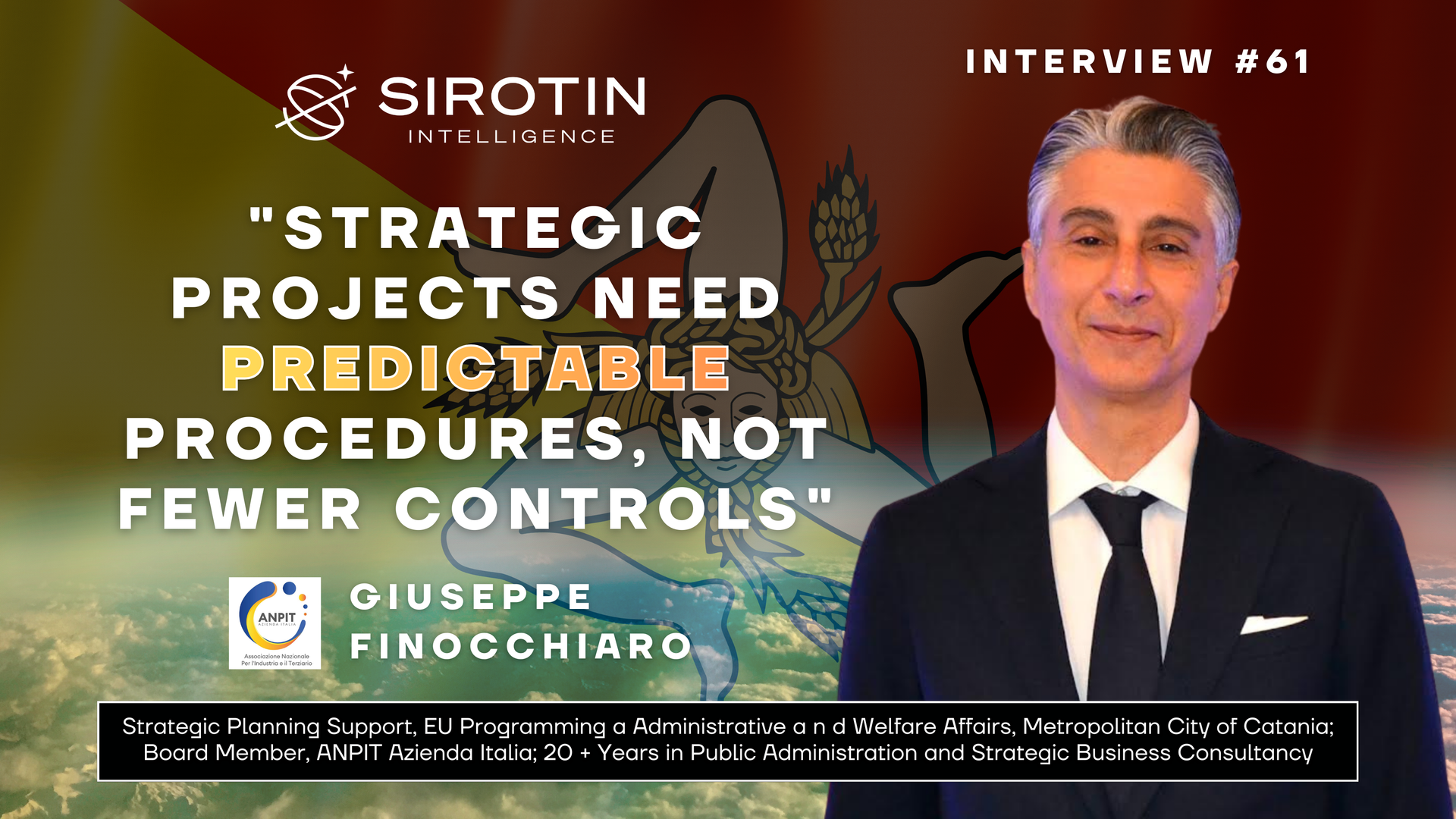
"Strategic Projects Need Predictable Procedures, Not Fewer Controls": ANPIT's Giuseppe Finocchiaro on Sicily's Space Potential, EU Funding Gaps, and Why Southern Italy's Mediterranean Position Could Reshape European Space Infrastructure

Sicily is closer to North Africa than to Milan. That fact tends to surface in conversations about logistics, migration, even cuisine. Less often does it come up in discussions about space infrastructure, though perhaps it should. The island sits equidistant from Gibraltar and the Suez Canal, at the crossroads of three continents, with southward trajectories over open water and orbital inclinations favorable to equatorial missions.
Italy has tested this geographic logic before. The Broglio Space Centre near Malindi, Kenya, conducted 9 satellite launches and approximately 20 orbital missions between 1967 and 1988. The Grottaglie Spaceport in Puglia is currently in discussions with Virgin Galactic for suborbital operations. Sicily's own Trapani-Milo base supported stratospheric balloon launches until 2010. The precedents exist.
Yet Southern Italy captures only a fraction of the €14.8 billion EU Space Programme funding through 2027. Why? And what would it take to change that?
Giuseppe Finocchiaro offers one perspective. Based in Catania, he has spent over two decades inside Italian public administration, working at the intersection of EU funding, regional development, and institutional coordination. As an Executive Board Member of ANPIT, the national association representing over 32,000 Italian companies, he observes how businesses across sectors navigate regulatory frameworks and funding mechanisms. At the Metropolitan City of Catania, he works on strategic planning and European programming. His vantage point is not aerospace engineering but something arguably more relevant to Sicily's space ambitions: the mechanics of how complex projects actually get approved, funded, and built.
You've spent over 20 years navigating Italian public administration. As Italy considers Sicily for potential space launch sites, what are the biggest bureaucratic obstacles? How do we cut through the red tape to make things actually happen?
"Based on my experience in public administration, one of the main challenges for complex projects such as space launch sites in Sicily is not the availability of technical expertise, but the inherent complexity of multi-level decision-making processes across different levels of government," Finocchiaro notes.
The issue, he explains, is structural rather than a matter of competence.
"Projects of this nature require coordination among state, regional, and local authorities, particularly in areas such as environmental impact assessments, infrastructure permitting, security considerations, and regulatory approvals. Each institutional level operates within its own legal mandates, timelines, and reporting frameworks, which, while essential for safeguarding public interests, benefit from effective coordination to provide greater predictability for all stakeholders.
"At the national level, strategic space initiatives are typically coordinated by the Italian Space Agency (ASI) through established ministerial channels. Examples include the IRIDE Earth observation initiative, funded through Italy's National Recovery and Resilience Plan, as well as Italy's participation in NASA's Artemis human spaceflight program, including work on the Multi-Purpose Habitation module. These programs illustrate how national agencies can rely on consolidated institutional frameworks to manage highly complex projects.
"By contrast, locally driven infrastructure proposals, such as those initiated at the municipal or regional level, often operate within the same regulatory environment but without access to equivalent centralized coordination mechanisms. This does not reflect a lack of capacity, but rather the structural challenge of navigating multi-level governance frameworks when responsibilities are distributed across institutions."
The solution he proposes may surprise those expecting calls for deregulation. Reform efforts should focus on improving procedural predictability and coordination rather than reducing essential controls.
"Effective reform involves harmonizing procedures across administrative levels to balance public safeguards with investment certainty. Potential measures include the establishment of a single coordination interface for strategic projects, the digitization and standardization of authorization processes, and the definition of clear and shared timelines among competent authorities.
"Environmental assessments, safety reviews, and community consultations remain fundamental components of responsible public decision-making. Challenges arise primarily when these processes advance in parallel without sufficient coordination, making it difficult for applicants to identify decision-making responsibilities or expected timelines. In this sense, procedural rationalization and predictability represent enabling conditions for complex projects, while preserving the integrity of public oversight."
The Coordination Problem
Through your work with ANPIT's network of companies, you see Sicily's business landscape. The island is perfectly positioned between Europe and Africa. How can Sicily leverage this location to become a space industry hub?
Finocchiaro's perspective here shifts from bureaucratic process to economic opportunity. Through his work with ANPIT – which represents over 32,000 Italian companies – he observes Sicily's productive base from a cross-sectoral vantage point.
"Through my work with ANPIT's network of companies, I have the opportunity to observe Sicily's business landscape from a cross-sectoral perspective, appreciating both its strategic geographic position and the diversity of its productive base. Situated between Europe, Africa, and the Middle East, Sicily is naturally positioned to support the development of space-enabled services and data-driven applications that can serve multiple markets, including communications, environmental monitoring, logistics, and infrastructure management."
ANPIT facilitates this cross-sectoral observation through structured networking initiatives. The association organizes two flagship annual events: Economica, held in Rome each October, brings together over 500 entrepreneurs, government ministers, economists, and journalists from Italy's leading media outlets to discuss macroeconomic trends, PNRR implementation, and institutional reforms. Apotheke, an itinerant training program recently hosted in Taormina, provides technical workshops on EU funding instruments, procurement processes, and operational compliance. Both serve as institutional bridges connecting private sector needs with public policy frameworks.
"Today, the space economy extends well beyond satellites and launch systems. It increasingly encompasses data analytics, software development, advanced manufacturing, and the integration of space-derived information into commercial and institutional applications. Within this evolving context, ANPIT contributes by facilitating access to relevant technical and regulatory information, fostering networking opportunities among enterprises, and promoting workshops and collaborative initiatives. These activities support companies in understanding broader market dynamics and in assessing how space-enabled data and technologies may complement their existing capabilities.”
“In practical terms, ANPIT promotes access to an ecosystem of services designed to help companies navigate EU, national, and PNRR funding opportunities. Through its Technical and Administrative Offices Departments, the association provides specialized assistance via the Sportello Bandi (Tender Desk) and Sportello Appalti (Public Procurement Desk), which monitor available funding in real time and offer operational support in project preparation. The goal is to streamline resource allocation to SMEs, ensuring effective access to non-repayable grants and competitive tenders."
This reframing matters. It suggests that Sicily need not compete for launch infrastructure to participate meaningfully in the space economy. The more accessible path may run through capabilities the region already possesses.
"Studies indicate that a substantial portion of Italy's space supply chain includes companies from adjacent sectors such as industrial metalworking, ICT, electronics, and automation. This demonstrates that competencies developed outside traditional aerospace can be effectively applied to space-related markets. For instance, a Sicilian engineering firm specializing in sensors, precision tooling, or automation could adapt its expertise to support ground segment equipment or data acquisition systems. Similarly, an ICT company could develop software solutions to process and interpret satellite-derived data for applications in agriculture, logistics, or environmental monitoring. This downstream specialization offers a realistic pathway for non-space companies to participate in the space economy without direct involvement in space vehicle hardware.
"The Copernicus programme provides a concrete example of how space data can generate economic and operational value. Projects such as ESA's Sen4CAP initiative, developed in collaboration with the European Commission, use Sentinel satellite imagery to monitor crop conditions, verify farmers' declarations, and support the implementation of the EU Common Agricultural Policy. Italy was among the six pilot countries for this program, and Sicily, with its climate-sensitive, high-value agricultural sectors including citrus, olives, vineyards, and wheat, stands to benefit directly from precision monitoring and data-driven decision-making enabled by these services.
"From a broader perspective, attracting investment and fostering sustainable growth requires the deliberate construction of integrated ecosystems, where prime contractors, innovative SMEs, research centers, and public administrations collaborate in a structured and complementary manner. Space applications are inherently cross-sectoral, spanning infrastructure resilience, telecommunications, Earth observation, and emergency management. By leveraging these collaborative dynamics and its geographic position, Sicily could evolve into a technological and services hub within the wider Mediterranean space economy, generating diversified opportunities based on space data and technologies while strengthening local industrial capacity and digital development."
The EU Space Programme provides €14.8 billion in funding through 2027, but Southern Italy captures only a small share. What factors contribute to this discrepancy when regional governments compete for space sector investments?
This question gets to the heart of why geographic advantage hasn't translated into funding success. Finocchiaro's answer is notably even-handed – he frames the challenge as systemic rather than unique to Southern Italy.
"Access to EU space funding depends on multiple complementary factors beyond resource availability. These include administrative coordination across governance levels, structured public-private partnerships, technical readiness, and the capacity to design projects that align with European strategic priorities. These requirements represent systemic challenges shared by many European regions seeking to compete in high-technology sectors.
"The €14.8 billion EU Space Programme supports strategic pillars such as Galileo and EGNOS navigation (€9.1 billion), Copernicus Earth observation (€5.42 billion), and space situational awareness and secure government communications (€442 million). These resources are primarily allocated through European Space Agency contracts and European Commission programmes, which operate according to specific technical requirements, governance frameworks, and competitive selection processes.
"At the same time, Italy benefits from €42.7 billion in EU Cohesion Policy funding for 2021–2027, with more than €30 billion earmarked for less-developed southern regions. This is complemented by the national Development and Cohesion Fund (FSC), which was initially allocated €73.5 billion for 2021-2030 (of which a significant portion remains available after PNRR-related reallocations, subject to ongoing programming decisions), with 80% legally earmarked for the Mezzogiorno under national legislation. These figures confirm that overall resource availability for Southern Italy is significant and represents a meaningful foundation for strategic investment."
The money exists. The question is absorption capacity.
"The challenge, common to many European regions seeking to enter or expand within high-technology sectors, lies in translating available resources into mature, technically validated projects that can compete within European frameworks." This requires several complementary elements: strategic alignment with EU priorities, structured public-private partnerships capable of combining public funding with private co-investment, administrative coordination across multiple governance levels, technical validation from research institutions, and workforce development plans that extend beyond the duration of public funding.
"Successful regions across Europe – whether in Northern, Southern, Eastern, or Western Europe – tend to present proposals that combine these elements effectively. Projects that perform well in competitive EU frameworks typically include concrete industrial commitments, research and innovation partnerships, clearly defined market pathways, and demonstrated operational continuity. In this context, EU resources function as catalysts that mobilize additional private and institutional capital, rather than as substitutes for it.
"For regions with emerging capabilities in high-technology sectors such as space, ongoing investment in administrative capacity, technical expertise, project design capabilities, and multilevel coordination represents an enabling condition for competitiveness. This applies equally to established industrial regions seeking to maintain their position and to territories developing new specializations. High-technology sectors reward long-term strategic vision, administrative continuity, and operational effectiveness – attributes that can be cultivated through sustained institutional commitment and targeted capacity-building measures.
"In the case of Southern Italy, the combination of significant available funding, strategic geographic positioning, diversified productive sectors, and growing research infrastructure provides a solid foundation. The opportunity lies in leveraging these assets through projects that demonstrate technical soundness, institutional commitment, and sustainable economic impact. Success in European space programmes ultimately depends not on the volume of funding available, but on the quality, strategic alignment, and operational readiness of the projects presented – criteria that are within reach for regions that approach these opportunities with clarity, coordination, and sustained institutional focus.
“The Metropolitan City of Catania offers one example. In recent years, the institution has achieved significant results in accessing and managing European and national funding for territorial development projects, securing substantial resources through various competitive programming instruments. This performance positions it among the more efficient entities in Southern Italy in terms of converting awarded funds into concrete spending commitments. Administrative reliability of this kind represents an essential prerequisite for attracting high-technology investments.”
The Money Exists
You have a background in agricultural sciences and technologies. Italy excels at Earth observation satellites for farming. How can we turn this research strength into profitable space companies?
Finocchiaro trained in agricultural sciences and technologies at the University of Catania before moving into public administration – a background that gives him an unusual perspective on how satellite data might actually reach end users.
"Italy is widely recognized at the European level for its excellence in Earth observation applications related to precision agriculture, environmental monitoring, and territorial management. This strength is the result of long-term public investment, scientific expertise, and industrial capability rather than isolated initiatives.
"National assets such as the COSMO-SkyMed radar constellation, developed by the Italian Space Agency (ASI), provide all-weather, day-and-night imaging capabilities that are particularly valuable for land-use monitoring, crop development analysis, and hydrogeological risk assessment. In parallel, the PRISMA hyperspectral satellite enables detailed observation of surface composition, allowing the detection of crop stress, soil characteristics, pollution levels, and resource use with a high degree of precision.
"This technological capacity is reinforced by industrial operators such as e-GEOS, which manages the Matera Space Centre, one of the core ground segments of the Copernicus programme. Through platforms such as AgriGeo, e-GEOSdelivers value-added services supporting agricultural monitoring, environmental analysis, and risk management. These examples demonstrate how space infrastructure can be translated into operational services serving both public administrations and private users."
The infrastructure exists. The challenge lies elsewhere.
"The central challenge, however, is not the availability of satellite data or research excellence, but the ability to transform research outputs into scalable industrial and commercial applications." Turning space assets into profitable companies requires making satellite data operational, embedding it into decision-making processes for farmers, agri-food enterprises, insurers, and public authorities, particularly in territories exposed to climate variability and hydrogeological risk.
"The AgroSat platform, developed within the Copernicus framework and often cited as a reference use case for agricultural services, clearly illustrates this gap. While the technical infrastructure and data streams are available, precision agriculture in Italy still covers only a limited share of cultivated land compared with Northern European countries. This highlights that the constraint lies not in space capability itself, but in the downstream systems needed to transform raw data into actionable intelligence for end users."
Finocchiaro makes this concrete:
"A vineyard operator, for example, does not require direct access to raw Sentinel-2 imagery; instead, they need timely assessments identifying water stress, vegetation vigor, or disease risk at the parcel level. Similarly, a citrus cooperative does not benefit from hyperspectral datasets in isolation, but from certified indicators that support sustainability compliance, traceability, and supply-chain transparency in line with EU requirements. Value creation occurs precisely at this translation stage, where scientific capability becomes a usable commercial service.
"The underlying principle is pragmatic: space becomes economically sustainable when it delivers solutions that integrate into the daily operations of businesses and public administrations. Italy's competitive advantage lies primarily in downstream services capable of converting orbital data into economic value. Sicily, given its agricultural diversity, exposure to Mediterranean climate dynamics, and established agri-food infrastructure, represents an effective environment in which to scale these applications and support the growth of space-enabled enterprises, without relying on the development of launch capabilities."
Finocchiaro's work extends beyond economic development. Sicily's position in the Mediterranean places it at the center of one of Europe's most complex coordination challenges: managing migration flows across multiple jurisdictions, agencies, and legal frameworks. This operational experience, he suggests, offers unexpected lessons for a different frontier.
From Orbit to Olive Grove
Sicily deals with complex immigration and integration challenges daily. As space activities grow internationally, what governance lessons from managing Mediterranean migration could apply to international space crews and eventual space settlements?
This question pivots from economics to governance – and Finocchiaro's answer draws on institutional experience rather than policy positions.
"Multilevel governance in complex transnational operational systems offers institutional lessons applicable to emerging international frameworks, including those being developed for space activities. When multiple actors, jurisdictions, and legal systems must coordinate under time-critical conditions, effectiveness depends less on centralized authority and more on structured cooperation, interoperability, and clearly defined institutional responsibilities.
"Maritime operations in transnational contexts provide a useful reference case. These operations typically involve national authorities, regional coordination bodies such as the European Border and Coast Guard Agency (Frontex), and international organizations including the International Organization for Migration (IOM). No single entity holds comprehensive authority. Instead, operational success relies on real-time information sharing, standardized procedures, burden-sharing arrangements, and mechanisms that enable institutions with different mandates to work within a common operational framework.
"Such environments demonstrate that in the absence of hierarchical control, structured coordination becomes the enabling condition for effective action. Roles must be clearly defined, legal accountability must be traceable, and decision-making protocols must be interoperable across jurisdictions. These are not theoretical principles but operational requirements that emerge from direct institutional experience in managing transnational systems where failures in coordination can have serious consequences.
"As international space activities expand, comparable governance challenges are becoming apparent. Multinational crews, orbital traffic management, public-private partnerships, and potential lunar or planetary installations will require coordination among sovereign states and commercial operators acting under different legal systems, technical standards, and strategic priorities. Sustainability in this context will depend on governance models that balance national sovereignty with international cooperation, and that provide predictable frameworks for liability, dispute resolution, and shared operational conduct.
"Existing space governance structures already reflect these principles. The ISS Intergovernmental Agreement, signed by the United States, Russia, Japan, Canada, and ESA member states, establishes binding rules on jurisdiction, liability allocation, intellectual property rights, and crew conduct. Similarly, the Artemis Accords extend cooperative governance concepts to future lunar exploration, emphasizing transparency, interoperability, and the peaceful use of space resources.
"The institutional lesson, therefore, is that in transnational systems – whether maritime, orbital, or planetary – effective governance depends on frameworks that enable coordination without requiring the subordination of sovereign actors to a single authority. This represents a governance model equally relevant to coordinated maritime operations and to the evolving regulation of international space activities."
From Mediterranean to Moon
Author's Analysis
A 2032 Scenario
The following scenario is provided by the editorial team to illustrate potential outcomes based on themes discussed in the interview. This section represents editorial interpretation only and does not constitute statements of intent, policy proposals, or institutional positions attributable to the interviewee.
By early 2032, a precision agriculture startup in Ragusa has processed its ten-thousandth vineyard assessment using Copernicus data. The company employs forty-seven people. Most graduated from the University of Catania around 2025, and few would have described themselves as entering the "space industry" at the time.
Similar stories have accumulated across the island, though they tend not to make aerospace headlines. A Palermo software firm that once built hotel booking systems now develops wildfire prediction algorithms for Mediterranean forestry agencies. An electronics manufacturer near Catania supplies ground segment components to three European satellite operators. A logistics company in Trapani coordinates North African agricultural exports using satellite-derived shipping intelligence. What connects them is downstream positioning; none required launch infrastructure to get started.
The shift, to the extent there was a single inflection point, came when regional authorities began focusing on a different question: not where rockets might launch, but what could be built with the data already available from orbit. Sicily's geographic position, often cited for its southward launch trajectories, turned out to matter more for market access. Positioned between European consumers and African producers, the island gradually became a node for Mediterranean data services.
The procedural reforms Finocchiaro described did eventually arrive, though later than optimists had hoped. A unified coordination interface for strategic projects reduced approval timelines from years to months. Digitized authorization processes made it easier for smaller companies to navigate regulatory requirements without dedicated compliance staff. In isolation, none of these changes seemed especially significant. Taken together, they shifted the calculus for companies deciding where to locate.
How large has the sector become? By 2032, Sicily's space-adjacent industries employ roughly 2,800 people directly and support perhaps twice that in related services. Annual revenue approaches €400 million, meaningful for the regional economy, though still a fraction of what Northern Italian aerospace clusters generate. The growth has been steady rather than spectacular.
What these numbers suggest is that regions can participate in the space economy without hosting launch sites. The value lies in translating orbital capability into services that integrate with existing industries, whether agriculture, logistics, or environmental monitoring. For a region with limited capital, fragmented administration, and distance from traditional aerospace centers, downstream specialization offered a more accessible entry point.
The vineyard startup in Ragusa is now negotiating with Tunisian agricultural cooperatives. Their satellite-derived assessments, refined over five years of Sicilian operations, transfer readily to North African terrain. The collaboration raises an interesting question: could Sicily's space economy eventually extend further into Mediterranean markets than its European neighbors anticipated?
Whether this trajectory continues depends on factors that remain uncertain. Institutional coordination across governance levels will need to hold. The pipeline of technical talent graduating from Sicilian universities will need to stay, or at least stay connected. And the market for space-derived services will need to mature in ways that reward local providers rather than consolidating around larger players elsewhere. None of these outcomes is guaranteed. But the foundation, at least, now exists.
Sicily's Space Economy
About Giuseppe Finocchiaro
Giuseppe Finocchiaro is an Executive Board Member of ANPIT (National Association for Industry and the Tertiary Sector), serving within the Active Policies Department, where he supports institutional relations and the management of projects and events. ANPIT operates in collaboration with the Ministry of Labour and Social Policies and represents over 32,000 Italian companies across multiple productive sectors. With national headquarters in Rome and Milan, ANPIT maintains independent governance and functions through a nationwide network of more than 100 offices, and also supports business internationalization.
Based in Catania, Italy, Giuseppe is a Public Administration Specialist with over 23 years of experience, providing strategic administrative and technical support within the Strategic Planning and European Programming Service of the Metropolitan City of Catania. With experience within the Mayor's Cabinet Office, he also carries out his professional activities in the Department of Administrative Affairs and Welfare, within the Service for Social and Labour Policies, Cultural Policies, and Tourism. His activities are carried out within the institutional administrative framework of the Metropolitan City of Catania, whose services and departments operate in accordance with national policy frameworks defined by the Italian Ministry of Labour and Social Policies, the Ministry of Culture, and the Ministry of Tourism.
He is the Metropolitan City of Catania's Liaison and Functional Coordinator for the Sicily Business Forum, an annual initiative developed with Plurimpresa, Performance Strategies, and ROI Group, bringing together regional and national businesses, institutions, and policymakers to discuss development, growth tools, and PNRR investments in Southern Italy. This institutional background was further enriched by his experience at the Sicilian Regional Government, within the Department of Tourism, Sport, and Entertainment. As a member of the organizational staff, he was responsible for coordinating major events and manifestations, as well as public relations, developing deep expertise in territorial promotion.
Previously engaged in roles involving Enterprise Risk & Compliance Management, Giuseppe now combines multidisciplinary expertise in institutional relations, stakeholder coordination, strategic communications, and territorial development, with a focus on facilitating public-private partnerships and supporting regional competitiveness initiatives. His work bridges technical knowledge of EU funding mechanisms with practical experience in project coordination and institutional communication, particularly in the context of space technologies and territorial protection.
Strategic projects require predictable procedures, not fewer controls. Giuseppe navigates administrative complexity with the aim of transforming bureaucratic constraints into opportunities for growth.
For more information about ANPIT, visit www.anpit.it
Get exclusive insights from our network of NASA veterans, DARPA program managers, and space industry pioneers. Weekly. No jargon.