
"We're Going to Disneyland. I Don't Care About the Car": October 24th, Rick Tumlinson's New Worlds Focuses on Why We Go, Not How

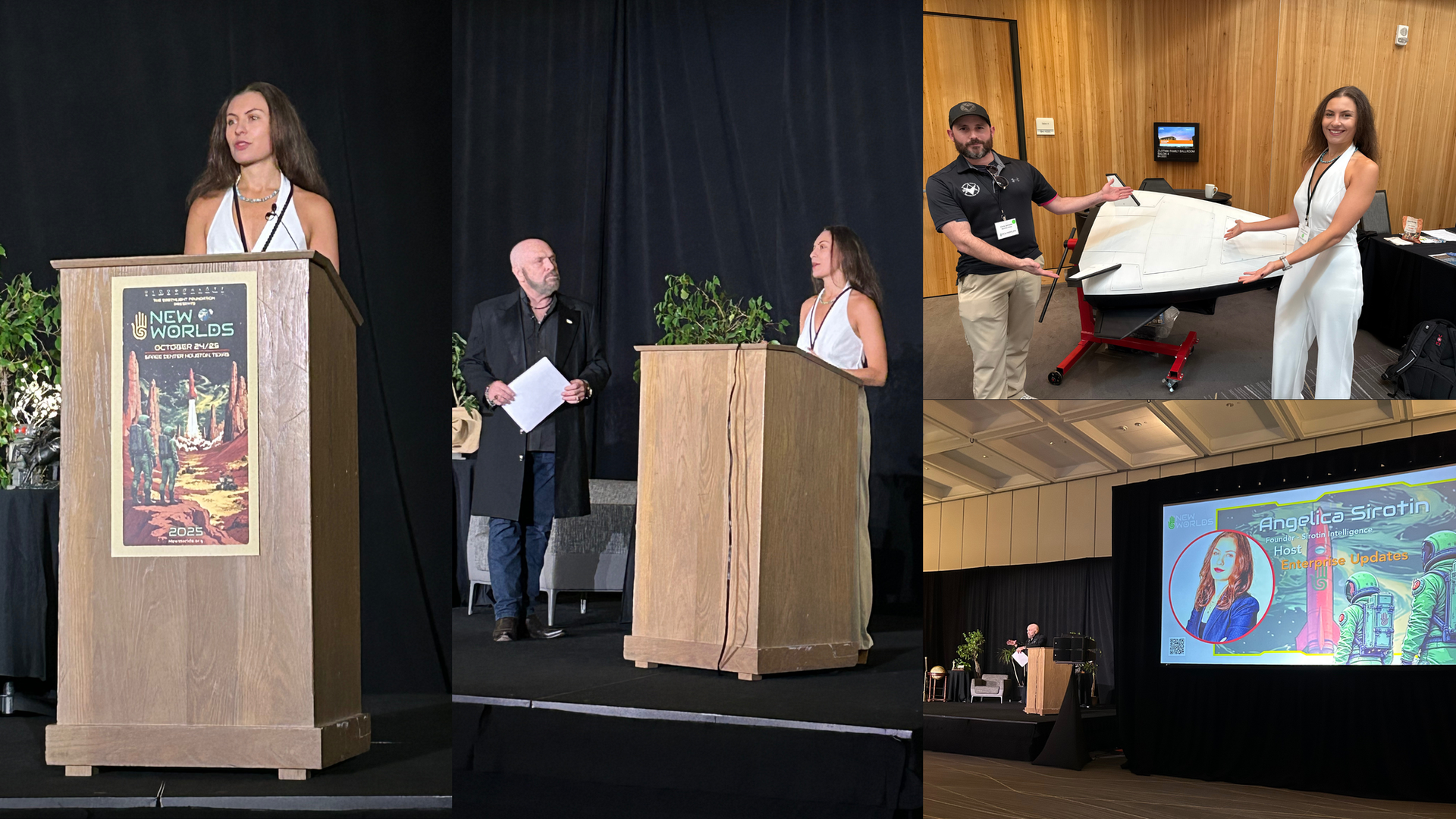
By Angelica Sirotin
The AT&T Hotel and Conference Center in Austin doesn't usually host consciousness researchers alongside rocket engineers. But Rick Tumlinson's New Worlds conference has never been usual.
Thursday morning, October 24th. Two hundred people gathered in a ballroom that normally hosts university fundraisers and corporate retreats. Except today, the PowerPoints would cover everything from diamond-cooled semiconductors to biomanufacturing human organs in zero gravity. The attendees? Former NASA engineers, venture capitalists hunting for the next SpaceX, artists who think settling Mars requires more than just life support systems, and at least three people working on classified propulsion systems they couldn't discuss over lunch.
This is Tumlinson's church, though he insists it's not a religion. Just faith in humanity's ability to become something more than "aspiring apes," as he'd tell us later.
Morning Session
The forum opened with Higher Prana presenting meditation technology. No rocket equations. No payload manifests. Just binaural beats and solfeggio frequencies while northern lights and starry cabins projected on screen. The company claims their psychedelic soundscapes change brain chemistry through guided meditation. Half the audience looked confused. The other half understood exactly why Tumlinson started here: because the biggest challenge to settling space isn't propulsion or life support. It's the human mind.
After the set change, Tumlinson took the stage wearing what he called his Willie Nelson hat. He brought out three co-chairs who represented the conference's range:
- Kimberly Washington runs Deep Space Biology, using AI to standardize 25 years of NASA microgravity research. Her Yotta platform transforms space experiments into medical breakthroughs for Mayo Clinic and MD Anderson. She also founded Space4Girls, getting young women into STEM before traditional barriers form.
- Dr. Phil Metzger directs UCF's Stephen W. Hawking Center for Microgravity Research and Education. Former NASA KSC Swamp Works co-founder who spent decades studying how rocket exhaust interacts with lunar regolith. NASA named asteroid 36329 Philmetzger after him. The kind of engineer who does the unglamorous work that determines whether anything else matters.
- Dr. Joel Mozer served as the first Chief Scientist of the U.S. Space Force after 28 years in uniform. Now VP of National Security Solutions at Argo Space. In 2021, he publicly stated human augmentation was "imperative" to keep up with strategic competitors. The kind of statement that gets you invited to certain meetings and disinvited from others.
Tumlinson's keynote reframed space as humanity's breakout moment: "Within the next year or so, the first rocket ship will go into space. A thousand years from now, our progeny (if we make it) will look back at this moment as being as important as railroads, airplanes, and steamships. All of them together. Because this is the breakout."
He said we're still lost and confused as a species. "But something in us always drives us forward, up. We don't know what that is." Then he cut through the usual industry fixations: "I don't care if it's communist ferries with magic—that's just the transportation system. We get hooked on that. We're going to Disneyland. I don't care about the car that takes me there."
Company Presentations Throughout the Day
As MC, Angelica SIROTIN introduced several companies presenting their enterprise updates:
- Akash Systems - Felix Ejeckam's Oakland startup discovered synthetic diamond conducts heat five times better than copper. After years developing the technology for satellites, they pivoted to cooling AI chips. Vinod Khosla and Peter Thiel wrote checks. The CHIPS Act added $68 million. Their GaN-on-Diamond radios launched with Pixxel in January, delivering 5-10x faster data rates. Now they're converting a West Oakland warehouse into a semiconductor plant. Four hundred jobs. One hundred percent renewable power by 2030. From space radios that don't overheat to GPUs that don't throttle.
- Space Teams PRO - Gregory Chamitoff spent 198 days in space, performed the last spacewalk of the Shuttle era, then became a professor at Texas A&M. His program turns space missions into multiplayer video games for students. NASA funds it through Space Grant awards. Over 100 sites across three states use his SpaceCRAFT platform, a VR simulation of the entire solar system with accurate physics. Students design spacecraft, navigate to planets, build habitats. The next generation learning space exploration like they learned Minecraft.
- Ambrosia Space - Mario Maggio worked on the IM-1 Lunar Lander and spacecraft life support before founding this Houston biomanufacturing company. His team includes Susan Gomez (30 years at NASA managing ISS systems) and Victoria (two decades advancing microbial safety in spaceflight). They're building bioreactors for zero gravity, processing large volumes of cell culture where normal Earth biology doesn't apply. NASA's TechLeap Prize recognized them as winners. The pitch: make better pharmaceuticals in microgravity today, enable Mars settlements tomorrow.
- Phantom Space - Jim Cantrell helped Elon Musk start SpaceX after the Russians laughed them out of meetings about buying ICBMs. His first company, Vector, went bankrupt. Now he's back with Phantom, building the Daytona rocket using Ursa Major engines instead of developing his own. Calls it the "Henry Ford approach" to space. Already has $100 million in pre-sold launches and a $300 million NASA task order. The rocket hasn't flown yet. Target: hundreds of launches per year starting 2025.
- Trans Astra - Joel Sercel spent 14 years at JPL where he conceived the NSTAR ion propulsion system used on NASA's Dawn spacecraft. He's received more NASA Innovative Advanced Concepts (NIAC) funding than anyone else. His company focuses on asteroid mining and orbital logistics. The plan: harvest water from asteroids for rocket fuel. Trans Astra's optical mining technology uses concentrated sunlight to extract materials from space rocks. They have agreements with Blue Origin to sell water in space. Sercel holds 22 patents, including the Omnivore Thruster and Sun Flower Power Tower. NASA even named asteroid 46308 after him.
- OrbitsEdge - Richard Ward, former Marine and Deep Space Industries veteran, wants to put data centers in orbit. His Florida company builds radiation-hardened micro data centers for satellites. The logic: process the massive amounts of Earth observation data in space before sending it down. HPE servers tested on the ISS will go into OrbitsEdge's SatFrame modules. Their first mission next spring includes an AI shoe designer from Syntilay (backed by Reebok's co-founder) that will create the first footwear designed off-planet. Ward calls it "above the clouds" computing. Thirty satellites planned, each one basically an edge data center floating in space.
Several other panels presented throughout the afternoon. Each bringing their piece of the settlement puzzle. Diamond cooling. Virtual training. Biomanufacturing. Mass production. Asteroid mining. Orbital data centers. The technologies themselves matter less than what they represent: every discipline converging on the same goal.
Later Talks
Bryan Talebi opened with a history lesson: Manhattan's horse manure crisis of the 1890s. Fifty thousand horses producing tons of waste daily. Sixty-foot tall piles. Armies of workers shoveling constantly. People proposing biological agents to make manure less attractive to flies. The solution came from nowhere they expected: the Model T. By 1912, Manhattan had more cars than horses. Technology solved what incremental improvements couldn't.
Talebi is the CEO and Co-Founder of Ahura AI, a company that has developed technology enabling people to learn 3-5x faster than traditional education. A former NASA engineer who worked at Goddard Space Flight Center at age 16, he later helped companies like ZocDoc achieve unicorn status. His company partners with Harvard and enterprise clients including Apple, while providing free licenses to underserved communities globally - from African nations to refugee camps in Syria, Turkey, and Norway.
"The biggest challenges we face as humanity will likewise be solved by technological processes," Talebi said. "We're at this turning point with both AI and spaceflight." He framed the next three years as defining the next 200—not as Republicans or Democrats, but as Americans ensuring the values of freedom and liberty percolate outward rather than being displaced by communism and control.
Talebi mapped out the infrastructure needs: transportation solved by SpaceX and others. Robots building infrastructure before humans arrive. AI controlling those robots because Mars communication delays make manual control impossible—20 minutes one way, 45 minutes round trip. Data centers in space. Entertainment districts. Tourism. Production facilities for Helium-3, critical for quantum computing and fusion, which China plans to fence off by 2029. Solar panels beaming energy to space stations. "This is the kind of opportunity that defines the future, defines America, defines the culture we'll be living in."
Frank White brought a different perspective, building on an AI demonstration from two years prior where Sophia the robot had shown unexpected synthesis capabilities during an on-stage conversation with Tumlinson. White is a space philosopher and author whose book "The Overview Effect: Space Exploration and Human Evolution" (first published in 1987) is considered a seminal work in the field. A magna cum laude graduate of Harvard College, Phi Beta Kappa member, and Rhodes Scholar who earned his M.Phil. in Politics from Oxford University, White coined the term "overview effect" to describe the cognitive shift astronauts experience when viewing Earth from space. A film based on his work has had over 8 million plays on Vimeo.
White described his new Turing test: Can an AI experience the Overview Effect? He's been experimenting. GPT-5 created its own protocol for experiencing it—analyzing its language for planetary versus political concepts, immersing itself in astronaut interviews, then comparing its transformed state. Now it approaches every conversation from an orbital perspective. "If AIs can be trained to have values derived from the Overview Effect, that can only be a good thing," White said. "We should see them as our children and take responsibility for giving them good values."
Tumlinson's conference draws the people who understand space isn't just an engineering problem. It's a human problem. And solving it requires consciousness researchers in the same room as rocket scientists, artists alongside engineers, all of them believers in humanity's next chapter.
Get exclusive insights from our network of NASA veterans, DARPA program managers, and space industry pioneers. Weekly. No jargon.