
“There’s No Single License For Doing Things in Space”: Prometheus Nominee Science Fiction Author and Former FAA Space Lawyer Laura Montgomery on Property Rights Beyond Earth, Colony Governance, and Why You Don't Need a License to Bake a Cake on the Moon

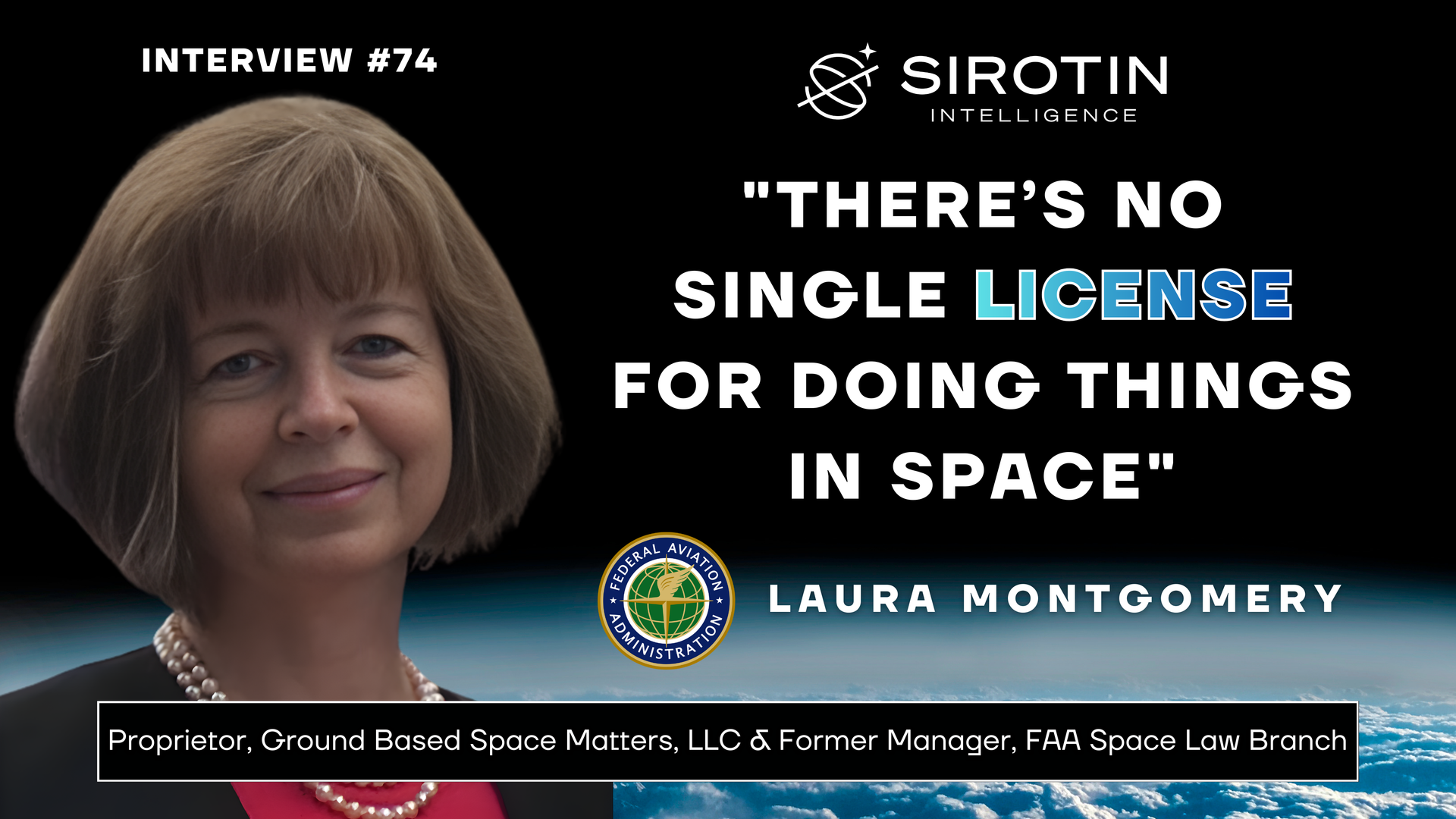
In one of Laura Montgomery's short stories, aliens arrive on Earth. The protagonist, a space lawyer who works for the FAA, has a problem. The Commercial Space Launch Act covers launch and reentry. But the aliens did not launch from Earth. They are coming in, not coming back. Does the FAA have jurisdiction? Does anyone?
It is the kind of question that sounds like a joke until you realize that the person writing it spent more than twenty years as the actual FAA space lawyer, drafting the actual regulations, and that the legal ambiguity she is playing with in fiction is not that far from the ambiguities she dealt with every day on the job.
She believes she got that job, in part, because of a moon rock. After her interview at the FAA, she walked over to the National Air and Space Museum and touched the lunar sample on display for good luck. "It was the greatest job in the world," she says, "until I met the general counsel for one of the asteroid mining companies. All right, I said, you win."
For over two decades, she served in the FAA's Office of the Chief Counsel as an attorney and then manager of the Space Law Branch. She drafted regulations, reviewed licenses, wrote legislative proposals, and handled enforcement issues. Her rulemakings touched human spaceflight, explosive siting, launch site licensing, lightning protection, and financial responsibility. She represented the FAA at the United Nations Committee on the Peaceful Uses of Outer Space, chaired an interagency working group on space property rights at the request of the White House Office of Science and Technology Policy, and testified before Congress on the FAA's interpretation of the Commercial Space Launch Act. One of her more memorable projects was licensing Sea Launch, a multinational venture that used Russian and Ukrainian rocket technology, Boeing's money, and a retrofitted oil platform that sailed through the Panama Canal to launch from the equator. "I had some folks from there say they didn't know how complicated this was going to be."
In 2016, Montgomery left the FAA to "hang out my shingle," as she puts it, starting Ground Based Space Matters, LLC, where she advises commercial space companies on regulatory compliance and writes about space law with the kind of detail that comes from having drafted the rules herself. She also writes science fiction. One of her favorite childhood authors, John Varley, once broke her heart by writing a novel that mentioned FAA air traffic control but completely ignored the space office. "That was who I worked with," she says, still a little wounded by it.
On the academic side, her published work includes a widely cited paper for the Mercatus Center arguing that U.S. regulators may not block private space activity on the basis of Article VI of the Outer Space Treaty. She contributed a chapter on interstellar colony governance to the academic volume Interstellar Travel: Purpose and Motivations, and taught as an adjunct professor of space law at Catholic University's Columbus School of Law from 2018 to 2023.
We spoke about what she would change in the regulations she helped write, why the legal distinction between granting and recognizing property rights matters more than most people think, what happens when a company wants to do something in space that no regulator has authority over, how science fiction and space law feed each other in directions neither field expects, and whether the era of big multilateral space treaties is finished.
After two decades as the FAA's space lawyer, is there a regulation you helped create that you would go back and rewrite, knowing what you know now?
Before the FAA, Montgomery practiced administrative law, the branch of legal work concerned with how federal agencies make and enforce rules. She worked before the FCC and the Department of Labor, learning the procedural rules that apply whenever an agency issues a regulation or grants a license. The Administrative Procedure Act requires notice-and-comment rulemaking, and the basic principles are similar whether you are regulating broadcast spectrum or rocket launches. That background carried over directly to the space office.
Asked what she would change, Montgomery does not hesitate. The first target is the FAA's payload review process. This is how the FAA looks at what a licensed rocket is carrying into orbit. Montgomery's worry is that the process has been read, by some, as a broader license for the FAA to regulate anything that happens in space, which is not what Congress set up. "I would change the payload review process to make it obvious that it's not a license for the FAA to regulate everything in space," she says. "There's still confusion about that."
The second gets into the kind of regulatory logic that Montgomery clearly finds maddening. The Commercial Space Launch Act says the U.S. government shall be responsible for harm to its own employees during launches. But in the 1990s, the FAA decided, through what Montgomery describes as "a lot of convoluted logic," that Congress could not have really meant that, and pushed the insurance cost onto launch operators instead. Montgomery considers this a plain misreading. "When Congress passes a law, the FAA is supposed to do what Congress says." An aerospace advisory rulemaking committee later recommended the FAA fix this. Whether the agency follows through is an open question.
With lunar mining becoming a real prospect, how does the legal distinction between granting and recognizing property rights in space actually work?
The legal framework for space resource extraction is further along than most people realize. "There's plenty of law to go around," Montgomery says, and she walks through it with the patience of someone who has explained this to audiences ranging from policy experts to science fiction conventions.
In 2015, Congress passed the U.S. Commercial Space Launch Competitiveness Act, which included a provision saying that if an American company goes to the Moon or an asteroid and extracts resources, those resources belong to that company. The language was careful. Congress did not claim sovereignty over any celestial body, which claim would have violated the Outer Space Treaty. Instead, it recognized property rights in what was taken out of the ground, the same legal logic that gives a fisherman ownership of the fish he pulls from the sea.
Montgomery is precise about the distinction, and she thinks it matters. "Under the US system, rights inhere in individuals. They are not given to you by a king." The government does not hand you the right to own what you mined. It recognizes a right you already have. Several countries followed suit after the 2015 law, including the United Arab Emirates, Luxembourg, and Japan. Luxembourg, Montgomery notes, was the first to follow the U.S. lead, and has been quietly aggressive on the space front.
Enforcement is the question that comes up every time. Montgomery is not worried, at least not for a while. "For the next 50 years, anyone doing anything in space is going to have its headquarters here on Earth," she says. "If Company X does something rotten, it can have its assets seized here on the ground." She has read all the Wild West scenarios and written some of them. But the reality is simpler. Companies are incorporated somewhere. Courts have reach. Even Title 18 of the United States Code, the federal criminal code, extends to outer space for crimes involving Americans. Someone asked her recently about what happens if there is a murder on the Moon. "There's laws for that too." She is aware of how this sounds compared to the genre she loves. "I read a lot of science fiction and watch all the science fiction movies, and it always looks wild and crazy out there. But that is not the situation now," she says, "and it's not going to be like that for 50 years, at least."
The next frontier, in her view, is land itself. Recognizing property rights in extracted resources was a start, but the harder question is the ground underneath. Montgomery is working on a paper that looks at whether adverse possession, of which squatter's rights is a variant, could apply to sustained habitation and development on the Moon. "These principles have been around for millennia," she says. "I think they would work well in outer space." If a company has been on a site long enough and invested enough, at what point does the law say the land belongs to it? The answer could shape the economics of lunar development for decades. The paper is currently in review.
If a company wants to do something in space that no regulator has authority over, like debris removal or in-orbit manufacturing, what actually happens?
This is where Montgomery's legal precision becomes most useful, because the answer is not what most people expect.
The United States splits commercial space regulation across three agencies. The FCC handles telecommunications satellites and radio frequencies. NOAA handles remote sensing, meaning if you are taking pictures of Earth from orbit, you need a NOAA license. The FAA handles launch, reentry, and the operation of launch and reentry sites. It does not have authority on orbit, though it has what Montgomery calls "this funky little thing called a payload review" that lets it look at what you are planning to do before you go.
She frames the setup with a comparison that clears away a lot of the confusion. "A lot of people think there should be one license for doing things in space. Well, there's no single license for doing things on Earth." If you want to open a restaurant, you need health permits, zoning approval, a fire inspection, a liquor license if you serve drinks. Space is the same idea. Different activities, different agencies.
But what if the activity does not have a corresponding license at all? This is where Montgomery's Mercatus Center paper comes in. Article VI of the Outer Space Treaty says countries must "authorize and supervise" the activities of their nationals in space. Many people read that to mean: if there is no license for your activity, you cannot do it until someone creates one. Montgomery thinks that reading is wrong.
The argument turns on a technical but important point in U.S. law: whether a treaty provision is self-executing. A self-executing provision takes effect the moment a treaty is ratified. A non-self-executing provision needs Congress to pass a law first before it means anything domestically. Montgomery argues, backed by testimony from the original treaty negotiator, that Article VI is not self-executing. Congress has told the FAA, FCC, and NOAA to regulate specific space activities through specific laws. But Congress has never created a debris-removal license or an in-orbit manufacturing license. Under U.S. law, that means you do not need one.
"If you're a US company that wants to bake a cake on the Moon, and there's no space cake license, you don't need to stand down," she says. "You can go and do it."
In practice, a debris-removal company would still go through the FAA's payload review for the launch, and would likely need an FCC license for communications and a NOAA license for any onboard cameras. Montgomery also flags that the FAA has started doing safety reviews during the payload review process that may go beyond what Congress actually gave it authority to do, since the statute only grants the agency safety jurisdiction over launch and reentry. Her advice to clients is practical: answer the questions if you want to, but say in writing that you are doing so voluntarily. "Preserve the issue for taking the FAA to court later on if you have to."
You are also a science fiction author. What draws you to writing fiction alongside practicing law, and does one ever inform the other?
Montgomery's path to science fiction started in Thailand. Her family lived there for about seven years, and the local Air Force base donated its surplus books to the missionary school she attended in the north. That is where she first picked up Robert Heinlein's The Moon Is a Harsh Mistress. "I jumped from being a horse-crazy little girl to being a science fiction-crazy girl," she says.
She tried writing in her late teens and twenties, came back to it later, and now has several novels and short stories out. The relationship between her legal career and her fiction runs mostly in one direction: the law feeds the fiction more than the other way around.
Consider Manx Prize, her novel about a competition to deorbit dead satellites, modeled on real space prizes like the Ansari X Prize that SpaceShipOne won in 2004. The plot turns on a legal fact: you cannot just grab someone else's dead satellite, even if it is junk, because it is still their property. The regulatory scaffolding of the whole story comes from the world she worked in for two decades.
The short fiction gets even more specific. The alien-reentry story, Rapunzel, I mentioned at the top features a space lawyer at the FAA trying to figure out what to do when the existing statute does not account for arrivals who never left. Another story, Took their Wages, about paying interstellar employees across relativistic time compression, required her to look up the Office of Personnel Management's guidance on how federal compensation works. "I personally am not a fan of daylight savings time," she says, as if that explains the impulse to write a story about time-dilation payroll.
Then there is Planting Life. It is about terraforming, but its scientific foundation came from gardening. A newsletter from an entomologist at the University of Delaware introduced her to the research on native plant-insect co-evolution, and Montgomery wondered whether it might give her a workable theory of terraforming. "Boy, did it ever." Roughly 90 percent of insect species can only eat the specific plant they evolved alongside. Send Brazilian plants and North American butterflies to Mars, and the ecosystem falls apart. "The jigsaw puzzle has to have all the right pieces," she says. "You have to send the Mid-Atlantic suite of plants and microbes and insects." The theory of terraforming in the novel grew out of that. Montgomery talks about her own yard with the zeal of a native plant convert. "I am an alien invader myself in my novels," she says, "but now I'm on the home team."
She is currently working on a sequel to Planting Life. It involves submarines. She did not elaborate.
Your science fiction explores colonies that lose their governance structures. Has writing those stories ever changed your mind about a real policy position?
Montgomery's space opera series follows a lost starship carrying 30,000 colonists in cold sleep that lands on a barely habitable planet. Cut off from Earth with no rescue coming, the survivors do what humans tend to do: they let a strong man take over. The result is a feudal structure that Montgomery clearly has no patience for. "Human nature likes a strong man," she says. "I'm not a fan of kings, and I like electricity, and it goes poorly if you take that approach." Still, she leaves room for something better. "There's still hope. The good guys get to do a good thing."
When I asked whether writing those scenarios had changed any of her actual policy views, she was straightforward. The influence goes the other direction. "Science fiction is where I can sort of play out, in a sublimated way, my own thinking," she says.
That thinking, as it applies to real regulatory questions, centers on concentrated authority. "I like the American structure with its checks and balances," she says, but she believes Congress hands executive agencies mandates that are too broad, telling them to regulate "consistent with public health and safety" and then adding feel-good language about keeping regulations minimal. "That gives the executive branch a whole lot of leeway," she says. "Congress should not extend as broad a mandate as they do." She doubts the aviation industry would describe its regulatory environment as minimal.
That concern about concentrated authority runs deeper in her thinking than regulatory policy. Montgomery points to the work of Charles Cockell, an astrobiologist and professor at the University of Edinburgh who studies how technology can be designed to prevent authoritarian control in off-world habitats. The problem is easy to state. "Whoever is in charge could just cut off the air to some dissenter while he's sleeping," Montgomery says. "Never mind shooting in the public square." In a sealed environment, you do not even need a weapon. Cockell's research looks at decentralizing life-support and other critical systems so that no single person or group can hold that kind of leverage.
Montgomery finds his work compelling, though she is realistic about human nature. "If you read other science fiction books, people will still sell their rights because it's convenient or necessary in the moment." She engaged with Cockell's framework at length in her chapter for the academic volume Interstellar Travel: Purpose and Motivations.
As someone who has been in the room for UN space law negotiations, are big multilateral space treaties a thing of the past?
Montgomery does not think the treaty era is dead, but she does not see a new Outer Space Treaty coming any time soon either. What she does see is the existing framework holding up and being followed.
The Artemis Accords, the partnership framework for nations returning to the Moon, drew early criticism for supposedly going around the Outer Space Treaty. Montgomery does not buy that reading. "The Outer Space Treaty is a big, vague, general statement of good principles, and the Artemis Accords put just a little bit more flesh on those bones." The Accords are consistent with the Treaty, not a workaround.
There is a subtler argument she wants to address, though. Some scholars have suggested that the Outer Space Treaty has become customary international law, a distinction that matters because customary law binds every nation, not just the ones that signed. Her objection is two-fold. First, the Treaty is a treaty, and treaties work through consent. Second, there is simply not enough activity on the Moon yet to create the kind of state practice that customary norms emerge from. "We do not have rovers roaming the Moon in large numbers, or people mining," she says. "There hasn't been room to see what kind of practice will be exercised or what the precedent is."
On whether the U.S. has any appetite for big new multilateral space agreements, she is direct. "Probably not anytime soon." There is no interest in Washington in reopening the Outer Space Treaty. What she sees instead is countries putting the Treaty's broad principles into action through their own domestic laws, bilateral deals, and frameworks like the Artemis Accords. The law is moving forward, just not through grand new instruments. "We're still trying to catch up with the ones we've got."
The trend she most wants to see is progress on recognizing property rights in land, not just extracted resources. That, in her view, would give commercial companies the certainty they need to plan long-term investments on the Moon and beyond. "Figure out how to ensure property rights in land, and that would encourage investment, certainty, and the ability of commercial enterprises to plan for the future."
Author's Analysis
"Habitat Seven, this is the council. We're showing a pressure drop in your west module. Can you confirm?"
Silence.
"Habitat Seven, please respond."
"Council, this is Habitat Seven. We're fine. Director Vasquez already sent a crew. He says the west module is under his maintenance authority now. He says you don't need to worry about it."
"Under whose authorization?"
A longer silence this time. Then: "His."
That exchange is my fiction. But the scenario underneath it is not far from what Laura Montgomery has been writing about for years, and it maps with uncomfortable precision onto the research Charles Cockell has been conducting at the University of Edinburgh. What makes this more than a thought experiment is that the legal habits forming right now, on Earth, in conference rooms and Congressional hearings and FAA rulemaking dockets, are the ones that will travel with us. Montgomery spent twenty years working to make sure that agencies stay inside the authority Congress gave them. That the text of a statute means what it says. That regulatory overreach, even the well-intentioned kind, sets precedents that are hard to walk back. In her Martha’s Sons and Waking Late novels, she plays out what happens when those habits erode, when the rules are vague, the enforcers are light-years away, and the person with the most practical power simply acts.
The space economy is early enough that the choices being made now will shape what comes after. The 2015 law recognized property rights in extracted resources. Montgomery suggests extending that principle to land. The Artemis Accords are putting flesh on the bones of a treaty written before anyone had walked on the Moon. Somewhere, an engineer is designing a life-support system for a habitat that does not exist yet, and the question of whether that system has a single point of control or a distributed architecture may matter more than any law Congress passes.
So here is what I keep thinking about after this conversation. If Montgomery is right that human nature likes the strong man, and if Cockell is right that the design of physical infrastructure is the last line of defense against that impulse, then who is making sure those two insights end up in the same room? Are the engineers building habitats talking to the lawyers drafting governance charters? Are the people writing property rights frameworks for the Moon thinking about what happens when the settlement is old enough to have its own politics, its own factions, its own version of a logistics officer who decides that the west module is under his authority now? And if the answer is that nobody is coordinating those conversations yet, at what point does that stop being an oversight and start being a risk?
About Laura Montgomery
Laura Montgomery is the proprietor of Ground Based Space Matters, LLC, where she specializes in regulatory space law with an emphasis on commercial space transportation and the Outer Space Treaties. She spent more than two decades with the Federal Aviation Administration, serving as manager of the Space Law Branch in the FAA's Office of the Chief Counsel and as the agency's Senior Attorney for Commercial Space Transportation. Her work included legal interpretations, regulatory development, legislative proposals, licensing reviews, and representation of the FAA at the United Nations Committee on the Peaceful Uses of Outer Space. She chaired an interagency working group on space property rights at the request of the White House Office of Science and Technology Policy and testified before Congress on the FAA's interpretation of the Commercial Space Launch Act. She taught as an adjunct professor of space law at Catholic University's Columbus School of Law from 2018 to 2023. She received her J.D. from the University of Pennsylvania and her undergraduate degree with honors from the University of Virginia. She blogs at GroundBasedSpaceMatters.com and writes science fiction.
Further Reading and Resources
Selected Publications and Papers:
- Selected Publications and Papers:
- "US Regulators May Not Prevent Private Space Activity on the Basis of Article VI of the Outer Space Treaty"(Mercatus Center, George Mason University)
Science Fiction:
- Manx Prize — space debris removal competition
- Planting Life — near-future terraforming
- Martha’s Sons and Waking Late series–governance issues in space opera
- Full catalog available on Amazon
Blog:
Related:
- Outer Space Treaty (1967)
- Commercial Space Launch Act
- NASA Artemis Accords
- Charles Cockell, University of Edinburgh — research on governance and tyranny prevention in off-world habitats
- "Questions of Governance for an Interstellar Colony," chapter in Interstellar Travel: Purpose and Motivations(Elsevier, 2024)
Get exclusive insights from our network of NASA veterans, DARPA program managers, and space industry pioneers. Weekly. No jargon.