
"They're Explorers, Even If They Do No Science": Former ESA Communications Lead and NATO DIANA Mentor Anna Ambroszkiewicz on the Economics of Dual-Use, the IGNIS Mission Behind the Scenes, and Poland's Rise in European Space

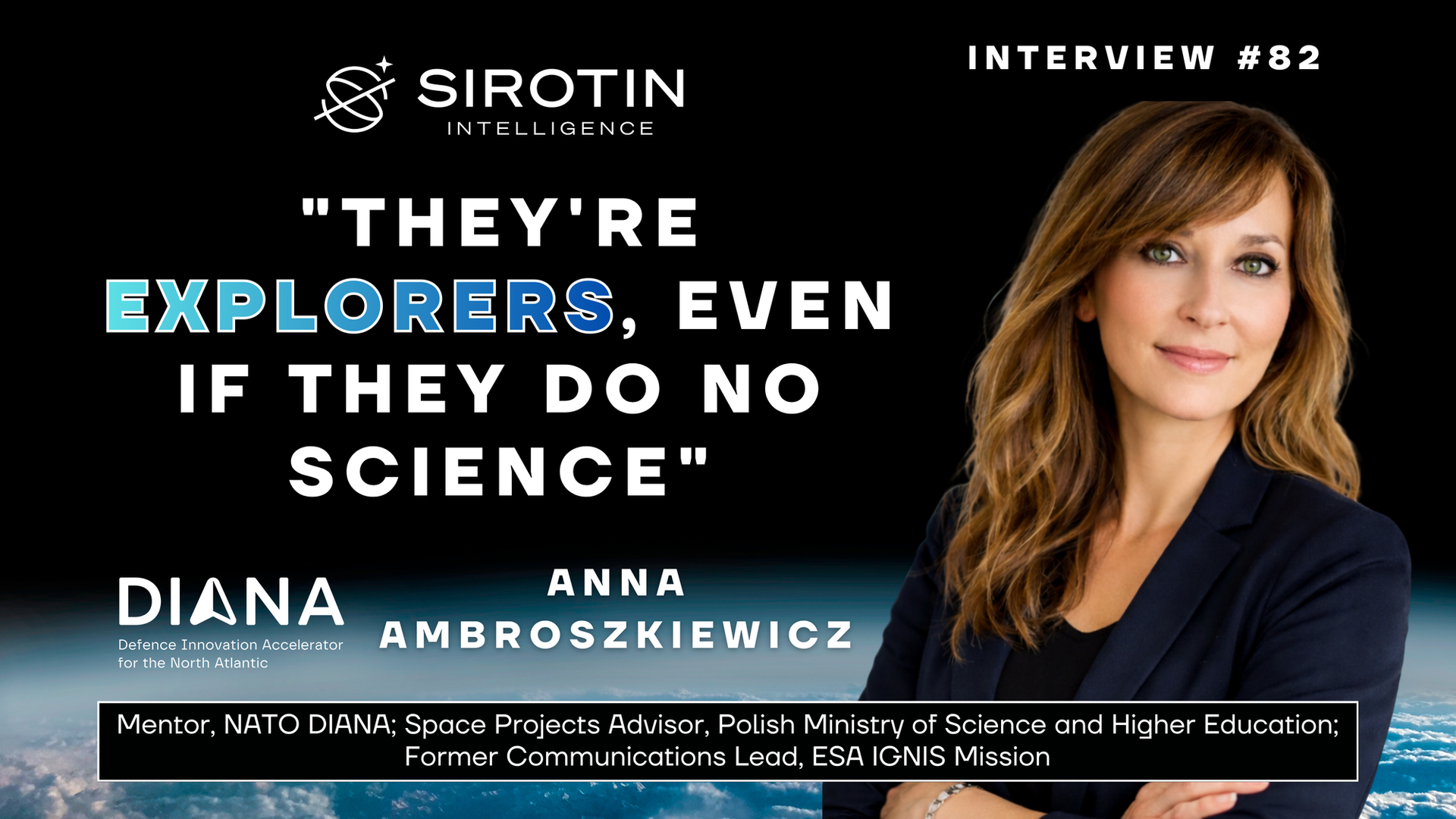
The thing most people picture when they think about a space mission is the moment the rocket leaves the pad. The part Anna Ambroszkiewicz spent two years living inside looked almost nothing like that. It involved procurement timelines, stakeholder maps with five or six institutions on them, and a launch date that kept moving for the better part of a year before it finally held.
She came to all of it without an engineering degree or a childhood dream of going to orbit, which turns out to be a useful vantage point for the work she now does. At the European Space Agency she led communications for IGNIS, Poland's first astronaut mission in more than 40 years. She mentors defense and dual-use startups through NATO DIANA, and she advises Poland's Ministry of Science and Higher Education on space projects. Before any of that, she spent more than a decade moving high-tech projects from idea to market, including co-founding a venture-backed startup of her own.
Her career sits at the point where ambitious ideas meet the institutions that fund, regulate, and eventually buy them. That is a useful place to understand what is happening in European space right now, and where Poland in particular is trying to go. We spoke about how she got here, what founders underestimate when they start selling to governments, what IGNIS looked like from behind the communications desk, and one phrase she would retire from the industry's vocabulary if she could.
Tell me your story. What pulled you into space, and was there a particular moment where the shift really happened for you?
Anna answers this one with a small caveat, because her route in does not follow the usual script. "I'm a bit of an unusual case," she says. "As a child I wasn't particularly drawn to space. I didn't dream of becoming an astronaut, the way many of my colleagues did." What she did have, from early on, was a wide curiosity about the world. As soon as she could, she started traveling. She liked meeting new people, seeing new places, and trying things she had not tried before.
That same instinct pulled her toward new technologies, which is where she spent the first part of her career. She co-founded a startup and worked at an IT company building new tools, always on the business side rather than the technical one. The work that interested her was getting something new in front of the people who might use it, and that interest has stayed consistent across every role since.
Space arrived through her brother, who had the genuine fascination she lacked. As a student he helped build a satellite at his university, then went to work at ESA. "It became contagious," she says. Through him she started moving into the space world, and when ESA was looking for someone with her profile, she took the opening. She is candid that the absence of a technical background has been an asset more often than a limitation. An engineer deep in a single propulsion concept can lose sight of the market and the audience around it, and the work she does depends on keeping both in view.
Dual-use is a very different game from a normal startup environment. What do founders usually underestimate when they first start working with governments or defense stakeholders?
The honest answer, in her experience, is the clock. "It's a very difficult market, selling to governments," she says. "The procurement processes are very long, and startups don't have the means or the time to wait that long for the money. They need to survive." There is a second, less obvious cost to the same problem. If a country wants to stay current on technology, it cannot afford procurement cycles that run years behind the pace of the companies actually building the capability.
That mismatch is what wears founders down. A young company can iterate quickly. The ministry of defence on the other end, or the army itself, often cannot. Anna is direct that the gap is not evenly distributed across Europe. "Ukraine is the exception," she says. "Because of the war, they have understood it. Unfortunate as it is, it has made them faster and more adaptable than the rest of the continent." Elsewhere on the continent, particularly in Western and Central Europe, she sees institutions that remain cautious about innovation and slow to make bold procurement decisions.
So the founders who survive tend to share a structural trait. They already have a working civilian business that pays the bills while the defense side develops. "That's the case with many of the startups I work with at DIANA," she says. "They started as civilian companies, and because they already have that stream of income, they are now building a second branch to sell to ministries of defense or to the big primes." For now, she considers that the most reliable route into the market, because it lets a company wait out a procurement timeline without running out of cash.
This is also where accelerators earn their place. A founder cannot simply approach a defense ministry and pitch, and certainly cannot show up at the Polish-Belarusian border and ask soldiers to try a new drone or drone detector. DIANA creates the introductions that would otherwise take years to build, and it does so on terms the institutions trust. "The relationships matter enormously here," Anna says, "because trust is what everything rests on." It is a word that gets overused in this industry, but in a market where the buyer is a government and the product may end up on a border, it is close to the entire game.
You're mentoring startups inside NATO DIANA at Fort Kraków and coaching the latest cohort. What's that actually like day to day, and where do most founders struggle when they first come in?
First, the structure, since DIANA is still unfamiliar to many readers. It stands for the Defence Innovation Accelerator for the North Atlantic, and it is open to companies headquartered in any of the 32 NATO countries. Each year it selects a cohort from a large pool of applicants across a set of published challenges, then distributes those companies across 16 accelerator sites based on their challenge area and profile. The 2026 cohort is the largest to date at 150 companies, more than double the prior year's 73. The call for the next group opened at the start of June, with six new challenge areas and proposals due July 3, which makes this a live window for anyone weighing an application.
Anna is clear about what the program is worth, and where its value actually sits. Each selected company receives €100,000 in contractual funding for the first six-month phase. "That is not much when you need to develop hardware," she says. The money, in her telling, is not the point. The mentoring, the access to military end users, the test opportunities, and the connections are what move a company forward.
In Poland she works at the Kraków accelerator, which was dedicated to counter-drone solutions, and she also cooperates with the COVE site in Halifax, Canada, on maritime technologies, though that one she supports only online. Each startup is assigned three lead mentors, one for business, one for defense, and one for deep technical questions. Anna serves as lead business mentor for two companies. The cadence is closer to a recurring side project than a daily job. The teams meet on-site roughly once a month for a couple of days, with online sessions in between whenever a company needs them.
Much of her hands-on work has been about how founders present themselves. She led two workshops on building a pitch deck and tailoring it to very different audiences, since the way you speak to an investor is not the way you speak to a military end user, a defense ministry, or a prime contractor. The improvement she saw was real. "Between the first time I heard them pitch and the demo day in May in Warsaw, the difference was striking," she says. Several of the companies also used DIANA's test events to put their technology in front of military users from NATO countries and collect feedback they could not have gotten on their own.
Whether all of this compounds depends on something slower than any single contract. A generation of young people is moving into engineering and space, and that pipeline is what will sustain the sector once the IGNIS attention fades. The early signs are showing up in enrollment. The Rector of the Warsaw University of Technology has said that applications to technical programs were already about 10 percent higher in 2025 than in prior years, and roughly 33 percent higher for aviation and aeronautics, even as Poland's student-age population declines. The interest is high right now. The open question, which she returns to in measured terms, is whether the next few years convert it into a durable industrial position.
You spent two years leading communications for IGNIS, Poland's first astronaut mission in more than 40 years. What was that experience actually like from the inside, and what stayed with you afterward?
For two years she relocated to Cologne to work at ESA's European Astronaut Centre, where the European astronauts had offices next to hers and she crossed paths with them daily. The proximity was remarkable. The workload was relentless. IGNIS was not a conventional long-duration ESA mission flown with NASA. It belonged to the newer category of commercial flights, arranged through Axiom Space and lasting only about two weeks. The shorter duration did not lighten the preparation. "A two-week mission takes nearly as much work from everyone as a long one," she says. "Only the time in orbit is shorter."
The stakes for Poland were unusually high. The country had sent exactly one national to space before, Mirosław Hermaszewski in 1978, which made Sławosz Uznański-Wiśniewski the second Pole in orbit after a gap of 47 years. That carried national and political weight, and it complicated the communications job considerably. A standard ISS mission might involve ESA, NASA, and the member state. IGNIS added Axiom Space and two further countries, since Shubhanshu Shukla of India and Tibor Kapu of Hungary flew on the same Axiom Mission 4 crew under commander Peggy Whitson. Getting that many institutions aligned on a single communication plan was a project in itself.
One discovery genuinely surprised her. "I didn't know that brand partnerships were possible in an international organization like ESA," she says. The mission worked with Polish brands to reach the public through more than science and education. The standout example came from CD Projekt Red, the studio behind The Witcher. Uznański-Wiśniewski carried two of the game's medallions, the Wolf worn by Geralt and the Lynx tied to the next title's protagonist, and filmed them aboard the ISS. The response was strong in Poland and abroad, since the franchise has a following well beyond Europe. A separate charity partnership raised funds for a children's cause. For a mission whose value was partly measured in public attention, those were efficient ways to earn it.
Then there were the delays, which taught her something about how this business actually runs. Launch dates in spaceflight are quoted as NET, no earlier than, because they move. IGNIS moved a great deal. The flight ultimately happened nearly a year after its original target, and the final stretch was its own ordeal. With the astronauts already in quarantine, the mission absorbed a Dragon capsule issue, then a liquid oxygen leak on the Falcon 9, then two days of weather. "By that point we were saying, what's next, aliens?" she recalls. The next morning brought a call about a pressure leak in the station's Russian Zvezda module, which had to be evaluated, and the launch slipped again.
The human logistics around that were as taxing as the technical ones. Guests, VIPs, and a large press contingent had all traveled to Florida specifically for the event. The communications team often knew more than it could say, while reporters pushed for information and for a spokesperson on camera. After nearly two weeks on site managing the holding pattern, everyone went home, most to Europe, one crew member's contingent to India. Almost immediately the word came that the launch was finally on for the next day, and the transatlantic flights are long enough that most of the team could not get back in time. After two weeks in Florida, Anna watched the launch from her office. It is the kind of detail that rarely makes the official mission story, and it captures the gap between how a launch looks from outside and what it costs the people running it.
You've stepped into an advisor role with Poland's Ministry of Science and Higher Education focused on space projects. From where you sit, what is Poland really trying to build right now in space, and into the future?
"The ambitions are big," she says, and the trajectory she describes is a country trying to move from the edge of the European space industry toward its center. That will take time. The established players, France and Germany, have held their positions for decades. Poland is earlier in the climb, and IGNIS gave it a push that went beyond the flight itself. The mission inspired children and students, and it caught the attention of decision-makers across more ministries than the one that sponsored the astronaut. The Ministry of Science and Higher Education, where Anna advises, now wants to promote space among universities and students directly.
The financial signal underneath that interest is substantial. At ESA's 2025 Ministerial Council in Bremen, Poland raised its three-year contribution to roughly €731 million, up from about €194 million in 2022, an increase of around 277 percent at a time when ESA's overall budget grew by roughly a third. By Anna's own count, that now places Poland eighth among the agency's contributing states. The money matters less as a headline than as a mechanism. A larger contribution means more contracts flowing to Polish companies, and more firms drawn into the sector, including some that have never worked in space but could become dual-use once the opportunity is there.
A second development is still taking shape. At the same ministerial, Poland and ESA signed a letter of intent to examine a new ESA center in the country focused on security and dual-use applications, with national financing reported in the €100 to €300 million range. "Everyone is waiting impatiently to hear when and where exactly it will be built," she says. If it lands, she expects it to be a meaningful boost for the region, not only for Poland.
Whether all of this compounds depends on something slower than any single contract. A generation of young people is moving into engineering and space, and that pipeline is what will sustain the sector once the IGNIS attention fades. The interest is high right now. The open question, which she returns to in measured terms, is whether the next few years convert it into a durable industrial position.
If you could ban one phrase from the European space startup world forever, what would it be?
She laughs at this one, then commits. "I really don't like the term space tourist," she says. Her objection is partly about accuracy and partly about respect for what the people involved are actually doing. "Maybe one day we'll take all-inclusive trips to the Moon. But the people who go to space now as so-called space tourists are not the usual tourists looking for comfort. They are explorers, even if they don't run any science on the trip." She would rather the field settle on space travelers, because the word "tourist" makes the experience sound like a beach resort, and at this stage of human spaceflight that framing undersells it.
I asked her how you actually unlearn a piece of vocabulary once it has taken hold, since telling an industry to stop saying something rarely works. Her answer was practical, and it reflected the communications discipline she has spent her career on. "Once a term is out there, it's hard to get people to switch," she says. "What works is to use the term you prefer as often as you can, until it becomes the natural choice. Create content with the new word, and make it more appealing than the old one." It is a quiet theory of language change, and it happens to describe how most of the sector's framing gets set in the first place.
Author's Analysis
Set aside the astronaut for a moment and look at the machinery Anna describes, because that is where Poland's trajectory will actually be decided. Three things are moving at once. The country has raised its ESA contribution roughly fourfold since 2022 and is in talks to host a new agency center oriented toward security and dual-use work. A NATO accelerator is teaching Polish founders how to reach the defense buyers they cannot approach directly. And a single short-duration mission generated enough public attention to pull additional ministries into the conversation. None of these is sufficient on its own. Together they describe a state trying to build the connective infrastructure that France and Germany assembled over decades, on a compressed timeline.
The dual-use survival model Anna sketches is the part worth watching most closely, because it carries the clearest risk. The companies that last, in her account, are the ones with a civilian revenue stream that funds the defense branch while procurement crawls. That works as a bridge. It also means the defense capability a country is counting on exists at the discretion of a commercial business that could pivot, get acquired, or decide the government market is not worth the wait. DIANA's €100,000 and its introductions reduce that risk without removing it. The unresolved question is what happens when a founder has to choose between a profitable civilian path and a slower, larger defense opportunity, and whether European institutions will have moved fast enough by then to make the second choice rational.
Consider a Polish counter-drone startup in 2028, two cohorts past the one Anna is mentoring now. It has a working civilian product, a defense prototype validated at a NATO test event, and a buyer at a ministry who is interested but bound by a procurement cycle that will not close for another 18 months. The new ESA center is operating. The contribution increase has begun flowing into contracts. If the institutions have genuinely changed their pace, that company stays in the defense market and Poland gains a domestic supplier it would otherwise have imported. If they have not, the company does the reasonable thing and concentrates on the civilian business that pays, and the capability migrates elsewhere.
That is the test the next few years will run, and it is not one that public enthusiasm settles. IGNIS proved Poland can capture attention and align a complicated set of partners around a single event. The harder problem is whether the funding, the accelerators, and the institutional reflexes can move quickly enough to keep the founders they are cultivating inside the defense market long enough to matter. If Poland reaches the next ministerial having converted this moment into a stable base of suppliers and a working ESA center, what does its position in European space look like by 2030, and which of today's dual-use founders will still be in the room?
About Anna Ambroszkiewicz
Anna Ambroszkiewicz has spent over a decade taking high-tech projects from idea to market, including co-founding a venture-backed startup of her own. More recently, space and defense have become her focus. At the European Space Agency, she led communications for IGNIS, Poland's first astronaut mission in over 40 years. She mentors defense and dual-use startups through NATO DIANA, and she advises Poland's Ministry of Science and Higher Education on space projects. She knows how to move complex, ambitious ideas through institutions, industries, and the public imagination, and she brings the founder instinct to everything she works on.e
Get exclusive insights from our network of NASA veterans, DARPA program managers, and space industry pioneers. Weekly. No jargon.