
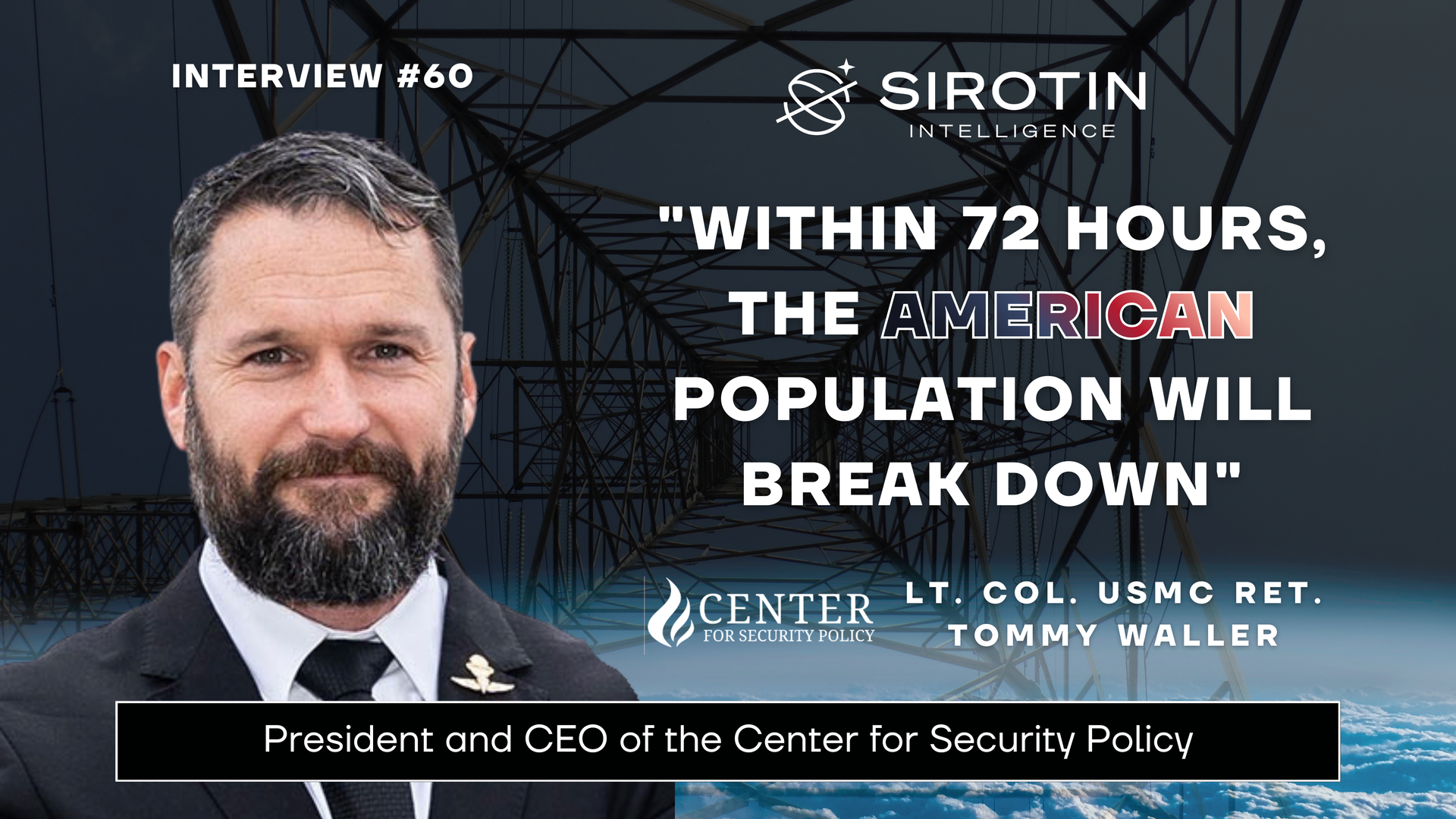
"Within 72 Hours, the American Population Will Break Down": Lt. Col. Tommy Waller, President & CEO of the Center for Security Policy, on Solar Storms, Chinese Transformers, and Why 623 Pieces of Critical Infrastructure May Already Be Compromised

In 1859, telegraph operators in Boston disconnected their batteries and kept transmitting messages to Portland, Maine, powered by nothing but the electrical current the Earth itself was generating. The Carrington Event, history's largest recorded geomagnetic storm, had turned the planet's crust into a conductor. People in New Orleans read newspapers by the green and purple glow of aurora that had no business appearing at that latitude. Telegraph systems threw sparks, shocking operators and starting fires in some telegraph stations. Magnetometers, which had been recently invented to measure the Earth's magnetic field strength, showed enormous fluctuations worldwide.
The telegraph was the only electrical infrastructure that existed back then. Today, the United States depends on thousands of extra-high-voltage transformers, some weighing 500,000 pounds, that take four to six years to manufacture overseas (many custom built) and require specialized railcars called Schnabel carts to transport. The country owns only a limited number of those carts. And 623 of those transformers were manufactured in China, where federal investigators have already found hardware backdoors in at least one seized unit that could allow remote shutdown.
Tommy Waller, President and CEO of the Center for Security Policy and a retired Marine Lieutenant Colonel, has spent more than a decade running the Secure the Grid Coalition tracking threats to American electrical infrastructure from multiple directions: physical sabotage, supply chain and cyberattack, electromagnetic pulse, and naturally occurring solar weather. That last category requires no adversary. The sun produces Carrington-class events regularly, and one missed Earth by roughly nine days of orbital position in July 2012. According to NASA, that storm "was in all respects at least as strong as the 1859 Carrington event," and "the only difference is, it missed." Had it arrived a week earlier, most Americans would have learned about it when they tried to turn on their lights.
You spent two decades in the Marine Corps before joining the Center for Security Policy. How did an infantry officer end up focused on electromagnetic threats to the power grid?
"I felt called to serve, specifically in the Marines, since I can remember," Waller begins. "I swore into the Marine Corps on my 18th birthday, and found myself commissioned shortly after 9/11. The first part of my career was predominantly involved with combat operations in Afghanistan and Iraq."
The transition to civilian work came through what Waller describes as a matter of faith rather than career planning. After leaving active duty, he received a phone call about a position at the Center for Security Policy, an organization he hadn't applied to. "Six hours after I fully gave it up, asking the Lord what he wanted me to do in civilian life, I got that phone call."
The Center for Security Policy operates differently from most Washington think tanks: it accepts no government money, no foreign money, and no funding from companies that could profit from its policy recommendations.Frank Gaffney, one of the Center's founders, had known about electromagnetic pulse since the 1980s, when the information was highly classified. After the congressional EMP Commission's declassified report in 2004, he sat Waller down at his Virginia home and walked him through the history of the threat and the need for aggressive policies to counter it.
"I should also say that I was never taught anything in the military about the ideology and doctrine of our adversaries," Waller notes. "All these things that helped me understand who I fought on the battlefield, that wasn't taught inside the government. It still isn't. It's why we catastrophically lose wars the way we did in Afghanistan and Iraq." Government leaders seeking accurate analysis of these hostile ideologies and doctrines often must look outside official channels, to organizations like the Center for Security Policy.
The same blind spots apply to infrastructure threats. The knowledge about grid vulnerabilities exists within specialized technical communities, but it rarely shapes broader policy or military planning. Waller's role became translating between those worlds. In February 2017, he briefed all fifty state adjutant generals of the National Guard on electromagnetic spectrum threats, reasoning that the Guard would be holding the bag if the grid collapsed. Only one responded: Major General Luke Reiner in Wyoming.
The following year brought more traction at the federal level. After the coalition briefed President Donald Trump in 2015, his administration's 2017 National Security Strategy included a commitment to protect critical infrastructure against electromagnetic spectrum threats. That top cover enabled Lieutenant General Steven Kwast to launch the Air Force's Electromagnetic Defense Task Force, where Waller served as the only Marine participant. The task force produced reports in 2018 and 2019 that raised significant concerns about nuclear power plant safety during extended grid outages, concerns that would later prove prescient.
Walk us through what the first 72 hours look like if a Carrington-level solar storm hits tomorrow. What fails first, what cascades from there?
"A coronal mass ejection the size of Carrington would be produced by a large X-class flare exploding off the sun towards Earth," Waller explains. "NOAA would issue a warning. Traveling faster than 6.5 million miles per hour, it would reach Earth in less than 15 hours."
The warning time sounds generous until you examine it closely. When the CME passes the ACE satellite roughly one million miles from Earth, NASA issues its most severe alert ("G5, K-9"). At that point, approximately nine minutes remain before impact. "The utility industry says they have operating procedures," Waller continues. "I have asked many people who work in the utility industry whether they would shut the grid down with advanced warning. The answer is 100% no. Widescale 'load shedding' during a massive solar storm can itself cause catastrophic damage to the grid, so it isn't a viable option.
What happens next unfolds above and below the ground simultaneously. As the CME slams into Earth's magnetic field, auroras appear at latitudes far south of their normal range, the same light show that appeared over New Orleans in 1859. But while people are looking up at the aurora, the real damage is happening beneath their feet. The disturbed magnetosphere generates electrical current in the Earth's crust, a quasi-DC ground-induced current, or GIC, that travels through rock and soil until it finds a lower-resistance conductor.
The power grid is a vastly better conductor. GIC surges up into the power grid through the transformer neutral ground wires connected to the earth, and enters transformer cores designed exclusively for alternating current.Transformer cores work by cycling magnetic fields back and forth at 60 times per second. The quasi-direct current from the earth doesn't alternate. It pushes the magnetic field in one direction and holds it there, forcing the core into what engineers call half-cycle saturation, a state where the transformer can no longer regulate power properly. GIC-induced half-cycle saturation is the source of nearly all grid operating and equipment problems caused by space weather.
As little as two to five amps of GIC per phase begins this process in our largest power transformers. A Carrington-class event can induce hundreds to thousands of amps of GIC. "The GIC causes these large power transformers to generate harmonic currents," Waller explains. "Think of harmonics like dirty power, vibrations that mess with the clean sine wave of alternating current."
A saturated transformer doesn't just fail. It becomes an active threat to everything connected to it, injecting those harmonic currents into the grid, damaging generator rotors, confusing protective relays, and destroying power supplies and customer equipment downstream. As GIC increases, total harmonic distortion across the grid increases along with the number of transformers simultaneously generating harmonics.
As the GIC event continues to build, more transformers begin injecting harmonic currents into the grid, damaging themselves and the rest of the grid. The cascade accelerates. Many high-voltage circuit breakers attempting to open(intentionally due to operating procedures or unintentionally due to harmonics) are destroyed because they are not designed to interrupt GIC. Localized hot-spot heating damages transformer insulation and sparks fires.
The current solar cycle is providing real-world demonstrations of this mechanism. During a recent smaller G4 geomagnetic disturbance in November 2025 that produced visible aurora as far south as Texas, a major utility reported that one of their largest transformers experienced GIC heating severe enough that operators nearly had to shut it down to prevent damage. The storm was significant enough to threaten this critical large power transformer, yet it was less than 3% the intensity of the Carrington event.
Meanwhile, many transformers are operating beyond their expected lifespan. According to the Department of Energy's Report to Congress dated July 2024, the average large power transformer in the U.S. fleet is beyond its designed expected lifespan of 40 years. This aging makes them even more vulnerable to GIC.
A 2016 Department of Energy meeting with government agencies, utilities, and major equipment suppliers reached a stark conclusion: GIC-induced harmonics from a severe geomagnetic disturbance could cause wide-scale grid collapse in tens of seconds.
Collapse, however, is only the beginning. Any attempts to turn the grid back on would have to wait until the GIC event is over. (The Carrington event lasted for over a week.) Turning a grid back on after catastrophic failure, a process called black start, requires carefully balancing electrical load with generation. Existing black start plans assume normal loads will be waiting when power returns. After a Carrington-class event, those assumptions fail. Power supplies and other equipment across the country will have been destroyed by harmonics. Equipment will need to be tested before reconnection. Some of that testing will reveal additional damage. Many transformers will be lost when attempting to turn them back on, as equipment is damaged in the shed/reconnect phase due to switching transients and overloading. According to major manufacturers of large power transformers, they have had transformer failures when trying to put a system back online. Lloyd's of London estimated in 2013 that a Carrington-class event could cause $0.6 to $2.6 trillion in economic losses, with power outages lasting one to two years. Today those losses would be much higher.
Even without catastrophic events, the United States is losing approximately $10 billion per year from harmonic current generation caused by GIC from routine solar weather. Every minor geomagnetic disturbance induces some level of GIC that passes through transformers, reducing their lifespan and damaging equipment downstream. The harmonic currents generated by high-voltage transformers amplify as they travel downstream toward lower-voltage systems. The damage to large power transformers accumulates invisibly until components fail prematurely.
Within the first 72 hours of widespread grid failure, the human consequences emerge. People in high-rise buildings discover that water no longer flows from their taps because pumping stations require electricity. The 1977 New York City blackout, which lasted 24 hours, resulted in 450 law enforcement officers injured, 4,500 arrests, and millions of dollars in damage. That was one city for one day.
U.S. Air Force veteran survival instructor Jonathan Hollerman, an expert on grid-down scenarios and social breakdown, has documented how quickly supply chains and civil order deteriorate when electricity disappears for extended periods.
"The decision points determining how long we're down depend on GIC damage to the largest equipment: transformers, circuit breakers, large power generators, the backbone of the power grid," Waller says.
Extra-high-voltage transformers take four to six years to produce, and manufacturing happens almost entirely overseas. If more than a handful are damaged simultaneously, the country lacks sufficient Schnabel carts to transport replacements. Each installation requires draining and refilling tens of thousands of gallons of transformer oil. Under optimal conditions, installation takes a month. After a Carrington event, conditions will be anything but optimal.
Damaged load across the grid from GIC-induced harmonics and societal chaos will also prevent installation of replacement transformers. Even if there was a fleet of spare transformers ready, they would never get plugged in. Electric power in the United States would be off and stay off for a very long time.
The North American Electric Reliability Corporation's TPL-007 standard is supposed to protect the grid against geomagnetic disturbances. Why do you argue it provides false assurance?
The problem lies in the benchmark itself. When NERC developed TPL-007, they ignored their own panel of eight space weather scientists who recommended planning for peak field strengths of 30-40 volts per kilometer (V/km). The final standard landed far below that: 4 V/km for northern states, 2 V/km across central states, and only 0.8 V/km for southern states.
To understand what those numbers mean, consider the 1989 Quebec blackout. That geomagnetic event measured approximately 2 V/km. The storm knocked out Hydro-Quebec's entire grid in 93 seconds, causing $13.2 billion in economic loss. The 1921 NY Railroad solar storm (prior to the development of our bulk power grid) measured at 20 V/km, more than ten times what the current standard protects against across the center of the United States. Both the Carrington Event of 1859 and the 2012 CME that missed Earth by one week were even larger than the 1921 storm.
"The artificially low NERC standard allows utilities to meet compliance without installing any GIC protection hardware," Waller explains. "They comply on paper while the physical vulnerability remains."
The consequences of this gap ripple into other regulatory decisions. The Nuclear Regulatory Commission requires only seven days of fuel for the emergency diesel generators that power nuclear plant safety systems. These systems, including the pumps that circulate water in spent fuel pools, need external power to operate. If the grid stays down longer than a week, operators face the challenge of refueling generators during a national emergency when fuel supply chains have collapsed.
Tom Popik of the Foundation for Resilient Societies saw this problem coming. He filed a petition with the NRC warning that a massive solar storm could make refueling impossible across multiple sites simultaneously. The timing proved grimly appropriate: he filed two weeks before the Fukushima disaster demonstrated exactly what happens when spent fuel pools lose cooling.
Fourteen years later, in May 2025, the NRC denied the petition. Their reasoning relied on two assertions: that the NERC TPL-007 standard adequately protects the grid, and that 80 percent of transformers are resistant to GIC.
"That is factually incorrect, also known as a lie," Waller says. "The NRC made an extraordinarily consequential decision based on dangerous assumptions from the electric utility industry."
The Secure the Grid Coalition responded by publishing Speed to Power on a Firm Foundation, a report documenting the gap between regulatory assurance and physical vulnerability.
The Coalition's report highlighted a fundamental point: the only way to protect the power grid from GIC is to block it, keeping GIC out of the grid entirely.
The report warns that utility "operating procedures" cannot block GIC from entering an operating grid, and that improved space weather warning systems and more GIC monitors will not block GIC from entering the grid. They will only provide a clearer view as catastrophic levels of GIC flood into thousands of large power transformers, turning each of them into reactive power consumers and harmonic current generators, causing them to destroy the grid and themselves.
Waller says he prays that leaders in government and in the electric industry will heed the report's warnings and recommendations and finally take action to install GIC-blocking hardware on the roughly 6,000 transformers that need it. He even included in the report a draft "Emergency Order" for the Secretary of Energy to issue, providing a policy pathway to accompany the authoritative threat and engineering information.
You mentioned 623 Chinese-manufactured transformers now installed in the American grid. Given that they're already operational, what does fixing the problem actually mean?
The strategic concern about Chinese grid components isn't speculation. It appears explicitly in Chinese military doctrine. Unrestricted Warfare, a 1999 book by two PLA colonels that was translated by the Foreign Broadcast Information Service, describes an attack sequence against a developed nation: secretly muster capital, strike financial markets, embed malware in computer systems, then paralyze "the civilian electricity network, traffic dispatch network, financial transaction network, telephone communications network, and mass media network" to trigger "social panic, street riots, and political crisis." The passage appears on pages 145-146. Grid disruption is stated doctrine.
China positioned itself to execute this doctrine partly through economic warfare. Years ago, Chinese manufacturers began dumping grain-oriented electrical steel, the specialized magnetic material required for transformer cores, into the international market at below-cost prices. Competitors couldn't match the pricing and folded. Today, the United States lacks domestic capacity to produce large power transformers at the scale required.
"Long-term mitigation means we build them here," Waller says. "Resilient to all hazards including electromagnetic pulse and GIC, with SolidGround® units installed, and cyber secure without hardware backdoors."
Short-term mitigation is harder. No requirement exists to inspect the 623 Chinese transformers already operating in American infrastructure. The executive order on bulk power system security that President Trump signed on May 1, 2020 was subsequently suspended by the Biden Administration and has yet to be reinstated.
The transformer supply chain threat overlaps with another documented vulnerability: the Aurora vulnerability, which involves exploiting protective relay timing to physically destroy generators and transformers through carefully timed connection and disconnection commands. Waller suspects utilities avoid discussing Chinese transformer risks because acknowledgment would create pressure to act, similar to what happened when the Aurora vulnerability became public. "I'm assuming the utility industry doesn't want to talk about it because it would be like Aurora, and then have to do something about it."
The Secure the Grid Coalition has drafted model state legislation called the SAVE Transformers Act, where SAVE stands for "Survey All Vulnerable Electric" Transformers. The bill would require utilities to report the country of origin and manufacturer of their transformers, giving state officials at least a map of their exposure. "If nothing else, states can assume that transformer is going to go down," Waller explains. "If a city depends on a Chinese transformer, you've got to plan that city goes without power if something happens. That's at least a start."
The SAVE Transformers Act also requires utilities to survey transformers for their vulnerabilities to real-world GIC threats and to report back to state leaders how many transformers need GIC protection, with recommendations on how to finance this protection. The bill helps state leaders begin addressing two distinct but related concerns for the security and resilience of their electric infrastructure. New Hampshire has already filed the bill, and Waller hopes other states will follow.
Regarding the severe GIC threat from the next Carrington-level event, what is the solution?
The chance of another Carrington-level event hitting Earth is 100%. It is a statistical certainty, with the odds of it occurring in the next 10 years estimated at around 12%. The Carrington Event is also not the largest solar event to hit Earth. Scientists have discovered evidence of many larger events in Earth's history called "Miyake" events.
For the GIC and harmonic threat, objective #1 is to prevent grid failure. A spare transformer program cannot achieve this, and operating procedures cannot block GIC. A technical solution already exists: the SolidGround® capacitive neutral-blocking device, developed by EMPRIMUS. The technology has been validated by the Defense Threat Reduction Agency, Idaho National Laboratory, Oak Ridge National Laboratory, the Department of Energy, and the utility industry. The device attaches to the neutral ground cable of transformers, automatically blocking GIC from entering transformers without disrupting normal AC operations. The devices have been running continuously for over a decade on the bulk power grid at 345 kV and 500 kV levels on the American Transmission Company, Western Area Power Administration, and Tennessee Valley Authority systems, performing as designed without failure. These major utilities have contributed to its design, written articles, given presentations, and co-authored papers on its performance, as well as submitted testimony to the U.S. Senate.
The main issue preventing widespread deployment of the SolidGround® technology is the artificially low NERC standard, which does not require GIC protection hardware to be installed. Worse, it misleads decision makers into believing that the grid is "hardened" against GIC when it is not. If a policymaker asks whether the Texas power grid is protected against a 1:100-year solar storm event, many in the industry will say with confidence "YES" because Texas "meets the standard." What they don't mention is that the NERC standard defines that solar storm as a small 0.8 V/km event for all states across the south.
"GIC is one of the greatest and undeterrable threats to our power grid, national security, and way of life. It is also one of the simplest and most cost-effective to solve."
According to independent analysis by Idaho National Laboratory, the Foundation for Resilient Societies, and ABB, Inc., nationwide deployment of the standardized SolidGround® device on approximately 6,000 large power transformers identified as "high risk design" (those that begin generating harmonic currents with GIC as low as 2-5 amps/phase) would cost $3-4 billion, less than 0.5 percent of the 2021 Infrastructure Investment and Jobs Act.
Beyond protecting against catastrophic grid failure from the next Carrington event, the devices would eliminate the estimated $10 billion in annual economic losses from routine solar weather that degrades equipment incrementally.
The technology exists. Utilities helped design it, have used it for over a decade, and are willing to install more. What is lacking is direction, and an answer to the question of who will pay for it.
Waller explained that utilities will not pay for grid protection if it is not required. The Secure the Grid Coalition's goal is to cut through the misleading NERC standard and provide decision makers with the information needed to incentivize utilities to protect the grid now.
Two weeks before this interview, Waller visited the Minnesota facility where SolidGround® units are manufactured. Units were being prepared for shipment to foreign countries. He pulled a AA battery from his pocket flashlight and touched it to one of the devices. It activated instantly, demonstrating its ability to block even minimal DC current, which is enough to disrupt large power transformers.
"It was motivating to see this thing work. And deeply depressing to watch it get loaded into a container for another nation while our United States of America remains completely unprotected when we could do it for less than the cost of a single modern battleship."
Senator Rick Scott introduced legislation addressing the manipulation of demand via Internet of Things, the idea that smart appliances could be weaponized to destabilize the grid. How does that threat compare to the transformer supply chain risk?
"MADIoT, manipulation of demand via Internet of Things, is a real threat," Waller acknowledges, adding that Senator Scott should be commended for sponsoring legislation to address it. "Academia has warned about it for years." The attack concept involves simultaneously triggering large numbers of internet-connected devices (air conditioners, water heaters, smart thermostats) to spike or crash demand faster than the grid can compensate.
Waller considers the transformer supply chain risk more dangerous because of the asymmetry involved. "The transformer risk requires only one device to affect large areas of the grid. In the MADIoT scenario, lots of devices have to be manipulated simultaneously, which should be more technically difficult if you're trying to gain control of them all at once."
A related threat emerged in recent intelligence community assessments. The Intelligence Authorization Act for Fiscal Year 2026, prepared by the Senate Select Committee on Intelligence, flags "Chinese-owned cryptocurrency mining facilities inside the U.S." as a national security danger, noting these operations cluster "near sensitive defense installations or critical U.S. infrastructure such as power grids, creating several disturbing vulnerabilities."
Waller draws a connection to the MADIoT concern. "If Senator Rick Scott is worried about smart devices being simultaneously operated to increase demand on the grid, what about infrastructure that already uses massive electrical demand, like a crypto mine?" Unlike thousands of distributed smart devices requiring coordinated compromise, a cryptocurrency mining facility concentrates enormous load in a single location with built-in capability to rapidly modulate power consumption. The Senate Intelligence Committee report documents the proximity of these facilities to critical infrastructure. The implications for grid manipulation follow from that positioning.
The congressional EMP Commission warned that long-term blackouts could kill up to 90 percent of the American population. How do you communicate that risk to policymakers without being dismissed as alarmist?
"There's two ways to message this," Waller says. "From the head, or from the heart." The intellectual case proceeds from carrying capacity. The Congressional EMP Commission looked at the U.S. population before electrification, noting that the North American landmass supported approximately 30 million people. Remove electricity permanently, and the systems sustaining 330 million people (water treatment, food distribution, medical care, heating and cooling) cease to function. The Department of Defense alone consumes 42,000 metric tons of food per week. The average American visits a grocery store 1.6 times weekly. The average piece of food travels 1,500 miles from harvest to consumption. Every link in that chain requires electricity.
The Committee on Homeland Security and Governmental Affairs of the U.S. Senate concurred with the EMP Commission's analysis in a report published on March 28, 2017. Waller also cautions that "back before electricity, those 30 million Americans knew how to live without it, a set of life skills lacking in today's American population."
"But at the end of the day, it's about connecting at the heart," Waller continues. "I ask them to imagine their children starving to death, and their wives looking at them asking why they didn't do something when they had a chance."
The emotional appeal reflects asymmetric resources. The electric utility industry spends approximately $150 million annually on federal lobbying alone. The Secure the Grid Coalition operates on nonprofit funding and volunteer expertise. "I'm contending with one of the most powerful lobbies in the world. I don't have money to give politicians. They do. I pay a power bill so they can. I've got all the facts, but sometimes facts don't matter when they've got money."
The approach works occasionally. In June 2023, Texas Senate Bill 75 became law, establishing grid security planning requirements that Waller describes as a major milestone in an eight-year effort. Similar legislation is advancing in other states, though progress depends on local political dynamics and utility industry resistance.
Waller's briefings to utility audiences begin with two statements. First, he thanks them: nothing he did in uniform could affect day-to-day American survival the way keeping the lights on does. Second, he invokes St. Augustine's observation that hope has two daughters, anger and courage. Anger at the way things are, and courage to ensure they don't remain that way. When Waller delivers this framing, he shows a photograph of his own daughters on the screen. The abstraction of 90 percent population loss becomes specific. The policy question becomes personal.
Author's Analysis
The regulatory capture Waller describes operates through a mechanism more subtle than simple corruption. The North American Electric Reliability Corporation, which develops grid security standards, is an industry self-regulatory organization. Its members are the utilities that would bear compliance costs. When NERC's own scientific advisors recommended benchmark field strengths of 30-40 volts per kilometer and the final standard emerged at 4, 2, and 0.8 volts per kilometer, the gap reflects institutional incentives that systematically discount low-probability, high-consequence events in favor of quantifiable near-term costs.
The Nuclear Regulatory Commission's May 2025 denial illustrates how these decisions compound. The NRC relied on grid resilience assumptions that originated with NERC, whose standards were shaped by utilities with financial stakes in minimizing requirements. Each agency's decision appears defensible in isolation. The systemic vulnerability emerges from their interaction: circular reasoning where one regulator trusts another's assessment without examining the institutional pressures that produced it.
This pattern has a name in organizational theory: the normalization of deviance. When nothing bad happens, the absence of catastrophe becomes evidence that current practices are adequate. The grid survived yesterday's solar weather, so yesterday's protections must be sufficient. The logic holds until it doesn't.
The November 2025 solar storm offers a case study. A geomagnetic disturbance far below Carrington intensity caused hot spot heating severe enough to nearly force shutdown of an unprotected transformer, while a transformer protected by SolidGround on the same system operated normally. The incident validates both the threat mechanism and the efficacy of available countermeasures. It also demonstrates that the $10 billion in annual losses from routine solar weather represents ongoing, measurable damage rather than theoretical future risk.
Three scenarios for 2035:
Scenario 1: The Standard Holds. Solar Cycle 25 peaks without producing a Carrington-class event directed at Earth. The TPL-007 standard remains unchanged. Chinese transformers continue operating without incident. Waller's warnings are filed alongside Y2K: valid concerns about real vulnerabilities that failed to materialize within the warning window.
Scenario 2: Partial Failure. A significant but sub-Carrington geomagnetic disturbance strikes during high grid stress, such as a summer heat wave or polar vortex. Several transformers fail. Regional blackouts last weeks rather than hours. The recovery reveals supply chain timelines that were previously abstractions. Congress holds hearings. NERC revises TPL-007 upward. SolidGround devices become a procurement priority. The United States begins hardening infrastructure after the demonstration rather than before.
Scenario 3: The Waller Scenario. A Carrington-class event arrives while the regulatory framework remains unchanged and Chinese transformers remain uninspected. The cascade proceeds as described: harmonics generation, grid collapse in seconds, damage to equipment with multi-year replacement timelines. The geopolitical consequences depend on whether adversaries, having protected their own infrastructure, choose to exploit American vulnerability.
The pattern is consistent: 1977 New York, 1989 Quebec, 2021 Texas. Each blackout produced reforms proportional to the damage experienced. The Carrington Event of 1859 produced reforms to telegraph operations. Nothing comparable has tested the modern grid since.
Which raises the questions this interview leaves unanswered:
If a $3-4 billion fix exists, has been validated by national laboratories, and would pay for itself in under a year by eliminating routine solar damage, why hasn't it been deployed? Who benefits from the current arrangement, and how much are they spending to maintain it?
If 623 Chinese-manufactured transformers sit in American critical infrastructure with documented hardware backdoor risks, and no inspection requirement exists, who decided that was acceptable? What would have to happen for that decision to change?
If the utility industry's own representatives admit they would not shut down the grid with nine minutes' warning, despite testifying to Congress that they have "operating procedures," what exactly are those procedures, and has anyone verified they would work?
If China's war-fighting doctrine explicitly describes paralyzing civilian electrical infrastructure as a precursor to military victory, and China has spent decades cornering the transformer manufacturing market through economic warfare, at what point does pattern recognition become actionable intelligence?
And if the next Carrington-class event arrives before any of these questions are answered, who will be asked why they didn't act when they had the chance?
About Lt. Col. Tommy Waller
Tommy Waller is the President and CEO of the Center for Security Policy. Waller retired from the Marine Corps Reserves at the rank of Lieutenant Colonel after serving more than two decades on both active duty and in the reserves with deployments to Afghanistan, Iraq, Africa, and the Caribbean.
Waller joined the Marine Corps in 1998 on a NROTC scholarship, was commissioned in 2002, trained as an infantry officer, and then conducted multiple deployments to Afghanistan and Iraq through 2006. During these combat tours he served in an infantry battalion, as part of a Marine Expeditionary Unit (MEU), and as a Reconnaissance Platoon Commander for 2d Recon Battalion.
In 2007, he accepted orders to Officer Candidates School in Quantico, Virginia, where he completed the Marine Corps Expeditionary Warfare School and was the first recipient of the Captain Robert M. Secher Scholarship to the Wharton School of Business, where he completed an executive education course on high-stakes negotiations.
From 2009, when Waller left active duty, he served multiple roles in the Marine Corps Reserves' 4th Marine Division, with most of his assignments at 3d Force Reconnaissance Company, eventually rising to the position of Commanding Officer of the unit in July 2019. During his time with 3d Force and 4th Marine Division, Waller conducted numerous missions on the continent of Africa and led a team of reconnaissance and intelligence Marines to Belize to conduct a counternarcotics/counterterrorism mission. He also completed the Marine Corps Command and Staff College and was cross-assigned to serve as a key staff member of the U.S. Air Force's Electromagnetic Defense Task Force (EDTF).
Waller joined the Center for Security Policy in 2014. He served as Director of Infrastructure Security until 2021, when he was officially named the Center's Executive Vice President. He became President & CEO in 2023.
He holds a BA in International Relations from Tulane University.
Further Resources
- Speed to Power on a Firm Foundation Report: securethegrid.com/transformers
- Center for Security Policy: centerforsecuritypolicy.org
- Secure the Grid Coalition: securethegrid.com
- Unrestricted Warfare (FBIS Translation): c4i.org/unrestricted.pdf
- NASA: Near Miss Solar Superstorm of July 2012: science.nasa.gov
- National Interest Articles: nationalinterest.org/profile/tommy-waller
Get exclusive insights from our network of NASA veterans, DARPA program managers, and space industry pioneers. Weekly. No jargon.