
"Trust Doesn't Collapse. It Becomes Conditional": Space Security Expert Sylwia Gorska on the Iran War, the Missile Defense Drain From Asia, and What Tokyo Does Next

On March 19, Japanese Prime Minister Sanae Takaichi sat in the Oval Office while the President of the United States explained, to her face, why he had not warned allies before launching strikes on Iran three weeks earlier. "Who knows better about surprise than Japan?" Trump said, turning toward her. "Why didn't you tell me about Pearl Harbor?"
Takaichi's eyes widened. She took a breath. She said nothing.
In Tokyo, the reaction was less composed. Former diplomat Hitoshi Tanaka wrote on social media that he was embarrassed watching the exchange. Japanese media ran the clip on every major outlet. And the public, already uneasy about a war they had no part in starting, was left to process what it looks like when the cornerstone of your national defense strategy, the alliance with the United States, gets reduced to a punchline in front of the world's cameras.
It is against this backdrop that we return to Sylwia Gorska, whose first interview with Sirotin Intelligence explored the U.S.-Japan space security alliance, Japan's wooden satellite program, and how constitutional constraints have driven unexpected innovation in space sustainability. That conversation happened before the 2026 Iran war began, before the U.S. started pulling Patriot and THAAD missile defense systems out of South Korea to plug gaps in the Middle East, and before Japan's prime minister found herself absorbing a World War II reference in the West Wing while being asked to help secure the Strait of Hormuz.
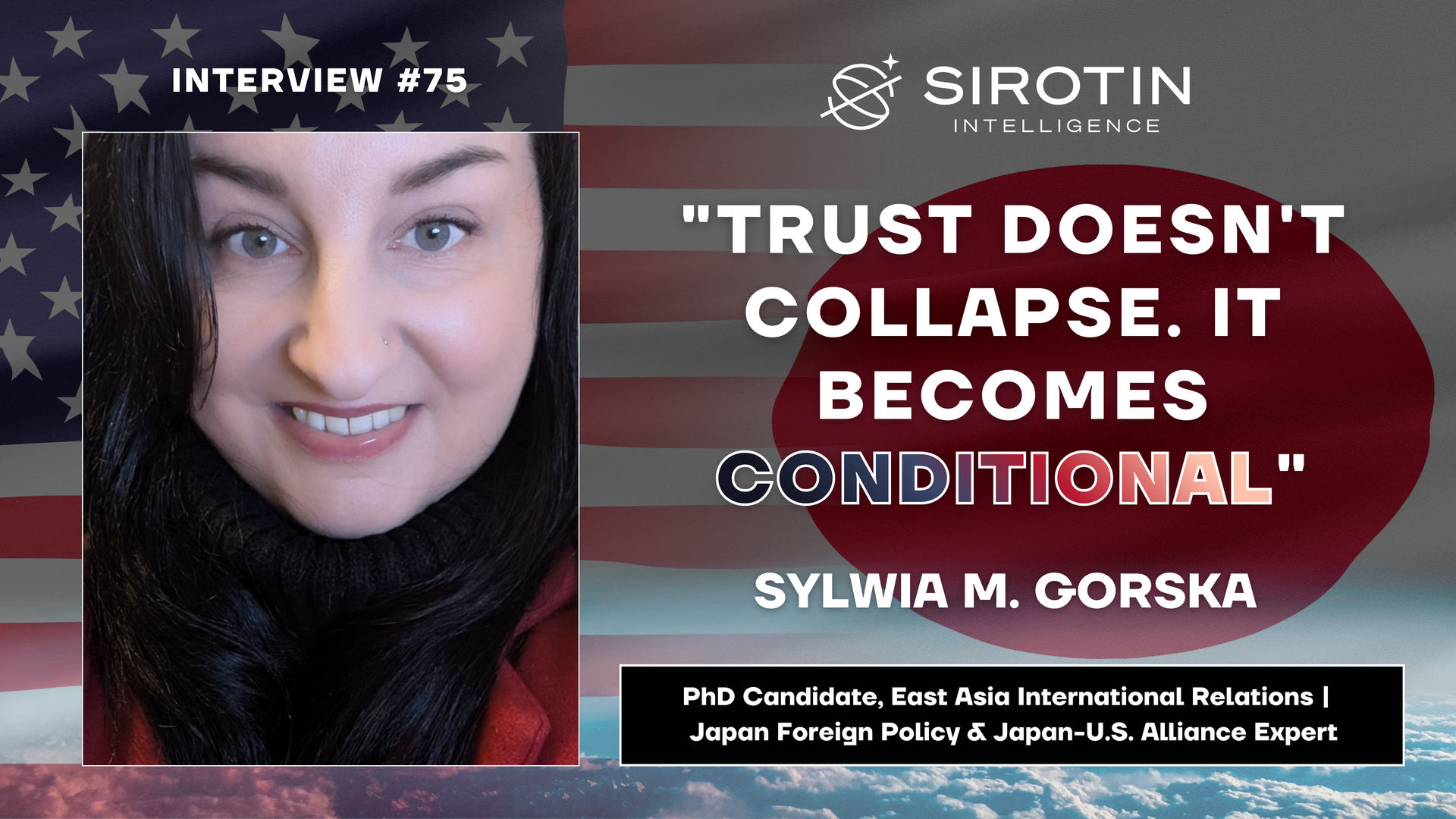
Gorska is a PhD candidate at the University of Central Lancashire whose research examines Japan-U.S. alliance dynamics in space security, dual-use technology governance, and Japan's evolving defense posture under its pacifist constitution. She is a regular commentator on East Asian security for international outlets including TRT World and has published on nuclear safety and energy security through the Global Taiwan Institute. When we spoke the first time, the conversation was largely forward-looking, centered on where the alliance might go. This time, the questions are more immediate. What happens to deterrence in Asia when the systems designed to keep it credible are loaded onto transport planes and flown to the Gulf?
The Iran war is forcing conversations that both Seoul and Tokyo had been avoiding. What is this conflict actually doing to U.S. alliance credibility in Asia, and how are Japan and South Korea responding differently?
Before we get to the broader alliance dynamics, I asked Gorska about a question that has been getting considerable attention: the succession of Kim Jong Un's daughter, Kim Ju Ae, who was recently photographed driving a tank at a military drill while her father watched from atop the vehicle.
Gorska is measured in her assessment. She notes that Kim Ju Ae's appearances in military settings have become more consistent and more deliberate, including the tank footage that circulated widely in March 2026. "In North Korea, political legitimacy is tied to the military," she says. "These appearances link her to the institutions that sustain the regime." South Korea's National Intelligence Service reported in February 2026 that it believes Kim Ju Ae has completed her successor training and entered what it called the "successor-designate stage," though no formal announcement has been made by Pyongyang.
Gorska cautions against reading too much into the gender dimension. "A female leader would not fundamentally change North Korea's relationship with its neighbors," she says. The real risk, in her view, sits in the transition itself. Kim Ju Ae is believed to be around 13 or 14 years old. Any succession while she is that young would likely involve a period of authority exercised through senior elites, a mentorship structure that could create internal pressure to demonstrate loyalty through visible military activity. "That's where the risk sits. When authority is not fully consolidated, it needs to secure position and demonstrate loyalty. In North Korea, that often happens through visible military activity."
That transition risk takes on a different character in the context of the Iran war. Since the U.S. and Israel launched strikes on Iran on February 28, the United States has begun redeploying missile defense systems from across its global footprint to shore up defenses in the Middle East, where Iranian retaliation has been sustained and, by multiple accounts, more intense than Western planners expected. The Washington Post reported in early March that the Pentagon had begun transferring components of the THAAD anti-ballistic missile system from South Korea, a move confirmed by South Korean officials. Patriot batteries have also been prepared for redeployment from Osan Air Base.
Gorska frames the issue in terms of capacity, not loyalty. "The deeper issue is capacity. Missile defense is a finite system. Interceptors are expensive and produced in limited numbers, and they're consumed quickly under sustained operations." She points to the fact that the U.S. reportedly expended over 25 percent of its global THAAD interceptor stockpile during the Twelve-Day War in June 2025, and that Patriot interceptor supplies had fallen to an estimated 25 percent of the Pentagon's target levels even before the current conflict began. Congress has faced urgent supplemental funding requests to sustain the war effort.
"Deterrence shifts," she says. "It's no longer just about whether the United States would defend an ally. It's about how quickly and with what resources, when multiple crises unfold at once." The question for South Korea and Japan is no longer abstract. "That does not mean trust collapses. It means it becomes conditional on availability and timing, and on U.S. priorities."
South Korean President Lee Jae Myung acknowledged the dilemma publicly, telling his cabinet that while Seoul had expressed opposition to the redeployment, "the reality is that we cannot fully impose our position." The systems, after all, belong to the United States. South Korea hosts them, but does not control them. North Korea, Gorska notes, continued its missile testing activity during this period. "That reinforces how closely shifts in defensive posture are watched."
Japan's response has been subtler. Rather than protesting the redeployment publicly, Tokyo has accelerated its own defensive development. Gorska points to the Aegis System Equipped Vessel (ASEV) program and a recent live SPY-7radar tracking test as evidence that Japan is building more of its own defensive depth. "Better tracking improves awareness, but not capacity," she says. "Interceptors and platforms are still limited. Prioritization does not disappear." And Japan's legal framework continues to shape what it can do. Article Nine of the constitution constrains response speed in a crisis, a limitation that becomes more consequential as U.S. attention and resources are pulled elsewhere.
China has maintained steady pressure around the Senkaku Islands and Taiwan throughout the Iran conflict. Is Beijing exploiting a distraction, or is this something that was already in motion?
Gorska pushes back on the framing. "I would not describe this as China exploiting a distraction," she says. "We are seeing what was already in place."
She walks through a specific incident from mid-March as an example. Two Chinese Coast Guard vessels entered Japan's territorial waters near the Senkaku Islands and moved to intercept a Japanese fishing boat. Beijing described it as expelling the vessel. The Japanese Coast Guard said it intervened and pushed the Chinese ships back. "Both sides are physically present. Both are asserting authority. And both are shaping the narrative." There was no escalation, and that, Gorska argues, is the point. "There's no escalation. It's a sustained pattern designed to normalize presence and test responses without crossing into open conflict."
What changes with the Iran war is the American side of the equation. U.S. naval assets are being redirected. Missile defense systems are under strain. Political attention is divided. At the same time, during the Takaichi-Trump meeting, Gorska notes that the Japanese prime minister made clear that Japan would define what it can and cannot do in relation to U.S. requests linked to the Iran conflict.
"When resources are stretched and alliance responses are less predictable, the cost of maintaining that level of activity goes down," Gorska says of China's calculus. "China does not need escalation to benefit from that. A major escalation would be risky. What works is maintaining steady, repeatable activity below the threshold of conflict."
The same logic applies around Taiwan, where Chinese military activity has shown some slight escalation but remains, in Gorska's assessment, carefully calibrated to stay below the line that would trigger a direct response. "That's the Chinese way of doing things."
China recently demonstrated real-time satellite imagery of U.S. military buildups. How does the Iran conflict affect Japan's approach to space-based intelligence and dual-use technology?
When we spoke the first time, Gorska described Japan's approach to space as shaped by the asymmetry built into the U.S.-Japan alliance. Japan leads in sustainability and tracking. The U.S. leads in defense and interception. That division of labor has not changed, but the Iran war is putting pressure on it in new ways.
"Japan is building AI-enabled sensor fusion, secure cloud-based systems, and new satellite constellations to track hypersonic and long-range threats," Gorska says. "But this is not just about improving visibility. It's about shortening the time between detection and action." The integration layer, the part that turns data into decisions, remains largely dependent on the United States. And that dependency is structural, not just technical. "It's about command authority, not just hardware."
Japan's constitutional constraints continue to shape the boundary. The country participates in space situational awareness sharing with the U.S. through the Space Surveillance Network, and it has invested in the ASEV program with SPY-7 radar capable of tracking multiple threats simultaneously and distinguishing real warheads from decoys. But its role within the alliance architecture remains weighted toward tracking and decision support rather than interception.
"Even though the U.S. pushes Japan to be more integrated within U.S. defense systems, Japan operates on different terms because of its legal constraints," Gorska says. South Korea, she notes, does not face this limitation. It does not have a pacifist constitution, and its defense cooperation with the United States operates under a different framework. "They are neighbors, very close neighbors, but they play different roles within the alliance."
The Takaichi-Trump meeting drew intense scrutiny at home and abroad. What actually came out of it, and what does it reveal about the state of the alliance?
Gorska pauses before answering this one. "I do not know how to feel about that, to be honest," she says.
The meeting, held on March 19 at the White House, was Takaichi's first visit to Washington as prime minister following her party's landslide electoral victory in February 2026. It was supposed to focus on trade, regional security, and energy cooperation. The Iran war changed all of that. Trump had been pressuring allies, Japan included, to help secure the Strait of Hormuz after Iran effectively shut down traffic through the waterway. Takaichi's office had said publicly that there were no plans to dispatch naval vessels and that there had been no specific U.S. request to Japan for such a deployment.
Gorska acknowledges the criticism that Takaichi faced at home for her demeanor during the meeting, particularly for not pushing back on the Pearl Harbor reference. But she reads the encounter differently. "Some people thought she behaved in a way that was, frankly, ridiculous," she says. "But I think it was a strategic move. She found a way to deal with Trump that kept the conversation moving forward without giving away anything Japan was not prepared to give."
Gorska draws on her understanding of Japanese diplomatic culture. "Japanese people do not really say directly what they think. They behave in the way that is appropriate to the situation. Behind closed doors, that's a different story." She notes that Takaichi made clear Japan would define its own role and limits with respect to the conflict, which, given the constitutional constraints on Japan's Self-Defense Forces, was itself a significant act of boundary-setting.
The broader significance, in Gorska's view, is that the meeting exposed the tension between alliance solidarity and sovereign decision-making at a moment when the U.S. is asking allies to support a war that many of those allies did not choose and were not consulted about in advance.
Japan and Germany just agreed to expand military cooperation, including a proposed reciprocal access agreement. Combined with Japan's deepening ties with Australia and the Philippines, what is driving this diversification?
On March 22, just days after the Takaichi-Trump meeting, German Defense Minister Boris Pistorius met Japanese Defense Minister Shinjiro Koizumi at the naval facility in Yokosuka. The two agreed to expand cooperation across defense-industrial areas including drone and counter-drone systems, and Pistorius proposed a Reciprocal Access Agreement that would lower bureaucratic hurdles for joint exercises and personnel exchanges. Japan has already signed similar agreements with Australia, the United Kingdom, and the Philippines, and is finalizing one with France.
Gorska is clear that this is not about replacing the U.S. alliance. "Japan is trying to diversify its defense relationships and have a backup plan, in case the United States does not adhere to its alliance commitments," she says. "It's not against the United States. It's about having alternatives."
She frames the Germany-Japan development within a larger pattern. Japan has been strengthening ties with Australia, expanding cooperation with the Philippines, including discussions about a munitions factory there to help sustain production capacity, and reaching out more broadly to European Union countries. "Japan wants to strengthen relations not only with Germany, but also Italy and other EU countries," she says.
The historical resonance of a Germany-Japan defense partnership is not lost on observers, but Gorska does not see it as cause for alarm. Both countries are democracies operating under constitutional constraints shaped by the lessons of the last century. The cooperation is oriented toward interoperability, joint exercises, and defense-industrial collaboration, not offensive capability.
What it does signal, in her view, is that the uncertainty generated by the current U.S. administration's approach to alliances, the unilateral strike on Iran, the Pearl Harbor remarks, the pressure to contribute to a conflict Japan did not join, is pushing Tokyo to hedge in ways it has not previously pursued with this level of urgency.
Japan also faces a more immediate economic vulnerability. How serious is the oil shock from the Strait of Hormuz disruption, and what is Japan doing about it?
Japan imports the vast majority of its oil from the Middle East, and the effective closure of the Strait of Hormuz has created acute pressure on prices and supply chains. Gorska notes that Japan has begun releasing oil reserves, a first-line response. But she also flags something more surprising: Tokyo has been in talks with Iran about the possibility of opening the strait for Japanese shipments.
"Even though Japan is a close ally of the United States, national interest is the priority," she says. "They will do everything to make sure the oil crisis does not strain Japan's economy, because that would create additional crises in terms of prices but also political pressure on the Takaichi government."
It is the kind of pragmatic calculation that does not always align neatly with alliance solidarity, and Gorska treats it as such. Japan has historically maintained a more nuanced diplomatic relationship with Iran than the United States has, and the current crisis may test how far that nuance can stretch without creating friction with Washington.
What are your predictions for how this conflict reshapes the security landscape for Japan and South Korea over the coming year?
Gorska sees Japan remaining a close U.S. ally but moving toward greater independence, particularly in defense capability. "I believe Japan will stay a close ally of the United States, but I would rather see Japan be more independent," she says. "They need to take into serious consideration revising their constitution, because in the light of the current security landscape, Japan cannot be left vulnerable."
She acknowledges that Japan's strike capabilities are advancing, but argues that the constitution remains a barrier to the kind of response speed that the current threat environment demands. This is a shift from our first conversation, where Gorska emphasized how Japan's constitutional constraints had driven innovation in space sustainability. The constraints have not changed. The security environment around them has.
On South Korea, Gorska argues for closer Japan-South Korea cooperation, a prospect that carries its own historical baggage but that the current moment makes more urgent. "South Korea needs a great ally, and Japan is the most suitable country," she says. The uncertainty generated by the current U.S. administration, she argues, creates anxiety that goes beyond military questions. It touches economics, space cooperation, and every aspect of the alliance framework.
"I would rather see those two countries work closer together," she says. "Not against the United States, but to have a backup plan, just in case."
Author's Analysis
You are Sanae Takaichi. You are seated in the Oval Office. The president of your most important ally has just turned to you and said, in front of cameras, "Who knows better about surprise than Japan? Why didn't you tell me about Pearl Harbor?" Your eyes widen. You take a breath. You say nothing. You are running calculations: what do I absorb, what do I refuse, what do I take home that my predecessor could not have gotten. You know that your interceptor cupboard is being emptied to fight someone else's war. You know that three days from now, your defense minister will be in Yokosuka with the Germans. You know that the man sitting next to you does not know that yet.
The Takaichi who flew back to Tokyo was not diminished. She had sat through the worst public moment any Japanese leader has endured in the postwar alliance and given up nothing of substance. No naval vessels dispatched. No constitutional red lines moved on someone else's schedule. And three days later, her defense minister was in Yokosuka signing cooperation frameworks with Germany. The sequence matters. Japan did not wait for Washington to define the terms of its next security relationship. It started building one while Washington was still asking for help with the last war.
Gorska sees Article Nine as a barrier that needs revisiting, and in the narrow sense of crisis response speed, she is right. If a missile is tracking over Hokkaido and the SPY-7 data is live on screen, the time it takes to route a decision through Japan's constitutional and legal framework is time the threat does not pause for. But there is something else in this conversation that resists the straightforward reading.
Japan's constitutional constraints produced the world's first wooden satellite. They produced a diplomatic identity that made Japan the natural leader in space sustainability. They produced, in Gorska's own telling, a country that thinks generationally about the commons, whether orbital or oceanic. And now those same constraints are producing something the alliance has not seen before: a Japan that is diversifying its security partnerships across three continents at a pace that would have been unthinkable five years ago. The RAA negotiations with Germany, France, Canada. The munitions production talks with the Philippines. The quiet oil diplomacy with Iran. None of that happened because Japan's constitution was amended. It happened because the constitution forced Japan to be resourceful in ways that a country with a blank check for military spending would not have needed to be.
The tension is real, and Gorska is honest about it. Japan can see a threat coming. Whether it can act on what it sees, in the minutes that count, depends on a legal framework written in 1947 for a world that no longer exists. But the question I am left with after this conversation is not the one I expected. It is not whether Japan will revise Article Nine. It is whether, in doing so, it would lose the constraint that has made it the most creative security partner in the alliance. If the thing that forced Japan to build wooden satellites and sign defense pacts with five countries in four years was the same thing that prevents it from firing an interceptor without a legal review, then the constitutional debate is not really about removing a limitation. It is about deciding which version of Japan the next fifty years require.
So here are my thoughts after this conversation. If Japan and South Korea are both hedging against American unpredictability, why are they hedging in parallel instead of together? If the interceptor stockpile can be drained to 25 percent in twelve days, who decided that the production line only needed to build 96 a year? And if the next North Korean provocation arrives while the Patriot batteries are still somewhere over the Indian Ocean, does the prime minister's office call Washington, or does it call Yokosuka, where three days earlier a German defense minister was already talking about what comes next?
About Sylwia M. Gorska
Sylwia M. Gorska is a PhD candidate in International Relations at the University of Central Lancashire ] (UK), where her doctoral research examines Japan-U.S. alliance dynamics in space security, dual-use technology governance, and Japan's evolving defense posture under its pacifist constitution. Her wider expertise spans East Asian international relations, Japan's foreign policy, and the political and strategic implications of emerging technologies in the space domain.
She holds a Master's degree in International Relations from the University of Central Lancashire, where her dissertation focused on Japan-South Korea bilateral relations, and a Bachelor's degree in Asia Pacific Studies from the same institution. She has been cited as a commentator on East Asian security by TRT World and has published on nuclear safety and energy security through the Global Taiwan Institute.
For more information, reach out to Sylwia at SMGorska1@uclan.ac.uk.
Further Reading and Resources
Previous Sirotin Intelligence Interview:
Selected Publications:
- Nuclear Safety and Energy Security (Global Taiwan Institute, 2024)
- Watching the Grey Zone from Space: Japan–Philippines Surveillance Cooperation in the South China Sea (CISES, 2026)
Related:
Get exclusive insights from our network of NASA veterans, DARPA program managers, and space industry pioneers. Weekly. No jargon.