
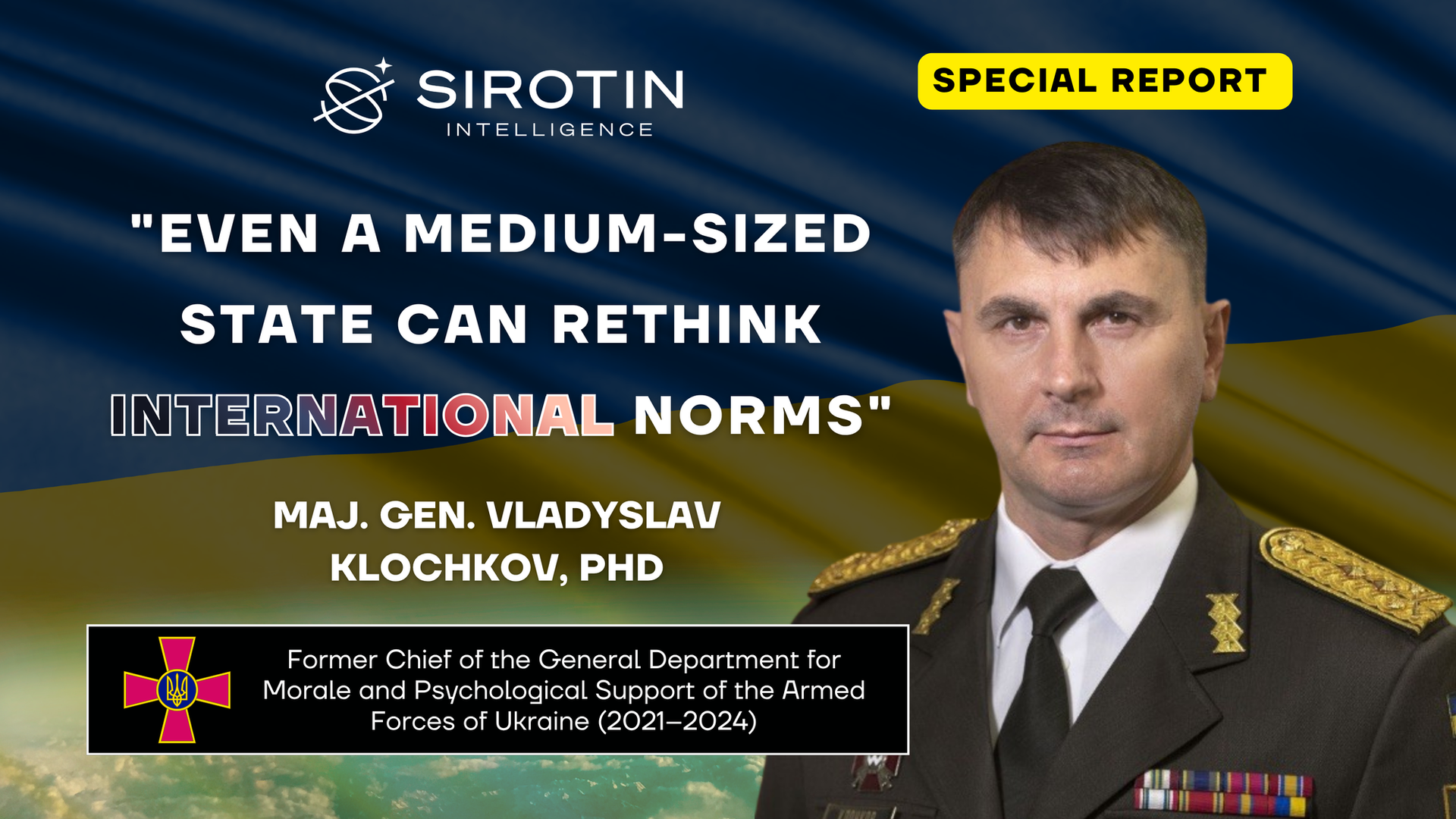
"Even a Medium-Sized State Can Rethink International Norms": Major General Vladyslav Klochkov, Former Chief of Moral-Psychological Support for Ukraine's Armed Forces, on Ukraine's Transformation from Buffer Zone to Subject of the New World Order

On March 16, 2022, three weeks into Russia's full-scale invasion, Ukraine's power grid was formally synchronized with the European Network of Transmission System Operators for Electricity. The project had been years in development, scheduled for 2023. Instead, a test run that began days before the invasion was made permanent while missiles were falling on Kharkiv.
The event rarely appears in war coverage. It's the week Ukraine moved out of the post-Soviet energy system it had shared with Russia and Belarus for decades and plugged directly into Europe's. The European Parliament granted Ukraine candidate status that same month. NATO initiated the largest reinforcement of its eastern flank since the Cold War. A country was being absorbed into European institutions while the defense of its territory was still being negotiated.
The speed and direction of that absorption is the subject Major General Vladyslav Klochkov has spent much of 2025 and early 2026 analyzing. Readers will know him from two earlier conversations in these pages. The first, published in September 2025, concerned the tactical architecture of Ukrainian psychological operations under fire. The second, published in March of this year, adapted his roundtable address arguing that the world had entered a Third World War with Ukraine at its center. This conversation returns to that thesis at a different altitude. Klochkov has extended the analysis into a full structural assessment of Ukraine's place in the emerging global order, drawing on his research at American University Kyiv and his editorial work on Rebooting the World Order 2022, the 337-page analytical volume he compiled for the Research Center of the General Staff of the Armed Forces of Ukraine.
The exchange below has been edited for length and clarity.
You have written that Ukraine has moved from being perceived as a "buffer zone" to becoming a central actor in European and world politics. For American readers, what does that shift look like in practice, and why did it take until 2022 for the rest of the world to see it?
Klochkov situates the question in a longer arc. Ukraine, he notes, has held strategic significance for as long as there has been a Europe to contest. From Kyivan Rus, which served as a commercial corridor between Europe and Asia, to the overlapping ambitions of the Polish-Lithuanian Commonwealth, the Ottoman Empire, and Muscovy, the territory has sat at the intersection of multiple civilizational projects. In the twentieth century, Ukrainian lands were the central arena of World War II and the industrial and agricultural engine of the Soviet Union. The question was never whether Ukraine mattered. The question was whose interests its mattering was being organized around at any given moment.
"Ukraine has always been a space where the interests of great powers intersected," he writes. Its territory falls within what Halford Mackinder called the Heartland in his 1904 essay "The Geographical Pivot of History," the central zone of Eurasia whose control, in Mackinder's framing, determined control over world politics. Zbigniew Brzezinski updated the formulation in 1997 with the sentence that has since become inescapable in any serious discussion of Russian imperial logic: "Without Ukraine, Russia ceases to be an empire." To most American readers at the time, it read as an interesting geopolitical observation rather than as a working thesis about what was coming.
What changed in 2022 was not Ukraine's geopolitical weight. It was the rest of the world's willingness to acknowledge it. For decades, Ukraine was treated as a variable in someone else's equation, a space across which larger powers worked out their calculations. The Revolution of Dignity in 2014, followed by the annexation of Crimea and the beginning of the war in Donbas, began to shift that framing. It took the full-scale invasion, and the unexpected fact of Ukrainian resistance holding through the first weeks, to complete it.
"Faced with the obvious threat of total destruction, Ukraine organized itself, united, and gave battle," Klochkov writes, "as a result of which the significantly more numerous and seemingly more powerful enemy quickly retreated, reduced its appetites, and, dropping the mask of respectability, resorted to extremely primitive and shameful methods of terror." What the world saw, once that framing cracked, was not only Russia without its mask. It was also Ukraine without its longstanding caricature. The country that had been described for decades as an unstable post-Soviet state with corruption problems and uncertain European credentials turned out to be capable of absorbing the largest conventional invasion since 1945 and reshaping the global agenda from inside it.
The structural point beneath all of this is worth pausing on. Medium-sized states have typically been treated in international relations scholarship as recipients of change rather than drivers of it. The interesting question Ukraine's experience raises is whether that default assumption still holds, or whether the conditions of twenty-first-century conflict, which are networked, informational, and technologically dispersed, have opened a narrower but real space for countries of Ukraine's weight to rewrite international norms by surviving the attempt to erase them.
The full-scale invasion exposed the weakness of the post-Cold War security architecture very quickly. The Budapest Memorandum did not protect you. The UN Security Council was paralyzed because the aggressor holds a veto. What did 2022 actually reveal, and what would a functional replacement need to have?
Klochkov's framing tightens here. The unipolar moment, in his reading, did not end on any single day. It eroded across more than two decades, accelerated by the 2008 financial crisis, the failures of Western intervention in the Middle East, the slow normalization of Russian revanchism, and the rise of China as a serious strategic competitor. The invasion simply made the erosion legible.
"Today we live under the conditions of a Third World War," Klochkov argued in his March 2026 address, "one that takes not a classical, but a hybrid, distributed, and asymmetric form." The war, in his reading, is not one discrete conflict. It is the simultaneous operation of kinetic combat in Ukraine, sustained tensions in the Indo-Pacific, proxy conflict across the Middle East, systematic cyber operations against state and commercial infrastructure, and coordinated economic pressure. The elements look unrelated from inside any one capital. Seen from Kyiv, they are components of a single global confrontation.
The architectural failure that 2022 exposed was not about any single institution. It sat underneath the entire post-1991 order, in the assumption that nuclear-armed great powers would behave as rational actors in a stable system of mutual deterrence and negotiated norms. Russia's decision to invade a nuclear-adjacent country that had given up its arsenal under explicit written guarantees broke that assumption. Over eight million Ukrainians became refugees, according to UNHCR figures. Another five million were internally displaced. The institutions designed to prevent exactly this scenario failed to prevent it.
I asked Klochkov in a follow-up what a functional replacement would look like, and his answer was more cautious than the diagnosis. He is clear that the old categories no longer hold. Regional conflict and great power competition, long treated as distinct tiers of analysis, have merged into a single confrontation operating across kinetic, economic, informational, technological, and cognitive domains simultaneously. What he is less willing to do is predict which specific institutional forms will emerge from the transition. "Currently, various scenarios for the future world order are being formed," he writes, "and leading actors are actively trying to occupy the best positions and create obstacles for competitors." The architecture is being built, in practice, by the actors with the will and the resources to build it. Which actors those turn out to be, and how much voice medium-sized states have in the process, is still open.
What he is confident about is the directional shift. "The world will not return to its former state," he writes. The operational question for democratic states is whether they can coordinate fast enough to shape the change, or whether the shape will be determined for them by the authoritarian coalition he has described as the axis of China, Russia, Iran, and North Korea.
You have described Ukraine's Armed Forces as "Europe's Shield." What does that mean in practice, and how has Ukrainian combat experience actually changed Western military thinking?
This is the section Klochkov answered with the most specificity, and the specificity is telling. The phrase "Europe's Shield" is often treated as rhetorical. In his framing, it is closer to a description of the current security topography.
"The Armed Forces of Ukraine have become 'Europe's Shield,'" he writes, "an instrument for ensuring not only national but also regional security." The immediate mechanism is straightforward. Ukrainian forces are attriting Russian combat power at a rate and scale no other European military could sustain, and doing it in a way that gives NATO visibility into Russian doctrine, equipment performance, and adaptation cycles that would otherwise require decades of intelligence collection. The secondary effect is institutional. Ukrainian combat experience is being absorbed into NATO planning in close to real time. Air defense architectures are being redesigned around threat profiles that Ukraine encounters daily. Ground-based layered air defense doctrine, long treated as a Cold War legacy problem, has become the most actively iterated domain in European defense planning. The procurement pipeline reflects the shift.
Klochkov lists several capabilities Ukraine has demonstrated at scale that NATO militaries are still catching up to. Interception of hypersonic missiles, widely assumed to sit outside the performance envelope of Western air defense systems, has been repeatedly achieved. Adaptation of those systems to threat profiles they were never originally designed for, including mass drone strikes and saturation attacks combining multiple weapon classes, has been demonstrated under sustained operational pressure. The continued functioning of state institutions under systematic infrastructure terror, with the power grid, water systems, and digital services repeatedly targeted over months and years, has produced operational data on societal resilience that no peacetime exercise could generate.
Does the integration go both directions? I raised the question with him directly. His answer treats the relationship as reciprocal but asymmetric. Ukraine is absorbing NATO standards, training protocols, and equipment at scale. NATO is absorbing Ukrainian combat data, tactical innovations, and operational lessons in return. Neither side has finished the integration. But the working vocabulary of European security now includes Ukraine as a participant rather than as a subject.
"In fact, without Ukraine, European security no longer exists as a self-sufficient concept," he states. The claim is a strong one, and it is worth noting how recently it would have been considered an overstatement. Four years ago, most European defense planners would have described Ukraine as a partner or a buffer. Today the question of what European defense looks like without integrated Ukrainian capability has no serious answer inside the alliance.
The Black Sea Grain Initiative turned food into an instrument of hybrid warfare, with direct consequences for populations thousands of kilometers from the front. How does Ukraine's role in the global economy intersect with its role in the global security system?
The grain story is one of those cases where the economic and military dimensions of modern conflict stop being separable. Ukraine provides over ten percent of the world's wheat. When Russia blockaded the ports of Odesa, Chornomorsk, and Pivdennyi in early 2022, the pressure on Ukrainian exports translated within weeks into food security crises across Africa and parts of the Middle East. Rising food prices then fed directly into inflationary pressure in developed economies, which in turn fed into political pressure on incumbent governments in capitals thousands of kilometers from the fighting.
Klochkov frames this as a demonstration of how the old distinctions between military and economic warfare have collapsed. "The grain blockade demonstrated that the war in Ukraine has not only regional but also global dimensions," he writes. "Ukraine's security is a component of global food stability, and the protection of Ukrainian ports and transport corridors is a matter not only of national defense but also of international security."
The Istanbul Agreement, signed in July 2022 between Ukraine, Russia, Turkey, and the UN, restored a partial export corridor. It also showed the structural limits of negotiated arrangements with an aggressor willing to suspend participation unilaterally. Russia did exactly that in July 2023, citing a drone strike on Black Sea Fleet vessels in Sevastopol, and the agreement effectively collapsed. Ukraine then opened a separate humanitarian corridor under its own security arrangements and continued exports at reduced but meaningful volumes.
The political dimension deserves its own attention. Klochkov notes that Russia attempted throughout 2023 and 2024 to position itself as an anti-colonial power courting the Global South, arguing that Western sanctions rather than Russian blockades were responsible for food insecurity. The argument had some success in specific capitals, particularly in parts of Africa where post-colonial framings retain political purchase. Ukraine's counter-narrative, connecting Russian aggression to the Holodomor and positioning Ukraine as a victim of imperial food weaponization rather than a Western proxy, was more successful over time but required sustained diplomatic investment. The Grain from Ukraine humanitarian initiative, launched on the 90th anniversary of the Holodomor in November 2022, has since delivered grain directly to countries facing acute food crises.
The broader point Klochkov is making is that in this war, economic instruments and military instruments function as coordinated applications of pressure against the same target rather than as parallel tracks. The target, as he put it in March, is states as systems, meaning populations, economies, and societal resilience rather than armies alone. That framing changes what counts as a defense priority. Grain corridors, energy infrastructure, logistics hubs, and payment systems become security assets in much the same way that air defense batteries are.
You have written extensively about the technological transformation of warfare, including AI-enabled command and control, drone swarms, space-based systems, hypersonics, and quantum technologies. What does the next generation of warfare actually look like, based on what you are seeing in Ukraine?
This is the most technical section of Klochkov's work, and it is also where his framing aligns most closely with recent Western defense planning. The Department of War and several NATO procurement documents describe similar force design priorities, though usually without the same degree of consolidation into a single doctrinal picture.
The core shift, as Klochkov describes it, is the dissolution of the classical distinction between front and rear. "Instead of traditional front operations, where strikes are exchanged, and rear areas, where forces remain in relative safety, the entire theater of operations becomes a place of simultaneous combat operations," he writes. Non-contact combat becomes the default rather than the exception. Precision fires at operational and strategic depth, enabled by integrated reconnaissance-surveillance-targeting networks, replace much of what used to require ground maneuver.
Several technology categories are driving this. Artificial intelligence in command and control, initially deployed for anomaly detection and logistics optimization, is moving into decision support for targeting, particularly for time-sensitive engagements against moving targets. Autonomous and semi-autonomous unmanned systems, initially concentrated in the aerial domain, are proliferating across ground, maritime, and subsurface applications. Drone swarms, in Klochkov's framing, are approaching a scale and operational tempo at which human operators can no longer maintain awareness of individual platforms, only of aggregate effects. Hypersonic weapons compress decision cycles to the point where pre-engagement detection and automated response become the only viable defense.
The space domain sits at the center of all of it. "Military forces' ability to operatively and effectively execute their missions now depends on space," Klochkov writes. Low-orbit and geostationary systems provide the reconnaissance, communications, and positioning layers on which everything else rests. The proliferation of commercial constellations has made precision strike and integrated air-space-cyber operations accessible to states that would previously have required decades of indigenous capability development. It has also made those constellations attractive targets, which in turn is accelerating investment in counter-space capabilities across the alliance.
Quantum technologies are on a longer timeline but carry strategic weight disproportionate to their current readiness. Quantum sensing offers precision navigation independent of GPS, which matters increasingly as GPS denial becomes standard in contested environments. Quantum computing, when it reaches operational scale, will reshape the cryptographic foundations of everything from battlefield communications to financial systems. Klochkov treats both as capabilities to track carefully over the next decade rather than as near-term operational factors.
The through-line in his analysis is that the character of decisive engagement has changed. "The ideal future war is a rapid complex operation in the first minutes of war under unified command before completion of enemy strategic deployment," he writes. The state that can move from detection to effect inside the adversary's decision cycle wins. This places enormous premium on persistent awareness, resilient networks, and autonomous response, and it places equally enormous premium on societal resilience as the backstop when the first move does not prove decisive.
Worth noting, too, that the technologies Klochkov is describing are not hypothetical. They are being operationally tested in Ukraine, iteratively, against a peer adversary with deep resources. The feedback loop between battlefield deployment and design refinement is measured in weeks rather than years. For anyone tracking where defense innovation is actually happening in 2026, the answer is not in any single Western capital. It is in a distributed ecosystem of Ukrainian units, startups, partner defense industrial bases, and allied labs, producing operational lessons at a tempo that peacetime development cycles were never designed to match.
The demographic cost of this war is staggering. Millions displaced, birth rates collapsing, hundreds of thousands killed or wounded. How does demographic resilience actually connect to national security, and what does a realistic recovery strategy look like?
This is the section Klochkov writes most carefully, and with reason. The numbers are difficult.
Before the invasion, Ukraine already had approximately 851,000 war participants from the years of conflict in Donbas. That number now stands at approximately 1.3 million and continues to rise. Klochkov projects that if the war is not stopped, Ukraine will have approximately five million veterans, roughly twenty percent of the population. Including immediate family members, thirty percent of the population will fall under veteran benefits and support systems. The average age of a currently serving member of the Armed Forces of Ukraine is 44 years.
The demographic picture beyond the military is equally strained. UNHCR figures place the number of Ukrainian refugees in Europe at over eight million, with another five million internally displaced within Ukraine. Birth rates have dropped by nearly half compared to pre-war years. Mortality is rising both from combat and from deteriorating access to medical care under sustained infrastructure pressure. A meaningful share of refugees, particularly women with children who have integrated into European educational and social systems, may not return.
Klochkov treats the demographic question as a national security problem of the first order rather than as a separate humanitarian file. "The combination of low birth rates, high mortality, and migration outflow threatens a significant reduction in Ukraine's population," he writes. The downstream consequences extend into labor markets, healthcare systems, and mobilization potential. The country that emerges from this war will need enough people, with enough skills, to both rebuild and defend what it has rebuilt.
What he proposes is a strategy with four integrated components. The first is birth rate stimulation and support for young families. The second is conditions for the return of Ukrainians from abroad, including housing, employment, and educational opportunities. The third is engagement of the diaspora in reconstruction through investment, science, and cultural ties. The fourth is direct integration of migration policy into the national security architecture. None of these are new ideas individually. The point Klochkov is making is that he treats them as a single portfolio rather than as discrete policy areas, and he places the portfolio at the core of post-war strategic planning rather than at its periphery.
The psychological dimension cuts across all of this. Between 25 and 35 percent of people in combat zones show symptoms of post-traumatic stress disorder, depression, or anxiety disorders, according to the estimates Klochkov cites. The information dimension of the war, with constant exposure to destruction and loss through social media, has produced what he calls witness trauma across populations that never physically encountered combat. A functioning recovery strategy, in his framing, has to scale mental health infrastructure at roughly the same pace as physical reconstruction, which is not a pace current systems are designed to support.
The question sitting behind this section is uncomfortable. A nation can win a war militarily and lose it demographically. Which of those outcomes looks more likely for Ukraine depends substantially on decisions being made now, in the middle of the conflict, about what kind of state is being rebuilt and for whom.
Looking ahead, what are the most plausible scenarios for Ukraine's place in the post-war order, and what actually determines which one we end up in?
Klochkov outlines three scenarios that he treats as genuinely open.
The first is complete Euro-Atlantic integration, with Ukraine as a full EU and NATO member, its security architecture formally embedded in Western collective defense, and its reconstruction financed through a combination of international investment and domestic capacity. This scenario requires sustained Western political will across multiple election cycles, successful institutional reform in Ukraine particularly around judicial independence and anti-corruption mechanisms, and a post-war settlement that prevents Russia from litigating the conflict indefinitely through frozen-conflict dynamics.
The second is prolonged confrontation, with Ukraine operating effectively as a permanent frontier state, integrated with but not fully inside the Western alliance system, carrying disproportionate defense burdens in exchange for partial security guarantees. This scenario emerges if political fatigue in Western capitals outpaces the pace of institutional integration, or if Russian domestic politics force Moscow into sustained low-intensity pressure short of renewed full-scale operations. Klochkov treats this as the most likely near-term outcome, which is not the same as describing it as a desirable one.
The third scenario is Ukraine's emergence as a new regional center of power in Eastern Europe, anchoring a broader security and economic architecture running from the Baltic to the Black Sea. This scenario assumes Ukraine builds sufficient indigenous capability, demographic and economic, to function as a peer rather than as a client within Western structures, and that it uses the institutional and technological experience of the war to project influence rather than merely to recover from it. It is the most ambitious of the three, and Klochkov is careful not to oversell its probability. He does, though, treat it as the scenario that would justify the costs the country has absorbed.
What determines which scenario actually unfolds, in his framing, is a combination of three factors. Scale of Euro-Atlantic integration, which depends on political decisions in Brussels, Washington, and other capitals as much as on Ukrainian performance. Reconstruction economics, particularly whether international aid transitions into investment at sufficient scale, and whether domestic institutions can absorb that investment productively. Strategic subjectivity, meaning whether Ukraine continues to be treated, and continues to treat itself, as an agent in the post-war order rather than as a space on which that order is negotiated.
The variable Klochkov emphasizes most is the third. "Ukraine has already become an integral element of the new world order of the 21st century," he writes. "Its resilience and capacity for strategic self-assertion prove that global norms can be transformed not only under the influence of great powers, but also through the determination of societies fighting for freedom and dignity." This is the argument his entire body of recent work is designed to support. If correct, it reframes how smaller states think about their own agency inside an unstable system.
Author's Analysis
It is 2035. A Ukrainian defense industrial cluster outside Lviv, originally built during the war to co-produce long-range strike systems with European partners, ships its ten-thousandth unit of a new class of autonomous maritime platform. The platform design is the product of a joint program between Ukrainian engineers who gained their operational experience on Neptune systems in the Black Sea between 2022 and 2025, and a consortium of Nordic and Baltic defense firms that have worked with Ukrainian counterparts for over a decade. The cluster employs approximately 40,000 people directly and roughly three times that across its supply chain. A third of its workforce is composed of veterans of the Armed Forces of Ukraine. Another sixth is composed of returned diaspora, many of whom left during the war and came back after 2028 under programs Klochkov's analytical work had flagged as essential.
The cluster's existence is not what most 2026 forecasts would have predicted. It assumes a post-war Ukraine that functions as an industrial peer within European security rather than as a recipient of reconstruction aid, and it assumes a Western procurement environment that treats Ukrainian industrial capacity as integrated with its own rather than as parallel to it. Both assumptions were, in 2026, contested. Both required political decisions that had not yet been made. By 2035, in this scenario, they have been made, and the results are visible in the trade data and the employment numbers and the pace of innovation across the combined defense industrial base.
The scenario also assumes things that could have gone differently. A settlement with Russia that did not permit the conflict to remain indefinitely frozen. Institutional reforms in Ukraine that created conditions for foreign direct investment at scale. Demographic policies that recovered enough of the diaspora and stabilized enough of the birth rate to sustain the workforce the cluster requires. A Western political environment that treated Ukraine as a partner rather than as a file to be managed. None of these were automatic, and several were close to unlikely at the time. The scenario exists in the same probability space as the others that could have emerged from the post-war transition, and its existence is a function of decisions being made, in real time, while Klochkov was writing the analysis that predicted it.
The uncomfortable question his work leaves you with is whether the architecture Ukraine is proving possible, in which a medium-sized state rewrites international norms through a combination of resilience, capability, and strategic subjectivity, will actually be institutionalized by the powers capable of institutionalizing it. If it is, the implications for other medium-sized states facing similar pressure, from the Baltics to Taiwan to South Korea, are substantial. If it is not, the lesson Ukraine demonstrated between 2022 and 2026 may end up as a historical anomaly rather than as a precedent. Who, in 2026, is in the position to decide which it becomes, and on what timeline?
About Major General Vladyslav Klochkov
Major General Vladyslav Klochkov is a distinguished Ukrainian military leader and expert in psychological resilience with over 26 years of service in the Armed Forces of Ukraine. His career represents a unique blend of combat leadership, strategic command, and pioneering work in military psychology and morale support.
Rising through the ranks from platoon commander to Major General, Klochkov has demonstrated exceptional leadership across all levels of military command. His combat experience includes commanding mechanized units during critical periods of Ukraine's defense, culminating in his command of the renowned 93rd Mechanized Brigade from 2015 to 2019 during active combat operations in Eastern Ukraine.
As Chief of the General Department for Morale and Psychological Support of the Armed Forces of Ukraine from 2021 to 2024, Klochkov led transformative initiatives to strengthen the psychological resilience of Ukrainian forces during wartime. His academic contributions include pioneering research on psychological resilience in combat conditions, resulting in five scientific publications, a monograph titled "Psychological Resilience of a Soldier," and ten training manuals on psychological support in military settings.
Klochkov holds a PhD in Public Management and Administration from the National Defense University of Ukraine, where his dissertation focused on "Development of Psychological Resilience in Land Forces Servicemen in Combat Conditions." His educational background also includes advanced studies in command and control, project management, and engineering mechanics from Ukraine's premier military institutions.
A prolific military scholar, his bibliography extends beyond psychological resilience to include analytical work on strategic communications, including "Resetting the World Order 2022," as well as contributions to social and cultural work within the military framework. His expertise has been instrumental in developing NATO-standard psychological support systems and implementing international best practices in the Ukrainian Armed Forces.
Fluent in Ukrainian with proficiency in English and basic Arabic, Major General Klochkov has been recognized with numerous state and departmental awards for his service. Released to the reserve in August 2024, he continues to contribute his expertise to strengthening Ukraine's defense capabilities and advancing the field of military psychology.
His legacy includes not only his combat leadership but also his transformative work in establishing comprehensive psychological support systems that have proven crucial for maintaining force morale and effectiveness during times of unprecedented challenge.
Previous Coverage
- "Modern War Isn't About Territory. It's About Narrative Control", September 4, 2025
- SPECIAL FEATURE: "The Third World War Is Already Underway", March 16, 2026
Get exclusive insights from our network of NASA veterans, DARPA program managers, and space industry pioneers. Weekly. No jargon.