
"We're Building Something That's Never Existed - Controllable, Reversible Cooling Infrastructure a Million Miles from Earth”: Morgan Goodwin, Executive Director of the Planetary Sunshade Foundation, on Engineering Earth's Thermostat from L1

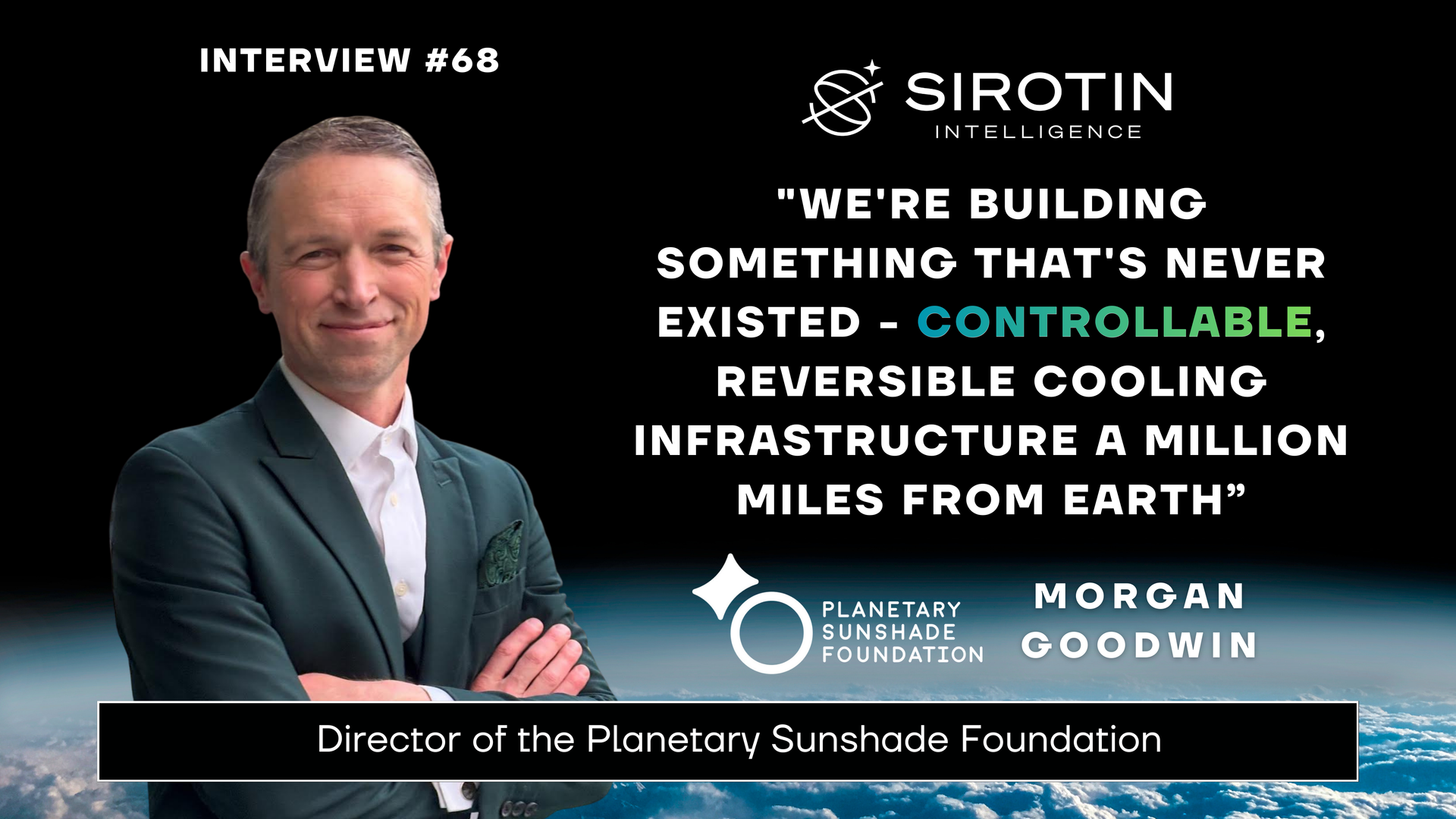
When Mount Pinatubo erupted in 1991, it ejected 20 million tons of sulfur dioxide into the stratosphere. Global temperatures dropped 0.5°C for two years. The planet demonstrated its own proof of concept: blocking a fraction of incoming sunlight cools Earth measurably. Now Morgan Goodwin wants to engineer that same effect with massive structures floating a million miles away in space.
The concept sounds like science fiction but relies on established physics. Position lightweight reflective materials at the Sun-Earth L1 Lagrange point, where gravitational forces balance to create a stable parking spot in space. To reduce the global average temperature by 1 degree C, these structures would be sized to block approximately 1% of incoming solar radiation. Unlike atmospheric aerosols that fall out after months, a sunshade would provide controllable, reversible cooling for decades. Think of it as a planetary umbrella, adjustable based on humanity's needs.
Goodwin brings deep, cross-disciplinery credentials to this cosmic engineering challenge. As Executive Director of the Planetary Sunshade Foundation, he approaches space-based climate intervention with 15 years of environmental organizing experience. He served as Director of the Sierra Club's Angeles Chapter, fighting fossil fuel expansion across Southern California. He advanced clean air policies as Mayor of Truckee, where he also built the town's premier makerspace from scratch, uniting artists and engineers under one roof.
The transformation from stopping pipelines to designing megastructures happened through arithmetic rather than ideology. Three years ago, a colleague asked what warming is predicted by climate scientists, even under best-case emission reduction scenarios. He had to acknowledge the fact that the math is unforgiving. Decades of heating remain locked into Earth's climate system regardless of how quickly humanity decarbonizes. The IPCC reports confirm this: even reaching net-zero emissions tomorrow wouldn't prevent significant additional warming. Climate responds to three variables: greenhouse gases emitted, greenhouse gases removed, and sunlight reflected. Focusing only on the first two while ignoring the third guarantees failure.
Hurricane Katrina first pushed Goodwin toward climate work in 2005. He watched New Orleans drown while UN climate negotiations accomplished nothing meaningful. For years, he mobilized millions through digital campaigns, celebrated victories like the Paris Agreement and the Inflation Reduction Act. Each win mattered. None proved sufficient. The Planetary Sunshade Foundation represents his acknowledgment that atmospheric carbon already commits Earth to dangerous warming that emissions cuts alone cannot prevent.
You spent nine years organizing digital campaigns that mobilized millions for climate action. Now you're advocating for megastructures at L1 to block solar radiation. What made you conclude that terrestrial climate solutions weren't enough? Was there a specific moment when you realized we needed to think beyond Earth?
"I've spent my whole career trying to stop fossil fuel expansion and promote renewable energy," Goodwin begins. The journey started with Hurricane Katrina's emotional impact in 2005, combined with watching UN climate negotiations fail to produce meaningful action. For years, he worked alongside a global community pushing for decarbonization, achieving real victories like the Paris Agreement and the Inflation Reduction Act.
The shift came three years ago through a challenging conversation. "My friend who founded the Planetary Sunshade Foundation asked me, even in a best-case scenario, what do you think is going to happen to global temperatures in the coming decades?" Goodwin knew the climate science well enough that the question forced him to acknowledge the big gap between the climate science and the aspirations of the climate movement. The latest climate models show that even if emissions stopped today, Earth would continue warming for 20-30 years due to thermal lag in the oceans and feedback loops already triggered. "There is a significant amount of warming that's baked in, and even in that best-case scenario, we're going to keep warming for decades."
This forced him to confront climate's fundamental equation. "The climate has really three factors. It's the amount of greenhouse gases that we emit as a civilization, the amount of greenhouse gases that are removed, and then the amount of sunlight that is reflected." The math becomes inescapable. Current carbon removal technologies can extract perhaps 0.01 gigatons annually, while humanity emits 40 gigatons. Even massive scaling wouldn't balance the equation in time. To keep global temperatures below the two degrees specified in the Paris Agreement requires reflecting sunlight, at least in the near term.
The hesitancy around discussing sunlight reflection runs deep in environmental circles. The National Academy of Sciences only recently began recommending research into solar geoengineering, acknowledging both its necessity and risks. Goodwin understands the discomfort but sees past it. "The climate doesn't care about our politics." That realization drove his decision to start working on planetary-scale solutions despite knowing how his environmentalist colleagues would react.
A planetary sunshade could cool Earth at the same scale that humanity is warming it, but who decides when to deploy it? You've worked in local government as Truckee Town Council member and Mayor. How do we create democratic governance for infrastructure that affects all 8 billion humans but exists in no nation's territory?
"I don't know," Goodwin states immediately. "And if you ever come across anyone who knows, either they're a total liar or I'd really like to meet them."
The governance challenge has no precedent. The scale and scope required would match what's needed to keep fossil fuels in the ground or prevent nuclear proliferation. The Montreal Protocol successfully phased out ozone-depleting substances through global cooperation, but that addressed a clearer threat with available substitutes. Climate intervention involves actively managing Earth's energy balance, a fundamentally different proposition.
Goodwin points to history for partial guidance. "The helpful historical analogy, and it's imperfect, but the easiest one that comes to mind is the Bretton Woods agreements." After World War Two, a massive global crisis created space for world leaders to redesign monetary systems and trade frameworks. The Bretton Woods system established the International Monetary Fund and World Bank, creating institutions that still shape global economics 80 years later. The disruption forced cooperation that normal times wouldn't allow.
For climate intervention, Goodwin sees a similar dynamic developing, though he takes no comfort in it. "I'm really scared of what level of climate crisis it would take to actually get people's attention." Recent disasters offer previews: the 2023 Canadian wildfires burned 45 million acres and sent smoke across North America. Pakistan's 2022 floods submerged one-third of the country. Each catastrophe builds pressure for action beyond traditional measures.
The crises will worsen. Political tolerance for climate disasters has limits. At some point, the damage becomes severe enough to force governments to the table. The question becomes whether humanity designs governance frameworks before or after deploying planetary-scale technologies. Waiting for crisis to force action guarantees reactive rather than thoughtful approaches.
The Planetary Sunshade Foundation remains far from deployment questions. "We're still in the desktop research phase. There's no sunshade planned, there's no demonstration mission planned. We are doing conceptual engineering and climate modeling to try and understand whether or not this is even a good idea." The research includes partnerships with climate modeling groups to simulate impacts on regional weather patterns, ocean currents, and agricultural zones.
Many environmentalists oppose geoengineering as a "moral hazard" that enables continued emissions. Having deep roots in the climate movement, how do you navigate this tension? Why should activists who've fought fossil fuels for decades trust space-based solutions?
The moral hazard argument follows predictable logic. If geoengineering provides an escape hatch, fossil fuel companies will use it to justify continued extraction. ExxonMobil knew about climate change in the 1970s but funded denial for decades. Why would they behave differently with a technological safety net?
Goodwin reframes the question through analogy. "Imagine you have a mother that has been smoking her whole life. Your mother says, 'I don't need to quit smoking because there's an emergency room just down the road, so if anything happens, I can just go to the emergency room.' That's a moral hazard." The solution requires the mother to stop smoking and adopt healthy habits. "But you don't really want to argue that there should not be an emergency room there. That's what people who make the moral hazard argument are sometimes implying, that we shouldn't even build the emergency room."
The complexity demands both/and thinking rather than either/or. Recent research from Harvard's Solar Geoengineering Research Program shows that moderate sunlight reflection could reduce climate risks while carbon removal scales up. "I want to know that we have the option to prevent ice sheets from collapsing and prevent the permafrost from thawing. That's why I'm working on this, and that's also why the global governance questions are so important."
Climate activists should engage these questions rather than dismissing them. Early involvement shapes better outcomes than waiting for governments to act during a crisis. "I think that gives people a much more effective hand in shaping them, rather than waiting for the disaster to get bad enough, and then all of a sudden, you have a very reactionary government response that is not well thought through."
Goodwin distinguishes between two methods of reflecting sunlight. Stratospheric aerosols could deploy faster but require constant replenishment as particles fall out after 18 months. The Stratospheric Controlled Perturbation Experiment planned to test this approach before being cancelled due to opposition. The sunshade takes longer to build but provides durable, reversible cooling without ongoing injection. Each approach has trade-offs that activists need to understand rather than reject wholesale.
His message to environmentalists focuses on pragmatism. "Start considering sunlight reflection as a tool in the toolbox, and start understanding the different ways that sunlight reflection can happen, and what their trade-offs and benefits are, because those are the policy questions that are going to be front and center for governments in the years and decades to come." The Climate Overshoot Commission recently recommended similar engagement, acknowledging that opposition without participation leaves critical decisions to others.
China is pursuing both space solar power and potentially sunshade technology. If they deploy unilateral climate intervention capabilities first, what happens to global climate governance? Could solar radiation management become a tool of geopolitical leverage?
"The shared interest that the US and China and every country on Earth wants a stable climate is actually the thing that will save us," Goodwin argues. The global nature of climate intervention creates incentives for cooperation rather than competition.
He points to successful precedents. The International Space Station represents one of the most enduring diplomatic relationships between the US and Russia, surviving decades of political tension. The Outer Space Treaty was signed at the height of the Cold War, yet both superpowers agreed on norms that have proven remarkably durable.
A sunshade affects every country virtually equally. The scale requires resources beyond any single nation's capacity. "It's the kind of thing that lends itself really well to cooperation, because it is so big, it does take so much to do." The physics of orbital dynamics and global climate systems resist nationalization in ways that terrestrial resources don't.
Goodwin hasn't found evidence of Chinese sunshade research, though he actively seeks connections with anyone working on similar concepts globally. The absence of visible competition might actually benefit development. Without a space race mentality, research can focus on getting the science right rather than achieving firsts.
The technology itself resists weaponization or selective deployment. A sunshade can't shade some regions more than others due to orbital dynamics. The cooling effect spreads evenly across Earth's surface. This physical constraint shapes political possibilities in helpful ways.
You created the Truckee Roundhouse makerspace from scratch and built coalitions at Sierra Club. The sunshade requires unprecedented international cooperation. What lessons from grassroots organizing apply to building consensus for planetary-scale infrastructure? How do you get India, Brazil, and Nigeria to agree on global thermostat settings?
"We work at the speed of trust," Goodwin explains, citing a concept that shapes all his organizing work. "Business happens at the speed of trust, collaboration happens at the speed of trust." Trust determines the rate of progress possible in any system. Low trust creates constant friction through demands for transparency, verification, and process. High trust enables rapid collective action.
The lesson emerged painfully during his work building the Truckee Roundhouse. Board members questioned his decisions, demanding approval for routine actions like press interviews. His frustration at their lack of trust created a negative spiral. "We were going really slowly. Every step was two steps forward, one step back."
The breakthrough came through accepting the actual level of trust rather than demanding more. "I learned that I just needed to slow down. I needed to reset my expectations of how quickly we could act." Paradoxically, slowing down to match the trust level enabled faster progress later. Working well together built pride in collective accomplishments, which increased trust, which accelerated decision-making.
Climate urgency creates pressure to move faster than trust allows. "We're all saying, oh my god, we need to go as fast as we can. We don't have time to check in with that person." But attempting to outpace trust guarantees failure. "Taking the time to build trust so that we can take these steps forward that are really solid together, I think, is the only way that we're going to succeed on any variety of global challenges."
The Truckee Roundhouse required artists and engineers to collaborate despite different worldviews and working styles. Digital people and analog people sharing space. The diversity created magic once trust developed. Global climate governance faces similar challenges at planetary scale. Different nations, cultures, and economic systems must find common ground. Trust can't be manufactured or rushed. It builds through consistent actions over time or collapses from single mistakes.
You've seen climate activism evolve from stopping pollution to managing planetary systems. Space solar promises abundant clean energy, the sunshade offers emergency cooling. Are we solving the climate crisis or just enabling humanity to consume at ever greater scales? What does "environmental victory" even mean when we're engineering Earth's energy balance from orbit?
The question cuts to contradictions within environmentalism itself. Goodwin frames the tension through global justice. "Poor countries who have done the least to contribute to climate change are now being told that they can't catch up development wise, that their people are not allowed the same standard of living as those of rich countries."
The Paris Agreement's significance lies partly in acknowledging this inequity. Rich nations must cut emissions first and more drastically than developing countries. But even that framework assumes limits that space-based solutions might transcend.
"If we are in the business of simply stopping industrial activity, degrowth, as some environmental folks think about this problem, we're essentially telling poor countries they are not allowed to do exactly what the rich parts of the world have done." Goodwin finds this neither fair nor politically stable. The alternative requires increasing available energy while eliminating pollution.
"There are ways that we can have this really abundant, flourishing humanity for everyone." Space-based solar power could provide energy without atmospheric impacts. The sunshade could stabilize the climate while development continues. These aren't perfect solutions, but they offer paths beyond the growth-versus-environment deadlock.
Humanity already lives in the Anthropocene, the geological age defined by human impact. "We've already taken it upon ourselves to decide, consciously or not, the climate should be different than it was." Acknowledging this reality enables taking responsibility rather than pretending humans haven't become a geological force.
The philosophical shift proves essential. Instead of asking whether humans should engineer planetary systems, Goodwin focuses on improving quality of life globally. "How can we create the abundance and access to healthy, clean, nice things that we all enjoy?" Victory means everyone accessing prosperity without destroying Earth's habitability. The tools might include orbital megastructures, but the goal remains fundamentally humanistic.
Author's Analysis
Scenario: The Emergency Session, 2034
The virtual UN assembly convenes at 3 AM Geneva time. Nobody planned this meeting. The West Antarctic ice sheet collapsed faster than any model predicted, raising sea levels 11 feet in eighteen months. Miami is gone. Manhattan's seawalls failed last week. Bangladesh lost 30 million people to flooding.
China announces they've already launched the first components of their sunshade constellation. India threatens military action if any nation attempts unilateral climate intervention. The European Union demands immediate deployment of stratospheric aerosols while their engineers design competing orbital reflectors. Brazil insists any cooling must preserve Amazon rainfall patterns. Small island nations just want to know if their children will have homes next year.
Morgan Goodwin watches from California, where his foundation has spent years developing governance frameworks nobody wanted to discuss. The desktop research phase ended when the emergency began. Now governments scramble for solutions they should have prepared decades ago. The trust required for global cooperation doesn't exist. The crisis that might force agreement has arrived, but it brought chaos rather than consensus.
The physical infrastructure could be built. Launch costs have dropped sufficiently. The materials science works. Orbital dynamics are solved problems. But nobody knows who should control Earth's thermostat, what temperature to target, or how to adjudicate between nations with opposing climate preferences. The same governments that couldn't agree on emission reductions now must agree on planetary engineering.
This scenario isn't prediction but extrapolation from current trajectories. Every month of delay makes orderly governance less likely and emergency deployment more probable. Goodwin's recognition that "we work at the speed of trust" collides with climate physics that accelerate regardless of human relationships.
What happens when the emergency room must be built during the heart attack? If trust takes decades to develop but climate tipping points arrive in years, which timeline wins? When China, India, and the United States disagree on planetary temperature settings, who breaks the deadlock? Does waiting for sufficient crisis to force cooperation guarantee the crisis becomes unsurvivable? Perhaps most critically: if environmentalists refuse to engage with sunlight reflection while others race ahead with deployment, haven't they already lost the fight for responsible governance?
About Morgan Goodwin
Morgan Goodwin, Executive Director of PSF and project lead, brings 15 years of experience in climate policy. He most recently served as the Director of the Sierra Club's Angeles Chapter, advancing policies for clean air, clean water, and protected wild places in Southern California. He served as Mayor of Truckee, California, where he also led the creation of the region's premier makerspace. His leadership spans global climate campaigns, local policy initiatives, and organizing within the space community to address global warming.
For more information about the Planetary Sunshade Foundation's research into space-based climate intervention, visit planetarysunshade.org.
Get exclusive insights from our network of NASA veterans, DARPA program managers, and space industry pioneers. Weekly. No jargon.