
"You Can Have All the Money and Still Fail": Space Historian Samuel Coniglio on the DC-X, the Death of Beal Aerospace, and 30 Years of Watching Space Dreams Collide with Reality

They leased the rocket engines.
In 1991, when McDonnell Douglas needed four RL10-A5 engines for the Delta Clipper Experimental (DC-X), they could not afford to buy them outright. So they negotiated a rental agreement with Rocketdyne. The engines flew twelve times between 1993 and 1996, proving that rockets could take off and land vertically, over and over again, two decades before SpaceX made the concept famous. When the program ended, the engines were returned. According to Samuel Coniglio, who worked on the project as a young technical writer, the engines are still sitting in a Rocketdyne office in Florida.
That detail says something about the early days of commercial space. The people trying to change how humanity reaches orbit were scrounging for parts. They held daily meetings across four time zones where decisions that would take NASA months happened before lunch. Sometimes they bought components at Walmart. The DC-X cost roughly $60 million total and flew from White Sands Missile Range in New Mexico, controlled by a crew of three people in a mobile trailer. Former Apollo astronaut Pete Conrad pushed the launch button. On July 31, 1996, a landing gear failed to deploy on the twelfth flight. The rocket tipped over and burned. NASA had just announced the X-33 program, awarding the contract to Lockheed Martin instead of McDonnell Douglas despite the latter having a working prototype.
Samuel Coniglio was 23 years old at the time, fresh out of the University of Central Florida with a degree in technical writing, working what he calls his "dream job" at Kennedy Space Center. He was documenting payload processing systems for the Space Shuttle while also developing documentation for a radical new concept: a mobile Flight Operations Control Center for a test rocket that would take off and land repeatedly. He did not know it at the time, but he was witnessing the birth of an industry that would spend the next three decades struggling to be taken seriously.
What followed was thirty years of attending conferences, documenting failures, and watching NASA administrators dismiss space tourism as a joke. He ended up working for several famous tech companies in Silicon Valley, because he could not get a job in the space industry full-time. “All they want are engineers,” he joked. On the side, when he is not tinkering on kinetic art projects, he does presentations on space tourism and the private space industry, and maintains a comprehensive informal archive of NewSpace history. His Substack newsletter, written under the name "Spaceman Sam," chronicles the companies that tried and failed, the turning points that actually mattered, and the ones that turned out to be hype.
He was in the conference room in 1999 when Dennis Tito first met Rick Tumlinson, a meeting that would lead to Tito becoming the first space tourist in 2001. He ran logistics for the film crew documenting SpaceShipOne's X Prize victory in 2004. He designed a zero-gravity cocktail glass based on fluid dynamics principles from rocket fuel tanks and spent years trying to test it, running into the same barrier every time: no alcohol allowed. His first book, Creature Comforts in Space, tackles the human factors that NASA has largely ignored. His second book, currently in progress, will compile what he calls "a roll call of the dead," a chronicle of the companies that came and went.
What Coniglio has learned, as a witness to history, is that the reasons space companies fail rarely have to do with engineering.
You were at McDonnell Douglas in the early '90s when the DC-X was proving reusable rockets could work. SpaceX and Blue Origin now cite it as direct inspiration. What did you see from inside that program, and what went wrong politically that killed it?
"The Delta Clipper Experimental was both an inspiration and a heartbreaking experience," Coniglio begins. "Here I am, fresh out of college in 1990, working my dream job in the space industry. I was a technical writer for McDonnell Douglas at Kennedy Space Center. The group I was in managed the payload processing systems for the Space Shuttle and was prepping for the upcoming International Space Station."
In 1991, several members of his department were chosen to join teams across the country for a special Department of Defense project. The DC-X had emerged from the efforts of space activists with key political connections. Max Hunter, science fiction author Jerry Pournelle, and retired Lieutenant General Daniel Graham pitched the concept to Vice President Dan Quayle in 1989. They understood that attaching the project to NASA would doom it, so they found a home instead within the Strategic Defense Initiative Organization, the "Star Wars" program that needed rapid launch capability to deploy satellites.
The contrast between NASA's pace and the DC-X team's approach became clear almost immediately. "I soon discovered the glacial pace of NASA bureaucracy, which made progress extremely slow for every project," Coniglio recalls. "Compare this to the stunning speed of decision-making for the DC-X team: daily morning meetings across four time zones where everyone had a say, and components were begged, borrowed, or sometimes bought at Walmart."
The leased engines capture the culture well. Rocketdyne's RL10 series had been flying since 1963 on various upper stages. McDonnell Douglas could not afford to buy four of the RL10A-5s, so they negotiated a lease. "Who the heck rents out rocket engines?" Coniglio asks. The answer, apparently, is Rocketdyne, if you have the right connections, ask nicely and promise to give them back.
In eighteen months, the rocket and support systems were built in Huntington Beach, California, and delivered to White Sands for testing. The first flight occurred on August 18, 1993. The vehicle rose to 150 feet, hovered, moved sideways 350 feet, and landed on its tail. The whole thing took fifty-nine seconds. Three people in a trailer ran the entire operation.
From 1993 to 1996, the DC-X flew eight times under Department of Defense management and four more under NASA as the upgraded DC-XA. The project kept running out of funding, surviving only through the lobbying efforts of groups like the Space Frontier Foundation. In 1995, NASA was, as Coniglio puts it, "shamed into taking the successful project over, since all of their attempts at space shuttle alternatives had failed."
Then came a political shift. NASA's X-33 program was supposed to develop the next generation of reusable launch vehicles, and on July 2, 1996, the contract was awarded to Lockheed Martin. Vice President Al Gore made the announcement. McDonnell Douglas had submitted a proposal based on their proven DC-X technology; Lockheed Martin proposed an untested lifting-body design with aerospike engines and composite fuel tanks.
"It was pure politics," Coniglio says. "Though no one officially knows why it happened, on the twelfth flight of the DC-X, one of the landing gears failed to open, and the rocket fell over and crashed."
The investigation determined that a helium pressurant line had been left disconnected during pre-flight maintenance. The liquid oxygen tank cracked on impact, feeding a fire that destroyed the vehicle. NASA's Gary Payton, director of the Reusable Launch Vehicle program, declared that they would "declare victory with the DC-XA" and move on.
Lockheed Martin's X-33 would be cancelled in 2001 after spending over $1.2 billion without ever flying. The composite hydrogen fuel tanks kept failing during pressure tests, and the program ended with the vehicle 85 percent assembled and the launch facility 100 percent complete. NASA's total investment was $912 million.
"It was during this experience that I learned about space activism and alternatives to NASA," Coniglio says. "Through email conversations and LISTSERV messages in those early days of the internet, I learned about the Space Frontier Foundation, Space Access Society, and other groups trying to jumpstart commercial space rockets."
You've been involved with the Space Tourism Society since 1996 and helped connect Dennis Tito with the right people for his 2001 flight. What was the hardest part about being taken seriously in those early years when everyone treated private spaceflight as science fiction?
The institutional resistance was direct and sometimes personal. Coniglio recalls a moment at the 1998 Space Frontier Conference in Los Angeles that made the attitude especially clear.
"(Space researcher) Patrick Collins asked NASA Administrator Dan Goldin about releasing a research study on space tourism. Goldin's response was harsh: 'No way are we going to release it. Space tourism is a joke,' or something to that effect." This was the beginning of years of resistance from parts of NASA about acknowledging space tourism's potential. "I have had instances where NASA representatives walked out of meetings when I began to speak about it."
The 1999 conference proved more consequential. "One of my first conferences with the Space Tourism Society was the one where Dennis Tito met Rick Tumlinson. Rick was co-founder of MIRCorp, the first company to lease a space station, the Russian MIR space station. I was merely an attendee at the time, but I witnessed the meeting." That introduction would eventually lead to Tito's flight aboard a Russian Soyuz on April 28, 2001, making him the first paying space tourist.
The documentary Orphans of Apollo captures this period, including MirCorp's efforts to commercialize the Russian space station and Goldin's opposition to Tito's flight. A climatic moment happened when Tito arrived at Johnson Space Center with fellow cosmonauts for ISS training, NASA manager Robert Cabana sent him home, stating they were "not willing to train with Dennis Tito." The Russians at first sided with Tito and refused to enter JSC without him. After some tense negotiations with the cosmonaut’s superiors, the Russians entered JSC and Tito was left behind..
The broader problem was perceptual. "In 1969, NASA landed astronauts on the Moon, and the world's news media proclaimed them heroes. After that, NASA and space became synonymous. Any guy with a nifty rocket idea was treated as a crackpot or had to go through NASA to get it funded."
Coniglio points to names that most people have never heard: Gary Hudson, Robert Truax, Phillip Bono. "Engineers with great ideas and no funding. Gary was the most persistent, and ran several rocket companies into the ground with shoestring budgets. Investors were nowhere to be found in the space arena, because NASA was the star child."
The DC-X flights had inspired a wave of private rocket startups in the 1990s. Most failed. The pattern repeated itself: sound engineering concepts, inadequate funding, no path to market because NASA occupied the entire public imagination of what space activity looked like.
The perception issue extended beyond investors. Coniglio’s research with the Space Tourism Society describes a hierarchy of space-related experiences that are economically viable, yet no one else connected the dots: Earth-based Immersive simulations with computer games, VR, and science centers/planetariums, parabolic aircraft flights, high altitude balloon flights, and finally, sub-orbital and orbital space adventures.:The challenge was convincing anyone that space tourism could be economically viable.
Your book tackles the livability problem that NASA has mostly ignored. You designed a zero-gravity cocktail glass using fluid dynamics principles from rocket fuel tanks. Why has the human factors side of space habitation been so neglected compared to propulsion and life support?
Coniglio's path to designing drinkware for space began, improbably, with an unusual hobby: building cocktail robots for hobby robotics events and for Maker Faires. “It’s fun collaborating with Silicon Valley engineers and Burning Man creative artists,” Coniglio says. He and his friends built machines that mixed drinks in amusing and entertaining ways, while learning about fluid dynamics, peristaltic pumps, and the challenge of moving liquids precisely from one place to another. The first was Cosmobot, a rocket-shaped device that “launched” Cosmopolitans, Cape Cods, and Kamikazes. Then he assisted his wife to build the Tea Engine, a steampunk creation built around a 1928 coffee percolator with Arduino controls and a rotary dial telephone interface. TIKITRON followed: a faux polynesian volcano god with glowing eyes that dispenses a dozen different drinks based on which RFID-tagged idol you drop into its caldera.
Meanwhile, he kept attending space conferences, collecting information, taking photos, making connections. "You keep showing up. You learn things, and they get to know you."
Then astronaut Donald Pettit started doing playful fluid experiments onboard the International Space Station. "He would squeeze out some coffee, let it float, get some chopsticks, grab the coffee blob, and eat it," Coniglio recalls. Pettit eventually developed a zero-gravity coffee cup, a teardrop-shaped open container that uses surface tension and capillary action to manage liquids in microgravity. "Someone who is playing. And that's how science works."
Coniglio saw a connection between his cocktail robots and Pettit's experiments. "Can I combine these two together?" He collaborated with a Hollywood prop maker and a robotics engineer friend to create a cocktail glass version, adding multiple grooves to guide different liquids. The design drew on the same physics used to manage propellant in rocket fuel tanks. The Zero Gravity Cocktail Glass was born.
Testing has proven difficult. "We've been trying to get funding to test it on the Zero-G plane for years, but kept running into the stigma of no alcohol allowed." A company called Made In Space (now part of Redwire), which operated the first 3D printer on the ISS, wanted to see if they could print the glass in orbit. "NASA Public Affairs found out what they were doing. They said no, nothing associated with alcohol, no drinking vessels."
Coniglio formed a company called Cosmic Lifestyle Corporation, and briefly attempted to commercialize the glasses. They had great global media coverage and almost had deals with Virgin Galactic and other vendors. A UK company making a TV commercial "completely copycatted the idea" and created a whiskey glass without the key groove features that make the design work. In the end, the company folded, but the dream lives on.
The broader issue, Coniglio argues, is that NASA's engineering mindset treats human comfort as an afterthought. "NASA is focused on science and exploration. Human comfort is secondary. That is why the ISS looks like a rat's nest of wires, cables, and equipment."
He ticks through the deficiencies. "NASA has done minimal research on improving the human experience onboard the ISS. The kitchen systems are primitive. There are no showers, no laundry, no noise mitigation. Toilet usage is humiliating. Astronaut training, combined with military training, helps the astronaut to just deal with it."
"Something I learned from desert camping, and the astronauts do this too: baby wipes are a good all-purpose cleaner of human bodies and general messes. Do you want to use that for your bath for years?"
The environmental control systems work in the sense that they keep people alive. But the Environmental Control and Life Support Systems (ECLSS) is prone to breaking, and Coniglio's book covers the maintenance challenges in detail.
There are exceptions. Beyond Pettit's coffee cup, the Lavazza ISSpresso was the first espresso machine designed for space. A zero-gravity oven attempted to bake DoubleTree cookies, though the design needs improvement. The Chinese Space Agency introduced an air fryer on their Tiangong space station.
"I believe when the private space stations come online, the human element will be taken more seriously," Coniglio says. "I've been in contact with some of the space station companies and key players in space hospitality. Things will be changing soon."
You've been documenting private space since the early days, including running logistics for the X Prize film crew in 2004. You've seen companies rise and fail. Which moments felt like genuine turning points versus hype cycles?
Coniglio is developing a second book that will address this question directly. He has been compiling what he calls "a roll call of the dead," a chronological record of space companies that came and went, often without the public ever knowing they existed.
Some turning points proved real. The NewSpace movement began coalescing in the 1980s as a loose network of activists and engineers working to educate Congress and investors about alternatives to NASA. The DC-X flights from 1993 to 1996 validated the concept of reusable rockets and inspired dozens of startup attempts. Zero-G Corporation launched in 1993, offering parabolic aircraft flights that made weightlessness accessible to researchers and eventually the public.
Dennis Tito's flight in 2001 opened the door for seven subsequent private astronaut missions to the ISS over the following years. SpaceX's founding in 2002 introduced a company that would eventually transform the industry. SpaceShipOne's Ansari X Prize victory on October 4, 2004, piloted by Mike Melvill and later Brian Binnie, proved that a small team under aviation designer Burt Rutan at Scaled Composites could reach space without government backing.
The year 2021 marked something like a threshold for Space Tourism. Blue Origin, SpaceX, and Virgin Galactic together flew 29 private astronauts that year. It's easy to forget how recently space tourism was still considered a joke.
Other moments looked promising but the jury is still out.. Coniglio is watching eight different companies that announced plans for developing private space stations. "One of them is almost ready to fly and will be flying early next year. The others are in progress, and some of them are distracted, and some of them don't have enough funding."
The current hype cycle, he believes, centers on orbital data centers. "The data centers in orbit, the data centers on the moon. I mean, it's absurd. We haven't even figured out how to send people back to the moon,, and now they're talking about building a data center on the moon already." His theory is that if these projects actually get funded, the infrastructure they require might benefit human spaceflight even if the business case proves dubious. Someone has to be on site to maintain a multi-billion dollar facility.
"My theory is that if we have these other excuses to go up into space, that will encourage funding to help humans learn how to live up there."
He draws parallels to transportation history. "I talk about the airline industry, the cruise ship industry, trains, and automobiles. In the very, very early days, it was just the wealthy. They're the ones that could afford these expensive luxuries. And then eventually regular folks were able to participate. Someone's got to pay the expense of building this stuff."
You mentioned having stories about the challenges of getting the private space industry taken seriously. What's one that hasn't been told?
Coniglio brings up Beal Aerospace, a company that most space enthusiasts have never heard of despite achieving what should have been a significant milestone.
"During the 1990s, a number of space rocket startup companies came out of the woodwork. None of them had enough money to keep their programs going, except for one." Andrew Beal, a billionaire banker and mathematician who founded Beal Bank in Dallas, started Beal Aerospace in 1997 with the goal of developing cost-effective orbital launch vehicles. The company's BA-2 rocket used hydrogen peroxide and kerosene, eliminating the need for cryogenic cooling.
On March 4, 2000, Beal Aerospace successfully tested the BA-810 Stage 2 engine at their facility in McGregor, Texas. At 810,000 pounds of vacuum thrust, it was the largest liquid-fueled rocket engine built since NASA's Saturn V.The company had funding, proven technology, and a clear path forward.
Seven months later, they shut down.
"Beal Aerospace ceased operations on October 23, 2000, only a few months after their successful test firing," Coniglio explains. The reason had nothing to do with technical failure. "Beal's worst fear was having to compete with government-subsidized launcher programs. 'No one can compete with an endeavor subsidized by the U.S. government,' he said."
NASA had announced the Space Launch Initiative, allocating $290 million initially with nearly $5 billion planned over five years for government-backed launch systems. Beal looked at the competitive landscape and concluded that private money could not win against public subsidy. Rather than slowly bleed capital in an unwinnable fight, he wrapped up operations entirely.
"The only legacy left behind is that the McGregor, Texas rocket testing facility was sold to SpaceX in 2002." The same site where Beal proved his technology worked is now where SpaceX tests its engines.
Coniglio sees Beal's story as a pattern that keeps repeating. "Most people just don't know that these private companies exist. Most people have never heard of these private space companies trying to do new things."
He mentions other examples. Masten Space Systems, inspired by the DC-X, built a reusable vertical landing rocket that flew hundreds of test flights. The company secured some Department of Defense contracts and a NASA lunar lander contract but filed for bankruptcy in 2022. XCOR Aerospace, formed by engineers from the defunct Rotary Rocket Company, built a reliable, throttleable rocket engine they called the XR-5A and installed it on a composite aircraft from Scaled Composites. The rocketplane flew reliably dozens of times. The company was perhaps 70 or 80 percent of the way to completing a working rocket plane. "They just didn't have the funding to complete it. They stuck through with almost no salary because these guys are fanatics. They wanted to get it done, but people had to get day jobs to pay the bills." XCOR ceased operations in 2017.
Bigelow Aerospace represents another variation of the space startup story. Robert Bigelow, a Las Vegas real estate developer, licensed NASA's TransHab inflatable habitat technology in 2000 and spent twenty years developing it. The company launched two prototype modules into orbit: Genesis I in 2006 and Genesis II in 2007. A third module, BEAM, is currently attached to the ISS. "He was trying to be a real estate developer in space. He had the technology that could do it. He had the funding to do it. The problem was there was no transportation available to bring people there." The company laid off all employees in March 2020 during the pandemic.
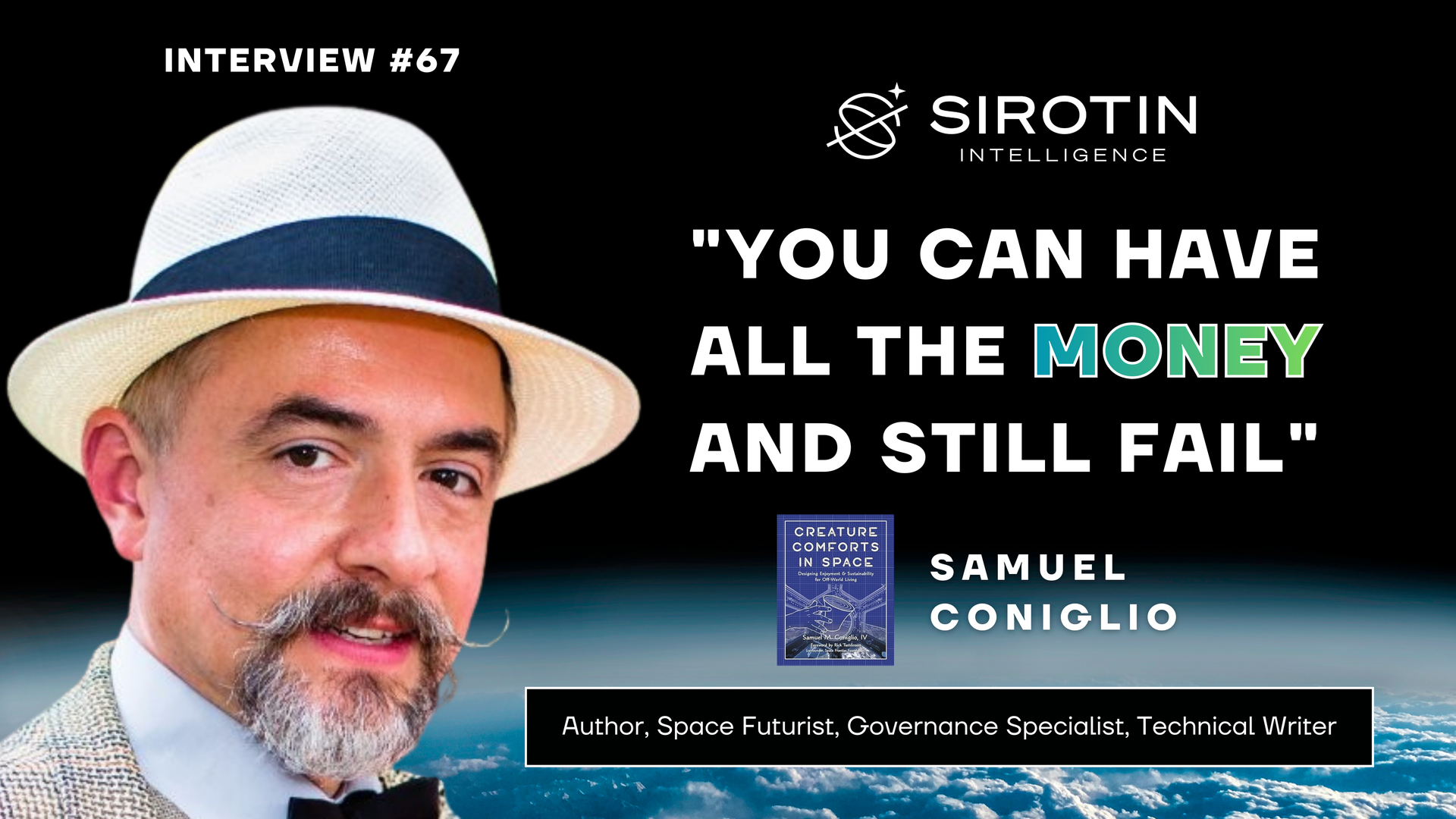
"You can have all the money and still fail," Coniglio observes. "It's timing."
Author's Analysis
Scenario: Low Earth Orbit, 2035
The station bar opens at 18:00 UTC. The module is small, perhaps the size of a shipping container, but the viewport spans nearly the entire wall. Earth rotates below at 17,500 miles per hour, though inside everything feels still.
Samuel Coniglio, now approaching seventy, is attending the first week of commercial operations for the orbital hospitality module. He has been waiting for this moment since 1996, when he first learned about the Space Tourism Society. His zero-gravity cocktail glasses are part of the bar service. It took thirty-nine years, but someone finally tested them on a parabolic flight and proved they work.
The glasses have multiple grooves that guide liquid toward the drinker's lips using surface tension and capillary action, the same physics that manages propellant in rocket fuel tanks. You can smell the aroma when you sip. This was impossible with squeeze tubes. A guest tries to set her glass down out of habit, then laughs as it drifts gently upward. The bartender catches it with practiced ease.
The guests are paying figures that would have seemed absurd in 2001, when Dennis Tito spent $20 million for a week on the ISS and NASA called it a joke. The rooms are small but comfortable. There are proper showers. The toilet is, for the first time in the history of human spaceflight, not humiliating. These details matter to paying customers in ways they never mattered to government astronauts trained to endure.
The station launched on a rocket that lands vertically and flies again, the way the DC-X proved was possible in 1993. That technology transfer took over forty years. Most of the engineers who built the DC-X are retired or dead. Pete Conrad, who pushed the launch button on the first flight, died in a motorcycle accident in 1999. The McGregor test site where Beal Aerospace proved their engine worked in 2000, then walked away seven months later, is still operational. SpaceX bought it in 2002.
Coniglio has spent four decades collecting the logos and brochures of companies that no longer exist. Beal Aerospace, Rotary Rocket, XCOR, Masten Space Systems, Bigelow Aerospace. Each one proved something could work, then ran out of funding or timing or patience before the market caught up. The log of the dead fills several binders.
The bartender asks if he wants another drink. Coniglio looks at the glass in his hand. He designed it in collaboration with a Hollywood prop maker and a robotics engineer. NASA Public Affairs refused to let anyone test it because it was associated with alcohol. A UK company tried to copy the design without understanding the fluid dynamics.
Through the viewport, the terminator line crosses the Pacific. Day becomes night in the span of a few minutes. Somewhere down there, a young engineer is building something in a garage, attending conferences, collecting rejection letters, waiting for the ecosystem to shift in ways that will make their idea viable.
"Sure," Coniglio says. "One more."
The drink is called the Orbital. The liquid stays where it should, guided by grooves that took thirty years to validate. Outside, the Earth keeps turning.
About Samuel Coniglio
Samuel Coniglio is a technical writer, space historian, and author known in the space community as "Spaceman Sam." He holds a degree in English with a specialization in technical writing from the University of Central Florida and has spent over three decades documenting the private space industry.
Coniglio began his career at McDonnell Douglas at Kennedy Space Center in 1990, where he worked on Space Shuttle payload documentation and contributed to the DC-X Delta Clipper program. He has been involved with the Space Tourism Society since 1996 and has attended and documented many major NewSpace conferences over the past thirty years,
He is the author of Creature Comforts in Space, which addresses human factors challenges in space habitation. His second book, currently in progress, will chronicle the history of private space companies and the repeated cycles of innovation and failure that have characterized the industry.
Beyond his space work, Coniglio is known for building elaborate cocktail-making robots, including Cosmobot, the Tea Engine, and TIKITRON, which have been featured at Maker Faires and private events. His zero-gravity cocktail glass design, developed in collaboration with a Hollywood prop maker and a robotics engineer, builds upon astronaut Donald Pettit's zero-gravity coffee cup research.
He currently works as a governance specialist in Silicon Valley and resides in Vallejo, California, on the edge of wine country, with his wife and son.
For more information, contact Samuel directly on LinkedIn or read his Substack newsletter at spacemansam.substack.com.
Get exclusive insights from our network of NASA veterans, DARPA program managers, and space industry pioneers. Weekly. No jargon.