
"Everyone Owns a Piece, But No One Owns the Seam": Former NASA Technology Maturation Director Niki Werkheiser on the First 3D Printer in Space, the Infrastructure That Decides Whether We Stay on the Moon, and Why She Left NASA to Build MAVE[N]

!["Everyone Owns a Piece, But No One Owns the Seam": Former NASA Technology Maturation Director Niki Werkheiser on the First 3D Printer in Space, the Infrastructure That Decides Whether We Stay on the Moon, and Why She Left NASA to Build MAVE[N]](https://storage.ghost.io/c/88/f9/88f9d38e-dcbd-48ee-ae27-d74c2b4a70fe/content/images/size/w1920/2026/08/Niki-Werkheiser-2.png)
Some careers in space begin with a telescope. Niki Werkheiser's began with a television set in Nashville, in a family that ran on country music, not math, on the April morning in 1981 when the Space Shuttle Columbia lifted off for the first time. What caught her attention, and shaped the next four decades, was how many people it took to fly one rocket.
Werkheiser went on to spend more than thirty years in human spaceflight and emerging technology. She trained John Glenn for his return to orbit on STS-95, established NASA's In-Space Manufacturing program and flew the first 3D printer ever operated in space, architected the Lunar Surface Innovation Initiative and its consortium, and rose to Director of Technology Maturation at NASA Headquarters, where she oversaw more than $1.5 billion in advanced technology investments. In March she turned in her badge after nearly twenty years to found MAVE[N] Innovations, a company built to work in what she calls the seam: the gap between a promising idea and a working capability. She was also a technical advisor on the film adaptation of Project Hail Mary, which has now grossed more than $655 million worldwide.
Our conversation covers the moment that set her course, the story behind the first 3D printer in space and what it revealed about life in orbit, the unglamorous infrastructure that will decide whether we stay on the Moon, the pattern of stalled programs that led her to found MAVE[N], and what Hollywood can do for space that NASA cannot.
How did you know space was your calling? Tell me the story that led you to run a billion-dollar technology portfolio at NASA. Did you always know it would be space?
Werkheiser is one of the rare people who can point to the exact moment it all started, and she has spent years thinking about what actually happened in it.
"I was seven years old, glued to the TV, in the living room by myself. It was the Space Shuttle Columbia lifting off," she said. "Even though I couldn't put it into words as a seven-year-old, I understood at some foundational level that it wasn't about wanting to build rockets, and it wasn't even that I wanted to be an astronaut. It was watching this monumental feat, knowing you had hundreds or thousands of people working across discrete disciplines, coming together for a collective goal. Something in me, even as a child, recognized that this was extraordinary and I wanted to be part of it. I never looked back."
What followed was a plan so thorough it would put most adults to shame. Growing up pre-internet, she researched universities near NASA centers, attended Space Academy twice, and discovered that an hour of course credit from the program qualified her for in-state tuition at the University of Alabama in Huntsville, near Marshall Space Flight Center, which she'd learned took more interns than any other center. "I stalked NASA," she admitted. "This played out over about six years."
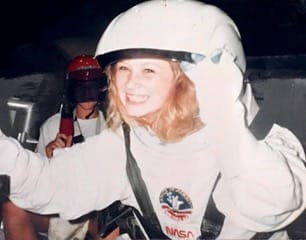
Then the plan fell apart in Washington. Her freshman year was the year the space station survived in the House of Representatives by a single vote, NASA's budget was cut, and the internship program she had spent six years aiming at was suspended. Eighteen-year-old Werkheiser thought her life was over. Instead, students in her campus space group pointed her to one of NASA's university-based commercial space centers, the Consortium for Materials Development in Space, and its director, Dr. Charles Lundquist, a physicist who had worked alongside Wernher von Braun.
"I scheduled an appointment, showed up, and sat at the man's desk while he just stared at me. I said, 'I will mop the floors if you will just let me be here. They cancelled the NASA internships. I just want to do space.' And he quietly got up, went to his bookshelf, pulled down some books, and said, 'I can't pay you anything, but I can teach you how to write a damn good proposal.'"
She worked with Lundquist for ten years, flying shuttle payloads with industry and university partners, and by STS-95 in 1998 she was training the crew, including the 77-year-old John Glenn, on the first commercial bioreactor flown in space. The path from there to a billion-dollar portfolio was, in her telling, never the goal itself.
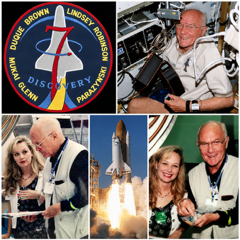
"The real answer is that I love chasing the hardest problems in space, and the hardest problems are almost never purely technical," she said. "The technical is hard, but it's really about getting very different people and institutions not only talking about their common objectives but actually moving in the same direction. Everybody's playing their instruments beautifully, but we have to play off the same sheet of music. And if I'm being really honest, the primary driver has always been that I'm not a patient person. I want constant, measurable progress. That $1.5 billion portfolio is a symptom of that. When you see the patterns and you're determined to navigate them, you produce tangible results."
Tell me the story of putting the first 3D printer in space. How did you get NASA to fly something nobody had ever flown, and what changed after it worked?
"The headline really shouldn't have been about a 3D printer," she began. "It should have been about a spoon and a back scratcher. I'll tell you why."
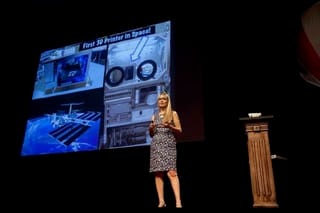
First, the logic, which she insists is the real story. "As cool as the printer is, it's like a computer. It's a tool. It exists because it has a job. The real story was about flipping an overly constrained logistics and supply chain model. Everyone in this business knows that the current model, with orbital replacement units, taking the whole thing up and wholesale replacing it, is not going to work for the Moon, and certainly not for Mars. As we go further from low Earth orbit, we can't take everything we need with us. So the argument became: you can't take everything you might need, so take the capability that lets you make what you need. Make it, don't take it."
The legacy model is more striking than the phrase "orbital replacement unit" suggests. Spares fly, and whole backup systems sit built and paid for on the ground. A failed valve or seal can mean flying up an entire replacement system and flying the broken one home to diagnose. That closes in low Earth orbit. It does not close for the Moon or Mars.
Getting a true first through NASA's gates, she argues, is less about the technology than about taking the fear out of it, one worry at a time. Her line about the agency is one of the more useful I've heard: "NASA is not allergic to innovation. It's appropriately allergic to unmanaged risk. In our world, failure can cost lives. So my big thing has always been not to fight that instinct but to address the elephant in the room. Ask people directly: tell me your biggest fear right now. With the printer, I could get through the engineering, the materials, the nanoparticles. The fears were about the parts. What if a printed wrench pokes an eye out? What if fragments go flying? You hit that head on. You run toward it, not away from it."
The partner on the other side of the table was Made In Space, then a scrappy startup of four or five young engineers. Werkheiser treated the project as a training ground for them as much as a test of the hardware. "The engineering honestly wasn't the biggest challenge. It was the safety process, the interfaces, making all of that repeatable so they could grow and do it on their own the next time. Which they did, wonderfully." The company was later acquired by Redwire, and its founders have since started new companies of their own. "To me, that's as big a success story as the printer."
While the printer had the public's attention, she was quietly building on it. Within the same year she had written the plan for a formal In-Space Manufacturing program, recyclers and multi-material fabrication and printed electronics, matched to realistic budgets and timelines, and won approval to launch it. The printer's first run on the ISS ended with a ratchet wrench designed on the ground and emailed to orbit.
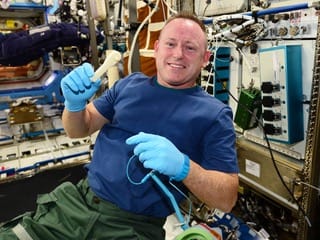
And the spoon? Before the printer flew, Werkheiser sat in an open conference room at Johnson Space Center, expecting astronauts to ask for seals and valve parts. "The first crew member who came in, I asked him: if we could print anything, what would be most useful? He said, 'Could you 3D print me a spoon?' I honestly thought he was messing with me. And he said, no, I'm dead serious. They're each assigned two spoons, the long skinny ones for the food packs. Forks aren't permitted at all, since pointed objects are a hazard once they float loose. And the spoons themselves go missing, sucked into the filters. He told me he once bartered with the Russians to get one of their spoons. And then, I kid you not, at least three quarters of the crew members I talked to brought up the spoon independently."
The lesson repeated itself after the printer reached orbit, when astronaut Butch Wilmore called down from the station and asked whether they could print him a back scratcher; the air on station is dry, and you cannot scratch your back against a wall in microgravity. Her interns designed him one, with interchangeable attachments, and it went through the safety panel like any other part.
"It just reminds you that these are human beings. I came in thinking they'd talk about valve problems. They want to eat, and their backs itch. You can't expect anyone to do their best work without a utensil and a decent night's comfort. It was a really good lesson."
You built the Lunar Surface Innovation Initiative from scratch. What actually decides whether we stay on the Moon, and what are we overlooking?
The initiative began, she says, with almost nothing: Artemis had just been announced in 2019, and NASA's space technology directorate received little more than a paragraph of direction. For over a decade before that, the agency had barely said the word Moon, so surface technology had been stuck at the earliest stages of development. "The gift, really, was the blank sheet," she said. "It forced the right question: what has to exist on the Moon for it to become a place we return to, operate on, and build on, instead of an extraordinary set of one-time visits?"
She is direct about why that distinction matters. "Planting a flag, if it's one mission, is destined for nostalgia and the history books. Staying is what sparks exponential innovation. That's the difference between planting footprints and building foundations."
Her first move went against the grain. The buzzword of the moment was "sustainability," and she watched the community spend two years of forums debating what the word meant. "I purposely steered to the word infrastructure, because infrastructure is the prerequisite before you can even talk about being sustainable. It's the unglamorous capabilities everyone needs no matter who they are or what they're doing. Power. Surviving the two-week lunar night. Dust mitigation. Navigation and mobility. Using the resources already there instead of launching every single gram from Earth. No single one of those will ever be the big headline, but you have to have all of them."
What worries her most sits in between. "We'll have our list of gaps, power, robotics, the finite down-and-in things. I worry about the cross-cutting capabilities, take autonomy, avionics, robotics, that are everywhere and nowhere. Everyone talks about them. Everyone needs them for their thing. But in terms of who owns them, who's making sure the maturity is advancing so they can be infused into each individual use, there are big gaps."
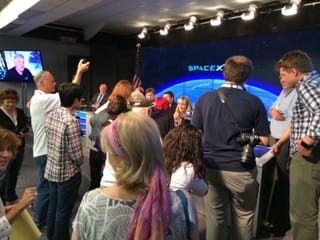
That concern, the unowned middle, shaped the Lunar Surface Innovation Consortium she stood up with Johns Hopkins Applied Physics Laboratory as facilitator. APL was chosen precisely because it had no competitive skin in the game, and one of its quiet jobs was stripping the names off hard questions. "When NASA puts out a big solicitation and you're a company that doesn't know how to do plume-surface interaction, it's really hard to write back and say, I need help. You don't want to show your cards or look less competitive. Having a neutral party in the middle means companies can ask those questions without fearing they won't be selected." Instead of the usual two annual meetings, she set up monthly working groups in each core area and quarterly workshops where the bigger themes surfaced, including an early session on the chicken-or-egg economics of mining resources on the Moon, where her answer was simple: the government must be the anchor tenant, the paying first customer for capabilities not yet profitable for industry. By the time she left, the consortium she started from that single paragraph had grown to thousands of participants across more than a thousand organizations and dozens of countries.
"The Moon punishes stovepipes," she said. "We're great at funding a brilliant component. We're much less organized to make sure the component shows up at the right time, connects to the rest of the architecture, has a customer, has a ride, and fits an economic model that outlives the demonstration."
There is a second thing she believes we overlook, and she raised it unprompted: the rules and ethics of what the new economy makes possible. Recent regulatory changes have opened up areas like microgravity pharmaceutical research and organoids dramatically, and she sees a familiar pattern forming. "We're good at asking, can we? We're a lot slower at asking, how should we? Questions of health and ethics and who gets access risk becoming an afterthought. It goes back to the printer: get ahead of the big questions, hit them head on, so the pathways to real commercialization open up and are viable."
After nearly two decades wearing the NASA badge, you left in March to start MAVE[N]. Why now? What did you keep seeing get stuck between the idea and the program?
Her answer began with a distinction that will stick with many readers. "For me there have always been two NASAs, and I love them both. One of them, whose badge I wore for nearly twenty years, is a physical institution, employees, programs, policies. The other is the one that seven-year-old fell in love with. It's the one recognized around the world, whether people see the meatball or the worm, whether they're five or ninety-five: a symbol for bringing together the bravest and the brightest to do big, hard things. That NASA doesn't have a badge. It doesn't have doors that say enter or exit. It belongs to all of us. So turning in the badge, in my mind, wasn't leaving NASA. Not the part I fell in love with. This feels like moving toward something, not away from it."
The practical reason for the move is a pattern she watched repeat for three decades. "The science can be sound. The engineering teams are amazing. Leadership generally wants the results. And things still stall in the exact same place, because there's no coherent path from the concept to an operational capability. The customer isn't defined early enough. The acquisition mechanism doesn't match the development model. The money arrives at the wrong time. Or the program offices and the technologists are quietly optimizing for different outcomes, using the same buzzwords but not meaning the same things."
She gave one example from deep inside the budget process, the kind most people outside government never see. When a partnership is folded into a federal budget cycle, the president's budget request is embargoed for roughly a year between planning and release. "If something got cancelled or changed in that plan, the company that committed its own internal R&D as your partner doesn't know for a whole year. That's a year's worth of opportunity loss on very limited IRAD. To me, partnerships need completely different protocols than a typical government contract. We are heavily dependent on public-private partnerships and always will be. A true partner is not a subcontractor. But the mental model on the government side hasn't fully accepted that."
Even the industry's favorite metaphor gets cut down to size in her telling. "The Valley of Death has a cool, mysterious sound. It's not. Most of the time it's a very human pileup: unclear decision rights, mismatched incentives, fragmented funding, unresolved interfaces, technical risk nobody has translated into terms the people holding the purse strings can act on. The world is not suffering from a shortage of ideas. It's suffering from a shortage of executable pathways."
Which brings her to the sentence that explains the company. "Everyone owns a piece, but no one owns the seam. And that's huge. That seam is where MAVE[N] is going to live." The company is deliberately small, "me, myself, and I," and its motto came to her in her sleep: turning what's possible into what's real. The work ranges from pressure-testing a company's technology and market plan before investors or agencies do, to building acquisition strategy around a new capability, to stepping in as interim leadership where momentum needs a jump start. Asked why now, she turned the question around. "Honestly, it was, why not now? Everybody's talking about all of it. And it's that thing again. It's everywhere, and it's nowhere."
You've done CNN, SXSW, and worked on Project Hail Mary. What can Hollywood do for space that NASA can't?
"NASA and Hollywood obviously do different jobs, but to me it's a relay team," she said. "NASA takes unimaginable dreams and turns them into tangible science and technology people can see and touch. Hollywood takes logical engineering and sterile hardware and turns them into emotional stories people can experience and feel. You could almost stop right there, because the entire relationship is captured in the gap between seeing something and experiencing it. Between touching and feeling. If English weren't your native language, those words would sound like synonyms. They're not. The difference is instinctual and uniquely human."
Her role as a technical advisor on Project Hail Mary, the Andy Weir adaptation that opened to the biggest debut of 2026, was, as she describes it, less about correcting the story than protecting it. "My job wasn't to turn a story into a textbook. NASA writes the manual. Good science advising protects the magic. It doesn't flatten it. How a person actually moves in microgravity, what an astronaut would really notice, where a moment would yank an expert right out of the story. The accuracy builds trust, and that trust gives the audience permission to follow the filmmaker somewhere extraordinary."
That reach, she notes, is something no agency can match. "The film has grossed over half a billion dollars. That's hundreds of millions of people feeling, for two hours, why this matters. Strip away the science fiction and it's a story about an unlikely friendship. It's a love letter to human ingenuity and connection, which is the same thing that drew me to this field: building on something bigger than ourselves."
She puts the film in a line that runs through Apollo 13, The Right Stuff, Hidden Figures, and The Martian, films that became a shared cultural vocabulary. "It creates memories around technical ideas. And those memories are what create future scientists and engineers before kids even know the name of the profession. So I don't see Hollywood versus NASA at all. You need the tech manual, but you also need the love letter."
Author's Analysis
Set the scene in 2032. An Artemis surface crew is three days from the start of their second lunar night. The power system that will carry them through it was built by one company, the rover that positions it by another, the autonomy software that coordinates the two by a third, and each element performed flawlessly in its own demonstration years earlier. What happens next depends on work that was either done or not done long before launch: whether the interfaces were resolved, whether the shared capabilities nobody owned, the autonomy and the avionics, matured as fast as the hardware, whether the economic model that funded each piece survived contact with a budget cycle. Werkheiser's entire career reads as preparation for exactly this moment, and her warning is that failure, if it comes, will look less like an explosion and more like a schedule slip nobody can quite explain, because everyone owned a piece and no one owned the seam.
What sets her account apart is where she puts the risk: in how institutions are designed, not in how ambitious the engineering is. The pattern she describes, brilliant components funded in parallel while integration goes unfunded because it belongs to no budget line, is hardly unique to NASA; it may be the default for any big effort spread across agencies, contractors, and partner nations. Her consortium was, in hindsight, a governance experiment disguised as a technical forum: a neutral referee, questions with the names stripped off, and a steady rhythm of contact designed to keep hundreds of organizations iterating between conferences rather than singing kumbaya at them. Whether that model can survive its founder's departure, and whether anything like it exists for the commercial side of the lunar economy, are open questions with real consequences.
There is also a quieter bet inside MAVE[N], one worth naming. A one-person company built to own the seam is a bet that the seam can be owned at all, that integration is a skill someone can practice from outside the institutions rather than something that only grows inside them. The history of systems engineering suggests she may be right; the history of government acquisition suggests she will be resisted. Her budget-embargo example makes the point, in part because it is so mundane. Nobody designed a year of lost opportunity into the budget process. It is simply what happens when contract-era habits run partnership-era programs, and no one has both the visibility and the authority to fix it.
The 2032 crew, whoever they turn out to be, will inherit these choices. If the lunar night passes uneventfully, it will be because the unglamorous work Werkheiser has spent a career on, the power and the dust mitigation and the interfaces and the protocols, was funded and integrated and owned by someone, somewhere, on purpose. The spoon story is the human-scale version of the same truth: capability without livability is just a visit, and the work that makes staying possible rarely makes headlines. Which leaves the question her career poses to the rest of the industry, now that she is asking it from the outside: if everyone agrees the seam is where programs go to die, who is actually going to pay for someone to own it?
About Niki Werkheiser
In her 30+ year career, Niki Werkheiser has carried hundreds of novel technologies from bold idea to real, commercial capability - bioreactors, the first 3D printers in space, the first 4G/LTE network on the Moon - including dozens of first-ever demonstrations aboard the Space Shuttle, the International Space Station, and, most recently, the lunar surface. And she never ran those programs from a conference room: she trained astronauts, including John Glenn, on flight technologies, and tested some herself aboard the KC-135 “vomit comet,” where zero gravity is, let’s say, an acquired taste.
But for Niki, it has never been purely about the technology. It’s about what happens when far-out ideas meet the right people, the right resources, and a stubborn refusal to accept “it can’t be done.” That intersection is where breakthroughs are born — and it’s exactly where she’s spent her career: connecting the disciplines and institutions that turn possibility into reality.
As NASA’s Director of Technology Maturation, Niki stewarded more than $1.5 billion in technology investments and public-private partnerships, established NASA’s In-Space Manufacturing Program, and founded its Lunar Surface Innovation Initiative and Consortium. Today she is Founder and CEO of MAVE[N] Innovations, and served as a Technical Advisor on the film adaptation of Project Hail Mary.
Note: MAVE[N] Innovations website is under constructions, but in the meantime my Linked In profile has my contact info and company services one-pager
Additional references:
- AL.com: “Alabama woman was a NASA adviser on Project Hail Mary” (2026)
- Redwire Press Release: “Former Merck and NASA Leader Bring Strategic Expertise to SpaceMD Amid Rising Demand for Its In-Space Pharmaceutical Development Capabilities”
- SIGNAL Magazine (AFCEA): “Wireless Reliability on the Moon” (Mar 2021) — NASA’s 4G/LTE lunar network
- NASA: “NASA to Talk Science, Tech Aboard Next Intuitive Machines Moon Flight”
- Forbes: “Meet the Phenomenal NASA Pioneer doing Whatever it Takes
- TEDx Huntsville: “3D Printing in Space: The Next Frontier”
- Small Steps, Giant Leaps Podcast: NASA’s Game Changing Development Program
- The Atlantic: “Space Is Now a Factory”
- The New York Times: 3D-printed lunar habitats feature (2023)
Get exclusive insights from our network of NASA veterans, DARPA program managers, and space industry pioneers. Weekly. No jargon.