
Sirotin Intelligence Briefing: December 1-5: S4S Marks Two Years as Space Force's Operational Engine, Germany's €35B Space Defense Strategy Signals NewSpace Pivot, ISS Enters Final Five-Year Countdown

This week's Sirotin Intelligence analysis tracks the maturation of U.S. space operations, Europe's accelerating defense pivot, and the ISS transition toward controlled deorbit. U.S. Space Forces – Space (S4S) marked its second anniversary having unified deltas, operations centers, and tactical units into a single operational component for U.S. Space Command. Under Lt. Gen. Dennis Bythewood, S4S has supported operations including June's Operation Midnight Hammer against Iranian nuclear facilities, led multinational rendezvous and proximity operations under Operation Olympic Defender, and served as C2 hub for USSPACECOM's Tier-1 Apollo Griffin exercise. The command also developed its first wartime-prioritized space target list. Across the Atlantic, Germany announced a €35 billion space defense strategy that marks a break from slow, prime-dominated procurement toward responsive launch, resilient constellations, and bodyguard satellites, positioning Berlin as Europe's emerging defense-space leader just as ESA's record €22.1B budget commits the continent to sovereign capabilities for the first time in the agency's 50-year history. The ISS entered its strategic endgame with NASA astronaut Mike Fincke assuming command of Expedition 74 as partner agencies formally plan for controlled deorbit around 2030, with SpaceX holding an $843 million contract for the U.S. Deorbit Vehicle that will guide the station to reentry over the South Pacific. Congressional witnesses warned that beating China back to the Moon remains uncertain given Artemis complexity and Beijing's steady progress toward a 2030 crewed landing, while Jared Isaacman's second confirmation hearing suggested the commercial-space entrepreneur could clear the Senate within weeks to lead NASA. Stanford researchers demonstrated AI-guided motion planning on free-flying ISS robots that generates safe paths 50-60% faster than prior methods, pointing toward more capable autonomous on-orbit servicing. This week also features a special announcement: Space Samurai, a new space trilogy produced by Angelic Pictures with Angelica Sirotin as Executive Producer, is positioned to be the next big space franchise with Universal Studios theatrical distribution committed. Production of the trilogy’s first movie begins in 2026, and the production is opening the floor to companies across the space ecosystem for product placement and brand integration. Lastly, our next guest Guillermo Söhnlein, OceanGate co-founder and Humans2Venus founder, argues that Venus's 91% Earth gravity versus Mars's 38% may determine whether humanity can sustain multi-generational settlements off-planet. He explains why off-world colonies will likely operate under neither democratic governance nor free-market economics.
🛡️ Defense Highlights
- S4S at Two Years: Space Force’s Operational Engine Comes Into Its Own: Marking its second anniversary, U.S. Space Forces – Space (S4S) highlights how it has unified deltas, operations centers and tactical units into a single operational component for U.S. Space Command, delivering integrated effects from missile warning and SATCOM to navigation warfare, EW, SDA and space‑based targeting. Under new commander Lt. Gen. Dennis Bythewood, S4S has supported operations such as June’s Operation Midnight Hammer against Iranian nuclear facilities, led complex multinational rendezvous and proximity ops under Operation Olympic Defender, and served as C2 hub for USSPACECOM’s Tier‑1 Apollo Griffin exercise, including development of its first wartime‑prioritized space target list.
- Quantum‑Inspired Sensing and Space‑Weather Monitoring: Recent UK work on quantum magnetometers and related space‑weather sensing—referenced in parallel coverage of national quantum and space programmes—underscores growing interest in using ultra‑sensitive instruments to protect grids, comms and GNSS from geomagnetic storms. These efforts dovetail with broader military and civil‑defence planning, where space‑borne and ground‑based quantum sensors are seen as a future layer in resilience against space‑weather‑driven infrastructure disruptions.
- AI‑Guided Free‑Flying Robots Point to Autonomous On‑Orbit Operations: A Stanford‑led team has demonstrated a machine‑learning motion‑planning system on a free‑flying robot aboard the ISS that generates safe paths roughly 50–60% faster than earlier methods while running on constrained onboard computing resources. The advance shows how AI‑driven navigation could enable more capable robotic assistants for inspection, logistics, and servicing in cluttered microgravity environments, with clear implications for both civil and defense space operations in future orbital infrastructures.
Major Contract Awards This Week:
- Lockheed Martin Aeronautics – F‑35 Long‑Lead for Lots 20–21: Awarded $1,141,213,934 to fund long‑lead materials, parts, and components for 65 Lot 20 and 133 Lot 21 F‑35s for the Air Force, Navy, Marine Corps, partners, and FMS customers, with work running through December 2030 across U.S., UK, and Italian facilities. This keeps the multinational F‑35 production line and its global supply chain locked in for the late‑2020s fighter fleet.
- Lockheed Martin Aeronautics – Additional F‑35 Long‑Lead (earlier mod on same AAC): Combined with the previously noted $178 million EOQ buy and this new $1.14 billion long‑lead mod, the Fort Worth line is now provisioned for well over 200 additional F‑35s across Lots 20–22, reinforcing allied fifth‑gen airpower and industrial base stability into the next decade.
- BAE Systems Land & Armaments – Armored Multi‑Purpose Vehicle (AMPV) Production Continuity: Received a $198,415,884 fixed‑price‑incentive modification to buy 240 additional AMPVs, preventing a production break and bringing the contract total above $2.47 billion. AMPV is the Bradley‑replacement utility platform that underpins protected mobility, command‑and‑control, and support functions in armored brigades.
- BAE Systems Land & Armaments – Amphibious Combat Vehicle Medium‑Caliber Cannon Variant: Awarded $184,400,905 to exercise options for 30 full‑rate‑production Amphibious Combat Vehicle (ACV) medium‑caliber cannon mission role variants plus fielding, support, and spares, part of a contract with potential up to $3.86 billion. This accelerates Marine Corps transition from legacy AAVs to a more survivable, better‑armed ACV fleet.
- BAE Systems Land & Armaments – M88 Recovery Vehicle Technical Support: Received a $91,324,646 modification for over 700,000 additional hours of system technical and sustainment support for M88A1/A2 Hercules recovery vehicles. These vehicles are critical for recovering heavily armored platforms, including Abrams, in high‑intensity land combat.
- Lockheed Martin – HIMARS/MLRS Fleet Operations and Support: Lockheed Martin Corp., Grand Prairie, TX, awarded $52,000,000 to maintain, operate, and configure HIMARS and MLRS launchers and their parts storage/distribution center through 2031. This sustains core U.S. rocket‑artillery capability and logistics for both U.S. and allied launcher fleets.
- Goodrich (Raytheon) – MQ‑9B Processing/Exploitation/Data Ground Stations for Taiwan: Awarded a not‑to‑exceed $23,403,663 order for MQ‑9B PED ground stations, exploitation software, manuals, FSRs, and installation for Taiwan. This builds out Taipei’s ISR processing backbone to turn MQ‑9B sensor feeds into actionable intelligence within an integrated air‑ and maritime‑domain picture.
- Trident Systems – Enhanced Regional Situational Awareness (ERSA): Won a $30,413,577 SBIR‑based contract to sustain, develop, and refresh the ERSA system, providing advanced maintenance, software development, and analysis for regional situational awareness. ERSA supports Air Force and joint C2 with fused, high‑fidelity regional threat and asset awareness.
- Concurrent Technologies Corp. – Large‑Capacity Energy Storage at Clear Space Force Station: Awarded $17,995,653 to demonstrate advanced large‑capacity energy storage and efficiency technologies at Clear SFS, Alaska, through 2030. This underpins resilient power for missile‑warning and space‑tracking radars in a critical northern site.
- Prism Maritime – MK 38 Gun System Alteration & Repair Team: Prism Maritime LLC received a $93,158,280 IDIQ to act as the alteration/installation team for MK 38 25‑mm machine‑gun systems on Navy and Coast Guard ships (including some FMS), covering ship and ordnance alterations and repairs through 2030. MK 38 mounts are key for close‑in defense against small boats and low‑end unmanned threats.
- Huntington Ingalls – Carrier and Destroyer Engineering & Follow‑Yard Support:
- $36,387,610 mod for Arleigh Burke‑class destroyer follow‑yard support, covering engineering and post‑delivery integration through Nov. 2026.
- $91,891,302 new contract (up to $471,969,850 with options) for Nimitz‑ and Ford‑class aircraft carrier engineering, technical, logistics, and modernization support through 2030.These sustain surface and carrier fleet modernization, availability, and lifecycle planning.
- HII Pascagoula – Shipyard Infrastructure for Distributed Shipbuilding: A cost‑type modification to N00024‑18‑C‑2307 funds long‑term infrastructure investments at Pascagoula in support of a distributed shipbuilding model, running to 2033. This underwrites capacity and efficiency for surface‑combatant and amphib production.
- Northrop Grumman – MQ‑4C Triton IFC‑4 Integration: Awarded $45,752,236 to continue non‑recurring engineering, tooling, and labor to complete Integrated Functional Capability 4 change requests and ECPs into MQ‑4C Triton Air Vehicle B5. IFC‑4 is the key capability upgrade turning Triton into a full‑up, multi‑INT maritime ISR asset.
- Northrop Grumman – E‑2D Advanced Hawkeye Aerial Refueling Retrofit: Received $22,161,472 to keep installing wing center‑section mods and aerial‑refueling retrofits on E‑2D Advanced Hawkeyes. These upgrades extend on‑station time for the Navy’s primary carrier‑borne airborne early warning and battle‑management platform.
- BAE Systems, Nashua – F‑35 Special Tooling & Test Equipment: Awarded $16,658,281 to procure special tooling and test equipment supporting F‑35 production and retrofit modifications for U.S. services, partners, and FMS customers. This quietly supports throughput, quality, and upgrade work across the global F‑35 industrial base.
- Charles Stark Draper Laboratory – Trident D5 Guidance Subsystem Production: Received $9,635,327 for additional Trident D5 guidance subsystem production work, including design analysis, testing, and manufacturing of critical gyroscopic accelerometer components. This sustains the accuracy and reliability of the sea‑based leg of the U.S. nuclear triad.
- Delphinus Engineering – Victoria‑Class Submarine Sonar Bow Array for Canada: Awarded $14,549,938 (up to $36,979,203 with options) for development, production, integration and testing of a bow array and lift system for Canada’s Victoria‑class submarines under FMS. The contract modernizes Canadian sub sonar capability, enhancing NATO undersea warfare.
- CGI Federal – Global Marine Corps Prepositioning Logistics & Data Support: Won a $17,653,994 task order to provide plans, data, logistics services, and software support for the Marine Corps Prepositioning Program across Norway, the Philippines, and maritime prepositioning forces. This underpins forward‑positioned equipment networks critical for rapid crisis response.
- Meridian Medical Technologies – Nerve Agent Antidote Auto‑Injectors: Awarded a max $72,940,000 IDIQ for nerve‑agent antidote auto‑injectors for all services and the Coast Guard. While medical, this is directly tied to CBRN defense readiness and force protection.
🌐 Policy, Geopolitical & Legal Developments
- Why the New Space Economy Risks Leaving Smaller Players Behind:A SpaceNews commentary argues that despite eye‑catching “trillion‑dollar” projections, much of the near‑term space‑economy value will accrue to a small set of mega‑constellations and vertically integrated primes with scale in launch, manufacturing, and capital. The piece warns that many smaller spacetech firms will only survive by focusing on narrow technical niches, leaning into dual‑use government work, or becoming acquisition targets as consolidation accelerates.
- Megaconstellations Threaten to “Photobomb” Space Telescopes’ View of the Cosmos:Nature reports that projected satellite megaconstellations could streak through more than 95% of images for some planned space telescopes, with simulations suggesting up to 96% of future exposures may contain at least one satellite trail. The article calls for coordinated action on brightness limits, orbital regimes, and advanced image‑processing to prevent serious degradation of deep‑sky surveys and precision cosmology from observatories like Roman and its successors.
- ISS Enters Strategic Endgame as Partners Plan Final Five Years and Deorbit:The International Space Station is transitioning to NASA astronaut Mike Fincke’s command of Expedition 74 just as partner agencies formally plan for roughly five more years of operations before a controlled deorbit around 2030. NASA has already awarded SpaceX an $843 million contract for a U.S. Deorbit Vehicle to guide the ISS to a safe re‑entry over the South Pacific, making the coming half‑decade both a scientific sprint and a policy bridge toward commercial LEO stations and a post‑ISS human‑spaceflight architecture.
- Germany’s Space Defense Strategy Signals Big Demand for Dual‑Use NewSpace: A SpaceNews analysis argues that Germany’s new space‑defense strategy and planned €35 billion in spending mark a “turning point” away from slow, prime‑dominated procurement toward faster, more open architectures built around responsive launch, resilient constellations, ISAM, bodyguard satellites and hypersonic/deep‑strike concepts. The piece urges European private investors to match Berlin’s ambition, noting that much of this funding is expected to flow into NewSpace companies providing agile tech for SDA, non‑chemical propulsion, spaceplanes and reentry systems across a pan‑European security architecture.
- Congress Briefed: Beating China Back to the Moon Is “No Sure Bet”: A SpacePolicyOnline report on a House hearing describes rare bipartisan agreement that the United States should not let China land astronauts on the Moon first, but notes witnesses were pessimistic that NASA’s current Artemis architecture can reliably outpace Beijing. Experts pointed to the complexity and tight choreography of Orion–Starship lunar operations and China’s steady progress toward a 2030 crewed landing, warning that without schedule realism and investment in cislunar logistics and infrastructure, the U.S. could lose symbolic and strategic leadership in lunar exploration.
- Isaacman’s Second NASA Administrator Hearing Seen as Path to Quick Confirmation: In a follow‑up confirmation hearing covered by SpacePolicyOnline, senators from both parties largely adopted a cordial tone toward billionaire entrepreneur Jared Isaacman, suggesting his nomination to lead NASA could clear the Senate within weeks after having been withdrawn earlier this year amid a Trump–Musk dispute. Lawmakers pressed Isaacman on issues such as his ties to Elon Musk, leaked “Project Athena” plans for a rapid Moon push, and his views on commercial partnerships, but the overall reception indicated growing acceptance of a private‑sector, commercial‑space‑savvy figure at the agency’s helm during a tight Moon‑race timeline.
- Weekly Space‑Policy Outlook Highlights Busy Hearing and Decision Calendar:SpacePolicyOnline’s “What’s Happening in Space Policy” for November 30–December 6 flags a crowded week of events, including agency briefings, advisory‑committee meetings and international forums focused on budgets, human‑spaceflight plans and security‑related space issues. The roundup emphasizes how congressional recess timing, ESA decisions and China’s crew‑launch cadence all intersect with U.S. planning on ISS transition, Golden Dome missile defense and broader civil‑space priorities.
- China Hands Over Satellite Ground Station, Boosting Namibia’s Space Ambitions:China has officially transferred a satellite ground data receiving station to Namibia, giving the country indigenous capability to receive, process and use satellite data for natural‑resource management, agriculture, disaster response, climate adaptation and anti‑poaching. The handover, part of a 2023–2025 bilateral project that also trained Namibian technicians, aligns with Namibia’s pending Space Science and Technology Bill and a new National Space Science Council, signalling a deliberate move to build sovereign space infrastructure in partnership with Beijing.
🛰️ Technology & Commercial Developments
- BlackSky Expands Gen‑3 Tactical Imaging Constellation with Stealth Electron Mission: BlackSky revealed it was the unnamed customer on a recent Rocket Lab Electron launch from New Zealand, confirming deployment of its latest Gen‑3 high‑resolution imaging satellite into low Earth orbit. The spacecraft extends BlackSky’s rapid‑revisit, sub‑meter imaging and analytics network, which the company says was tasked and delivering data within about a day of launch under a new multi‑year defense ISR contract with a strategic international customer.
- Roman Space Telescope Fully Assembled, Edging Toward Earlier Launch Window:NASA has completed integration of the Nancy Grace Roman Space Telescope at Goddard, mating the spacecraft bus and telescope assembly in the facility’s largest clean room and moving into environmental and performance testing. With its wide‑field infrared camera and advanced coronagraph, Roman is designed to map dark matter and dark energy, detect isolated black holes via microlensing, and discover more than 100,000 exoplanets, with launch targeted no later than May 2027 and possibly as early as late 2026 on a Falcon Heavy to a Sun–Earth L2‑class orbit.
- Rocket Lab’s “RAISE And Shine” to Flight‑Qualify Next‑Gen Japanese Space Hardware: Rocket Lab’s upcoming “RAISE And Shine” Electron mission will loft JAXA’s RAISE‑4 satellite, which carries eight experimental payloads from Japanese companies, universities, and research institutes under the Innovative Satellite Technology Demonstration Program. The spacecraft will test new sensors, subsystems, and on‑board processing technologies in orbit, giving Japanese industry and academia critical flight heritage that can be leveraged into follow‑on commercial and government missions.
- U.S.–Japan Forum Maps Post‑ISS Commercial LEO Playbook: At Rice University’s 2025 U.S.–Japan Space Forum, NASA, JAXA and industry leaders from Axiom, Vast, Blue Origin, Voyager, Mitsubishi Heavy Industries and Japan LEO Shachu outlined how modular commercial stations, diversified launch, and new research platforms will replace ISS-era infrastructure. Speakers emphasized LEO’s shift toward commercially driven models anchored by public‑private partnerships, with Texas and Japan positioned as key industrial nodes in a more networked, U.S.–Japan‑led commercial LEO ecosystem.
- Intuitive Machines and JHU APL Build Low‑Latency Space Data Network for Cislunar Ops: Intuitive Machines detailed its Space Data Network, an in‑space communications, navigation and data overlay designed to provide near–real‑time telemetry, tracking and PNT across lunar and cislunar space by leveraging waveform, navigation and router technologies co‑developed with Johns Hopkins Applied Physics Lab and KinetX. By aligning with NASA’s LunaNet concepts and supporting both legacy and modern payloads via integrated waveforms, the SDN aims to cut data latency from hours or days to near light‑time limits, enabling more autonomous lunar surface operations, hosted payloads and national‑security missions.
- South Korean Space Cluster Expands Industrial and Military Satellite Capacity:Korea IT–linked reporting describes how Hanwha Systems’ Jeju Space Center is emerging as the country’s largest private satellite‑manufacturing hub, paired with development of defense‑grade space semiconductors and higher‑resolution SAR satellites down to 15‑cm class. Together with new multipurpose EO satellites and a growing CubeSat program, these moves are designed to reduce reliance on foreign tech, support a NewSpace ecosystem and strengthen South Korea’s autonomous military ISR and communications capabilities.
- Why Food Tastes So Weird in Space: A popular‑science explainer builds on recent aroma and VR studies showing that microgravity‑induced fluid shifts, nasal congestion and altered spatial perception blunt astronauts’ sense of smell, making food taste dull and reducing appetite. Researchers find that certain sweet, almond‑like aroma compounds (such as benzaldehyde) are perceived very differently in simulated space environments, suggesting tailored aroma profiles could help make space menus more appealing and support astronaut nutrition on long‑duration missions.
- Seraphim Space Investment Trust Rides Spacetech Updraft but Warns on Volatility: Seraphim Space Investment Trust reports a strong rebound in net asset value driven by valuation gains in core holdings such as ICEYE, D‑Orbit and other Earth‑observation, in‑orbit services and connectivity plays, arguing that secular demand for data, climate intelligence and security is underpinning long‑term growth potential. Management cautions, however, that listed spacetech remains highly cyclical and sentiment‑driven, positioning the trust as a way to get diversified exposure to late‑stage private and early public space companies rather than making single‑name bets.
- Starlab Commercial Station Team Adds Leidos, Deepening U.S. Defense Links:Voyager‑led Starlab Space has brought Leidos onto its industrial team for the planned Starlab commercial space station, joining core partners Airbus, Hilton, Northrop Grumman and MDA. Leidos will contribute systems‑engineering, integration and mission‑operations expertise, strengthening Starlab’s pitch to NASA as an ISS follow‑on platform and to defense customers seeking secure, persistent presence in low Earth orbit.
- UC Davis–Proteus “Dynamic Digital Twin” Satellite Reaches Orbit: UC Davis engineers confirm that their AI‑enabled “dynamic digital twin” payload—developed with Proteus Space under a rapid 13‑month design‑to‑launch schedule—has been successfully launched and deployed on a small satellite from Vandenberg Space Force Base. The onboard digital‑twin software continuously models the spacecraft’s power system in real time, predicting battery health and future states so the satellite can essentially “self‑report” its condition, a step toward more autonomous, self‑diagnosing spacecraft operations.
- New Insurance Products Target Fast‑Growing Space Tech Sector: Relm Insurance has launched two specialized offerings – OMEGASPACE, a combined financial, professional and cyber‑tech policy for companies that rely on space‑based signals and data, and NOVASPACE, a bespoke errors‑and‑omissions product for firms in the space supply chain. The move broadens financial infrastructure around the space economy by giving satellite operators, analytics firms and component suppliers tailored coverage for data loss, cyber incidents and contractual risk tied to space services.
- PixArt Becomes First Company Licensed on Space‑Grade Tech by Taiwan Space Agency: PixArt Imaging is the first firm to receive a space‑grade technology license from Taiwan Space Agency under a five‑year Optical Payload Development Program aimed at building a domestic optical‑remote‑sensing industrial base. The initial licensed products – a space‑grade TDI image sensor for follow‑on FORMOSAT‑8 satellites and a CubeSat‑class optical payload module—are designed to meet international CCSDS standards and help Taiwan’s suppliers enter the global EO and small‑satellite supply chain.
- UK Space Agency Injects £17 Million into Next‑Generation Space Innovation: The UK Space Agency is investing £17 million in 17 projects through its National Space Innovation Programme, backing technologies in space domain awareness, in‑orbit servicing and manufacturing, satellite communications, and Earth observation. Officials say the funding, which complements a separate £1.7 billion UK pledge to ESA, is meant to strengthen sovereign industrial capabilities and accelerate commercialisation in a domestic space sector already valued at about £18 billion.
🎬 Star In The Next Big Hollywood Space Franchise

Now's your chance to get in on the ground floor of the next big Hollywood space franchise. Space Samurai is being produced by Angelic Pictures, a Universal Studios Vendor-Affiliate, with Universal Studios theatrical distribution committed. In theaters. On the big screen. Where legends are made. Where E.T. was born. Where Aston Martin became Bond. Where Ray-Ban became cool. The same theatrical distribution that launched Apollo 13 and First Man into the cultural consciousness.
Production begins Q1 2026, and we project a global audience of 38M+ when it hits theaters. This trilogy will be the next major space franchise. There hasn't been a Star Trek since Star Trek. The genre is wide open, the audience is hungry, and the timing is now. Think Die Hard meets Gravity.
Space Samurai: Oasis is set aboard a luxury space station in 2063. A battleground in zero gravity. Secrets buried in orbit resurface. The Cold War never ended; it just moved higher. An unlikely hero rises. Edge-of-your-seat thriller from start to finish.
The underlying message: the things we build to protect ourselves become the things that define us. Innovation is survival. And the nation that leads in space leads the future.
Interested? Contact Angelica directly at angelica@sirotinventures.com.
In Theaters Worldwide
Space Samurai
Oasis Station • 2063
Die Hard meets Gravity
The Cold War never ended — it just moved higher.
An unlikely hero rises.
💭 A Word From Christophe Bosquillon
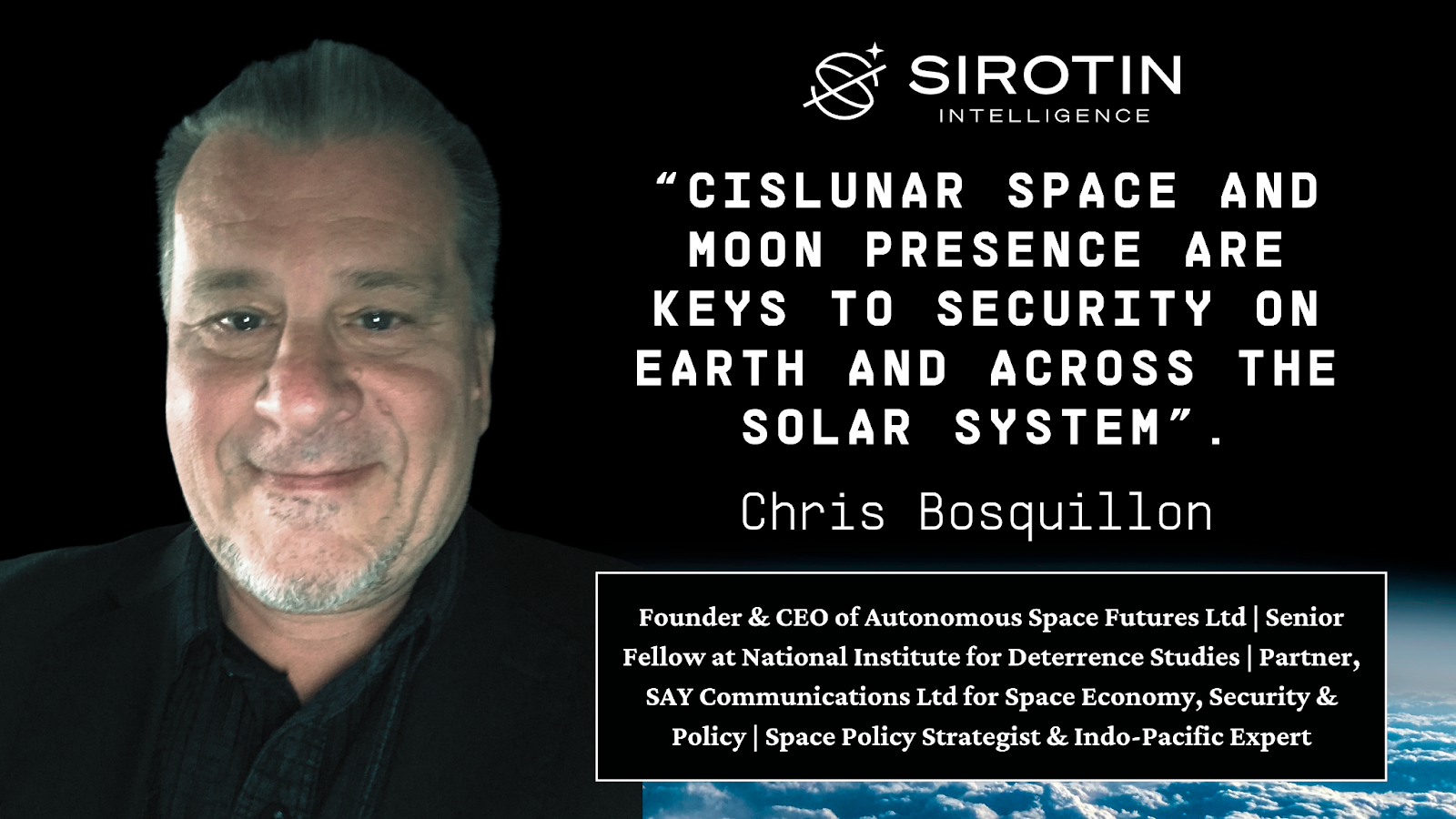
The European Space Agency (ESA) Ministerial pledged a record €22.1B ($25.6 B) for 2026-28, a nearly $6B budget increase, 32% more than the 2022 level (17% once adjusted for inflation). For the first time in its 50 years history, ESA goes boldly into multiple-use technologies for "non-aggressive" defense and security, with the European Resilience from Space program funded at $1.39B.
ESA's largest budgetary effort goes into space launch systems (€4.4B or $5.2B) and secure comms, with the aim to build sovereign and autonomous capabilities away from U.S. dependency. Science got an increase. Exploration got €2.9B, less than ESA’s €3.7B request, but key programs are secured: Mars rover Rosalind Franklin (UK), Artemis involvement with hardware and astronauts, while ESA focuses on its own lunar lander program Argonaut. And the winner is... Germany?While Canada quintupled (x5) its contribution, smaller European member states tripled or quadrupled their ESA budget. Germany leads with a 46% budget increase to just over €5B, representing 23.1% of total ESA funding. France and Italy follow with 14.8% and 13.2% increases respectively. Spain doubled its budget up to 4th place, while the UK dropped to 5th place from 11.2% to 7.7% of total contributions (€1.878B down to €1.706 B). Germany is serious about its leadership in space, and in defense and security in the larger picture. As Russia rearms itself, the balance of power is changing.With the prospect of war on the eastern flank by the 2030's, Germany has put together its (not anymore secret) OPLAN DEU for Operation Plan Deutschland, enabling NATO to move 800,000 troops eastward should the need arise. Roads, railways, bridges, ports, and critical infrastructures whose maintenance for military purposes had been abandoned since the 1991 USSR dissolution, must now be rebuilt to support a NATO-led, Bundeswehr-enabled effort de guerre. If Europe is steadily preparing for a larger conflict across all domains, half-way around the world, Japan readies itself. While ESA will endeavor non-offensive space defense and security capabilities, the agency further seeks international cooperations, leaning toward the best in human nature to prevail through peaceful, safe, and sustainable space exploration. Time will tell.
P.S. The 2025 U.S. National Security Strategy just dropped. Quoting this document, the future of Europe is bleak: "Should present trends continue, the continent will be unrecognisable in 20 years or less. As such, it is far from obvious whether certain European countries will have economies and militaries strong enough to remain reliable allies." We take a stab at this NSS next week – stay tuned.
Have a great space week ahead!
🎤 Our Next Guest: Guillermo Söhnlein
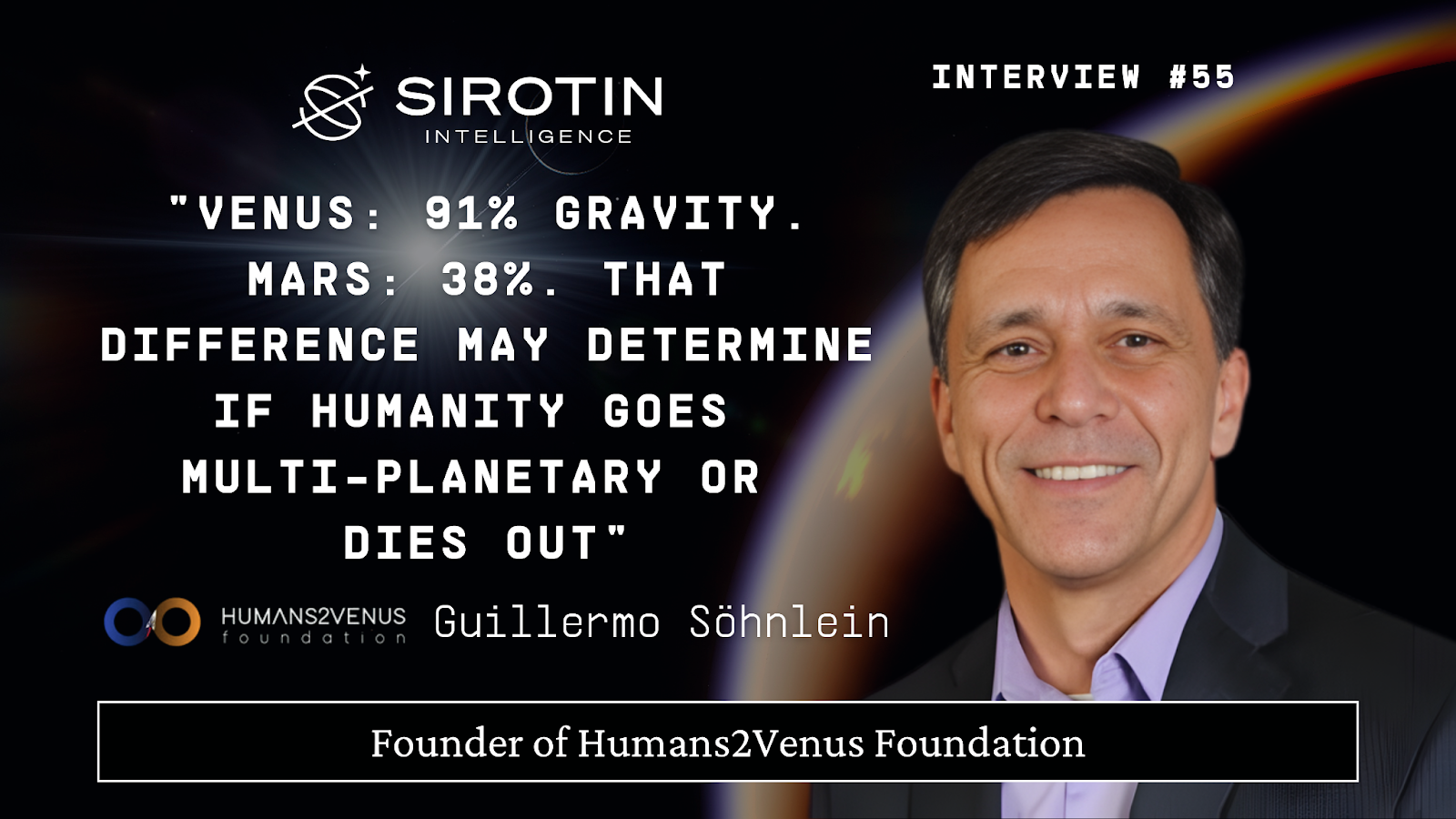
Guillermo Söhnlein is the Founder of the Humans2Venus Foundation, which aims to establish a thousand-person presence in the Venusian atmosphere by 2050. His focus on Venus stems from a problem Mars cannot solve: gravity. Mars offers 38% of Earth's gravitational pull, raising questions about whether humans can reproduce across generations there. Venus offers 91%. No one has conceived, carried a pregnancy to term, or raised a child off-planet. Söhnlein believes the gravity difference may determine whether humanity becomes truly multi-planetary or merely visits other worlds. He is also the author of Titan Unfinished: An Untold Story of Exploration, Innovation, and the OceanGate Tragedy.
Key topics:
- Why Venus's near-Earth gravity addresses reproductive viability questions that Mars cannot answer
- His argument that off-world colonies will operate under hierarchical command rather than democratic governance
- What the Titan incident revealed about who should decide when to put humans into unproven technology
- The ecosystem approach: funding Venus science and education today that points toward floating habitats in 2050
Watch Guillermo's YouTube preview Tuesday on the Sirotin Intelligence YouTube channel. Full interview drops Thursday.
📚 Essential Intel from Our Archives
Missed a beat? These groundbreaking conversations are must-reads
"America Must Build 2,500 Hoover Dams Worth of Space Solar Power or Lose Energy Independence"
Mike Snead reveals why only space solar power can replace fossil fuels at scale, how China's playing the long game while America conducts studies, and why fracking's 20-year window is America's last chance to build orbital energy infrastructure.
"When Mars Rovers Hit Anomalies, They Stop Dead"
Dr. Mark Woods explains why $2.5 billion Mars rovers freeze when confused, how neuro-symbolic AI from the early 2000s still beats LLMs for space missions, and why Silicon Valley is rediscovering 20-year-old solutions to autonomy problems.
"Space Solar Requires 1,000 Times Less Critical Minerals Than Wind and Solar"
Martin Soltau reveals how orbital power stations could deliver £30/MWh energy while breaking China's critical mineral stranglehold, and why controlling space-based power means controlling civilization's future.
"Chemical Lasers Are Out, Solid-State Lasers Failed Too"
Dr. Andrew Motes exposes three decades of directed energy failures, why you can't defend satellites against determined adversaries, and how a golf-ball-sized meteor could trigger the Kessler cascade that ends space access.
"We're Building the World's Biggest Gun to Shoot Refrigerators at Mach 20"
Mike Grace explains why a 10km cannon using Nazi V-3 technology can launch satellites at $10/kg versus SpaceX's $3,000, and how disposable daily satellites make space denial economically suicidal.
"Every Rocket Component, Every Drop of Fuel—It All Moves By Ship"
Bo Jardine reveals why SpaceX barges are billion-dollar sitting ducks, how controlling 21-mile-wide shipping straits determines space dominance, and why a $600 drone beats a $67 million rocket every time.
"We Don't Understand How Interconnected Everything Is Until It All Falls Apart"
Ulpia Elena Botezatu warns that cyber attacks on satellites would suspend modern life—no banking, no transport, no power—while the gap between IT security and space technologists creates the blind spot where catastrophe lives.
"We're Sitting on $100 Trillion and Want to Pay $400 Billion to Throw It Away"
Steven Curtis reveals why nuclear "waste" contains 97% of its original energy worth $100 trillion, how the NRC charges $300/hour to say no to reactors that can't melt down because they're already melted, and why one governor with two minutes of courage could solve our energy crisis.
"We're Playing by 1987 Rules in a 2025 Game"
Former White House space chief Sean Wilson exposes how export controls from 1987 are killing U.S. competitiveness, why China bundles "practically free" satellites with predatory loans, and how satellites "don't have mothers" fundamentally changes space escalation dynamics.
"Modern War Isn't About Territory—It's About Narrative Control"
Major General Vladyslav Klochkov, former Chief of Moral-Psychological Support for Ukraine's Armed Forces, reveals how information warfare determines victory before armies meet, and why the battle for minds matters more than the battle for land.
"We're Traveling with Biological Machinery That Can Melt in Space"
Dr. Ekaterina Kostioukhina, extreme environments physician, explains why human hibernation may be essential for Mars missions, how ground squirrels avoid muscle atrophy during torpor, and why patents on hibernating fish could revolutionize interplanetary travel.
"The Universe Isn't a Machine—It's an Information Processing System"
Theoretical physicist Davide Cadelano presents his Codex Alpha framework where spacetime emerges from quantum information networks, unifying relativity and quantum mechanics through a radical new understanding that treats the universe as a vast computational system rather than mechanical clockwork.
"How Nation-States Could Blind U.S. Intelligence Without Firing a Shot"
Robi Sen reveals how "kindergarten children could take over" most satellite networks, why adversarial ML can make satellites gradually shift their perception of reality, and how the convergence of biological, RF, and space warfare creates nightmares current defense frameworks can't even conceptualize.
"We Can Hit Our Target in Space and Return for Rapid Reuse"
Dr. Robert Statica on building hypersonic aircraft, space-based defense systems, and the race to sub-100 kg space access—revealing how reusable hypersonic platforms could revolutionize both space access and global strike capabilities.
"They Don't Call for Their Parents. They Say 'Long Live the Great Leader'"
Lt. Gen. (Ret.) In-Bum Chun exposes North Korea's transformation into a cyber superpower, why cognitive warfare is the real threat, and the chilling reality of a society where dying children praise their dictator instead of calling for their mothers.
"Space Wars Are Over in 24 Hours—Most People Don't Even Know They're Happening"
Space warfare doctrine pioneer Paul Szymanski reveals mathematical proof that the U.S. lost its first space war to Russia in 2014, exposing how temporal pattern analysis unmasks satellite attacks hidden behind "solar flare" cover stories and why hypervelocity weapons from orbit could render the U.S. Navy obsolete overnight.
"The Grid Is Already a Living System—We Just Don't Recognize It"
Power systems veteran Mike Swearingen explains why treating the power grid as a living, autonomous system isn't science fiction—it's an engineering reality we refuse to acknowledge, and how space-domain tactics can secure the grid of tomorrow.
"The Hidden Power Struggle Reshaping China: Xi Jinping's Dramatic Fall From Grace"
An investigation into China's internal power dynamics reveals how Xi Jinping's grip on power is weakening amid economic turmoil, military purges, and rising opposition within the Communist Party.
"I Patented a Space Airlock That Uses 6,000 Times Less Air"
NASA veteran Marc Cohen reveals his revolutionary Suitport design and four decades of challenging engineering orthodoxy, advocating for space habitats that prioritize human experience over forcing astronauts to adapt to machines.
"I Created a Language That Lets AI Think in 128 Dimensions"
Former corporate sales executive Chris McGinty reveals how his McGinty Equation unifies quantum mechanics with relativity through fractal geometry, creating Hyperfluid AI and revolutionary space-folding technologies now being adopted by NATO defense strategists.
"I'm on a Crusade to Expand the Domain of Life"
Space pioneer Rick Tumlinson reveals how he created the NewSpace movement, his work with Dr. Gerard K. O'Neill, and his 40-year mission to expand humanity beyond Earth through commercial space ventures.
"Space Law Is The First Domain Where Nations Agreed On Rules Before Having Practice"
Military JAG-turned-attorney Trevor Hehn explains how Cold War-era space treaties meet modern commercial ventures, highlighting the challenges of re utilization, dual-use technologies, and regulatory navigation for companies expanding beyond Earth's atmosphere.
"The Unprotected Power Grid Will Be Our Civilization's Death Warrant If We Don't Act"
Doug Ellsworth, Co-Director of the Secure the Grid Coalition, warns about America's vulnerability to electromagnetic pulse attacks and advocates for urgent power grid protection to prevent catastrophic infrastructure collapse.
"When AI Designs Components, They Sometimes Defy Textbook Engineering"
Space Force Lt. Colonel Thomas Nix reveals how 3D printing and AI are creating revolutionary spacecraft designs, with parts that are stronger and lighter than what human engineers could develop using traditional methods.
"The Gaps in Our Lunar Knowledge Are Enormous"
Extraterrestrial Mining Company Chief Scientist Dr. Ruby Patterson describes the urgent need for more lunar geological data before making commercial decisions, while offering a balanced view on helium-3 mining and advocating for inclusive international cooperation in cislunar space.
"We're Building the Railroads of the Space Gold Rush"
Space Phoenix Systems CEO Andrew Parlock positions his company as "FedEx for space," creating an infrastructure that helps businesses launch and return payloads from orbit with minimal friction.
"Our Nuclear Shield Was Killed For Political, Not Technological Reasons"
Reagan's SDI Director Ambassador Henry Cooper argues that effective missile defense technology developed during the Reagan-Bush years was abandoned for political reasons when the Clinton administration "took the stars out of Star Wars."
"Every Country Has a Border with Space"
UK Space Agency CEO Dr. Paul Bate is developing Britain's space industry through initiatives like spaceports in Scotland's Shetland Islands to establish the UK as Europe's premier satellite launch destination.
"We're Treating Satellites Like They're Still In The 1990s"
Niha Agarwalla, Director of Commercial Space, explains why traditional satellites are obsolete and how resilient constellations will transform space economics.
"When People See Space Guardians in Uniform, They Ask If They're Real"
Colonel Bill Woolf, 25-year space defense veteran, reveals his mission to build public support for the newest military branch defending America's orbital assets.
"One Kilogram of Helium-3 Is Worth $50 Million"
Jeffrey Max, Magna Petra CEO, explains how lunar re extraction could revolutionize Earth's energy production and fuel humanity's expansion across the solar system.
"I'm Building a Rocket Engine That Could Reach Alpha Centauri"
Michael Paluszek, Princeton Satellite Systems President, reveals how fusion propulsion could reduce travel times throughout our solar system and enable humanity's first interstellar missions.
Chris Newlands, CEO of Space Aye, discusses how his company's satellite technology is revolutionizing wildlife conservation and helping to combat illegal fishing and poaching.
"I Learned From the Last Generation of Manhattan Project Veterans”
Patrick McClure, former Kilopower Project Lead at Los Alamos National Laboratory, explains how small nuclear reactors could power future missions to the Moon, Mars, and beyond.
"We're Being Attacked Every Day"
Christopher Stone, Former Pentagon Space Advisor, warns about America's vulnerabilities in orbit and explains why China's "attack to deter" doctrine makes space conflict more likely than many realize.
"I Helped SpaceX Secure Their First Commercial Contracts"
Serial entrepreneur Robert Feierbach discusses building billion-dollar space ventures across four continents and developing North America's newest spaceport.
"We Can Fly 8,000 Miles In 2 Hours"
Jess Sponable, Ex-DARPA PM & President of NFA, explains how rocket-powered aircraft will revolutionize global travel through simplified hypersonic technology.
"This Could Be Our Biggest Economy"
Kevin O'Connell, Former Space Commerce Director, reveals how space is transforming from a government domain to a $1.8 trillion market.
"How Do You Win a War in Space?"
Ram Riojas, Ex-Nuclear Commander and Space Defense Expert, explains why the next war will start in space and how nations are preparing their defenses.
"First Day on the Job, Hubble Was Broken"
Mike Kaplan, James Webb Space Telescope Pioneer, reveals how early setbacks with Hubble shaped NASA's approach to complex space missions and discusses the commercial revolution transforming space exploration.
The Future of Human Space Habitation
Jules Ross reveals how her journey from artist to space visionary is reshaping human adaptation to space through Earth's first artificial gravity station.
Attorney Michael J. Listner unpacks the complex legal challenges facing modern space activities. From re rights to orbital debris management
Making Oceans Transparent From Space
Navy Legend Guy Thomas, inventor of S-AIS, shares how his invention transformed global maritime surveillance and security.
Sources:
https://spacenews.com/surprisingly-this-space-economy-isnt-for-everyone/
https://www.nature.com/articles/d41586-025-03968-8
https://news.stanford.edu/stories/2025/12/ai-robot-international-space-station-autonomous-missions
https://www.war.gov/News/Contracts/Contract/Article/4351194/
https://www.war.gov/News/Contracts/Contract/Article/4349976/
https://www.war.gov/News/Contracts/Contract/Article/4347847/
https://www.war.gov/News/Contracts/Contract/Article/4345564/
https://spacepolicyonline.com/news/whats-happening-in-space-policy-november-30-december-6-2025/
https://www.sciencedaily.com/releases/2025/11/251130205501.htm
https://beinsure.com/news/relm-omegaspace-novaspace/
https://www.digitimes.com/news/a20251205PD201/pixart-taiwan-space-agency-sensor-technology.html
https://www.computerweekly.com/news/366635670/UK-Space-Agency-pumps-17m-into-tech-projects
https://spacepolicyonline.com/news/getting-back-to-the-moon-before-china-no-sure-bet/
https://www.fool.com/investing/2025/12/06/the-starlab-space-station-team-just-keeps-growing/
https://www.sciencefocus.com/space/weird-tasting-food-space
https://www.jas-hou.org/news/2025/12/2/us-japan-space-forum-in-texas
https://www.dvidshub.net/news/553209/s4s-two-years-space-forces-operational-engine-gains-momentum
https://www.koreaittimes.com/news/articleView.html?idxno=148560
Get exclusive insights from our network of NASA veterans, DARPA program managers, and space industry pioneers. Weekly. No jargon.