
Sirotin Intelligence Briefing: December 15-20: Trump EO Sets 2028 Moon Base and Golden Dome Deadlines, SDA Awards $3.5B for 72 Missile-Tracking Satellites, Isaacman Confirmed as 15th NASA Administrator


This week's Sirotin Intelligence analysis tracks President Trump's "Ensuring American Space Superiority" executive order, which sets a 2028 Moon return, a 2030 lunar outpost with nuclear surface power, and prototype Golden Dome technologies by 2028. The order also directs DoD to build a responsive national security space architecture spanning very low Earth orbit through cislunar space. The Space Development Agency awarded approximately $3.5 billion to L3Harris, Lockheed Martin, Northrop Grumman, and Rocket Lab for 72 Tranche 3 Tracking Layer satellites, enabling near-continuous global missile warning and fire-control-quality tracks. Jared Isaacman was confirmed as the 15th NASA Administrator with a 67-30 Senate vote. He now faces the task of delivering on aggressive lunar timelines while leaning heavily on commercial partners. In a notable commercial development, India's Digantara raised $50 million to expand from space situational awareness into missile detection for U.S. and allied defense customers. This week also marks the release of our first comprehensive guide to strategic communications for space and defense professionals. Built on more than 50 expert interviews, the guide addresses a recurring pattern across the industry: technically sound programs that lose funding, adoption, and public support because the people building them cannot explain their value to the people who decide their fate. Our next guest is Gabe Arrington, a Senior Air Force Officer and co-founder of Higher Prana, on why commercial logistics companies solved problems the Pentagon still struggles with, and what it signals when retired four-star generals join startups building pilotless cargo planes.
🛡️ Defense Highlights
- Trump EO Ties “Space Superiority” to 2028 Moon Base and Golden Dome: A new Trump executive order titled “Ensuring American Space Superiority” sets a goal to return Americans to the Moon by 2028 and field “initial elements of a permanent lunar outpost” by 2030, including nuclear surface power, while also reaffirming the Golden Dome plan for a next‑generation U.S. air and missile defense shield. The order directs DoD to field prototype Golden Dome technologies by 2028, build a “responsive and adaptive” national security space architecture from very low Earth orbit through cislunar space, and produce a strategy for detecting and countering potential adversary nuclear weapons in orbit.
- Largest‑Ever Planetary Defense Drill Uses 3I/ATLAS as Live Test Case: As interstellar comet 3I/ATLAS makes its safe closest approach, NASA, ESA and more than 23 nations under the International Asteroid Warning Network are running the most extensive planetary defense exercise yet, treating 3I/ATLAS as a surrogate threat to rehearse detection, tracking and impact‑prediction workflows. The drill exposes both technical limits and coordination gaps in global planetary‑defense readiness, highlighting the need for better data‑sharing and decision lines if a real impactor were found on a hazardous trajectory.
- India’s Digantara Raises $50M to Pivot from SSA to Missile Warning: Bengaluru‑based Digantara has closed a $50 million Series B to expand from space‑situational awareness into space‑based missile detection and tracking for U.S., Indian and allied defense customers. The company plans to deploy a ~15‑satellite constellation with EO, LiDAR and infrared sensors for early warning and is opening a Colorado Springs office to pursue U.S. space and missile‑defense work, positioning itself as a dual‑use surveillance and missile‑warning provider.
- SDA’s $3.5B Tranche‑3 Missile Tracking Constellation Locks In”: The Space Development Agency awarded about $3.5 billion to L3Harris, Lockheed Martin, Northrop Grumman, and Rocket Lab for 72 Tranche 3 Tracking Layer satellites, split between missile warning/tracking IR payloads and more advanced missile warning, tracking, and defense sensors. Each firm will deliver 18 spacecraft, enabling near‑continuous global coverage and fire‑control‑quality tracks for missile defense as part of the Proliferated Warfighter Space Architecture.
- Space Force Eyes On‑Orbit Interceptors for Hypersonic Defense: Service leaders signaled interest in advanced technologies for future space‑based interceptors, emphasizing low‑cost, survivable kill vehicles, on‑orbit autonomy, and resilient architectures to engage hypersonic and other advanced threats from space. This pushes missile defense concepts beyond traditional ground‑ and sea‑based interceptors toward layered, globally persistent options integrated with SDA’s tracking network.
- Navy Seeks Dual‑Use Seabed‑to‑Space Sensing and Comms Tech: The Navy released a recompete solicitation worth up to $350 million for “seabed and space” technologies, seeking industry proposals in undersea sensing, seabed infrastructure, and space‑related systems that support cross‑domain situational awareness and communications. The contract is structured as a multi‑award IDIQ aimed at tapping commercial innovation for dual‑use capabilities that link the deep ocean to orbit.
- SDA Locks In Tranche‑3 Missile‑Tracking Awards Across Four Primes: The Space Development Agency awarded four firm‑fixed‑price OTA deals totaling about $3.5 billion to Lockheed Martin, Rocket Lab, Northrop Grumman, and L3Harris—each to build 18 satellites—for the Tranche 3 Tracking Layer of the Proliferated Warfighter Space Architecture. Lockheed and Northrop Grumman’s spacecraft will carry fire‑control‑quality payloads while all 72 vehicles together enable near‑continuous global missile warning and tracking, extending SDA’s spiral missile‑defense architecture into the 2029 launch window.
- Northrop Grumman and Hungary’s 4iG Deepen C‑UAS and Space Weapons Ties: Northrop Grumman and Budapest‑based 4iG Space and Defence Technologies signed an MoU to explore collaboration in counter‑UAS, space, and advanced weapons, explicitly pitched as strengthening U.S. tech leadership, Europe’s sovereign defense industrial base, and NATO capabilities. The partners plan to fuse Northrop’s long‑range strike and space portfolios with 4iG’s regional defense footprint to accelerate C‑UAS and space solutions for European customers.
Major Contract Awards This Week:
- F‑35 Global Sustainment Keeps 5th‑Gen Fleet War‑Ready; Lockheed Martin Aeronautics received a $3.63 billion contract modification to provide global F‑35 logistics, including depot work, ALIS/ODIN sustainment, supply chain management, and pilot/maintainer training for U.S. services, partners, and FMS customers through December 2026. The award underwrites day‑to‑day readiness and upgrade pathways for the joint and allied F‑35 fleet, central to U.S. and partner airpower in any high‑end fight.
- Nuclear Fleet Power: Naval Reactor Components Buy: Bechtel Plant Machinery was awarded $927.6 million for naval nuclear propulsion components to support current and future nuclear‑powered submarines and aircraft carriers through 2035. The long‑lead reactor hardware is foundational for sustaining and recapitalizing the sea‑based leg of U.S. power projection and strategic deterrence.
- Enterprise‑Scale SAR/MTI Radar for Multi‑Domain ISR: Raytheon won a $512.2 million contract to develop, produce, field, and sustain Synthetic Aperture Radar/Moving Target Indicator radar systems for the Army through 2036. The SAR/MTI suite will provide high‑resolution all‑weather imaging and ground moving‑target tracking, feeding joint kill‑chains and long‑range precision fires.
- PWSA Ground and Missile‑Warning Ecosystem Backstopped: General Dynamics Mission Systems received an additional $39.3 million (now over $1.08 billion total) to further develop and sustain the Proliferated Warfighter Space Architecture ground segment, adding verification/validation capabilities for operational acceptance. This work is key to integrating SDA’s proliferated LEO tracking and transport layers into a usable missile‑warning, missile‑tracking, and comms enterprise for combatant commanders.
- Global Initial Pilot Training Capacity for USAF and Allies: U.S. Aviation Academy secured an $835.6 million IDIQ to provide standardized initial pilot training, using contractor aircraft, simulators, and instructors for U.S. and international students through 2035. The deal expands foundational flying capacity for Air Education and Training Command, directly affecting long‑term fighter, bomber, mobility, and ISR pilot pipelines.
- C‑17 Flight Deck Modernization for Strategic Airlift: Boeing was awarded a $266.6 million contract to design, integrate, qualify, and certify a C‑17A flight‑deck replacement, including hardware, software, and interim contractor support. The upgrade mitigates obsolescence and keeps the strategic airlift fleet viable into the 2030s for rapid global mobility and contested logistics.
- Enterprise Radar and EW Upgrades for Tactical Air: Northrop Grumman received a $41.6 million modification to continue development of Active Electronically Scanned Array (AESA) radar for USAF aircraft, bringing the contract total to $1.79 billion. In parallel, Northrop won $14.5 million for spares and engineering‑change kits for the Navy’s Surface Electronic Warfare Improvement Program (SEWIP) Block 3, enhancing shipboard electronic attack.
- Phalanx / SeaRAM Life‑Cycle Engineering: Raytheon obtained a $63.4 million option for design‑agent and technical‑data support for Phalanx CIWS, SeaRAM, and land‑based Phalanx, including U.S. Navy and Japan FMS work. The engineering support sustains close‑in defense against cruise missiles, drones, and small‑boat threats for ships and critical sites.
- TRICARE West: Strategic Health Readiness Backbone: TriWest Healthcare Alliance’s Option Period Two was exercised for $6.81 billion to continue TRICARE West health care and admin support, covering service members, retirees, and families across 26 states in 2026. While not a weapons program, the contract underpins force readiness and resilience for a large portion of the joint force.
- SHIELD IDIQ Mass-Award Deepens U.S. Missile Defense Industrial Base: The Missile Defense Agency added 1,086 more awardees to the Scalable Homeland Innovative Enterprise Layered Defense (SHIELD) multiple‑award IDIQ, bringing the total to 2,100+ awardees sharing a potential $151 billion ceiling through 2035. The vehicle lets MDA and other DoD customers rapidly compete orders for AI/ML‑enabled missile defense, sensing, command‑and‑control, and digital‑engineering solutions across the U.S. industrial base.
- F‑35 Global Mod/Retrofit Surge for U.S. and Partners: Two Lockheed Martin awards add over $500 million in new F‑35 modification and retrofit scope, including material, tooling, and depot/field installs plus laser shock‑peening support for B/C variants, covering U.S. services, FMS customers, and non‑DoD partners through 2026. These awards complement the separate $3.63 billion sustainment mod, collectively funding structural life extension, capability insertions, and global depot capacity for the Joint Strike Fighter enterprise.
- Columbia‑Class Launcher Long‑Lead Buy (with UK CMC Tie‑In): Northrop Grumman Marine Systems received $120 million in long‑lead funding for launcher subsystem hardware for the Columbia‑class Common Missile Compartment, including components that also support the UK’s Dreadnought SSBN program. The award secures critical launcher supply chain for the next‑generation sea‑based nuclear deterrent ahead of full‑rate construction.
- PATRIOT Firing Unit for Romania Extends Allied Air & Missile Defense: Raytheon’s $168.1 million PATRIOT modification funds an additional firing unit for Romania via Foreign Military Sales, with completion expected by 2029. The deal deepens NATO integrated air and missile defense on the alliance’s eastern flank and extends PATRIOT’s global footprint.
- Global Hawk Sustainment Keeps HALE ISR Viable Through 2026: Northrop Grumman’s $142.5 million Global Hawk contract modification covers teardown, evaluation, repair, and inventory management for RQ‑4B systems and spares under Options 5 and 6. The work preserves high‑altitude, long‑endurance ISR capacity for the Air Force and partners as newer architectures come online.
- ACV-30 Remote Turrets Advance USMC Medium-Caliber Lethality: Kongsberg Defence & Aerospace received an $80.2 million option to provide 52 PROTECTOR Remote Turret 30 systems for the Amphibious Combat Vehicle‑30 fleet, plus associated fielding, support gear, and spares. The turrets give Marine units stabilized 30 mm firepower and modern sensors on a survivable, amphibious chassis for littoral and contested‑shore operations.
- Columbia / Ford Infrastructure & CVN-74 RCOH Support: Huntington Ingalls Newport News collected multiple facility and shipyard‑support modifications—including $12.5 million for CVN‑74 John C. Stennis RCOH workforce facilities and $11.0 million for Pier 3 upgrades—to support current Nimitz‑class refueling and Ford‑class carrier operations. These infrastructure investments are prerequisites for on‑time refuelings, inactivations, and Ford‑class throughput, directly affecting carrier availability for global deployments.
- TRICARE East: Strategic Health Backbone for Eastern Force: Humana Government Business received a $7.34 billion option for TRICARE East health care and administrative services, covering active‑duty families, retirees, and beneficiaries across 30+ eastern states and D.C. from January–December 2026. This underpins medical readiness and family support for a large share of the joint force and directly affects retention and deployability in the East Region.
- SEWIP Block 3: Fleetwide Electronic Attack Production Ramps: Northrop Grumman was awarded a $334.4 million firm‑fixed‑price modification to produce SEWIP Block 3 hemisphere and quadrant systems for surface combatants, with total contract value now able to reach $783 million if all options are exercised. Block 3 adds high‑power electronic attack and advanced EW sensing to U.S. ships, boosting offensive and defensive capability against modern RF threats through 2030.
- ACV‑30 Remote Turrets Expand USMC Medium‑Caliber Firepower: Kongsberg Defence & Aerospace secured an $80.2 million option to deliver 52 full‑rate PROTECTOR 30 mm remote turrets for Amphibious Combat Vehicle‑30 variants, along with test gear, fielding, and spares. The buy continues ACV lethality modernization, giving Marine formations stabilized 30 mm cannons and modern sensors for littoral and expeditionary operations.
- Columbia / Virginia Nuclear Enterprise: Reactor and Training Yard Support: General Dynamics Electric Boat received a $20.9 million modification (with options up to $111.3 million) for reactor‑plant planning‑yard work on nuclear‑powered submarines and moored training ships. The effort sustains technical authority and configuration management for the nuclear fleet, supporting both operational boats and pipeline training.
- Range Safety and Ocean Surveillance Software for Pacific Missile Tests:Peraton Technology Services won a $10.9 million IDIQ to update and operate the Intelligence Situation Awareness Tool used for range‑safety situational awareness and long‑range ocean surveillance during missile and target flight tests at the Pacific Missile Range Facility. The software is critical for safe execution of live‑fire testing and for maintaining high‑fidelity tracking around complex Pacific test events.
- Secure Space Conversion and SOF Facility Repairs in Japan: Gilbane Federal received a $17.25 million Army contract to convert a building in Okinawa into a secure facility, funded with Marine Corps O&M and scheduled through 2027. Separately, Gilbane Japan GK won a $53.1 million Air Force award to repair and re‑roof a Special Operations Wing facility at Kadena AB by 2028, reinforcing forward‑deployed SOF and intelligence infrastructure in the Western Pacific.
- Super Hornet Service Life Mods Add Block III Capability: The Navy awarded Boeing a ceiling $930.8 million IDIQ to perform service life modifications on up to 60 F/A‑18E/F Super Hornets, extending airframe life from 6,000 to 10,000 flight hours and integrating Block III avionics. Work in San Diego and San Antonio plus St. Louis runs through late 2028, preserving carrier air wing capacity and upgrading key strike‑fighter capabilities.
- Lakota Fleet Sustainment for Army and Partners: Airbus U.S. Space & Defense received a $323.7 million modification for UH‑72 Lakota logistics support and engineering services, with work performed in Grand Prairie, Texas, through December 2026. The award funds depot‑level sustainment, engineering, and supply support that keep the Army’s light utility helicopter fleet available for training, homeland missions, and partner support.
- Global Counter‑IED EW Support for U.S.–Australia Fleet: Northrop Grumman secured a $25.3 million modification for engineering and sustainment of the Joint Counter Radio‑Controlled IED Electronic Warfare (JCREW) Increment 1 Block 1 system for the Navy and Australia. The effort maintains software, hardware, and lifecycle support for shipboard and expeditionary CREW systems that protect forces against RCIED threats.
- Army Aviation Training and Maintenance Backbone: M1 Support Services received a $601.1 million modification for aviation maintenance at Fort Rucker, Alabama, bringing the total contract value to about $4.85 billion and extending through January 2027. The work underwrites maintenance for the Army’s primary flight training fleet, directly supporting pilot throughput and rotary‑wing readiness.
- Iraq F‑16 Fleet CLS for Long‑Term Partner Airpower: Vertex Aerospace was awarded an undefinitized FMS logistics‑support contract, not‑to‑exceed $21.0 million, for contractor logistics support to the Iraqi F‑16 fleet at Martyr Brigadier General Ali Flaih Air Base through 2031. The deal covers sustainment, parts, and on‑site support, helping keep Iraq’s frontline fighter fleet operational for air defense and counterterror missions.
- DDG‑98 Depot Modernization Extends Fleet Lethality: BAE Systems Norfolk Ship Repair received a $117.7 million firm‑fixed‑price modification to modernize and repair USS Forrest Sherman (DDG‑98) during its FY26 depot modernization period, with completion planned for August 2027. The availability funds combat‑system and hull/mechanical upgrades that preserve front‑line destroyer capacity for air/missile defense and strike missions.
- VH‑92A “Patriot” Presidential Fleet Sustainment: Sikorsky (Lockheed Martin) was awarded a $113.5 million contract ceiling increase to continue integrated logistics, sustaining engineering, spares, overhaul, and training for the VH‑92A presidential support helicopter fleet through November 2031. The award ensures high availability and configuration control for the White House airlift mission, a critical piece of national‑command‑authority continuity.
- Army Aviation and Attack Helicopter Sustainment: Amentum Services received a $30.6 million modification for worldwide Army aviation maintenance, lifting the total contract value to $289.5 million and funding work through November 2026. In parallel, Longbow LLC obtained an $11.2 million modification for AH‑64D/E fire‑control radar sustainment, covering depot and supply support that keep Apache targeting radars mission‑ready.
- M4A1 Carbines and Suppressors for Israel: Colt’s Manufacturing was awarded a $12.9 million firm‑fixed‑price contract to provide M4A1 carbines, suppressors, and flash hiders under Foreign Military Sales to Israel, with delivery expected by June 2026. The package bolsters a key ally’s small‑arms inventory for infantry and special operations units.
🌐 Policy, Geopolitical & Legal Developments
- Kazakhstan’s Chinese‑Launched Dier‑5 Nanosat Shows It Is Hedging Away from Russia: Oilprice.com reports that Kazakhstan’s jointly developed Dier‑5 nanosatellite, launched Dec. 13 on a Chinese rocket into a 330‑mile orbit, underscores Astana’s growing doubts about the long‑delayed Russian Soyuz‑5/Baiterek project at Baikonur. Russia’s share of global orbital launches has fallen from nearly 50% in 2005 to under 5% of 312 launches in 2025, while the U.S. now holds about 57%, and Kazakhstan’s tilt toward Chinese launch services signals a broader rebalancing of the global launch market away from Moscow.
- US–China Interactive: Military Satellite Race Escalates in All Orbits: The Washington Post’s interactive traces the rapid expansion of U.S. and Chinese military and dual‑use satellites across LEO, MEO, GEO, and cislunar space, showing dense clusters of ISR, communications, PNT, and suspected counterspace systems. Visualizations highlight how both states are fielding maneuverable inspection satellites, relay constellations, and resilient architectures, raising concerns about escalation risks and the difficulty of distinguishing benign from hostile on‑orbit behavior.
- Global Times Counters U.S. Space “Militarization” Narrative: China’s Global Times responds to U.S. criticism of Chinese space activities by accusing Washington of hyping a “space threat” to justify its own space weaponization and expand alliances like AUKUS and NATO into orbit. The commentary stresses Beijing’s stated support for a space arms‑control regime and portrays Chinese projects—including launch services for partners like Kazakhstan—as peaceful development, while warning that U.S. proliferated LEO architectures and space‑based missile‑defense ideas risk destabilizing strategic balance.
- Congress Presses Pause on Space Force Special Ops Component: Lawmakers inserted language in the NDAA blocking funds to establish or expand a Space Force Special Operations Component Command until DoD delivers a detailed report on its purpose, manpower, facilities, and command relationships with SOCOM, U.S. Space Command, and the Space Force itself. Analysts note this reflects broader unease over overlapping roles between Space Force and Space Command and whether a full SOF component is necessary for a small service that already has a SOCOM‑supporting space element at MacDill.
- Trump Issues “Ensuring U.S. Space Superiority” Executive Order: SpacePolicyOnline’s analysis of the EO underscores its dual focus: aggressive civil goals like a 2028 Moon return, a 2030 permanent outpost and ending ISS operations by 2030, paired with a mandate to “progressively and materially enhance America’s air and missile defenses.” The order directs the Pentagon and intelligence community to deliver within 180 days a space security strategy covering threats from very low Earth orbit to cislunar space, including adversary space‑nuclear concepts, and calls for attracting $50 billion in new private investment while reshaping spectrum and space‑traffic policy.
- Isaacman Confirmed as 15th NASA Administrator Amid Moon‑Race Pressure:The Senate has confirmed Jared Isaacman as the 15th NASA administrator after a contentious two‑hearing process that probed his commercial ties and leaked “Project Athena” proposals for a faster Moon push. SpacePolicyOnline notes that Isaacman now must deliver on the EO’s 2028 lunar return and early Moon‑base goals while leaning heavily on commercial partners like SpaceX, balancing Artemis science objectives with geopolitical signaling in the race with China.
- White House Sets Ambitious “New Age” Space Agenda Against China and Russia: A presidential fact sheet casts current U.S. efforts as launching a “new age of American space achievement,” spotlighting Artemis lunar missions, commercial crew and cargo, SDA’s proliferated LEO network, and an energized National Space Council. It explicitly frames space as a primary arena of strategic competition with China and Russia and commits to sustained investment in exploration, space security, and commercial space to preserve U.S. leadership.
- Interstellar Visitor 3I/ATLAS Offers Rare Test of Extrasolar Comet Science:Live coverage of interstellar comet 3I/ATLAS tracks its Dec. 19, 2025, closest approach, explaining how observers can see it and why its alien origin makes it scientifically valuable. Spectroscopic and trajectory data from the flyby help researchers compare its composition to Solar System comets and refine estimates of how often such extrasolar objects pass through the inner solar system, informing origin‑of‑systems and planetary‑defense studies.
- Crew‑12: Meir‑Led Dragon Mission Extends ISS Partnership into Artemis Era: NASA’s SpaceX Crew‑12 mission, launching no earlier than Feb. 15, 2026, will carry NASA astronauts Jessica Meir (commander) and Jack Hathaway (pilot), ESA astronaut Sophie Adenot, and Roscosmos cosmonaut Andrey Fedyaev to the ISS for a long‑duration Expedition 74 stay. Flying on Crew Dragon under the Commercial Crew Program, the quartet will conduct microgravity science and technology demos that feed into Artemis and future Mars missions while continuing U.S.–European–Russian crew cooperation in low Earth orbit.
🛰️ Technology & Commercial Developments
- Bengaluru Funding Boom Puts SpaceTech and Defense‑Adjacent Startups in the Spotlight: Entrepreneur India highlights a 46% week‑over‑week jump in Indian startup funding, with Bengaluru dominating rounds that span fintech, EVs, and deep tech, including Digantara’s $50 million raise for its AIRA/SCOT/ALBATROSS/SKYGATE space‑surveillance and missile‑tracking infrastructure. The article reinforces Bengaluru’s role as India’s core deep‑tech hub, with investors backing dual‑use space systems alongside customer engagement, HR, and EV platforms in a single week’s deal flow.
- EraDrive Raises $5.3M to Bring “Self‑Driving” Autonomy Modules to Satellite: Stanford spinoff EraDrive closed a $5.3 million seed round led by Haystack Ventures and others to commercialize flight‑ready autonomy modules that fuse optical vision and AI to let satellites “see, decide, and act” in orbit instead of following ground‑uploaded maneuver scripts. The company aims to proliferate these modules across LEO, GEO, and xGEO constellations to build a space‑traffic intelligence network that can outperform purely ground‑based tracking in coverage and latency, with early customers in rendezvous/inspection, SDA, and vision‑based PNT missions.
- Spacetech Outlook Flags Autonomy, In‑Orbit Services, and Defense as Key 2025 Growth Vectors: StartUs Insights’ spacetech outlook identifies satellite internet, on‑orbit servicing, planetary defense, and dual‑use SSA/ISR as some of the highest‑momentum innovation areas, driven by NewSpace startups and defense demand. The report notes a surge in companies offering autonomous guidance, rendezvous, and inspection systems—mirroring players like EraDrive and Digantara—as well as in‑space manufacturing and cislunar infrastructure concepts.
- Blue Origin Flight Makes Michi Benthaus the First Wheelchair User in Space: SpacePolicyOnline reports that Blue Origin’s NS‑37 New Shepard mission has flown Michaela “Michi” Benthaus—a paraplegic ESA aerospace engineer—making her the first person who uses a wheelchair ever to reach space. The short suborbital flight, developed with AstroAccess and accessibility advocates, is framed as a milestone for inclusive spacecraft design and a proof‑of‑concept that disabled professionals can directly participate in human spaceflight.
- AnySignal Raises $24M to Scale Software‑Defined Space Comms Radios: Los Angeles–area startup AnySignal closed a $24 million Series A led by Upfront Ventures to expand production of its vertically integrated RF platform for space communications, sensing, EW, and radar. By designing the full radio stack—algorithms, hardware, and cloud services—the company treats spectrum as a software‑defined resource, is already flying on multiple missions, and expects at least 12 more spacecraft (including two lunar) to launch with its radios over the next year from a new Torrance manufacturing facility.
- ESA Greenlights Europe’s Next Solid Rocket Motor at CSG: ESA completed key programme reviews for a new large solid‑propellant rocket motor intended for Europe’s Spaceport in French Guiana, clearing it to move into the detailed design and qualification phase. The motor is designed to support future European launchers by providing a more flexible, modular solid booster option that can be tailored for different missions and help reduce recurring launch costs.
- Gaia Hints at Planets in Infant Star Clusters: Using ultra‑precise astrometry, ESA’s Gaia mission has detected subtle wobbles and motions in young star clusters that point to the presence of nascent planets in “baby” systems only a few million years old. These early hints of protoplanets help constrain how quickly planets can form and migrate, and will guide follow‑up studies with JWST and ground‑based observatories.
🔔 Coming Soon….
Sirotin Intelligence is releasing the first comprehensive guide to strategic communications for space and defense professionals. Built on 50+ expert interviews and months of planning, this paper addresses a pattern that repeats across the industry: technically sound programs losing funding, adoption, and public support because the people building them cannot explain why they matter to the people who decide their fate.
The guide provides frameworks, templates, and worked examples for translating technical capability into stakeholder action, from pitch decks and one-pagers to LinkedIn positioning and public communication.
What the paper covers:
- Why programs with functional technology get cancelled when decision-makers cannot explain their value, and how to prevent it
- The five-step Translation Framework for converting any technical capability into audience-appropriate communication
- Complete before-and-after transformations of a 16-slide pitch deck, with downloadable templates
- How to build public constituencies that protect programs during budget battles
- What to say when classification or competitive sensitivity limits what you can disclose
The full paper drops on Friday. Stay tuned!
💭 A Word From Christophe Bosquillon

There's intensifying interest in space data centers since Bezos and Musk joined the conversation. Blue Origin is on orbital AI data centers tech development. SpaceX plans an upgrade of Starlink to host AI computing payloads. 'Project Suncatcher,' a Google-Planet Lab partnership, will deploy two prototype satellites in 2027 to test solar-powered Google's Tensor Processing Unit (TPU) AI chips. Ahead of a SpaceX IPO, Musk envisions building AI satellites on the Moon, sending them away with a railgun.
Techno-economics hurdles will have to be cleared. The largest on-going data centers built on Earth surface currently target a one-gigawatt level compute capacity. With currently available 100-kilowatt solar-powered satellites, you'd need 10,000 of these for the watt math to start adding up. The question becomes: are you better off keeping data centres on Earth and beaming down the orbitally generated solar power, or bring data center AI GPUs up to orbit? In both cases, the top bottleneck remains the cost of launch to orbit, constraining both the ability to deploy orbital solar power and GPU nodes networks at scale with maximum proximity to optimise connectivity and transmission. From that bottleneck derives the CAPEX to be reconciled with orbital data centers revenue models.
Predictable engineering hurdles include thermal management via radiators in the vacuum of space, hardware-disrupting radiations compromising data flows, costly maintenance riveted into zero default autonomous systems, low-latency comms between swarms of AI-satellites GPUs. Legal and policy hurdles revolve around managing orbital data compliance across jurisdictions, sustainability issues linked to satellite swarms proliferation, debris, plus maintenance, liability, insurance, etc.
Both in orbit and on or near the Moon, primes and ventures (Thales-Alenia, NTT/JAXA, Axiom Space, Starcloud, Lonestar Data Holdings, Space Solar) have an opportunity to scale up autonomous orbital manufacturing and maintenance capabilities.
The techno-economic business case for space data-centers-as-a-service isn't firmed up yet. It's worth taking the risk and solving the challenges since both Earth monitoring and space exploration means processing vast volumes of data while training AI. This can be gradually scaled up either by dominant players with massive CAPEX, and ventures able to secure a revenue niche.
P.S.: This has been another eventful week, with Senate confirming with a 67-30 vote Jared Isaacman as NASA Administrator, followed the day after by a Trump Executive Order "Ensuring American Space Superiority" prioritizing lunar exploration and placing a clear focus on Artemis, cislunar security as a theatre, and space nuclear power as a schedule. Digesting all this for more next week!
Have a great space week ahead!
🎤 Our Next Guest: Gabe Arrington – December 24th
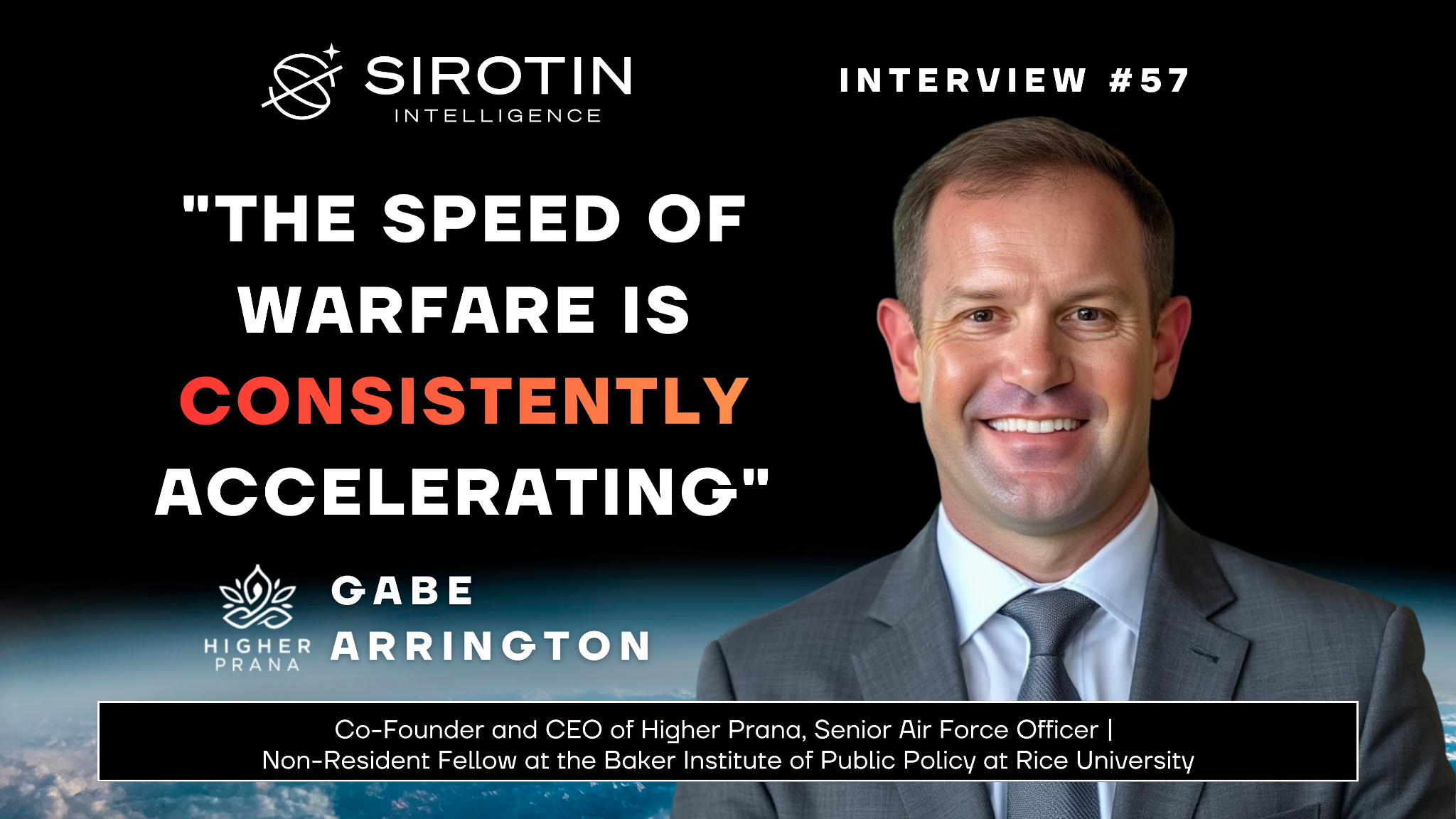
Gabe Arrington is a Senior Air Force Officer and mobility pilot who co-founded Higher Prana, a VR-based platform for mindfulness and mental health. He serves as a Non-Resident Fellow at Rice University's Baker Institute, focusing on energy security and critical minerals. Inside the military, he's drawn criticism for pushing unconventional approaches, though several of those ideas were later adopted by the current Chairman of the Joint Chiefs. His credentials include three master's degrees, an MIT Seminar XXI fellowship, and a National Defense Fellowship at CNAS.
From his position, the disconnect between commercial and military innovation is hard to miss. FedEx and UPS solved data-integration problems the Pentagon has struggled with for decades. SpaceX launches more satellites in a month than the military does in a year. Ukrainian workshops modify commercial drones faster than American contractors can update specifications. Recently, retired four-star generals, including the former commander of Air Mobility Command, have joined startups building pilotless cargo planes. The direction of aviation, in practice, looks quite different from what budget documents suggest.
Key topics:
- The conversation he has with his 14-year-old son, who wants to be a pilot, about why the profession will look fundamentally different, and what that shift implies for the Air Force Academy's core mission
- How AI in strategic wargaming can lead experienced commanders to conclusions that turn out to be completely wrong, and why current simulations still underestimate the speed at which decisions now unfold
- Why he believes the most significant capability gap has less to do with classified technology than with the RPA and UAS revolution playing out daily in Ukraine, a pace no traditional procurement process can match
- What it suggests when commercial cargo ships navigating the Taiwan Strait have better situational awareness than most military vessels
Watch Gabe's YouTube preview Tuesday, December 23rd on the Sirotin Intelligence YouTube channel. Full interview drops Thursday, December 25th.
📚 Essential Intel from Our Archives
Missed a beat? These groundbreaking conversations are must-reads:
"America Must Build 2,500 Hoover Dams Worth of Space Solar Power or Lose Energy Independence"
Mike Snead reveals why only space solar power can replace fossil fuels at scale, how China's playing the long game while America conducts studies, and why fracking's 20-year window is America's last chance to build orbital energy infrastructure.
"When Mars Rovers Hit Anomalies, They Stop Dead"
Dr. Mark Woods explains why $2.5 billion Mars rovers freeze when confused, how neuro-symbolic AI from the early 2000s still beats LLMs for space missions, and why Silicon Valley is rediscovering 20-year-old solutions to autonomy problems.
"Space Solar Requires 1,000 Times Less Critical Minerals Than Wind and Solar"
Martin Soltau reveals how orbital power stations could deliver £30/MWh energy while breaking China's critical mineral stranglehold, and why controlling space-based power means controlling civilization's future.
"Chemical Lasers Are Out, Solid-State Lasers Failed Too"
Dr. Andrew Motes exposes three decades of directed energy failures, why you can't defend satellites against determined adversaries, and how a golf-ball-sized meteor could trigger the Kessler cascade that ends space access.
"We're Building the World's Biggest Gun to Shoot Refrigerators at Mach 20"
Mike Grace explains why a 10km cannon using Nazi V-3 technology can launch satellites at $10/kg versus SpaceX's $3,000, and how disposable daily satellites make space denial economically suicidal.
"Every Rocket Component, Every Drop of Fuel—It All Moves By Ship"
Bo Jardine reveals why SpaceX barges are billion-dollar sitting ducks, how controlling 21-mile-wide shipping straits determines space dominance, and why a $600 drone beats a $67 million rocket every time.
"We Don't Understand How Interconnected Everything Is Until It All Falls Apart"
Ulpia Elena Botezatu warns that cyber attacks on satellites would suspend modern life—no banking, no transport, no power—while the gap between IT security and space technologists creates the blind spot where catastrophe lives.
"We're Sitting on $100 Trillion and Want to Pay $400 Billion to Throw It Away"
Steven Curtis reveals why nuclear "waste" contains 97% of its original energy worth $100 trillion, how the NRC charges $300/hour to say no to reactors that can't melt down because they're already melted, and why one governor with two minutes of courage could solve our energy crisis.
"We're Playing by 1987 Rules in a 2025 Game"
Former White House space chief Sean Wilson exposes how export controls from 1987 are killing U.S. competitiveness, why China bundles "practically free" satellites with predatory loans, and how satellites "don't have mothers" fundamentally changes space escalation dynamics.
"Modern War Isn't About Territory—It's About Narrative Control"
Major General Vladyslav Klochkov, former Chief of Moral-Psychological Support for Ukraine's Armed Forces, reveals how information warfare determines victory before armies meet, and why the battle for minds matters more than the battle for land.
"We're Traveling with Biological Machinery That Can Melt in Space"
Dr. Ekaterina Kostioukhina, extreme environments physician, explains why human hibernation may be essential for Mars missions, how ground squirrels avoid muscle atrophy during torpor, and why patents on hibernating fish could revolutionize interplanetary travel.
"The Universe Isn't a Machine—It's an Information Processing System"
Theoretical physicist Davide Cadelano presents his Codex Alpha framework where spacetime emerges from quantum information networks, unifying relativity and quantum mechanics through a radical new understanding that treats the universe as a vast computational system rather than mechanical clockwork.
"How Nation-States Could Blind U.S. Intelligence Without Firing a Shot"
Robi Sen reveals how "kindergarten children could take over" most satellite networks, why adversarial ML can make satellites gradually shift their perception of reality, and how the convergence of biological, RF, and space warfare creates nightmares current defense frameworks can't even conceptualize.
"We Can Hit Our Target in Space and Return for Rapid Reuse"
Dr. Robert Statica on building hypersonic aircraft, space-based defense systems, and the race to sub-100 kg space access—revealing how reusable hypersonic platforms could revolutionize both space access and global strike capabilities.
"They Don't Call for Their Parents. They Say 'Long Live the Great Leader'"
Lt. Gen. (Ret.) In-Bum Chun exposes North Korea's transformation into a cyber superpower, why cognitive warfare is the real threat, and the chilling reality of a society where dying children praise their dictator instead of calling for their mothers.
"Space Wars Are Over in 24 Hours—Most People Don't Even Know They're Happening"
Space warfare doctrine pioneer Paul Szymanski reveals mathematical proof that the U.S. lost its first space war to Russia in 2014, exposing how temporal pattern analysis unmasks satellite attacks hidden behind "solar flare" cover stories and why hypervelocity weapons from orbit could render the U.S. Navy obsolete overnight.
"The Grid Is Already a Living System—We Just Don't Recognize It"
Power systems veteran Mike Swearingen explains why treating the power grid as a living, autonomous system isn't science fiction—it's an engineering reality we refuse to acknowledge, and how space-domain tactics can secure the grid of tomorrow.
"The Hidden Power Struggle Reshaping China: Xi Jinping's Dramatic Fall From Grace"
An investigation into China's internal power dynamics reveals how Xi Jinping's grip on power is weakening amid economic turmoil, military purges, and rising opposition within the Communist Party.
"I Patented a Space Airlock That Uses 6,000 Times Less Air"
NASA veteran Marc Cohen reveals his revolutionary Suitport design and four decades of challenging engineering orthodoxy, advocating for space habitats that prioritize human experience over forcing astronauts to adapt to machines.
"I Created a Language That Lets AI Think in 128 Dimensions"
Former corporate sales executive Chris McGinty reveals how his McGinty Equation unifies quantum mechanics with relativity through fractal geometry, creating Hyperfluid AI and revolutionary space-folding technologies now being adopted by NATO defense strategists.
"I'm on a Crusade to Expand the Domain of Life"
Space pioneer Rick Tumlinson reveals how he created the NewSpace movement, his work with Dr. Gerard K. O'Neill, and his 40-year mission to expand humanity beyond Earth through commercial space ventures.
"Space Law Is The First Domain Where Nations Agreed On Rules Before Having Practice"
Military JAG-turned-attorney Trevor Hehn explains how Cold War-era space treaties meet modern commercial ventures, highlighting the challenges of re utilization, dual-use technologies, and regulatory navigation for companies expanding beyond Earth's atmosphere.
"The Unprotected Power Grid Will Be Our Civilization's Death Warrant If We Don't Act"
Doug Ellsworth, Co-Director of the Secure the Grid Coalition, warns about America's vulnerability to electromagnetic pulse attacks and advocates for urgent power grid protection to prevent catastrophic infrastructure collapse.
"When AI Designs Components, They Sometimes Defy Textbook Engineering"
Space Force Lt. Colonel Thomas Nix reveals how 3D printing and AI are creating revolutionary spacecraft designs, with parts that are stronger and lighter than what human engineers could develop using traditional methods.
"The Gaps in Our Lunar Knowledge Are Enormous"
Extraterrestrial Mining Company Chief Scientist Dr. Ruby Patterson describes the urgent need for more lunar geological data before making commercial decisions, while offering a balanced view on helium-3 mining and advocating for inclusive international cooperation in cislunar space.
"We're Building the Railroads of the Space Gold Rush"
Space Phoenix Systems CEO Andrew Parlock positions his company as "FedEx for space," creating an infrastructure that helps businesses launch and return payloads from orbit with minimal friction.
"Our Nuclear Shield Was Killed For Political, Not Technological Reasons"
Reagan's SDI Director Ambassador Henry Cooper argues that effective missile defense technology developed during the Reagan-Bush years was abandoned for political reasons when the Clinton administration "took the stars out of Star Wars."
"Every Country Has a Border with Space"
UK Space Agency CEO Dr. Paul Bate is developing Britain's space industry through initiatives like spaceports in Scotland's Shetland Islands to establish the UK as Europe's premier satellite launch destination.
"We're Treating Satellites Like They're Still In The 1990s"
Niha Agarwalla, Director of Commercial Space, explains why traditional satellites are obsolete and how resilient constellations will transform space economics.
"When People See Space Guardians in Uniform, They Ask If They're Real"
Colonel Bill Woolf, 25-year space defense veteran, reveals his mission to build public support for the newest military branch defending America's orbital assets.
"One Kilogram of Helium-3 Is Worth $50 Million"
Jeffrey Max, Magna Petra CEO, explains how lunar re extraction could revolutionize Earth's energy production and fuel humanity's expansion across the solar system.
"I'm Building a Rocket Engine That Could Reach Alpha Centauri"
Michael Paluszek, Princeton Satellite Systems President, reveals how fusion propulsion could reduce travel times throughout our solar system and enable humanity's first interstellar missions.
Chris Newlands, CEO of Space Aye, discusses how his company's satellite technology is revolutionizing wildlife conservation and helping to combat illegal fishing and poaching.
"I Learned From the Last Generation of Manhattan Project Veterans”
Patrick McClure, former Kilopower Project Lead at Los Alamos National Laboratory, explains how small nuclear reactors could power future missions to the Moon, Mars, and beyond.
"We're Being Attacked Every Day"
Christopher Stone, Former Pentagon Space Advisor, warns about America's vulnerabilities in orbit and explains why China's "attack to deter" doctrine makes space conflict more likely than many realize.
"I Helped SpaceX Secure Their First Commercial Contracts"
Serial entrepreneur Robert Feierbach discusses building billion-dollar space ventures across four continents and developing North America's newest spaceport.
"We Can Fly 8,000 Miles In 2 Hours"
Jess Sponable, Ex-DARPA PM & President of NFA, explains how rocket-powered aircraft will revolutionize global travel through simplified hypersonic technology.
"This Could Be Our Biggest Economy"
Kevin O'Connell, Former Space Commerce Director, reveals how space is transforming from a government domain to a $1.8 trillion market.
"How Do You Win a War in Space?"
Ram Riojas, Ex-Nuclear Commander and Space Defense Expert, explains why the next war will start in space and how nations are preparing their defenses.
"First Day on the Job, Hubble Was Broken"
Mike Kaplan, James Webb Space Telescope Pioneer, reveals how early setbacks with Hubble shaped NASA's approach to complex space missions and discusses the commercial revolution transforming space exploration.
The Future of Human Space Habitation
Jules Ross reveals how her journey from artist to space visionary is reshaping human adaptation to space through Earth's first artificial gravity station.
Attorney Michael J. Listner unpacks the complex legal challenges facing modern space activities. From re rights to orbital debris management
Making Oceans Transparent From Space
Navy Legend Guy Thomas, inventor of S-AIS, shares how his invention transformed global maritime surveillance and security.
Sources:
https://www.nasa.gov/news-release/nasa-shares-spacex-crew-12-assignments-for-space-station-mission/
https://www.space.com/news/live/interstellar-comet-3i-atlas-closest-to-earth-flyby-today-dec-19-2025
https://nypost.com/2025/12/15/science/planetary-defense-drill-launched-with-3i-atlas-approaching/
https://spacepolicyonline.com/news/first-wheelchair-user-flies-to-space/
https://spacepolicyonline.com/news/trump-issues-executive-order-to-ensure-u-s-space-superiority/
https://spacepolicyonline.com/news/isaacman-confirmed-as-15th-nasa-administrator/
https://defensescoop.com/2025/12/19/sda-tranche-3-missile-tracking-layer-contract-awards/
https://www.esa.int/ESA_Multimedia/Images/2025/12/Gaia_finds_hints_of_planets_in_baby_star_systems
https://www.war.gov/News/Contracts/Contract/Article/4365523/
https://www.war.gov/News/Contracts/Contract/Article/4364107/
https://www.war.gov/News/Contracts/Contract/Article/4362955/
https://www.war.gov/News/Contracts/Contract/Article/4361740/
https://www.war.gov/News/Contracts/Contract/Article/4360555/
https://www.entrepreneur.com/en-in/news-and-trends/from-space-tech-to-evs-bengaluru-
dominates-startup-funding/501141
https://www.startus-insights.com/innovators-guide/spacetech-outlook/
Get exclusive insights from our network of NASA veterans, DARPA program managers, and space industry pioneers. Weekly. No jargon.