
Sirotin Intelligence Briefing: December 8-13: 2025 National Security Strategy Signals Hard-Nosed Realism, China-Russia Test Radar-Evading Satellites, Iran to Launch from Vostochny on Russian Soyuz

This week's Sirotin Intelligence analysis tracks Nvidia-backed Starcloud training the first AI model in orbit using an H100 GPU roughly 100 times more powerful than any previous spaceborne processor, China and Russia experimenting with radar-evading satellite designs that turn orbital awareness into a "hide-and-seek" game, and the 2025 National Security Strategy repositioning economic security and industrial edge as primary U.S. objectives. SpaceX is reportedly targeting a $1.5 trillion IPO in 2026 that could eclipse Saudi Aramco as the largest listing in history, while Iran plans to launch three satellites on a Russian Soyuz from Vostochny on December 28. Our next guests include Dr. Mohamed Al-Aseeri, CEO of the Bahrain Space Agency, on how 14 nations are building shared space capabilities and why a unified Arab Space Agency may be taking shape, and Francesca Tonini, Executive Director of ARTES 4.0 (Italy's High Competence Center for advanced robotics and enabling technologies, subsidized by the Ministry of Enterprises and Made in Italy (MIMIT)) on how Italy's network of 160 partners prevents promising technologies from stalling between lab and market.
🛡️ Defense Highlights
- Space Force's Top Enlisted Leader: Gray-Zone Interference Now Defines Space Conflict: At Spacepower 2025, Chief Master Sergeant of the Space Force John Bentivegna told Guardians and partners that space has transformed competition and conflict, with most hostile actions manifesting as electronic interference, subtle proximity maneuvers, and other hard-to-attribute behaviors rather than visible destruction. He argued that this environment demands a new kind of warfighter, technically literate, cognitively agile, and multi-domain aware, and said USSF is overhauling training, exercises, and readiness models to give Guardians hands-on experience with realistic contested-space scenarios.
- JHU APL Releases Open-Source Space Weather Model After Analyzing 2022 Starlink Storm: JHU APL's release also highlights a broader ecosystem: IMAP (with its I-ALiRT real-time link), the EZIE auroral-current mission, Parker Solar Probe's close-approach CME data, and a 2024–25 national Space Weather Tabletop Exercise and after-action report aimed at informing emergency management and infrastructure protection. Together with MAGE, these tools are positioned as foundational for protecting power grids, GNSS, comms, and astronauts as Artemis and other programs push humans and hardware deeper into cislunar space.
- Kongsberg and Helsing Plan Sovereign European ISR Constellation by 2029: Kongsberg Defence & Aerospace and German AI-defense firm Helsing plan a sovereign European satellite constellation for intelligence, surveillance, and targeting (IST) by 2029, with an interconnected comms layer for defense users. The system will combine Kongsberg satellites, Hensoldt's SAR/EO/IR/EW sensors, and Helsing's on-orbit and ground AI to fuse SAR, electro-optical, and RF data, with local satellite production in Germany aimed at building a self-reliant European space-based targeting and ISR capability informed by lessons from Ukraine.
- Europe's Orbital 6G Lab Targets Jam-Resistant Military Links: Beyond commercial promise, the 6G space lab is pitched as a way to secure sovereign, jam-resistant, high-throughput links for European armed forces and critical infrastructure, counterbalancing Chinese advances in space-based 6G experiments. Testing optical switching, dynamic routing, and integrated satellite–6G architectures on orbit is seen as foundational for future secure tactical networks and resilient command-and-control.
- Space Force and NRO Preparing Multi-Vendor Acquisition for Aircraft-Tracking Satellites: At Spacepower 2025, Air Force Secretary Troy Meink said the Space Force and NRO are crafting a competitive, multi-award acquisition to field space-based Airborne Moving Target Indication (AMTI) satellites that can track aircraft and drones from orbit. The plan emphasizes rapid initial delivery of capability while avoiding single-vendor dependence, with a phased architecture that distributes sensing across satellites, aircraft, drones, and ground systems to preserve air-domain awareness and A2/AD reach as legacy E-3/E-7 fleets age.
- Navy SEAL Astronaut Jonny Kim to Brief on 245-Day ISS Mission: NASA announced that astronaut (and former Navy SEAL/physician) Jonny Kim will hold a Dec. 19 news conference from Johnson Space Center to recap his 245-day Expedition 72/73 mission, during which he completed 3,920 orbits and supported nine visiting spacecraft. Kim's research portfolio included bioprinted vascularized tissue experiments, multi-robot "Surface Avatar" telerobotics tests, and in-space manufacturing of DNA-mimicking nanomaterials, work with clear implications for future military medicine, autonomous exploration, and resilient on-orbit manufacturing.
- Space Force Unveils Naming Themes: Norse Gods, Ghosts, Sharks, and Snakes: At the Spacepower Conference in Orlando, Chief of Space Operations Gen. B. Chance Saltzman unveiled seven naming themes chosen by Guardians to brand Space Force satellites and ground systems: Norse gods for orbital warfare, mythological creatures for cyber warfare, constellations for SATCOM, "Ghosts" for space domain awareness, "Snakes" for electromagnetic warfare, "Sentinels" for missile warning, and "Sharks" for navigation warfare. Saltzman said the goal is to give space systems identities on par with platforms like the Abrams tank or Fighting Falcon, reinforcing mission focus and service culture as space capabilities enter the joint fight.
- NATO DIANA Selects 150 Startups for 2026, Including Two Dozen Space Firms: NATO's Defence Innovation Accelerator for the North Atlantic (DIANA) has selected 150 companies from 24 member states for its 2026 challenge program, with more than two dozen tied to space technologies such as Earth observation platforms, on-orbit services, secure comms, and sensing. Starting January 2026, these firms will receive contractual funding and access to 16 accelerator sites and 200-plus test centers, fast-tracking dual-use tech from lab to operator for Alliance missions.
- Latvia's First NATO DIANA Selection: Lunar Power Systems: Latvian startup Deep Space Energy became the country's first firm selected for NATO DIANA support, securing a €100,000 grant to mature a compact, autonomous energy-system concept aimed at powering future lunar infrastructure. Latvian officials frame the award as both an industrial milestone and a symbolic step toward participation in Moon-focused security and logistics architectures alongside larger NATO allies.
Major Contract Awards This Week:
Air and Missile Strike Systems
- Kongsberg Wins $240.9M for Joint Strike Missile Lot 2: Firm-fixed-price contract for additional Joint Strike Missile all-up rounds, containers, test hardware, and support items. This expands a key long-range, stealthy, anti-ship/land-attack weapon for 5th-gen aircraft, directly strengthening stand-off strike against maritime and high-value land targets.
- Northrop Grumman Secures Up to $100M for Stand-In Attack Weapon and AARGM-ER: IDIQ for work spanning hardware design, systems engineering, modeling, qualification, test, and repair for the Stand-In Attack Weapon and AARGM-ER. This underwrites continued development and production support for penetrating anti-radiation and stand-in weapons aimed at modern IADS.
- Lockheed Martin Awarded $35.8M Modification for Apache Sensor Sustainment: Modification (total >$363M) for performance-based logistics on AH-64 MTADS/PNVS sensor suites, including obsolescence upgrades. This keeps the U.S. Army's primary attack-helicopter targeting and night-vision sensors modern and available for high-end land fights.
Space, Strategic, and C3ISR
- General Dynamics Adds $39.3M to Proliferated Warfighter Space Architecture Ground Segment:Modification to the PWSA ground-management and integration contract, adding verification/validation capabilities and raising ceiling over $1.08 billion. This is central to fielding, certifying, and sustaining SDA's multi-layer LEO constellation for missile warning, tracking, and resilient comms.
- Analex/Arcfield Wins $25.2M Base for Trident Reentry Subsystem Support: Base contract (options to $71.1M) for Navy Strategic Weapons System reentry subsystem program support, including design disclosures, test procedures, planning, facilities integration, and lifecycle concepts. This directly supports the Trident II D5 strategic deterrent and UK Dreadnought integration.
- JRC Integrated Systems Awarded $10.7M for Trident II/Dreadnought Program Support: Cost-plus-fixed-fee contract for operator expertise, special studies, root-cause analysis, and lifecycle support concepts on Trident II D5 and UK Dreadnought programs. Another key piece of nuclear-deterrence engineering and allied SSBN integration.
- SAIC Secures $241.7M IDIQ for Navy Propulsion Test Facility Operations: Operations and maintenance at the Navy's Propulsion Test Facility Complex, supporting U.S. and multiple FMS navies. Undersea propulsion and test infrastructure are critical enablers for submarine and torpedo performance and survivability.
- Centurum, Serco, SES, and VT Milcom Split $95.99M Ceiling for C4ISR Production: Each awarded a share of an IDIQ for production management, integration, fabrication, and procurement for Network Integration Engineering Facility projects. Work covers end-to-end design and lifecycle support of C4ISR systems, core to fleet networking and information dominance.
Air Platforms and Rotary‑Wing
- Sikorsky Receives $433.2M to Continue Black Hawk Multi-Year Production: Modification to fully fund Program Year 5 of the UH-60M/HH-60M multi-year, delivering 24 helicopters plus program management through 2027; total contract value now about $4.70 billion. This continues recapitalization of Army utility and medevac fleets for contested environments.
- Sikorsky Awarded $43.6M for UH-60 Foreign Military Sales Support: FMS support contract for UH-60A/L/M fleets for foreign customers. This sustains allied rotary-wing capacity and interoperability.
- Sikorsky Wins $28.8M Modification for CH-53K Logistics Support: Modification for logistics analysis, product data, and technical publications tied to CH-53K King Stallion production changes and DMSMS. Supports USMC heavy-lift modernization for expeditionary operations.
- Boeing Secures $31.7M for P-8A Increment 3 ASW Retrofit: Contract to install three P-8A Increment 3 retrofit kits, upgrading Navy P-8s with enhanced anti-submarine warfare capabilities. This improves maritime patrol/ASW effectiveness against advanced submarines.
- Northrop Grumman Awarded $17.4M for AESA Radar Interim Support: Modification for continued repair/return and interim contractor support on Active Electronically Scanned Array radars for the fighter/tactical fleet. AESA sustainment is central to high-end air combat.
- Boeing Receives $15.5M to Expand VC-25B Presidential Aircraft Communications: Modification to expand communications capabilities on the two VC-25B Presidential aircraft. Enhances resilient, secure airborne national-command-authority comms.
Ground, Infrastructure, and Support
- Cummins Wins $500M Contract for Mobile Power Generation: Contract for 500-kW skid mobile generator sets and plants. Major investment in deployable power for dispersed, expeditionary operations.
- Oshkosh Defense Awarded Up to $49.2M for USMC Resupply Vehicle Conversions: IDIQ to convert MTVR XLWB cargo armored vehicles into Condition Code "A" resupply vehicles. Sustains protected logistics capacity for Marine formations.
🌐 Policy, Geopolitical & Legal Developments
- Iran to Launch Three Satellites on Russian Soyuz from Vostochny December 28: Iran's Nour-linked outlets say three domestically built satellites will launch on a Russian Soyuz rocket from Vostochny Cosmodrome on December 28, with stated missions in agriculture, natural resources, and environmental monitoring. Iranian space chief Hassan Salarieh recently highlighted progress toward sub-meter imaging satellites, development of the Chabahar Space Center as a liquid-fuel launch hub for SSO and GEO access, and private contracts for Iranian satellite constellations, all framed by Tehran as civilian but viewed in the West as dual-use with missile implications.
- Russia and Belarus Announce "Unified Defense-Industrial Space" for Missiles and Satellites: Belarusian defense industry head Dmitry Pantus said Minsk and Moscow are creating a "unified defense-industrial space," integrating enterprises and R&D across precision weapons, air defense, and space-related technologies under Union State structures. This framing suggests Belarusian plants and design bureaus will be further embedded into Russian-led supply chains for missiles, ISR, and potentially satellite components, tightening Moscow's control over regional defense production.
- Starlink Satellite Reentry Lights Up Minnesota Sky, Raises Atmospheric Pollution Questions: Residents across northern Minnesota, Wisconsin, Michigan, and parts of Canada reported a bright white-green streak on Dec. 7 that American Meteor Society investigators now say was almost certainly Starlink satellite 3322 burning up on reentry, not a meteor. Local coverage notes scientists' concern that frequent satellite reentries are injecting aluminum oxide and other materials into the upper atmosphere, with the cumulative environmental impact of mega-constellation reentry "smog" still poorly understood.
- Inaugural Global Space Awards Honor Jim Lovell, Debris Mitigation, and Mars Weather Science: The inaugural Global Space Awards in London honored Apollo 13 astronaut Jim Lovell with a lifetime recognition and highlighted a slate of winners spanning science, sustainability, and investment. Planetary scientist Beatriz Sánchez-Cano won the Science Breakthrough Award for leading ESA's proposed M-MATISSE Mars space-weather mission, while Space Forge took the Sustainability for Earth Award for in-orbit semiconductor fabrication, and Astroscale and its policy lead Tahara Dawkins received twin Sustainability for Space and Playmaker awards for debris-mitigation and LEO-preservation work.
- Florida Stakes Claim as National Hub for Space, Quantum, and Defense Innovation: At the Florida Deep Tech Venture Summit and related Miami events, investors and officials argued that Florida's mix of launch infrastructure, defense presence, and university talent positions it to lead in space, quantum, AI, and dual-use innovation. Speakers including UCF's Greg Autry and venture firms Phase Shift Ventures and Backswing Ventures framed "Space Coast to Tampa–Orlando–Gainesville" as a single emerging corridor where founders, federal customers, and capital can converge around space, defense, and frontier computing opportunities.
- Defense Secretary Hegseth Visits Redstone Arsenal for Space Command Ceremony: Local coverage notes that Defense Secretary Pete Hegseth is expected at Redstone Arsenal for a Space Command sign unveiling, symbolically reinforcing Huntsville's status in U.S. space and missile-defense enterprises. The event highlights how Army, Space Force, and MDA activities clustered at Redstone are central to integrated missile warning, space control, and joint fires architectures.
- Nature Study: 96% of Future Space Telescope Images Could Contain Satellite Trails: A Nature paper finds that if all currently proposed satellite megaconstellations are deployed, more than 96% of exposures from future space telescopes like NASA's SPHEREx, ESA's ARRAKIHS, and China's Xuntian will contain at least one sunlit satellite trail, with Hubble-class observatories also seeing a large fraction of images affected. The authors liken the situation to early ozone-layer warnings, arguing that industrial expansion of LEO is outpacing regulation and that meaningful mitigation will require coordinated limits on constellation design, brightness, and orbital altitudes.
- Space Force Official: China and Russia Testing Radar-Evading Satellite Designs: At the Spacepower 2025 conference, Chief Master Sgt. Ron Lerch said Chinese and Russian programs are experimenting with shapes and materials that reduce satellites' radar cross-section and optical signatures, turning GEO "cat-and-mouse" into a LEO "hide-and-seek" game. He cited China's Shiyan-24 trio, which performed synchronized maneuvers with each satellite presenting a smaller apparent radar signature, and noted Russia's recent Mozhayets experimental satellite in MEO, underscoring growing concern about hard-to-track on-orbit assets.
- National Academies: Search for Life Should Be Top Priority for First Human Mars Landing: A new National Academies report, requested by NASA, says the top science priority for the first human Mars landing should be the search for past or present life, organized into four campaign concepts spanning the first three crewed missions. The 240-page roadmap calls for a surface lab on Mars, returned samples from every human mission, and updated planetary-protection rules, and ties science goals to constraints like crew size, surface stay time, and site selection near accessible ice and potential cave systems.
- Soyuz MS-27 Returns Crew to Earth, ISS Operations Continue Despite Geopolitical Strain:SpacePolicyOnline notes that Soyuz MS-27 has landed back on Earth, returning its three-person crew and keeping Russia's ISS rotation cadence intact despite recent launch-pad damage and wider geopolitical strains. The mission's completion underscores the continuing practical interdependence between NASA and Roscosmos for ISS operations even as both sides prepare for post-ISS futures.
- Isaacman Clears Commerce Committee Again, Full Senate Vote Expected Soon: Jared Isaacman's nomination to lead NASA has once more cleared the Senate Commerce Committee, with members emphasizing both urgency in the Moon race with China and concerns about his commercial ties and leaked "Project Athena" fast-track plans. The committee vote sets up a full Senate confirmation fight that will shape how aggressively NASA leans into commercial partnerships and schedule risk to keep Artemis ahead of China's Long March 10–based lunar campaign.
🛰️ Technology & Commercial Developments
- JHU APL Open-Sources MAGE Space Weather Model on GitHub: Johns Hopkins APL and NASA's Center for Geospace Storms have publicly released the Multiscale Atmosphere-Geospace Environment (MAGE) model, a physics-based system that couples magnetosphere and upper-atmosphere models (including GAMERA and TIEGCM) to simulate how solar storms affect Earth, satellite drag, and radiation environments. MAGE, which has already been used via NASA's Community Coordinated Modeling Center to analyze major storms and the 2022 "SpaceX storm" that deorbited 38 Starlinks, is now on GitHub under a permissive license with an accompanying analysis/visualization toolkit to support broader heliophysics, mission-design, and resilience work.
- MeerKAT Discovers 50-Million-Light-Year Spinning Galaxy Filament: Astronomers using South Africa's MeerKAT radio telescope have identified a razor-thin, 50-million-light-year-long filament containing more than 280 galaxies that all appear to be rotating in the same direction as the filament itself, making it the largest individual spinning structure yet detected. The result, which shows coherent spin alignment and bulk rotation on enormous scales, challenges standard models of when and how galaxies acquire angular momentum and will feed into Euclid and Vera Rubin analyses of intrinsic alignments and large-scale structure.
- Blue Origin to Fly First Wheelchair User to Space December 18: Blue Origin plans to launch NS-37 on Dec. 18 from West Texas, sending six people on a suborbital New Shepard flight that will include Michaela "Michi" Benthaus, a German aerospace engineer at ESA who has used a wheelchair since a 2018 spinal cord injury. Her ~10–12-minute mission, giving a few minutes of weightlessness, is being framed by Blue Origin and AstroAccess as a landmark for accessibility in commercial human spaceflight and a pathfinder for design changes that enable more disabled passengers and professionals to reach space.
- EPCOT's Mission: SPACE Remains Polarizing Test of Public Spaceflight Expectations: Theme-park commentary notes that EPCOT's Mission: SPACE remains polarizing: some guests appreciate its centrifuge-based "orange team" ride as a surprisingly intense analog for launch forces, while others prefer the milder "green team" and criticize dated visuals and queuing. The discussion underscores how simulated G-loads, disorientation, and tight capsules have become part of popular culture's mental model of spaceflight, even as real commercial rides diversify who can fly.
- India's Space Sector Projected to Hit $44 Billion by 2033, Add 200,000 Jobs: Adecco India projects India's aerospace, drones, and space-tech sector will grow more than five-fold to about 44 billion USD by 2033, lifting India's share of the global space economy from ~2% to 7–8% and generating over 200,000 new jobs for engineers, researchers, data scientists, and business professionals. High-demand roles include space policy analysts, robotics engineers, avionics specialists, GNC experts, ATDC and remote sensing specialists, with hubs in Bengaluru, Hyderabad, Chennai, Ahmedabad, and Pune and salary premiums of 20–30% for niche skills.
- Europe Launches Orbital 6G Lab to Test Satellite-Terrestrial Integration: Europe is fielding a "6G lab in space," often referenced as 6GStarLab, developed by Open Cosmos with Barcelona-based research center i2CAT to test 6G waveforms, flexible routing, and space-based backhaul in orbit. The effort is framed as "one-upping" earlier Chinese 6G-in-space demos by pushing toward a full experimental platform for satellite–terrestrial 6G integration and secure, ultra-low-latency links for military and commercial use.
- Nvidia-Backed Starcloud Trains First AI Model in Orbit Using H100 GPU: Nvidia-backed startup Starcloud has trained and is running Google's Gemma large language model on its Starcloud-1 satellite, which carries an Nvidia H100 GPU said to be roughly 100 times more powerful than any previous GPU flown in space. The company is already using the in-orbit compute to run inference on Capella Space imagery for tasks like spotting lifeboats and wildfires, and plans a follow-on satellite in 2026 with added Nvidia hardware and a Crusoe cloud module so customers can deploy AI workloads directly in space.
- Aetherflux Plans Solar-Powered Orbital Data Centers by 2027: Aetherflux is pushing a "Galactic Brain" constellation concept: solar-powered satellites serving as AI data centers in orbit, powered continuously by sunlight and eventually tied into a space-based power-beaming architecture. The startup, which has focused on space-based solar power since 2024, plans its first commercial orbiting data center in early 2027 and argues that space nodes can sidestep the land, grid, and water constraints now slowing terrestrial AI data-center build-outs.
- The 1993 Orbital Billboard That Sparked Calls for Advertising Bans in Space: Popular Science revisits a 1993 plan by Space Marketing Inc. to launch a Mylar "billboard" into low Earth orbit that would have reflected sunlight to create giant ads visible from the ground, sparking a fierce public and political backlash and calls for bans on orbital advertising. The piece situates that episode alongside more recent concepts like StartRocket's orbital logo grid and modern cost models showing that a 50-satellite ad constellation could turn a profit, while astronomers warn such projects would further pollute already satellite-crowded skies.
- Texas A&M Profiles Space and Defense Programs Feeding Civil and Military Missions: Texas A&M profiles faculty and alumni shaping space-related work, from astronaut Col. Mike Fossum's emphasis on character and teamwork in NASA operations to researchers advancing hypersonics, autonomous systems, and space-domain awareness. The article frames Aggie programs in aerospace engineering, cyber, and leadership as directly feeding both civil exploration and defense-oriented space missions.
- Webb Detects Thick Atmosphere on 3,200°F "Wet Lava Ball" Exoplanet: James Webb observations of ultra-hot super-Earth TOI-561 b show its dayside is about 3,200°F rather than the ~4,900°F expected for bare rock, implying a substantial, volatile-rich atmosphere above a global magma ocean. Researchers conclude only a dense atmosphere with strong winds and possibly bright silicate clouds can explain the low density and cooler dayside, suggesting an equilibrium where gases continuously cycle between the magma ocean and atmosphere on this "wet lava ball."
- China Targets 2026 Debut for Long March 10 Lunar Rocket: China is building toward a 2026 debut of the new Long March 10, a three-stage kerolox rocket with optional boosters tailored for both LEO crew transport and dual-launch lunar missions as part of a 2030 taikonaut landing plan. The architecture foresees two Long March 10 launches per crewed lunar mission, one for the crew vehicle and one for the lander to rendezvous in lunar orbit, making the maiden flight a key test of China's parallel "Moon race" track to NASA's Artemis.
- Chinese Satellite Passes Within 200 Meters of Starlink, No Coordination Provided: SpaceX says one of nine satellites launched on a Chinese Kinetica-1 (Lijian-1) rocket from Jiuquan on Dec. 9 passed within roughly 200 meters of Starlink-6079 at 560 km altitude, with no advance coordination or deconfliction from the other operator. Starlink's VP of engineering Michael Nicolls warned that most on-orbit risk now stems from poor information-sharing, even as Starlink has already executed about 145,000 collision-avoidance maneuvers in the first half of 2025 across a fleet approaching 9,300 satellites.
- SpaceX Reportedly Targeting 2026 IPO at $1.5 Trillion Valuation: Multiple reports based on unnamed sources indicate SpaceX is preparing a mid- to late-2026 IPO that could raise more than $30 billion at a target valuation of roughly $1.5 trillion, potentially eclipsing Saudi Aramco as the largest listing in history. The plan would mark a shift from earlier talk of spinning off Starlink alone, and comes as secondary share sales reportedly value the private company at around the high-$800 billion range.
🎬 Star In The Next Big Hollywood Space Franchise

Now's your chance to get in on the ground floor of the next big Hollywood space franchise. Space Samurai is being produced by Angelic Pictures, a Universal Studios Vendor-Affiliate, with Universal Studios theatrical distribution committed. In theaters. On the big screen. Where legends are made. Where E.T. was born. Where Aston Martin became Bond. Where Ray-Ban became cool. The same theatrical distribution that launched Apollo 13 and First Man into the cultural consciousness.
Production begins Q1 2026, and we project a global audience of 38M+ when it hits theaters. This trilogy will be the next major space franchise. There hasn't been a Star Trek since Star Trek. The genre is wide open, the audience is hungry, and the timing is now. Think Die Hard meets Gravity.
Space Samurai: Oasis is set aboard a luxury space station in 2063. A battleground in zero gravity. Secrets buried in orbit resurface. The Cold War never ended; it just moved higher. An unlikely hero rises. Edge-of-your-seat thriller from start to finish.
The underlying message: the things we build to protect ourselves become the things that define us. Innovation is survival. And the nation that leads in space leads the future.
Interested? Contact Angelica directly at angelica@sirotinventures.com.
💭 A Word From Christophe Bosquillon
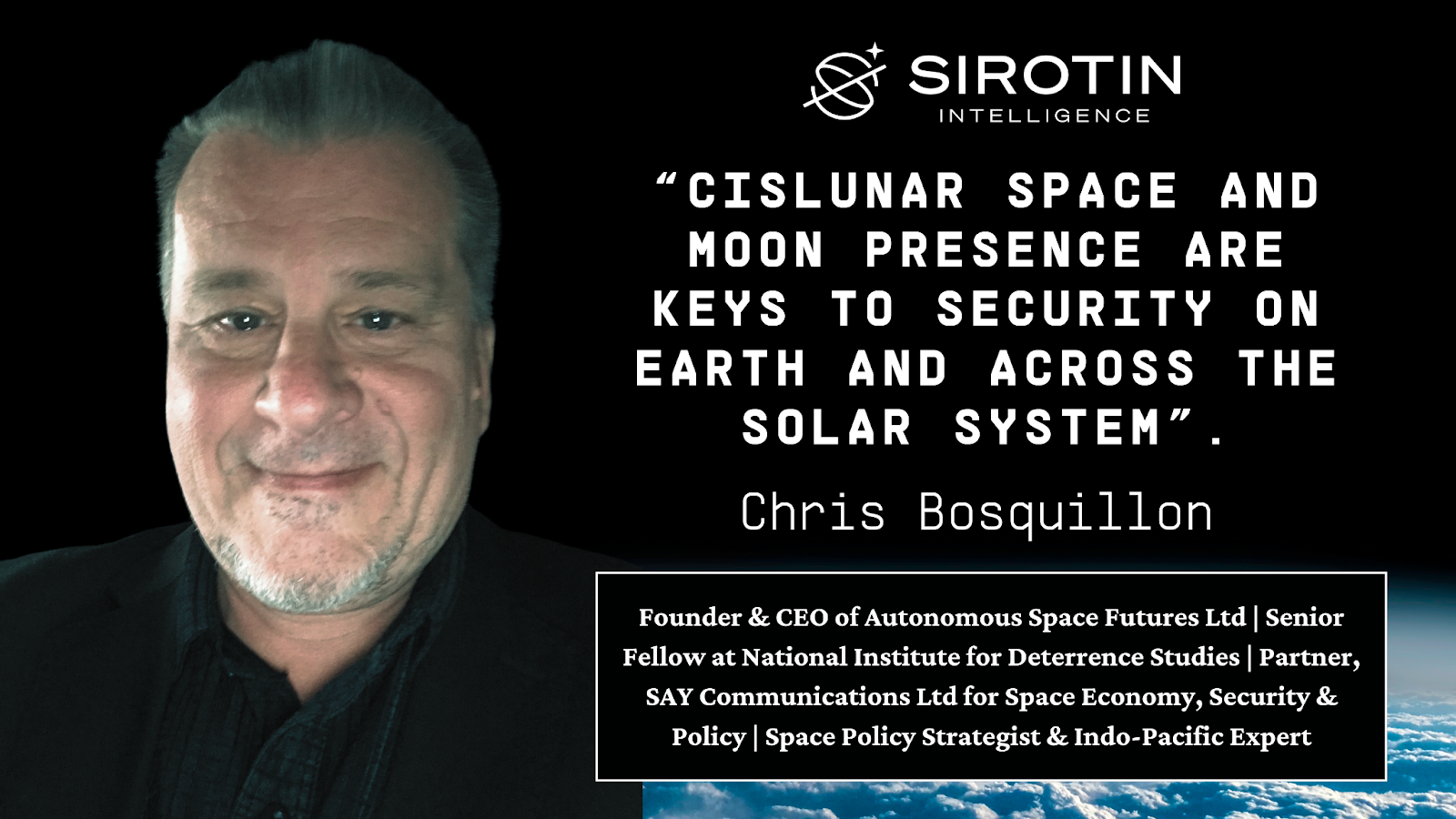
The 2025 U.S. National Security Strategy (NSS) dropped on December 4th. NSS bottomline: the era of hubristic overreach is over. America remains that 800-pound gorilla. Balancing offshore influence with the only other major powers it recognises, Russia and China. Vis-à-vis allies America requires to become self-standing.
The Western Hemisphere is the de facto core position for undisputed U.S. power integrity and uncompromising sovereignty. As said by the Secretary of War: “Out with utopian idealism, in with hard-nosed realism.” In other words, the NSS could be translated as “Out with neoconservative and neoliberal ideological crusades, in with fiscally responsible, economy-driven geostrategic deterrence.”
While “space" is only mentioned once on page 21 of the NSS, space is implicitly emphasised in the drive to regain an industrial edge over competitors across domains. Technology-driven trade and investment includes AI, quantum, and nuclear renewal. The 2025 U.S. National Defense Strategy will follow the NSS, in the wake of Department of War policy statements on the urgency of rebuilding the defense industrial base, which includes space and increased procurement from the private sector.
Instead of antagonizing China, the NSS frames it as economic and technological competitor rather than an ideological one. Sustaining American reshoring, reindustrialization, industrial base funding, technological edge, manufacturing supply chains, and access to critical materials, is what underwrites how the U.S. should deal with China. Indo-Pacific deterrence postures nonwithstanding, the NSS understates the potential for military confrontation in the Indo-Pacific. Status quo over Taiwan is advised, regional allies are encouraged to step up to the plate of their own defense.
Commentators miffed by the statement on "civilisational erasure"(*) in Europe, and search for political equilibrium vis-à-vis Russia and China, chide the NSS as “returning to 19th-century sphere of influence geopolitics.” An NSS major strategic merit is to reposition economic security and industrial edge as primary objective for the U.S. to lead globally and prevail in military conflicts.
After 35 years of the West divorcing itself from Reality, we now face a technology-savvy tripolar world. The NSS merely reflects a long overdue readjustment to fast-tracked 21st century geopolitics, becoming fundamentally space and disruptive technologies-focused.
(*) NSS statement on “civilisational erasure” in Europe: "Should present trends continue, the continent will be unrecognisable in 20 years or less. As such, it is far from obvious whether certain European countries will have economies and militaries strong enough to remain reliable allies."
Have a great space week ahead!
🎤 Our Next Guests:
🇧🇭 Dr. Mohamed Al-Aseeri – December 16th
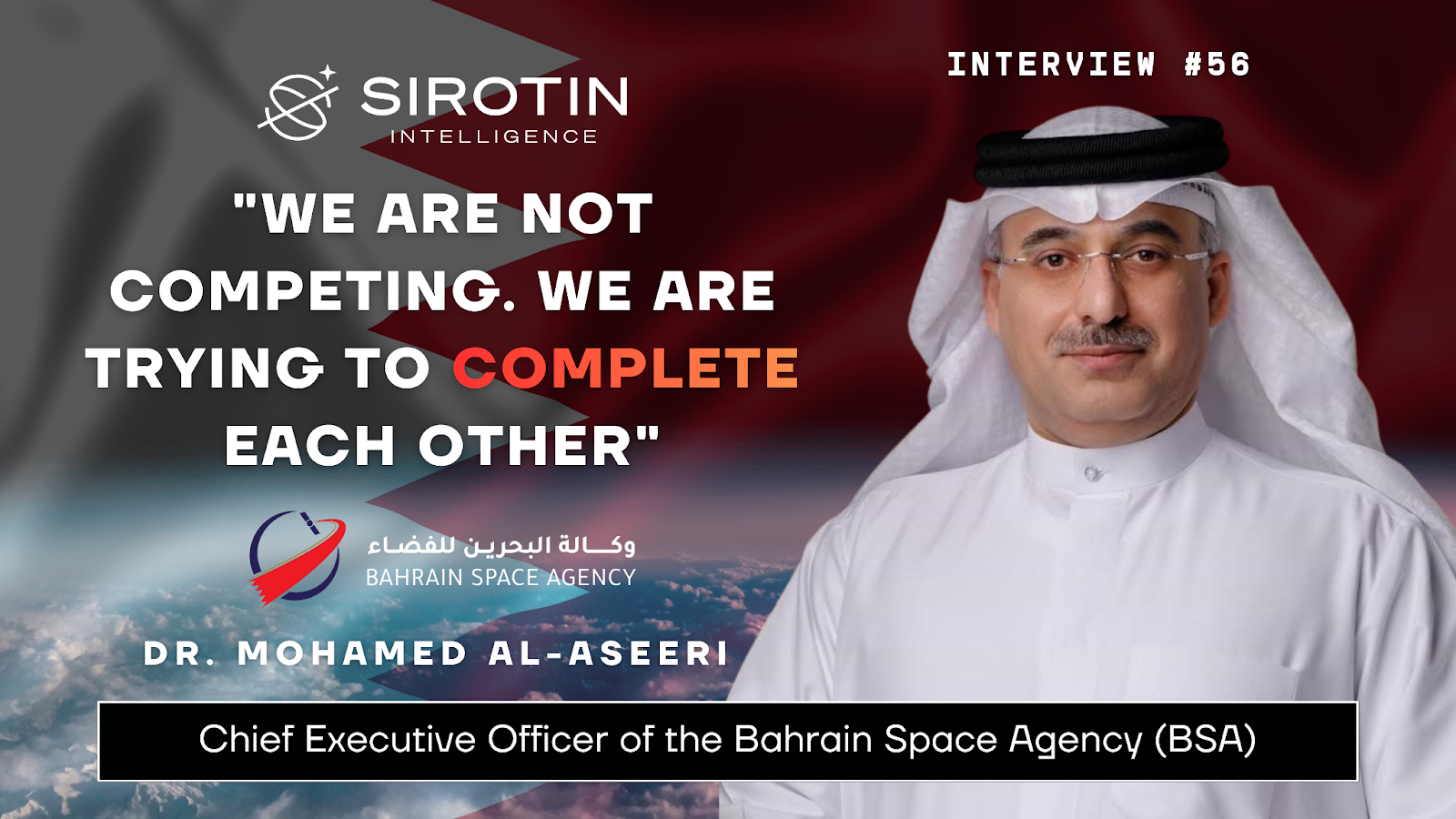
Dr. Mohamed Al-Aseeri is the CEO of the Bahrain Space Agency and a founding member of the Arab Space Collaboration Group, the 14-nation partnership preparing to launch Satellite 813. The mission represents the Arab world's first joint satellite. His focus on regional integration addresses a constraint that national programs face when operating alone: a small nation cannot compete on scale, but 14 nations sharing ground stations, engineering talent, and technology transfer can build capabilities none could afford individually. Bahrain has fewer people than Philadelphia and just launched a satellite designed and built entirely by Bahraini engineers.
His background in reactor design and chemical engineering maps directly to spacecraft systems, including closed-loop life support, propellant chemistry, and materials science for extreme environments. Bahrain's century of experience with corrosive conditions and industrial-scale aluminum production now transfers to satellite bus manufacturing.
Key topics:
- Why neighbors are written into Bahrain's strategic plan as "fundamental pillars," and what Saudi Arabia and the UAE offered when they heard Bahrain was building a space program
- How a nation smaller than London produces engineers who publish research, present at international conferences, and work across the GCC
- His argument that it's time for a unified Arab Space Agency modeled on ESA, and the quiet meetings in Riyadh that suggest something is already taking shape
- What Satellite 813's name reveals: it marks 813 AD, when Baghdad's House of Wisdom became a center for scientific discovery during the Islamic Golden Age
Watch Dr. Al-Aseeri's YouTube preview Monday on the Sirotin Intelligence YouTube channel. Full interview drops Tuesday.
🇮🇹 Francesca Tonini – December 19th
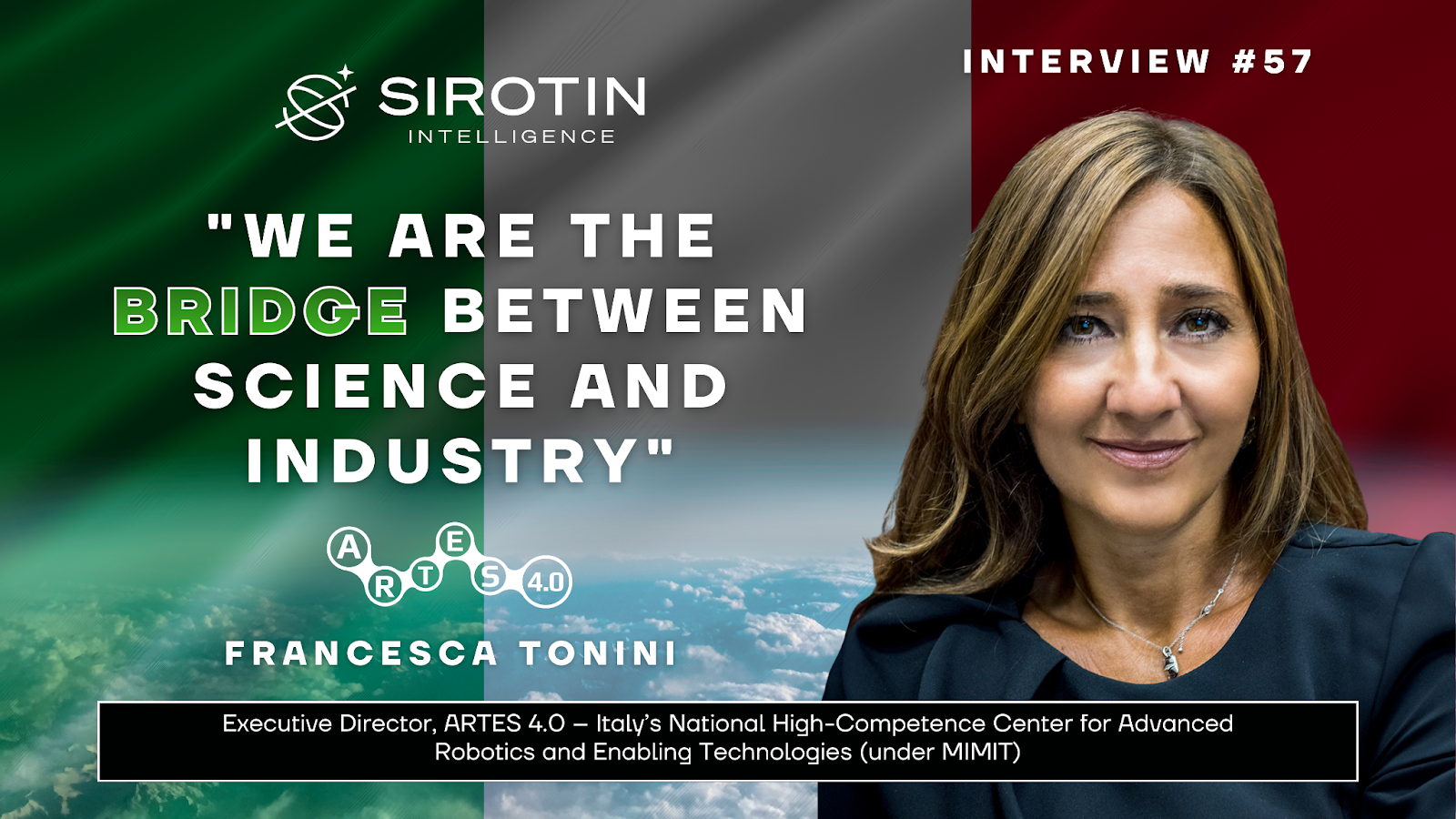
Francesca Tonini is the Executive Director of ARTES 4.0, Italy's High Competence Center for advanced robotics and enabling technologies. She oversees a network of more than 160 partners working on problems in space, defense, and the domains where both sectors overlap. Her organization exists to prevent promising technologies from stalling between laboratory development and market deployment.
Italy ranks third in the European Union for absolute R&D spending at €27.3 billion annually. The difficulty lies in what happens after initial research concludes: technologies frequently fail not because the underlying science is flawed, but because no one tested them under realistic operational conditions or provided the funding needed to demonstrate commercial viability. ARTES 4.0 provides the infrastructure and partnerships to close that gap.
Key topics:
- How the IRIDE constellation, set to become operational in 2026 and funded through Italy's National Recovery Plan, exemplifies space infrastructure built with a sustainability mandate
- Why pharmaceutical biosensors designed for patient monitoring now track astronaut health, and how fashion companies verify cotton supply chains from orbit
- Her argument that strategic autonomy requires human capital as much as hardware, and that Italy cannot retain engineers through patriotism alone
- The "Test Before Invest" methodology that allows failure and iteration to happen cheaply in the lab rather than expensively in the market
Watch Francesca's YouTube preview Thursday on the Sirotin Intelligence YouTube channel. Full interview drops Friday.
📚 Essential Intel from Our Archives
Missed a beat?
"America Must Build 2,500 Hoover Dams Worth of Space Solar Power or Lose Energy Independence"
Mike Snead reveals why only space solar power can replace fossil fuels at scale, how China's playing the long game while America conducts studies, and why fracking's 20-year window is America's last chance to build orbital energy infrastructure.
"When Mars Rovers Hit Anomalies, They Stop Dead"
Dr. Mark Woods explains why $2.5 billion Mars rovers freeze when confused, how neuro-symbolic AI from the early 2000s still beats LLMs for space missions, and why Silicon Valley is rediscovering 20-year-old solutions to autonomy problems.
"Space Solar Requires 1,000 Times Less Critical Minerals Than Wind and Solar"
Martin Soltau reveals how orbital power stations could deliver £30/MWh energy while breaking China's critical mineral stranglehold, and why controlling space-based power means controlling civilization's future.
"Chemical Lasers Are Out, Solid-State Lasers Failed Too"
Dr. Andrew Motes exposes three decades of directed energy failures, why you can't defend satellites against determined adversaries, and how a golf-ball-sized meteor could trigger the Kessler cascade that ends space access.
"We're Building the World's Biggest Gun to Shoot Refrigerators at Mach 20"
Mike Grace explains why a 10km cannon using Nazi V-3 technology can launch satellites at $10/kg versus SpaceX's $3,000, and how disposable daily satellites make space denial economically suicidal.
"Every Rocket Component, Every Drop of Fuel—It All Moves By Ship"
Bo Jardine reveals why SpaceX barges are billion-dollar sitting ducks, how controlling 21-mile-wide shipping straits determines space dominance, and why a $600 drone beats a $67 million rocket every time.
"We Don't Understand How Interconnected Everything Is Until It All Falls Apart"
Ulpia Elena Botezatu warns that cyber attacks on satellites would suspend modern life—no banking, no transport, no power—while the gap between IT security and space technologists creates the blind spot where catastrophe lives.
"We're Sitting on $100 Trillion and Want to Pay $400 Billion to Throw It Away"
Steven Curtis reveals why nuclear "waste" contains 97% of its original energy worth $100 trillion, how the NRC charges $300/hour to say no to reactors that can't melt down because they're already melted, and why one governor with two minutes of courage could solve our energy crisis.
"We're Playing by 1987 Rules in a 2025 Game"
Former White House space chief Sean Wilson exposes how export controls from 1987 are killing U.S. competitiveness, why China bundles "practically free" satellites with predatory loans, and how satellites "don't have mothers" fundamentally changes space escalation dynamics.
"Modern War Isn't About Territory—It's About Narrative Control"
Major General Vladyslav Klochkov, former Chief of Moral-Psychological Support for Ukraine's Armed Forces, reveals how information warfare determines victory before armies meet, and why the battle for minds matters more than the battle for land.
"We're Traveling with Biological Machinery That Can Melt in Space"
Dr. Ekaterina Kostioukhina, extreme environments physician, explains why human hibernation may be essential for Mars missions, how ground squirrels avoid muscle atrophy during torpor, and why patents on hibernating fish could revolutionize interplanetary travel.
"The Universe Isn't a Machine—It's an Information Processing System"
Theoretical physicist Davide Cadelano presents his Codex Alpha framework where spacetime emerges from quantum information networks, unifying relativity and quantum mechanics through a radical new understanding that treats the universe as a vast computational system rather than mechanical clockwork.
"How Nation-States Could Blind U.S. Intelligence Without Firing a Shot"
Robi Sen reveals how "kindergarten children could take over" most satellite networks, why adversarial ML can make satellites gradually shift their perception of reality, and how the convergence of biological, RF, and space warfare creates nightmares current defense frameworks can't even conceptualize.
"We Can Hit Our Target in Space and Return for Rapid Reuse"
Dr. Robert Statica on building hypersonic aircraft, space-based defense systems, and the race to sub-100 kg space access—revealing how reusable hypersonic platforms could revolutionize both space access and global strike capabilities.
"They Don't Call for Their Parents. They Say 'Long Live the Great Leader'"
Lt. Gen. (Ret.) In-Bum Chun exposes North Korea's transformation into a cyber superpower, why cognitive warfare is the real threat, and the chilling reality of a society where dying children praise their dictator instead of calling for their mothers.
"Space Wars Are Over in 24 Hours—Most People Don't Even Know They're Happening"
Space warfare doctrine pioneer Paul Szymanski reveals mathematical proof that the U.S. lost its first space war to Russia in 2014, exposing how temporal pattern analysis unmasks satellite attacks hidden behind "solar flare" cover stories and why hypervelocity weapons from orbit could render the U.S. Navy obsolete overnight.
"The Grid Is Already a Living System—We Just Don't Recognize It"
Power systems veteran Mike Swearingen explains why treating the power grid as a living, autonomous system isn't science fiction—it's an engineering reality we refuse to acknowledge, and how space-domain tactics can secure the grid of tomorrow.
"The Hidden Power Struggle Reshaping China: Xi Jinping's Dramatic Fall From Grace"
An investigation into China's internal power dynamics reveals how Xi Jinping's grip on power is weakening amid economic turmoil, military purges, and rising opposition within the Communist Party.
"I Patented a Space Airlock That Uses 6,000 Times Less Air"
NASA veteran Marc Cohen reveals his revolutionary Suitport design and four decades of challenging engineering orthodoxy, advocating for space habitats that prioritize human experience over forcing astronauts to adapt to machines.
"I Created a Language That Lets AI Think in 128 Dimensions"
Former corporate sales executive Chris McGinty reveals how his McGinty Equation unifies quantum mechanics with relativity through fractal geometry, creating Hyperfluid AI and revolutionary space-folding technologies now being adopted by NATO defense strategists.
"I'm on a Crusade to Expand the Domain of Life"
Space pioneer Rick Tumlinson reveals how he created the NewSpace movement, his work with Dr. Gerard K. O'Neill, and his 40-year mission to expand humanity beyond Earth through commercial space ventures.
"Space Law Is The First Domain Where Nations Agreed On Rules Before Having Practice"
Military JAG-turned-attorney Trevor Hehn explains how Cold War-era space treaties meet modern commercial ventures, highlighting the challenges of re utilization, dual-use technologies, and regulatory navigation for companies expanding beyond Earth's atmosphere.
"The Unprotected Power Grid Will Be Our Civilization's Death Warrant If We Don't Act"
Doug Ellsworth, Co-Director of the Secure the Grid Coalition, warns about America's vulnerability to electromagnetic pulse attacks and advocates for urgent power grid protection to prevent catastrophic infrastructure collapse.
"When AI Designs Components, They Sometimes Defy Textbook Engineering"
Space Force Lt. Colonel Thomas Nix reveals how 3D printing and AI are creating revolutionary spacecraft designs, with parts that are stronger and lighter than what human engineers could develop using traditional methods.
"The Gaps in Our Lunar Knowledge Are Enormous"
Extraterrestrial Mining Company Chief Scientist Dr. Ruby Patterson describes the urgent need for more lunar geological data before making commercial decisions, while offering a balanced view on helium-3 mining and advocating for inclusive international cooperation in cislunar space.
"We're Building the Railroads of the Space Gold Rush"
Space Phoenix Systems CEO Andrew Parlock positions his company as "FedEx for space," creating an infrastructure that helps businesses launch and return payloads from orbit with minimal friction.
"Our Nuclear Shield Was Killed For Political, Not Technological Reasons"
Reagan's SDI Director Ambassador Henry Cooper argues that effective missile defense technology developed during the Reagan-Bush years was abandoned for political reasons when the Clinton administration "took the stars out of Star Wars."
"Every Country Has a Border with Space"
UK Space Agency CEO Dr. Paul Bate is developing Britain's space industry through initiatives like spaceports in Scotland's Shetland Islands to establish the UK as Europe's premier satellite launch destination.
"We're Treating Satellites Like They're Still In The 1990s"
Niha Agarwalla, Director of Commercial Space, explains why traditional satellites are obsolete and how resilient constellations will transform space economics.
"When People See Space Guardians in Uniform, They Ask If They're Real"
Colonel Bill Woolf, 25-year space defense veteran, reveals his mission to build public support for the newest military branch defending America's orbital assets.
"One Kilogram of Helium-3 Is Worth $50 Million"
Jeffrey Max, Magna Petra CEO, explains how lunar re extraction could revolutionize Earth's energy production and fuel humanity's expansion across the solar system.
"I'm Building a Rocket Engine That Could Reach Alpha Centauri"
Michael Paluszek, Princeton Satellite Systems President, reveals how fusion propulsion could reduce travel times throughout our solar system and enable humanity's first interstellar missions.
Chris Newlands, CEO of Space Aye, discusses how his company's satellite technology is revolutionizing wildlife conservation and helping to combat illegal fishing and poaching.
"I Learned From the Last Generation of Manhattan Project Veterans”
Patrick McClure, former Kilopower Project Lead at Los Alamos National Laboratory, explains how small nuclear reactors could power future missions to the Moon, Mars, and beyond.
"We're Being Attacked Every Day"
Christopher Stone, Former Pentagon Space Advisor, warns about America's vulnerabilities in orbit and explains why China's "attack to deter" doctrine makes space conflict more likely than many realize.
"I Helped SpaceX Secure Their First Commercial Contracts"
Serial entrepreneur Robert Feierbach discusses building billion-dollar space ventures across four continents and developing North America's newest spaceport.
"We Can Fly 8,000 Miles In 2 Hours"
Jess Sponable, Ex-DARPA PM & President of NFA, explains how rocket-powered aircraft will revolutionize global travel through simplified hypersonic technology.
"This Could Be Our Biggest Economy"
Kevin O'Connell, Former Space Commerce Director, reveals how space is transforming from a government domain to a $1.8 trillion market.
"How Do You Win a War in Space?"
Ram Riojas, Ex-Nuclear Commander and Space Defense Expert, explains why the next war will start in space and how nations are preparing their defenses.
"First Day on the Job, Hubble Was Broken"
Mike Kaplan, James Webb Space Telescope Pioneer, reveals how early setbacks with Hubble shaped NASA's approach to complex space missions and discusses the commercial revolution transforming space exploration.
The Future of Human Space Habitation
Jules Ross reveals how her journey from artist to space visionary is reshaping human adaptation to space through Earth's first artificial gravity station.
Attorney Michael J. Listner unpacks the complex legal challenges facing modern space activities. From re rights to orbital debris management
Making Oceans Transparent From Space
Navy Legend Guy Thomas, inventor of S-AIS, shares how his invention transformed global maritime surveillance and security.
Sources
https://www.airandspaceforces.com/snakes-sharks-ghosts-space-force-names-themes-platforms/
https://spacenews.com/china-plans-2026-debut-of-new-rocket-for-crewed-lunar-and-leo-missions/
https://spacepolicyonline.com/news/human-exploration-of-mars-gets-a-science-strategy/
https://spacepolicyonline.com/news/soyuz-ms-27-back-on-terra-firma/
https://spacepolicyonline.com/news/isaacmans-nasa-nomination-clears-senate-commerce-committee-again/
https://spacepolicyonline.com/news/whats-happening-in-space-policy-december-7-13-2025/
https://spacenews.com/multiple-space-companies-join-natos-diana-defense-accelerator/
https://stories.tamu.edu/stories/leading-with-character-for-earth-and-space/
https://www.popsci.com/science/space-billboard/
https://www.theverge.com/news/841887/data-center-space-solar-power-aetherflux-lunch
https://www.mprnews.org/story/2025/12/11/space-debris-falls-over-northern-minnesota-upper-penninsula
https://caspianpost.com/iran/iran-to-launch-three-satellites-from-russia-on-december-28
https://www.sdxcentral.com/news/europe-one-ups-china-with-6g-lab-in-space/
https://www.jhuapl.edu/news/news-releases/251212-center-geospace-storms-mage-model
https://futurism.com/space/scientists-detect-huge-rotating-structure-in-space
https://www.wdwinfo.com/walt-disney-world/do-people-actually-like-mission-space-at-disney-world/
https://www.war.gov/News/Contracts/Contract/Article/4354503/
https://www.war.gov/News/Contracts/Contract/Article/4355873/
https://www.war.gov/News/Contracts/Contract/Article/4357707/
https://www.war.gov/News/Contracts/Contract/Article/4358989/
Get exclusive insights from our network of NASA veterans, DARPA program managers, and space industry pioneers. Weekly. No jargon.