
"Orbit Is a Global Resource, Not a Rich Man's Plaything": Black Arrow Space Technologies Founder Paul Williams on Four Decades in European Propulsion, Demisable Tanks, and the Seaborne Spacefleet Designed to Widen Access to Launch

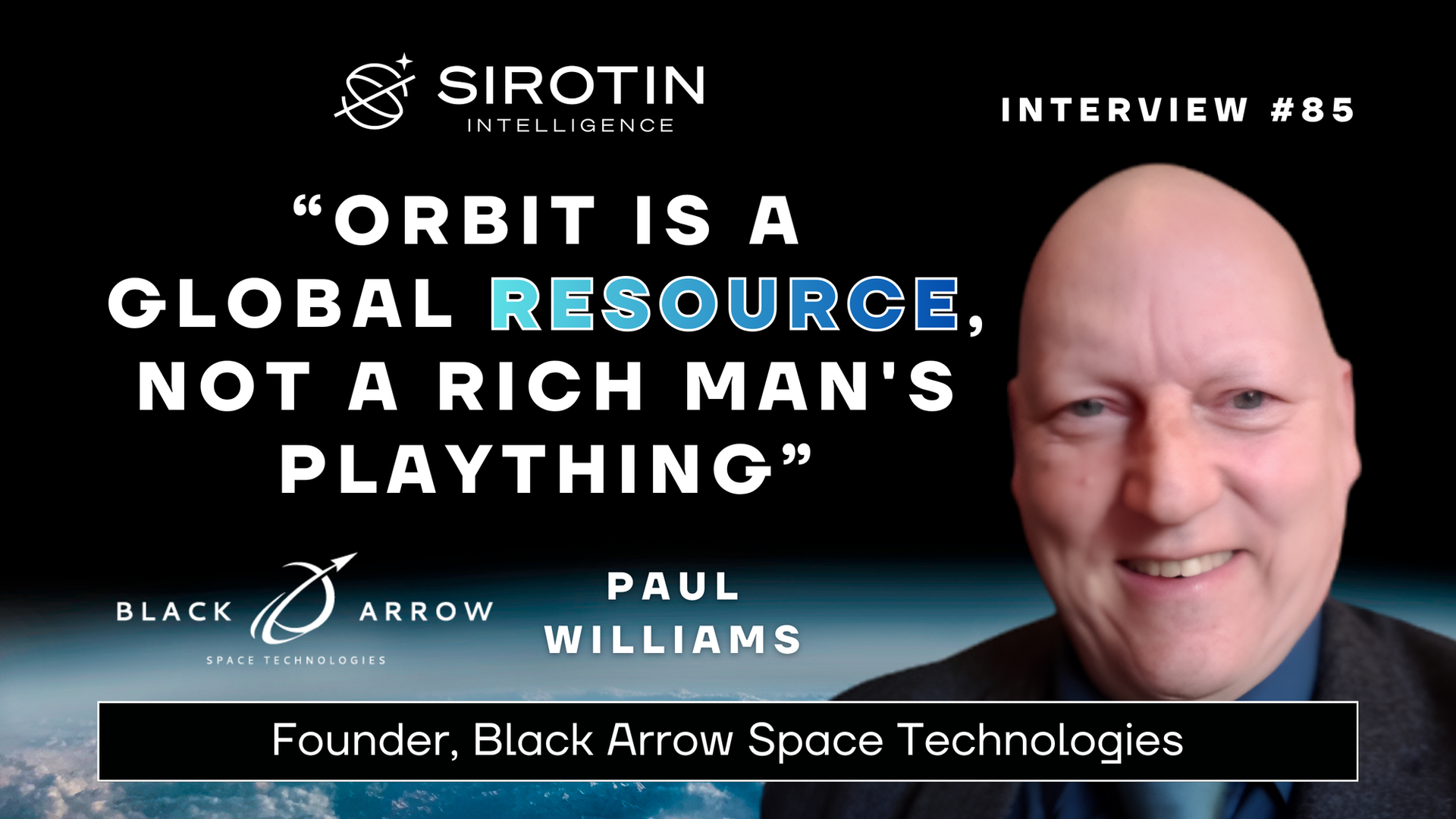
Every conversation about the future of space seems to start downstream, with the applications: artificial intelligence, data processing, and power generation in orbit. That is where the capital and the attention go. Far less of either reaches the people who build the pressure vessels, propulsion systems, and launch infrastructure that make any of it physically possible. Paul Williams has spent his career in that quieter part of the industry, and he has come to believe the imbalance is now a strategic problem.
Williams is a career engineer and technologist with more than four decades in the European space sector, primarily in chemical propulsion. He served on the launch team for ESA's Olympus telecommunications satellite at Kourou in 1989, worked propulsion on the Cluster science satellites, and was in Cannes with Aérospatiale colleagues when Ariane 5's first flight destroyed them in 1996. In 2017 he founded Black Arrow Space Technologies, reviving the name of Britain's cancelled national launcher, and in 2024 spun out Sea to Space to develop a seaborne "spacefleet" for launching small satellites from the waters of customers who have no spaceport of their own. Through AstroTanks, he is developing demisable propellant tanks designed to burn up cleanly on reentry.
We spoke about an unusual route into the industry, what four decades of watching hardware succeed and fail teaches you about reliability, and why the upstream sector keeps finding itself outside the room where strategy gets made. His answers were direct, occasionally uncomfortable, and grounded in the kind of experience that is getting harder to find.
You started out in 1977 in a heat-transfer lab at GEC in Leicester. Twelve years later you were on the launch team at Kourou for Olympus. How does that happen? Was there a moment you knew space was it, or did it pull you in gradually?
Williams laughed at the premise. He has been thinking about how he would open his memoirs, he told me, and the honest answer undercuts the genre.
"Everybody wants to know where you were when JFK was shot or when man landed on the moon," he said. "When JFK was shot, I was three and a half. When man landed on the moon, I was happily ensconced in my studies and unaware it had even happened. The whole Mercury, Gemini, Apollo era passed me by until I was well into my twenties, when I started looking back into space history and found an interest I've followed ever since."
The route in was an apprenticeship, secured with help from his father, who worked at GEC. Williams describes himself as a poor academic who was good with his hands and good in the brain, and the apprenticeship rewarded exactly that combination. It also gave him something a more structured program would not have: neglect, of the productive kind. His mentor retired partway through his second year, and the teenager was left running the heat-transfer laboratory alone for roughly six months while the company found a replacement.
"I was thrust into this position of lowly seniority, and I had to not only make it work but be perceived to be making it work," he recalled. "That raised confidence. It raised capability, and communication with different engineering teams. It's an industrial upbringing you wouldn't ordinarily get if you were mollycoddled in a standard apprenticeship."
The academic side never cooperated. He failed his Ordinary National Certificate twice, and in 1983 he resigned, at what he calls great risk, to complete a rapid Higher National Certificate elsewhere and earn a ticket into industry. It worked. He joined British Aerospace at Stevenage in 1985, just as the site buzzed with the launch of Giotto, ESA's first deep-space mission. The following year he was invited onto a small, newly formed propulsion development team. Three core staff, considerable freedom, and a bonus every year he was there. That period culminated at Kourou in 1989 with the Olympus launch, his "teeth-cutting exercise in propulsion."
"I didn't know about space until I fell into it," he said. "Then I picked it up with gusto, found I was good at what I did, and I've been using that to my advantage ever since."
You've spent decades around product assurance, the discipline nobody celebrates until something fails. You worked on ESA Cluster, the satellites lost on Ariane 5's first flight in '96. What has watching hardware succeed and fail taught you about reliability, and what do newer players still get wrong?
Williams corrected me first, which was itself a lesson in the discipline. He has been in product assurance formally for fifteen years, he noted. The instinct, though, was trained decades earlier in propulsion, where the tolerance for error approaches zero.
"Being in propulsion, you have to have an eye for doing the job properly," he said. "There is no second-guessing when you've got propellants and pressures very close to you. Other people's safety, the spacecraft's safety, the facility's safety. You've got to keep all of that in consideration."
At Bristol, where he transferred at the end of 1989, he worked the Cluster propulsion system with what he remembers as remarkable freedom and remarkable mentors. Some of the engineers around him had served on the original Black Arrow program, Britain's national launcher, and they passed down the habits of doing things properly. His last day on staff was spent testing a propulsion system on one of the Cluster spacecraft. Two years after he went freelance, he watched from Cannes as Ariane 501 veered and broke apart about 40 seconds into flight, taking all four Cluster satellites with it. A software fault, inherited from Ariane 4, destroyed hardware that had consumed years of careful work.
His conclusion from all of it is almost anti-heroic. "I always tell the people who need to know: if everybody did the correct job, product assurance and quality assurance would be redundant. It would just be a box-ticking exercise." Quality, in his framing, is what you install because organizations are made of people, and people cut corners under pressure.
He also sees a structural divide in how the two sides of the Atlantic manage that reality. "In the States, you have the luxury of money. You have lots of teams doing lots of different things. You're allowed to fail. If something fails, you go back, rebuild it, relaunch it. We don't have that luxury here. So we spend a lot more time on quality, on product assurance, to make sure we get it done as well as we possibly can to start with. Things still go wrong, but the effort is there to get it right the first time."
Neither culture is wrong, exactly. One is a function of abundant capital, the other of scarce capital. The trouble starts when European startups import American iteration rhetoric without American budgets. Consider what "move fast and break things" means when you cannot afford the replacement.
In 1971, Britain became the only country to achieve orbital launch and then cancel the program; Prospero is still up there. You named your company Black Arrow. What does that name mean to you, and how do Black Arrow and Sea to Space finish what got left undone?
The name carries personal history. The mentors who trained Williams at Bristol included veterans of the original program, the one that put the Prospero satellite into orbit in October 1971 on a rocket the government had already cancelled. Britain remains the only nation to have developed an independent orbital launch capability and then walked away from it.
The modern chapter began in 2016, when Williams joined an effort to win a share of the UK government funding then circulating for domestic launch. His team asked the space agency whether a combined proposal, a launcher with a spaceport attached, would be accepted as a bona fide submission. They were told yes, spent months building it, and were deselected almost immediately. The competition wanted a spaceport or a launcher. It did not want both.
"That put us on the back foot fairly quickly," he said. When the venture was handed to him at the end of 2017, he remodeled it as Black Arrow and, to his own surprise, found the name unclaimed. "I was very surprised the name was available for trademark. So I bought it. The name belongs to me, for space in the UK. I'm quite pleased with that."
He is candid, to some degree unusually so, about what has followed. Years of investor conversations that consumed time without producing capital. A 2024 spinout, Sea to Space, created when an investor wanted to take the commercial launch option forward. A plan for a purpose-built dockside campus in South Wales, where local officials have courted space industry for years. And a catch he describes without varnish: "Private investors want public money committed first, for credibility, which we can't get hold of. And we can't go to ESA without the national agency's blessing. We're kind of stuck in a hole, really."
What the years of unfunded work did produce is engineering. "We used the time to build the entire baseline for both developments. I've now got a data locker that would be enviable to many." The spacefleet concept, launch vessels that sail to where the customer is, has drawn steady interest from regions with limited infrastructure, the Indo-Pacific and Africa in particular. Interest, he notes, has not yet converted to finance.
At AstroTanks you built demisable propellant tanks, cheaper, faster, and designed to burn up cleanly, years before debris became everyone's talking point. What does the industry still not understand?
The idea came to Williams during his time at a European tank supplier, and it has two halves. The first is safety. A propellant tank is among the most durable components of a satellite, one of the pieces most likely to survive reentry and reach the ground, as fragments of SpaceX hardware have done on farmland in Saskatchewan and elsewhere. Designing tanks to demise, to burn up completely, removes one of the heavier objects from that risk equation.
His concern goes well beyond his own product line. "We're not that far away from collisions in orbit that will put low Earth orbit spacecraft into reentry without planning," he said. "These LEO constellations are flying everywhere. We're talking 30,000-plus satellites, and it scares the pants off me, to be honest." The traffic data supports the anxiety. SpaceX's own regulatory filings show the Starlink fleet performing collision-avoidance maneuvers at a pace that works out to roughly one dodge per satellite per week, and the cadence rises with every launch.
The second half of the idea is industrial, and it is the part he thinks Europe has been slow to grasp. "There's a rule of thumb that if you want to buy a propellant tank from the US incumbent as a European manufacturer, it can take up to two years from placement of order. The tank sits in the middle of the spacecraft, so everything waits for it. That suits the Americans. It doesn't suit the Europeans."
A European source of demisable tanks, built quickly and cheaply for LEO satellites, addresses the sovereignty problem and the debris problem in the same piece of hardware. The concept has attracted development funding from the UK Space Agency, channelled through ESA's demisable-tank work, which aims to establish a new UK-based supply chain for exactly this class of pressure vessel. Engineering models have already validated the designs and materials, including plasma wind tunnel trials of how completely the tanks demise. One more funding line, which he is currently waiting on, would carry the tanks to flight readiness.
"AstroTanks, I'd like to say, will be successful," he said. "We will get these tanks to market in two, two and a half years."
You've told me the hidden upstream sector isn't well represented in conversations about strategic futures. What does the strategy conversation get wrong when the builders aren't in the room?
Williams traces the problem to an old division that investment patterns have hardened. "We've always had this mechanical-electrical divide. The focus has always been something like 85-15 toward the downstream side. Everything is sexy when it's got electronics attached. Now you've got AI, data centers in space, solar panels in space, all of it draining investor interest. But that leaves the question: who is going to put all this stuff into orbit?"
At the moment, the answer is largely one company. Williams argues that the market's comfort with that answer is itself the strategic risk. The capital that might build alternative launch capability is instead flowing toward the applications SpaceX will launch, which deepens the dependence. He is blunt about the incumbent's posture: "I think Musk is somewhat defensive of what he has. And the US government is right by him. We're pushing against a very severely jammed door trying to get this small commercial sector moving."
His proposed lane for Black Arrow and the spacefleet is deliberately modest: small trucks, for regions the big trucks do not serve. "The people in Indonesia, where a lot of satellite systems are designed and built. Africa. South America. They don't have launch capability on their doorstep. It just allows more flexibility. It democratizes space."
When I asked what it would take for the small players to earn a seat at the table, he reached for a historical parallel. "Go back twenty years. SpaceX very nearly went bust, because they had a small launcher that didn't have a market, and it was failing too many times. The small launchers today have exactly the same problem. They have to prove credibility by launching, but they can't fund the launches. Not everybody has what Musk had in his back pocket. So we have to rely on public funding to get onto that first rung."
And when skeptics say small launch cannot compete with the giants? "Rocket Lab is doing it," he said. "So the argument fails." It is hard to dismiss the point. The company closed 2025 with a record twenty-one Electron launches and a perfect success rate, servicing exactly the responsive, dedicated-orbit niche Williams describes.
As for why the builders stay uninvited, his answer was quieter. "The upstream is not in the room because we're not really invited. The conversation is for the self-funded, or the large institutionally funded. Which is a shame."
Looking five to ten years out from where you sit, what should we actually be paying attention to?
I closed by asking Williams for predictions, and mentioned that a previous guest had raised graphene. His answer was measured on materials and considerably sharper on orbital governance.
Graphene, he thinks, has been "the great white material hope for a decade," largely proven but still waiting on a clear understanding of what it can and cannot do. The materials question that interests him more is radiation. As operators look beyond a crowded LEO toward medium and geostationary orbits, spacecraft will need materials that survive longer in harsher environments. He expects the significant advances to come from laboratories he has no window into, and he is comfortable saying so.
On the uses of low Earth orbit itself, he is less patient. Proposals to light up ground areas with orbital mirrors strike him as poorly thought through, with real consequences for wildlife and the night sky. He cannot make the economics of in-orbit manufacturing close. Beamed power from orbital solar arrays raises atmospheric questions he has not seen answered. "All these applications for LEO and very low Earth orbit need a bit more thinking through," he said. "It's not just an industrial area that you can use at will. And the FCC needs to be told this, because they're currently representing US companies only, but using a global orbit."
That regulatory asymmetry, an American licensing body making decisions with planetary consequences, is for Williams the core governance failure. "Unless we start protecting those orbits, there are going to be inadvertent accidents that will destroy it for everybody. We have to see it as a global resource and use it as a global community, not just as a rich man's plaything."
He would also spend money on looking outward. Williams has long advocated a constellation of space-based telescopes for asteroid early warning, watching the approach corridors, including sunward, where ground observatories are blind. "Another Tunguska will happen at some point," he said, referring to the 1908 airburst that flattened some 2,000 square kilometers of Siberian forest. "We keep getting caught with our trousers down." The recent passage of the interstellar comet 3I/ATLAS, which the world watched approach for weeks in late 2025, made his point for him. Because the trajectory was safe, no serious public dialogue followed about what would happen if it had not been. "It didn't raise the discussion about what we would do if something were aiming for us. That's a global community dialogue that needs to happen, and to my knowledge it hasn't."
Where does that leave the upstream sector he has spent a career in? Building wider, in his view. "We need an African spaceport. We need to involve Asia more, and South America. The developed world has been putting rockets up for donkey's years. It's time we spent some money getting these other regions up to speed and capable. We have a world out there, and we need to involve everybody."
Author's Analysis
Consider 2031. A converted vessel rides at anchor in the Banda Sea, a launch rail angled off its stern. The satellite in its fairing was designed and built in Jakarta; the tank at its center was manufactured in the UK and will demise completely when the spent stage comes home. Nothing about the picture requires exotic technology. Every element exists today as engineering models, baselined designs, or operating precedent. What separates the picture from reality is finance: the credibility loop Williams described, in which private capital waits for public commitment, public agencies wait for private validation, and the only actors exempt from the loop are those already inside it.
Whether that scene materializes depends, in part, on a question governments have quietly answered without debating: is launch a commodity to be purchased from the cheapest, largest provider, or an infrastructure whose distribution matters? The commodity answer is winning. It is efficient in the short run, and it concentrates capability in one company and one country's regulatory regime, a concentration Williams experiences as a jammed door and strategists might reasonably describe as a single point of failure. The FCC's expanding role as de facto licensing authority for activities affecting a shared orbital environment follows the same pattern. The institutions doing the governing remain national even as the environment they govern is shared by everyone in orbit.
There is a version of the next decade in which this resolves gradually and well. Rocket Lab's record year demonstrates that small launch can run profitably as a business. European demisability requirements could write clean-burning hardware into procurement standards. A seaborne launch capability, indifferent to geography, could give Africa, Southeast Asia, and South America their first practical access to orbit on their own terms, seeding exactly the wider participation Williams calls for. In that version, the upstream sector stops petitioning for a seat at the strategy table because its indispensability finally becomes legible to the people setting the agenda.
There is also a version in which the 85-15 split persists until an unplanned event rearranges it. That might be a collision cascade in a crowded orbital shell, or a piece of surviving hardware through a roof somewhere unlucky. It might be an asteroid on a less forgiving trajectory than 3I/ATLAS. Williams has spent more than four decades in the discipline of preventing failures that only become visible when prevention stops working, and his warning deserves to be read in that light. The builders he speaks for have a claim on the strategy conversation that goes beyond fairness: every downstream ambition currently rests on upstream capacity that few want to fund. If orbit really is a global resource, as Williams insists, then the harder question is the one his career leaves open: who, exactly, is responsible for keeping it usable, and what will it take for them to start acting like it?
About Paul Williams
Paul Williams is a career Engineer/Technologist, with 42 years’ experience in the European space industry, primarily in Chemical Propulsion and Business Development disciplines.
Paul became a Consultant Engineer in 1994, working through his own business (ISP International Space Propulsion) and has provided support in various capacities with great success and high regard, to many clients, including all the major (and many minor) European industrial contractors, and prestigious projects including ATV, Galileo and Exomars.
Paul founded Black Arrow Space Technologies Ltd in 2017 to provide a true sovereign launch capability to the UK market, in support of the myriad high performance satellite and space companies in the sector. Black Arrow will develop and manufacture space quality pressure vessels and structures, and, with a number of critical systems produced by international partners, will integrate them into launch vehicles for a reliable satellite delivery service, operating from a seaborne spacefleet (Sea to Space), potentially operating from a purpose-built dockside campus in South Wales.
Paul has been a Member of the Institute of Engineering and Technology (IET) since 1993.
For more information about Black Arrow Space Technologies, see materials attached below:
Get exclusive insights from our network of NASA veterans, DARPA program managers, and space industry pioneers. Weekly. No jargon.