Sirotin Intelligence Briefing: November 18–21, 2026: ULA Clears the BE-4 and Blames Vulcan's Fuel Supply, the Incoming House Intelligence Chair Puts Every SpaceX Contract on Notice Over Starshield, and NATO Starts Booking Military Launches With STARLIFT
ULA points to its own vehicle, Jim Himes tells Musk the Starshield slowdown "calls into question every contract," NATO pools launch demand across eleven nations, and the Senate funds the Space Force at $54.7 billion.


This week's Sirotin Intelligence analysis covers ULA's November 18 finding that Vulcan's first-stage thrust shortfall came from "inadequate fuel supply from the vehicle to the BE-4 engines, not from the performance of the engines," which clears Blue Origin's January New Glenn return but leaves the Space Force with one certified rocket and Todd Harrison talking about the Defense Production Act, Rep. Jim Himes's November 20 letter to Elon Musk warning that SpaceX's "potentially unilateral modification of a U.S. Government contract" on Starshield "calls into question every contract the U.S. Government has with SpaceX," and NATO's November 17 launch of STARLIFT and the Global Data Marketplace for Space at NATO EDGE 26 in İzmir. We also cover the Senate Appropriations Committee's Space Force numbers, $54.7 billion against a $59.1 billion request with $7.08 billion for 54 launches and report language accusing the service of abandoning "meaningful competition" on AMTI and the Space Data Network, the Air Force's $16.1 billion Advanced Propulsion Enterprise contract to 58 companies, USSF-317 as the sixth 23-satellite batch in the Space Force's "R" series, and the Senate Commerce Committee's 15–0 votes on NASA's CFO and Inspector General nominees with no Democrats in the room. Rounding out the week: Trump, Putin, and Xi in Shenzhen with a four-point declaration that names neither Ukraine nor Iran, Russia's largest strike of November after Ukraine dropped a span of the Crimea Bridge, Iranian drones at Patriot batteries in Kuwait and radars in Bahrain as the Senate rejects a war powers resolution 48–51, ICEYE's €2.1 billion bid for Avio, Christophe Bosquillon's column on STARLIFT and Europe's launch gap, and our interview this week with John Keith King, U.S. Navy veteran, former White House Lead Communications Engineer, and founder of Q Advisory LLC, on what governments should settle before a satellite outage looks like an attack.
🛡️ Defense Highlights

Falcon flies alone
- ULA clears the BE-4 and points at Vulcan's fuel supply – New Glenn stays on for January, Vulcan stays grounded, and Todd Harrison raises the Defense Production Act: ULA said on November 17 that the Leo 1 failure traced to "low booster performance" and on November 18, after an initial integrated review of flight data, that "preliminary indications are that the low booster thrust resulted from inadequate fuel supply from the vehicle to the BE-4 engines, not from the performance of the engines." The Centaur V started normally and its RL10s ran as planned but "was unable to recover from the performance loss," and the six Northrop solids performed nominally after the nozzle fixes made for this flight. No root cause and no return-to-flight date. Blue Origin's January New Glenn launch shows no schedule change; the New Glenn BE-4 variant failed a May ground test on a main oxygen valve that was also retrofitted onto Vulcan's engines, and ULA says that retrofit is not implicated. Brig. Gen. Eric Zarybnisky said his office remains "fully committed to our partnership with United Launch Alliance and the long-term success of the Vulcan Centaur program." AEI's Todd Harrison called the pressure on ULA "existential," since Vulcan is its only vehicle, and noted that Falcon 9 is near its maximum flight rate, SpaceX has stopped taking commercial Falcon 9 orders past 2028, and few remaining missions can be swapped; his options for the government ran from invoking the Defense Production Act to keep Falcon 9 flying, which has never been tested on a space system, to licensing Falcon 9 technology or requiring SpaceX to spin off Falcon operations, both of which he called lengthy and politically hard. The Space Force can order Falcon launches under the current NSSL phase through 2029 and says Starship certification is SpaceX's to initiate. Ars Technica counts about 70 Vulcan launches booked by the Space Force and Amazon. For the next several months the investigation into a fuel line is the only path back to a second certified provider.
- Jim Himes puts every SpaceX contract on notice – the incoming House Intelligence chair ties Starshield answers to authorization of funds: Rep. Jim Himes, who takes the House Intelligence Committee gavel in January, wrote to Musk on November 20 that SpaceX's "potentially unilateral modification of a U.S. Government contract" on Starshield in Ukraine, and its failure to respond to several staff requests for a briefing, "calls into question every contract the U.S. Government has with SpaceX." He asked what changed in October, why, and whether SpaceX acted on its own or at a U.S. official's direction, for a technical account of which parts of Ukraine receive service, and for a meeting with senior SpaceX officials. In a classified note to DNI Jay Clayton, excerpted by CNN, he wrote that "our committee cannot authorize funds for the development of government systems" the government "will not fully control." Sens. Jeanne Shaheen and Chris Coons gave Musk until November 30 to confirm preservation of records back to September 1, including communications with the White House and Pentagon; nine senators asked the Pentagon inspector general to investigate and were referred to the military departments; Rep. Mike Turner called for an investigation in October. The White House referred reporters to Trump's "It wasn't me, and I don't think it was Elon," Rubio said "no one at the White House ordered" the slowdown, and Reuters and CNN report officials and SpaceX executives privately telling lawmakers the October order came from the White House. SpaceX says it imposed no new restrictions; Zelensky said last week the caps were "systematic." Himes's tools are ring-fencing in the Intelligence Authorization Act or redirects by appropriators, and whether he has the votes is open. SpaceX holds the AMTI, SDN, SBST, and Starshield contracts that the Senate bill below funds at more than $5 billion, which is the money an intelligence authorization could fence.
- NATO launches STARLIFT and the Global Data Marketplace for Space – eleven nations pool launch bookings, 222 companies join a Space Force-run procurement platform: At NATO EDGE 26 in İzmir on November 17, NATO formally launched STARLIFT, funded through a NATO Support and Procurement Agency agreement signed on October 29 by Belgium, Canada, Finland, Germany, Italy, the Netherlands, Norway, Sweden, Türkiye, and the United Kingdom, with South Korea as a partner; NATO lists fifteen Allies in the wider framework, in development since 2024. STARLIFT is a brokerage that pools military demand and books slots on commercial rockets across spaceports in NATO countries and South Korea, tests urgent launch and replacement of disabled satellites, standardizes spaceport logistics, and coordinates air and maritime traffic for short-notice launches. Officials said on-demand launch is not yet operational and that participants are setting a joint timeline for initial capability before contracting with providers. The same day, NATO and the U.S. Space Force announced the Global Data Marketplace for Space, a procurement platform built on the Space Force Joint Commercial Operations solution from Bluestaq, with 222 companies from 17 Allied nations already onboarded through SPACENET and a first order, supporting the Space Theatre Component at Allied Air Command in Ramstein, expected before the end of 2026. Its initial focus is commercial data on objects in orbit. Christophe's column below sets STARLIFT against Europe's launch gap; the marketplace is the quieter development, since it puts NATO's commercial space buying on an American platform.
- Senate appropriators fund the Space Force at $54.7 billion – $7.08 billion for 54 launches, AMTI and SDN moved into the base, and a warning on sole-source awards: The Senate committee's defense bill, released November 16 and detailed this week, gives the Space Force $54.693 billion against a $59.110 billion base request and $26.135 billion enacted in FY26; the $71.1 billion request included $12 billion in reconciliation money that does not appear. Procurement rises to $13.829 billion against $9.645 billion requested, while RDT&E is cut to $32.270 billion from $38.373 billion and O&M to $6.780 billion from $9.266 billion. NSSL gets $7.08 billion against $4.12 billion requested, raising planned launches from 31 to 54, with $2.1 billion in classified funds and $890 million drawn from the reconciliation request. Space-based AMTI, requested at $7.7 billion through reconciliation, gets about $2 billion in the base; the Space Data Network gets $3.3 billion against $3.86 billion requested; Next-Gen OPIR Polar, which the Pentagon proposed cancelling, is funded at $520 million. SDA's LEO tracking satellites are cut from $2.73 billion to $833 million and SSC's missile warning and tracking line from $1.02 billion to $391 million. The report says the Space Force "appears to abandon meaningful competition in favor of sole-source awards" on AMTI ($4.16 billion to SpaceX) and SDN ($2.29 billion to SpaceX), directs officials "to maintain multiple vendors," and Section 8127 would limit funds for non-competitive awards at the Space Force and NRO. Golden Dome's $9.4 billion comes with an objection to funding "enduring requirements" through a one-time account. Sen. Collins has not scheduled a markup, the CR runs out December 11, and the Space Force's 73 percent increase now depends on a conference that may not happen before January 3.
- USSF-317 flies the sixth "R" batch – 23 more satellites, and the Air Force opens a $16.1 billion propulsion contract to 58 companies: After a Thursday scrub, a Falcon 9 launched USSF-317 from Vandenberg at 6:32 p.m. PST on November 20 on booster B1100's eleventh flight, with a landing on Of Course I Still Love You and no payload details. It is the sixth mission in the classified R series after August 16, September 10, September 26, November 6, and November 12, each of which produced 23 catalogued objects, and NROL-136 follows from the same pad on November 22. On November 20 the Air Force named 58 companies to the Advanced Propulsion Enterprise indefinite-delivery contract, a $16.1 billion shared ceiling through November 2041 covering technology maturation, demonstration, production, and sustainment, with $1,000 obligated to each awardee; the list runs from GE, RTX, Rolls-Royce, Safran, Honeywell, Boeing, Lockheed, Northrop, and Aerojet Rocketdyne to Hermeus, Mach Industries, Whisper Aero, and Zulu Pods. Sen. Jim Banks said at a Senate Armed Services hearing on November 17 that Rear Adm. Patrick Finney will lead a new office at Naval Weapons Station Crane to put the nuclear Sea-Launched Cruise Missile and Conventional Prompt Strike on ships and submarines, reporting to Strategic Systems Programs. The Pentagon's counter-drone directed energy shoot-off at Dugway is set for December, with purchase orders promised to systems that perform.
Major Contract Awards This Week:
- 58 companies, led by General Electric, RTX, Rolls-Royce, Safran, Honeywell, Lockheed Martin, Northrop Grumman, and The Boeing Co. – Advanced Propulsion Enterprise: A $16,100,000,000 shared-ceiling indefinite-delivery/indefinite-quantity Air Force Materiel Command contract for propulsion technology maturation, demonstration, production, and sustainment, with $1,000 obligated per awardee, through November 2041.
- V2X Systems LLC – Isa Air Base, Bahrain: A $219,092,027 cumulative-value firm-fixed-price indefinite-delivery/indefinite-quantity Naval Facilities Engineering Systems Command modification exercising option six for base operating support at Isa Air Base, through November 2027.
- Raytheon Co. – Rolling Airframe Missile Block 2B: A $120.3 million firm-fixed-price Navy modification for guided-missile round packs for the Navy and Japan under Foreign Military Sales, through February 2030.
- Lockheed Martin Corp. – F-35 depot sustainment: A $93,246,155 cost-plus-fixed-fee and firm-fixed-price Naval Air Systems Command order for depot maintenance capacity, avionics test equipment, cybersecurity upgrades, and ejection seat repair, through January 2030.
- Raytheon Co. – Cooperative Engagement Capability: A $26.7 million Navy modification for design, development, integration, testing, and maintenance of the CEC weapon system for the United States, Australia, Japan, and Canada, fully obligated at award.
- General Dynamics Mission Systems – AN/BYG-1 submarine combat control: A $20,542,038 cost-plus-fixed-fee Naval Sea Systems Command modification exercising an option for information assurance software builds, through December 2027.
- Raytheon Co. – Rolling Airframe Missile engineering: A $12,337,200 cost-plus-fixed-fee Navy modification for design agent and engineering support on the RAM weapon system, funded by Germany, through September 2028.
🌐 Policy, Geopolitical & Legal Developments
no word on Ukraine
- Trump, Putin, and Xi in Shenzhen – a four-point declaration on nuclear risk and the ICC, nothing on Ukraine, nothing on Iran: The first three-way meeting of sitting U.S., Chinese, and Russian leaders took place on November 19 on the APEC margins, Putin's first APEC since 2017. The joint statement reaffirmed that a nuclear war "cannot be won and must never be fought," pledged dialogue on nuclear risk and non-proliferation with no commitments, declared that the International Criminal Court "must not abuse" its jurisdiction and that state consent and official immunities are paramount, and called for more production and supply of refined petroleum products, which analysts read as support for Russia's oil sector. Trump called the ICC "a rogue globalist organization" and Xi's embrace "a big win for us"; Xinhua called the meeting "positive, constructive and fruitful." Beijing kept Ukraine off the agenda, China did not agree to join arms control talks (about 620 warheads against more than 5,000 each for Washington and Moscow), Kim Jong-un left without meeting Trump, and the statement did not mention the Iran war Trump had wanted to raise. Iran struck Bahrain and Kuwait the same day. The summit's one concrete output, the petroleum language, runs against the sanctions the EU is tightening and against Washington's own blockade of Iranian crude; it is the only line in the declaration that changes anyone's behavior, and it favors Moscow.
- Russia's largest strike of November after Ukraine drops a span of the Crimea Bridge – 27 ballistic missiles, 84 cruise missiles, 404 drones, and an 11 percent ballistic intercept rate: Ukraine's seven-stage operation against the Kerch Bridge ended overnight November 16 to 17 with Flamingo, Neptune, and Ruta cruise missiles and Palianytsia and other long-range drones; Destinus said seven Rutas dropped a span, satellite imagery showed rail damage in at least three places and the road section destroyed, and Russia said rail traffic resumed on one track by November 19. Putin promised "much more painful" retaliation and delivered it overnight November 19 to 20: 27 ballistic missiles, 84 cruise missiles, and 404 Shahed-type drones against energy, logistics, and defense-industrial sites in at least 15 oblasts and Kyiv, damaging the Podilsko-Voskresensky, Darnytskyi, and Southern bridges in the capital, killing eight. Ukraine intercepted about 94 percent of the cruise missiles and drones and about 11 percent of the ballistic missiles. On the ground, Operation Bear Trap retook about 204 square kilometers and 14 settlements north and northeast of Velykyi Burluk. In Washington, the Wall Street Journal reported that U.S. negotiators have put two frameworks on the table: territory for full NATO membership, or a frozen line with a U.S. treaty guarantee; Kushner said on November 19 that Russia had accepted Article 5-style language, and Deputy Foreign Minister Ryabkov said on November 20 that Ukrainian accession is "unacceptable," with Moscow's Abu Dhabi demands including removal of NATO aspirations from Ukraine's constitution and NATO's return to its 1997 posture. The intercept figures set Ukraine's priorities for any settlement: ballistic missiles get through at close to nine in ten, and the jet-drone defense depends on the Starshield service that Himes is now asking SpaceX to explain.
- Iranian drones at Patriot batteries in Kuwait and radars in Bahrain – two carriers after the Washington leaves, the Senate keeps the war, Trump says "I'm not rushing": After U.S. strikes on an IRGC missile site on Qeshm Island on November 17, which an official called self-defense, Iran's army said its drones targeted Patriot systems at Ali Al-Salem Air Base in Kuwait and radars in Bahrain on November 18; CENTCOM said all were intercepted with no U.S. injuries. The USS George Washington left for the Indo-Pacific, leaving the Bush and the Roosevelt. An ADNOC vessel struck on November 17 had 11 crew injured and its Jordanian captain missing; UKMTO logged a tanker hit by a projectile in Hormuz on November 18; the Joint Maritime Information Center extended the blockade to ships that take Iranian cargo by ship-to-ship transfer, and Tehran-affiliated media claimed 14 tankers staged at Kharg Island to run it. Trump told Fox there was "indication" Iran was looking at biological and chemical weapons and "we wipe them out" if so; Baqaei called it a "fraudulent script" and compared it to Colin Powell in 2003. Bloomberg and the Times reported new U.S. strikes increasingly likely, with Netanyahu pushing a four-to-seven-day joint campaign; Trump told Channel 12 he was "not rushing" and might wait until the new year, that Iran wants a deal, and that he did not need Russia or China. The Senate rejected a war powers resolution 48–51 with Collins, Murkowski, and Paul in favor; a Pentagon official put the war's cost above $48 billion since February. The Houthis hit Riyadh's airport and a financial tower, Saudi strikes killed at least 17 in Yemen and 19 on a boat by Houthi count, and the Houthis took ground in Lahij toward Aden. The IEA called the crisis the "largest threat" to energy security in history. ISW's negotiations line for the week reads "nothing significant to report," and the war's cost now has an official figure.
- Senate Commerce reports NASA's CFO and IG with no Democrats present – 15–0 votes, a quorum rule set aside, and a committee Cantwell chairs in January: On November 18 the committee reported Joshua Shoemaker for NASA Chief Financial Officer, Robert Steinau for NASA Inspector General, and Danielle Thumann Severs for the FCC, each 15–0, with every Republican present and no Democrats. Shoemaker was RNC Controller from March 2025 to March 2026 and has no space background; Steinau has been in the NASA IG office since 2009 and was acting IG until September 18. Democrats boycotted over the FCC nominee, who is not paired with a Democrat as practice requires, and over what Cantwell called rushing nominees "in a lame-duck session" and stacking independent commissions; Commissioner Anna Gomez's term expired in June and, after Trump v. Slaughter, a third Republican would let the president remove her. Cruz: "There's ample precedent for advancing nominations during a lame duck session," citing eight Biden nominees reported in December 2024. Committee rules require at least one minority senator for a quorum; Cruz announced the nominations "ordered reported" without one. The full Senate has not scheduled votes. NASA's CFO and IG now go to the floor with a procedural dispute attached, in front of a committee Cantwell will chair within seven weeks.
🛰️ Technology & Commercial Developments
for Avio
- ICEYE bids €2.1 billion for Avio – a Finnish radar operator offers to buy Europe's Vega C and Ariane 6 solid motor builder: On November 17 ICEYE's Italian subsidiary Iris 2 S.p.A. launched an all-cash tender for Avio at €41 a share, a 21.3 percent premium to the November 16 close, about €2.1 billion, funded from cash and acquisition debt, to take Avio private and delist it from Euronext Milan. CEO Rafal Modrzewski: "Governments need control of their critical space infrastructure, and Europe needs it most." ICEYE pledges to keep Avio's brand and workforce, keep Italy central, and invest an additional €1 billion there over five years; the deal needs Italian and U.S. approval, Leonardo holds 18 percent and its CEO said he was pleasantly surprised, and closing is "a few more months" off. Avio builds Vega C, the Ariane 6 boosters, and tactical missile motors, including a €55 million ASTER 30 order from MBDA in October; about half its €237 million in nine-month orders are defense. At Space Tech Expo in Bremen, ESA awarded OHB a €102 million prime contract for ClearSpace-1, to deorbit a defunct satellite no earlier than 2030; ATMOS Space Cargo and MBDA signed a teaming agreement to study deep-strike weapons launched from orbit; and Josef Aschbacher said the year-end ministerial will vote on a €10 billion program for European crewed spaceflight. Isar's Spectrum has an Andøya window from November 26. A radar company buying a rocket company is one answer to the fragmentation Christophe describes below, and the ATMOS–MBDA study is the first European teaming agreement on strike from orbit that either firm has announced.
- Starship after Flight 15 – the FAA's Starbase scoping, Flight 16 at 39A, and Sean Duffy's answer on why the FAA said no to Starlink: The FAA held scoping meetings November 17 to 19 on increased Starbase launch rates as SpaceX prepares Flight 16, Booster 23 and Ship 43, planned as the first Starship launch from LC-39A. Transportation Secretary Sean Duffy responded to Musk's claim that the FAA refused free Starlink terminals before the November 13 nationwide ground stop, when legacy equipment became unstable under about 1,000 connection attempts every four to five seconds; Duffy did not dispute the offer, said an earlier Starlink version went to the FAA's tech lab, "ran into issues," and the agency chose a ground network, and Musk replied with a facepalm. Sophia Space ran its Kubernetes-based orbital operating system across several Kepler Tranche 1 optical relay satellites, three processors per satellite with a fourth in reserve, which CEO Rob DeMillo called the "first distributed network computer in orbit," and is pitching on-orbit inference for missile warning and maritime tracking. HEO released Insights Next, built on 7,500 non-Earth imaging missions of 1,200 objects, and expects 10,000 missions by end-2027; RBC Signals raised $10 million for government and SDA work; GomSpace took an €8 million phase two to build two lunar prospecting orbiters for a North American customer its CEO has identified as Blue Origin. Voyager 1 passed one light-day from Earth on November 18. China's Long March 8A launched nine SatNet satellites on November 20, and JAXA dropped Hayabusa2's 1998 KY26 landing after engine trouble. The ground stop and the Duffy exchange are the domestic version of the Starshield question: whether a federal network should depend on one provider, and who decides.
💭 A Word From Christophe Bosquillon

military launches
NATO officially launched the multinational STARLIFT initiative on November 17, 2026, at the NATO EDGE 26 conference in İzmir, Türkiye, to secure reliable commercial satellite launch services for military users. The program was formalized through a financing memorandum signed on October 29, 2026, via the NATO Support and Procurement Agency. Ten NATO Allies - Belgium, Canada, Finland, Germany, Italy, the Netherlands, Norway, Sweden, Türkiye, and the UK - committed to co-funding the project alongside partner nation South-Korea. While 11 nations signed, NATO lists 15 Allies involved in the wider STARLIFT framework in development since 2024.
STARLIFT acts as a booking platform that pools military demand to reserve launch slots on commercial rockets across a network of spaceports in NATO countries (Andøya in Norway, SaxaVord in the UK, Esrange in Sweden) and South Korea. It aims at responsiveness and cost-effectiveness for critical military capabilities including intelligence and early warning. STARLIFT is a testing ground for rapid satellite deployment, enabling allies to urgently launch or replace disabled satellites during crises or conflicts. Allies will standardize spaceport logistics, treat launchpads as protected strategic infrastructure, and coordinate air and maritime traffic management for routine and short-notice launches. That unified, coordinated demand signal aims to encourage private-sector investment in European, North American, and South Korean commercial launch providers.
Meanwhile, ULA has released information on its rocket failure to reach orbit: low booster thrust appears to be the result of inadequate fuel supply from the vehicle to the BE-4 engines, not of an issue with the Blue Origine engines design or performance. The epic Starship Flight #15 success further positions SpaceX as leading provider in the super heavy class.
At the İzmir launch, NATO officials noted that immediate on-demand launches are not yet operational. Participating nations are currently working to establish a joint timeline for initial operational capability before contracting directly with commercial launch providers. This means more pressure on Europe which is developing more small and medium lift launchers but lags behind with its own nascent reusable and super heavy launch capabilities while suffering from market fragmentation. Creating stronger civilian and military markets is paramount.
Have a great Space Week ahead!
🎤 Our Next Guest: John Keith King
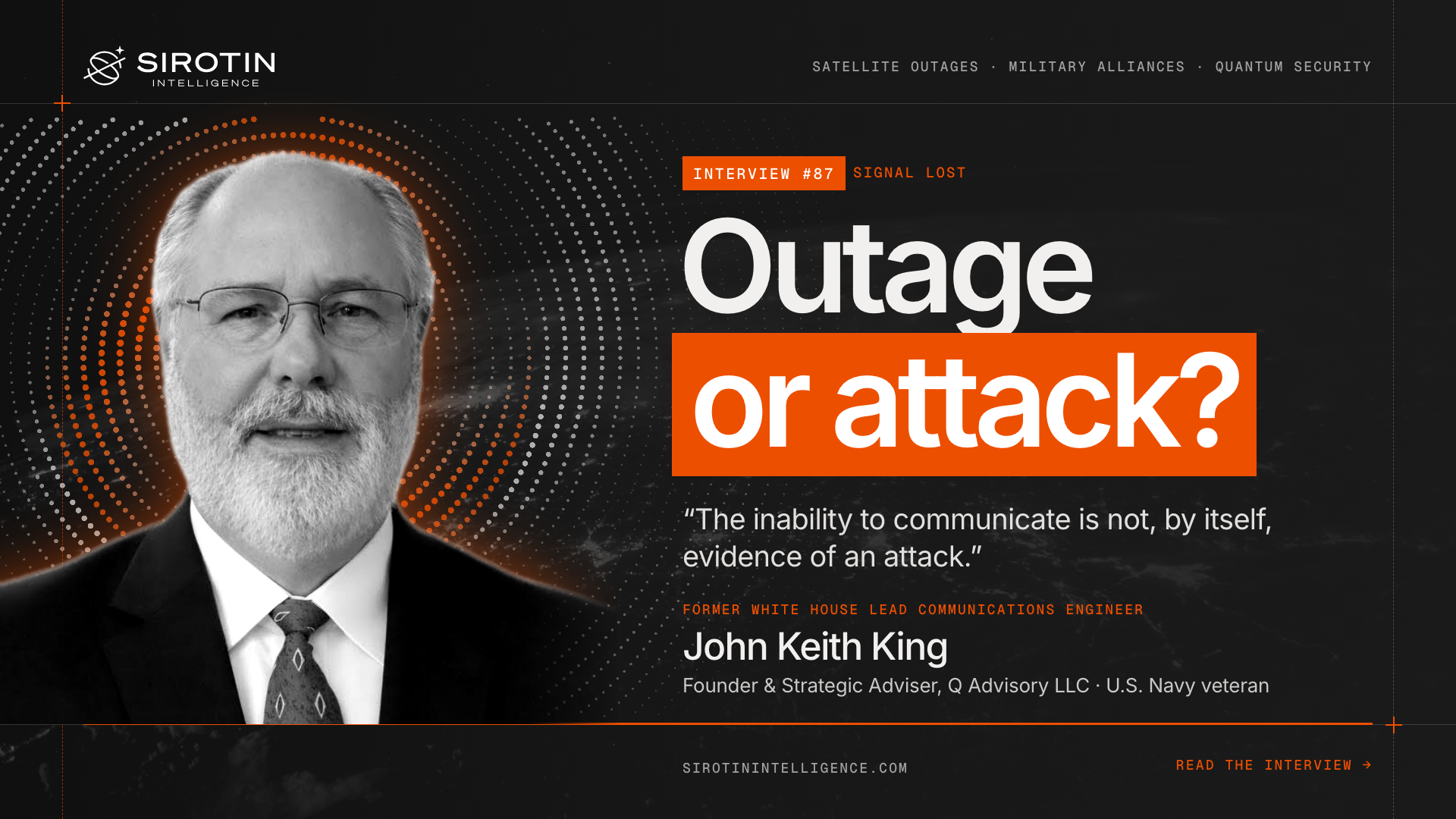
on satellite outages
John Keith King is a U.S. Navy veteran, former White House Lead Communications Engineer, and founder of Q Advisory LLC, an independent practice focused on artificial intelligence, quantum computing, post-quantum cybersecurity, resilient communications, and sovereign digital infrastructure. He has supported communications for the White House, the U.S. Department of State, the Joint Chiefs of Staff, U.S. Space Command, and U.S. Africa Command. His starting point for the interview is the KA-SAT outage an hour before Russia invaded Ukraine in 2022, which took 75 days to attribute publicly: "The real measure of a communications system is not how well it performs under ideal conditions, but whether decision-makers can depend upon it when circumstances deteriorate."
- What a commercial satellite provider must demonstrate before a government puts a national-security mission on it, and why "resilience must be demonstrated rather than advertised"
- Why "the inability to communicate is not, by itself, evidence of an attack," and what governments should agree on beforehand so an outage does not become a dangerous misunderstanding
- Which capabilities African governments should keep at home as they buy satellite service abroad: rules, keys, monitoring, and the ability to switch suppliers, rather than ownership of every component
- What to ask a vendor that calls its communications "quantum-secure," from post-quantum standards and key handling to cryptographic agility and the "harvest now, decrypt later" problem
- What NATO's HALO allies need to settle before a crisis, starting with who gets priority when several nations want the same satellite
Full interview drops Thursday.
Sources:
https://spacepolicyonline.com/news/insufficient-fuel-flow-may-have-doomed-vulcan/ https://spacepolicyonline.com/news/ula-investigating-low-booster-performance-in-vulcan-launch-failure/ https://www.airandspaceforces.com/ula-launch-failure-trouble-space-force/ https://keeptrack.space/space-brief/space-brief-2026-11-19 https://www.newsweek.com/spacex-funding-threat-ukraine-satellite-dispute-12750525 https://www.cnn.com/2026/11/20/politics/himes-ukraine-starlink-slowdown https://democrats-intelligence.house.gov/uploadedfiles/11.20.12_letter_from_hpsci_ranking_member_jim_himes_to_musk.pdf https://www.nato.int/en/news-and-events/articles/news/2026/11/17/nato-launches-its-global-data-marketplace-for-space https://defence-industry.eu/nato-begins-implementing-starlift-to-help-10-member-countries-and-south-korea-book-commercial-launches-for-military-satellites/ https://spacepolicyonline.com/news/senate-appropriators-release-1-072-trillion-defense-bill/ https://www.airandspaceforces.com/senate-backs-bigger-space-force-but-trims-pentagon-plans/ https://keeptrack.space/space-brief/space-brief-2026-11-20 https://keeptrack.space/space-brief/space-brief-2026-11-21 https://pulse2.com/air-force-selects-58-companies-for-16-1-billion-advanced-propulsion-contract/ https://pulse2.com/raytheon-receives-159-4-million-in-direct-navy-awards-for-missile-and-sensor-systems/ https://www.forth.news/lists/dod/Ch9Mzzz3qzZiPgaf62bH7 https://www.rferl.org/a/trump-xi-putin-summit-four-key-takeaways/33902100.html https://www.criticalthreats.org/analysis/russian-offensive-campaign-assessment-november-20-2026 https://www.twz.com/news-features/these-are-the-weapons-ukraine-used-to-drop-the-kerch-bridge https://www.cbsnews.com/live-updates/iran-war-us-gulf-retaliation-strikes-strait-of-hormuz/ https://www.criticalthreats.org/analysis/iran-update-november-20-2026 https://spacepolicyonline.com/news/nasa-and-fcc-nominations-advance-out-of-committee-despite-democratic-boycott/ https://thedefensepost.com/2026/11/18/iceye-bid-avio/ https://satnews.com/2026/11/19/esa-awards-ohb-e102-million-prime-contract-for-clearspace-1-debris-removal-mission/ https://spacepolicyonline.com/news/voyager-1-reaches-new-milestone-one-light-day-from-earth/ https://edsnews.substack.com/p/defense-tech-intelligence-brief-november-9d8 https://www.linkedin.com/posts/natos-new-space-initiative-starlift-begins-ugcPost-7528854947254374400-wY5x/ https://www.korea.net/NewsFocus/policies/view?articleId=303089 https://medium.com/eipio-intelligence-review/space-domain-intelligence-and-security-01d418dc8932 https://arstechnica.com/space/2026/11/vulcan-failure-caused-by-inadequate-fuel-supply-to-engines-ula-says/ https://www.space.com/space-exploration/launches-spacecraft/whats-next-for-spacexs-starship-after-epic-flight-15-chopsticks-catch https://spacewatch.global/2026/11/spacewatchgl-gray-space-mechazilla-catches-starship-europes-day-of-reckoning-gets-closer/
Subscribe to intelligence others miss. Get exclusive insights from our network of NASA veterans, DARPA program managers, and space industry pioneers. Weekly. No jargon.
Subscribe to intelligence others miss
Get exclusive insights from our network of NASA veterans, DARPA program managers, and space industry pioneers. Weekly. No jargon.