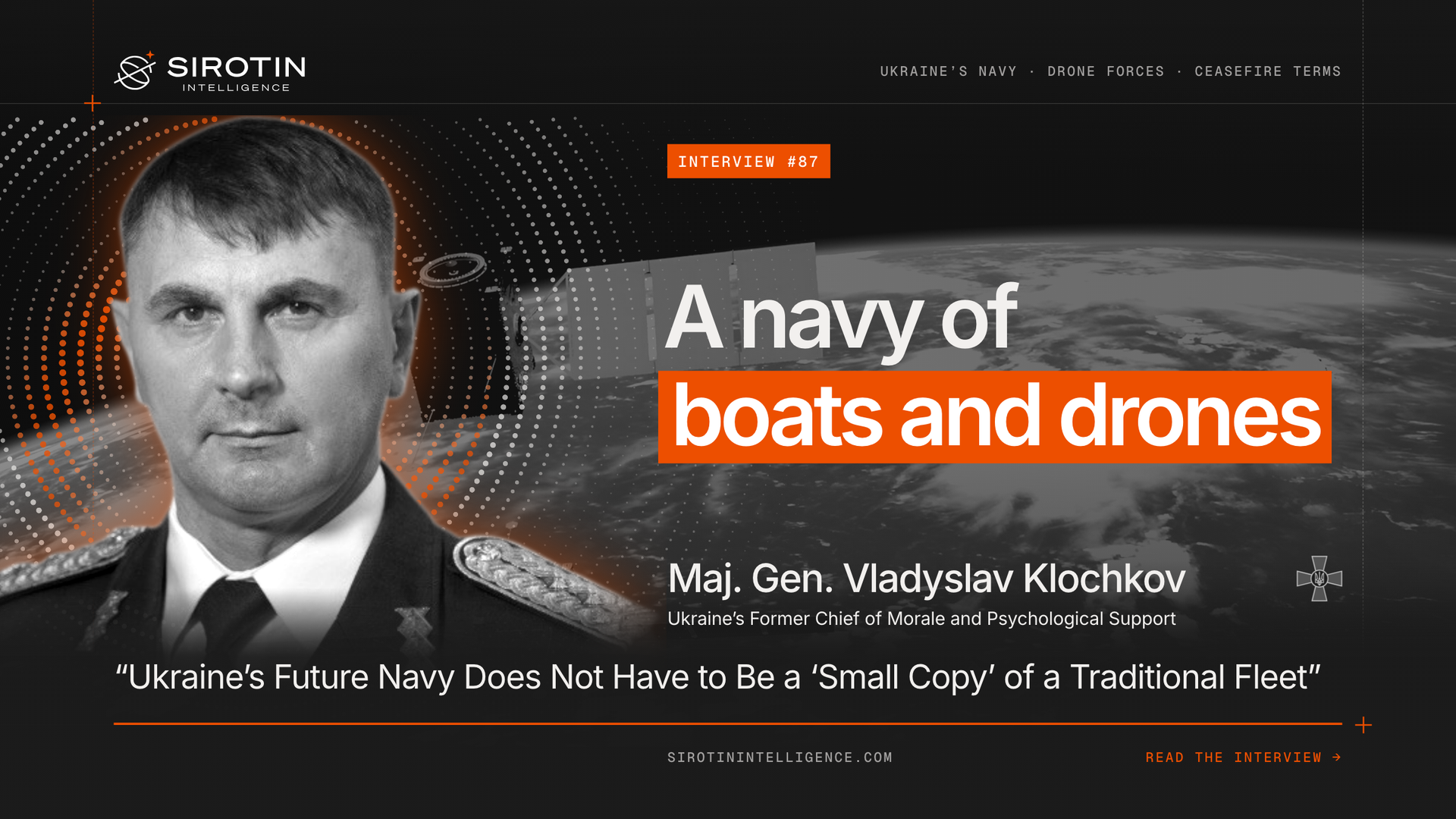
“Ukraine’s Future Navy Does Not Have to Be a ‘Small Copy’ of a Traditional Fleet”: Major General Vladyslav Klochkov on Drones, Washington and the Terms of a Ceasefire
Ukraine’s former chief of morale and psychological support explains what kind of navy he thinks the country can afford and defend, how drones became a branch of service, and what Kyiv should ask for before accepting limits on refinery strikes or signing a ceasefire.

In 2022, volunteers were flying civilian quadcopters on Ukraine’s front lines. Units had no common procedures, and Ukraine’s own electronic warfare equipment sometimes interfered with the flights. In September 2024, Ukraine’s parliament voted to make the Unmanned Systems Forces a separate branch of the armed forces.
Major General Vladyslav Klochkov commanded the 93rd Mechanized Brigade from 2015 to 2019 and led the General Department for Morale and Psychological Support from 2021 to 2024. He now teaches at American University Kyiv and writes about how Ukraine organizes its forces. For this interview, he shared a naval proposal, two studies on unmanned systems and cooperation with Ukraine’s allies, and notes on U.S. politics and negotiations with Russia.
I started with the navy because Ukraine already has two corvettes on order. Klochkov wants the country to decide whether it can use those ships before it buys any more.
Klochkov’s remarks were translated from Ukrainian and edited for length and clarity.
What would you build instead of a smaller version of a traditional navy?
Klochkov starts with the navy Ukraine already has. Since 2022, he says, marines have likely come to account for most of its personnel. Boats supplied by partners have strengthened the fleet, while maritime and aerial drones have become central to its operations. In his assessment, missiles and strike drones help deny Russia access to parts of the sea, while the boats give Ukraine some ability to operate there itself.
"In my view, this should also define the future model of the navy," he writes.
He sees three jobs for the navy over the next several years: help regain control of Ukraine’s coast and waters, protect the coast and shipping, and deter or stop attacks at sea. "Supporting the defense industry and mastering new technologies are important, but they should not be defined as the navy's main tasks in their own right."
He would focus on the northwestern Black Sea, the Dnipro and the Danube, with room for special operations elsewhere in the Black Sea. With Crimea and much of Ukraine’s coast still occupied, he argues, a large ship would be vulnerable in the waters where the navy needs it most.
In the near term, he would put more of the budget into crewed boats up to 40 meters long, including missile-armed patrol boats, CB-90s and Mark VIs. He would give them dispersed, mobile bases and use concealment to protect them. The rest of his proposal includes coastal missiles, air defenses for ports and shipping routes, reconnaissance above and below the water, and unmanned systems for strike, reconnaissance, mine clearance, and search and rescue. He wants those capabilities to work with the rest of Ukraine’s defense forces, with training based on Western doctrine.
"Ukraine needs a fleet designed for its own geography, threats, financial means and the experience of this war: mobile, dispersed, network-centric, saturated with unmanned and missile systems, and integrated with the other components of the Defense Forces," he writes.

drones and missiles
Where does that leave Ukraine’s Ada-class corvettes and minehunters?
Klochkov calls the future of ships longer than 40 meters "especially debatable."
"Building them requires significant funds, separate basing infrastructure and a long life cycle. At the same time, under current conditions they remain vulnerable to missile and unmanned systems," he writes. He recommends that Ukraine review its plans to build large ships.
Klochkov would review the two Ada-class corvettes Ukraine has already ordered. Could Ukraine base and operate them safely enough to justify the remaining cost? He gives a clearer answer on the next pair: "In my opinion, two additional corvettes should not be ordered."
After the war, he would consider operating the five minehunters with Romania in the Black Sea and on the Danube under an agreement between the two governments, or transferring them to other countries. For mine clearance in the northwestern Black Sea, he sees a growing role for unmanned systems and smaller boats based in Ukraine.
He would put naval aviation under the Air Force while keeping the capabilities the navy needs at sea. He would also consider moving Navy command to Kyiv so it can work more closely with the General Staff, the Ministry of Defense, partners and industry, while keeping the necessary command functions in Odesa. For planning and training, he would start with NATO’s maritime doctrine, known as AJP-3.1, and update the combat manuals and Naval Academy curriculum to match.
face a review
How did Ukraine go from volunteer-run drone units to a separate branch of service?
For Klochkov, the change began well before parliament voted.
At first, units and volunteers largely worked things out on their own. Drones could get information to soldiers quickly, help correct artillery fire and reduce the risk to people on the ground. But without common procedures or a clear chain of command, it was hard to repeat what worked across units.
In 2022 and 2023, the military tried several ways to organize the work. Unmanned aviation moved from a directorate within existing structures to a Central Directorate of Unmanned Systems, and then to a Main Directorate of Unmanned Systems within the General Staff.
Then came the legal steps. Presidential Decree No. 51/2024 ordered work on creating a separate branch. Decree No. 382/2024, issued June 25, put the National Security and Defense Council’s decision into effect. On September 3, Law No. 3943-IX added the branch to Article 3 of the Law on the Armed Forces of Ukraine.
A dedicated branch, Klochkov says, can decide what units need, test and maintain equipment, train operators, and get feedback from the front to manufacturers. "The main result of this evolution lies not in the appearance of a separate class of weapon but in the formation of a new type of military capability," he writes.
Creating the branch hasn’t taken drones away from the other services. They continue to develop their own systems across the Land Forces, Air Force, Navy, Air Assault Forces, Special Operations Forces and support units, including logistics and medical teams. "Separation therefore does not mean isolation."
to a branch by law
When a new drone can be copied within months, what keeps one side ahead?
"In a drone-centric war, technological advantage is unstable," Klochkov writes. A new model can work for a short period before the adversary adapts its electronic warfare, air defense or its own drones.
An inventory tells you how many drones a force has. Klochkov also wants to know how long it takes to get a revised model back to the crews that reported a problem. Electronics are widely available and software travels quickly, so he puts more weight on how the military and its suppliers respond to what crews see in the field.
More designs give units more ideas to try. They also mean more parts to keep in stock, more repairs to learn and more equipment that has to share data. Klochkov says the extra choice stops helping when units can no longer keep up with the maintenance.
Klochkov sees some tasks shifting from the operator to the software, including navigation, object recognition and keeping a system running when communications deteriorate. He is more cautious about handing over combat decisions, which still pose technical and legal problems. "The nearest practical prospect is not the full replacement of a human by an algorithm but a division of functions between the operator and the software," he writes.
Even then, drones still have to contend with electronic warfare, air defenses, weather and range. They also depend on imported parts, trained operators and reliable reconnaissance data. "Unmanned systems are not a universal replacement for traditional means."
reaches the crew
What’s missing from the description of Ukraine as NATO’s “testing ground”?
Klochkov looked for public evidence that Western countries send equipment to Ukraine specifically to test it in combat. The programs he could document are more specific than that label suggests.
The Joint Analysis, Training and Education Centre gives NATO and Ukraine a way to use lessons from the war in training. NATO and Ukraine also announced UNITE – Brave NATO in 2025. NATO expected its first competition in 2026 to award about €10 million in contracts, with up to €50 million in funding available through the wider program. NATO held drone and counter-drone trials in Latvia in 2026. In Ukraine, soldiers can rate drones through DOT-Chain Defence and report problems they’ve encountered in use. Britain and Ukraine have a separate technology-sharing agreement, which includes producing an interceptor drone in Britain for use in Ukraine under Project OCTOPUS.
What he couldn’t confirm was a single U.S. or NATO program that sends a defined list of Western systems to Ukraine purely for battlefield testing.
"The claim that Ukraine is 'NATO's testing ground' is analytically attractive, but without additional sources it is an oversimplification," he writes. He describes a country learning from its own combat experience and increasingly working with allies to apply those lessons.
Ukraine’s contribution, he argues, is how quickly a problem reported at the front can reach a factory. That speed comes with trade-offs: "This does not mean that all Ukrainian solutions are automatically better than Western ones." Something that works quickly in one unit may be unreliable or hard to maintain, standardize or produce in quantity. U.S. cooperation is also harder to track publicly than NATO’s. Kyiv and Washington discussed a five-year arrangement in 2025 for U.S. purchases of Ukrainian drones and joint production, but much of the work is out of public view.
He expects the next advantage to come from how well forces combine sensors, command and control, electronic warfare, drones, interceptors and AI, and how well their operators can use them together. "The winner will be not simply the better FPV drone but the better integration."
and tests
If Washington asks Kyiv to limit strikes on Russian refineries, what should Ukraine ask for in return?
The Wall Street Journal reported on October 29 that Ukrainian units had been told in mid-October to put their refinery campaign on hold once missions already under way were complete. It attributed the pause to pressure from the Trump administration. Reuters picked up the story the following day but said it could not independently verify the report.
At the October 20 meeting in Oslo, U.S. envoy Jared Kushner pressed Zelensky to suspend refinery strikes, the Journal reported, citing U.S. officials. One of those officials described a 30-day pause as a way for Kyiv to support Washington’s mediation. Ukraine had not publicly announced such a commitment.
That was separate from an earlier U.S. proposal to halt attacks on energy infrastructure on both sides. After Trump announced an energy ceasefire on October 11, Zelensky said Ukraine was prepared to stop if Russia did the same. He told reporters later that month that Ukraine had held off on refinery strikes for three days while Russia kept attacking Ukraine’s energy system. By November 23, Zelensky was again referring publicly to strikes on Russian refineries. The October reporting describes a pause at the time, not a continuing agreement.
Klochkov sees the reported pause as an effort to preserve U.S. support despite a disagreement over how Ukraine should fight.
Oil and gas fund a large share of Russia’s budget. Klochkov says strikes on energy infrastructure can cut fuel output, raise repair costs and disrupt exports. In March 2026, Reuters estimated that at least 40 percent of Russia’s oil export capacity was temporarily halted. That estimate covered several disruptions, including attacks on export infrastructure, a disputed pipeline attack and tanker seizures. It was not a measure of how much revenue Russia lost.
"At the same time, it is important not to overstate the effectiveness of this campaign," he writes. Russia can repair damaged facilities, reroute exports and draw on spare capacity. A refinery can also lose output without Russia losing an equivalent amount of revenue from crude exports.
Klochkov would ask Washington what it was prepared to offer before agreeing to a limit. The Journal reported that Zelensky’s requests included more Patriot interceptors, guarantees for the protection of Ukraine’s energy infrastructure and answers on satellite communications for defense.
"In my view, the greatest risk lies not in the possibility of a temporary pause itself but in the fact that it could become permanent practice without corresponding concessions from Russia," he writes. A longer pause could reduce the pressure on Moscow, weaken Kyiv’s negotiating position and set a precedent for more one-sided demands. At home, it would be harder to justify while Russian attacks on cities continued. He also points to Starlink as an example of a technology Ukraine still depends on.
"The main problem for Kyiv is the asymmetry of dependence," he writes. Ukraine needs American air defense, intelligence and technology, and Washington can use that need to press Kyiv.
The satellite-service dispute made that dependence visible. In a November 13 letter to SpaceX, U.S. senators described restrictions from October 13 to 24 and cited Ukrainian reports of renewed disruptions in November. U.S. officials told the Journal that the October restrictions and the talks over refinery strikes were unrelated. The timing explains why Klochkov treats reliable satellite service as part of the wider relationship with Washington. It does not establish that access was used to secure a pause.
In his follow-up analysis, Klochkov draws a distinction between a short pause, a longer period of pressure from Washington, and an agreement both Kyiv and Moscow would have to keep. For the last of those, he would want a defined term, clear rules about what the agreement covers, and a way to verify and record violations. That could reduce attacks on energy infrastructure without settling the wider war.
something in return
Democrats won both chambers in November. What changes for Ukraine when the new Congress takes office?
Klochkov expects the incoming Congress to press the administration for more information on negotiations and to have a greater say over how aid is funded. The president would still direct U.S. diplomacy, and Democrats don’t have the votes to override a veto on their own.
"A Democratic victory does not mean an automatic return to the previous model of American support for Ukraine," he writes.
That’s why he would keep working with the White House and both parties in Congress, as well as with U.S. defense companies, think tanks, state governments and the public. He recommends updating Ukraine’s U.S. strategy for 2027 and 2028, identifying defense projects it could pursue with American companies, and backing legislation that makes support less dependent on who is in office.
His warning is that Congress can approve aid without getting it to Ukraine on time. In his follow-up on the midterms, he lays out three ways the next two years could go: Congress secures steadier funding and stronger oversight; lawmakers back Ukraine but the White House still sets the terms of its talks with Moscow; or fights between Congress and the administration delay funding and make sanctions harder to sustain. He treats those as scenarios, not predictions.
That is one reason he wants Ukraine to keep its European partners closely involved even if the incoming Congress is sympathetic. He also sees room to give the U.S. relationship a firmer footing through long-term contracts and joint projects, including in energy and reconstruction.
"Ukraine should regard the United States as a key strategic partner while building a national security system that does not depend on political changes in a single country," he writes.
can and cannot do
What would a ceasefire need to include for Ukraine to sign it?
Klochkov brings up the Minsk process. "The problem is not the ceasefire itself but what happens after it is announced," he writes. Without a way to verify violations and respond to them, he argues, a pause could give Russia time to rearm, rotate units and rebuild its supply lines. Moscow could also keep up pressure outside the battlefield and use the talks to weaken the coalition backing Ukraine.
He would look for six provisions:
- A way to record violations
- Independent international monitoring
- Technical surveillance of the line of contact
- A procedure for deciding who was responsible for violations
- Ukraine’s right to continue modernizing its military and producing defense equipment
- An automatic or pre-agreed international response if Russia resumes its aggression
Klochkov also separates the line where fighting stops from the legal border. A ceasefire might need to spell out where forces are positioned and who monitors them. In his view, that does not give Russia legal title to occupied territory. Article 73 of Ukraine’s Constitution says changes to the country’s territory can be decided only by a nationwide referendum.
He would keep sanctions in place until agreed conditions are met and reject an agreement that limits Ukraine’s ability to defend itself while Russia remains free to rearm. For him, a security guarantee needs to say who provides support, how it will be funded, and what partners do if Russia attacks again. He wants both the U.S. and European governments involved, so a change in one capital doesn’t undo the agreement.
In his follow-up paper, he describes four possibilities: a ceasefire that leaves the political questions open; a series of narrower agreements; a comprehensive peace deal; or continued fighting with occasional talks. A phased deal could make it possible to exchange prisoners, return deported children, or agree on safe shipping before the territorial issues are settled. The risk, he says, is that one side takes the benefits of an early deal without carrying out the rest.
"A truce cannot substitute for peace," he writes. Any settlement should rest on one principle: "An end to hostilities must be accompanied by conditions that rule out the use of peace as an instrument for preparing new aggression."
for a ceasefire
Author’s Analysis
The two corvettes already on order are the first test of Klochkov’s proposal. Even if the navy can afford to finish them, it still has to find somewhere to base them and pay for their protection.
In the Black Sea, Ukraine has already used smaller vessels and drones to push back a larger fleet. I’d judge the corvettes by what they could do that the navy’s smaller vessels can’t.
There’s a similar question on the drone side. Common standards make equipment easier to maintain and crews easier to train. But if a unit has to wait longer for a manufacturer to act on its feedback, it could lose the advantage Klochkov describes: being able to get a fix back to the people who asked for it.
I’d judge an agreement on energy infrastructure by what happens after the announcement. If Kyiv accepts a pause, does Moscow also stop striking Ukraine’s power system? Can someone independent verify that both sides kept their word? And if Washington offers more protection for Ukraine’s energy infrastructure, when does it arrive? Those are different commitments, and a single announcement can leave all three unsettled.
The same question applies to a ceasefire. I’d look for who is supposed to respond to a violation, what they’ve agreed to do, and how Ukraine can keep defending itself while the harder political questions are still open.
About Major General Vladyslav Klochkov
Major General Vladyslav Klochkov served more than 26 years in Ukraine’s armed forces, rising from platoon commander to major general. He commanded the 93rd Mechanized Brigade from 2015 to 2019 during combat operations in eastern Ukraine.
From 2021 to 2024, he led the General Department for Morale and Psychological Support. He has written a monograph, “Psychological Resilience of a Soldier,” and ten training manuals on psychological resilience in combat. He entered the reserve in August 2024 and is an associate professor at American University Kyiv.
Previous Coverage
- "Modern War Isn't About Territory. It's About Narrative Control", September 4, 2025
- SPECIAL FEATURE: "The Third World War Is Already Underway", March 16, 2026
- "Even a Medium-Sized State Can Rethink International Norms", May 7, 2026
Got a story to share?
Or know someone who does?
Join 80+ experts from NASA, the U.S. Space Force, the Air Force Research Laboratory and more.
Request an interview →Subscribe to intelligence others miss
Get exclusive insights from our network of NASA veterans, DARPA program managers, and space industry pioneers. Weekly. No jargon.